US Business

Biden, Macron close ranks on Russia, China during state visit

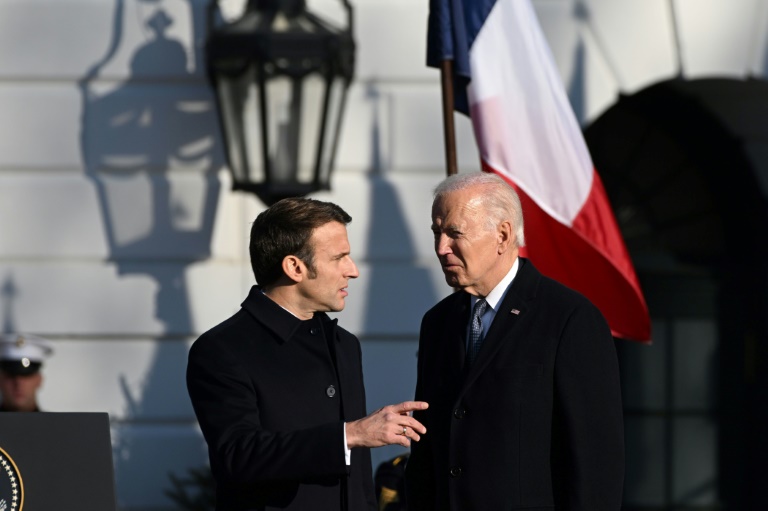
US President Joe Biden and French President Emmanuel Macron emerged from White House talks Thursday pledging to close ranks in helping Ukraine defend itself from Russia and in facing the “challenge” posed by China.

The leaders issued a joint statement following Oval Office talks during Macron’s state visit, which Biden said demonstrated their countries’ “unwavering” alliance.

They “outlined a shared vision to strengthen security and increase prosperity worldwide, combat climate change, build greater resilience to its effects, and advance democratic values,” the statement said.

The two reaffirmed “support for Ukraine’s defense of its sovereignty and territorial integrity, including the provision of political, security, humanitarian, and economic assistance to Ukraine for as long as it takes.”

“They also reiterate their steadfast resolve to hold Russia to account for widely documented atrocities and war crimes,” the statement added.

On China, they said “the United States and France will continue to coordinate on our concerns regarding China’s challenge to the rules-based international order, including respect for human rights, and to work together with China on important global issues like climate change.”

They also expressed “respect for the Iranian people, in particular women and youth, who are bravely protesting to gain the freedom to exercise their human rights and fundamental freedoms, which Iran itself has subscribed to and is violating.”

– 21 gun salute –

Despite tensions over transatlantic trade, Macron took pains to emphasize their countries’ deep historic ties and the current partnership in confronting Russia’s Ukraine invasion. “We need to become brothers in arms once more,” Macron said as he was welcomed to the White House.

Service members from the marines, army, air force and even a detachment of soldiers in 18th-century Revolutionary War garb paraded in front of the White House. Artillery fired off a 21-gun salute, sending puffs of white smoke into the clear, chilly December sky.

Standing on a red-carpeted podium with Macron, Biden said “France is our oldest ally, our unwavering partner in freedom’s cause.”

The visit certainly symbolized how Washington and Paris have buried last year’s bitter spat over the way Australia pulled out of a French submarine deal in favor of acquiring US nuclear subs instead.

However, Macron has made clear, in unusually blunt language, that he wants to confront Biden over the issue of trade.

– Trade dispute –

On his first day of the visit Wednesday, when he toured NASA headquarters, Arlington National Cemetery and met US lawmakers, the French leader surprised his hosts with a bitter attack on Biden’s signature policy to boost the US green economy, saying it would “kill” European jobs.

The legislation, called the Inflation Reduction Act or IRA, is set to pour billions of dollars into environmentally friendly industries, with strong backing for US-based manufacturers. The White House touts the IRA as a groundbreaking effort to reignite US manufacturing and promote renewable technologies, while breaking Chinese dominance in the field.

However, European Union governments are crying foul, threatening to launch a trade war by subsidizing their own green economy sector.

Macron told Biden it is “extremely important precisely to have close coordination” as the US and EU forge ahead in the booming green economy.

Working towards a carbon neutral economy means “creating a lot of jobs, which means investing a lot in our economies, and we have to synchronize our action,” he said.

White House Press Secretary Karine Jean-Pierre insisted that US advances in clean energy will help Europeans too, saying: “This is not a zero-sum game.”

And in their joint statement, Biden and Macron pledged that a US-European Union task force would aim to further strengthen their “partnership on clean energy and climate through mutually beneficial ways.”

– Menu and music –

Aside from the trade dispute fireworks, most of the visit revolves around kindling the long, if often slightly prickly US-French diplomatic friendship.

The state dinner at the White House will return grand-scale entertainment to Washington in a way not seen since the Covid-19 pandemic shut down the capital’s typically busy schmoozing scene.

Grammy-award-winning American musician Jon Batiste will perform at the banquet, which the White House said will kick off with butter-poached Maine lobster, paired with caviar, delicata squash raviolo and tarragon sauce.

The main course features beef and triple-cooked butter potatoes, before leading to the cheese course of award-winning US brands, and finally orange chiffon cake, roasted pears with citrus sauce and creme fraiche ice cream.

Washing all that down will be three different wines — all from US vineyards.
Biden, Macron close ranks on Russia, China during state visit

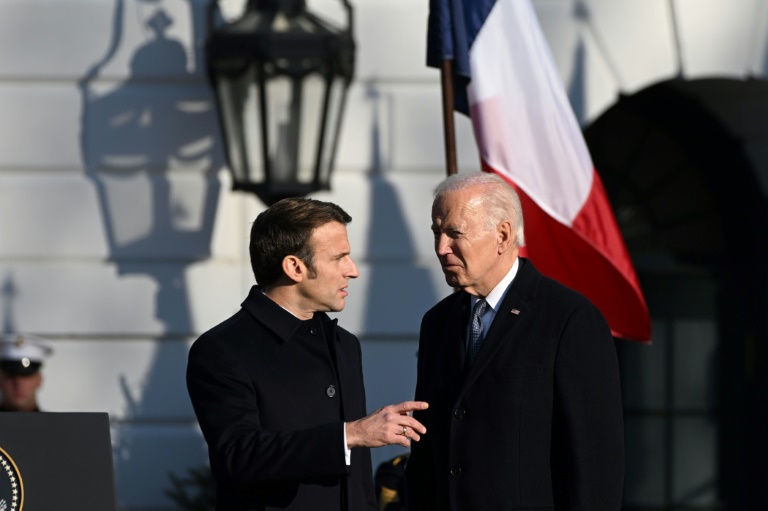
US President Joe Biden and French President Emmanuel Macron emerged from White House talks Thursday pledging to close ranks in helping Ukraine defend itself from Russia and in facing the “challenge” posed by China.

The leaders issued a joint statement following Oval Office talks during Macron’s state visit, which Biden said demonstrated their countries’ “unwavering” alliance.

They “outlined a shared vision to strengthen security and increase prosperity worldwide, combat climate change, build greater resilience to its effects, and advance democratic values,” the statement said.

The two reaffirmed “support for Ukraine’s defense of its sovereignty and territorial integrity, including the provision of political, security, humanitarian, and economic assistance to Ukraine for as long as it takes.”

“They also reiterate their steadfast resolve to hold Russia to account for widely documented atrocities and war crimes,” the statement added.

On China, they said “the United States and France will continue to coordinate on our concerns regarding China’s challenge to the rules-based international order, including respect for human rights, and to work together with China on important global issues like climate change.”

They also expressed “respect for the Iranian people, in particular women and youth, who are bravely protesting to gain the freedom to exercise their human rights and fundamental freedoms, which Iran itself has subscribed to and is violating.”

– 21 gun salute –

Despite tensions over transatlantic trade, Macron took pains to emphasize their countries’ deep historic ties and the current partnership in confronting Russia’s Ukraine invasion. “We need to become brothers in arms once more,” Macron said as he was welcomed to the White House.

Service members from the marines, army, air force and even a detachment of soldiers in 18th-century Revolutionary War garb paraded in front of the White House. Artillery fired off a 21-gun salute, sending puffs of white smoke into the clear, chilly December sky.

Standing on a red-carpeted podium with Macron, Biden said “France is our oldest ally, our unwavering partner in freedom’s cause.”

The visit certainly symbolized how Washington and Paris have buried last year’s bitter spat over the way Australia pulled out of a French submarine deal in favor of acquiring US nuclear subs instead.

However, Macron has made clear, in unusually blunt language, that he wants to confront Biden over the issue of trade.

– Trade dispute –

On his first day of the visit Wednesday, when he toured NASA headquarters, Arlington National Cemetery and met US lawmakers, the French leader surprised his hosts with a bitter attack on Biden’s signature policy to boost the US green economy, saying it would “kill” European jobs.

The legislation, called the Inflation Reduction Act or IRA, is set to pour billions of dollars into environmentally friendly industries, with strong backing for US-based manufacturers. The White House touts the IRA as a groundbreaking effort to reignite US manufacturing and promote renewable technologies, while breaking Chinese dominance in the field.

However, European Union governments are crying foul, threatening to launch a trade war by subsidizing their own green economy sector.

Macron told Biden it is “extremely important precisely to have close coordination” as the US and EU forge ahead in the booming green economy.

Working towards a carbon neutral economy means “creating a lot of jobs, which means investing a lot in our economies, and we have to synchronize our action,” he said.

White House Press Secretary Karine Jean-Pierre insisted that US advances in clean energy will help Europeans too, saying: “This is not a zero-sum game.”

And in their joint statement, Biden and Macron pledged that a US-European Union task force would aim to further strengthen their “partnership on clean energy and climate through mutually beneficial ways.”

– Menu and music –

Aside from the trade dispute fireworks, most of the visit revolves around kindling the long, if often slightly prickly US-French diplomatic friendship.

The state dinner at the White House will return grand-scale entertainment to Washington in a way not seen since the Covid-19 pandemic shut down the capital’s typically busy schmoozing scene.

Grammy-award-winning American musician Jon Batiste will perform at the banquet, which the White House said will kick off with butter-poached Maine lobster, paired with caviar, delicata squash raviolo and tarragon sauce.

The main course features beef and triple-cooked butter potatoes, before leading to the cheese course of award-winning US brands, and finally orange chiffon cake, roasted pears with citrus sauce and creme fraiche ice cream.

Washing all that down will be three different wines — all from US vineyards.
Oh rats! New York seeks 'bloodthirsty' rodent czar

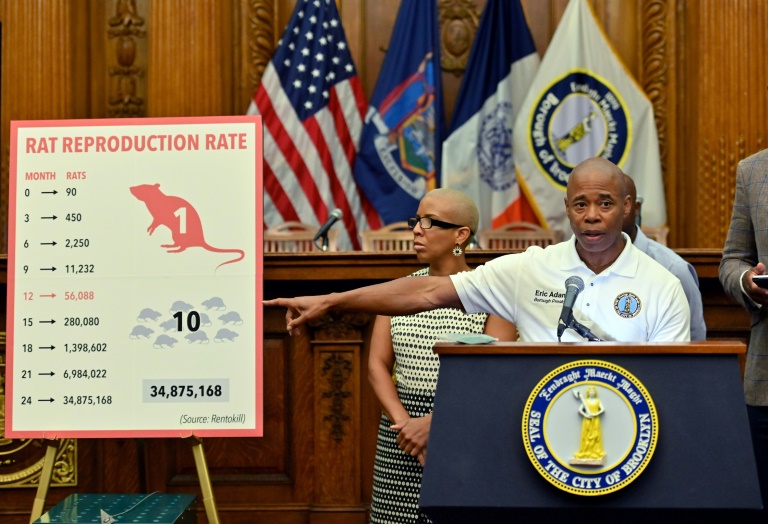
If you are “somewhat bloodthirsty” and willing to consider “wholesale slaughter” of vermin then you might be the ideal candidate to become New York City’s new rat czar.

Mayor Eric Adams’s administration on Wednesday posted the job listing for Director of Rodent Mitigation, a position that pays between $120,000 and $170,000 a year.

“Do you have what it takes to do the impossible?” asks the ad, which seeks someone with a “virulent vehemence for vermin” and a “general aura of badassery.”

A bachelor’s degree is a must, as is experience in urban planning, project management or government, and proficiency in spreadsheets.

But above all the successful candidate must possess “the drive, determination and killer instinct needed to fight the real enemy — New York City’s relentless rat population.”

Rats are one of the more unappealing aspects of life in America’s largest metropolis, often seen scurrying between subway tracks and sniffing around garbage bags.

Legend has it that there are as many rats as humans — around nine million — although that figure has been debunked as a myth by a local statistician.

English novelist Charles Dickens complained about the rodents when he visited New York in 1842. 

And a rat shot to internet stardom in 2015 when it was filmed walking down the stairs of a subway station with a slice of pizza in its mouth.

City officials have spent millions of dollars trying to cull the rat population over the years, deploying everything from rodent birth control to vermin-proof trash cans.

During a stomach-turning presentation in 2019, Adams, then Brooklyn borough president, unveiled a machine that drowned the rats in a pool of alcohol-based liquid.

The city also runs a “Rat Academy,” where local residents can learn rodent prevention methods. 

The rats continue to run rampant, however.

Between January and September this year, more than 21,500 sightings were reported to the city’s hotline, up from around 18,000 for the same period last year, according to local reports.

“There’s NOTHING I hate more than rats,” Mayor Adams tweeted Thursday, adding that for someone “your dream job awaits.”

Equities slow after gains on Fed rate optimism

Stocks diverged Thursday after Federal Reserve boss Jerome Powell signalled a moderation in interest rate hikes, as fears over the health of the global economy persist.

Asian and European equities mainly tacked higher as investors eyed news that eurozone unemployment plumbed to a record-low 6.5 percent in October.

But on Wall Street, the three main indices were down in mid-afternoon trading after a slew of mixed data from the United States, as markets balance recession concerns with relief over inflation slowing down.

One survey showed the US manufacturing sector contracted in November for the first time since mid-2020 when the country struggled with the coronavirus pandemic.

“Manufacturing clearly is struggling in the wake of significantly higher borrowing costs,” said Kieran Clancy, senior US economist at Pantheon Macroeconomics.

Another release meanwhile showed a closely-watched measure of US inflation edged down in October.

“The mood has been enhanced by the reaction to Fed chairman Powell’s comments on the potential for a dialling down of the pace of rate hikes when the FOMC (Fed policy) next meets in just under a fortnight’s time,” said Michael Hewson of CMC Markets.

“However the gains are being tempered by concerns over the extent of some of the economic data weakness being seen today,” he added.

Oil prices climbed before this weekend’s OPEC output meeting of key crude producing nations.

– ‘Moderate’ pace –

In a much-anticipated speech Wednesday, Powell said the full effects of the Fed’s belt-tightening had yet to be felt but that it “makes sense to moderate the pace of our rate increases as we approach the level of restraint that will be sufficient to bring inflation down”.

He signalled the US central bank’s December gathering would likely see officials lift borrowing costs by 50 basis points.

The Fed has yanked up rates by a bumper 75 points at each of the last four meetings.

However, Powell did say policy would need to remain tight “for some time” to restore price stability, echoing comments from other Fed officials who suggested there might not be any cuts until 2024.

Analysts said the reaction to Powell’s remarks — which had been expected to be his most dovish in some time — highlighted a sense of relief among investors that a long-hoped-for pivot was on the cards.

On Thursday, the Fed’s preferred inflation measure — the personal consumption expenditures (PCE) price index — rose six percent from a year ago in October, down from a larger jump the month before.

– Asian gains –

In Asia, Hong Kong extended gains into a third day, with tech giants including Alibaba and Tencent tracking massive gains in their US-listed stock, while Shanghai was also up.

Equities were also helped by signs that China is edging towards a more pragmatic approach to fighting the coronavirus, having hammered the economy this year with its strict zero-Covid strategy of lockdowns and mass testing.

After widespread unrest against the measures — and calls for more political freedoms — authorities have announced moves aimed at loosening some restrictions.

The dollar sank, having soared across the board this year as Fed monetary policy diverged more and more from other central banks.

– Key figures around 1645 GMT –

New York – Dow: DOWN 0.9 percent at 34,276.35 points

EURO STOXX 50: UP 0.5 percent at 3,984.50

London – FTSE 100: DOWN 0.2 percent at 7,558.49 (close)

Frankfurt – DAX: UP 0.6 percent at 14,490.30 (close)

Paris – CAC 40: UP 0.2 percent at 6,753.97 (close)

Tokyo – Nikkei 225: UP 0.9 percent at 28,226.08 (close)

Hong Kong – Hang Seng Index: UP 0.8 percent at 18,736.44 (close)

Shanghai – Composite: UP 0.5 percent at 3,165.47 (close)

Euro/dollar: UP at $1.0498 from $1.0406 on Wednesday

Dollar/yen: DOWN at 135.60 yen from 138.07 yen

Pound/dollar: UP at $1.2248 from $1.2058

Euro/pound: DOWN at 85.69 pence from 86.30 pence

Brent North Sea crude: UP 1.2 percent at $88.00 per barrel

West Texas Intermediate: UP 1.9 percent at $82.07 per barrel

burs-raz/kjm

SpaceX again postpones Japanese moon lander launch

SpaceX on Wednesday postponed the launch of the world’s first private lander to the Moon, a mission undertaken by Japanese firm ispace.

A Falcon 9 rocket was scheduled to blast off at 3:37 am (0837 GMT) on Thursday from Cape Canaveral in the US state of Florida, but SpaceX said further checks on the vehicle had led to a delay. 

“After further inspections of the launch vehicle and data review, we’re standing down from tomorrow’s launch of @ispace_inc’s HAKUTO-R Mission 1; a new target launch date will be shared once confirmed,” the firm tweeted.

Until now, only the United States, Russia and China have managed to put a robot on the lunar surface.

The mission by ispace is the first of a program called Hakuto-R. 

The lander would touch down around April 2023 on the visible side of the Moon, in the Atlas crater, according to a company statement.

The delay came after the launch had already been postponed by a day due to the need for additional pre-flight checks, SpaceX and ispace said on Wednesday.

Measuring just over 2 by 2.5 meters, the lander carries on board a 10-kilogram rover named Rashid, built by the United Arab Emirates. 

The oil-rich country is a newcomer to the space race but counts recent successes including sending a probe into Mars’ orbit last year. If it succeeds, Rashid will be the Arab world’s first Moon mission.

“We have achieved so much in the six short years since we first began conceptualizing this project in 2016,” said ispace CEO Takeshi Hakamada.

Hakuto was one of five finalists in the international Google Lunar XPrize competition, a challenge to land a rover on the Moon before a 2018 deadline, which ended without a winner. But some of the projects are still ongoing.

Another finalist, from the Israeli organization SpaceIL, failed in April 2019 to become the first privately-funded mission to achieve the feat, after crashing into the surface while attempting to land.

ispace, which has just 200 employees, says it “aims to extend the sphere of human life into space and create a sustainable world by providing high-frequency, low-cost transportation services to the Moon.”

burs-aha/rma

SpaceX again postpones Japanese moon lander launch

SpaceX on Wednesday postponed the launch of the world’s first private lander to the Moon, a mission undertaken by Japanese firm ispace.

A Falcon 9 rocket was scheduled to blast off at 3:37 am (0837 GMT) on Thursday from Cape Canaveral in the US state of Florida, but SpaceX said further checks on the vehicle had led to a delay. 

“After further inspections of the launch vehicle and data review, we’re standing down from tomorrow’s launch of @ispace_inc’s HAKUTO-R Mission 1; a new target launch date will be shared once confirmed,” the firm tweeted.

Until now, only the United States, Russia and China have managed to put a robot on the lunar surface.

The mission by ispace is the first of a program called Hakuto-R. 

The lander would touch down around April 2023 on the visible side of the Moon, in the Atlas crater, according to a company statement.

The delay came after the launch had already been postponed by a day due to the need for additional pre-flight checks, SpaceX and ispace said on Wednesday.

Measuring just over 2 by 2.5 meters, the lander carries on board a 10-kilogram rover named Rashid, built by the United Arab Emirates. 

The oil-rich country is a newcomer to the space race but counts recent successes including sending a probe into Mars’ orbit last year. If it succeeds, Rashid will be the Arab world’s first Moon mission.

“We have achieved so much in the six short years since we first began conceptualizing this project in 2016,” said ispace CEO Takeshi Hakamada.

Hakuto was one of five finalists in the international Google Lunar XPrize competition, a challenge to land a rover on the Moon before a 2018 deadline, which ended without a winner. But some of the projects are still ongoing.

Another finalist, from the Israeli organization SpaceIL, failed in April 2019 to become the first privately-funded mission to achieve the feat, after crashing into the surface while attempting to land.

ispace, which has just 200 employees, says it “aims to extend the sphere of human life into space and create a sustainable world by providing high-frequency, low-cost transportation services to the Moon.”

burs-aha/rma

Jon Batiste: the jazz master set to serenade Macron

An artist’s artist with elastic talent and high-octane charisma, the world-class jazzman Jon Batiste will cap off his banner year Thursday by performing at President Joe Biden’s first White House state dinner.

The effervescent musician — who cleaned up at the Grammys in April — will headline the crown jewel of Washington’s holiday social season, a lavish meal hosted by Biden and wife Jill in honor of visiting French leader Emmanuel Macron.

“An artist who transcends generations, Jon Batiste’s music inspires and brings people together,” said the first lady’s press secretary Vanessa Valdivia.

“We’re thrilled to have him perform at the White House for the first state dinner of the Biden-Harris Administration.”

The musical talent and artistic vision of Batiste, the scion of a prominent New Orleans musical dynasty, have made him an industry mainstay for years, with a prodigious body of work and an eye towards social justice.

He’s also long been a red carpet regular, flashing his megawatt smile and hamming for photographers.

But until recently he wasn’t particularly well-known outside music world circles, perhaps best recognized among Americans for his role as the bandleader on Stephen Colbert’s popular late night comedy show.

That all changed in April at the Grammys, where Batiste won five trophies, the most of the night, including the prestigious Album of the Year prize for “We Are.”

And now he’ll bring his musical chops to one of Washington’s most glamorous affairs.

“From Kenner to the White House,” Batiste posted on Instagram this week, referring to the New Orleans suburb he was born in. The artist’s father, a bassist, will accompany him during the set.

– ‘Spiritual practice’ –

The 36-year-old Batiste has recorded with legendary artists including Stevie Wonder, Prince and Willie Nelson.

The piano virtuoso is also the creative director of Harlem’s National Jazz Museum, and in recent years took home an Oscar, Golden Globe and a BAFTA for co-composing the soundtrack of Pixar’s animated hit “Soul” with Trent Reznor and Atticus Ross.

He’s dubbed music his “spiritual practice,” producing work spanning medium and genre from R&B to jazz to contemporary classical.

Batiste began playing drums and other percussion instruments as a child with his family, which includes a long line of gospel and jazz artists.

He switched to the piano as a pre-teen, releasing his debut album “Times in New Orleans” in 2005. 

Batiste graduated from the New Orleans Center for Creative Arts in 2004, before going on to attend New York’s prestigious Juilliard school.

He and his band Stay Human secured the high-profile “Late Show with Stephen Colbert” gig starting in 2015, bringing his music to millions of eyes each weeknight.

In recent years, Batiste has emerged as an advocate, notably taking part in June 2020’s Juneteenth celebration in Brooklyn as protests raged over the police murder of a Black man, George Floyd.

In March 2021, he released “We Are,” his eighth studio album, which he has said he put together largely prior to the mass protests as well as the Covid-19 pandemic, but whose content offered prescient messages of hope and community.

A genre-spanning effort that fuses jazz with soul, hip-hop, pop and R&B, Batiste has called the record “a culmination of my life to this point.”

Biden, Macron pledge 'unwavering' alliance, but trade dispute looms

President Joe Biden greeted President Emmanuel Macron at the White House on Thursday with full-scale military honors and a pledge to uphold the “unwavering” US-French alliance ahead of talks on Ukraine, China and a looming trade dispute.

Service members from the marines, army, air force and even a detachment of soldiers in 18th century Revolutionary War garb paraded in front of the White House. Artillery fired off a 21-gun salute, sending puffs of white smoke into the clear, chilly December sky.

Standing on a red-carpeted podium with Macron, Biden said “France is our oldest ally, our unwavering partner in freedom’s cause.”

Like Biden, Macron noted that the two countries had stood side by side through many wars. Referring to the Western alliance helping Ukraine to confront the Russian invasion, Macron said “we need to become brothers in arms once more.”

The two presidents then met in the Oval Office for discussions on Ukraine, handling the rise of China and European fears that Biden’s economic policies will lead to a trade war.

Biden and Macron were then to give a joint press conference before winding up the day with a lavish dinner featuring French favorites of wine and cheese — but in both cases American-made.

– Subsidies dispute –

The visit symbolizes how Washington and Paris have buried last year’s bitter spat over the way Australia pulled out of a French submarine deal in favor of acquiring US nuclear subs instead.

However, Macron has made clear, in unusually blunt language, that he is not just in Washington for the niceties.

On his first day of the visit Wednesday, when he toured NASA headquarters, Arlington National Cemetery and met US lawmakers, the French leader surprised his hosts with a bitter attack on Biden’s signature policy to boost the US green economy, saying it would “kill” European jobs.

On Thursday, right before arriving at the White House, he repeated his criticism in an ABC television interview where he said Biden’s policy would remove “a level playing field.”

The legislation, called the Inflation Reduction Act or IRA, is set to pour billions of dollars into environmentally friendly industries, with strong backing for US-based manufacturers. The White House touts the IRA as a groundbreaking effort to reignite US manufacturing and promote renewable technologies.

However, European Union governments are crying foul, threatening to launch a trade war by subsidizing their own green economy sector.

“The consequence of the IRA is that you will perhaps fix your issue but you will increase my problem. I’m sorry to be so straightforward,” Macron said on Wednesday, warning Biden could “split the West.”

The White House responded by insisting that European companies have nothing to fear from the IRA.

US advances in the clean energy economy will help Europeans too, White House Press Secretary Karine Jean-Pierre said. The IRA “presents significant opportunities for European firms as well as benefits to EU energy security. This is not a zero-sum game.”

– Menu and music –

Aside from the trade dispute fireworks, most of the visit revolves around kindling the long, if often slightly prickly US-French diplomatic friendship.

On Wednesday evening, Macron and his wife Brigitte joined Biden and First Lady Jill Biden at an upscale Washington Italian restaurant.

The state dinner at the White House will return grand-scale entertainment to Washington in a way not seen since the Covid-19 pandemic shut down the capital’s typically busy schmoozing scene.

Grammy-award-winning American musician Jon Batiste will perform at the banquet, which the White House said will kick off with butter-poached Maine lobster, paired with caviar, delicata squash raviolo and tarragon sauce.

The main course features beef and triple-cooked butter potatoes, before leading to the cheese course of award-winning US brands, and finally orange chiffon cake, roasted pears with citrus sauce and creme fraiche ice cream.

Washing all that down will be three different wines — all from US vineyards.
– China high on agenda –

Trade tensions, however, are only part of the uncomfortable flip side to the red carpet occasion.

Another gripe in Europe is the high cost of US liquid natural gas exports — which have surged to help compensate for canceled Russian deliveries.

There is also divergence on how to deal with the rise of superpower China. The question — with Washington pursuing a more hawkish tone and EU powers trying to find a middle ground — is unlikely to see much progress.

“Europe has since 2018 its own, unique strategy for relations with China,” tweeted French embassy spokesman Pascal Confavreux in Washington.

White House National Security Council spokesman John Kirby said China will be “very high on the agenda” this week but stressed that both countries share a broad approach.

“We believe that not only France, but every other member of the G7 — frankly, our NATO allies too — see the threats and challenges posed by China in the same way.”

Key US inflation index ticks down in October: official data

A closely-watched measure of US inflation edged down in October, government data showed Thursday, with costs of goods easing while incomes grew and spending remained resilient.

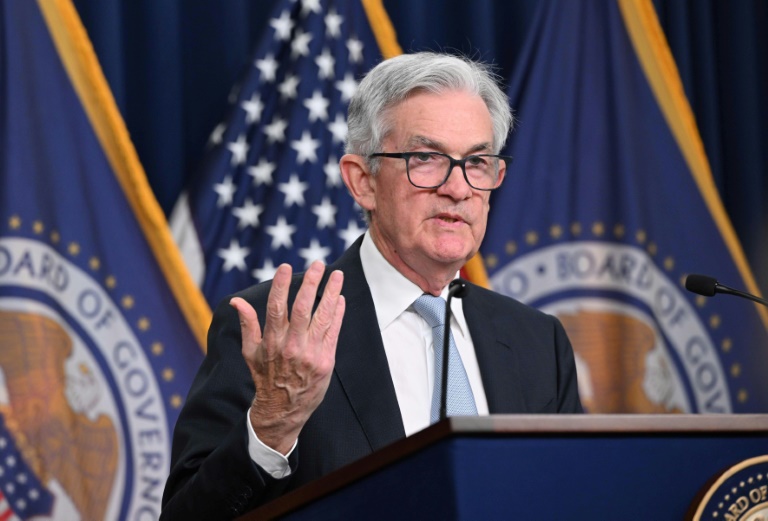
The latest figures are welcome news a day after Federal Reserve Chair Jerome Powell signaled it could soon be time to moderate an aggressive campaign to cool the economy, although he maintains that inflation “remains far too high” for now.

The personal consumption expenditures (PCE) price index — the Fed’s preferred inflation measure — rose 6.0 percent from a year ago in October, down from a larger jump the month before, Commerce Department figures showed.

The central bank focuses on the PCE price index as it reflects consumers’ actual spending, including shifts to less pricey items, unlike the more well-known consumer price index.

“We are seeing initial signs that we are making progress in tackling inflation,” President Joe Biden said in a statement after the data release.

This is good news for Americans, Biden added, though he cautioned that “it will take time to bring inflation back to normal” and there could be “setbacks along the way.”

On a monthly basis, the PCE index held steady at 0.3 percent.

While there was an uptick in prices of goods like gasoline and other energy products, this was partly offset by “widespread decreases in prices for durable goods,” the Commerce Department said.

Excluding the volatile food and energy segments, the PCE price index rose 5.0 percent in October, year over year, also easing from before.

As families struggle with surging costs, worsened by logistics problems and fallout from Russia’s invasion of Ukraine, the Fed embarked on a forceful effort to cool demand.

It raised the benchmark lending rate six times this year, including four steep rate hikes, with effects now trickling through the world’s biggest economy.

The latest data could lead to some reprieve, but economist Rubeela Farooqi of High Frequency Economics warned Thursday that inflation measures “remain well above target and support a move up in rates into restrictive territory.”

Compared with a year ago, food prices remained 11.6 percent higher and energy costs were 18.4 percent more.

Meanwhile, household spending picked up in October by 0.8 percent, led by expenditure on new motor vehicles and gas, along with food services and accommodations.

“Household spending has remained resilient in the face of a 40-year high in inflation and rising borrowing costs. However, some softening can be expected going forward, as the Fed hikes rates” further, said Farooqi.

Key US inflation index ticks down in October: official data

A closely-watched measure of US inflation edged down in October, government data showed Thursday, with costs of goods easing while incomes grew and spending remained resilient.

The latest figures are welcome news a day after Federal Reserve Chair Jerome Powell signaled it could soon be time to moderate an aggressive campaign to cool the economy, although he maintains that inflation “remains far too high” for now.

The personal consumption expenditures (PCE) price index — the Fed’s preferred inflation measure — rose 6.0 percent from a year ago in October, down from a larger jump the month before, Commerce Department figures showed.

The central bank focuses on the PCE price index as it reflects consumers’ actual spending, including shifts to less pricey items, unlike the more well-known consumer price index.

“We are seeing initial signs that we are making progress in tackling inflation,” President Joe Biden said in a statement after the data release.

This is good news for Americans, Biden added, though he cautioned that “it will take time to bring inflation back to normal” and there could be “setbacks along the way.”

On a monthly basis, the PCE index held steady at 0.3 percent.

While there was an uptick in prices of goods like gasoline and other energy products, this was partly offset by “widespread decreases in prices for durable goods,” the Commerce Department said.

Excluding the volatile food and energy segments, the PCE price index rose 5.0 percent in October, year over year, also easing from before.

As families struggle with surging costs, worsened by logistics problems and fallout from Russia’s invasion of Ukraine, the Fed embarked on a forceful effort to cool demand.

It raised the benchmark lending rate six times this year, including four steep rate hikes, with effects now trickling through the world’s biggest economy.

The latest data could lead to some reprieve, but economist Rubeela Farooqi of High Frequency Economics warned Thursday that inflation measures “remain well above target and support a move up in rates into restrictive territory.”

Compared with a year ago, food prices remained 11.6 percent higher and energy costs were 18.4 percent more.

Meanwhile, household spending picked up in October by 0.8 percent, led by expenditure on new motor vehicles and gas, along with food services and accommodations.

“Household spending has remained resilient in the face of a 40-year high in inflation and rising borrowing costs. However, some softening can be expected going forward, as the Fed hikes rates” further, said Farooqi.

Close Bitnami banner
Bitnami