US Business

Adidas probing allegations about Kanye West's behaviour

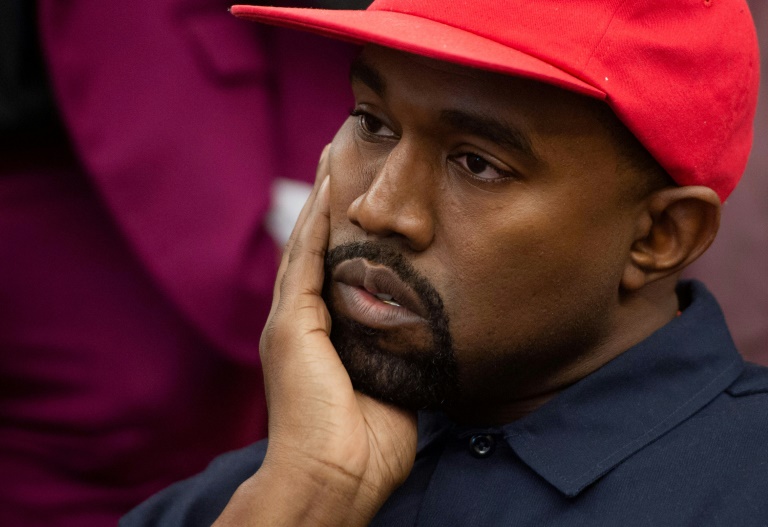
Adidas said Thursday it was investigating claims against Kanye West after a report detailed alleged inappropriate behaviour, just weeks after the German sportswear giant ended its partnership with the rapper.

US magazine Rolling Stone reported claims that the rapper played pornography to Adidas staff in meetings, and discussed porn and showed an intimate photo of ex-wife Kim Kardashian in job interviews.

It said former members of the team involved in “Yeezy” — the product line designed with the rapper — had released a letter alleging Adidas executives were aware of the behaviour, which went on for years, but turned a blind eye.

“It is currently not clear whether the accusations made in an anonymous letter are true,” Adidas said in a statement.

“However, we take these allegations very seriously and have taken the decision to launch an independent investigation of the matter immediately to address the allegations.”

The Rolling Stone report, citing unnamed former staff, alleged the rapper used intimidation tactics with employees, which were often directed towards women.

In the letter, the ex-Yeezy employees urged Adidas to address “the toxic and chaotic environment that Kanye West created”.

The new revelations came after Adidas last month terminated its lucrative tie-up with West — known formally as Ye — after a series of anti-Semitic outbursts by the star. 

At the time, the company said his comments were “unacceptable, hateful and dangerous”.

– Controversial rapper –

The sports outfitter took a heavy financial blow from the move, which it forecast would cuts its 2022 net income in half. 

In its latest statement Thursday, Adidas said it has been and continues to be “actively engaged in conversations with our employees about the events that lead to our decision to end the partnership.

“They have our full support and as we’re working through the details of the termination.”

Adidas began a review of its relationship with West after he appeared at a Paris fashion show wearing a shirt emblazoned with “White Lives Matter”, a slogan created as a backlash to the Black Lives Matter movement.

Days later he was locked out of Twitter and Instagram over anti-Semitic threats.

The artist was associated with rival sportswear company Nike for years but broke away in 2013, lending his name to Adidas as they launched their first Yeezy shoe in 2015 — a partnership that went on to make him a billionaire.

Along with Beyonce, Stella McCartney and Pharrell Williams, West has been one of the top names used by Adidas to boost sales, especially online.

But rights campaigners and entertainment world figures had heaped pressure on Adidas to stop working with the rapper.

US clothing company Gap and Paris-based fashion house Balenciaga have also recently ended tie-ups with West.

Earlier this month, Adidas named a new CEO — Bjorn Gulden, chief of rival outfitter Puma. As well as the fallout from the West controversy, he faces the task of improving sales that have been hit by Covid restrictions in key market China. 
Struggling Ghana plans tax rise, debt swap to secure IMF aid

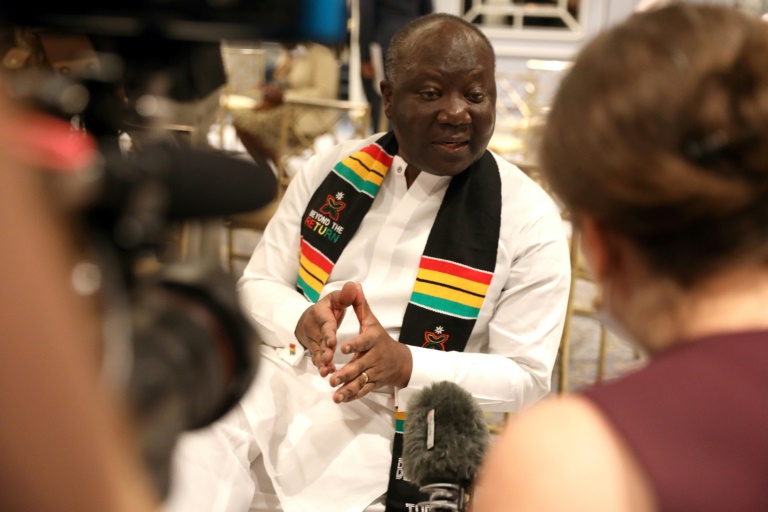
Ghana’s finance minister, Kenneth Ofori-Atta, presented the 2023 budget to parliament on Thursday, hiking tax and planning a debt swap as the country’s negotiates an International Monetary Fund (IMF) loan.

Ofori-Atta is facing calls for his dismissal as the West African state battles an economic crisis, with inflation at more than 40 percent and the cedi currency falling sharply.

Ghana hopes to secure up to $3 billion in IMF credit this year to shore up public finances after the government initially said it would not need to go to the multilateral lender.

“The challenges we face are daunting,” the minister said in a statement to lawmakers. “I, therefore, ask all of us to play a constructive role in getting our nation back on track.”

To increase revenues, the 2023 budget will raise value-added tax by 2.5 percent to 15 percent. The so-called E-levy on electronic transactions will be reduced from 1.5 percent to 1.0 percent in a bid to encourage more transactions.

The government will also freeze hiring of public workers for next year.

Ghana, a top cocoa and gold producer, also has oil and gas reserves but its debt service payments are high and its revenues low. Like the rest of Africa, it has been hit hard by economic fallout from the global pandemic and the Ukraine war. 

Since the start of the year, the cedi currency has depreciated more than 53 percent. That compared to an average seven percent average annual depreciation between 2017 and 2021, the finance minister said. 

Inflation in October hit 40.2 percent.

The local currency’s depreciation against the dollar has increasing Ghana’s foreign debt stock by 93 billion cedi or $6 billion this year alone, the minister said. 

He said the government would start a debt exchange programme but did not give details of how that would happen.

Earlier this year, President Nana Akufo-Addo reversed his government’s position and said the country would go to the IMF for help.

Critics have questioned what austerity measures may have to accompany any loan deal. Ghanaians already struggling with high costs of living.

Ofori-Atta said the IMF talks had made “substantial progress”, with agreement on “fiscal adjustment path, debt strategy and financing”.

The government is under increasing pressure over the country’s economic woes and Ofori-Atta faced an enquiry from lawmakers last week over his financial management.

Speaking in parliament on Friday, he apologised to Ghanaians for the struggles they faced. 

Earlier this month, Akufo-Addo fired the government’s junior finance minister, Charles Adu Boahen, over graft allegations after he appeared in a documentary on illegal gold mining.

US happy underdogs ahead of England World Cup clash: Adams

United States skipper Tyler Adams says his teammates are embracing their underdog status as they chase another World Cup upset against mighty England on Friday.

The US head into Friday’s Group B clash at the Al Bayt Stadium desperately needing a positive result after being held to a 1-1 draw against Wales on Monday.

England meanwhile go into the game on a high after a 6-2 mauling of Iran, and a win for Gareth Southgate’s side would see them assured of a place in the last 16.

Leeds midfielder Adams however says the Americans are unfazed by the prospect of taking on a team he regards as one of the tournament favourites.

“I think England are currently one of the favourites to win the World Cup,” Adams told a press conference on Thursday.

“I think that in a lot of games people say we’re the underdogs. But we carry that with pride. It doesn’t mean anything to us to be underdogs, or to be favourites. That being said, when we step on the field against England we have to be prepared or else a win is not possible.”

In two previous meetings at the World Cup, the United States have never lost to England.

They famously sent the English crashing out of the tournament in 1950 with a 1-0 defeat, and in 2010 held a star-studded England team to a 1-1 draw in South Africa.

Adams says Friday’s game is a chance to accelerate a positive shift in how American soccer is perceived around the world.

“It’s a huge opportunity to fast track the impact that we can have,” Adams said.

“These are the games where it’s a high pressure, privileged moment to step on the field against some of these guys… When you get a result in a game like this people start to respect Americans a little bit more.”

US coach Gregg Berhalter meanwhile said the Americans were confident of being able to pose a threat to England’s hopes of victory.

“We think there’s areas that we can exploit and we can hurt them,” Berhalter said.

The United States have the second youngest team in the World Cup, with a talented largely Europe-based squad brimming with technical ability.

Berhalter however said suggestions that the current crop of American players represented a “Golden Generation” were premature.

“That’s just TBD (to be determined),” Berhalter said. “We haven’t achieved anything as a group on the world stage. 

“When you’re talking about England — they came fourth (at the 2018 World Cup) and second (at Euro 2020). Those are tangible things that you can point to. We’re just not there yet.

“We need to use this World Cup to establish ourselves and then hopefully move to the next World Cup and do the same. We’re getting a little bit of ourselves calling the team that.”

Berhalter meanwhile revealed that his off-field friendship with Southgate had been put on hold in the build-up to Friday’s game.

“I’ve been Whatsapping him but I haven’t seen the blue check marks,” Berhalter said.

“We kind of took a hiatus. I’m sure we’ll pick up our relationship after tomorrow.”

Emperor Charles V's secret code cracked after five centuries

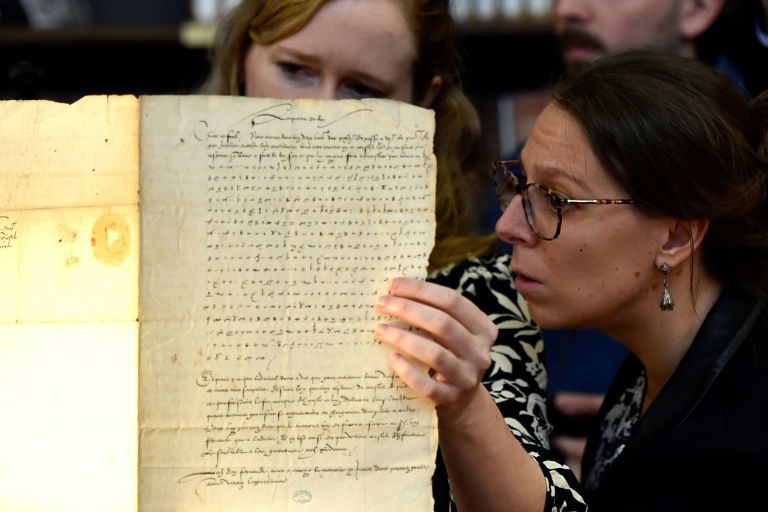
A team of researchers has cracked a five century-old code which reveals a rumoured French plot to kill the Holy Roman Emperor and King of Spain Charles V.

Charles was one of the most powerful men of the 16th century, presiding over a vast empire that took in much of western Europe and the Americas during a reign of more than 40 years.

It took the team from the Loria research lab in eastern France six months to decipher the letter written in 1547 by the emperor to his ambassador in France.

The tumultuous period saw a succession of wars and tensions between Spain and France, ruled at that time by Francis I, the Renaissance ruler who brought Leonardo da Vinci from Italy.

The letter from Charles V to Jean de Saint-Mauris had languished forgotten for centuries in the collections of the Stanislas library in Nancy.

Cecile Pierrot, a cryptographer from Loria, first heard of its existence at a dinner in 2019, and after much searching was able to set eyes on it in 2021.

Bearing the signature of Charles V, it was at once mysterious and utterly incomprehensible, she told reporters on Wednesday. 

– ‘Snapshot of strategy’ –

In painstaking work backed by computers, Pierrot found “distinct families” of some 120 symbols used by Charles V.

“Whole words are encrypted with a single symbol” and the emperor replaced vowels coming after consonants with marks, she said, an inspiration probably coming from Arabic.

In another obstacle, he also used symbols that mean nothing to mislead any adversary trying to decipher the message.

The breakthrough came in June, when Pierrot managed to make out a phrase in the letter, and the team then cracked the code with the help of historian Camille Desenclos.

“It was painstaking and long work but there was really a breakthrough that happened in one day, where all of a sudden we had the right hypothesis,” she said.

Another letter from Jean de Saint-Mauris, where the receiver had doodled a form of transcription code in the margin, also helped.

– More discoveries to come –

Desenclos said it was “rare as a historian to manage to read a letter that no one had managed to read for five centuries.”

It “confirms the somewhat degraded state” in 1547 of relations between Francis I and Charles V, who had signed a peace treaty three years earlier, she said.

But relations were still tense between the two, with various attempts to weaken each other, she said. 

So much so that one nugget of information revealed was the rumour of an assassination plot against Charles V that was said to have been brewing in France, Desenclos said.

She said “not much had been known” about the plot but it underlined the monarch’s “fear”.

The researchers now hope to identify other letters between the emperor and his ambassador “to have a snapshot of Charles V’s strategy in Europe”, she said. 

“It is likely that we will make many more discoveries in the coming years,” the historian said.

Ukraine battles to restore power after latest Russian barrage

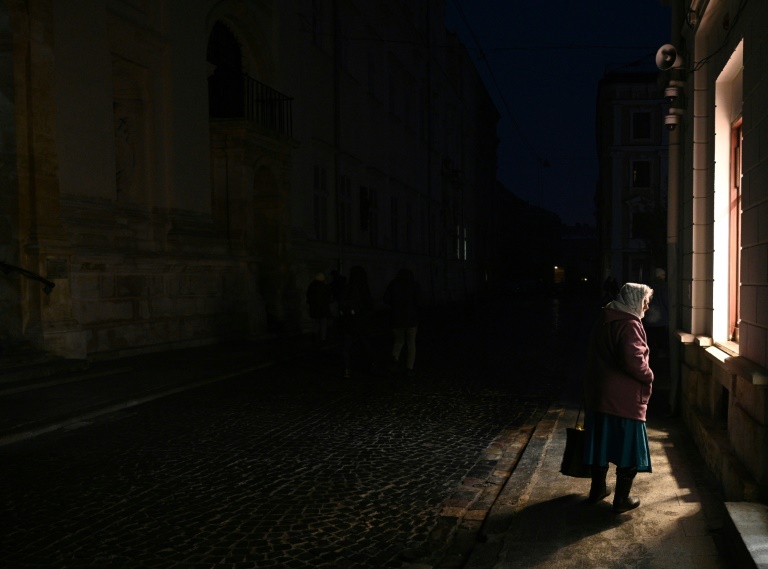
Ukraine struggled Thursday to repair its battered power and water services after Russia targeted the electricity grid with dozens of cruise missiles and temperatures plunged.

The Ukrainian energy system is on the brink of collapse and millions have been subjected to emergency blackouts for weeks due to systematic Russian bombardments of the grid.

The World Health Organisation has warned of “life-threatening” consequences and estimated that millions could leave their homes as a result.

Mayor Vitali Klitschko said more than two-thirds of the capital was still cut off despite municipal workers in Kyiv restoring some water service overnight.

“Seventy percent of the capital remains without electricity,” Klitschko said. “Energy companies are making every effort to return it as soon as possible,” he added.

Kyiv shivered Thursday as temperatures hovered just above zero degrees Celsius (32 degrees Fahrenheit) with some rain.

Ukraine’s military accused Russian forces of firing around 70 cruise missiles at targets across the country on Wednesday and of deploying attack drones.

Ten people were killed and around 50 wounded, Ukrainian Prosecutor General Andriy Kostin told local media.

But Russia’s defence ministry denied striking any targets inside Kyiv and said damage in the capital was the result of Ukrainian and foreign air defence systems.

– ‘Scariest day’ –

“Not a single strike was made on targets within the city of Kyiv,” it said.

Moscow’s targeting of power facilities is their bid to force capitulation after nine months of war that has seen Russian forces fail in most of their stated territorial objectives.

“So many victims, so many houses ruined,” 52-year-old Iryna Shyrokova told AFP in Vyshgorod on the outskirts of Kyiv after Wednesday’s Russian strikes.

“People have nowhere to live, nowhere to sleep. It’s cold. I can’t explain it. What for? We are also human beings,” she said, calling it “the scariest day”.

This month Moscow’s troops withdrew from the only regional capital they had captured, destroying key infrastructure as they retreated from Kherson in the south. 

Kostin said Ukrainian authorities had discovered a total of nine torture sites used by the Russians in Kherson as well as “the bodies of 432 killed civilians”. He did not specify how they were killed.

Wednesday’s attacks disconnected three Ukrainian nuclear plants automatically from the national grid and provoked blackouts in neighbouring Moldova, whose energy network is linked to Ukraine.

Ukraine’s energy ministry said that all three nuclear facilities had been reconnected by Thursday morning.

The governor of Kharkiv region — home to the country’s second largest city — said the eponymous city was suffering electricity supply issues and “emergency power shutdowns”.

The head of the central region of Poltava, Dmytro Lunin, said authorities were “working around the clock to restore power”.

– ‘Shutdowns’ –

“In the coming hours, we will start supplying energy to critical infrastructure and then to the majority of households,” Lunin said.

About 50 percent of central Dnipropetrovsk region had electricity, governor Valentyn Reznichenko said.

“The energy supply situation is complicated. So shutdowns will continue in the region to reduce the pressure on the grid as much as possible,” Reznichenko warned.

Repair work was ongoing elsewhere, including in the Rivne, Cherkasy, Kirovograd and Zhytomyr regions, officials said.

The Kremlin said Ukraine was ultimately responsible for the fallout from the strikes and that Kyiv could end the strikes by acquiescing to Russian demands.

Ukraine “has every opportunity to settle the situation, to fulfil Russia’s demands and as a result, end all possible suffering of the civilian population,” spokesman Dmitry Peskov said.

Moscow announced separately it had issued tens of thousands of Russian passports to residents of four Ukrainian territories, which President Vladimir Putin claimed to have annexed in September.

“More than 80,000 people received passports as citizens of the Russian Federation,” Valentina Kazakova, a migration official with the interior ministry, said in remarks carried by Russian news agencies. 

In September, Russia held so called referendums in Donetsk, Lugansk, Zaporizhzhia and Kherson and claimed residents had voted in favour of becoming subjects of Russia.

Putin formally annexed the territories at a ceremony in the Kremlin later that month, even though his forces have never had full control over them.

EU fails to agree gas price cap amid deep divisions

EU energy ministers failed Thursday to agree a cap on gas prices to mitigate the energy crunch in Europe amid deep divisions over an initial proposal slammed by many as a “joke”.

The ministers will now meet in the first half of December to try to bridge differences, said Czech Industry Minister Jozef Sikela, whose country holds the current presidency of the EU.

He added that the ministers did manage to adopt a couple of other “important measures”, including joint gas purchases to avoid intra-EU competition driving up prices, supply solidarity in times of need, and hastening authorisation of renewable energy sources.

Several ministers going into Thursday’s meeting complained that the gas price cap proposal on the table, unveiled by the European Commission just two days earlier, was clearly designed to never be used.

The Polish and Spanish energy ministers called the proposal a “joke”. 

Greek Energy Minister Kostas Skrekas said the cap “is not actually a ceiling” on gas prices, and “we are losing valuable time without results”.

The price cap plan — which the commission was never keen on — sets a maximum threshold of 275 euros per megawatt hour.

But it comes with so many conditions attached that it would not even have been activated back in August, when the gas price briefly soared above 300 euros, alarming Europe used to historic prices around 10 percent of that.

– Drop in Russian gas –

The cap proposal would only be triggered if the 275-euro limit was breached continuously for at least two weeks, and then only if the price for liquified natural gas (LNG) rose above 58 euros for 10 days within that same two-week period.

The price of wholesale gas in Europe on Thursday was around 124 euros, according to the main TTF benchmark.

The commission’s proposed price cap was seen as neutered under pressure from members including Germany and the Netherlands, which feared a cap could divert gas supplies to more lucrative markets, especially Asia.

Yet at least 15 EU countries — more than half the bloc — want some form of workable ceiling on wholesale gas prices to tackle a crunch in supply forced by Russia’s war in Ukraine.

While the European Union hasn’t banned Russian gas, the Kremlin has been turning off the taps in retaliation for sanctions imposed by Brussels in the wake of Moscow’s invasion. 

Before the war, Russian gas supplies accounted for more than 40 percent of all imported gas into the European Union, with export powerhouse Germany particularly needy.

That has now dropped to less than 10 percent. 

But alternative sources — such as LNG shipped from the United States and the Gulf — cannot make up the shortfall, and Europe faces a pricey heating bill for winter.

EU energy commissioner Kadri Simson acknowledged the divisions over the price cap as she went into the meeting.

She noted that the ministers have “a right to calibrate the different parameters” if they wished — something that may happen in time for their next meeting, likely to be called for December 13.

The price cap plan, if adopted, would start in January. It would run alongside a voluntary initiative for EU member states to cut natural gas use by 15 percent over the northern hemisphere winter.

rmb/dc/raz

For political activists, Twitter packs a vital punch

From the Arab Spring uprisings to the MeToo movement in which women spoke up about sexual assaults, Twitter has proven itself a formidable ally for political activists and opposition groups, one whose reach and impact would be difficult to replace.

Other social media platforms may have more users, but the network now owned by the billionaire Elon Musk dominates the global conversation — even as Twitter’s future is being called into doubt.

“Twitter is clearly very influential in getting the media and officials to pay attention. So it has a very special and unique place in that way,” said Mahsa Alimardani, a senior researcher at the human rights NGO Article 19.

During the anti-government protests that have rocked Iran in recent months, tweets are “helping Iranians bear witness to the pain and struggles of their fellow countrymen, helping the world bear witness to what’s happening,” she told AFP.

Especially in countries that have clamped down on independent journalism or foreign correspondents, Twitter provides a crucial lifeline to the outside world.

This week, posts from inside the Chinese iPhone factory operated by Foxconn showed workers rebelling against a total Covid lockdown, shattering the government’s attempts to portray a veneer of calm amid its draconian efforts to contain the virus.

“It’s very important to get information out to the international media but also to document human rights violations and atrocities,” said Marcus Michaelsen, a researcher specialised in digital activism under authoritarian regimes.

– ‘Protest identity’ –

Twitter had some 237 million daily users at end-June, well below the nearly two billion Facebook or one billion TikTok users.

But its pithy, at-a-glance format allows the network to punch far above its weight for opposition groups, since anyone can become a “citizen journalist” who instantly shares images that government authorities don’t want to be seen.

For  Nadia Idle, an Egyptian-British activist who took part in the Tahrir Square uprising in Egypt in 2011, tweets of anti-regime protests across the Middle East also encouraged people by showing that they were not alone.

“Its capacity to broadcast this event, and the amount of activists that were tweeting in English, made it a spectacle for people from the outside,” she said.

Faced with viral tweets provoking global outrage, outside governments can also feel domestic pressure to take action or at least condemn repressive governments.

And even in democratic countries, Twitter’s function as a digital town hall can provide activists with a megaphone that previously might have been out of reach.

Over the past decade, the BlackLivesMatter hashtag has become synonymous with the movement to highlight racism and police violence against African Americans, shining a light on discriminations that often went unseen.

“They use the features of Twitter, of social media, to create a protest identity, to create a common feeling within the movement,” Michaelsen said.

“They know that they can reach journalists and policymakers more, more directly than on Instagram, for instance.”

– ‘Would be a big loss’ –

Since the upheaval created by Musk’s takeover, Twitter has seen a wave of defections as people worry that posts will no longer be sufficiently curated to weed out disinformation and provocations.

Activists warn that if Twitter dies, the world will lose a crucial historical record of social movements that might not have gained traction without the digital documentation.

“Twitter has maintained an archive of so many different movements and so many different events… So losing that archive would be a big loss, it’s a historical record in some way,” Alimardani said.

Charles Lister, a political scientist at the Middle East Institute in Washington, said oppressive regimes or terror groups would be the only beneficiaries of losing a powerful check on their behaviour.

In his work on the Syria civil war, Lister says Twitter has been “vital” to documenting war crimes and providing aid.

Ukraine battles to restore power after latest Russian barrage

Ukraine struggled Thursday to repair its battered power and water services after Russia targeted the electricity grid with dozens of cruise missiles and temperatures plunged.

The Ukrainian energy system is on the brink of collapse and millions have been subjected to emergency blackouts for weeks due to systematic Russian bombardments of the grid.

The World Health Organisation has warned of “life-threatening” consequences and estimated that millions could leave their homes as a result.

Mayor Vitali Klitschko said more than two-thirds of the capital was still cut off on Thursday despite municipal workers in Kyiv restoring some water service overnight.

“Seventy percent of the capital remains without electricity,” Klitschko said. “Energy companies are making every effort to return it as soon as possible,” he added.

Ukraine’s military accused Russian forces of firing around 70 cruise missiles at targets across the country on Wednesday and of deploying attack drones.

Moscow’s targeting of Ukrainian power facilities is their latest strategy hoping to force capitulation after nine months of war that has seen Russian forces fail in most of their stated territorial objectives.

– ‘Scariest day’ –

Wednesday’s attacks left multiple people dead, disconnected three Ukrainian nuclear plants automatically from the national grid and even provoked blackouts in neighbouring Moldova, whose energy network is linked to Ukraine.

“So many victims, so many houses ruined,” 52-year-old Iryna Shyrokova told AFP in Vyshgorod on the outskirts of Kyiv after the Russian strikes.

“People have nowhere to live, nowhere to sleep. It’s cold. I can’t explain it. What for? We are also human beings,” she said, calling it “the scariest day”.

Ukraine’s energy ministry said that all three nuclear facilities had been reconnected by Thursday morning.

The governor of Kharkiv region — home to the country’s second largest city — said the eponymous city was suffering electricity supply issues and “emergency power shutdowns”.

The head of the central region of Poltava, Dmytro Lunin, said authorities were “working around the clock to restore power”.

“In the coming hours, we will start supplying energy to critical infrastructure and then to the majority of households,” Lunin said.

– ‘Shutdowns’ –

About 50 percent of central Dnipropetrovsk region had electricity, governor Valentyn Reznichenko said.

“The energy supply situation is complicated. So shutdowns will continue in the region to reduce the pressure on the grid as much as possible,” Reznichenko warned.

Repair work was ongoing elsewhere, including in the Rivne, Cherkasy, Kirovograd and Zhytomyr regions, officials said. 

Moscow announced separately it had issued tens of thousands of Russian passports to residents of four Ukrainian territories, which President Vladimir Putin claimed to have annexed in September.

“More than 80,000 people received passports as citizens of the Russian Federation,” Valentina Kazakova, a migration official with the interior ministry, said in remarks carried by Russian news agencies. 

In September, Russia held so called referendums in Donetsk, Lugansk, Zaporizhzhia and Kherson and claimed residents had voted in favour of becoming subjects of Russia.

Putin formally annexed the territories at a ceremony in the Kremlin later that month, even though his forces have never had full control over them.

Stocks rise, dollar slips as Fed signals softer rate hike pace

Stock markets mostly rose Thursday and the dollar largely weakened after minutes from the Federal Reserve’s latest policy meeting suggested it could slow the pace of its rate hikes.

The news provided traders with a cushion against concerns about surging Covid-19 cases in China that have fanned speculation authorities will revert to lockdowns and other economically debilitating measures to fight the outbreak.

Oil prices extended Wednesday’s sharp losses fuelled by worries about the impact on demand from China’s Covid outbreaks.

Wednesday’s much-anticipated minutes showed most US central bank chiefs felt smaller increases would “likely soon be appropriate” as the economy shows signs of weakness following almost a year of monetary tightening.

“Equities are revelling in the wake of the… minutes after the Fed telegraphed a downshift from jumbo to extra-large rate hikes,” said SPI Asset Management’s Stephen Innes.

“A commitment to moving toward restrictive monetary policy remains intact, but the (policy board) is ready to slow the path toward that destination.”

He added that a less aggressive Fed “should pave the runway for take-off in Asia, fuelled by expectations of China’s reopening by March next year”.

Bets were growing on officials announcing a 50-basis-point lift at their December gathering, down from four straight 75-point hikes.

The latest indicators showed the manufacturing and services sectors continued to contract last month, while jobless claims picked up.

The developments allowed Wall Street traders to head off to their Thanksgiving break with a spring in their step, the S&P 500 ending at a two-month high as they finally see a glimmer of light at the end of the tunnel after a painful year.

Asia and Europe mostly followed suit.

Kuala Lumpur surged more than three percent and the ringgit held gains after opposition leader Anwar Ibrahim was named prime minister, ending a days-long leadership impasse after inconclusive polls that had rattled Malaysia’s markets.

The more risk-on environment was also reflected in a further drop in the dollar against its peers, having surged for much of the year as traders bet on ever-higher US interest rates.

Investors were keeping a close watch also on China after it announced a record number of new Covid cases, as authorities worked to curb the spread with snap lockdowns, mass testing and travel restrictions.

While officials are trying more targeted measures to contain the disease, concerns remain that they will resort to the painful city-wide shutdowns seen in Shanghai earlier this year as part of the zero-Covid strategy, which hammered the economy.

However, that worry has been tempered somewhat after China signalled fresh support measures aimed at boosting growth, with the State Council saying tools would be used to ensure liquidity in markets.

The comments led to talk of another cut in the amount of cash that banks must keep in reserve, freeing them to lend more.

– Key figures around 1130 GMT –

London – FTSE 100: UP 0.1 percent at 7,475.73 points

Paris – CAC 40: UP 0.6 percent at 6,716.21

Frankfurt – DAX: UP 0.9 percent at 14,550.77

EURO STOXX 50: UP 0.5 percent at 3,967.92

Tokyo – Nikkei 225: UP 1.0 percent at 28,383.09 (close)

Hong Kong – Hang Seng Index: UP 0.8 percent at 17,660.90 (close)

Shanghai – Composite: DOWN 0.3 percent at 3,089.31 (close)

New York – Dow: UP 0.3 percent at 34,194.06 (close)

Euro/dollar: DOWN at $1.0391 from $1.0401 on Wednesday

Dollar/yen: DOWN at 138.28 yen from 139.52 yen

Pound/dollar: UP at $1.2099 from $1.2064

Euro/pound: DOWN at 85.91 pence from 86.18 pence

West Texas Intermediate: DOWN 0.6 percent at $77.44 per barrel

Brent North Sea crude: DOWN 0.9 percent at $84.63 per barrel

China iPhone factory workers take the money and leave after protests

Employees are leaving a vast Foxconn iPhone factory in central China over working conditions and Covid restrictions, relieved to be taking pay-offs home after angry protests at the Taiwanese tech giant’s plant.

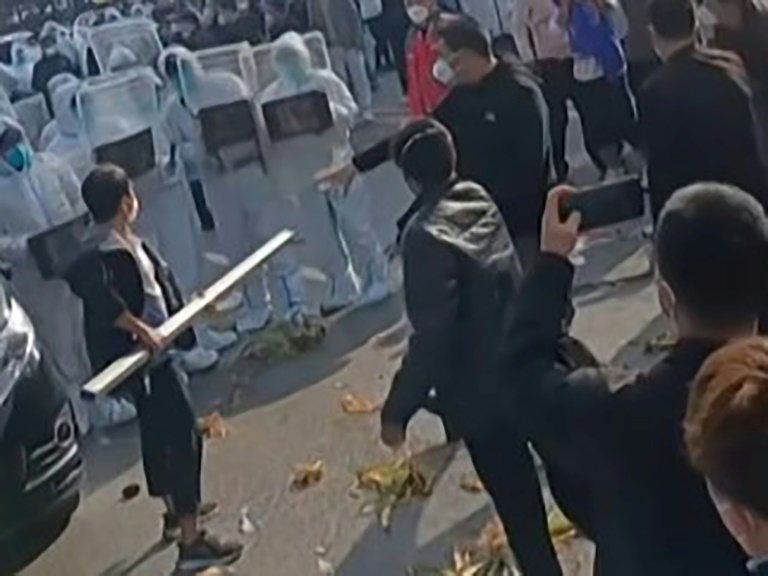
The workers are leaving the plant in Zhengzhou in the wake of bloody clashes with police, in which more than a dozen protesters were hurt, furious about Foxconn’s failure to deliver promised bonuses, employees  told AFP. 

“The contract suddenly changed and everyone was unhappy, in addition the previous incidents at Foxconn made everyone lose trust, so the protests happened,” one female worker who wished to remain anonymous told AFP.

Foxconn has been desperate to keep operations ticking along at the factory, the world’s biggest manufacturer of iPhones, after a handful of Covid cases forced it to lock down the facility.

Now the firm is offering payouts to those that leave, with employees taking to social media Thursday to show they had received bonuses of 10,000 yuan ($1,400) in return for terminating their contracts.

Several coaches are parked outside dormitories in the background of several videos, supposedly there to take staff home. 

“Everyone’s got their money and are about to leave,” the female worker said.

“I’m pretty satisfied, workers who still want this or that should not be too greedy,” she said.

Foxconn also appears keen to placate those who were beaten by police, with another worker telling AFP that injured colleagues received an additional 500 yuan on top of their leaving bonus.

Foxconn did not respond to an AFP request for comment.

However, screenshots of a company notice circulating online Thursday show that new employees who wished to leave would be offered 10,000 yuan to cover lost salary, quarantine and transport costs. 

The notice said employees who registered to end their contracts would be paid 8,000 yuan and given another 2,000 yuan upon boarding buses arranged by the company back to their hometowns.

– Protesters beaten –

Footage of the protests shared with AFP and captured by a factory worker showed one person lying motionless on the ground next to a man in a blood-spattered jacket having his head bound in an effort to staunch a wound.

Another clip shows dozens of hazmat-clad personnel wielding batons and chasing employees, one of whom is knocked to the ground before appearing to be kicked in the head.

The worker who shared the videos and who was present at the protests estimated that around 20 people were wounded in the clashes, some of whom were taken to hospital. He requested anonymity to protect his safety.

He told AFP the confrontations broke out after new employees who signed an agreement with the factory to work at least 30 days in return for a one-time payment of 3,000 yuan ($420) suddenly saw the figure slashed to just 30 yuan.

Foxconn has blamed a “technical error” in its payment systems for the non-payment, and promised employees that all salaries would be paid in line with company policies.

The unrest now seems to have cooled down, one worker told AFP.

“The new recruits should have all left, now everything is normal,” the worker said.

One video published Thursday on the short-video platform Kuaishou shows hundreds of workers waiting to leave the dormitory quarters carrying suitcases.

“Get money and return home,” read the caption, punctuated with a smiley emoji.

Close Bitnami banner
Bitnami