US Business

Musk to testify at trial over his $50 bn Tesla compensation

Tesla tycoon Elon Musk will take the stand on Wednesday as part of a trial over his $50 billion pay package as CEO of the electric car giant.

Musk will testify in the same Delaware court where he faced a lawsuit by Twitter to make sure he went through with his buyout of the social platform.

The $44 billion purchase of Twitter has put Musk under a deluge of scrutiny after he conducted massive layoffs, scared advertisers and opened the platform to fake accounts.

The unrelated Tesla case is based on a complaint by shareholder Richard Tornetta, who accused Musk and the company’s board of directors of failing in their duties when they authorized the pay plan.

Tornetta alleges that Musk dictated his terms to directors who were not sufficiently independent from their star CEO to object to a package worth around $51 billion at recent share prices.

The Tesla shareholder accuses Musk of “unjustified enrichment” and asked for the annulment of a pay program that helped make the entrepreneur the richest man in the world.

According to a legal filing, Musk earned the equivalent of $52.4 billion in Tesla stock options over four and a half years after virtually all of the company’s targets were met. 

When the plan was adopted it was valued at a total of $56 billion.

The non-jury trial began Monday with testimony from Ira Ehrenpreis, head of the compensation committee on Tesla’s board of directors, who said the targets set were “extraordinarily ambitious and difficult”.

Ehrenpreis argued that the board wanted to spur Musk to focus on Tesla at a time when the company was still struggling to gain traction.

– ‘Highly unusual’ –

The trial will run through Friday and is being presided over by Judge Kathaleen McCormick, the same judge who was to preside over the Twitter case.

There is no deadline for her decision which could take months.

It’s “highly unusual” for this kind of case to be brought to trial, Jill Fisch, Law professor at the University of Pennsylvania, told AFP.

“There aren’t all that many successful challenges to executive compensation (as) the courts have typically treated this as a business decision,” she added.

But the court found in this case that Musk’s ownership of about 22 percent of Tesla and his role as CEO “could have an undue impact” on the board and other shareholders, she noted.

Musk canceled an in-person appearance on Sunday at an event on the sidelines of the G20 in Bali to be in court.

Asked why he had not traveled to the tropical Indonesian island, the new Twitter boss joked that his “workload has recently increased quite a lot” after his takeover of the social media giant.


Musk to testify at trial over his $50 bn Tesla compensation

Tesla tycoon Elon Musk will take the stand on Wednesday as part of a trial over his $50 billion pay package as CEO of the electric car giant.

Musk will testify in the same Delaware court where he faced a lawsuit by Twitter to make sure he went through with his buyout of the social platform.

The $44 billion purchase of Twitter has put Musk under a deluge of scrutiny after he conducted massive layoffs, scared advertisers and opened the platform to fake accounts.

The unrelated Tesla case is based on a complaint by shareholder Richard Tornetta, who accused Musk and the company’s board of directors of failing in their duties when they authorized the pay plan.

Tornetta alleges that Musk dictated his terms to directors who were not sufficiently independent from their star CEO to object to a package worth around $51 billion at recent share prices.

The Tesla shareholder accuses Musk of “unjustified enrichment” and asked for the annulment of a pay program that helped make the entrepreneur the richest man in the world.

According to a legal filing, Musk earned the equivalent of $52.4 billion in Tesla stock options over four and a half years after virtually all of the company’s targets were met. 

When the plan was adopted it was valued at a total of $56 billion.

The non-jury trial began Monday with testimony from Ira Ehrenpreis, head of the compensation committee on Tesla’s board of directors, who said the targets set were “extraordinarily ambitious and difficult”.

Ehrenpreis argued that the board wanted to spur Musk to focus on Tesla at a time when the company was still struggling to gain traction.

– ‘Highly unusual’ –

The trial will run through Friday and is being presided over by Judge Kathaleen McCormick, the same judge who was to preside over the Twitter case.

There is no deadline for her decision which could take months.

It’s “highly unusual” for this kind of case to be brought to trial, Jill Fisch, Law professor at the University of Pennsylvania, told AFP.

“There aren’t all that many successful challenges to executive compensation (as) the courts have typically treated this as a business decision,” she added.

But the court found in this case that Musk’s ownership of about 22 percent of Tesla and his role as CEO “could have an undue impact” on the board and other shareholders, she noted.

Musk canceled an in-person appearance on Sunday at an event on the sidelines of the G20 in Bali to be in court.

Asked why he had not traveled to the tropical Indonesian island, the new Twitter boss joked that his “workload has recently increased quite a lot” after his takeover of the social media giant.

Chagall painting stolen by Nazis sells for $7.4 mn at US auction

A painting by Marc Chagall, which was among 15 works stolen by Nazis and eventually returned by France to the heirs of the affected families, sold for $7.4 million at auction in New York Tuesday. 

The sale at the Phillips auction house was part of the fall auction season, which sees major industry players sell hundreds of works of art for several billion dollars in a few days in the upscale neighborhoods of Manhattan. 

On Tuesday, Phillips sold 46 works for nearly $139 million. The most expensive, a monumental painting by Cy Twombly, “Untitled” (2005), which once belonged to the French businessman Francois Pinault, went for $41.6 million. 

Chagall’s 1911 oil on canvas, “The Father,” was purchased in 1928 by a Polish-Jewish violin maker, David Cender, who lost his possessions when he was forced to move to the Lodz ghetto.

Deported to Auschwitz, where his wife and daughter were killed, the violin maker survived and moved to France in 1958, where he died in 1966 without regaining possession of the painting.

In the meantime, the work had reappeared in exhibitions and it turned out that it was Marc Chagall himself who had bought it, probably between 1947 and 1953 — without knowing its provenance, according to Phillips and the French culture ministry.

After the artist, who was born in the Russian empire, died in France in 1985, “The Father” entered the national collections in 1988, and was then assigned to the Pompidou Center and deposited in the Museum of Jewish Art and History in Paris.

The French parliament unanimously adopted a law at the beginning of the year to return 15 works of Jewish families looted by the Nazis. The then culture minister, Roselyne Bachelot, had called it a historic “first step,” noting that other looted works of art and books were still kept in public collections.

Cender’s heirs decided to sell the painting, a common scenario “when a work is restituted so long after it has been stolen,” because “you’ve got multiple heirs and the work itself cannot be split,” said Phillips deputy chairman Jeremiah Evarts.

Chagall painted the portrait of his father the year he arrived in Paris. He was “electrified by the modernism” of the city at the time and his works from that period are rare.

“Many of them were destroyed when he left Paris to return to Russia in 1914,” Evarts noted, saying he was certain “The Father” would attract interest from museums and collectors.

Phillips did not reveal details about who bought the work, a common practice among auction houses.

US judge throws out policy used to block migrant entry

A US federal judge ruled Tuesday that the government could not use public health rules to block the entry of asylum-seeking migrants, marking the apparent end of a controversial Donald Trump-era policy that has been criticized as cruel and ineffective.

Judge Emmet Sullivan said Title 42, which has been used to expel hundreds of thousands of people since being invoked in the early days of the Covid-19 pandemic, was an “arbitrary and capricious” policy that violated government procedures.

The Department of Homeland Security filed a stay motion asking that Tuesday’s decision be suspended for five weeks, but stressed it was doing so as a transitional measure.

“The delay in implementation of the court’s order will allow the government to prepare for an orderly transition to new policies at the border,” a statement said.

“But to be clear, under the unopposed motion, Title 42 would remain in place for some period. During the period of this freeze, we will prepare for an orderly transition to new policies at the border.”

The stay, until midnight on December 21, would give the government time to put in place tools to stem the flow of migrants at the southern border with Mexico, most of whom ask for asylum.

The ballooning numbers at the border — more than 200,000 have been interdicted each month this year — is an increasing political headache for President Joe Biden and his Democratic Party, who the Republicans have repeatedly sought to paint as soft on illegal immigration.

Before the ruling, newly re-elected Texas Governor Greg Abbott, a Republican immigration hardliner, took to Twitter to say that he was deploying the national guard and gunboats to turn back migrants.

“I invoked the Invasion Clauses of the US & Texas Constitutions to fully authorize Texas to take unprecedented measures to defend our state against an invasion,” he tweeted.

Those clauses, he said, would allow him to “build a border wall” and “designate Mexican drug cartels as foreign terrorist organizations.”

– ‘Huge victory’ –

Tuesday’s ruling came after a lawsuit brought in January by the American Civil Liberties Union, which accused the Department of Homeland Security and Border Patrol of “summary expulsion” of vulnerable families seeking asylum who showed no signs of Covid infection.

“This is a huge victory and one that literally has life-and-death stakes,” said ACLU attorney Lee Gelernt, who led the lawsuit.

“We have said all along that using Title 42 against asylum seekers was inhumane and driven purely by politics. Hopefully this ruling will end this horrific policy once and for all,” he said in a statement.

The ruling came six months after a Louisiana judge ruled in a separate suit that Biden’s administration, which inherited the Title 42 policy from Donald Trump, could not drop it.

The judge in that case said ending the use of Title 42 rule would violate official government procedures.

While Biden’s team had wanted to end the use of Title 42, it has at the same time continued to rely heavily on the policy.

Border agents logged a record 2.3 million migrant encounters along the land border with Mexico in the year to September 22.

Critics branded Title 42 “inhumane,” and said it was an ad-hoc immigration plan dressed up as a health policy, but fit for neither purpose.

The measure, originally placed on the books in the 19th century in an effort to control contagious diseases, allows for the immediate removal of any foreigner or non-resident trying to enter the country without a visa.

There is no legal process, or any formal deportation to the country of origin, and a border agent can apply a Title 42 expulsion without the lengthy interview process usually required.

But, unlike a regular expulsion, which usually results in some kind of ban on attempting to re-enter the United States, a Title 42 expulsion comes with no black mark.

Some have noted that this means anyone who is apprehended while illegally crossing can simply try again.

Aaron Reichlin-Melnick, director of policy for the American Immigration Council said Title 42 had been “a failed border management policy that caused chaos along the border, immeasurable harm to innocent people seeking our protection, and diminished our standing on the world stage.”

“Judge Sullivan’s decision is… a long overdue step toward rebuilding a humanitarian protection system at the border that is safe, humane, and orderly.”

Trump pulls trigger on 2024 White House run

A combative Donald Trump launched into the 2024 White House race on Tuesday, setting the stage for a bruising Republican nomination battle after a poor midterm election showing by his hand-picked candidates weakened his grip on the party.

“America’s comeback starts right now,” the 76-year-old former president told hundreds of supporters gathered in an ornate American flag-draped ballroom at his palatial Mar-a-Lago residence in Florida.

“In order to make America great and glorious again, I am tonight announcing my candidacy for president of the United States,” Trump said, minutes after filing the official paperwork for his third presidential run.

Trump’s unusually early entry into the race is being seen in Washington as an attempt to get the jump on other Republicans seeking to be party flag-bearer — and to stave off potential criminal charges.

In a fiery, hour-long speech, Trump lauded — and at times inflated — his accomplishments as America’s 45th president and fired off verbal salvos against Democrat Joe Biden, who defeated him in 2020.

“I will ensure that Joe Biden does not receive four more years,” Trump vowed, while the US leader greeted his announcement with a tweet saying: “Donald Trump failed America.”

Trump, who was impeached for seeking political dirt on Biden from Ukraine and again after the January 6, 2021 attack on the Capitol by his supporters, launches his new bid with several potential handicaps.

He is the target of multiple investigations into his conduct before, during and after his first term as president — which could ultimately result in his disqualification.

These include allegations of fraud by his family business, his role in the attack on the Capitol, his attempt to overturn the 2020 election, and his stashing of classified documents at Mar-a-Lago.

Meanwhile Trump’s Republicans are licking their wounds after disappointing midterms, widely blamed on the underperformance of Trump-anointed candidates, and some are openly asking whether Trump — with his divisive politics and mess of legal woes — is the right person to carry the party colors next time around.

Several possible 2024 primary rivals are circling, chief among them the governor of Florida Ron DeSantis, who bucked the tide and won a resounding reelection victory on November 8.

– ‘Nation in decline’ –

The powerful media empire of Rupert Murdoch has already appeared to turn its back on Trump, labelling him a “loser” who shows “increasingly poor judgement.”

And Trump remains banned by Facebook and Twitter, which was instrumental in his stunning political rise.

In his announcement speech, Trump attacked Biden over inflation, crime and immigration, mocked climate change and congratulated himself for toppling the Islamic State, keeping North Korea in check and building a border wall with Mexico.

“Under our leadership, we were a great and glorious nation. But now we are a nation in decline,” he said. “This is not just a campaign this is a quest to save our country.

“In two years the Biden administration has destroyed the US economy,” he said. “With a victory we will again build the greatest economy ever.

“The blood-soaked streets of our once great cities are cesspools of violent crimes,” he said, vowing to “restore and secure America’s borders.”

The 79-year-old Biden has said his intention is to seek a second term — but he will make a final decision early next year.

Trump had made denial of the 2020 election results a key litmus test for midterm candidates seeking his endorsement — but a string of defeats by loyal allies sapped his momentum for a new White House bid.

Having failed to wrest control of the Senate, Republicans appeared poised to take over the House with a razor-thin majority.

But despite his lackluster election performance, the real estate tycoon retains an undeniable popularity with the millions of grassroots supporters who have flocked to his “Make America Great Again” banner.

And though abandoned by several top donors, he has a campaign war chest of well over $100 million.

– 2024 challengers –

For the moment, the hard-right DeSantis looks like the leading challenger to Trump in a Republican field that may include former vice president Mike Pence, Texas Senator Ted Cruz, Virginia Governor Glenn Youngkin, former secretary of state Mike Pompeo and ex-South Carolina governor Nikki Haley.

The 44-year-old DeSantis, dubbed “Ron DeSanctimonious” by Trump, had a ready reply Tuesday when asked about the former president’s attacks on him, urging “people to go check out the scoreboard from last Tuesday night.”

By throwing his hat in the ring, Trump is seeking to become just the second American president to serve non-consecutive terms — Grover Cleveland was elected in 1884, lost in 1888, and won again in 1892.

Title 42: the US health policy that blocks asylum seekers

A controversial US anti-immigration rule imposed at the height of the Covid-19 pandemic that automatically blocked asylum-seekers trying to enter the country has been struck down.

The measure, Title 42, had been branded “inhumane” by reformers and criticized as an ad-hoc immigration plan dressed up as a health policy.

Here’s what you need to know about the rule:

– What is it? – 

Title 42 is the colloquial name for a rarely used public health measure first invoked in 1893 when the United States sought to curb outbreaks of cholera and yellow fever.

In March 2020, the administration of then-president Donald Trump instituted the rule again as Covid-19 spread around the world.

Title 42 allows for the immediate removal of any foreigner or non-resident trying to enter the country without a visa.

There is no legal process, or any formal deportation to the country of origin, and a border agent can apply a Title 42 expulsion without the lengthy interview process usually required.

There were limited exceptions: thousands of Ukrainian nationals have been permitted to cross through the US-Mexico border and granted immediate entry because they were fleeing invading Russian forces.

– What happens at the border? – 

The vast majority of people arriving at the southern US border have traveled from Central or Southern America.

There are usually two routes they take to try to enter the United States: an asylum claim, or an illegal crossing.

In pre-Title 42 times, if they made a claim for asylum, this kicked off a lengthy procedure that might see them processed in the United States or in Mexico.

But under Title 42, a border agent simply did not accept the claim and the applicant was refused entry. The process took a matter of minutes. 

Anyone caught illegally crossing the border can be similarly and swiftly ejected. Significantly, this is done without the legal penalty normally imposed for an illegal crossing — for example a ban on entering the United States, even to claim asylum, for a number of years.

This means that some migrants have tried repeatedly crossing, knowing they will not suffer legally if they do not succeed. 

– What is wrong with swift removal? –

Activists say any system that prevents people from making an asylum claim is inhumane.

They point out that people presenting themselves at the US border are frequently fleeing brutal violence from gangs that rule swathes of Central and Southern America. 

Conversely, the lack of legal penalty for an illegal crossing encourages people to take more risks to get over the border.

This can mean they are trying to make their way through hostile deserts or ford difficult rivers.

A total of 557 people died at the border in 2021, making it the deadliest year for migrants since records began in 1998.

– How many people has Title 42 affected? –

Because of the issue of multiple crossing attempts, it’s impossible to say how many people have been refused entry under the rule.

What we do know is that there were more than 2.3 million migrant encounters at the southern border in the year to September 22. Many of those people were dealt with under Title 42.

– What’s the public health argument for Title 42? –

The United States has the world’s highest official death toll from Covid-19. It also has widespread infection among its population.

The benefits of preventing people from entering a country where the disease is well established are uncertain.

The US Centers for Disease Control and Prevention said in April it was in favor of ending the measure because of the relatively positive Covid situation in the country and the tools now available to fight the pandemic.

– What happened today? –

A federal judge struck down the policy, meaning asylum applications can once again be lodged at the border.

Hours later, the government filed a motion to have the decision suspended for five weeks, but stressed the measure was transitional to allow time for new controls to be put in place.

The five week stay means Title 42 will be gone at midnight on December 21.

US judge throws out policy used to block migrant entry

A US federal judge ruled Tuesday that the government could not use public health rules to block the entry of asylum-seeking migrants, marking the apparent end of a controversial Donald Trump-era policy that has been criticized as cruel and ineffective.

Judge Emmet Sullivan said Title 42, which has been used to expel hundreds of thousands of people since being invoked in the early days of the Covid-19 pandemic, was an “arbitrary and capricious” policy that violated government procedures.

The Department of Homeland Security filed a stay motion asking that Tuesday’s decision be suspended for five weeks, but stressed it was doing so as a transitional measure.

“The delay in implementation of the court’s order will allow the government to prepare for an orderly transition to new policies at the border,” a statement said.

“But to be clear, under the unopposed motion, Title 42 would remain in place for some period. During the period of this freeze, we will prepare for an orderly transition to new policies at the border.” 

The stay, until midnight on December 21, would give the government time to put in place tools to stem the flow of migrants at the southern border with Mexico, most of whom ask for asylum.

The ballooning numbers at the border — more than 200,000 have been interdicted each month this year — is an increasing political headache for President Joe Biden and his Democratic Party, who the Republicans have repeatedly sought to paint as soft on illegal immigration.

Before the ruling, newly re-elected Texas Governor Tony Abbott, a Republican immigration hardliner, took to Twitter to say that he was deploying the national guard and gunboats to turn back migrants.

“I invoked the Invasion Clauses of the US & Texas Constitutions to fully authorize Texas to take unprecedented measures to defend our state against an invasion,” he tweeted.

Those clauses, he said, would allow him to “build a border wall” and “designate Mexican drug cartels as foreign terrorist organizations.”

– ‘Huge victory’ –

Tuesday’s ruling came after a lawsuit brought in January by the American Civil Liberties Union, which accused the Department of Homeland Security and Border Patrol of “summary expulsion” of vulnerable families seeking asylum who showed no signs of Covid infection.

“This is a huge victory and one that literally has life-and-death stakes,” said ACLU attorney Lee Gelernt, who led the lawsuit.

“We have said all along that using Title 42 against asylum seekers was inhumane and driven purely by politics. Hopefully this ruling will end this horrific policy once and for all,” he said in a statement.

The ruling came six months after a Louisiana judge ruled in a separate suit that Biden’s administration, which inherited the Title 42 policy from Donald Trump, could not drop it.

The judge in that case said ending the use of Title 42 rule would violate official government procedures.

While Biden’s team had wanted to end the use of Title 42, it has at the same time continued to rely heavily on the policy.

Border agents logged a record 2.3 million migrant encounters along the land border with Mexico in the year to September 22.

Critics branded Title 42 “inhumane,” and said it was an ad-hoc immigration plan dressed up as a health policy, but fit for neither purpose.

The measure, originally placed on the books in the 19th century in an effort to control contagious diseases, allows for the immediate removal of any foreigner or non-resident trying to enter the country without a visa.

There is no legal process, or any formal deportation to the country of origin, and a border agent can apply a Title 42 expulsion without the lengthy interview process usually required.

But, unlike a regular expulsion, which usually results in some kind of ban on attempting to re-enter the United States, a Title 42 expulsion comes with no black mark.

Some have noted that this means anyone who is apprehended while illegally crossing can simply try again.

Aaron Reichlin-Melnick, director of policy for the American Immigration Council said Title 42 had been “a failed border management policy that caused chaos along the border, immeasurable harm to innocent people seeking our protection, and diminished our standing on the world stage.”

“Judge Sullivan’s decision is… a long overdue step toward rebuilding a humanitarian protection system at the border that is safe, humane, and orderly.”

The legal woes of former US president Donald Trump

Donald Trump has launched a new White House run despite facing legal exposure, and potential criminal charges, on several fronts — with some suggesting the prospect may even have pushed him towards another presidential bid.

The 76-year-old Trump is being investigated for his role in last year’s US Capitol attack, his efforts to overturn the 2020 election, and the stashing of classified documents at his Mar-a-Lago residence.

And New York state’s attorney general Letitia James has filed a civil suit against Trump and three of his children, accusing them of business fraud.

Trump, who says he is a victim of political persecution, has not been charged with any crimes. His becoming a presidential candidate makes indicting him a much more delicate matter.

Even if charged, he can still run for president — nothing in US law bars a person charged with or convicted of a crime from doing so.

Here are some of the key investigations weighing on the one-term president as he launches into the 2024 race:

– Capitol assault –

A series of explosive hearings by the House of Representatives panel probing the attack on the US Capitol by Trump supporters on January 6, 2021 offered a roadmap for potentially charging the ex-president with a crime.

The lawmakers leading the hearings presented their case that Trump knew he lost the 2020 presidential election to Joe Biden, yet pressed his claims of fraud and ultimately brought his supporters to Washington for a rally that ended with a violent assault on Congress.

The House select committee also uncovered evidence of alleged misconduct by Trump leading up to the insurrection, including his attempt to co-opt government departments into his bid to overturn the election.

The lawmakers’ work is separate from a criminal probe that the Justice Department has launched into the unrest and the events leading up to it.

Besides the legal ramifications, an unprecedented prosecution of a former chief executive would likely cause a political earthquake in a country already starkly divided along partisan Democratic and Republican lines.

– ‘Find’ the votes –

Trump is being investigated for pressuring officials in the southern swing state of Georgia to overturn Democrat Joe Biden’s 2020 victory — including a now-infamous taped phone call in which he asked the secretary of state to “find” enough votes to reverse the result.

Fulton County’s top prosecutor Fani Willis has assembled a special grand jury that could see Trump facing conspiracy charges connected to election fraud and interference.

Willis has already amassed significant testimony from members of Trump’s inner circle, including his former personal lawyer, ex-New York mayor Rudy Giuliani.

– The Trump Organization –

The civil suit filed by James, the New York state attorney general, against Trump and three of his children — Donald Trump Jr, Ivanka Trump and Eric Trump — accuses them of overvaluing multiple assets to secure loans and then undervaluing them to minimize taxes.

James is seeking $250 million in penalties as well as banning Trump and his children from serving as executives at companies in New York.

The attorney general is also seeking to bar Trump and his company, The Trump Organization, from purchasing property in the state for five years.

She also said her office was making a criminal referral to the US Justice Department and the Internal Revenue Service.

Trump denounced the suit as “another Witch Hunt by a racist Attorney General.”

– Raid on Florida residence –

An FBI search of Trump’s palatial Mar-a-Lago home in Florida in August turned up classified documents taken to his estate when he left office in January 2021.

The raid, which was personally approved by US Attorney General Merrick Garland, was triggered by a review of classified records that Trump finally surrendered to authorities in January this year — after months of back and forth with the National Archives.

The Justice Department began investigating after the 15 boxes were found to contain national defense information, including 184 documents marked as confidential, secret or top secret.

The FBI, in the affidavit used to justify the raid, said it was conducting a criminal investigation into “improper removal and storage of classified information” and “unlawful concealment of government records.”

The search warrant said the probe was also related to “willful retention of national defense information,” an offense that falls under the Espionage Act, and potential “obstruction of a federal investigation.”

A “special master,” a senior New York judge, has been appointed to screen the seized files for privileged materials.

On Wednesday, a three-judge appellate panel ruled that while the special master conducts his review, the government should be able to continue using those documents marked as classified for its investigation.

Trump launches 2024 White House bid

Donald Trump pulled the trigger on a third White House run on Tuesday, setting the stage for a bruising Republican nomination battle after a poor midterm election showing by his hand-picked candidates weakened his grip on the party.

“America’s comeback starts right now,” the former president told hundreds of supporters gathered in an ornate American flag-draped ballroom at his palatial Mar-a-Lago residence in Florida.

“In order to make America great and glorious again, I am tonight announcing my candidacy for president of the United States,” said the 76-year-old, who filed his official 2024 paperwork with the US election authority moments earlier.

Trump’s unusually early entry into the White House race is being seen in Washington as an attempt to get the jump on other Republicans seeking to be the party flag-bearer — and to stave off potential criminal charges.

Republicans are licking their wounds after disappointing midterms, widely blamed on the underperformance of Trump-anointed candidates, and some are openly asking whether Trump — with his divisive brand of politics and mess of legal woes — is the right person to carry the party colors next time around.

Several possible 2024 primary rivals are circling, chief among them the governor of Florida Ron DeSantis, who bucked the tide and won a resounding reelection victory on November 8.

Trump, who lost the 2020 election to Democrat Joe Biden after being impeached twice by the House of Representatives, launches his new bid with several potential handicaps.

He is the target of multiple investigations into his conduct before, during and after his first term as president — which could ultimately result in his disqualification.

These include allegations of fraud by his family business, his role in last year’s attack on the US Capitol, his attempt to overturn the 2020 election, and his stashing of classified documents at Mar-a-Lago.

With Trump now a declared candidate, Biden’s attorney general, Merrick Garland, may be forced to name a special counsel to pursue the various investigations into the former president launched by the Department of Justice.

– Popular support –

In addition, the powerful media empire of Rupert Murdoch has appeared to turn its back on Trump, labelling him after the midterms as a “loser” who shows “increasingly poor judgement.”

Trump also remains banned by Facebook and Twitter, which was instrumental in his stunning political rise.

In a combative speech, Trump attacked Biden over inflation and crime and lauded his own accomplishments as president, including toppling the Islamic State and building a border wall with Mexico.

“Under our leadership, we were a great and glorious nation. But now we are a nation in decline,” he said.

“In two years the Biden administration has destroyed the US economy,” he said. “With a victory we will again build the greatest economy ever.

“The blood-soaked streets of our once great cities are cesspools of violent crimes,” he said, vowing to “restore and secure America’s borders.”

The 79-year-old Biden has said his intention is to seek a second term — but he will make a final decision early next year.

“I will ensure that Joe Biden does not receive four more years,” Trump vowed, while the US leader greeted Trump’s announcement with a tweet saying: “Donald Trump failed America.”

Trump had made denial of the 2020 election results a key litmus test for midterm candidates seeking his endorsement — but a string of defeats by loyal allies sapped his momentum in preparing a new White House bid.

Having failed to wrest control of the Senate, Republicans appeared poised to take over the House, but with a razor-thin majority.

Despite his lackluster election performance, the real estate tycoon retains an undeniable popularity with the millions of grassroots supporters who have flocked to his “Make America Great Again” banner.

And though abandoned by several top Republican donors, he has amassed a campaign war chest of well over $100 million.

– 2024 challengers –

For the moment, the hard-right DeSantis looks like the leading challenger to Trump in a Republican field that may include former vice president Mike Pence, Texas Senator Ted Cruz, Virginia Governor Glenn Youngkin, former secretary of state Mike Pompeo and ex-South Carolina governor Nikki Haley.

The 44-year-old DeSantis, dubbed “Ron DeSanctimonious” by Trump, had a ready reply Tuesday when asked about the former president’s attacks on him, urging “people to go check out the scoreboard from last Tuesday night.”

Without naming Trump, he also suggested a Republican ticket headed by the former president would have trouble attracting independent voters “even with Biden in the White House and the failures that we’re seeing.”

By throwing his hat in the ring, Trump is seeking to become just the second American president to serve non-consecutive terms — Grover Cleveland was elected in 1884, lost in 1888, and won again in 1892.

Asian stocks swing as Ukraine fears offset inflation hopes

Asian stocks fluctuated Wednesday as another positive US inflation report that fanned hopes of a slowdown in the Federal Reserve’s interest rate hike campaign was offset by fresh geopolitical concerns over Ukraine.

World markets have rallied since last week after data showed US consumer prices rose much less than expected in October, suggesting months of Fed monetary tightening was kicking in.

The news was followed Tuesday by a below-forecast reading on wholesale prices, providing extra room for the central bank to take its foot off the pedal when raising borrowing costs and possibly easing pressure on the economy.

The optimism has been further enhanced by China’s pledge to provide much-needed support to the country’s beleaguered property sector as well as ease some of the strict Covid-19 restrictions that have played a major role in dragging the economy down.

However, the positive mood that had flowed through markets was dealt a blow after Poland said a Russian-made missile had struck a village in the country’s east, killing two people.

Warsaw put its military on alert and US President Joe Biden and other Western leaders met in an “emergency roundtable” Wednesday on the sidelines of the G20 summit in Indonesia.

The news sparked fears that if it was proved to be an attack on Poland, a NATO member, the nine-month war in Ukraine could escalate.

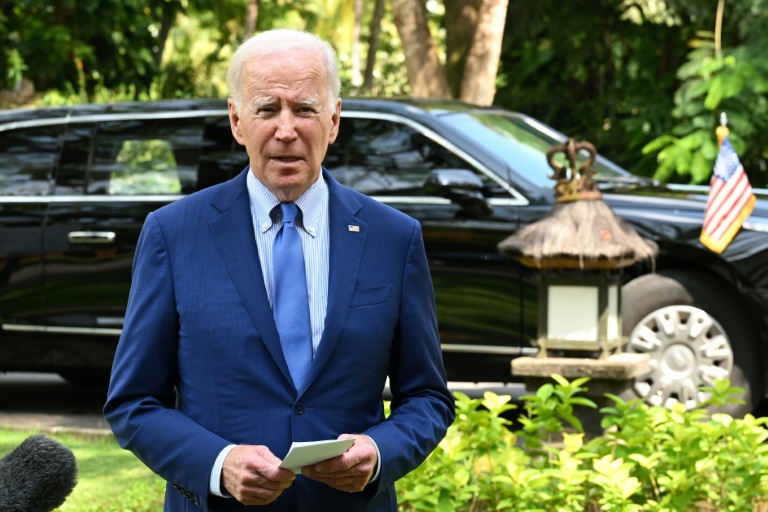
Biden told reporters that allies would support Poland in probing “exactly what happened” but that preliminary information showed it was probably not fired “from Russia”.

The comments helped ease concern on trading floors, though profit-taking after three days of healthy gains also kept buyers in check.

Hong Kong, Shanghai, Wellington and Taipei were slightly higher, while Tokyo, Sydney, Seoul, Singapore, Manila and Jakarta dipped.

“Even if the missiles that crossed the Polish border were indeed deemed Russian and not Ukrainian anti-missile interceptors, the case would fall short of triggering an escalation at this point,” said SPI Asset Management’s Stephen Innes

“Hence the markets are deferring to a wartime mistake, believing this to be a case of misfire.”

Still, he added: “While the market is not in full risk-off mode while deferring to a wartime mistake, the risk of a NATO-Russia clash is growing and real.”

On currency markets, the dollar also saw sharp swings against its peers in reaction to the news out of Poland, while oil slipped.

– Key figures around 0230 GMT –

Tokyo – Nikkei 225: DOWN 0.1 percent at 27,955.85 (break)

Hong Kong – Hang Seng Index: UP 0.2 percent at 18,368.52

Shanghai – Composite: UP 0.3 percent at 3,142.74

Euro/dollar: UP at $1.0382 from $1.0354 on Tuesday

Pound/dollar: UP at $1.1877 from $1.1871 

Dollar/yen: UP at 139.86 yen from 139.16 yen

Euro/pound: UP at 87.41 pence from 87.18 pence

West Texas Intermediate: DOWN 0.3 percent at $86.66 per barrel

Brent North Sea crude: DOWN 0.3 percent at $93.63 per barrel

New York – Dow: UP 0.2 percent at 33,592.92 points (close)

London – FTSE 100: DOWN 0.2 percent at 7,369.44 (close)

Close Bitnami banner
Bitnami