US Business

US accuses Russia of trying to 'freeze Ukraine into submission'

The United States on Friday accused the Russia of wanting to “freeze” Ukraine into submission since it has failed to triumph on the battlefield, as Moscow pushed ahead Friday with moving thousands of civilians out of the occupied Kherson region.

Since Kyiv’s forces have advanced against the invading troops in the east and south of Ukraine, Russia has repeatedly rained missiles and explosive drones onto Ukrainian infrastructure.

Ukrainian President Volodymyr Zelensky said on Thursday Russia’s campaign against Ukraine’s energy network had left around 4.5 million people without power.

“President (Vladimir) Putin seems to have decided that if he can’t seize Ukraine by force, he will try to freeze it into submission,” US Secretary of State Antony Blinken said after G7 foreign ministers met in Germany.

The West vowed to assist Ukraine to rebuild after the damage by Moscow’s strikes.

The top diplomats from the club of rich nations agreed a structure to funnel aid to Ukraine to replace infrastructure targeted by Russia after they held two days of talks in Muenster.

The United States, which has already committed to more than $18.2 billion of security aid to Ukraine since the invasion began in February, is also examining options to address the damage.

US President Joe Biden’s National Security Advisor Jake Sullivan also met Zelensky in Kyiv on Friday to reaffirm US support to Ukraine.

Sullivan told a press conference in Kyiv that  Ukraine had an “acute need for air defence in this critical moment”.

The Pentagon announced  Friday it will fund the refurbishment of T-72 tanks and HAWK surface-to-air missiles as part of a $400 million security assistance package for Ukraine.

– ‘Deportations’ –

Ahead of a mounting Ukrainian counter-offensive, Moscow continued to pull civilians out of the Kherson region, with Putin saying residents must be “removed” from danger zones. 

The Russian army said “more than 5,000 civilians” were being led across the Dnipro River every day, showing footage of soldiers directing lines of cars onto flotillas crossing over to the river’s eastern bank.

Moscow’s forces began urging tens of thousands of civilians to leave Kherson in mid-October, vowing to turn the region’s main city of the same name into a fortress.

Kyiv has likened the departures to Soviet-style “deportations” of its people.

“Those who live in Kherson should be removed from zones of dangerous fighting,” Putin said on Red Square as he marked Russian Unity Day, a patriotic holiday. 

“The civilian population should not suffer from shelling, an offensive, a counter-offensive or other such things,” he said. 

– Grain deal extension? –

Western countries, meanwhile, have urged Putin to extend a landmark deal for the export of Ukrainian grain to avert a global food crisis, which is up for renewal on November 19. 

Russia rejoined the UN-brokered deal on Wednesday, after suspending its participation for four days over a drone attack on its Black Sea fleet in Russian-annexed Crimea, but has threatened to pull out again.

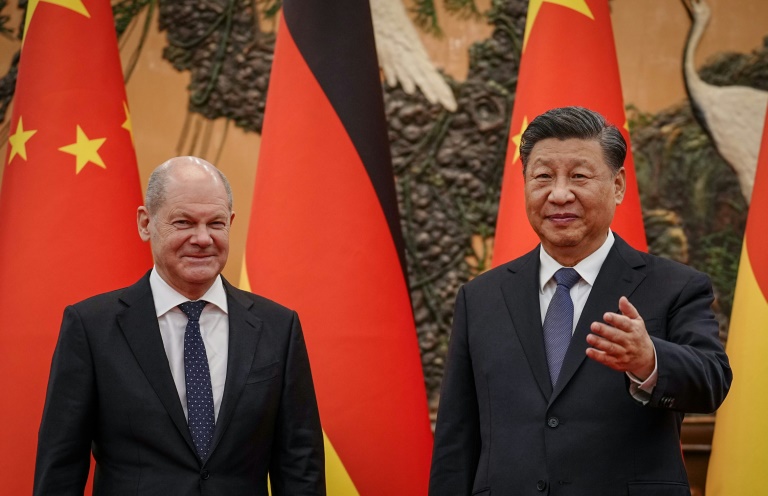
On a visit to China, German Chancellor Olaf Scholz urged Putin to extend the deal.

“Hunger must not be used as a weapon,” he said.

“I urge the Russian president not to refuse to extend the grain agreement which ends in a few days.”

He asked China’s Xi Jinping — who has good relations with Moscow — to use Beijing’s “influence” to stop fighting in Ukraine.

“The Russian war in Ukraine is a dangerous situation for the whole world,” Scholz said.

– ‘49,000 new recruits already fighting’ –

In Moscow, Putin led patriotic celebrations on Unity Day — a holiday he instated in 2005 to celebrate fending off a Polish invasion in 1612. 

Speaking to a handful of patriotic volunteers, Putin said 318,000 recruits had signed up since he announced a military call-up in September, which has since been completed. 

That exceeded his target of 300,000 because “volunteers keep coming”, he claimed. 

Of that number, 49,000 were taking part in active fighting.

Putin’s draft led to another wave of tens of thousands rushing to leave the country. Russia’s ex-leader Dmitry Medvedev on Friday called them “cowardly traitors and greedy defectors”.

The Kremlin chief said he wanted to restore historical monuments in the occupied territories so that those “who lived under crazy, idiotic propaganda for 30 years” would know “where their ancestors came from”.

He singled out the port city of Mariupol on the Sea of Azov, which was flattened by weeks of battles over its steelworks and fell into Russian hands in May. 

“Mariupol is a very famous — an ancient, you could say — Russian city,” Putin said.  

He said Russian authorities had a “lot to work on” in reconstruction plans of the city. 

The war has dragged on into its ninth month, forcing millions to flee Ukraine and leaving thousands of troops dead on both sides.


Twitter sacks half of staff as Musk launches overhaul

Twitter sacked half of its 7,500-strong staff on Friday as new owner Elon Musk launched his major overhaul of the troubled company just a week after his blockbuster takeover.

An internal document seen by AFP said “roughly 50 percent” of employees were impacted and would be denied access to company computers and email on an immediate basis.

Workers around the world were shown the door and took to Twitter to vent their frustration or disbelief and say good-bye to one Silicon Valley’s most iconic companies.

“Woke up to the news that my time working at Twitter has come to an end. I am heartbroken. I am in denial,” said Michele Austin, Twitter’s director of public policy for the US and Canada.

Ahead of the  layoffs, Twitter closed access to its offices worldwide, asking employees to stay at home to await news of their fate at the company.

The cull is part of Musk’s push to find ways to pay for the mammoth $44 billion deal for which he took on billions of dollars in debt and sold $15.5 billion worth of Tesla shares, his electric car company.

Musk, the Tesla and SpaceX chief, has been scrambling to find new ways for Twitter to make money after his mammoth buyout, including an idea to charge users $8 a month for verified accounts.

The moves would help overcome the potential loss of advertisers, Twitter’s main source of revenue, with many of the world’s top brands putting their ad buys on hold, spooked by Musk’s well-known disdain for content controls.

The mercurial tycoon on Friday complained on Twitter of a “massive drop in revenue” that he blamed on “activist groups” that were pressuring advertisers.

“We did everything we could to appease the activists. Extremely messed up! They’re trying to destroy free speech in America,” he added.

This appeared to refer to Musk’s recent meeting with civil rights groups in which he heard concerns that Twitter would open the floodgates to hate speech a week before midterm election in the United States.

In an effort to soothe nerves, Musk had vowed that Twitter will not become a “free-for-all hellscape,” but his pledge was quickly followed by a tweet relaying a conspiracy theory about an assault on the husband of US House Speaker Nancy Pelosi.

“We are witnessing the real time destruction of one of the world’s most powerful communication systems. Elon Musk is an erratic billionaire who is dangerously unqualified to run this platform,” said Nicole Gill, Executive Director of Accountable Tech.

She was part of a coalition of 60 rights groups calling on Friday for a boycott by advertisers of the Musk-owned platform.

“Elon Musk has demonstrated that it’s not possible for him to keep the brand safeguards that have existed on Twitter in place. There’s no more time for trust but verify, it’s time for escalation,” said Angelo Carusone, President and CEO of Media Matters for America.

Though extremely influential with opinion-makers and celebrities, the California company has long struggled to generate profit and has failed to keep pace with Facebook, Instagram and TikTok in gaining new users.

Twitter employees have been bracing for this kind of bad news since Musk completed his acquisition late last week and quickly set about dissolving its board and firing its chief executive and top managers.

Late on Thursday, a group of five Twitter employees who had already been fired filed a class action complaint against the company on the grounds that they had not been given the required 60-day notice period as required by law.

The lawsuit references the US Worker Adjustment and Retraining Notification (WARN) Act, which provides workers a right to advance notice in cases of mass layoffs or plant closings.

Twitter sacks half of staff as Musk launches overhaul

Twitter sacked half of its 7,500-strong staff on Friday as new owner Elon Musk launched his major overhaul of the troubled company just a week after his blockbuster takeover.

An internal document seen by AFP said “roughly 50 percent” of employees were impacted and would be denied access to company computers and email on an immediate basis.

Workers around the world were shown the door and took to Twitter to vent their frustration or disbelief and say good-bye to one Silicon Valley’s most iconic companies.

“Woke up to the news that my time working at Twitter has come to an end. I am heartbroken. I am in denial,” said Michele Austin, Twitter’s director of public policy for the US and Canada.

Ahead of the  layoffs, Twitter closed access to its offices worldwide, asking employees to stay at home to await news of their fate at the company.

The cull is part of Musk’s push to find ways to pay for the mammoth $44 billion deal for which he took on billions of dollars in debt and sold $15.5 billion worth of Tesla shares, his electric car company.

Musk, the Tesla and SpaceX chief, has been scrambling to find new ways for Twitter to make money after his mammoth buyout, including an idea to charge users $8 a month for verified accounts.

The moves would help overcome the potential loss of advertisers, Twitter’s main source of revenue, with many of the world’s top brands putting their ad buys on hold, spooked by Musk’s well-known disdain for content controls.

The mercurial tycoon on Friday complained on Twitter of a “massive drop in revenue” that he blamed on “activist groups” that were pressuring advertisers.

“We did everything we could to appease the activists. Extremely messed up! They’re trying to destroy free speech in America,” he added.

This appeared to refer to Musk’s recent meeting with civil rights groups in which he heard concerns that Twitter would open the floodgates to hate speech a week before midterm election in the United States.

In an effort to soothe nerves, Musk had vowed that Twitter will not become a “free-for-all hellscape,” but his pledge was quickly followed by a tweet relaying a conspiracy theory about an assault on the husband of US House Speaker Nancy Pelosi.

“We are witnessing the real time destruction of one of the world’s most powerful communication systems. Elon Musk is an erratic billionaire who is dangerously unqualified to run this platform,” said Nicole Gill, Executive Director of Accountable Tech.

She was part of a coalition of 60 rights groups calling on Friday for a boycott by advertisers of the Musk-owned platform.

“Elon Musk has demonstrated that it’s not possible for him to keep the brand safeguards that have existed on Twitter in place. There’s no more time for trust but verify, it’s time for escalation,” said Angelo Carusone, President and CEO of Media Matters for America.

Though extremely influential with opinion-makers and celebrities, the California company has long struggled to generate profit and has failed to keep pace with Facebook, Instagram and TikTok in gaining new users.

Twitter employees have been bracing for this kind of bad news since Musk completed his acquisition late last week and quickly set about dissolving its board and firing its chief executive and top managers.

Late on Thursday, a group of five Twitter employees who had already been fired filed a class action complaint against the company on the grounds that they had not been given the required 60-day notice period as required by law.

The lawsuit references the US Worker Adjustment and Retraining Notification (WARN) Act, which provides workers a right to advance notice in cases of mass layoffs or plant closings.

German leader calls for equal trade ties in controversial China summit

German Chancellor Olaf Scholz told Chinese leaders in Beijing on Friday that Berlin expected equal treatment on trade as he tried to drum up greater economic cooperation despite growing distrust of the Asian superpower in the West.

Scholz is under pressure to push Beijing to get tough on Russia over the war in Ukraine, and he said Friday that Germany and China had agreed they both opposed any use of nuclear weapons in the conflict.

The German chancellor is the first G7 leader to visit China since the start of the coronavirus pandemic, which led the world’s number two economy to close its borders and President Xi Jinping to largely eschew in-person diplomacy.

But his trip has prompted criticism at home over Berlin’s growing economic reliance on Beijing, and sparked controversy for coming so soon after Xi strengthened his hold on power in China just last month.

Tensions are also running high between the West and Beijing on issues ranging from Taiwan to alleged human rights abuses.

Scholz held talks with human rights lawyers critical of the regime in Beijing ahead of the trip, a source in his entourage told AFP.

Received by a smiling Xi at Beijing’s Great Hall of the People shortly after arriving, Scholz said he hoped to “further develop” economic cooperation — while alluding to areas of disagreement.

“It is good that we are able to have an exchange here about all questions, including those questions where we have different perspectives — that’s what an exchange is for,” Scholz said. 

“We also want to talk about how we can further develop our economic cooperation on other topics: climate change, food security, indebted countries.”

“Xi underscored the need for China and Germany, two major countries with great influence, to work together in times of change and instability and contribute more to global peace and development,” Beijing’s Xinhua News Agency reported.

Scholz also spoke with Chinese Premier Li Keqiang at a meeting in which he called for fair trade between the two countries. 

At a press briefing during which Chinese officials said there was “not enough time” for questions, Scholz urged Beijing to do more to “use its influence” on its ally Russia, currently engaged in a months-long war in Ukraine.

Both sides said they opposed the use of nuclear weapons in the conflict, with Scholz telling reporters: “Everyone says clearly that an escalation via the use of a tactical nuclear weapon is ruled out”.

China has steadfastly avoided criticising Russia for invading Ukraine and instead blames the United States and NATO for the war.

– ‘Keep doing business’ –

The German delegation of more than 60 people was met on the tarmac at Beijing airport by a military guard — as well as health workers in white hazmat suits who conducted mandatory PCR tests in buses converted into mobile laboratories. 

Scholz’s PCR test was taken in his plane by a German doctor he brought with him and supervised by Chinese health officials, according to the German government.

China’s economic importance is seen by some in Berlin as more crucial than ever, as Germany hurtles towards a recession battling an energy crisis triggered by the Ukraine war. 

China is a major market for German goods, from machinery to cars.

But German industry’s heavy dependence on China is facing fresh scrutiny after the over-reliance on Russian energy imports left it exposed when Moscow turned off the taps.

Scholz’s approach is still underpinned by the idea that “we want to keep doing business with China, no matter what that means for the dependence of our economy, and for our ability to act”, opposition lawmaker Norbert Roettgen told the Rheinische Post newspaper.

Concern about China has also come from within Germany’s ruling coalition, with Foreign Minister Annalena Baerbock saying past mistakes with Russia must not be repeated.

– ‘All the more important’ –

There are also concerns that the trip — coming on the heels of Xi securing a historic third term at a Communist Party Congress last month — may have unsettled the United States and the European Union.

“For Beijing, this is less about concrete outcomes and more about the symbolism of the German chancellor paying Xi a visit so soon after the party congress,” said Noah Barkin, visiting senior fellow in the Asia Program at the US German Marshall Fund.

“It gives international legitimacy to his leader-for-life status, and it shows that China is not isolated,” he added.

Berlin, however, says there have been consultations with key partners, and Scholz has insisted he is visiting China as a “European” as well as the leader of Germany.

In an article published before his departure, he said direct talks with Chinese leaders were “all the more important” after the long hiatus caused by the pandemic.

He promised to raise thorny topics such as respect for civil liberties and the rights of minorities in Xinjiang.

“We strongly agree with what he (Scholz) shared in that op-ed”, including “encouraging President Xi to press President Putin on never using a nuclear weapon of any kind”, US Secretary of State Antony Blinken said Friday after a meeting of G7 foreign ministers in Germany.

US to fund refurbishment of tanks, anti-air missiles for Ukraine

The United States will fund the refurbishment of T-72 tanks and HAWK surface-to-air missiles as part of a roughly $400 million security assistance package for Ukraine, the Pentagon announced Friday.

Air defense and armor capabilities are both high on the list of assistance desired by Ukraine, but the T-72s fall short of more modern tanks such as the German Leopard or US Abrams that have been sought by Kyiv.

The “tanks are coming from the Czech Republic defense industry, and the United States is paying for 45 of those to be refurbished, and the government of the Netherlands is matching our commitment” for a total of 90 T-72s, Deputy Pentagon Press Secretary Sabrina Singh told journalists.

The T-72s — a Soviet-era tank — will be equipped with “advanced optics, communications and armor packages,” with some ready by the end of December and others to be delivered in 2023, she said.

Asked why more modern tanks were not being provided, Singh cited factors including ease of use and cost.

“These are tanks that the Ukrainians know how to use on the battlefield,” she said, adding that “introducing a new main battle tank is extremely costly, is time sensitive, and it would be a huge undertaking for the Ukrainian forces.”

The package also funds the refurbishment of HAWK missiles from US inventories — an important asset as Ukraine seeks to counter Russian drone and missile strikes targeting its cities and energy infrastructure.

– Drones, boats, infrastructure –

Singh declined to specify how many of the missiles were being refurbished, citing security concerns. 

Spain previously agreed to provide four of the medium-range HAWK air defense systems to Ukraine — part of international efforts to assemble a patchwork of various surface-to-air capabilities to help the country defend against strikes.

The assistance package also includes 1,100 Phoenix Ghosts — a type of explosive-equipped “suicide” drone — as well as 40 armored boats and funding for the refurbishment of 250 M1117 armored vehicles, among other items.

It falls under the Ukraine Security Assistance Initiative, which funds procurement of equipment from the defense industry, rather than taking items directly from existing military stocks.

The latest assistance brings Washington’s total commitment of security aid to Ukraine to more than $18.2 billion since Russia invaded in late February.

In addition to security assistance, the United States is also examining options to address infrastructure damage from Russian strikes, which Ukrainian President Volodymyr Zelensky said Thursday had left millions without power.

“We are looking to try to see what we can do in the short term to help Ukraine repair the damage done, particularly to their electrical infrastructure, the grid itself,” National Security Council spokesman John Kirby told journalists.

Washington is working with other countries on spare parts and technical assistance as well as the provision of fuel to help Ukraine during the coming winter, Kirby added.

US blacklists two top Haiti politicians as 'drug traffickers'

The United States imposed sanctions on two top Haitian politicians, former Senate President Joseph Lambert and former senator Youri Latortue, accusing them of being longtime drug traffickers.

The US Treasury said Lambert, who made a bid for the presidency last year, and Latortue, formerly a top security official, “have abused their official positions to traffic drugs and collaborated with criminal and gang networks to undermine the rule of law in Haiti.”

In a parallel statement placing Lambert on the State Department’s blacklist, Secretary of State Antony Blinken said the powerful politician was involved in “significant corruption and a gross violation of human rights.”

Blinken said there was also credible evidence that Lambert was behind an extrajudicial killing. 

The announcements, which said Canada was also sanctioning the two, came as the international community seeks to help the Haitian government restore order and regain control of crucial port facilities after a surge in gang violence.

Since mid-September armed gangs have virtually paralyzed Haiti, including blockading the most important oil terminal of the country, causing shortages of fuel and drinking water.

On Monday UN Secretary-General Antonio Guterres told the Security Council that it was urgent to act on a proposal to send an international peacekeeping force to Haiti to deal with the “nightmare” there.

John Kirby, spokesman for the White House’s National Security Council, said Friday that discussions were ongoing on a multinational force for Haiti. 

“We’re actively involved in talking with a variety of partners about what a force could look like,” he said.

“No decisions have been made about any one particular state participating,” he said, adding that the force would be restricted to “provision of humanitarian assistance.”

– Gangs and drugs –

Both Lambert and Latortue have been accused of close associations with gangs.

A classified 2006 US diplomatic memo leaked in 2010 by Wikileaks said Latortue “may well be the most brazenly corrupt of leading Haitian politicians.”

It identified him as the “first cousin once removed” of former prime minister Gerard Latortue.

The Treasury said Lambert and Latortue have long histories of drug trafficking.

Both were deeply involved in trafficking cocaine from Colombia and Haiti, gave protection to other traffickers, and ordered followers to carry out violent acts on their behalf.

“The United States and our international partners will continue to take action against those who facilitate drug trafficking, enable corruption, and seek to profit from instability in Haiti,” said Treasury Under Secretary Brian Nelson in a statement.

Kirby said US authorities “stand ready to take additional action as appropriate against other bad actors.”

Treasury sanctions seek to seize any assets that those named have under US jurisdiction and block any US individuals or entities, including international banks with US offices, from doing business with them.

The State Department designation generally bans them from entry into the United States. The State Department also blacklisted Lambert’s wife Jesula Lambert Domond.

Stocks, oil prices rally on China hopes

Stock markets and oil prices rallied Friday on hopes China would roll back some of its economically-painful policies surrounding Covid.

Equities also got a boost from the latest US jobs data, which raised hopes of a soft landing of the economy despite rising interest rates.

“Asia markets bounced back strongly today on more unsubstantiated reports that the Chinese government is looking at a reopening strategy as it looks to navigate a path out of the straitjacket of its current zero-Covid policy,” said CMC Makets analyst Michael Hewson. 

“These reports, which still haven’t been confirmed in any official capacity, have prompted a huge relief rally in equity markets, despite concerns that any reopening is unlikely to happen in the immediate future, and the very real risk that it is merely a sucker’s rally,” he added.

The rally continued into Europe, where London, Paris and Frankfurt all rose at least two percent.

Wall Street stocks also shot higher at the opening bell, but much of the gains had evaporated by midday.

The optimism also lifted oil prices by more than four percent at one point as traders eyed rising demand for crude on the news out of China.

In foreign exchange, the dollar slid more than one percent against the euro despite the prospect of higher US interest rates.

The pound also won back some ground against the dollar, rising 1.2 percent a day after tumbling as the Bank of England said the UK economy could face a two-year-long recession that it believes has already begun.

The BoE on Thursday also lifted its main interest rate by 0.75 percentage points, the most in 33 years in efforts to contain runaway inflation.

The week also saw the Federal Reserve hike its key rate by the same amount, as central banks try to cool decades-high inflation.

The Fed has pointed to a still-strong labour market as a key reason for not shifting from aggressive rate-tightening.

The addition of 261,000 jobs last month, far more than economists had forecast, will likely reinforce the determination of policymakers to continue the hawkish policy.

That would normally see equities tumble as higher interest rates are bad for most businesses.

But the figures are “consistent with achieving a soft landing for the economy”, said market analyst Patrick O’Hare at Briefing.com.

Fed Chair Jerome Powell has indicated the central bank is willing to push the US economy into recession if necessary to tame inflation.

But Chris Beauchamp, chief market analyst at online trading platform IG, pointed to one indicator in the report that suggests a drop of 300,000 jobs was the reason why the unemployment rate inched higher.

“This might be a case of cherry-picking par excellence, but markets have taken it as the first sign that the hitherto-unstoppable US market is weakening, thus perhaps bringing forward the chances of that fabled Fed pivot we keep hearing so much about,” said Beauchamp.

Markets have been looking for any data that would help the Fed “pivot” away from its aggressive rate hikes.

– Key figures around 1530 GMT –

New York – Dow: UP 0.3 percent at 32,085.46 points

EURO STOXX 50: UP 2.7 percent at 3,688.33

London – FTSE 100: UP 2.0 percent at 7,334.84 (close)

Frankfurt – DAX: UP 2.5 percent at 13,459.85 (close)

Paris – CAC 40: UP 2.8 percent at 6,416.44 (close)

Tokyo – Nikkei 225: DOWN 1.7 percent at 27,199.74 (close)

Hong Kong – Hang Seng Index: UP 5.4 percent at 16,161.14 (close)

Shanghai – Composite: UP 2.4 percent at 3,070.80 (close)

Pound/dollar: UP at $1.1303 from $1.1160 Thursday

Euro/dollar: UP at $0.9911 from $0.9751

Dollar/yen: DOWN at 147.15 yen from 148.25 yen

Euro/pound: UNCHANGED at 87.73 pence

Brent North Sea crude: UP 3.0 percent at $97.50 per barrel

West Texas Intermediate: UP 3.7 percent at $91.41 per barrel

burs-rl/bp

NASA rolls Moon rocket out to Kennedy Space Center launch pad

NASA rolled out its largest-ever rocket to a launch pad in Florida on Friday and will try again 10 days from now to blast off on a much-delayed uncrewed mission to the Moon.

After two launch attempts were scrubbed this summer because of technical problems, the rocket returned to the Vehicle Assembly Building to protect it from Hurricane Ian.

The US space agency used the time to carry out minor repairs and to recharge the batteries that power systems on the Space Launch System (SLS) rocket.

The SLS rocket’s four-mile (six-kilometer) journey from the Vehicle Assembly Building to the Kennedy Space Center’s Launch Pad 39B took nearly nine hours, NASA said.

The 322-foot (98-meter) rocket was rolled out slowly on a giant platform known as the crawler-transporter designed to minimize vibrations.

The next launch attempt is scheduled for 12:07 am Eastern Time (0407 GMT) on November 14 with backup dates on November 16 at 1:04 am and November 19 at 1:45 am.

“We’re comfortable launching at night,” NASA associate administrator Jim Free said at a briefing on Thursday.

Free said radar and infrared camera imaging will provide the necessary data to track the rocket’s performance.

If the rocket blasts off on November 16, the mission would last a little more than 25 days with the crew capsule splashing down in the Pacific Ocean on December 9.

The highly anticipated uncrewed mission, dubbed Artemis 1, will bring the United States a step closer to returning astronauts to the Moon five decades after humans last walked on the lunar surface.

The goal of Artemis 1, named after the twin sister of Apollo, is to test the SLS rocket and Orion crew capsule that sits on top.

Mannequins equipped with sensors are standing in for astronauts on the mission and will record acceleration, vibration and radiation levels.

The Orion capsule is to orbit the Moon to see if the vessel is safe for people in the near future. At some point, Artemis aims to put a woman and a person of color on the Moon for the first time.

And since humans have already visited the Moon, Artemis has its sights set on another lofty goal: a crewed mission to Mars.

During the trip, Orion will follow an elliptical course around the Moon, coming within 60 miles (100 kilometers) at its closest approach and 40,000 miles at its farthest — the deepest into space ever by a craft designed to carry humans.

Burnt-out teachers battle with inflation in Arizona

In recent months, Shivani Dalal has had to give up her favorite ramen noodles and find a second job, as soaring inflation has strained her meager teacher’s salary.

Teachers in Arizona are among the United States’ lowest paid, making the cost-of-living crisis even more acute for educators in this key battleground for the upcoming midterm elections.

Over the summer “I was cutting it very, very close,” the 27-year-old English teacher told AFP in her Phoenix apartment.

After rent, utilities and car loan payments, she had just $400 a month to live on — a major challenge at a time when the United States is experiencing its worst inflation in four decades.

Dalal gave up nights out at the movies, road trips through the desert and soy ramen, after seeing the price of Japanese noodles quadruple.

Since September, she has received a $300 monthly raise. But even that relief threatens to be subsumed by the explosion in prices.

While gas prices briefly fell, “now they’re slowly creeping back up, so that can be a little disconcerting,” she said. Her student loan payments, frozen during the pandemic, are also due to resume in 2023. 

To get by, Dalal now canvasses for the Democrats after her classes are finished, earning her an extra $250 to $300 per week until the midterms — shifts she is putting in on top of 70-hour weeks.

“I sometimes think that working as much is definitely very stressful,” said Dalal, who wants to stay in teaching, but is considering a move back to California where she could live with her family. 

Inflation is particularly troublesome in Arizona, where the capital city Phoenix clocked the nation’s highest price surge in August — a whopping 13 percent year-on-year.

That has placed enormous strain on educators in the southwestern US state, which ranks 44th out of 50 states in terms of teacher salary. The average pay is $52,157 per year, according to the National Education Association. 

– ‘Mental toll’ –

Kareem Neal, 48, has spent half his life working with disabled students, and finally managed to rent a dream apartment with a scenic view of downtown Phoenix.

Even while racking up professional awards, including his admission into the National Teachers Hall of Fame, Neal has supplemented his salary by working as a ride-share driver, nightclub bouncer, and recently as a motivational coach.

But the increase in prices over the past six months has stopped him from saving any money. In order to fulfil his dream of becoming a homeowner and saving for retirement, he is thinking of downsizing. 

“It takes a mental toll… Will I ever be able to not work two jobs?” he said. “Will I ever be able to slow down in my older age and start enjoying the world a bit more?”

Asked about the November 8 vote, Neal is jaded.

“I’ve been in Arizona for 23 years now, and since I’ve gotten here just about all politicians have said they’re pro-public education and… teachers deserve to get paid more,” he said.

Having witnessed inadequate salary rises over that time, “I don’t buy it at all,” he added.

At Neal’s high school, some teachers have left the profession. At the start of the school year, more than a quarter of Arizona teaching positions were vacant, according to the Arizona School Personnel Administrators Association.

“Many districts have been bringing teachers from places like the Philippines” as well as India, Vietnam, and other countries, said Paul Tighe, executive director of Arizona School Administrators.

– ‘Huge relief’ –

In a bid to retain teachers, Northern Arizona University launched a mentoring program this summer that allows students to learn the profession in the classroom of another teacher, without spending anything upfront on their master’s degree.

They earn a $15,000 scholarship their first year, then a teacher’s salary, and must teach in the state for at least three years.

“If I wasn’t in the program, I would probably have to take out student loans and I would probably have to pay for my own insurance,” said Aisha Thomas, 25, describing the scheme as “a huge relief.”

Officials running the Arizona Teacher Residency plan to take on 100 trainee teachers every year, and hope to soon offer housing to some of them. 

“That would even go further to be able to help them survive the kinds of inflation that they’re experiencing now,” said director Victoria Theisen-Homer. 

The renaissance of the world's largest pipe organ

You’ve never felt Bach’s Toccata and Fugue in D minor quite like this: in Atlantic City, the largest organ in the world is coming back to life.

The pipe organ in the New Jersey city’s Boardwalk Hall was constructed in the 1920s, during the seaside resort area’s golden age.

But the instrument suffered the wrath of a hurricane in 1944, and wear and tear after years of quasi-abandonment for a while left it unusable. Now, through private donations and careful restoration, it is coming back to ear-pleasing functionality.

From near the stage the antique wooden cabinet looks tiny, but inside it includes a record seven keyboards and rows of keys and pedals that control the pipes, only two-thirds of which are currently in working order.

“It’s an experience that’s hard to really describe,” said Dylan David Shaw, a 23-year-old organist.

“Every conceivable sound of the orchestra that you can think of is available at your fingertips: strings and woodwinds, orchestral trumpets, flutes,” Shaw said. “Anything you can possibly think of: percussions, glockenspiel, even a full grand piano in one of the side chambers.”

He added: “It’s a magical experience.”

The history of the instrument, which was constructed by the Midmer-Losh Organ Company, goes hand in hand with that of Boardwalk Hall itself.

The imposing arena facing the ocean has been the site of Miss America competitions, the 1964 Democratic convention, and boxer Mike Tyson fights.

The organ was built “to fill this enormous space with music,” said organ curator Nathan Bryson, who called the “enormous instrument” the “precursor of surround sound.”

– 50 percent playable –

The pipe organ has a stunning 33,112 pipes, the most in the world, in wooden rooms accessible by a narrow staircase and ladders.

By comparison, the famous Grand Organ of Notre Dame in Paris has fewer than 8,000 pipes.

When the organist plays “The Star-Spangled Banner,” listeners feel almost as if their bodies are vibrating with the notes of the US national anthem.

While Atlantic City holds the record for most pipes, just an hour’s drive away in Philadelphia stands the “Wanamaker,” the world’s largest organ in working order that’s inside a Macy’s department store. 

Since 2004 a historic organ restoration committee entirely financed through donations has been working to return Atlantic City’s organ to its full sonic power.

Behind the stage, Dean Norbeck, a retired electrical engineer, patiently mounts small magnets on a board, which conduct air in the pipes to produce sound.

Some repairs are easy to identify, but “sometimes it can be tricky to figure out why the pipes are not playing,” Bryson said, and “where the point of failure is along the way.”

For organist Shaw, the instrument is “over 50 percent playable.”

The total restoration will cost some $16 million, Bryson said. So far $5 million has been raised.

Close Bitnami banner
Bitnami