US Business

N. Korea ICBM launch appears to have failed, Seoul says

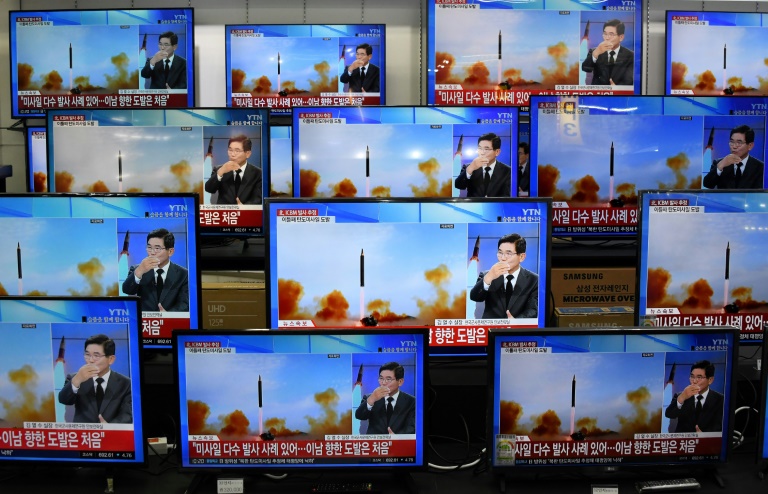
North Korea unsuccessfully fired an intercontinental ballistic missile during a new salvo of launches Thursday, the South Korean military said, with Washington urging all nations to enforce sanctions on Pyongyang.

In response to the launches, South Korea and the United States said they would extend their ongoing joint air drills, the largest-ever such exercises — a move Pyongyang immediately branded “an irrevocable and awful mistake”.

People in parts of northern Japan were ordered to seek shelter during the North’s latest launches, which included five short-range missiles and followed a blitz of projectiles fired Wednesday.

The largest of Thursday’s launches, however, “is presumed to have ended in failure”, the South Korean military said.

The United States slammed the ICBM launch, while the G7 club of rich nations said it condemned the flurry of missiles “in the strongest terms”.

“This action underscores the need for all countries to fully implement DPRK-related UN Security Council resolutions,” US State Department spokesman Ned Price said, using the North’s official name of the Democratic People’s Republic of Korea.

Washington also confirmed information provided by the South Korean military, which said earlier it had detected the launch of the long-range ballistic missile at around 7:40 am (2240 GMT Wednesday) in the Sunan area of Pyongyang.

Seoul’s Joint Chiefs of Staff said the ICBM appeared to have failed during “second-stage separation”.

“The range of the long-range ballistic missile is around 760 kilometres (470 miles), altitude of 1,920 kilometres at speed of Mach 15,” the military said.

It also detected what were “believed to be two short-range ballistic missiles fired at around 08:39 am from Kaechon, South Pyongan province”.

That was followed late in the day by three more short-range ballistic missiles fired towards the East Sea, also known as the Sea of Japan, according to Seoul’s Joint Chiefs of Staff.

South Korea’s military “is maintaining a full readiness posture while closely cooperating with the US and strengthening surveillance and vigilance”, it said.

– ‘Shocked and frightened’ –

Pyongyang fired more than 20 missiles on Wednesday, including one that landed near South Korea’s territorial waters, triggering an air raid siren warning on Ulleungdo, an island about 130 kilometres off the country’s east coast.

“We were shocked and frightened, as something like this had never happened before. We didn’t know where to take refuge,” said Chae Young-sim, a 52-year-old shopkeeper on the island.

One short-range ballistic missile crossed the Northern Limit Line, the de facto maritime border, on Wednesday, prompting President Yoon Suk-yeol to call it “effectively a territorial invasion”.

The launches come as Seoul and Washington stage their largest-ever joint air drills, involving hundreds of warplanes from both sides.

Pyongyang has called the exercise, dubbed Vigilant Storm, “an aggressive and provocative military drill targeting the DPRK”.

The exercise had been due to end Friday, but South Korea’s air force said Thursday that it would extend its air drills with the United States in response to the latest launches.

Pyongyang said this was “a very dangerous and false choice” and warned that Washington and Seoul’s “provocative military acts” were taking the situation into “an uncontrollable phase”.

America “and South Korea will get to know what an irrevocable and awful mistake they made”, Pak Jong Chon, secretary of the Central Committee of the Workers’ Party of Korea, said in a statement carried by news agency KCNA.

Tokyo confirmed Thursday’s launches, with the Japanese government issuing a special warning to residents of northern regions to stay indoors or seek shelter.

Tokyo initially said the ICBM had flown over Japan, prompting a “J-Alert” to be issued, but defence minister Yasukazu Hamada later said “the missile did not cross the Japanese archipelago, but disappeared over the Sea of Japan”.

– ‘Tactical nuclear drills’ –

Washington and Seoul have repeatedly warned that North Korean leader Kim Jong Un’s recent missile launches could culminate in another nuclear test — which would be Pyongyang’s seventh.

“Quite possible tactical nuclear weapons test(s) will be next. Possibly very soon,” Chad O’Carroll of Seoul-based specialist site NK News said on Twitter.

Ahn Chan-il, a North Korean studies scholar, agreed. 

“These are North Korea’s pre-celebration events ahead of their upcoming nuclear test,” he told AFP.

“They also seem like a series of practical tests for their tactical nuclear deployment.”

North Korea revised its laws in September to allow for pre-emptive nuclear strikes, with leader Kim declaring the country to be an “irreversible” nuclear power — effectively ending negotiations over its banned arms programmes.

On October 4, North Korea fired a missile over Japan that also prompted evacuation warnings. It was the first time North Korea had fired a missile over Japan since 2017.

Pyongyang later claimed that the launch and a blizzard of other tests around the same time were “tactical nuclear drills” that simulated showering South Korea with nuclear-tipped missiles.


Canada trade surplus doubles as wheat shipments rebound

Canada’s trade surplus doubled to Can$1.1 billion (US$800 million) in September from the previous month as wheat shipments rebounded strongly, the national statistical agency said Thursday.

Exports increased 1.3 percent — at a slower pace than in previous months — to Can$66.4 billion, while imports were up just 0.4 percent to Can$65.2 billion, according to Statistics Canada.

Following a poor harvest last year, wheat shipments to other countries rebounded (+65.2 percent) and canola exports nearly doubled.

Exports of crude oil and natural gas were also up, but exports of coal, potash and lumber fell.

The availability of updated Covid vaccines, meanwhile, drove an increase in imports, which were also up on more inbound shipments of machinery and equipment used, for example, in logging, construction, mining, and oil and gas fields — some of it destined for Alberta wind farm projects.

Canada’s trade surplus with the United States — its neighbor and largest trading partner — narrowed slightly to Can$9.8 billion.

The September figures rounded out a third quarter that saw total exports fall 2.3 percent, led by a drop in shipments of energy products, and an 0.8 percent increase in imports as demand for cars and trucks as well as industrial machinery picked up.

Those gains were partially offset by lower imports of metal and non-metallic mineral products in the quarter.

Non-binary category allows marathon runners to compete 'as authentic self'

Nick Dill is a veteran marathon runner, but this weekend’s race in New York will be the first time they participate in the non-binary category, after contest organizers added the option in response to demands for better representation and inclusion.

A professional dancer who now works as an acupuncturist, Dill has already run the 26.2-mile distance in less than three hours, previously racing in the men’s category.

“I was born a male, I identified as a male for many years,” the 28-year-old told AFP.

But since coming out as non-binary in January, Dill said they felt “discomfort” and “confusion” over having to decide between the races for men and women.

“I’m kind of both and kind of neither… it feels really comforting to be able to race in the category that I identify with.”

Growing up as a dancer and gymnast, Dill didn’t take up running until adulthood. 

“I was nervous to get into racing because of this kind of toxic masculine energy,” they said. “Kind of still having those fears of like, not fitting in.”

A 2021 study from the Williams Institute at the University of California, Los Angeles found that approximately 1.2 million people identify as non-binary across the United States.

Notable figures including singers Sam Smith and Demi Lovato along with actress Emma Corrin, who played Princess Diana in “The Crown,” are among those who’ve adopted the terminology.

According to a list maintained by activist Jake Fedorowski, more than 200 road or trail racing events in the US now offer three gender categories.

“For somebody who doesn’t identify as either male or female, having to register with no other options already kind of creates either a mental barrier or just another obstacle for them being able to fully participate,” said Kerin Hempel, CEO of the New York Road Runners organization behind the city’s famed marathon, which was the first event of its kind to expand the categories.

– ‘More visibility’ –

In 2021 the New York marathon included 16 non-binary runners. This year it counts more than 60. Several other major races, including Boston and London, have since taken similar steps to expand options.

Jake Caswell, a 25-year-old clinical analyst who was a top athlete for Columbia University, said crossing the finish line earlier this year for the first time as a non-binary runner was “freeing.”

“I think it’s just being able to run as your authentic self” they said, to “create a space for, you know, a group of people that that space was never there before.”

This year the New York marathon has financially endowed its newest category, with a $5,000 prize for the first-place runner.

Nancy Hogshead-Makar of the organization ChampionWomen, sees this new category as “one step” towards inclusion, that could extend to “more categories” including one for transgender athletes “that have male-sport advantage.” 

She, along with other activists, favors limiting the women’s category to transgender athletes who “have taken steps to roll back their male puberty advantage with hormones and/or surgery” — a stance widely criticized within the LGBTQ community.

It’s a topic that’s provoked significant controversy in the US. Debate roiled after the transgender swimmer Lia Thomas won a university title in March, and the International Swimming Federation banned from women’s categories all athletes who have transitioned after the age of 12. 

And a number of states controversially have adopted legislation forbidding transgender athletes from participating in youth sports.

But so far, creating non-binary categories generally has provoked positive reaction.

Caswell did say they were booed during a race on Staten Island in New York, but took it in stride.

“It happens… welcome to America,” they said. “Not everybody is going to agree with the system. And some people were very vocal about it.”

Fellow athlete Dill said much of the criticism they’ve seen has been online.

“I think it’s just a lack of education… as people learn more and except more, and as there’s more visibility, I think it’ll be more accepted,” they said.

Much of the resistance to expanding inclusion comes from older people, Dill said, including within the LGBTQ community.

Older generations can be “stuck in this kind of black and white” concept, they said, whereas “non-binary is getting into that gray space.”

For Dill, the marathon on November 6 will be “a celebration,” citing “a sense of community.”

“We all kind of are really taking part in this like, uplifting of each other.”

US trade deficit widens in September as imports rise

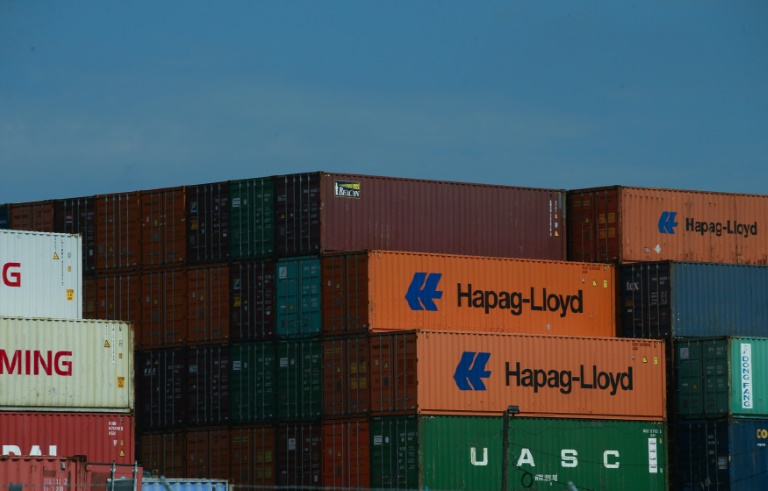
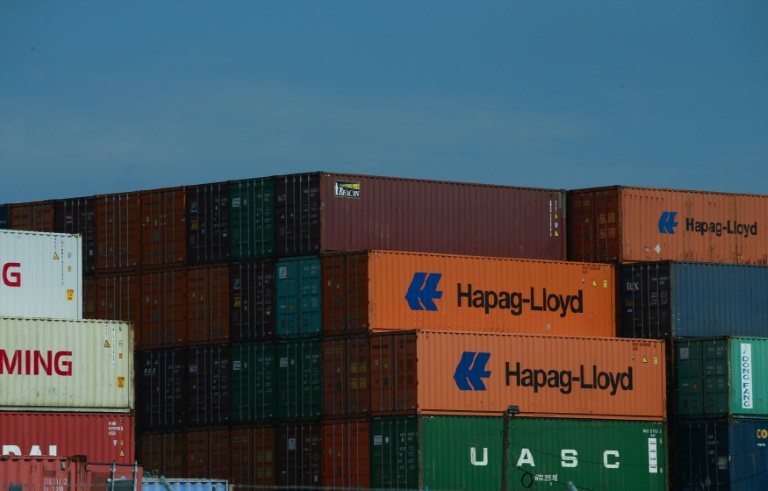
The US trade gap widened in September after five straight months of decline, government data showed Thursday, on cooling food and energy exports while imports of products like semiconductors and consumer goods picked up.

Although companies had rushed to replenish depleted inventories to meet strong demand from consumers, analysts caution that domestic demand in the United States would weaken while a strong dollar and slowing global growth bog down exports.

In September, the overall trade deficit widened to $73.3 billion, up from a revised $65.7 billion figure in August, Commerce Department data showed.

The expansion was more than analysts expected and came as exports dipped to $258 billion on a drop in industrial supplies such as crude oil and food like soybeans.

Imports rose to $331.3 billion, helped by shipments of semiconductors and consumer goods including cell phones.

The imports rise in September was “likely a result of businesses pulling in holiday inventory in early to avoid supply disruptions,” said Matthew Martin of Oxford Economics in a note.

But a “precipitous decline in ocean and air freight volumes, coupled with the recent slowdown in the trucking market, signal a clear slowing of domestic demand,” he added.

The US deficit with China decreased $1.4 billion to $32.1 billion in September, data showed.

While there has been strong demand from US consumers, soaring inflation has raised concerns that shoppers will pull back, causing firms to become more cautious.

The Federal Reserve has been raising interest rates aggressively to cool the economy and bring down surging prices, but stubbornly high costs has meant many families have to spend a greater share of their incomes on staple goods.

The central bank announced a fourth straight bumper rate hike on Wednesday, with Fed Chair Jerome Powell saying that it remains “premature” to think about pausing the increases.

Higher interest rates have also strengthened the US dollar, making American goods relatively more expensive, which could weigh on exports.

“Looking ahead, trade flows are likely to weaken,” said economist Rubeela Farooqi of High Frequency Economics in an analysis.

US trade deficit widens in September as imports rise

The US trade gap widened in September after five straight months of decline, government data showed Thursday, on cooling food and energy exports while imports of products like semiconductors and consumer goods picked up.

Although companies had rushed to replenish depleted inventories to meet strong demand from consumers, analysts caution that domestic demand in the United States would weaken while a strong dollar and slowing global growth bog down exports.

In September, the overall trade deficit widened to $73.3 billion, up from a revised $65.7 billion figure in August, Commerce Department data showed.

The expansion was more than analysts expected and came as exports dipped to $258 billion on a drop in industrial supplies such as crude oil and food like soybeans.

Imports rose to $331.3 billion, helped by shipments of semiconductors and consumer goods including cell phones.

The imports rise in September was “likely a result of businesses pulling in holiday inventory in early to avoid supply disruptions,” said Matthew Martin of Oxford Economics in a note.

But a “precipitous decline in ocean and air freight volumes, coupled with the recent slowdown in the trucking market, signal a clear slowing of domestic demand,” he added.

The US deficit with China decreased $1.4 billion to $32.1 billion in September, data showed.

While there has been strong demand from US consumers, soaring inflation has raised concerns that shoppers will pull back, causing firms to become more cautious.

The Federal Reserve has been raising interest rates aggressively to cool the economy and bring down surging prices, but stubbornly high costs has meant many families have to spend a greater share of their incomes on staple goods.

The central bank announced a fourth straight bumper rate hike on Wednesday, with Fed Chair Jerome Powell saying that it remains “premature” to think about pausing the increases.

Higher interest rates have also strengthened the US dollar, making American goods relatively more expensive, which could weigh on exports.

“Looking ahead, trade flows are likely to weaken,” said economist Rubeela Farooqi of High Frequency Economics in an analysis.

Stock markets sink, dollar jumps

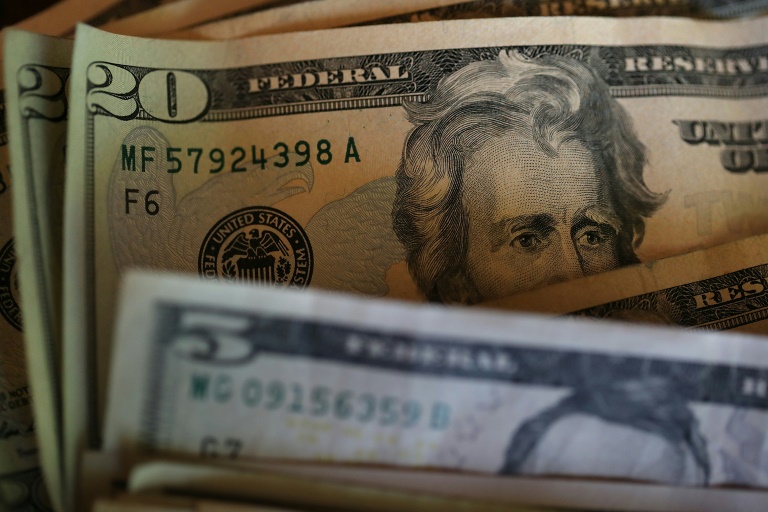
Stock markets around the world sank Thursday while the dollar rallied after the Federal Reserve warned US interest rates would go higher than previously expected in its fight against decades-high inflation.

Meanwhile the Bank of England warned that Britain faced a recession set to last until mid-2024.

The Fed on Wednesday unveiled a fourth straight 0.75-percentage-point increase as expected — the sixth hike this year to cool rampant prices.

The dollar rose strongly against the pound on Thursday despite the Bank of England also delivering a 0.75-percentage-point hike — the largest in 33 years — to 3.0 percent, or the highest rate since 2008.

The pound fell by two percent against the dollar in afternoon trading.

Norway’s central bank raised its policy rate for a fourth consecutive time, with a quarter-point increase that took it to its highest level since 2009 at 2.5 percent.

European Central Bank president Christine Lagarde flagged more interest rate hikes on Thursday with comments that a “mild” eurozone recession was looming but would not be enough to bring down record-high inflation.

Oil prices also fell heavily on Thursday as aggressive rate hikes increase expectations of a global recession.

Hong Kong led stock market losses as the city’s central bank hiked rates in line with the Fed, owing to their policy link via the dollar peg.

Traders gave back a chunk of the previous two days’ gains, which came on the back of speculation China was planning to roll back some of its painful zero-Covid policies.

Adding to the selling was confirmation from Beijing’s health authority that it intended to stick to the strategy.

– ‘Some ways to go’ –

“Stocks fell… after the Federal Reserve raised benchmark interest rates and warned that there was still some ways to go in its efforts to tame inflation,” said Mark Haefele, chief investment officer at UBS Global Wealth Management.

Before the Fed announcement, stocks had rallied for more than a week on speculation the US central bank would indicate that its rate tightening could soon reach a peak as the world’s biggest economy showed signs of slowing.

Yet Fed chief Jerome Powell poured cold water on these hopes for a “pivot” in policy, telling a news conference that “incoming data since our last meeting suggests that ultimate level of interest rates will be higher than previously expected”.

He added that “we still have some ways” until borrowing costs were at the necessary level and that it “is very premature to be thinking about pausing”.

Briefing.com analyst Patrick O’Hare said that for investors “the point that registered was (Powell’s) view that it is very premature to talk about pausing the rate hikes”.

Another key point was that “the Fed still has a ways to go to get the policy rate to a restrictive level that is sufficient for getting inflation back down to the 2.0 percent target,” O’Hare noted.

Moreover, Powell indicated “that the Fed’s terminal rate is apt to be higher than previously expected and is likely to be held there longer than previously expected,” which upended previous market expectations.

Investors now expect Fed rates to top out at more than five percent, compared with four percent previously.

Global equities have slumped this year on mounting fears that rising borrowing costs will curtail consumer and business spending and spark a global recession.

“The Federal Reserve… didn’t offer any real crumbs of comfort for traders or indeed the global economy when it came to how rapidly the now relentless — and potentially damaging — run of rate hikes may conclude,” said Scope Markets analyst James Hughes.

– Key figures around 1330 GMT –

London – FTSE 100: DOWN 0.5 percent at 7,110.98 points

Frankfurt – DAX: DOWN 1.6 percent at 13,040.32

Paris – CAC 40: DOWN 1.3 percent at 6,196.72

EURO STOXX 50: DOWN 1.5 percent at 3,566.85

New York – Dow: DOWN 0.8 percent at 31,893.44

Hong Kong – Hang Seng Index: DOWN 3.1 percent at 15,339.49 (close)

Shanghai – Composite: DOWN 0.2 percent at 2,997.81 (close)

Tokyo – Nikkei 225: Closed for a holiday

Pound/dollar: DOWN at $1.1174 from $1.1390 Wednesday

Euro/dollar: DOWN at $0.9753 from $0.9816

Dollar/yen: UP at 148.15 yen from 147.90 yen

Euro/pound: UP at 87.24 pence from 86.17 pence

Brent North Sea crude: DOWN 1.5 percent at $94.73 per barrel

West Texas Intermediate: DOWN 1.9 percent at $88.26 per barrel

burs-rl/imm

Stock markets sink, dollar jumps

Stock markets around the world sank Thursday while the dollar rallied after the Federal Reserve warned US interest rates would go higher than previously expected in its fight against decades-high inflation.

Meanwhile the Bank of England warned that Britain faced a recession set to last until mid-2024.

The Fed on Wednesday unveiled a fourth straight 0.75-percentage-point increase as expected — the sixth hike this year to cool rampant prices.

The dollar rose strongly against the pound on Thursday despite the Bank of England also delivering a 0.75-percentage-point hike — the largest in 33 years — to 3.0 percent, or the highest rate since 2008.

The pound fell by two percent against the dollar in afternoon trading.

Norway’s central bank raised its policy rate for a fourth consecutive time, with a quarter-point increase that took it to its highest level since 2009 at 2.5 percent.

European Central Bank president Christine Lagarde flagged more interest rate hikes on Thursday with comments that a “mild” eurozone recession was looming but would not be enough to bring down record-high inflation.

Oil prices also fell heavily on Thursday as aggressive rate hikes increase expectations of a global recession.

Hong Kong led stock market losses as the city’s central bank hiked rates in line with the Fed, owing to their policy link via the dollar peg.

Traders gave back a chunk of the previous two days’ gains, which came on the back of speculation China was planning to roll back some of its painful zero-Covid policies.

Adding to the selling was confirmation from Beijing’s health authority that it intended to stick to the strategy.

– ‘Some ways to go’ –

“Stocks fell… after the Federal Reserve raised benchmark interest rates and warned that there was still some ways to go in its efforts to tame inflation,” said Mark Haefele, chief investment officer at UBS Global Wealth Management.

Before the Fed announcement, stocks had rallied for more than a week on speculation the US central bank would indicate that its rate tightening could soon reach a peak as the world’s biggest economy showed signs of slowing.

Yet Fed chief Jerome Powell poured cold water on these hopes for a “pivot” in policy, telling a news conference that “incoming data since our last meeting suggests that ultimate level of interest rates will be higher than previously expected”.

He added that “we still have some ways” until borrowing costs were at the necessary level and that it “is very premature to be thinking about pausing”.

Briefing.com analyst Patrick O’Hare said that for investors “the point that registered was (Powell’s) view that it is very premature to talk about pausing the rate hikes”.

Another key point was that “the Fed still has a ways to go to get the policy rate to a restrictive level that is sufficient for getting inflation back down to the 2.0 percent target,” O’Hare noted.

Moreover, Powell indicated “that the Fed’s terminal rate is apt to be higher than previously expected and is likely to be held there longer than previously expected,” which upended previous market expectations.

Investors now expect Fed rates to top out at more than five percent, compared with four percent previously.

Global equities have slumped this year on mounting fears that rising borrowing costs will curtail consumer and business spending and spark a global recession.

“The Federal Reserve… didn’t offer any real crumbs of comfort for traders or indeed the global economy when it came to how rapidly the now relentless — and potentially damaging — run of rate hikes may conclude,” said Scope Markets analyst James Hughes.

– Key figures around 1330 GMT –

London – FTSE 100: DOWN 0.5 percent at 7,110.98 points

Frankfurt – DAX: DOWN 1.6 percent at 13,040.32

Paris – CAC 40: DOWN 1.3 percent at 6,196.72

EURO STOXX 50: DOWN 1.5 percent at 3,566.85

New York – Dow: DOWN 0.8 percent at 31,893.44

Hong Kong – Hang Seng Index: DOWN 3.1 percent at 15,339.49 (close)

Shanghai – Composite: DOWN 0.2 percent at 2,997.81 (close)

Tokyo – Nikkei 225: Closed for a holiday

Pound/dollar: DOWN at $1.1174 from $1.1390 Wednesday

Euro/dollar: DOWN at $0.9753 from $0.9816

Dollar/yen: UP at 148.15 yen from 147.90 yen

Euro/pound: UP at 87.24 pence from 86.17 pence

Brent North Sea crude: DOWN 1.5 percent at $94.73 per barrel

West Texas Intermediate: DOWN 1.9 percent at $88.26 per barrel

burs-rl/imm

Bank of England warns UK faces two-year recession, hikes rate

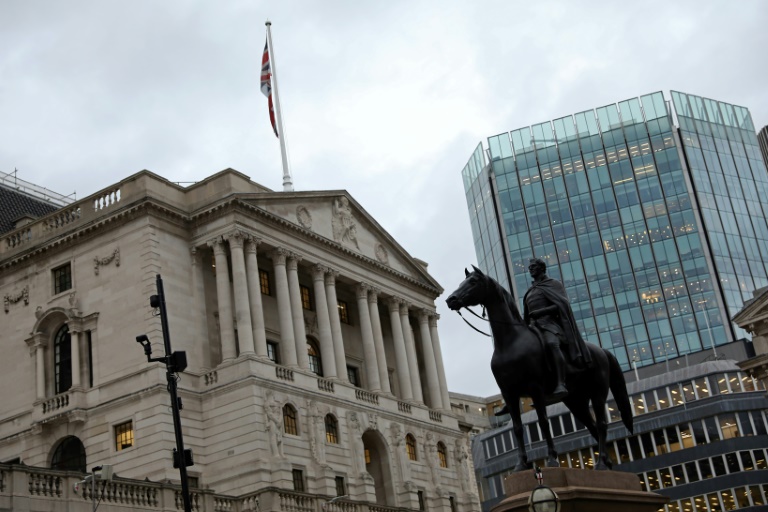
The Bank of England on Thursday announced its biggest interest rate hike since 1989 to combat sky-high inflation that it warned was pushing Britain into a recession set to last until mid-2024.

Following a regular meeting, the BoE said it was lifting borrowing costs by 0.75 percentage points to three percent — the highest level since the 2008 global financial crisis — to cool UK inflation that it sees shortly peaking at a four-decade high near 11 percent.

“It is a tough road ahead,” BoE governor Andrew Bailey told a press conference.

“The sharp increase in energy prices caused by Russia’s invasion of Ukraine has made us poorer as a nation. The level of economic activity is likely to be flat and even fall for some time,” he warned.

The latest rate increase mirrors aggressive rate-tightening by central banks worldwide as food prices and energy bills soar.

On Wednesday, the US Federal Reserve sprang a fourth consecutive hike of 0.75 percentage points — and its boss Jerome Powell suggested they would go higher than expected.

The BoE said British inflation would peak at 10.9 percent this year, but with the level so high, analysts said the central bank rate could hit as high as five percent in the coming months.

– ‘Prolonged recession’ –

Minutes of its meeting warned of a “challenging outlook for the UK economy” that was “expected to be in recession for a prolonged period”, dealing a blow to Britain’s troubled government.

The BoE said the economy had shrunk since the third quarter, entering a technical recession that is forecast to last until the first half of 2024.

The pound tumbled two percent against the dollar on expectations of a long-lasting recession.

“A typical textbook trade is out of the window because currencies usually move higher when a central bank increases rates,” noted Naeem Aslam, chief market analyst at Avatrade.

“Tough times are ahead, and we are going to see the economy, markets, and the currency tanking in the coming months.”

London’s FTSE 100 shares index fared better, losing about half-a-percent.

– Cost-of-living crisis –

The BoE rate increase is set to worsen a cost-of-living crisis for millions of Britons as hikes by central banks see retail lenders push up interest rates on their own loans.

“The central bank has had the unenviable job of fighting soaring inflation amid enormous economic and political uncertainty,” said Craig Erlam, analyst at trading platform OANDA.

Repayments on UK mortgages have surged in recent weeks also after the debt-fuelled budget of previous British prime minister Liz Truss spooked markets, forcing her to resign and triggering emergency buying of UK government bonds by the BoE.

Her successor Rishi Sunak has attempted to bring calm to markets by hinting at tax rises in a fresh budget on November 17, even if such a move further harms Britain’s economy.

“I think everyone knows we do face a challenging economic outlook and difficult decisions will need to be made,” Sunak, a former UK finance minister, told parliament on Wednesday.

British annual inflation stands at 10.1 percent, the highest level in 40 years.

As the Covid-19 pandemic began in early 2020, the BoE slashed its key interest rate to a record-low 0.1 percent and also pumped massive sums of new cash into the economy.

The Bank of England started raising rates last December, while Thursday’s hike was the eighth increase in a row.

“Importantly, most of the tightening in policy over the past year was yet to feed through to the real economy,” said the BoE minutes.

Biden hits campaign trail in final uphill push to salvage Democrats

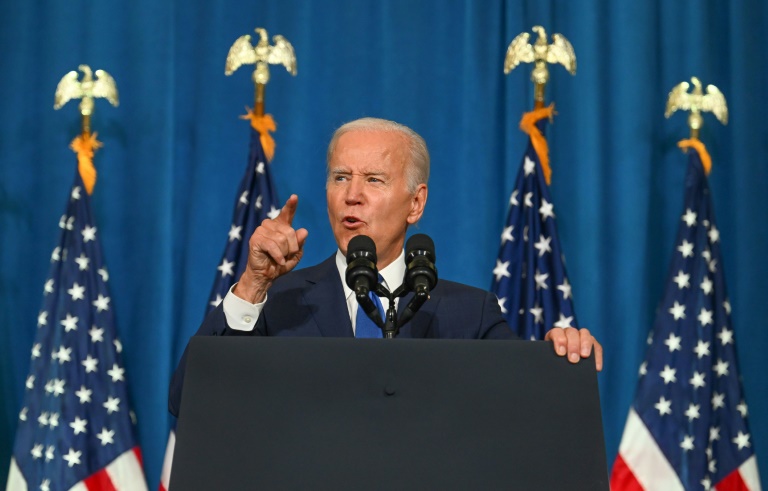
President Joe Biden was embarking Thursday on a final push to try and save Democrats from defeat in next week’s midterms, hours after he gave a dramatic speech casting the election as a make-or-break moment for US democracy.

Biden was flying to New Mexico, California and Illinois, before winding up with his latest of many appearances in the crucial electoral battleground Pennsylvania on Saturday.

The president spending so much campaign time in areas already considered Democratic strongholds — like California — indicates just how defensive the party has become.

Polls show Republicans likely to win the House of Representatives and possibly also the Senate. Currently, Democrats hold tiny majorities in both, but the party has been dragged down by popular discontent over high inflation.

Biden argued in a speech in Washington, DC, late Wednesday that the next week’s contest is about far more than electoral politics, pointing out that hundreds of Republican candidates for offices across the nation have joined the false far-right conspiracy theory led by former president Donald Trump that the 2020 presidential contest was rigged.

Trump, despite being under investigation for hoarding top secret documents in his Florida golf resort and being twice impeached during his one-term presidency, has re-emerged as the Republican party’s most powerful character, with many expecting him to run again in 2024.

The divisive figure, still a hero to tens of millions of Americans, is leading the charge by a slate of so-called election denying candidates. He is set to hold his latest rally in Iowa Thursday evening.

With conservatives hammering the administration over inflation, crime and illegal immigration, Biden, 79, used his Wednesday speech to attack Trump and his followers as a deeper threat to the country.

“There are candidates running for every level of office in America… who won’t commit to accepting the results of the elections they’re in,” Biden said.

Their goal, he said, was to follow Trump’s lead and try to “subvert the electoral system itself” — noting there are more than 300 Republican election deniers on the ballot in races across the country this year.

“They’ve emboldened violence and intimidation of voters and election officials,” he charged — less than two years after a mob of Trump supporters ransacked the US Capitol to try to overturn the 2020 result.

“That is the path to chaos in America,” he said. “It’s unprecedented. It’s unlawful. And it is un-American.”

In the wake of a violent attack on the husband of the Democratic House Speaker Nancy Pelosi, which dramatically heightened concerns about heated political rhetoric, Biden urged Americans to unite in defense of democracy. 

“We must with an overwhelming voice stand against political violence and voter intimidation, period,” he said.

– Economic concerns take priority –

But nearly 22 months after the Capitol insurrection, polling shows that American voters are more concerned with the economy. 

More than half say the price of gas and consumer goods is the economic issue that worries them the most in a new Quinnipiac University national poll.

In response to Biden’s speech, House Republican Leader Kevin McCarthy accused the president of refusing “to address Americans top concerns.”

“In six days, Republicans will win convincingly and help put America back on track,” McCarthy, who stands to become House speaker if the Republicans win next week’s election, tweeted.

Make glasses cool with new emojis, urges UK schoolgirl

British schoolgirl Lowri Moore is just 13 but has achieved a lot in her short life, championing children who like her wear glasses.

Aged nine, she persuaded Disney to create a bespectacled heroine for the first time, in the hit film “Encanto”.

Her #GlassesOn campaign has meanwhile struck a chord with thousands of young people and their parents around the world.

Now she has another US giant in her sights.

The teenager from Nottinghamshire, central England, is urging the body responsible for all new emojis to give people the option to put glasses on them.

She says many people believe that children being stigmatised for wearing glasses is a thing of the past.

But she argues many children still resist wearing their glasses for fear of appearing “different or uncool”.

Research shows children with spectacles are over 35 percent more likely to be bullied at school, and not wearing them can have far-reaching consequences.

“We are in touch with a professor who works in Botswana to give children glasses and he said that most of the children that get glasses don’t want to wear them for fear of being different and not cool,” Lowri told AFP.

– ‘Biggest fan’ –

She said that without glasses you need, “you won’t be able to learn and that will limit your job options and you will probably really struggle in life all because you didn’t wear your glasses. That’s not fair.”

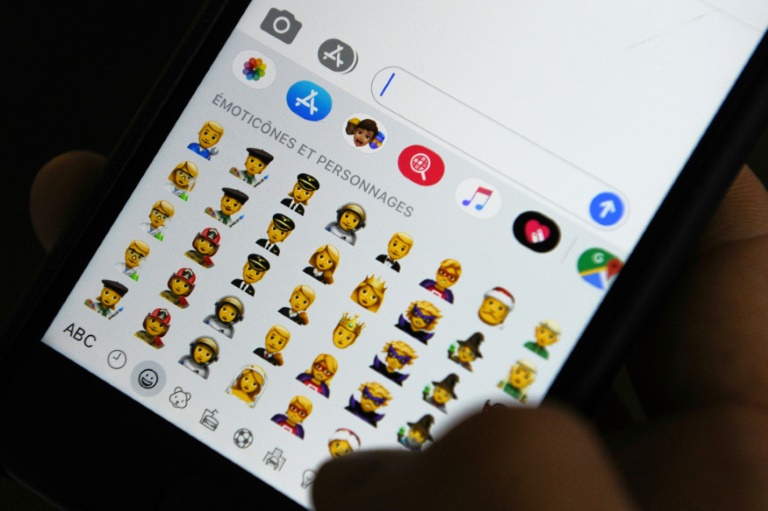
Lowri’s latest campaign was sparked when her mother Cyrilyn tried to find an emoji relevant to her daughter.

“She was looking for an emoji that would represent me but all she found was a nerd.

“She kept on looking and there was a granny and a teacher but obviously that doesn’t represent me,” she said.

Lowri said it was great there were some bespectacled emojis, but three was not enough.

“It’s not really positive so we’re just asking for the option of putting glasses onto already existing emojis,” she said after handing in copies of her letter at the London offices of tech giants Google and Meta on Wednesday.

Lowri’s campaigning began in 2019 when she wrote to Disney calling for more characters with glasses in their films.

Two years later, the “Encanto” character Mirabel Madrigal hit the big screen.

Director Jared Bush revealed he had been inspired by the schoolgirl’s letter, telling her: “I am your biggest fan, I’m so impressed by you.”

The director also said he had wanted to let her know much earlier, but had to keep it secret until the movie was in the bag.

– ‘Negative stereotypes’ –

In her latest letter, Lowri praised the Unicode Consortium, the non-profit organisation based in California that oversees new emojis, for offering users more choice.

But she urged them to go further.

“I’d love to see the option to add glasses to face emojis, similar to changing skin colour or hair colour as you have already made available,” she wrote.

Having the current “nerd” emoji as the only one available for young people could be “damaging as it helps to confirm the negative stereotype and stigma that we are trying hard to destroy”, she added.

Lowri’s campaigning success was recognised earlier this year when she was named “Campaigner of the Year” by the International Agency for the Prevention of Blindness (IAPB).

Failing to wear glasses can prevent children’s eyes from developing normally and lead to avoidable eye conditions.

Jessica Thompson of the IAPB, which works in over 100 countries worldwide, said Lowri’s advocacy was helping to highlight the damage to children’s futures of not wearing glasses.

“If you struggle to see, you struggle to learn,” she told AFP.

Wearing glasses was the single “most effective” health intervention for schoolchildren, “reducing the odds of failing a class by 44 percent”, she added.

Close Bitnami banner
Bitnami