US Business

Portuguese textiles become international player

Shaken in the last 20 years by competition from Asia, Portugal’s textile industry has found its footing again and become a major player, supplying firms not just in Europe but also in the United States.

The industry has benefited from its flexibility and inexpensive labour along with a spirit of innovation focused on limiting damage to the environment.

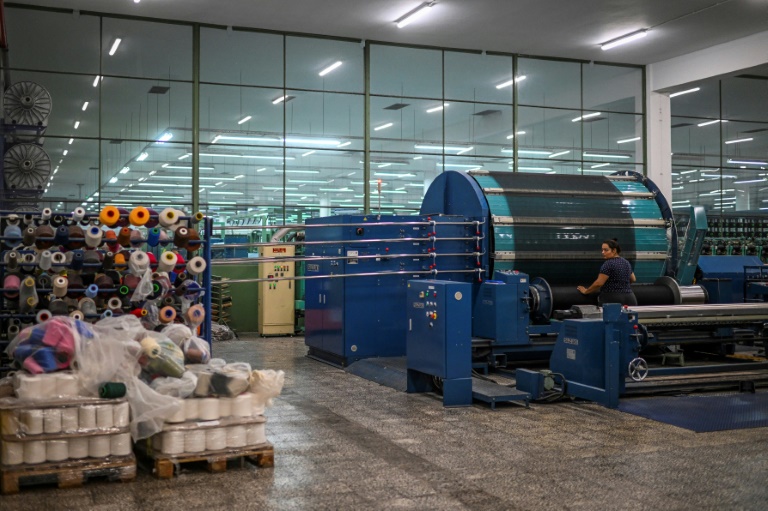
Near Vila Nova de Famalicao, in the northern district of Porto, the Riopele factory hums with a deafening noise of nearly 200 state-of-the art weaving machines that run 24 hours a day six days a week.

The textile industry’s advantages are “reactivity and the capacity to adapt”, engineer Jose Rosas told AFP as he stood by a digital screen where he follows the massive workshop’s activity in real time.

One of the jewels in an industry anchored in the Ave valley, the company founded in 1927 and its thousand employees are struggling to meet orders after a respite during the Covid crisis.

Every day, the factory produces 40,000 metres (131,200 feet) of fabric, 98 percent of which is earmarked for export.

Among its growing customers are Spain’s Inditex, which owns Zara, and France’s SMCP (Sandro, Maje, Claudie Pierlot and Fursac), according to Portuguese industry figures.

There is also increased demand from firms in Germany and Italy as well as in the United States such as Tommy Hilfiger.

Customers value a “capacity to be different” from foreign competition, Riopele group director Albertina Reis told AFP, citing her firm’s ability to use “new techniques” for sustainable output without compromising on aesthetics.

Alberto Paccanelli, who heads Brussels-based Euratex, which represents the European textile and clothing industry, paid tribute to Portugal’s sector.

“Portugal has the advantage of a workforce that remains competitive” by offering “quality products at reasonable prices,” according to the president of Euratex, which held its annual conference in Porto in mid-October.

Portugal’s textile sector has made a dramatic comeback.

Shaken by competition from companies relocating to Asia for cheaper production costs, the sector lost between the years 2000 and 2015 nearly 100,000 jobs out of a total of 235,000 recorded at the start of the era, according to the Portuguese Textile Association (ATP).

Riopele is one of Portugal’s biggest textile producers but there are many others, including JF Almeida and the TMG group.

– Record exports –

Since then, the sector has resumed hiring, benefiting from a minimum salary of 705 euros ($696) per month paid over 14 months, one of the lowest wages in the European Union, after those in eastern Europe.

Exports of textile products from Portugal, which find their largest markets in Spain and France, hit last year the record sales figure of 5.4 billion euros, 16.4 percent higher than the previous year, according to the ATP.

The industry group hopes to do even better this year.

This success is owing not only to Portugal’s low production costs, but also to the sector’s capacity to “adapt to the market”, ATP President Mario Jorge Machado said.

Following the pandemic, which led to delays in deliveries, the industry prefers to use supply chains that are closer to home, Machado said.

“The companies understood that they needed to find solutions and partners to reconcile sustainable development with competitiveness,” he said, hitting on the theme of the Porto conference.

To meet the challenge, the region of Vila Nova de Famalicao has been equipped for 30 years with a technological institute for textiles and clothing (CITEVE), which works on new fibres produced from recycled material and dyes derived from natural products.

However, the sharp gas and electricity price increases caused by the war in Ukraine penalise a sector heavily dependent on energy.

Despite several billion euros in Portuguese government aid pledged for textile firms, industry executives are calling for a coordinated European plan to avert distortions in competition.

That would “avoid creating competition” among European countries, said Dirk Vantyghem, Euratex director general.

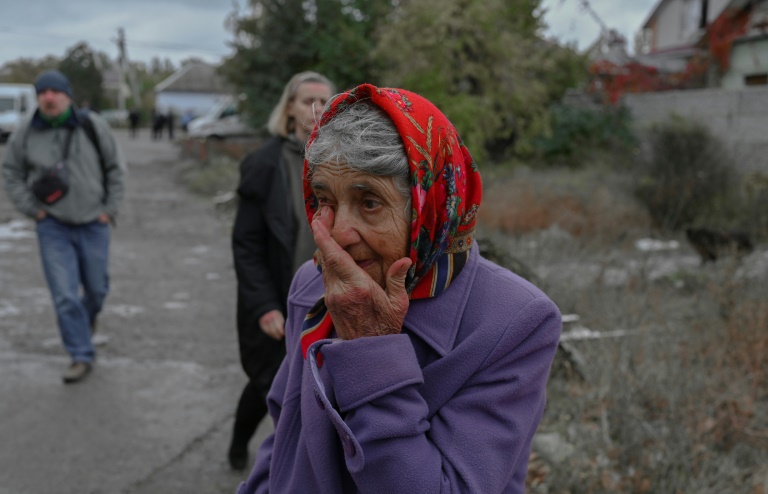
Two dead in shooting at US high school, gunman killed by police

Two people were killed on Monday and several were injured by a gunman who opened fire at a high school in the midwestern US city of St. Louis, police said.

The gunman was shot dead by police officers who rushed to the Central Visual & Performing Arts High School, St. Louis police chief Mike Sack told reporters.

Sack said the gunman appeared to be about 20 years old and has not been identified yet.

He said an adult woman and a teenage girl were killed by the gunman, who was armed with what he called a “long gun,” and another half-dozen people suffered “shrapnel and gunshot” wounds.

Sack said police arrived at the school “within a couple of minutes” of receiving a report of an “active shooter.”

“Officers began to clear the building looking for the shooter,” the police chief said. “Upon hearing gunfire, they ran to that gunfire, located the shooter, and engaged that shooter in an exchange of gunfire.”

He said the gunman was shot and killed.

Students told the St. Louis Post-Dispatch that they locked classroom doors when they heard gunshots, while others fled the building.

Nylah Jones, a student at the school, told the newspaper the gunman fired from a hallway into the room where she was in math class but was unable to get into the classroom.

“We just heard gunshots,” she said. 

School shootings are frequent in the United States.

In May, a teenage gunman killed 19 children and two teachers at an elementary school in Uvalde, Texas.

A 16-year-old boy pleaded guilty in Michigan on Monday to shooting dead four classmates at his high school last year with a gun purchased as a gift by his father.

NATO warns Russia against 'dirty bomb' pretext

Russia must not escalate the conflict in Ukraine with false claims that Kyiv is planning to unleash a so-called “dirty bomb”, the head of NATO has warned.

Jens Stoltenberg weighed in following Moscow’s repeated allegations that Ukraine could deploy such a weapon, sparking fears Russia could use one and blame Kyiv.

The head of the US-led military alliance said he had spoken with Pentagon chief Lloyd Austin and Britain’s Defence Secretary Ben Wallace “about Russia’s false claim that Ukraine is preparing to use a dirty bomb on its own territory.”

“NATO Allies reject this allegation. Russia must not use it as a pretext for escalation. We remain steadfast in our support for Ukraine,” he wrote on Twitter.

The Kremlin has alleged that Ukraine is in the “final stages” of developing a dirty bomb. 

But a senior military official said the United States has no indication Russia has decided to use nuclear, chemical or biological weapons in Ukraine.

“The Ukrainians are not building a dirty bomb, nor do we have indications that the Russians have made a decision to employ nuclear, chem, bio” weapons, the US official told journalists on condition of anonymity.

The head of the Russian army Valery Gerasimov repeated Moscow’s claims in a telephone call with his US counterpart earlier on Monday, the defence ministry said. 

The call was the latest in a string of conversations between Russian defence officials and counterparts from NATO countries, during which Moscow said, without providing evidence, that Kyiv was planning to deploy the weapon.

Earlier, a statement from Lieutenant General Igor Kirillov said: “According to the information we have, two organisations in Ukraine have specific instructions to create a so-called ‘dirty bomb’. This work is in its final stage”. 

At its most basic, a dirty bomb is a conventional bomb laced with radioactive, biological or chemical materials which are disseminated in an explosion.

It follows weeks of military defeats for Russia in southern and eastern Ukraine, with observers and Kyiv saying the Kremlin is becoming increasingly desperate.

In Kyiv’s first recent announcement of territorial gains, the Ukrainian military claims to have pushed Russian forces from several villages in the northeast of the country.

“Due to successful actions, our troops pushed the enemy out of the settlements of Karmazynivka, Myasozharivka and Nevske in the Lugansk region and Novosadove in Donetsk region,” the Ukrainian military said in a statement.

– Inspection mission –

Since Russia’s allegations and thinly veiled threat of potential nuclear escalation, both Kyiv and its allies have fiercely rejected the claim.

Ukrainian Foreign Minister Dmytro Kuleba said the head of the United Nations nuclear agency (IAEA), Rafael Grossi, accepted his request to “urgently send experts to peaceful facilities in Ukraine, which Russia deceitfully claims to be developing a dirty bomb.”

The United Kingdom, the United States and France issued a joint statement dismissing the claim earlier on Monday.

“Our countries made clear that we all reject Russia’s transparently false allegations that Ukraine is preparing to use a dirty bomb on its own territory,” according to the statement.

With the help of Western-supplied heavy weapons, Ukraine has managed to claw back swathes of its territory from Russia in the east and south, while its power grid has been pummelled ahead of winter.

As momentum has swung toward Ukraine, Russian President Vladimir Putin has faced fissures in domestic support for his campaign, as a messy troop draft and battlefield losses challenged the prospect of a quick conclusion.

Meanwhile the Kremlin said on Monday that France and Germany were showing “no desire” to participate in mediation on the conflict and praised Turkish President Recep Tayyip Erdogan’s offer to organise talks.

Turkey helped broker the deal that allowed grain exports to resume under the UN’s aegis in July, and played a role in a prisoner swap in September, one of the largest exchanges.

Trump family business fraud trial opens

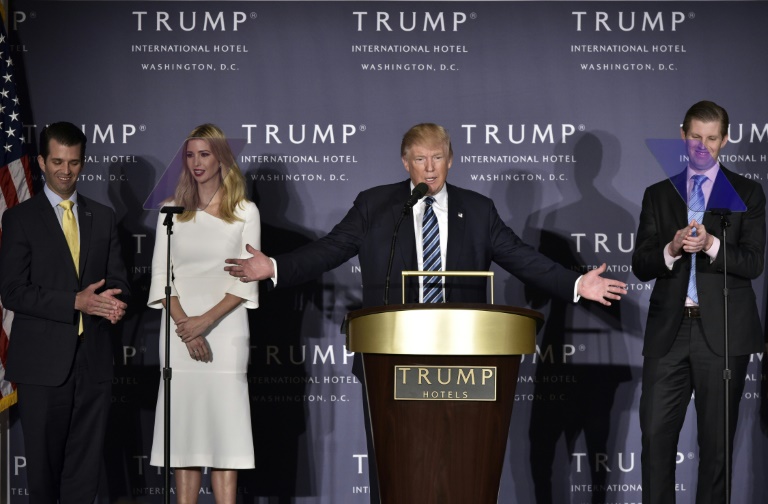
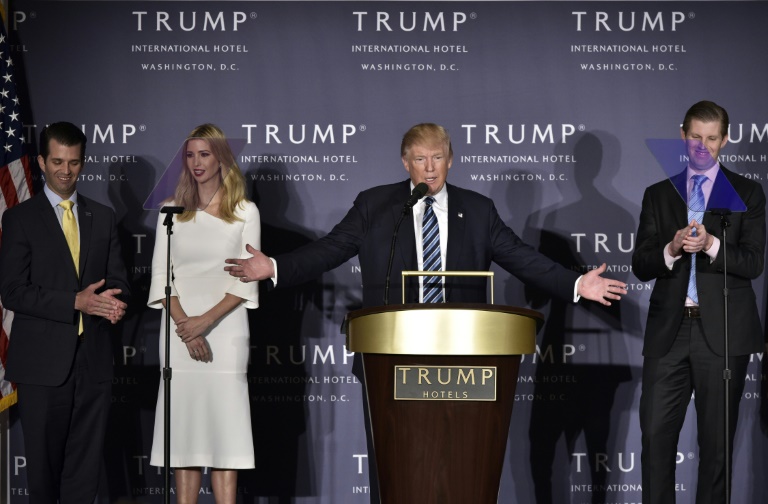
The trial of Donald Trump’s family business on fraud and tax evasion charges began in New York on Monday, with the former US president immediately dismissing as it as a political stunt.

Manhattan prosecutors have charged the Trump Organization, currently run by Trump’s two adult sons, Donald Jr and Eric Trump, with hiding compensation it paid to top executives between 2005 and 2021.

Trump, who is not named in the case, slammed the charges as a “witch hunt” by rivals, weeks ahead of congressional elections on November 8.

“The highly partisan Democrat Witch Hunt goes on, this time in New York… right during the important Mid-Term Elections, of course,” he said on social media.

The company faces potential fines of over $1.5 million if found guilty.

One of the implicated executives, longtime CFO Allen Weisselberg, has already pleaded guilty to 15 counts of tax fraud, and is expected to testify against his former company as part of a plea bargain.

A close friend of the Trump family, the 75-year-old Weisselberg admitted he schemed with the company to receive undeclared benefits such as a rent-free apartment in a posh Manhattan neighborhood, luxury cars for him and his wife and private school tuition for his grandchildren.

According to his plea deal, Weisselberg has agreed to pay nearly $2 million in fines and penalties and complete a five-month prison sentence in exchange for testimony during the trial, for which jury selection began Monday.

“This plea agreement directly implicates the Trump Organization in a wide range of criminal activity and requires Weisselberg to provide invaluable testimony in the upcoming trial against the corporation,” Manhattan District Attorney Alvin Bragg said in August.

Weisselberg has so far refused to give testimony directly implicating the former president in the scheme.

– Multiple legal cases –

Two subsidiaries of the Trump family’s sprawling real estate, golf and hospitality business are targeted by the suits.

While Donald Trump is not named in this case, he is facing charges along with three of his eldest children in a civil investigation led by New York’s attorney general, Leticia James.

James, a Democrat, has accused the family of purposefully inflating and deflating the value of their properties to avoid tax liabilities and to get more favorable loan and insurance deals.

Her office is seeking $250 million in fines against the former president, and that his family be barred from conducting business in the state.

The suit also calls for three of Trump’s children — Donald Jr, Eric and Ivanka — to be barred from purchasing real estate in New York for five years.

The 76-year-old Trump, who has heavily hinted but not yet announced a 2024 White House run, is also facing legal action on several other fronts.

He is at the center of a Justice Department investigation into the handling of highly classified documents, which the FBI seized from his Florida home in a raid, as well as multiple state and federal probes into his involvement in the January 6, 2021, attack on the US Capitol.

The congressional committee investigating the Capitol riot has issued a subpoena requiring him to submit documents by November 4 and give sworn testimony by mid-November.

Without confirming that Trump had received the subpoena, his lawyer David Warrington has said his team would “review and analyze” the document and “respond as appropriate to this unprecedented action.”

Trump’s compliance would mean testifying under oath.

If he refuses, the House of Representatives can hold him in criminal contempt in a vote recommending him for prosecution. 

Trump family business fraud trial opens

The trial of Donald Trump’s family business on fraud and tax evasion charges began in New York on Monday, with the former US president immediately dismissing as it as a political stunt.

Manhattan prosecutors have charged the Trump Organization, currently run by Trump’s two adult sons, Donald Jr and Eric Trump, with hiding compensation it paid to top executives between 2005 and 2021.

Trump, who is not named in the case, slammed the charges as a “witch hunt” by rivals, weeks ahead of congressional elections on November 8.

“The highly partisan Democrat Witch Hunt goes on, this time in New York… right during the important Mid-Term Elections, of course,” he said on social media.

The company faces potential fines of over $1.5 million if found guilty.

One of the implicated executives, longtime CFO Allen Weisselberg, has already pleaded guilty to 15 counts of tax fraud, and is expected to testify against his former company as part of a plea bargain.

A close friend of the Trump family, the 75-year-old Weisselberg admitted he schemed with the company to receive undeclared benefits such as a rent-free apartment in a posh Manhattan neighborhood, luxury cars for him and his wife and private school tuition for his grandchildren.

According to his plea deal, Weisselberg has agreed to pay nearly $2 million in fines and penalties and complete a five-month prison sentence in exchange for testimony during the trial, for which jury selection began Monday.

“This plea agreement directly implicates the Trump Organization in a wide range of criminal activity and requires Weisselberg to provide invaluable testimony in the upcoming trial against the corporation,” Manhattan District Attorney Alvin Bragg said in August.

Weisselberg has so far refused to give testimony directly implicating the former president in the scheme.

– Multiple legal cases –

Two subsidiaries of the Trump family’s sprawling real estate, golf and hospitality business are targeted by the suits.

While Donald Trump is not named in this case, he is facing charges along with three of his eldest children in a civil investigation led by New York’s attorney general, Leticia James.

James, a Democrat, has accused the family of purposefully inflating and deflating the value of their properties to avoid tax liabilities and to get more favorable loan and insurance deals.

Her office is seeking $250 million in fines against the former president, and that his family be barred from conducting business in the state.

The suit also calls for three of Trump’s children — Donald Jr, Eric and Ivanka — to be barred from purchasing real estate in New York for five years.

The 76-year-old Trump, who has heavily hinted but not yet announced a 2024 White House run, is also facing legal action on several other fronts.

He is at the center of a Justice Department investigation into the handling of highly classified documents, which the FBI seized from his Florida home in a raid, as well as multiple state and federal probes into his involvement in the January 6, 2021, attack on the US Capitol.

The congressional committee investigating the Capitol riot has issued a subpoena requiring him to submit documents by November 4 and give sworn testimony by mid-November.

Without confirming that Trump had received the subpoena, his lawyer David Warrington has said his team would “review and analyze” the document and “respond as appropriate to this unprecedented action.”

Trump’s compliance would mean testifying under oath.

If he refuses, the House of Representatives can hold him in criminal contempt in a vote recommending him for prosecution. 

Greening global economy brings dependence on critical minerals

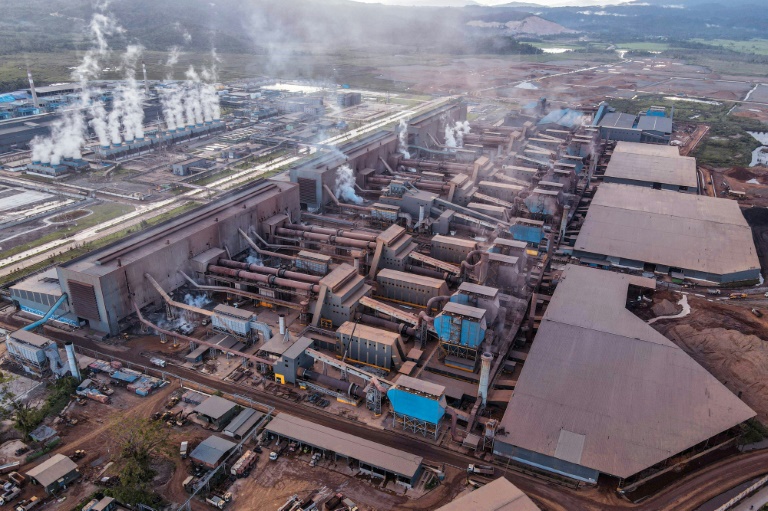
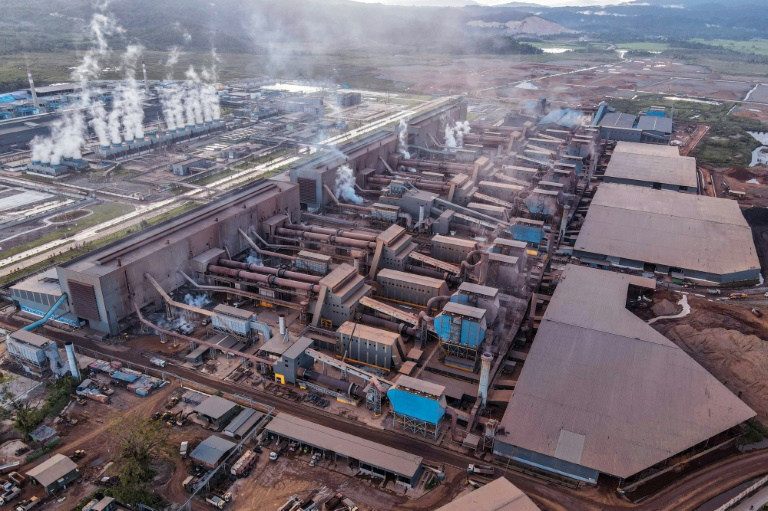
After nearly a century of geopolitical tension over access to oil, experts worry that the global transition to clean energy is creating new dependencies on the critical minerals needed for solar panels, wind turbines and electric vehicle batteries.

Control over most of these essential elements is concentrated in a handful of countries, none more than China, they note.

– Which metals are key for the energy transition? –

Cobalt, nickel, manganese and lithium are critical to making electric vehicle batteries. Rare earths such as neodymium, praseodymium and dysprosium are used in computer memory and magnets in wind turbines. 

Copper and aluminium are used in electricity networks, and platinum is a catalyst for hydrogen.

These materials “will be at the centre of decarbonisation efforts and electrification of the economy, as we move from fossil fuels to wind and solar power generation, battery- and fuel-cell-based electric vehicles (EVs) and hydrogen production”, consulting firm McKinsey reported earlier this year.

– How much demand is there? –

Global demand for these critical metals may quadruple by 2040 if the world is to meet its pledges under the Paris climate pact, according to estimates by the International Energy Agency (IEA).

French researcher Olivier Vidal has calculated that more of the metals will need to be manufactured by 2050 than humanity has produced throughout history.

While many predict shortages, some believe technology improvements and recycling will keep up with increased production needs.

But some regions are more vulnerable than others.

According to a study by Belgium’s Louvain university, Europe faces critical shortages of metals for the next 15 years, particularly lithium, cobalt, nickel, copper and rare earths. 

The European Raw Materials Alliance (ERMA) says Europe will only be able to cover between five and 55 percent of its key metals needs by 2030.

While Europe does have untapped resources of cobalt, gallium, germanium and lithium, it will need to issue mining permits to get to them, noted senior ERMA official Bernd Schaefer.

On Monday, industrial minerals manufacturer Imerys announced plans for a major lithium mine in central France.

The United States is opening its first cobalt mine in decades, in Idaho.

Automakers such as Tesla have announced their intention to enter directly into the capital of mining firms. 

– Which countries produce these metals? –

Cobalt mining is dominated by the Democratic Republic of Congo, which accounts for 70 percent of the world total. But in terms of processing, China is the leader, at 50 percent.

South Africa accounts for 37 percent of global manganese output.

China and Guinea account for more than half of the global production of bauxite, which is used to make aluminium.

Argentina, Australia and Chile are major lithium producers, while Bolivia has considerable untapped resources.

– What are the geopolitical risks? –

“The oil and gas triangle — Saudi Arabia, Russia and the United States — has governed the world for 40 years,” said Philippe Varin, who has led French steel and car firms and recently wrote a report on the supply of raw materials to French companies.

He said that is now “little by little transforming into a bipolarisation of the world between the United States and China, the major users of metals in the energy transition”.

Varin said Chinese companies had taken control of 40 percent of the value chain for the metals needed for battery production.

Emmanuel Hache, a forecaster at the French Institute of Petroleum, said that raw materials “could be the cause of a confrontation between China and the United States in the years to come”.

“Behind all conflicts you find raw materials as a top cause,” said CyclOpe, an annual French publication on raw materials, making a link between the military coup in Guinea in 2021 and bauxite.

Greening global economy brings dependence on critical minerals

After nearly a century of geopolitical tension over access to oil, experts worry that the global transition to clean energy is creating new dependencies on the critical minerals needed for solar panels, wind turbines and electric vehicle batteries.

Control over most of these essential elements is concentrated in a handful of countries, none more than China, they note.

– Which metals are key for the energy transition? –

Cobalt, nickel, manganese and lithium are critical to making electric vehicle batteries. Rare earths such as neodymium, praseodymium and dysprosium are used in computer memory and magnets in wind turbines. 

Copper and aluminium are used in electricity networks, and platinum is a catalyst for hydrogen.

These materials “will be at the centre of decarbonisation efforts and electrification of the economy, as we move from fossil fuels to wind and solar power generation, battery- and fuel-cell-based electric vehicles (EVs) and hydrogen production”, consulting firm McKinsey reported earlier this year.

– How much demand is there? –

Global demand for these critical metals may quadruple by 2040 if the world is to meet its pledges under the Paris climate pact, according to estimates by the International Energy Agency (IEA).

French researcher Olivier Vidal has calculated that more of the metals will need to be manufactured by 2050 than humanity has produced throughout history.

While many predict shortages, some believe technology improvements and recycling will keep up with increased production needs.

But some regions are more vulnerable than others.

According to a study by Belgium’s Louvain university, Europe faces critical shortages of metals for the next 15 years, particularly lithium, cobalt, nickel, copper and rare earths. 

The European Raw Materials Alliance (ERMA) says Europe will only be able to cover between five and 55 percent of its key metals needs by 2030.

While Europe does have untapped resources of cobalt, gallium, germanium and lithium, it will need to issue mining permits to get to them, noted senior ERMA official Bernd Schaefer.

On Monday, industrial minerals manufacturer Imerys announced plans for a major lithium mine in central France.

The United States is opening its first cobalt mine in decades, in Idaho.

Automakers such as Tesla have announced their intention to enter directly into the capital of mining firms. 

– Which countries produce these metals? –

Cobalt mining is dominated by the Democratic Republic of Congo, which accounts for 70 percent of the world total. But in terms of processing, China is the leader, at 50 percent.

South Africa accounts for 37 percent of global manganese output.

China and Guinea account for more than half of the global production of bauxite, which is used to make aluminium.

Argentina, Australia and Chile are major lithium producers, while Bolivia has considerable untapped resources.

– What are the geopolitical risks? –

“The oil and gas triangle — Saudi Arabia, Russia and the United States — has governed the world for 40 years,” said Philippe Varin, who has led French steel and car firms and recently wrote a report on the supply of raw materials to French companies.

He said that is now “little by little transforming into a bipolarisation of the world between the United States and China, the major users of metals in the energy transition”.

Varin said Chinese companies had taken control of 40 percent of the value chain for the metals needed for battery production.

Emmanuel Hache, a forecaster at the French Institute of Petroleum, said that raw materials “could be the cause of a confrontation between China and the United States in the years to come”.

“Behind all conflicts you find raw materials as a top cause,” said CyclOpe, an annual French publication on raw materials, making a link between the military coup in Guinea in 2021 and bauxite.

Stocks, pound up as Sunak poised to become new British PM

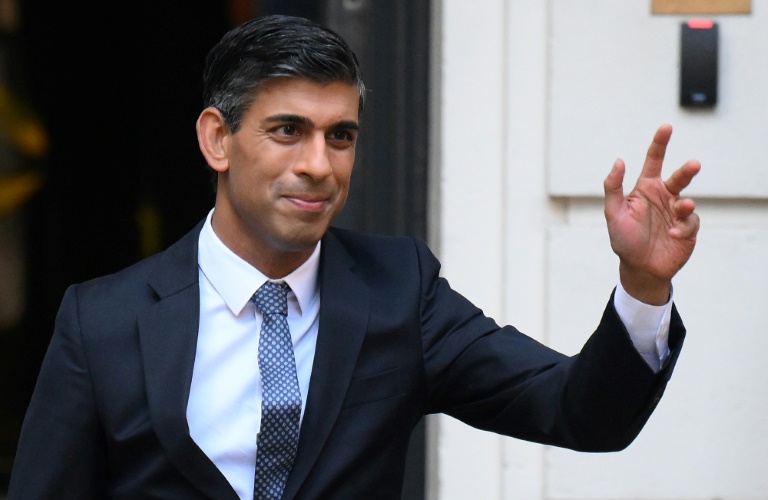
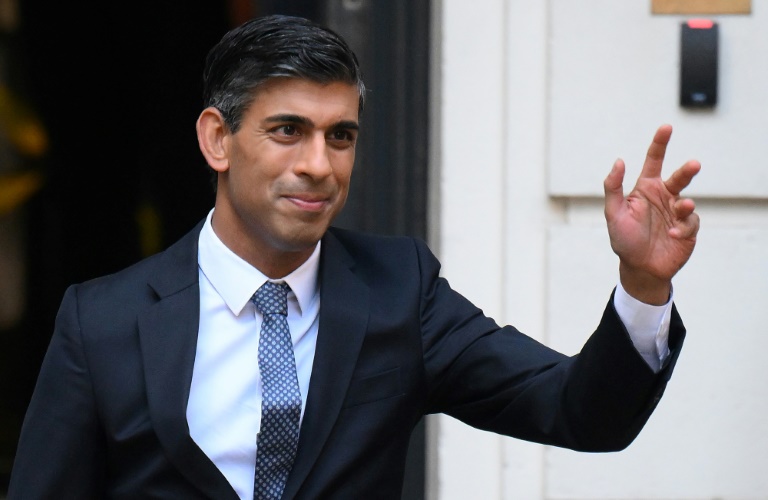
Global stocks and the pound climbed on Monday as markets reacted to the news that former finance minister Rishi Sunak was to become Britain’s new prime minister.

European markets closed in positive territory, despite data showing Britain and Germany heading for recession and the Hong Kong stock market plunging as Chinese President Xi Jinping handed key economic posts to loyalists behind his zero-Covid strategy.

Wall Street stocks also continued to rise on Monday. The Dow Jones was up by around one percent around 1530 GMT, with sentiment boosted by hopes the US Federal Reserve would soon slow the pace of its interest rate hikes.

News that European gas prices were at a four-month low also spurred traders. The reference Dutch TTF dipped below 100 euros ($99) for the first time since June, reaching 98.60 euros per megawatt hour at around 1030 GMT on Monday.

Analysts at Energi Danmark said the price fall was due to mild weather in Europe and high levels of gas stocks, with governments replenishing reserves before winter after supply cuts from Russia.

Oil prices were also down, on recession fears.

– Sunak ‘the final chance’ –

All eyes were on Britain as Sunak prepared to become the country’s third prime minister in less than two months following the resignations of Boris Johnson and Liz Truss.

His last rival for leadership of the ruling Conservative party, Penny Mordaunt, dropped out of the race on Monday, clearing the way for Sunak to become prime minister.

“The pound started the week trading higher, as many see the new potential PM as a source of some stability, particularly when compared to the chaotic term served by the Truss government, which saw massive volatility across markets,” noted XTB chief market analyst Walid Koudmani.

“Many see Sunak as the final chance for the Conservative party, as he has managed to maintain some credibility” compared with the uncertainty of the Truss and Johnson premierships, he added.

Yields on 10-year UK government bonds also dropped following recent surges in the wake of the disastrous budget that led to Truss’s downfall, while the benchmark FTSE 100 index closed 0.6 percent higher.

“Investors clearly hope Sunak will stabilise the economy and the political situation — though it’s hard to work out at this point which is the harder task,” commented AJ Bell financial analyst Danni Hewson.

Focus was also on the euro after new Italian Prime Minister Giorgia Meloni took office following her post-fascist Brothers of Italy party’s historic victory in the general election on September 25.

Meloni’s new government is the most far-right in Italy since World War II. It takes power at a time of decades-high inflation and an energy crisis linked to Russia’s invasion of Ukraine.

Milan’s stock market was up in early afternoon trading on Monday, while yields on Italian government bonds fell.

The eurozone was meanwhile looking ahead to Thursday, when the European Central Bank is expected to announce another bumper rise in interest rates aimed at curbing sky-high prices.

– Key figures around 1530 GMT –

London – FTSE 100: UP 0.6 percent at 7,013.99 points (close)

Frankfurt – DAX: UP 1.6 percent at 12,931.45 (close)

Paris – CAC 40: UP 1.6 percent at 6,131.36 (close)

EURO STOXX 50: UP 1.5 percent at 3,527.79

New York – Dow: UP 1.0 percent at 31,395.76

Tokyo – Nikkei 225: UP 0.3 percent at 26,974.90 (close)

Hong Kong – Hang Seng Index: DOWN 6.4 percent at 15,180.69 (close)

Shanghai – Composite: DOWN 2.0 percent at 2,977.56 (close)

New York – Dow: UP 2.5 percent at 31,082.56 (close)

Pound/dollar: UP at $1.1296 from $1.1258 on Friday

Dollar/yen: UP at 148.83 yen from 147.65 yen

Euro/dollar: UP at $0.9877 from $0.9863

Euro/pound: UP at 87.47 pence from 87.26 pence

West Texas Intermediate: DOWN 0.9 percent at $84.33 per barrel

Brent North Sea crude: DOWN 0.6 percent at $90.81 per barrel

burs/imm/gil

Stocks, pound up as Sunak poised to become new British PM

Global stocks and the pound climbed on Monday as markets reacted to the news that former finance minister Rishi Sunak was to become Britain’s new prime minister.

European markets closed in positive territory, despite data showing Britain and Germany heading for recession and the Hong Kong stock market plunging as Chinese President Xi Jinping handed key economic posts to loyalists behind his zero-Covid strategy.

Wall Street stocks also continued to rise on Monday. The Dow Jones was up by around one percent around 1530 GMT, with sentiment boosted by hopes the US Federal Reserve would soon slow the pace of its interest rate hikes.

News that European gas prices were at a four-month low also spurred traders. The reference Dutch TTF dipped below 100 euros ($99) for the first time since June, reaching 98.60 euros per megawatt hour at around 1030 GMT on Monday.

Analysts at Energi Danmark said the price fall was due to mild weather in Europe and high levels of gas stocks, with governments replenishing reserves before winter after supply cuts from Russia.

Oil prices were also down, on recession fears.

– Sunak ‘the final chance’ –

All eyes were on Britain as Sunak prepared to become the country’s third prime minister in less than two months following the resignations of Boris Johnson and Liz Truss.

His last rival for leadership of the ruling Conservative party, Penny Mordaunt, dropped out of the race on Monday, clearing the way for Sunak to become prime minister.

“The pound started the week trading higher, as many see the new potential PM as a source of some stability, particularly when compared to the chaotic term served by the Truss government, which saw massive volatility across markets,” noted XTB chief market analyst Walid Koudmani.

“Many see Sunak as the final chance for the Conservative party, as he has managed to maintain some credibility” compared with the uncertainty of the Truss and Johnson premierships, he added.

Yields on 10-year UK government bonds also dropped following recent surges in the wake of the disastrous budget that led to Truss’s downfall, while the benchmark FTSE 100 index closed 0.6 percent higher.

“Investors clearly hope Sunak will stabilise the economy and the political situation — though it’s hard to work out at this point which is the harder task,” commented AJ Bell financial analyst Danni Hewson.

Focus was also on the euro after new Italian Prime Minister Giorgia Meloni took office following her post-fascist Brothers of Italy party’s historic victory in the general election on September 25.

Meloni’s new government is the most far-right in Italy since World War II. It takes power at a time of decades-high inflation and an energy crisis linked to Russia’s invasion of Ukraine.

Milan’s stock market was up in early afternoon trading on Monday, while yields on Italian government bonds fell.

The eurozone was meanwhile looking ahead to Thursday, when the European Central Bank is expected to announce another bumper rise in interest rates aimed at curbing sky-high prices.

– Key figures around 1530 GMT –

London – FTSE 100: UP 0.6 percent at 7,013.99 points (close)

Frankfurt – DAX: UP 1.6 percent at 12,931.45 (close)

Paris – CAC 40: UP 1.6 percent at 6,131.36 (close)

EURO STOXX 50: UP 1.5 percent at 3,527.79

New York – Dow: UP 1.0 percent at 31,395.76

Tokyo – Nikkei 225: UP 0.3 percent at 26,974.90 (close)

Hong Kong – Hang Seng Index: DOWN 6.4 percent at 15,180.69 (close)

Shanghai – Composite: DOWN 2.0 percent at 2,977.56 (close)

New York – Dow: UP 2.5 percent at 31,082.56 (close)

Pound/dollar: UP at $1.1296 from $1.1258 on Friday

Dollar/yen: UP at 148.83 yen from 147.65 yen

Euro/dollar: UP at $0.9877 from $0.9863

Euro/pound: UP at 87.47 pence from 87.26 pence

West Texas Intermediate: DOWN 0.9 percent at $84.33 per barrel

Brent North Sea crude: DOWN 0.6 percent at $90.81 per barrel

burs/imm/gil

US math and reading scores crashed during Covid

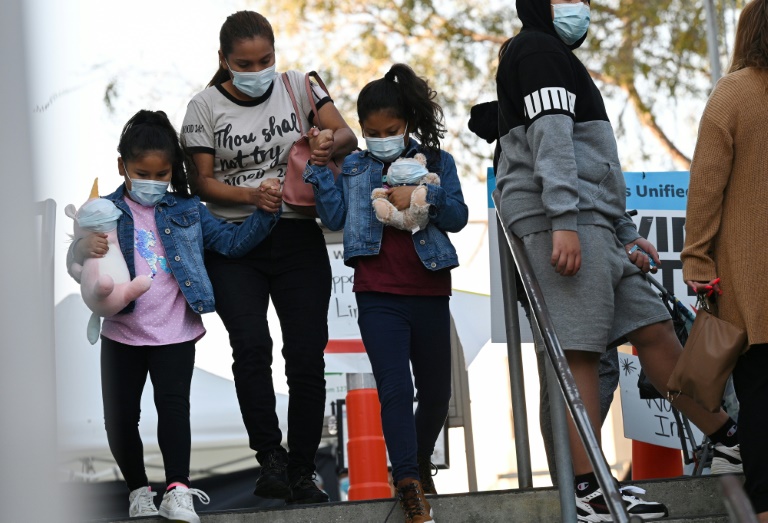
American students saw big declines in their reading and mathematics scores after years of disrupted learning due to the pandemic, with national test results described as “appalling and unacceptable” by the education secretary.

The National Assessment of Educational Progress (NAEP), also known as the Nation’s Report Card, released full data Monday for the first time since 2019, after the 2021 exams were postponed a year.

NAEP assessed a representative sample of fourth- and eighth- grade students, finding reading scores dropped back to 1992 levels. Mathematics slid back to 2003 levels.

One-quarter of fourth graders, and nearly four-in-ten eighth graders failed to grasp basic concepts.

“This is a moment of truth for education,” said Secretary of Education Miguel Cardona in comments to reporters. “How we respond to this will determine not only our recovery, but our nation’s standing in the world.”

Prior research has shown shuttered schools during Covid-19 lockdowns restricted students’ opportunities to learn, hitting those from lower-income families and ethnic minorities the hardest.

The pandemic also worsened learning outcomes in other ways, according to the National Center for Education Statistics, which organizes the tests.

These included increases in students seeking mental health services, absenteeism, school violence and disruption, cyberbullying, and nationwide teacher and staff shortages.

“The eighth graders who took NAEP last spring are in high school today,” said Beverly Perdue, chair of the National Assessment Governing Board in a statement.

“We must invest in education so resources and supports are in place to accelerate student learning and close gaps that predated — but were exacerbated by — the pandemic.”

Results from the latest scorecard showed the pandemic widened the gap between higher- and lower-performing students was widening.

Black and Hispanic students saw larger score drops compared to their white peers in fourth-grade math.

Economist Emily Oster tweeted an graphic analysis showing that states which maintained higher levels of in-person learning during the 2020-21 school year had lower drops in averaged math scores than those with more virtual learning.

California and Hawaii were notable exceptions to the trend.

Angie Schmitt, a writer and mother-of-two from Cleveland, told AFP the issue of school closures had become overly politicized early in the pandemic.

Private schools remained open while public schools, particularly in liberal regions, were closed. 

“A lot of Democrats invented rationalizations for that but I don’t think they were very compelling,” said Schmitt, who describes herself as left-leaning.

Close Bitnami banner
Bitnami