US Business

US midterms: Four pivotal Senate battlegrounds

The US midterm elections were once seen as a likely landslide victory for Republicans, as President Joe Biden’s approval ratings slumped amid spiraling inflation, record migrant arrivals and rising violent crime.

With a month to go, Democrats are banking on a much closer contest amid a series of legislative wins, improving gas prices and the nomination of a slate of Trumpist candidates who have been struggling in winnable seats.   

The biennial midterms don’t get the attention that presidential elections command, but they are crucial in determining which party has control of Congress — and the power to advance or frustrate the president’s agenda. 

Every seat in the House of Representatives — the lower chamber — is up for grabs, while a third of the Senate vies for reelection. 

The evenly-divided 100-member upper chamber — controlled by Democrats thanks to Vice President Kamala Harris’s tie-breaking vote — is considered the more powerful and prestigious, with its statewide constituencies and six-year terms.

Senators have the unique authority to approve treaties, try officials impeached by the House and confirm Cabinet secretaries, ambassadors and federal judges. 

At least eight of the 35 Senate races are considered competitive, but the battle for control of the chamber is likely to come down to four key states. 

– Pennsylvania –

Recent polling suggests Democrat John Fetterman’s commanding lead over Republican celebrity medic Mehmet Oz has all but evaporated, turning the race into a margin-of-error tussle. 

The pair are duking it out for the seat held by a retiring Republican, in what remains Democrats’ top target for flipping a seat.

Most September polls showed Fetterman with a narrow lead of between two and five points, down from an average of nine points in August.

Democrats have characterized Oz as an opportunistic New Jersey carpet-bagger with tenuous local ties and a penchant for gaffes that demonstrate he is out of touch.

Fetterman, meanwhile, faces scrutiny over his health following a stroke, and he has come under fire about his law enforcement record as lieutenant governor, when there was a significant increase in the number of people serving life sentences who were recommended for early release.

“John gave a second chance to those who deserve it: nonviolent offenders, marijuana users… John Fetterman has the courage to do what’s right,” a police officer says in a recent ad from the Fetterman camp.

– Wisconsin –

In Wisconsin, Republican Senator Ron Johnson struggled in summer but pulled ahead of Democratic challenger Mandela Barnes in mid-September and is up by three points in an average of the last dozen polls.

The latest Fox News poll found that 44 percent of Wisconsin voters think Barnes’s political positions are “too extreme” — against 43 percent for Johnson. 

Notably, Barnes’s figure was 14 points higher than a month earlier. 

Like Fetterman, Barnes is a lieutenant governor who has been accused of being soft on crime, primarily because of his advocacy for making bail conditions less onerous.

“Under Mandela Barnes, Wisconsin has released 784 violent criminals back into our communities,” Johnson tweeted on Monday.

“Including 270 murders and attempted murderers. Mandela Barnes’ policies make our communities more dangerous. He is too extreme for Wisconsin.” 

– Nevada –

In Nevada, Republican challenger Adam Laxalt leads Democratic Senator Catherine Cortez Masto by a narrow two points in the polling average compiled by RealClearPolitics.

Democratic strategists have sounded the alarm over turnout, with many Latinos threatening to sit out the election despite Cortez Masto being the first-ever Latina elected to the US Senate.    

“It’s what’s keeping me up at night,” Melissa Morales, president of the pro-Cortez Masto Somos PAC, told NBC.

“What I’m looking at is: Do Latinos actually turn out to vote this year? If we see high turnout, we win in Nevada.”

Laxalt, who lost a gubernatorial race in 2018, has argued that a floundering economy, rampant crime and sky-high inflation were dampening Latino enthusiasm for the Democrats. 

The National Republican Senatorial Committee launched its latest Spanish language ad last week, again focusing on the Democratic candidate’s criminal justice record when she was the state’s attorney general.

“Catherine Cortez Masto’s track record of releasing convicted criminals, blocking funding to stop drug trafficking, and sending millions of dollars to criminals behind bars shows that her focus is not on the well-being of Nevada,” said NRSC Hispanic press secretary Juan Arias. 

– Georgia –

In Georgia, Republican challenger Herschel Walker was looking like the Republicans’ best bet for a pick-up against incumbent freshman Democrat and pastor Raphael Warnock.

Walker’s name recognition as a former football star has kept him in the race despite a series of missteps overshadowing his campaign, and he trails Warnock by four points in the latest Fox News poll.

Georgia’s electorate is more trenchantly partisan than in other battleground states, and the race has been about juicing turnout rather than winning swing voters.  

Warnock has focused on cutting prescription drug charges, addressing climate change and helping restore abortion rights. 

“Senate Republicans’ plan to ban abortion nationwide is on the ballot this November — and we are ensuring that it remains front and center for voters,” the Democratic Senatorial Campaign Committee said.

Walker has focused on the economy and anti-abortion activism. 

But the anti-abortion hardliner has been accused of paying for a girlfriend to terminate her pregnancy in 2009, and lying about the number of children he has and about having worked in law enforcement.

He has also faced allegations of domestic violence and criticism over policy gaffes. 
He's not even running — but US midterms could make or break Trump

After losing the 2020 presidential election, Donald Trump could have worked on his golf swing or produced another book by the pool at his south Florida beach club.

Instead he threw himself into the midterm election campaign with unprecedented gusto, staking his kingmaker reputation on a slew of controversial candidates in key primary races.

His US Senate picks in open races — mostly anti-abortion hardliners, backers of his election fraud conspiracy theories or out-of-towners with tenuous local ties — have been struggling however.

And with exactly a month to go until Election Day, many Republicans are laying the blame at the gates of Mar-a-Lago. 

“Donald Trump is not on any ballot in 2022, but his political future is,” John Hudak, a senior fellow at the Brookings Institution, wrote in a recent blog post.

Trump’s project to reshape the Republican Party in his image via the midterms will likely “either make Donald Trump an also-ran or the commanding force in party politics for years to come,” Hudak argued.

Many of Trump’s primary endorsements have been seen as undermining more electable, mainstream alternatives, and potentially squandering easy victories in key battlegrounds seen as ripe for flipping from the Democrats.

Among his controversial picks are celebrity physician Mehmet Oz in Pennsylvania — seen by many as an out-of-touch “carpetbagger,” prone to rhetorical gaffes — and Ohio’s J.D. Vance, a venture capitalist who has spent most of his adult life in Silicon Valley and faces similar issues. 

The story is the same in Georgia, where ex-football star Herschel Walker faces questions over domestic abuse, dishonesty about his past and mental fitness. 

And in Arizona, Blake Masters is struggling in what should be a winnable seat with a campaign that Politico has described as “hardline nationalist.”

– ‘Little to gain’ –

Senate Minority Leader Mitch McConnell — who needs just one gain to take the upper chamber from the Democrats — has offered oblique hints that he sees “candidate quality” as a problem. 

Hudack put it more starkly.

“(If) Senate candidates like Walker, Oz, Vance or Blake Masters ultimately lose in numbers that maintains Democrats’ Senate majority, Mr Trump will be widely blamed,” he said. 

A poor election night for Trump candidates would be chum in the water for his 2024 rivals, a list that potentially includes outspoken anti-Trumpist Liz Cheney, Florida’s firebrand governor Ron DeSantis and ex-vice president Mike Pence. 

Cheney aside, Republican presidential hopefuls have largely continued to genuflect to Trump through his post-presidency. 

But figures such as ex-secretary of state Mike Pompeo, estranged Trump ally Chris Christie and one-time UN ambassador Nikki Haley could be emboldened by poor results on November 8.

David Greenberg, a media and history professor at Rutgers University, said the former president — for now the clear frontrunner for the 2024 Republican nomination — had “little to gain” in the midterms.

“But Trump has a lot to lose because if his candidates flame out, then he will be seen as having lost his magic,” Greenberg told AFP. 

“Some primary voters in 2024 may think twice about supporting him again, especially if a popular alternative such as DeSantis also runs.”

A note of caution: the polls are expected to tighten before November and all of Trump’s most divisive candidates could yet triumph in photo finishes. 

– ‘Clear leader’ –

Expect some of the circling sharks to back off if this happens — and for Trump to look suddenly like a political genius with a bold vision rather than a liability.   

Trump watchers often point out that much of the former president’s die-hard base cares little about the Senate or Washington politics in any case. 

“Despite losing reelection, two impeachments, nearly a dozen serious criminal probes, and countless scandals that would have long ago sunk most any other politician, Trump remains the clear leader of the Republican Party,” said political analyst Nicholas Creel, of Georgia College and State University. 

“Trump’s support in the Republican Party is far too resilient to be damaged by a poor showing by the party this November.”

Other observers though expect the tycoon’s many legal woes, including the mushrooming scandal over his mishandling of classified government secrets, to be as a big a drag on his political prospects as the performance of his midterm picks.

Irina Tsukerman, a New York-based national security lawyer and geopolitical analyst, said Trump was increasingly perceived as a “political liability” — incapable of winning a future presidential election even against a weak Democrat.

“Overall, it looks like he will be strongly discouraged from running in 2024, which he may not do for his own reasons — such as avoiding embarrassment and keeping the money he is currently raising,” she told AFP.

Trump’s office did not respond to a request for comment.

US ammunition supplies dwindle as Ukraine war drains stockpiles

The United States will soon be unable to provide Ukraine with certain types of ammunition that are essential to Kyiv’s battle against Russia’s invasion, as supplies are being used up faster than they can be replaced.

Washington has become by far the largest supplier of arms to Ukraine since Russia launched the invasion on February 24, with more than $16.8 billion in military assistance provided since that date.

But US stockpiles of some equipment are “reaching the minimum levels needed for war plans and training,” and restocking to pre-invasion levels could take years, Mark Cancian of the Center for Strategic and International Studies wrote in a recent analysis.

Washington is “learning lessons” from the conflict about ammunition needs in a great power war, which are “far greater” than expected, a US military official acknowledged on condition of anonymity.

American defense firms were forced to drastically reduce production in the 1990s as the United States slashed defense spending following the collapse of the Soviet Union, and their number fell dramatically, from dozens to single digits.

Now, the US government must convince the industry to reopen assembly lines and relaunch production of items such as Stinger anti-aircraft missiles, which have not been made since 2020.

Some US-provided equipment has become emblematic of the war in Ukraine, such as Javelin anti-tank weapons that were widely used by Kyiv’s forces to blunt the Russian advance on the capital, and the Himars, a precision rocket system now playing a key role in counter-offensives against Moscow’s troops in the east and south.

– ‘No alternatives’ –

But US stocks of ammunition for Himars — which fires GPS-guided rockets known as GMLRS, with a range of more than 80 kilometers (50 miles) — are dwindling.

“If the United States sent one-third of that inventory to Ukraine (as has been the case with Javelin and Stinger), Ukraine would receive 8,000 to 10,000 rockets. That inventory would likely last several months, but, when the inventory is exhausted, there are no alternatives,” said Cancian, who previously worked on weapons procurement for the US government.

“Production is about 5,000 a year. Although the United States is working to increase that amount, and money has recently been allocated for that purpose, it will take years,” he said, adding that older equipment could help fill the gap.

The United States has provided some 8,500 Javelin missiles to Kyiv, but production of a weapon that has become a symbol of Ukrainian resistance is only about 1,000 per year.

– ‘As long as it takes’ –

The US government ordered $350 million worth of the missiles in May, but it will again take several years before stockpiles are replenished.

The United States has also supplied more than 800,000 NATO standard 155 mm artillery shells to Kyiv — three-quarters of the total amount delivered by all Western countries, according to official Pentagon statistics.

The amount of shells Washington has provided “is probably close to the limit that the United States is willing to give without risk to its own warfighting capabilities,” Cancian said.

US production of these shells currently stands at 14,000 per month, but the Pentagon has announced that it aims to increase that figure to 36,000 within three years. That would still only bring annual production to 432,000 — less than half of what has been provided to Ukraine in seven months.

And the US defense industry production is speeding up, Laura Cooper, a senior defense department official responsible for Russia and Ukraine, said Tuesday.

“The United States will continue to stand with the Ukrainian people and provide them with the security assistance they need to defend themselves for as long as it takes,” she said.

US ammunition supplies dwindle as Ukraine war drains stockpiles

The United States will soon be unable to provide Ukraine with certain types of ammunition that are essential to Kyiv’s battle against Russia’s invasion, as supplies are being used up faster than they can be replaced.

Washington has become by far the largest supplier of arms to Ukraine since Russia launched the invasion on February 24, with more than $16.8 billion in military assistance provided since that date.

But US stockpiles of some equipment are “reaching the minimum levels needed for war plans and training,” and restocking to pre-invasion levels could take years, Mark Cancian of the Center for Strategic and International Studies wrote in a recent analysis.

Washington is “learning lessons” from the conflict about ammunition needs in a great power war, which are “far greater” than expected, a US military official acknowledged on condition of anonymity.

American defense firms were forced to drastically reduce production in the 1990s as the United States slashed defense spending following the collapse of the Soviet Union, and their number fell dramatically, from dozens to single digits.

Now, the US government must convince the industry to reopen assembly lines and relaunch production of items such as Stinger anti-aircraft missiles, which have not been made since 2020.

Some US-provided equipment has become emblematic of the war in Ukraine, such as Javelin anti-tank weapons that were widely used by Kyiv’s forces to blunt the Russian advance on the capital, and the Himars, a precision rocket system now playing a key role in counter-offensives against Moscow’s troops in the east and south.

– ‘No alternatives’ –

But US stocks of ammunition for Himars — which fires GPS-guided rockets known as GMLRS, with a range of more than 80 kilometers (50 miles) — are dwindling.

“If the United States sent one-third of that inventory to Ukraine (as has been the case with Javelin and Stinger), Ukraine would receive 8,000 to 10,000 rockets. That inventory would likely last several months, but, when the inventory is exhausted, there are no alternatives,” said Cancian, who previously worked on weapons procurement for the US government.

“Production is about 5,000 a year. Although the United States is working to increase that amount, and money has recently been allocated for that purpose, it will take years,” he said, adding that older equipment could help fill the gap.

The United States has provided some 8,500 Javelin missiles to Kyiv, but production of a weapon that has become a symbol of Ukrainian resistance is only about 1,000 per year.

– ‘As long as it takes’ –

The US government ordered $350 million worth of the missiles in May, but it will again take several years before stockpiles are replenished.

The United States has also supplied more than 800,000 NATO standard 155 mm artillery shells to Kyiv — three-quarters of the total amount delivered by all Western countries, according to official Pentagon statistics.

The amount of shells Washington has provided “is probably close to the limit that the United States is willing to give without risk to its own warfighting capabilities,” Cancian said.

US production of these shells currently stands at 14,000 per month, but the Pentagon has announced that it aims to increase that figure to 36,000 within three years. That would still only bring annual production to 432,000 — less than half of what has been provided to Ukraine in seven months.

And the US defense industry production is speeding up, Laura Cooper, a senior defense department official responsible for Russia and Ukraine, said Tuesday.

“The United States will continue to stand with the Ukrainian people and provide them with the security assistance they need to defend themselves for as long as it takes,” she said.

Actor who accused Spacey says was 'frozen' during alleged 1980s assault

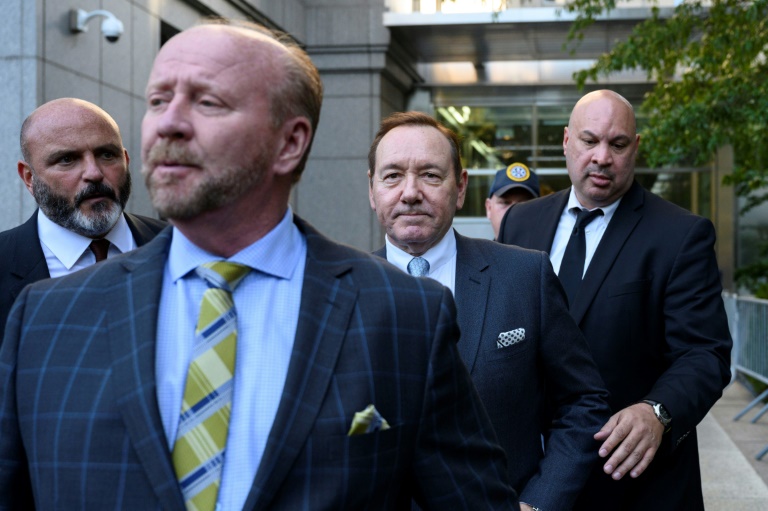
US actor Anthony Rapp told a New York courtroom Friday that he froze up when he was allegedly assaulted by Kevin Spacey as a minor in 1986, on the second day of the disgraced Oscar winner’s trial over the accusation.

Spacey, 63, has disappeared from public view after becoming one of the first stars to be caught up in the global #MeToo reckoning over sexual abuse.

Rapp told the court he was still an unknown actor when he met the “American Beauty” star, who was in his late 20s at the time.

Rapp, then 14, and friend and fellow actor John Barrowman, then 18, had seen a show starring Spacey in New York and went to greet the cast after the performance.

Spacey invited the two teens to dinner and then for a drink at a nightclub. A few days later, he invited them to a gathering of friends at his Manhattan studio.

Barrowman had since gone home to Illinois, so Rapp attended alone. Upon seeing that he did not know anyone there, he went to a bedroom to watch television.

He was sitting on the bed when he looked up and saw Spacey.

Spacey’s eyes were glazed over, and he told the younger actor he was drunk, Rapp told Judge Lewis Kaplan.

The teen realized that everyone else had gone.

“He approached me a little unsteady on his feet, picked me up as a groom carrying a bride over the threshold” and laid Rapp on the bed.

Spacey lay down next to Rapp and put his arms around the teenager, “pressing his groin” against his body.

“I felt that moment was very long. I felt frozen,” Rapp, now 50, said, his voice breaking.

Rapp said he managed to “wiggle his way” out and took refuge in the bathroom, where he made up his mind to go.

At the door, Spacey stopped him and asked if he was sure he wanted to leave.

“I didn’t remember the answer. I was thinking very much that I wanted to leave,” Rapp said.

Despite the “disturbing and threatening experience,” the “Star Trek: Discovery” star did not tell his mother anything because he did not want to talk about sex with her. He also did not want to worry her and was unsure whether Spacey had committed a crime.

Before Rapp took the stand, his lawyers called a former film industry employee named Andrew Holzman as their first witness.

Holzman said that Spacey had also sexually assaulted him, in 1981.

Rapp is seeking $40 million in damages. Spacey, whose full name is Kevin Spacey Fowler, has always denied allegations of sexual abuse.

The “House of Cards” star also has pleaded not guilty to charges of sexual assault of three men between March 2005 and April 2013 in Britain, and in 2019, charges against the actor of indecent assault and sexual assault were dropped in Massachusetts. 

Deal reached for civil aviation to try for net-zero emissions by 2050

UN aviation agency members on Friday set the year 2050 as their goal for achieving net-zero carbon emissions for air travel — an industry often criticized for its outsized role in climate change.

The assembly, which brought together representatives from 193 nations at the International Civil Aviation Organization (ICAO) headquarters in Montreal, reached a “historic agreement on a collective long-term aspirational goal of net-zero carbon emissions by 2050!” the United Nations agency said on Twitter.

It added that it “continues to advocate for much more ambition and investment by states to ensure aviation is fully decarbonized by 2050 or earlier.”

“It’s an excellent result,” a diplomatic source told AFP, revealing that only four countries — including China, the main thrust of global growth in air travel — “had expressed reservations.”

The agreement, however, was far from satisfying for some non-governmental organizations expressing regret it didn’t go far enough and was not legally binding.

The air transportation industry has faced growing pressure to deal with its outsized role in the climate crisis.

Currently responsible for 2.5 percent to three percent of global CO2 emissions, the sector’s switch to renewable fuels is proving difficult, even if the aeronautics industry and energy companies are seeking progress.

The International Air Transport Association said airlines were “strongly encouraged” by the adoption of the climate goal, coming one year after the IATA endorsed the same position at its own general meeting.

IATA director general Willie Walsh said now “we expect much stronger policy initiatives in key areas of decarbonization such as incentivizing the production capacity of sustainable aviation fuels.”

According to airlines, it will require massive investments — $1.55 trillion between 2021 and 2050 — to decarbonize aviation.

“The global aviation community welcomes this landmark agreement,” said Luis Felipe de Oliveira, head of Airports Council International which represents 1,950 airports in 185 countries.

“This is a watershed moment in the effort to decarbonize the aviation sector with both governments and industry now heading in the same direction, with a common policy framework,” he said in a statement.

– Deal is non-binding –

The French Minister in charge of Transport, Clement Beaune, welcomed “a major step forward,” saying on Twitter that “there will be no future for the plane without decarbonization” and that he was “proud of having fought this fight with my European counterparts.”

Planes in general attract particularly sharp criticism because only about 11 percent of the world’s population fly each year, according to a widely quoted 2018 study by Nordic researchers.

In addition, 50 percent of airline emissions come from the one percent of travelers who fly the most, it found.

“This is not the aviation’s Paris agreement moment. Let’s not pretend that a non-binding goal will get aviation down to zero,” said Jo Dardenne of NGO Transport & Environment.

She also expressed disappointment over lacklustre tweaks considered by delegates to the sector’s carbon offsetting and reduction scheme, known as CORSIA.

During the 10-day meeting, Russia had sought but failed to get enough votes to be re-elected to the ICAO’s governing council, which is responsible for ensuring compliance with aviation rules.

Moscow was accused of breaking international rules by registering hundreds of leased planes in Russia rather than returning them, as required by sanctions imposed after its invasion of Ukraine in February.

The ICAO general meeting was the first since the start of the pandemic, which had brought the airline industry to its knees. In 2021 passenger numbers stood at only half the 4.5 billion in 2019, marking a small rebound from the 60 percent year-over-year drop in 2020.

The sector hopes in 2022 to draw 83 percent of its customer levels from three years ago and to become profitable again worldwide next year.

Chickens, fish tanks and childbirth: this week on the US campaign trail

One month before the US midterm elections, candidates are tapping their creativity to reach out to voters, flexing their comedic chops or displaying intimate moments of their lives. Here are some of the most interesting moments from a week on the campaign trail.

– Who’s a chicken? –

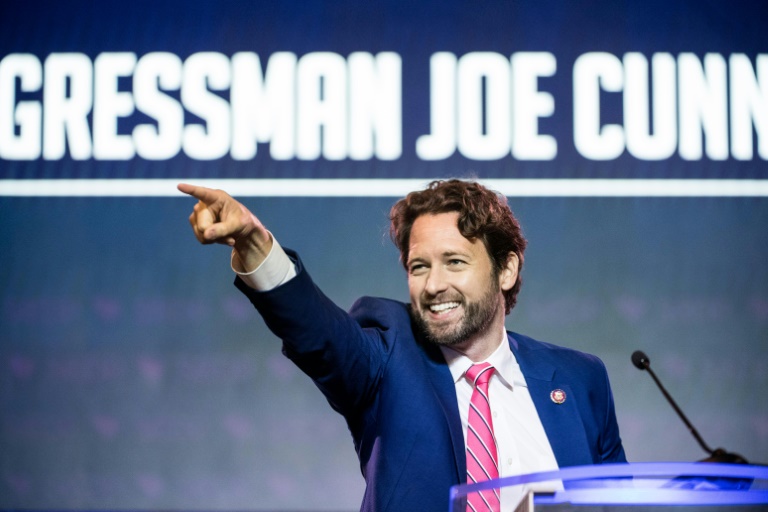
He calls his opponent a chicken — while holding a chicken. South Carolina gubernatorial candidate Joe Cunningham called out his opponent, current Republican governor Henry McMaster, for not agreeing to more televised debates.

“Come on, Governor, don’t be a chicken,” the young Democratic candidate said Thursday, holding a hen aptly named “Henrietta McMaster.”

“I’m not a chicken, I’m not afraid to defend my views,” he added to the press. 

– A stinging barb –

Standing against a white background, John Neely Kennedy chose to attack Democrats while standing next to a vertical fish tank full of jellyfish.

“The left thinks that vetting people at our southern border is racist. The left thinks that government employees have a constitutional right to talk to five years old about sexuality,” the Republican senator from Louisiana said.

“It’s frustrating to me to see how our country, which was founded by geniuses, (is) being run by idiots. But still, I’m an optimist, guys. I have hope for my liberal friends,” he says, approaching the fish tank and preparing a zinger. “Jellyfish have survived for 165 million years without a brain.”

– Two birds, one stone –

Ray Perkins is the owner of the “Chubby Ray” restaurant in Jeffersontown, a suburb of Louisville, Kentucky. He is also a candidate for mayor, and does not hesitate to mix personal business with his public campaign.

But a local news station said he may have gone too far: it ran a story about an unusual campaign mailer that is partly a flyer for Perkins’s mayoral campaign and also contains coupons for his restaurant. 

On the left, against a blue background, are Perkins’s face and slogans. On the right is a coupon for burgers and pizzas.

“I’m just letting people know that the guy running for mayor is the same guy who owns the restaurant,” he said on television.

– Televised childbirth –

It’s a campaign clip that opens like so many others: a candidate alongside her husband and her daughter, talking about family amid scenes from their farm in Louisiana.

“And someone else is going to join us,” Katie Darling adds in voiceover, her pregnancy bump plainly visible.

The next shots show her entering a hospital. 

“We should be putting pregnant women at ease, not putting their life at risk,” the Democrat running for a congressional seat says, as viewers see her going into labor. 

By showing herself giving birth, Darling said she was supporting the fight for abortion rights in one of the states that has banned abortions since the Supreme Court overturned the nationwide right to the procedure in June.

“I am the one in the hospital bed, not the legislators in Baton Rouge or Washington,” she says.

Stocks slump, dollar boosted by US jobs data

Stocks slid and the dollar surged Friday after US jobs data showed only a timid slowdown in the labor market, setting the stage for further aggressive interest rate hikes. 

Equity markets have taken a battering in the past couple of months, as the US Federal Reserve has made it clear it intends to continue to aggressively raise interest rates until soaring inflation is tamed, even if that means sending the economy into a recession.

There was a brief rebound at the start of the week, when investors hoped data pointing to an economic slowdown would allow the Fed to “pivot,” or slow down rate hikes.

However, the jobs report shows the US labor market is still robust, with hiring in the US economy slowing only slightly in September, to a net gain of 263,000 jobs, from 315,000 in August. 

That was more than the consensus forecast for a net gain of 250,000, sending equities lower and the dollar higher. 

“Those hoping for a Fed pivot have been sorely disappointed with today’s job numbers, which have confirmed that (the) US economy continues to rumble along quite well,” said Chris Beauchamp, chief market analyst at online trading platform IG.

“The latest bear market bounce has now begun to wilt as investors wearily return to expectations” of further Fed rate hikes.

Futures markets show investors saw the report as boosting the odds that the Fed will again undertake a 0.75 percentage point interest rate increase in November.

Major US indices were in the red the entire day, with the broad-based S&P 500 finishing 2.8 percent lower.

In Europe, Frankfurt fell 1.6 percent, and Paris shed 1.2 percent. London ended the day 0.1 percent lower. 

“Investors are simultaneously fretting that the fall in the pace of hirings indicates a slowing economy, but also that the better-than-expected data shows that the jobs markets hasn’t slowed enough to stop the Fed from hiking rates aggressively,” said markets analyst Susannah Streeter at Hargreaves Lansdown brokerage.  

The next data point that the Fed, and investors, will be scrutinizing is the consumer price index report next week.

Elsewhere, oil prices jumped and were set for their biggest weekly gain since March after OPEC and other major producers led by Russia agreed to slash daily output by two million barrels.

– Key figures around 2030 GMT –

New York – Dow: DOWN 2.1 percent at 29,296.79 (close)

New York – S&P 500: DOWN 2.8 percent at 3,639.66 (close)

New York – Nasdaq: DOWN 3.8 percent at 10,652.40 (close)

London – FTSE 100: DOWN 0.1 percent at 6,991.09 (close)

Frankfurt – DAX: DOWN 1.6 percent at 12,273.00 (close)

Paris – CAC 40: DOWN 1.2 percent at 5,866.94 (close)

EURO STOXX 50: DOWN 1.7 percent at 3,375.46 (close)

Tokyo – Nikkei 225: DOWN 0.7 percent at 27,116.11 (close)

Hong Kong – Hang Seng Index: DOWN 1.5 percent at 17,740.05 (close)

Shanghai – Composite: Closed for a holiday

Pound/dollar: DOWN at $1.1082 from $1.1162 on Thursday

Euro/dollar: DOWN at $0.9743 from $0.9791

Euro/pound: UP at 87.987 pence from 87.71 pence

Dollar/yen: UP at 145.38 yen from 145.14 yen

Brent North Sea crude: UP 3.5 percent at $97.92 per barrel

West Texas Intermediate: UP 4.7 percent at $92.64 per barrel

burs-jmb/to

France's Mbappe tops football earnings list at $128 mn: Forbes

French superstar striker Kylian Mbappe will earn a record $128 million in annual earnings to top the list of the world’s highest-paid football players, according to a Friday Forbes magazine report.

The magazine noted Mbappe crossed the $100 million milestone at age 23 while such legends as Lionel Messi and Cristiano Ronaldo were in their 30s and at the peak of their careers when crossing that money mark for the first time.

Mbappe signed a three-year contract extension in May to remain with dominant Ligue 1 side Paris-Saint Germain.

Forbes reported the deal will bring Mbappe about $110 million for his salary and season share of a signing bonus plus an estimated $18 million in annual endorsement income from such companies as Nike, Dior, Hublot and Oakley.

Mbappe was on the cover of the EA Sports FIFA video game, founded the production company Zebra Valley and is an investor in fantasy NFT platform Sorare.

“He’s a global icon already,” Sorare co-founder Nicolas Julia told Forbes. “He wants to aid the world and show, also, that huge things can be built out of France.”

PSG teammate Messi, 35, ranks second at $120 million with Manchester United’s Ronaldo, 37, third on $100 million. They had shared the top two spots since 2014 and still set the endorsements pace, Ronaldo at $60 million and Messi at $55 million.

In all, the top top-10 players will collect $652 million this season, an 11% jump from last year’s $585 million figure. Mbappe, Messi and Portugal’s Ronaldo together account from more than half of that money total.

PSG forward Neymar of Brazil ranked fourth on $87 million followed in order by Mohamed Salah, on $53 million, Erling Haaland on $39 million, Robert Lewandowski at $35 million, Eden Hazard at $31 million, Andres Iniesta at $30 million and Kevin De Bruyne at $29 million.

EU leaders struggle for answer to Putin's 'energy missile'

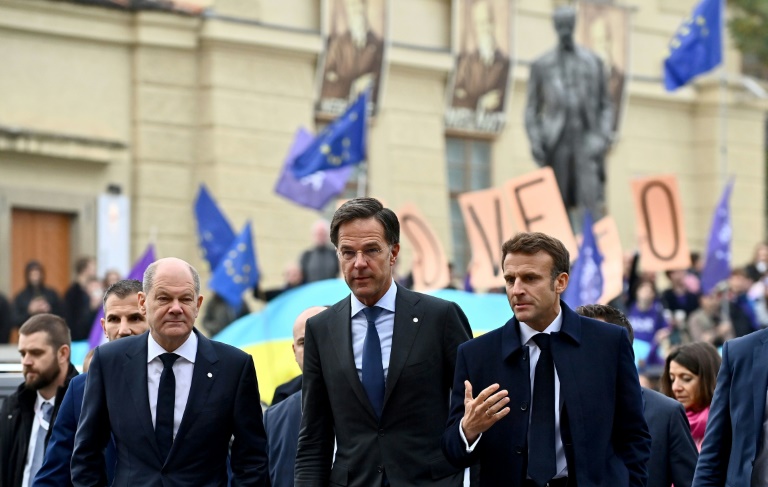
EU leaders wrestled on Friday to come up with a plan to tackle soaring energy costs as they struggled with the fallout from Russia’s war on Ukraine at a summit in Prague. 

President Volodymyr Zelensky urged further sanctions on Moscow’s energy sector and more arms as the bloc looks to maintain its backing for Ukraine and hold a tough line against the Kremlin.

“We must be strong – until our common victory, to preserve all that we value so much,” Zelensky told the leaders by videolink. 

“We must invest now in our defence, in our security, in our cooperation as much as possible.”

The leaders also discussed ways to better protect their critical infrastructure in the wake of leaks from the Russia-Europe Nord Stream gas pipelines that have been blamed on “sabotage”.

But it was the sharp disagreements over how to tackle the energy crisis that were the major focus of attention as the 27 nations wrangled over the best plan to try to bring down prices.

Europe is facing an energy crunch as the cost of electricity generation skyrockets because of a massive surge in gas prices caused by Russia turning off the taps.

“Russia has fired an energy missile at the European continent and the world,” European Council head Charles Michel said. 

Governments across the bloc are scrambling to lower bills for their consumers, but they rely on different sources for their energy and are split over the solutions.

EU executive head Ursula von der Leyen is proposing a “roadmap” of measures to help ease the burden — including potential moves to cap the price of gas. 

However, there is no consensus on how any caps could work and leaders are not set to take a firm decision until a summit in Brussels later this month.  

“We will have a lot of work this autumn and winter and it will not be easy,” German Chancellor Olaf Scholz said.  

– Not ‘intimidated’ –

More than half of the bloc have pushed for the EU to impose a price ceiling on how much it would pay for gas piped or shipped in, as the northern hemisphere winter sets in.

But Germany has so far stood in the way over fears that the move could divert precious supplies away from Europe.

“A price cap on gas if that could be achieved would be grand, with the caveat that we cannot endanger security of supplies,” said Latvian Prime Minister Krisjanis Karins.

“We cannot set the price so that no one would sell gas into Europe.”

Berlin has come under fire from other EU members for dragging its feet on the issue while announcing a 200-billion-euro ($199-billion) fund to subsidise gas purchases at home.

“My message to Germany is be united with all the others because during difficult times everybody has to agree on a common denominator,” Polish Prime Minister Mateusz Morawiecki said.

Despite some discontent from Hungary, the bloc has managed to remain largely united in its opposition to the Kremlin as Putin has escalated the conflict by claiming four occupied regions of Ukraine.

– ‘Ukraine needs support now’ –

A broader summit of 44 nations from across Europe held in Prague on Thursday highlighted Moscow’s isolation.

Michel insisted the EU does not “intend to be intimidated” after US President Joe Biden warned of the risk of nuclear “Armageddon” as Putin ratcheted up his threats. 

The bloc is looking to maintain its backing for Kyiv as Zelensky’s troops push Russian forces back on several fronts over seven months into the war. 

Ukraine is urging the EU to speed up much-needed economic support, after Brussels on Monday signed a memorandum of understanding to provide five billion euros.

On the military front, the bloc is planning to launch a training mission for Ukrainian forces later this month.

It is also eyeing a possible fresh tranche of funding for arms for Ukraine that would take its overall spending on weaponry to three billion euros.

French President Emmanuel Macron for his part announced Paris was setting up a special 100-million-euro fund to allow Kyiv to buy arms directly. 

“Ukraine needs our support not tomorrow, Ukraine needs support today, right now,” said Lithuanian President Gitanas Nauseda. 

Close Bitnami banner
Bitnami