US Business

Spore the merrier: Boom in mushrooms grown on Belgian beer

In Belgium, a country reputed for its beer, mushrooms nourished on a byproduct from the brew are doing booming business.

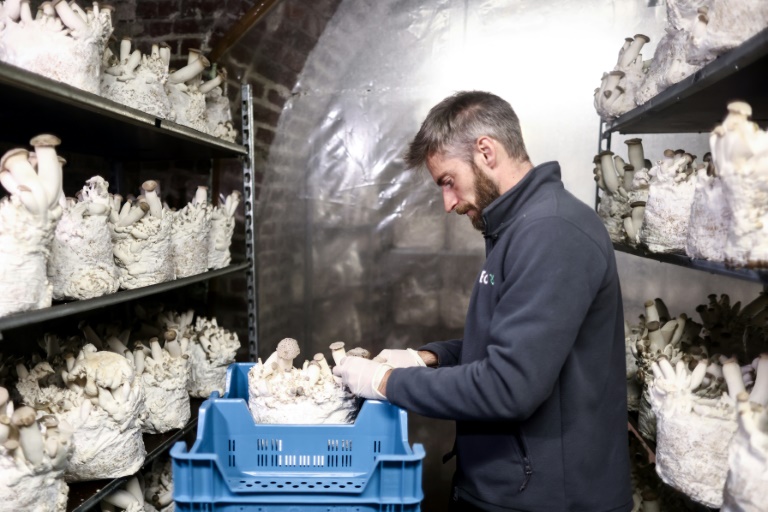
The high-end fungi grown by a Brussels firm, Eclo, in a disused abattoir are finding their way to gourmet customers — while boosting the circular economy.

The seven mushroom varieties produced by Eclo are mostly sought-after exotic types usually found in Asia, including shiitake, maitake (also known as hen-of-the-woods) and pom pom mushrooms.

They all fetch premium prices on the firm’s website, around 22 euros ($22) for a 750-gramme (26-ounce) box. 

And the substrate — the substance the spores grow out of — is easy to come by in Belgium: a mix of spent grain left over from the mashing process to make beer, and discarded baguettes and dried bread.

“The beer and the bread don’t have any effect on the mushrooms’ taste, but we get better yields from them in terms of quantity and quality,” explained Quentin Declerck, one of Eclo’s founders.

His company has for several years been collecting the brewers’ grain from Belgian beer-maker Cantillon and leftover bread from Colruyt supermarkets and the Bon Pain chain of bakery-and-sandwich shops.

The collaboration allows Eclo to recycle five tonnes of brewers’ discarded grain and 18 tonnes of bread annually. 

That castoff material then goes into Eclo’s cold rooms, where the mushrooms grow in the moist air. 

Each week, the company sells between eight and 10 tonnes of its mushrooms.

Beyond the blooming financial advantage the activity brings, Declerck explained that contributing to a domestically made and ecologically friendly production in Brussels was a motivation.

“We realised that many of the mushrooms bought in shops came from the Netherlands, many from eastern (European) countries, and even further afield, from China,” he said.

“Today there is a certain production that has been relocalised (to Belgium). We are part of that movement.”

– ‘Tough’ work –

Eclo was created in 2014 after its founders read a book about the circular economy, in which discarded items are repurposed and reintroduced into the market rather than thrown away. 

The book spoke of growing mushrooms from coffee grounds — a process already being used by another Brussels company.

Eclo tried that route initially, but “it was a resounding failure” for the varieties it wanted to grow, Declerck said.

“Shiitake doesn’t grow at all in coffee grounds.”

So it switched direction for its substrate, and trained some 30 people on how to grow mushrooms from brewers’ grain and bread.

The experience has had its ups and downs.

“Some of them just gave up. This is still a form of farming and it’s tough — you work in very moist rooms, sometimes you don’t see the sun all day,” Declerck said.

Trying to compete against industrial-scaled rivals also dealt a blow to the morale of some.

“You need to cope with market prices otherwise you simply don’t sell. We’ve found our niche, so we’re able to pay our people fairly, but a lot of projects don’t pay.”

Eclo is testing out other options in its production, for instance seeing if substrate using discarded ground cacao beans. 

It is also seeking to grow and set up a factory that can sell substrates on the European market.

In Belgium, the number of companies involved in the circular economy grew by a third between 2019 and 2021, according to a study by the Inoopa start-up in 2022.

But there is still a long path ahead: a study for Belgium’s Wallonia region in June found that 60 percent of the companies on its territory didn’t at all know about the concept of the circular economy.

Ukraine pushes east, Moscow vows to win back lost ground

Kyiv on Wednesday claimed further victories over Russian troops in eastern Ukraine as the Kremlin vowed to recapture territory lost in a lightening Ukrainian counteroffensive.

In recent weeks, Ukraine’s forces, bolstered by Western weapons, have wrested Russian troops out of a string of towns and villages in the east and in the south.

Kyiv this week claimed gains in the southern Kherson region and control of almost the entire eastern Kharkiv region, paving the way for its forces to enter the separatist stronghold of Lugansk.

“The de-occupation of the Lugansk region has already officially started,” regional governor Sergiy Gaiday said in a video posted on social media, dressed in camouflage and adding that several settlements had been liberated.

On Wednesday, Russian President Vladimir Putin signed into legislation his annexation of four Ukrainian territories — including Lugansk — as the EU agreed a new round of sanctions against Moscow in response.

Kremlin spokesman Dmitry Peskov said Moscow would take back land it lost to Kyiv within the annexed regions, vowing they would be “Russian forever and will not be returned.” 

Putin last Friday signed agreements with the Moscow-installed leaders of the four regions to become subjects of the Russian Federation, despite condemnation from Kyiv and the West.

The four territories — Donetsk, Kherson, Lugansk and Zaporizhzhia — create a crucial land corridor between Russia and the Crimean Peninsula, which was annexed by Moscow in 2014.

Together, the five regions make up around 20 percent of Ukraine.

– ‘Strike back’ –

The Kremlin annexed the territories after hastily conducting referendums, denounced as void by Kyiv and its Western allies, but has yet to confirm what areas exactly of those regions are being annexed.

Russian forces do not have full control over Kherson or Zaporizhzhia and recently lost control of several settlements in Donetsk.

“The way we are regrouping (our forces) along the front means that we can gather strength and strike back,” Kirill Stremousov, the Moscow-appointed deputy head of Kherson region, told the RIA Novosti news agency.

Ukraine’s forces “won’t enter Kherson. Its impossible,” he said referring to the region’s eponymous main city.

On Tuesday, Ukrainian President Volodymyr Zelensky said his forces were making “rapid and powerful” gains and had retaken “dozens” of villages in the east and south.

The latest battlefield maps from Moscow showed that Russian troops had left many areas in Kherson, including along the west bank of the Dnipro River.

In Kharkiv, the maps indicated that Russian forces had almost entirely abandoned the east bank of the Oskil River, potentially giving the Ukrainians space to shell key Russian troop transportation and supply corridors.

While Russian authorities remain largely silent about the extent of the setbacks, war correspondents of pro-Kremlin media admitted that troops were in trouble. 

“There won’t be any good news in the near future. Not from the Kherson front nor from Lugansk,” newspaper journalist Alexander Kots wrote on his Telegram channel with over 640,000 followers.

– ‘Chase them’ –

Near Lyman, a strategic transport hub in Donetsk that Kyiv recaptured over the weekend, a Ukrainian paratrooper told AFP that forces were “exhausted”. 

“We’ll rest for a bit and then we will go further,” said the young, bearded soldier. “We will chase them,” he added.

On Tuesday, US President Joe Biden told Zelensky that another $625 million in military assistance was on the way.

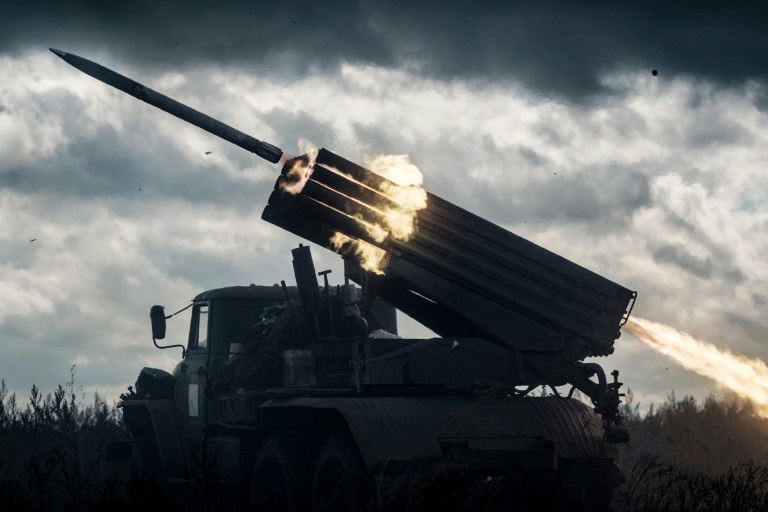
The new batch includes more HIMARS multiple rocket launchers, which have allowed Ukraine to strike Russian command depots and arms stockpiles far behind the front line.

From the EU, there were no details about the nature of fresh sanctions agreed against Russia.

The latest package — the eighth since Russia’s invasion in February — is now going through a final approval procedure which, if no objections emerge, will be published and come into effect on Thursday, the Czech Republic’s EU ambassador said on Twitter.

Otherwise, Russia insisted that it should be part of an international probe into leaks in the Nord Stream pipeline that carries gas from Russia to Europe. Sweden has blocked off the area pending an investigation.

Moscow has accused the West of being behind blasts that lead to four leaks on the Baltic Sea pipelines.

Both Moscow and Washington have denied involvement.

US duo and Dane win Nobel for 'click chemistry'

A trio of chemists from the United States and Denmark who laid the foundation for a more functional form of chemistry where molecules are snapped together on Wednesday won the Nobel Chemistry Prize.

Americans Carolyn Bertozzi and Barry Sharpless, together with Denmark’s Morten Meldal, were honoured “for the development of click chemistry and bioorthogonal chemistry”, the jury said.

Bertozzi is the only woman among the seven Nobel laureates honoured so far this year, with women vastly under-represented in the history of the prizes, especially in the science disciplines.

The chemist — who as an undergraduate at Harvard played keyboards in a band called Bored of Education with future Rage Against the Machine guitarist Tom Morello — is only the eighth woman to win a Nobel Chemistry Prize, out of 189 recipients.

The award marks the second Nobel for 81-year-old Sharpless, who won the chemistry Nobel in 2001. 

Only four other individuals have achieved the feat of winning two Nobel Prizes, including Polish-born Frenchwoman Marie Curie, who won the chemistry prize in 1911 after first winning the physics prize in 1903.

She was followed by American Linus Pauling who won for chemistry in 1954 and peace in 1962. American John Bardeen won the physics prize in 1956 and 1972, and Britain’s Frederick Sanger won the chemistry prize in 1958 and 1980.

– To make drugs, map DNA –

Click chemistry “is an elegant and efficient chemical reaction that is now in widespread use,” the jury said in a statement.

“Among many other uses, it is utilised in the development of pharmaceuticals, for mapping DNA and creating materials that are more fit for purpose,” it added.

Sharpless, a professor at Scripps Research in California, “started the ball rolling” and “coined the concept of click chemistry” around 2000, the jury said.

Afterwards, Sharpless and Meldal, a professor at the University of Copenhagen, “independently of each other, presented what is now the crown jewel of click chemistry: the copper catalysed azide-alkyne cycloaddition”.

The process allows chemists to “snap” molecules together like Lego bricks “with the help of some copper ions”, which among other things allow for the production of new materials.

“If a manufacturer adds a clickable azide to a plastic or fibre, changing the material at a later stage is straightforward,” the Nobel committee explained.

It is possible to click in substances that conduct electricity, capture sunlight, are antibacterial, protect from ultraviolet radiation or have other desirable properties, it said.

While there is widespread application of his research, Meldal said he was “very surprised and very proud” to receive the honour.

“There are so many good discoveries and developments in the world, it’s incredible to be in this situation,” Meldal told Swedish public radio.

– ‘A new level’ –

Bertozzi, 55, a professor at Stanford in the United States, was highlighted for then taking “click chemistry to a new level”.

“She developed click reactions that work inside living organisms. Her bioorthogonal reactions take place without disrupting the normal chemistry of the cell,” the jury said.

Her research is now being used to investigate how these reactions can be used to diagnose and treat cancer.

“I’m absolutely stunned, I’m sitting here and I can hardly breathe,” Bertozzi told reporters via telephone, minutes after the announcement.

Silvia Diez-Gonzaleza, a chemist who works on click chemistry at Imperial College, London, welcomed the win.

“Thank goodness” that the days of women not being allowed in chemistry labs are over, she told AFP, though “there is a lot of bias still out there”.

“I want to believe that it’s just a matter of time that as women and non-white people get more opportunities to achieve their potential, then eventually the recognition they get will be spread more widely.”

The Royal Swedish Academy of Sciences, which awards the Nobels in the science disciplines, has refused to introduce quotas despite the dearth of women laureates.

Goran Hansson, then-secretary general of the academy, told AFP last year after all of the science nods went to men, that it wanted every laureate to be accepted “because they made the most important discovery, and not because of gender or ethnicity”. 

The lack of women laureates “reflects the unfair conditions in society, particularly in years past but still existing”, he acknowledged.

This year’s laureates will share the Nobel award sum of 10 million Swedish kronor (more than $910,000), and will receive the prize from King Carl XVI Gustaf at a ceremony in Stockholm on December 10, the anniversary of the 1896 death of scientist Alfred Nobel who created the prizes in his last will and testament.

Oil prices rise awaiting OPEC output cut

Oil prices rose Wednesday as OPEC and Russia-led allies prepare to announce a big cut in output.

Stocks markets diverged following Tuesday’s surge on hopes the US Federal Reserve could temper its rate hike campaign.

The pound continued to suffer against the dollar over fears for Britain’s recession-threatened economy, losing around one percent. 

The main focus has been the oil market. “There will be a lot of attention on just how big this (oil output) cut is,” said AJ Bell investment director Russ Mould.

“Speculation they could be double the volume previously flagged… has been behind the recent surge in crude.”

Major oil producers led by Saudi Arabia and Russia were on Wednesday expected to announce a large cut in output to prop up prices despite Western concerns over energy-fuelled inflation.

The 13-nation OPEC cartel and its 10 Russian-led allies are reportedly considering a reduction of up to two million barrels per day at a meeting in Vienna — the biggest cut since 2020.

In a reminder of the global economic turmoil, the World Trade Organization (WTO) dramatically lowered its global trade forecast for 2023.

“Today the global economy faces multi-prong crises. Monetary tightening is weighing on growth across much of the world,” WTO Director-General Ngozi Okonjo-Iweala told reporters in Geneva.

Presenting a revision of their annual trade forecast, WTO economists said they still anticipated global economic growth rising 2.8 percent this year.

Hong Kong stocks soared Wednesday following a public holiday, catching up with the previous day’s global rally.

In corporate news, Elon Musk has offered to push through with his buyout of Twitter at the original agreed price.

The world’s richest man said in a filing with the Securities and Exchange Commission that he sent Twitter a letter vowing to honour the contract.

The latest twist in the long-running saga came ahead of the high-stakes court battle launched by Twitter in an attempt to hold the Tesla chief to the $44-billion deal he signed in April.

– Key figures around 1100 GMT –

Brent North Sea crude: UP 0.9 percent at $92.57 per barrel

West Texas Intermediate: UP 0.7 percent at $87.10 per barrel

London – FTSE 100: DOWN 1.0 percent at 7,016.57 points

Frankfurt – DAX: DOWN 0.8 percent at 12,570.82

Paris – CAC 40: DOWN 0.7 percent at 5,996.54

EURO STOXX 50: DOWN 0.8 percent at 3,456.56

Tokyo – Nikkei 225: UP 0.5 percent at 27,120.53 (close)

Hong Kong – Hang Seng Index: UP 5.9 percent at 18,087.97 (close)

Shanghai – Composite: Closed for a holiday

New York – Dow: UP 2.8 percent at 30,316.32 (close)

Pound/dollar: DOWN at $1.1372 from $1.1477 on Tuesday

Euro/dollar: DOWN at $0.9926 from $0.9992

Euro/pound: UP at 87.27 pence from 87.03 pence

Dollar/yen: UP at 144.34 yen from 144.09 yen

burs-bcp/rfj/lcm

WTO slashes 2023 global trade forecast as recession looms

The World Trade Organization on Wednesday dramatically lowered its global trade forecast for 2023, as Russia’s war in Ukraine and other shocks take their toll on the world economy.

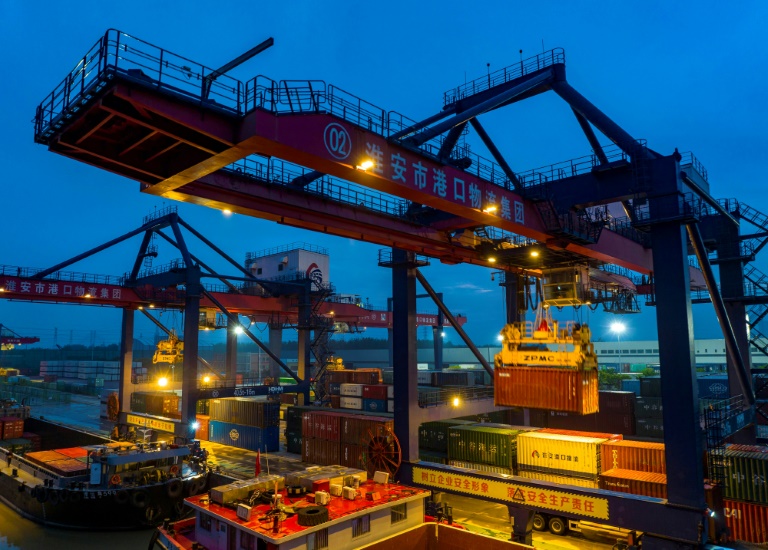
Presenting a revision of their annual trade forecast, WTO economists said they expected the volume of global merchandise trade to grow 3.5 percent this year, which is slightly higher than their expectations in April.

But they forecast it would grow by only one percent in 2023 — dramatically down from their expectations of 3.4-percent growth six months ago.

“The picture for 2023 has darkened considerably,” WTO Director-General Ngozi Okonjo-Iweala told reporters in Geneva.

“Today the global economy faces multi-prong crises. Monetary tightening is weighing on growth across much of the world.” 

As for the global economy as a whole, WTO economists stuck with their April forecast of 2.8-percent GDP growth this year, but said growth in 2023 was now expected to be just 2.3 percent — down a full percentage point from the previous forecast.

By way of comparison, the Organisation for Economic Co-operation and Development has maintained its 2022 forecast at three percent, and expects 2.2 percent growth next year.

The International Monetary Fund meanwhile forecasts growth at 3.2 percent this year and 2.9 percent in 2023.

– ‘Overly optimistic’ –

The WTO pointed out that its April forecasts were presented only weeks into the start of Russia’s full-scale war in Ukraine, making them very uncertain.

The estimates for 2023 “now appear overly optimistic, as energy prices have skyrocketed, inflation has become more broad-based, and the war shows no sign of letting up,” it said.

The WTO said surging energy prices in Europe, stemming from the war in Ukraine, were expected to squeeze household spending and raise manufacturing costs on the continent.

Meanwhile monetary policy tightening in the United States was hitting the housing, motor vehicle and fixed investment sectors, and China was still grappling with Covid-19 outbreaks and production disruptions.

Furthermore, the growing import bills for fuel, food and fertiliser risked leading to more food insecurity and debt distress in developing countries, the WTO said.

If its new forecasts pan out, world trade will slow considerably next year, but will still continue to grow.

But the global trade body stressed that it still remained very unclear how things would pan out.

“There’s a great deal of uncertainty in the estimates going forward, simply because of the nature of the conflict” in Ukraine, WTO senior economist Coleman Nee told reporters. 

– ‘Huge impact’ –

If the war “worsens rather than gets better, then that’s going to have a huge impact,” Okonjo-Iweala agreed, adding though that if the situation in Ukraine improves, that would have a “positive impact” on global trade growth.

Such uncertainty leaves WTO economists with a broad spectrum of possibilities for how global trade will evolve in 2023, ranging from a decline of 2.8 percent to a hike of as much as 4.6 percent. 

Last week, Okonjo-Iweala warned that Russia’s war in Ukraine, the climate crisis, food price and energy shocks plus the aftermath of the Covid-19 pandemic were creating the conditions for a world recession.

“Now we have to weather what looks like an oncoming recession,” she told the opening of the WTO’s annual public forum in Geneva.

On Wednesday, she acknowledged that monetary “policymakers are confronted with unenviable choices as they try to find an optimal balance among tackling inflation, maintaining full employment, and advancing important policy goals such as transitioning to clean energy.”

EU signals shifts towards gas price cap

The EU is “ready to discuss” a price cap on gas within the bloc to bring down soaring energy costs, European Commission chief Ursula von der Leyen said Wednesday.

Her comment, to the European Parliament, signalled a shift in tone after powerhouse EU country Germany had expressed worries that a broad price cap might divert supplies for Europe.

It comes after 15 EU countries — more than half the bloc — made a joint call for the EU to impose a price ceiling on how much it would pay for gas piped or shipped in, as the northern hemisphere winter sets in.

Europe is facing an energy crunch as the price of electricity generation skyrockets because of a massive surge in the price of gas.

Russia, which used to be Europe’s main gas supplier, has turned off the taps after being hit by EU sanctions over the war in Ukraine that, while not touching gas, crimped sales of its more lucrative oil exports.

“We are ready to discuss a cap on the price of gas that is used to generate electricity,” Von der Leyen told MEPs sitting in Strasbourg, France.

“This cap would also be a first step on the way to a structural reform and overall reform of our electricity market.”

She added that “we also have to look at gas prices beyond the electricity market”.

– Still being ‘fleshed out’ –

Her spokesman, Eric Mamer, later explained that the proposal was still being “fleshed out” and would be detailed in a letter to EU leaders ahead of a Friday summit in Prague.

But he did say that the idea was “related to the wholesale market of gas trading in Europe” and not directly on the price paid for imported gas.

He acknowledged however that “there are links between the price of gas traded within Europe and the price of the gas that we buy from outside”.

Brussels has been amenable to a cap on pipeline gas to hurt Russia and deprive it of cash for its Ukraine invasion.

But it has resisted a cap on liquified natural gas (LNG), fearing that sellers might simply divert to higher-paying markets, further starving Europe of gas.

Germany, traditionally the biggest beneficiary of Russian gas, had also rebuffed the idea. But it has come under pressure from other EU countries after it announced a 200-billion-euro ($199-billion) fund to shield its own consumers from soaring prices.

Von der Leyen admitted a price cap “entails drawbacks in terms of security of supply of gas”.

But she argued that “the situation has critically evolved” and now, “more member states are open for it and we are better prepared”.

She noted that Europe’s stockpile of gas for winter had reached 90 percent of capacity, exceeding a target set.

She also said any price cap would be “a temporary solution” and that “exceptional times require exceptional emergency measures”.

Musk-Twitter deal: a roller-coaster saga

Elon Musk’s pursuit of Twitter was a melodrama from the beginning — a mercurial billionaire locked in a bitter fight with his favorite social media platform.

After months of recriminations and attempts to cancel his attempt to buy, Musk on Tuesday called a truce and agreed to honor his initial offer.

Here are the main ups and downs of the saga: 

– ‘Passionate believer’ –

Musk is a long-time Twitter user with more than 100 million followers, using the platform as a megaphone for his corporate and personal ambitions.

In an April 4 regulatory filing, he revealed he had splashed out nearly $2.9 billion on a 9.2 percent stake in the company.

Twitter shares soared, Musk got a seat on the board, and CEO Parag Agrawal called him “a passionate believer and intense critic of the service”, saying it was “exactly what we need”.

Both sides appeared to be getting along famously.

– ‘Poison pill’ –

But it took less than a week for things to fall apart.

Musk decided against joining the board, and Agrawal said it was “for the best”.

Musk then launched a hostile takeover bid, an April 13 filing showed, and Twitter adopted a “poison pill” defense that would allow shareholders to buy additional stock.

– Deal back on –

Then Twitter reversed course and on April 25 revealed that it would sell after all in a deal that valued the firm at $44 billion.

Musk parted with $8.4 billion in shares in Tesla, pledged up to $21 billion from his personal fortune and got some friends to stake him a few billion.

The billionaire mogul, known for his provocative messages, set out plans to allow former US president Donald Trump back on to the platform.

– See you in court –

Then it was Musk’s turn to get cold feet. He said on May 13 the deal was “temporarily on hold” while he sought details of spam and fake accounts on the platform.

After two months of very public fighting over the issue, he called off the deal and accused Twitter of making “misleading” statements.

The company quickly launched legal action to enforce the deal.

– Rapprochement –

Both sides had been gearing up for a lengthy and hugely expensive showdown at the Delaware Chancery Court.

Musk had been buoyed by whistleblower revelations that portrayed the company as cavalier with its bot counting and lax on security.

Twitter, however, believed the agreement it had with Musk was watertight.

Then, on Tuesday, Musk revealed — on Twitter, of course — that he had agreed to close the deal at the price he had initially offered.

“I think that Musk realized he was not going to win that trial,” said law professor Carl Tobias.

– The future is ‘X’ –

In his tweet on Tuesday, Musk said the acquisition would be an “accelerant” towards creating “X”, which he said would be “the everything app”.

He offered no further detail.

He had previously told Twitter staff that he envisaged a platform with one billion users, but he was hazy on issues like potential staff layoffs and free-speech limits.

Text messages revealed during the legal process showed how he briefly considered making a blockchain-based social media app.

But before the future of Twitter can even be discussed, either side could still quibble over the details of the sale.

The potential of a courtroom showdown has receded but remains a possibility.

OPEC+ expected to slash oil output

Major oil producers led by Saudi Arabia and Russia were expected Wednesday to agree on a major cut in output to prop up prices despite Western concerns over energy-fuelled inflation.

The 13-nation OPEC cartel and its 10 Russian-led allies is reportedly considering a reduction of up to two million barrels per day at a meeting in Vienna — the biggest cut since 2020.

Such a move could turbocharge crude prices, further aggravating inflation which has reached decades-high levels in many countries and is contributing to a global economic slowdown.

US President Joe Biden personally appealed to Saudi leaders in July to boost production in order to tame prices which soared following Russia’s invasion of Ukraine earlier this year. 

But crude price have fallen in recent months on concerns over dwindling demand and fears over a possible global recession.

“With consumers only just breathing a sigh of relief after being forced to pay record prices at the pump, today’s cut is not going to go down well,” said Craig Erlam, an analyst at trading platform OANDA. 

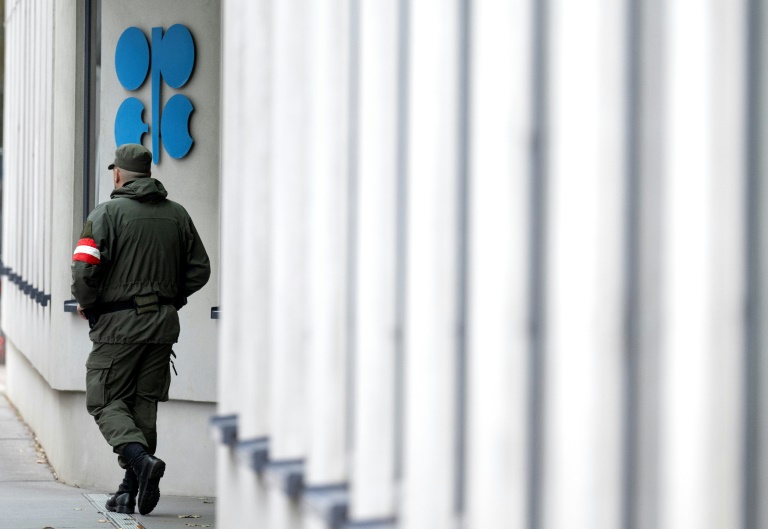
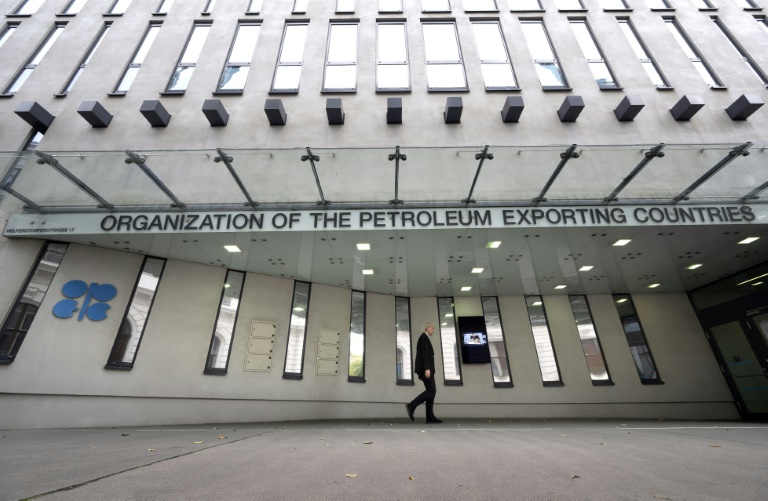
Ministers from the Saudi-led Organization of the Petroleum Exporting Countries and its partners will discuss their next move at their first in-person meeting at the group’s headquarters in Vienna since March 2020.

They were tight-lipped as they arrived for the gathering on Tuesday.

“Let’s wait… We will have to listen to the technical team,” the energy minister of the United Arab Emirates, Suhail al-Mazrouei, told reporters, adding that the group was still reviewing market data.

– Geopolitical tensions –

Collectively known as OPEC+, the alliance drastically slashed output by almost 10 million barrels per day (bpd) in April 2020 to reverse a massive drop in crude prices caused by Covid lockdowns.

OPEC+ began to raise production last year after the market improved. Output returned to pre-pandemic levels this year, but only on paper as some members have struggled to meet their quotas.

The group agreed last month on a small, symbolic cut of 100,000 bpd from October, the first in more than a year.

Bloomberg, the financial news agency, said OPEC+ officials were discussing the removal of about two million bpd out of the market from November, twice as much as earlier predictions.

Consumer countries have pushed for months for OPEC+ to open taps more widely to bring down prices — calls that the group has largely ignored.

“Knowing that Russia is willing to cut output, the move could also be perceived as another escalation of the geopolitical tensions” between Moscow and the West, said Ipek Ozkardeskaya, a Swissquote bank analyst.

The OPEC+ discussion also comes as Western nations mull imposing a price cap on Russian oil while an EU ban on most crude from Russia comes into effect in December. 

– US elections –

Biden made a controversial trip to Saudi Arabia in July in part to convince the kingdom to loosen the production taps. The trip saw Biden meet Crown Prince Mohammed bin Salman despite his promise to make Riyadh a “pariah” following the 2018 killing of journalist Jamal Khashoggi.

A major cut now would be “something that will not be well received by the White House ahead of next month’s midterm elections,” said Tama Varga, analyst at PV Energy, referring to congressional elections.

While such a cut could anger Washington, several OPEC+ nations have struggled to meet their quotas in the first place.

Prices soared close to $140 per barrel in the aftermath of Russia’s invasion of Ukraine in late February but fell as low as below $90 more recently.

After rallying earlier this week on speculation over the OPEC+ cut, the international benchmark, Brent North Sea crude, was slightly down on Wednesday, hovering above $91.

According to UBS bank, a cut of at least 500,000 bpd would be necessary to stop the price plunge.

EU signals shifts towards price cap on imported gas

The EU is “ready to discuss” a price cap on imported gas to bring down soaring energy costs, European Commission chief Ursula von der Leyen said Wednesday.

Her comment, to the European Parliament, signalled a shift in tone in Europe after powerhouse EU country Germany had expressed worries that a broad price cap might divert supplies for Europe.

It comes after 15 EU countries — more than half the bloc — made a joint call for the EU to impose a price ceiling on how much it would pay for gas piped or shipped in, as the northern hemisphere winter bears down.

Europe is facing an energy crunch as the price of electricity generation skyrockets because of a massive surge in the price for gas.

Russia, which used to be Europe’s main gas supplier, has turned off the taps after being hit by EU sanctions over the war in Ukraine that, while not touching gas, crimped sales of its more lucrative oil exports.

“We are ready to discuss a cap on the price of gas that is used to generate electricity,” von der Leyen told MEPs sitting in Strasbourg, France.

“This cap would also be a first step on the way to a structural reform and overall reform of our electricity market.”

She added that “we also have to look at gas prices beyond the electricity market”.

– ‘Drawbacks’ on supply –

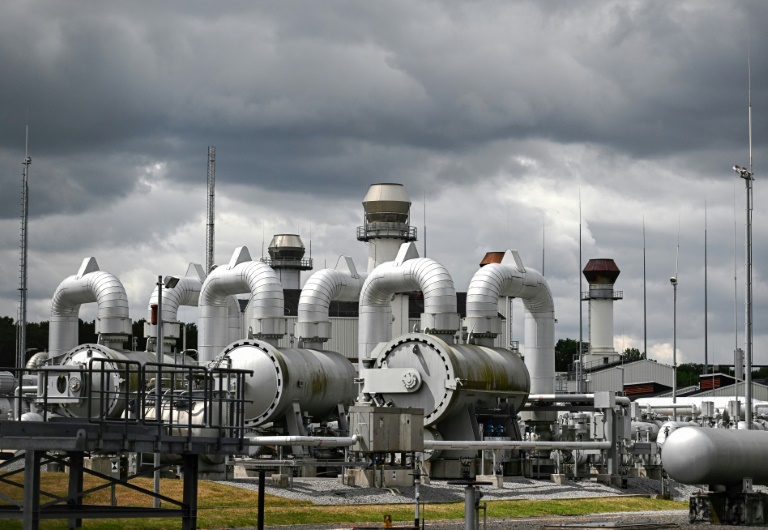
Von der Leyen did not specify whether the mooted price cap would cover all gas imports — not only the gas that arrives mainly by pipeline from Russia, but also liquified natural gas (LNG) that can be shipped around the world.

Brussels has been amenable to a cap on pipeline gas to hurt Russia and rob it of cash for its Ukraine invasion.

But it has resisted a cap on LNG, fearing that sellers might simply divert to higher-paying markets, further starving Europe of gas.

Germany, traditionally the biggest beneficiary of Russian gas, had also rebuffed the idea. But it has come under pressure from other EU countries after it announced a 200-billion-euro ($199-billion) fund to shield its own consumers from soaring prices.

Von der Leyen admitted a price cap “entails drawbacks in terms of security of supply of gas”.

But she argued that “the situation has critically evolved” and, now, “more member states are open for it and we are better prepared”.

She did not detail what had changed, beyond noting that Europe’s stockpile of gas for winter had reached 90 percent of capacity, exceeding a target set.

She also said any price cap would be “a temporary solution” and that “exceptional times require exceptional emergency measures”.

Asia markets extend rally on rate hopes, OPEC in focus

Asian investors joined their Wall Street counterparts in an equity buying spree Wednesday as more data pointing to weakness in the US economy further fanned hopes the Federal Reserve could temper its rate hike campaign.

The much-needed dose of optimism has also put pressure on the dollar, pushing it down against most of its peers and adding to the upward march in oil prices fuelled by expectations OPEC will announce a massive output cut later in the day.

The mood on trading floors was lightened Monday by data showing US factory activity slowed more than forecast in September to a two-year low, suggesting the Fed’s rate hike campaign against decades-high inflation could be kicking in.

That was followed Tuesday by news that US job openings had also dropped by almost 10 percent in August, its fastest fall since April 2020.

“Rate hikes are really beginning to take a bite out of the US employment numbers,” said Matt Simpson, of City Index.

He added that the figures put more emphasis on jobs reports out later in the week, with weak readings likely to provide more support to stocks as investors bet the Fed will temper its tightening campaign.

However, officials at the central bank continue to flag their determination to crush inflation, even if that means sparking a recession.

“For the market to continue higher, the jobs data will have to be in-line with, or short of expectations,” said Lindsey Bell, of Ally Financial.

The market is currently anticipating a “Goldilocks” labour market report that’s “not too hot and not too cold”.

All three main indexes on Wall Street rallied Tuesday, with the S&P 500 and Nasdaq up more than three percent. European markets also thundered higher Tuesday, though they gave back some of those gains in early trade Wednesday.

And Asia continued the run, with Hong Kong rocketing almost six percent as investors there returned from a one-day break, while there were also healthy performances in Tokyo, Singapore, Sydney, Wellington, Bangkok, Seoul, Taipei, Jakarta and Manila.

– ‘No time to get carried away’ –

“It’s been a very impressive relief rally, albeit one aided by a rose-tinted interpretation of certain economic indicators and a terrible plunge in the weeks before,” said OANDA’s Craig Erlam. 

“This isn’t the time to get carried away but it is understandable that we’re seeing some relief. It all hangs on whether the data is the start of a weakening trend or just a blip, as with the July inflation drop.”

The gains in Asia were also helped by a smaller-than-expected rate hike by the Reserve Bank of Australia.

That came after the Bank of England last week pledged to pump billions of dollars into supporting financial markets after they were hammered by the UK government’s big-borrowing mini-budget.

The BoE pivot “seems to have convinced investors that the Fed now must give more weight to financial stability, which means that the current monetary tightening cycle might end sooner rather than later”, Ed Yardeni, president of Yardeni Research, said.

Focus is now on the meeting later Wednesday of OPEC and other major producers, who are reportedly considering a two million barrels cut in output — double what had earlier been flagged — after prices plunged to their January lows owing to recession concerns.

But such a large reduction would likely annoy the United States, which has joined several other countries in releasing crude from their emergency supplies to help tamp down the cost of energy, which is a key driver of inflation.

Both main contracts have bounced this week on talk of the reductions, while the weaker dollar makes the commodity cheaper for buyers using other currencies.

WTI and Brent edged down slightly Wednesday with downward pressure coming from news that Russia will resume gas deliveries to Italy after suspending them over a transport problem in Austria.

However, analysts said the commodity may have more road to run up as supplies tighten and the dollar softens.

– Key figures around 0810 GMT –

Tokyo – Nikkei 225: UP 0.5 percent at 27,120.53 (close)

Hong Kong – Hang Seng Index: UP 5.9 percent at 18,087.97 (close)

Shanghai – Composite: Closed for a holiday

London – FTSE 100: DOWN 0.4 percent at 7,058.05

Pound/dollar: DOWN at $1.1423 from $1.1477 on Tuesday

Euro/dollar: DOWN at $0.9961 from $0.9992

Euro/pound: UP at 87.15 pence from 87.03 pence

Dollar/yen: UP at 144.44 yen from 144.09 yen

West Texas Intermediate: DOWN 0.2 percent at $86.31 per barrel

Brent North Sea crude: DOWN 0.2 percent at $91.63 per barrel

New York – Dow: UP 2.8 percent at 30,316.32 (close)

— Bloomberg News contributed to this story —

Close Bitnami banner
Bitnami