US Business

US suicide rate rose in 2021 after falling for two years

The US suicide rate rose in 2021, particularly among young men, according to official data out Friday — an increase that ends a two-year-decline.

The number of suicides rose from around 46,000 in 2020 to 47,650 in 2021, according to preliminary figures released by the Centers of Disease Control and Prevention (CDC).

The age-adjusted suicide rate per 100,000 people grew from 13.5 in 2020 to 14 last year. The most significant increase was seen among young boys and men between the ages of 15 and 24, where the rate rose eight percent.

In 2000, after a decade of decline, the United States recorded a recent low of 10 deaths by suicide per 100,000 people.

“One of the things that may have contributed to the decrease in the 1990s was the  advent of medications that help reduce risk for suicide,” Jill Harkavy-Friedman of the American Foundation for Suicide Prevention, told AFP.

The rate then started growing — potentially because of new warning labels attached to antidepressants, according to Harkavy-Friedman  — until by 2018 it was 35 percent over 2000 levels.

Then, it fell five percent from 2018 until 2020. 

According to Harkavy-Friedman, the recent fluctuations are difficult to interpret.

“We don’t really know yet what the full implications of this kind of rise are,” she said, adding it was necessary to look at patterns over the long term.

The role of the Covid-19 pandemic, in particular, is complex.

According to the AFSP, research has shown that “people tend to come together during traumatic events initially and this can serve as a protective factor against suicide, though this societal cohesion may not persist as time passes.”

Data from 2021 shows that the suicide rate for men is four times higher than for women, which is in line with past trends.

Among the reasons put forward include the idea that men are more likely to use lethal means, and have more difficulty in seeking mental help. 

This preliminary data does not yet provide a breakdown by ethnicity or income of the deceased. 

According to the CDC, suicides are the second leading cause of death among those aged 10-34. 

Recently, the United States introduced a simpler three-digit helpline (988) for people in distress, replacing the previous 10-digit number.

“We’re very happy about 988, which is the new mental health crisis line, and the accompanying crisis services that goes with it, because this is going to bring options to people who feel so desperate and in such pain,” said Harkavy-Friedman.

Hurricane Ian damage toll in the billions, will slow US growth

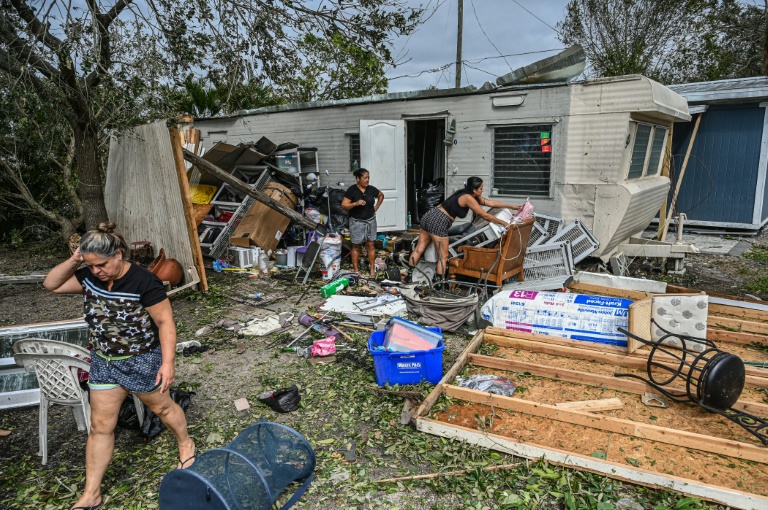
With homes and infrastructure wrecked by wind or flooding and businesses shut down, the destruction left in the wake of Hurricane Ian is expected to cost Florida tens of billions of dollars and hit the broader US economy.

The devastation will weigh on insurance companies in the southern US state, and poses a danger to uninsured homeowners as well.

After making landfall on the southwest coast of Florida on Wednesday, Ian brought strong winds and torrential rains, sometimes turning streets into rivers.

The damage estimates remain very preliminary, but it is clear “the hurricane is expected to severely disrupt economic activity over 10 days, with power cuts, flight cancellations, suspension of energy production, impact on farms agricultural crops, in particular oranges,” Gregory Daco, economist at EY-Parthenon, told AFP.

He predicted that Ian will slow Florida’s economic activity by six percentage points in the third quarter, and shave three-tenths off US GDP. 

As with all natural disasters, this economic impact will gradually lessen over time, especially when reconstruction efforts get underway, he said.

CoreLogic, a firm that specializes in property analysis, said wind-related losses from residential and commercial properties could cost insurers up to $32 billion while losses related to flooding could go as high as $15 billion.

– Top 10 list –

“This is the costliest Florida storm since Hurricane Andrew made landfall in 1992 and a record number of homes and properties were lost due to Hurricane Ian’s intense and destructive characteristics,” CoreLogic’s Tom Larsen said in a statement.

Fitch Ratings and S&P Global Ratings estimate the total cost could amount to $40 billion.

Meanwhile, Moody’s projects losses for insurers could reach $55 billion, and economic activity lost in Florida could total $10 billion. 

The average damage estimate, adjusted for inflation, is $46 billion, making Ian among the top 10 most costly hurricanes in the United States, according to Moody’s, led by Katrina in 2005 ($160 billion), and Harvey ($124 billion) and Maria ($111 billion) in 2017. 

These initial estimates do not take into account properties without flood insurance, which represent the vast majority of real estate in Florida, where insurance premiums outstrip those in many other states.

Many large insurance companies have reduced their exposure in the state, while smaller firms have gone bankrupt. National and state agencies often provide emergency aid, such as temporary housing, for impacted families, but the help is limited.

According to data from risk-management firm Milliman provided to AFP on Friday, only 18.5 percent of houses in the counties subject to evacuation orders have policies with the National Flood Insurance Program. 

The federal government program is available in areas prone to flooding, and offers coverage many private insurance companies do not provide. 

“Obviously, Florida has more environmental risks than a lot of other states just because of its geography, and because of the way the climate is changing, with more damaging storms and sea level rising,” Denise Rappmund of Moody’s Analytics told AFP.

This situation is complicated by the fact that lawyers and contractors frequently encourage Florida residents to file damage claims, which insurers then challenge, she said.

Rappmund noted that in 2019 the state accounted for just eight percent of insurance claims nationwide but more than 75 percent of the claims that went to litigation. 

“It stands to reason that we would probably see a few more liquidations” of insurance firms in Ian’s wake, Rappmund said.

Hurricane Ian damage toll in the billions, will slow US growth

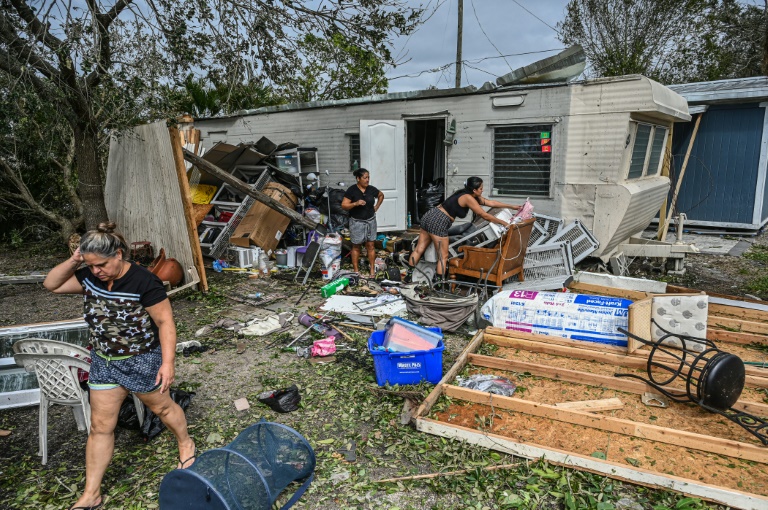
With homes and infrastructure wrecked by wind or flooding and businesses shut down, the destruction left in the wake of Hurricane Ian is expected to cost Florida tens of billions of dollars and hit the broader US economy.

The devastation will weigh on insurance companies in the southern US state, and poses a danger to uninsured homeowners as well.

After making landfall on the southwest coast of Florida on Wednesday, Ian brought strong winds and torrential rains, sometimes turning streets into rivers.

The damage estimates remain very preliminary, but it is clear “the hurricane is expected to severely disrupt economic activity over 10 days, with power cuts, flight cancellations, suspension of energy production, impact on farms agricultural crops, in particular oranges,” Gregory Daco, economist at EY-Parthenon, told AFP.

He predicted that Ian will slow Florida’s economic activity by six percentage points in the third quarter, and shave three-tenths off US GDP. 

As with all natural disasters, this economic impact will gradually lessen over time, especially when reconstruction efforts get underway, he said.

CoreLogic, a firm that specializes in property analysis, said wind-related losses from residential and commercial properties could cost insurers up to $32 billion while losses related to flooding could go as high as $15 billion.

– Top 10 list –

“This is the costliest Florida storm since Hurricane Andrew made landfall in 1992 and a record number of homes and properties were lost due to Hurricane Ian’s intense and destructive characteristics,” CoreLogic’s Tom Larsen said in a statement.

Fitch Ratings and S&P Global Ratings estimate the total cost could amount to $40 billion.

Meanwhile, Moody’s projects losses for insurers could reach $55 billion, and economic activity lost in Florida could total $10 billion. 

The average damage estimate, adjusted for inflation, is $46 billion, making Ian among the top 10 most costly hurricanes in the United States, according to Moody’s, led by Katrina in 2005 ($160 billion), and Harvey ($124 billion) and Maria ($111 billion) in 2017. 

These initial estimates do not take into account properties without flood insurance, which represent the vast majority of real estate in Florida, where insurance premiums outstrip those in many other states.

Many large insurance companies have reduced their exposure in the state, while smaller firms have gone bankrupt. National and state agencies often provide emergency aid, such as temporary housing, for impacted families, but the help is limited.

According to data from risk-management firm Milliman provided to AFP on Friday, only 18.5 percent of houses in the counties subject to evacuation orders have policies with the National Flood Insurance Program. 

The federal government program is available in areas prone to flooding, and offers coverage many private insurance companies do not provide. 

“Obviously, Florida has more environmental risks than a lot of other states just because of its geography, and because of the way the climate is changing, with more damaging storms and sea level rising,” Denise Rappmund of Moody’s Analytics told AFP.

This situation is complicated by the fact that lawyers and contractors frequently encourage Florida residents to file damage claims, which insurers then challenge, she said.

Rappmund noted that in 2019 the state accounted for just eight percent of insurance claims nationwide but more than 75 percent of the claims that went to litigation. 

“It stands to reason that we would probably see a few more liquidations” of insurance firms in Ian’s wake, Rappmund said.

US Congress signs off on $12 bn for war-torn Ukraine

The US Congress approved $12.3 billion in aid Friday to help Ukraine battle its invasion by Russia as part of a stopgap spending bill that averts a chaotic government shutdown ahead of a midnight deadline.

The package includes $3 billion for arms, supplies and salaries for Ukraine’s military and authorizes President Joe Biden to direct the Pentagon to transfer $3.7 billion in weapons and other hardware to Ukraine.

The so-called “continuing resolution” — passed by 230 votes to 201, with 10 Republicans joining the Democrats — also provides $4.5 billion for Kyiv to keep the country’s finances stable and keep the government running.

The allocation takes the US contribution to the war effort to $65 billion. It was approved just hours after Russian President Vladimir Putin annexed four Moscow-occupied Ukrainian regions, in defiance of warnings from the West. 

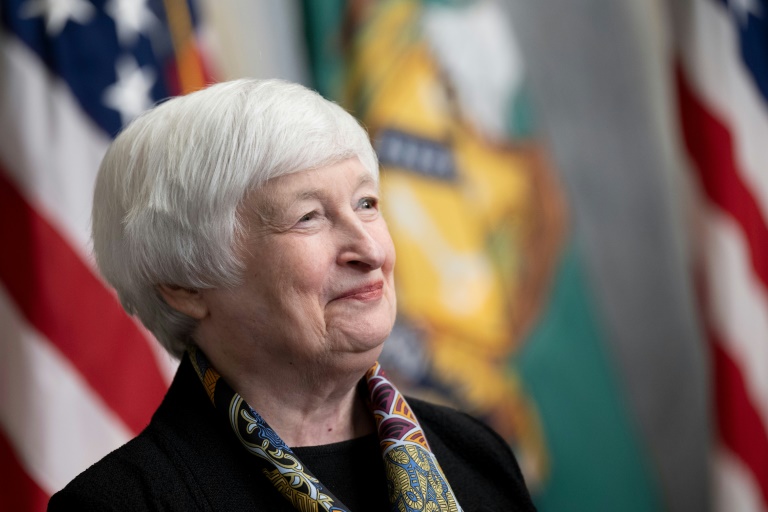
“This new grant assistance is a further demonstration of US confidence in Ukraine and will support critical government operations and provide relief to Ukrainian people suffering under Russia’s brutal war,” Treasury Secretary Janet Yellen said in a statement.

“Critically, this funding will also help bolster Ukraine’s valiant resistance to Putin’s illegal war of aggression. We call on fellow donors to not only speed up their existing disbursements to Ukraine, but also to increase their scale of assistance.”

Government shutdowns threaten the finances of hundreds of thousands of workers who risk being sent home without pay as parks, museums and other federal properties close. 

The stopgap measure, which keeps federal agencies open until December 16, cleared the Senate Thursday by a comfortable 72 votes to 25.

It includes $1 billion in winter fuel allowance for low-income families, $20 million for a clean water crisis in Jackson, Mississippi, and billions in disaster aid for various states. 

Its passage was unusually light on drama this time around, with lawmakers keen to skip town and get back to the campaign trail ahead of midterm Election Day on November 8.

A proposal attached to the package to speed up the approval process for large energy projects provided the only controversy.

But its author Joe Manchin, a Democrat with extensive interests in the fossil fuel industry, agreed to drop the text after conceding it didn’t have the support and risked sinking the entire package. 

Lawmakers rejected a request by the White House for billions of dollars for the nation’s Covid-19 and monkeypox response, amid staunch Republican opposition. 

The president last week declared the pandemic “over,” easing the path for Republicans to reject the request. 

Putin annexes Ukraine territories, Kyiv vows to fight back

Russian President Vladimir Putin on Friday annexed four parts of Ukraine occupied by his army, staging a grand ceremony in Moscow as Kyiv vowed to battle on and pushed for expedited NATO membership.

The event at the Kremlin — a turning point in recent post-Soviet history — came hours after shelling killed 25 people in Ukraine’s southern region of Zaporizhzhia in one of the worst attacks against civilians in months.

Putin was defiant during his address to Russia’s political elite, telling the West that the internationally condemned manoeuvre was irreversible and urging Ukraine’s emboldened army to negotiate a surrender.

“I want to say this to the Kyiv regime and its masters in the West: People living in Lugansk, Donetsk, Kherson and Zaporizhzhia are becoming our citizens forever,” Putin said.

“We call on the Kyiv regime to immediately stop fighting and stop all hostilities… and return to the negotiating table,” the Russian leader added.

The packed hall erupted into chants of “Russia! Russia” after the four leaders inked the deal. 

Putin — rarely seen making physical contact since the pandemic — joined hands with his proxy leaders and they shouted along in unison on state TV.

Washington announced “severe” new sanctions against Russian officials and the country’s defence industry, and said G7 allies support imposing “costs” on any nation that backs the annexation.

President Volodymyr Zelensky immediately urged the US-led military alliance NATO to grant Ukraine expedited membership, a move Kyiv had threatened earlier and that rattled Putin.

– No talks with Putin –

The Ukrainian leader doubled down in an address to the nation, vowing never to hold talks with Russia so long as Putin was in power.

“We will negotiate with the new president,” Zelensky said.

US President Joe Biden condemned Russia’s “fraudulent” declaration, vowing to keep backing Kyiv army. 

“We will continue to support Ukraine’s efforts to regain control of its territory by strengthening its hand militarily and diplomatically,” he said.

NATO chief Jens Stoltenberg condemned the annexation as “illegal and illegitimate” but remained non-committal after Ukraine said it was applying to join the Western alliance.

“France opposes this and stands with Ukraine against Russian aggression,” President Emmanuel Macron said, according to his office.

Despite warnings from Putin prior to the annexation that he could use nuclear weapons to defend the captured territories, Ukraine’s Foreign Minister Dmytro Kuleba said Kyiv would “continue liberating our land and our people”.

Hours ahead of the ceremony, an attack in Zaporizhzhia in the south, killed at least 25 people as civilians were preparing to leave to pick up relatives, Ukrainian officials said.

Bodies clothed in civilian wear were strewn across the ground after the attack and windows of cars blown out, an AFP photographer said.

One man, 56-year-old Viktor, said his life was saved because he went to get a coffee.

“The waitress gave it to me. And there was a bang. She got scared and left the cafe. A few minutes later, there was another explosion. Now she is on the floor,” he said.

“I managed to hide. She did not.”

– ‘Scared’ –

But pro-Kremlin regional chief Vladimir Rogov however said Kyiv was responsible attack in Zaporizhzhia and accused Ukrainian troops of carrying out a “terrorist act”.

In central Moscow, at least 10,000 people convened for state-organised annexation celebrations, with huge banners emblazoned: “Donetsk. Lugansk. Zaporizhzhia. Kherson. Russia!”

“I’m happy if they want to join Russia,” Natalya Bodner, a 37-year-old lawyer told AFP. “They have more hope than we do”.

“It should have been done a long time ago,” a Russian serviceman Ildar Babaev from the southern region of Dagestan said.

The four territories create a crucial land corridor between Russia and the Crimean peninsula, annexed by Moscow in 2014.

– Ukraine forces press Donetsk –

Together, all five regions including Crimea, make up around 20 percent of Ukraine, whose forces in recent weeks have been clawing back wins as part of a counter-offensive.

In Sloviansk, a city in Donetsk, a military medic who goes by the name of Coconut said the annexations were nonsense.

“If my neighbour comes to my house and announces that it’s his, nobody believes it actually belongs to him,” he told AFP.

Ukrainian forces were also on the doorstep of Lyman in Donetsk, which Moscow’s forces pummelled for weeks to capture this summer.

“Lyman is partially surrounded,” said Denis Pushilin, the pro-Moscow leader in the breakaway region of Donetsk, on social media adding later that Russian forces were holding out “with the last of their strength”.

The four regions’ Kremlin-installed leaders formally requested annexation after claiming residents backed the move in hastily organised referendums that were dismissed by Kyiv and the West as fraudulent.

The UN Security Council will vote Friday on a resolution condemning the referendums, according to France, the council’s current president, but it has no chance of passing due to Moscow’s veto power.

burs/jmm

UK teen died after 'negative effects of online content': coroner

A 14-year-old British girl died from an act of self-harm while suffering from the “negative effects of online content”, a coroner said Friday, in a case that has shone a spotlight on social media companies.

Molly Russell was “exposed to material that may have influenced her in a negative way and, in addition, what had started as a depression had become a more serious depressive illness,” Andrew Walker ruled at North London Coroner’s Court.

The teenager “died from an act of self-harm while suffering depression”, he said, but added it would not be “safe” to conclude it was suicide.

Some of the content she viewed was “particularly graphic” and “normalised her condition,” said Walker.

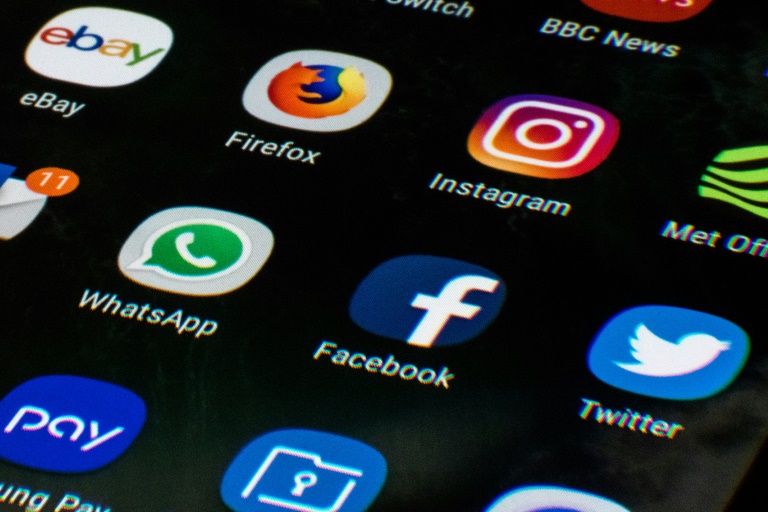
Of the 16,300 posts Russell saved, shared or liked on Instagram in the six-month period before her death, 2,100 related to depression, self-harm or suicide, the inquest was told.

Russell, from Harrow in northwest London, died in November 2017, leading her family to set up a campaign highlighting the dangers of social media.

“Molly was a thoughtful, sweet-natured, caring, inquisitive, selfless, beautiful individual — although a few words cannot possibly encapsulate our wonderful girl,” her father Ian said in a statement.

“We have heard a senior Meta (Instagram parent company) executive describe this deadly stream of content the platform’s algorithms pushed to Molly as ‘safe’ and not contravening the platform’s policies.

“If this demented trail of life-sucking content was safe, my daughter Molly would probably still be alive and instead of being a bereaved family of four, there would be five of us looking forward to a life full of purpose and promise that lay ahead for our adorable Molly.

“It’s time the toxic corporate culture at the heart of the world’s biggest social media platform changed,” he urged.

– Silicon Valley ‘shockwaves’ –

The week-long hearing became heated when the family’s lawyer, Oliver Sanders, took a Meta executive to task.

A visibly angry Sanders asked Elizabeth Lagone, the head of health and wellbeing at Meta, why the platform allowed children to use it when it was “allowing people to put potentially harmful content on it”.

“You are not a parent, you are just a business in America. You have no right to do that. The children who are opening these accounts don’t have the capacity to consent to this,” he said.

Lagone apologised after being shown footage, viewed by Russell, that “violated our policies”.

In a statement issued following the ruling, a spokeswoman for Meta said: “Our thoughts are with the Russell family and everyone who has been affected by this tragic death.

“We’ll continue our work with the world’s leading independent experts to help ensure that the changes we make offer the best possible protection and support for teens,” she added.

Children’s charity NSPCC said the ruling “must be a turning point”, stressing that any delay to a government bill dealing with online safety “would be inconceivable to parents”.

“Tech companies must be held accountable when they don’t make children’s safety a priority,” tweeted the charity. 

NSPCC chief executive Peter Wanless said the ruling should “send shockwaves through Silicon Valley”.

“The magnitude of this moment for children everywhere cannot be understated,” he added.

In a reaction later Friday, Prince William, much of whose charity work is focussed on mental health issues, said no parent should ever have to endure what the Russells had been through.

“They have been so incredibly brave. Online safety for our children and young people needs to be a prerequisite, not an afterthought.”

Hurricane Ian heads for Carolinas after ravaging Florida

Rescue workers went door-to-door in Florida on Friday to assist survivors of Hurricane Ian as the Carolinas braced for the arrival of the Category 1 storm.

Ian, one of the most powerful hurricanes ever to hit the United States, left a trail of devastation across Florida and officials said they have received reports of at least 20 deaths in the southern state.

After weakening as it crossed over Florida, the storm regained strength over the Atlantic and is bearing down on the coast of South and North Carolina packing maximum sustained winds of 85 miles per hour (140 kilometers per hour), the National Hurricane Center (NHC) said.

It warned Carolina residents that Ian could bring “life-threatening storm surge” of up to seven feet (two meters) and damaging winds.

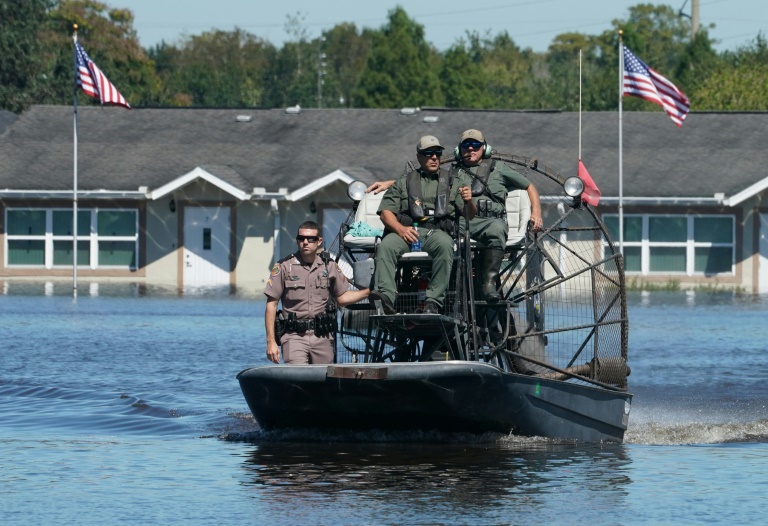
The storm left hundreds of people in need of rescue in Florida, many trapped in flooded homes.

Governor Ron DeSantis said more than 1,000 rescuers were going “up and down the coastline” checking on residents.

“Rescue personnel have gone to more than 3,000 homes in the hardest hit areas, going door to door to check on the occupants of those residences,” he told reporters.

Helicopter crews also plucked people from the rooftops of homes inundated by floodwater while other rescues were made by boat.

DeSantis said the coastal town of Fort Myers where the hurricane made landfall on Wednesday afternoon, was “ground zero” but “this was such a big storm that there are effects far inland.”

Many people evacuated, but thousands chose to shelter in place. DeSantis said Florida officials had so far contacted 20,000 people who chose to stay.

DeSantis said that it was too early to give a death toll, and that concrete information about casualty numbers could be expected over several days.

State officials said there had been one confirmed death from the hurricane and at least 20 others had been reported but have not yet been confirmed as being due to the storm.

In addition, 17 migrants were missing from a boat that sank during the hurricane on Wednesday, with one person found dead and nine others rescued, the Coast Guard said. Among them were four Cubans who swam to shore in the Florida Keys.

– ‘It was all submerged’ –

In Bonita Springs, Jason Crosser, 37, was inspecting the damage to his small store.

“The water went over the whole building. It was all submerged,” Crosser said. “It’s all saltwater and water damage.”

After making landfall in South Carolina, Ian is expected to weaken fast and dissipate by Saturday night.

Fort Myers, where Ian came ashore as a monster Category 4 storm, took much of the brunt, as streets became rivers and seawater poured into houses.

Dozens of boats moored in the marina were sunk while others were tossed onto downtown streets.

DeSantis described the destruction as a “500-year flood event.”

He said about 1.9 Florida residents remained without power on Friday. 

Two barrier islands near Fort Myers, Pine Island and Sanibel Island, popular with vacationers, were essentially cut off when the storm damaged causeways to the mainland.

– Electricity returning in Cuba –

Before pummeling Florida, Ian plunged all of Cuba into darkness after downing the island’s power network.

Electricity was gradually returning, but many homes remain without power.

Laura Mujica, 20, joined dozens of Cuban women gathered in the capital Havana on Thursday to demand electricity be restored.

“We took to the street, because we haven’t had electricity for several days and we are tired of it,” Mujica said. 

Human-induced climate change is resulting in more severe weather events across the globe, scientists say — including with Ian.

According to a rapid and preliminary analysis, human-caused climate change increased the extreme rain that Ian unleashed by over 10 percent, US scientists said.

Stocks waver, pound wobbles on mixed data

Stock markets advanced and the pound seesawed on Friday as investors tracked fresh growth and inflation data at the end of another turbulent week.

The pound jumped on revised figures showing the UK economy had avoided recession — but it swiftly fell back on expectations of an eventual downturn owing to sky-high inflation, but then moved higher again.

“Sterling has been all over the place this week,” said Fawad Razaqzada, analyst at City Index and Forex.com. “For traders, the pound is a confusing arena to be in right now.”

Britain’s borrowing costs soared and the pound hit a record dollar-low earlier this week days after the government announced a controversial tax-cutting budget. 

London stocks ended the day with a small gain.

In the eurozone, consumer prices rocketed a record 10 percent in September on soaring energy prices caused by Russia’s war on Ukraine, separate official data showed.  

Nevertheless Paris and Frankfurt stocks ended the day with gains of over one percent.

In the United States, data showed the Federal Reserve’s preferred yardstick for inflation — the personal consumption expenditures price index — was higher than expected.

“The key takeaway from the report is that the inflation the Fed says it can control (i.e. core inflation) did not move in a friendly direction in August,” said Patrick O’Hare, analyst at Briefing.com.

“Therefore, market participants can continue to expect the Fed not to be their friend with monetary policy,” he said.

Fed officials have again reiterated their intention to ramp up rates until they have tamed inflation, even if that means plunging the world’s top economy into recession.

Wall Street stocks opened lower and wobbled in early trades, but moved higher by late morning.

In Asia on Friday, Shanghai dropped as data showed China’s manufacturing and services sectors struggled again in September from Covid lockdowns in parts of the country that have battered the world’s number-two economy.

There was also little reaction to news that Beijing would allow some cities to reduce mortgage rates for first-home purchases as it tries to support the property market.

Market sentiment was being eroded also by rising fears about developments in the Ukraine war, as Russia  annexed four occupied regions of its neighbour Friday, with President Vladimir Putin threatening to use nuclear weapons to defend the territories.

– Key figures around 1530 GMT –

New York – Dow: UP 0.3 percent at 29,318.18 points

EURO STOXX 50: UP 1.2 percent at 3,318.20

London – FTSE 100: UP 0.2 percent at 6,893.81 (close)  

Frankfurt – DAX: UP 1.2 percent at 12,114.36 (close)

Paris – CAC 40: UP 1.5 percent at 5,762.34 (close)

Tokyo – Nikkei 225: DOWN 1.8 percent at 25,937.21 (close)

Hong Kong – Hang Seng Index: UP 0.3 percent at 17,222.83 (close)

Shanghai – Composite: DOWN 0.6 percent at 3,024.39 (close)

Pound/dollar: UP at $1.1143 from $1.1116 on Thursday

Euro/dollar: DOWN at $0.9797 from $0.9818

Euro/pound: DOWN at 87.97 pence from 88.28 pence

Dollar/yen: UP at 144.69 yen from 144.42 yen

Brent North Sea crude: DOWN 0.4 percent at $88.15 per barrel

West Texas Intermediate: DOWN 0.6 percent at $80.72 per barrel

burs-rl/pvh

Stocks waver, pound wobbles on mixed data

Stock markets advanced and the pound seesawed on Friday as investors tracked fresh growth and inflation data at the end of another turbulent week.

The pound jumped on revised figures showing the UK economy had avoided recession — but it swiftly fell back on expectations of an eventual downturn owing to sky-high inflation, but then moved higher again.

“Sterling has been all over the place this week,” said Fawad Razaqzada, analyst at City Index and Forex.com. “For traders, the pound is a confusing arena to be in right now.”

Britain’s borrowing costs soared and the pound hit a record dollar-low earlier this week days after the government announced a controversial tax-cutting budget. 

London stocks ended the day with a small gain.

In the eurozone, consumer prices rocketed a record 10 percent in September on soaring energy prices caused by Russia’s war on Ukraine, separate official data showed.  

Nevertheless Paris and Frankfurt stocks ended the day with gains of over one percent.

In the United States, data showed the Federal Reserve’s preferred yardstick for inflation — the personal consumption expenditures price index — was higher than expected.

“The key takeaway from the report is that the inflation the Fed says it can control (i.e. core inflation) did not move in a friendly direction in August,” said Patrick O’Hare, analyst at Briefing.com.

“Therefore, market participants can continue to expect the Fed not to be their friend with monetary policy,” he said.

Fed officials have again reiterated their intention to ramp up rates until they have tamed inflation, even if that means plunging the world’s top economy into recession.

Wall Street stocks opened lower and wobbled in early trades, but moved higher by late morning.

In Asia on Friday, Shanghai dropped as data showed China’s manufacturing and services sectors struggled again in September from Covid lockdowns in parts of the country that have battered the world’s number-two economy.

There was also little reaction to news that Beijing would allow some cities to reduce mortgage rates for first-home purchases as it tries to support the property market.

Market sentiment was being eroded also by rising fears about developments in the Ukraine war, as Russia  annexed four occupied regions of its neighbour Friday, with President Vladimir Putin threatening to use nuclear weapons to defend the territories.

– Key figures around 1530 GMT –

New York – Dow: UP 0.3 percent at 29,318.18 points

EURO STOXX 50: UP 1.2 percent at 3,318.20

London – FTSE 100: UP 0.2 percent at 6,893.81 (close)  

Frankfurt – DAX: UP 1.2 percent at 12,114.36 (close)

Paris – CAC 40: UP 1.5 percent at 5,762.34 (close)

Tokyo – Nikkei 225: DOWN 1.8 percent at 25,937.21 (close)

Hong Kong – Hang Seng Index: UP 0.3 percent at 17,222.83 (close)

Shanghai – Composite: DOWN 0.6 percent at 3,024.39 (close)

Pound/dollar: UP at $1.1143 from $1.1116 on Thursday

Euro/dollar: DOWN at $0.9797 from $0.9818

Euro/pound: DOWN at 87.97 pence from 88.28 pence

Dollar/yen: UP at 144.69 yen from 144.42 yen

Brent North Sea crude: DOWN 0.4 percent at $88.15 per barrel

West Texas Intermediate: DOWN 0.6 percent at $80.72 per barrel

burs-rl/pvh

Ketanji Brown Jackson inaugurated as first Black woman on US Supreme Court

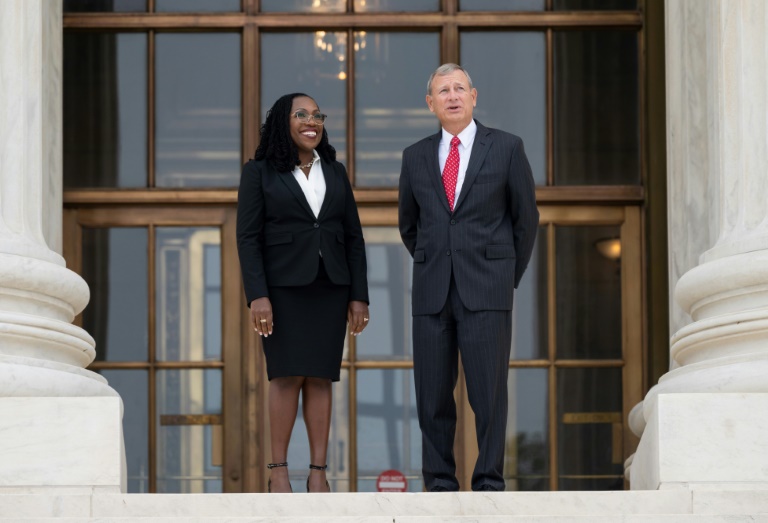
The first Black woman to sit on the US Supreme Court, Ketanji Brown Jackson, was inaugurated Friday at a ceremony in Washington attended by President Joe Biden and Vice President Kamala Harris.

Jackson, who was nominated to the top court by Biden, will be part of a progressive minority in the body that decides some of the most important social and legal issues in the United States.

But the 52-year-old may find her hands largely tied by the conservative majority of six justices — three of whom were appointed by Biden’s predecessor, Donald Trump.

That majority has wielded its power in recent months, overturning the constitutional right to abortion and strengthening gun rights. 

Jackson was chosen at the end of February by Democrat Biden, who promised during his campaign to appoint the first African-American woman to the highest judicial institution in the country. 

She replaced Justice Stephen Breyer, 84, who retired. 

Despite acute polarization surrounding the court, her Senate confirmation process went smoothly, and her arrival does not change the balance of power on the bench. 

The 2022/2023 session of the Supreme Court is scheduled to begin Monday.

Close Bitnami banner
Bitnami