US Business

EU proposes new Russia sanctions including oil price cap

The EU’s executive on Wednesday proposed a new round of sanctions on Moscow over its latest “escalation” in Ukraine, including an oil price cap and ban on Russian exports worth seven billion euros ($7 billion). 

It also plans to expand its travel blacklist and asset freezes to include high-ranking Russian defence officials and organisers of widely derided annexation votes in occupied Ukrainian territories.

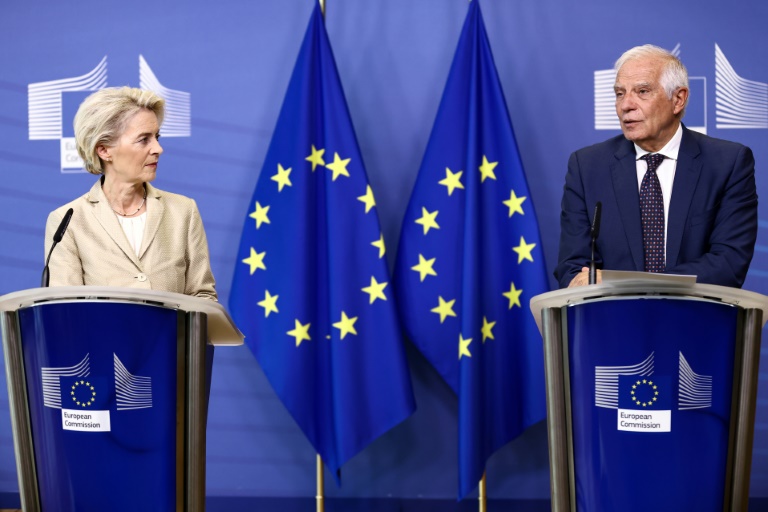
“Last week, Russia has escalated the invasion of Ukraine to a new level,” European Commission President Ursula von der Leyen said.

She listed the “sham” referendums staged by Russia in the occupied regions of Ukraine, Moscow’s military mobilisation and President Vladimir Putin’s “threat to use nuclear weapons”. 

“We’re determined to make the Kremlin pay for this further escalation,” von der Leyen said. 

As part of the new round of sanctions — which has to be signed off by the bloc’s 27 nations — the commission is laying out a “legal basis” for a price cap on Russian oil, in line with an agreement by the G7.

It will also look to ban Russian exports worth $7 billion and tighten restrictions on goods flowing from the EU that could help Russia’s war machine. 

“The aim is here to deprive the Kremlin’s military complex of key technologies,” von der Leyen said.

“For example, this includes additional aviation items, or electronic components and specific chemical substances.”

The proposal includes a prohibition on Europeans sitting on the board of Russian state-owned companies. 

EU foreign policy chief Josep Borrell said the blacklisted individuals would also include those helping Moscow to circumvent sanctions.

The bloc has already imposed seven waves of unprecedented sanctions on Moscow since it invaded its pro-Western neighbour at the end of February.  

The EU has already agreed a ban in May on most oil flowing from Russia to the bloc, to take full effect in December.

The push for an oil price cap is aimed at limiting how much third countries, such as China and India, pay for Russian crude. 

To get there, it would include restrictions on European firms shipping and ensuring Russian oil cargoes heading to the rest of the globe. 

The Baltic states, Ireland and Poland had pushed for stronger measures to be taken in this latest round, among them restricting cooperation with Russia’s commercial nuclear sector. 

That measure, though, was rebuffed by member states worried about further hitting energy supplies as Europe faces a crunch in the face of Russian cuts this winter. 
Stocks rally but investors cautious over recession fears

Global stock markets rallied on Wednesday in a volatile trading, with investors given an “energy boost” by an intervention by the Bank of England.

But geopolitical tensions continued to temper enthusiasm, analysts said, with heightened Ukraine tensions and looming recession fears.

Wall Street stocks traded up after the Bank of England’s surprise intervention in the British bond market pushed down bond yields in Britain and the United States.

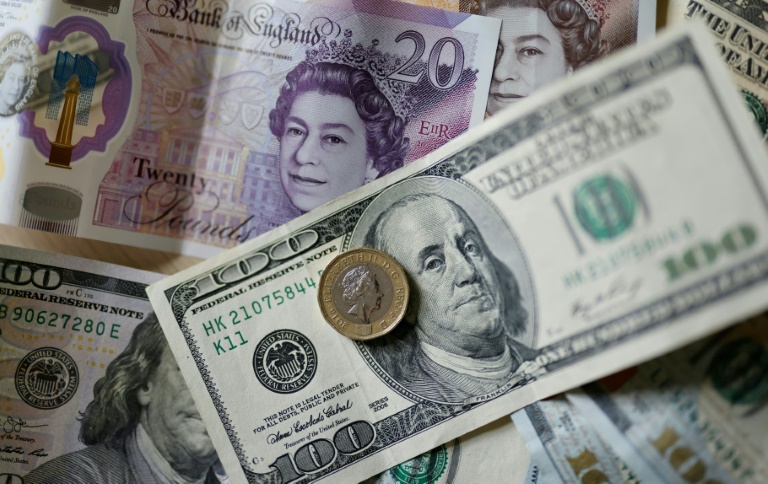
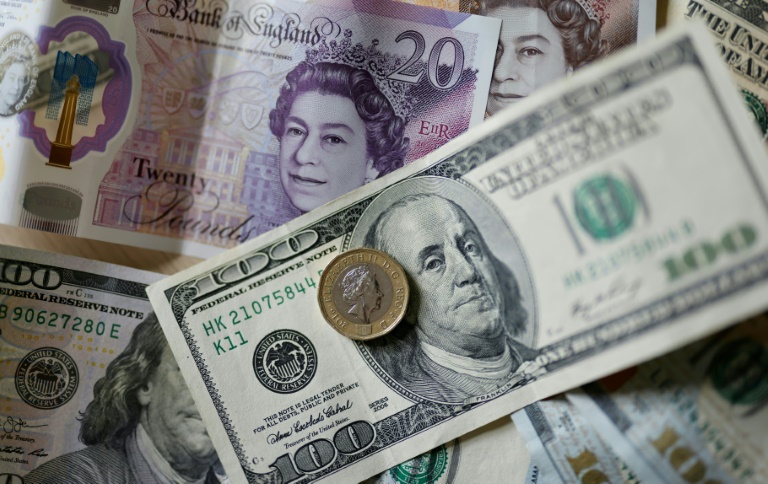
Following a historic slump in the pound, the BoE announced it was temporarily buying up long-dated UK government bonds “to restore orderly market conditions.”

“The BoE intervention helped cooling the (dollar) strength and give an energy boost to the market,” said Ipek Ozkardeskaya, senior analyst at Swissquote bank.

The UK government’s 30-year bond yield retreated to 4.44 percent after the announcement, having hit a 1998 peak at 5.14 percent.

The yield on the 10-year US Treasury note — a closely-watched proxy of US interest rates — also pulled back as analysts said the BoE manoeuvre had “soothed” investors in the short run.

Britain’s new finance minister Kwasi Kwarteng’s tax-cutting budget sent shockwaves through markets, pushing the pound to a record low and leading to dire warnings for Britain’s economy — though sterling later rallied against the US currency.

The BoE intervention followed rare criticism from the International Monetary Fund, which argued that Britain’s recent budget could increase inequality and worsen inflation.

“The BoE’s intervention is an attempt to soothe investor nerves after they were spooked by last week’s mini-budget,” said City Index analyst Fawad Razaqzada.

After early losses, major indices in London, Frankfurt and Paris all closed up Wednesday.

– Fear grips markets –

Analysts warned of looming risks in the shape of soft economic data and crumbling earning expectations.

“Fear of tightening-induced recessions has wiped out the recovery we saw in stock markets over the bulk of the summer as investors were once again burned by an over-eagerness to catch the bottom in the market, despite there being little evidence of it being justified,” said OANDA’s Craig Erlam.

“That fear has now gripped the markets and we may see a little more caution going forward,” Erlam said.

Sentiment was also rattled by worries about developments in Ukraine, after Kremlin-installed authorities in four regions under Russian control claimed victory in annexation votes, with Moscow warning it could use nuclear weapons to defend the territories.

Ukraine and its allies have denounced the so-called referendums as a sham, saying the West would never recognise the results.

Volatile oil prices also rose Wednesday, as the EU proposed a new round of sanctions on Moscow, including a possible oil price cap.

Leaks from two Russia-Germany undersea gas pipelines — which the EU said were caused by deliberate sabotage — also threatened to fuel further tensions in the energy conflict.

– Key figures at around 1550 GMT –

London – FTSE 100: UP 0.3 percent at 7005.39 points (close)

Frankfurt – DAX: UP 0.4 percent at 12183.28 (close)

Paris – CAC 40: UP 0.2 percent at 5765.01 (close)

EURO STOXX 50: UP 0.2 percent at 3335.30 (close)

New York – Dow: UP 1.1 percent at 29436.77 

Tokyo – Nikkei 225: DOWN 1.5 percent at 26,173.98 (close)

Hong Kong – Hang Seng Index: DOWN 3.4 percent at 17,250.88 (close)

Shanghai – Composite: DOWN 1.6 percent at 3,045.07 (close)

Pound/dollar: UP at $1.0748 from $1.0730 on Tuesday

Euro/dollar: UP at $0.9639 from $0.9595

Euro/pound: UP at 90.67 pence from 89.39 pence 

Dollar/yen: DOWN at 144.45 yen from 144.81 yen

Brent North Sea crude: UP 1.9 percent at $86.73 per barrel

West Texas Intermediate: UP 2.9 percent at $80.77 per barrel

burs-rfj/rox/cdw

Monster Hurricane Ian hammers Florida

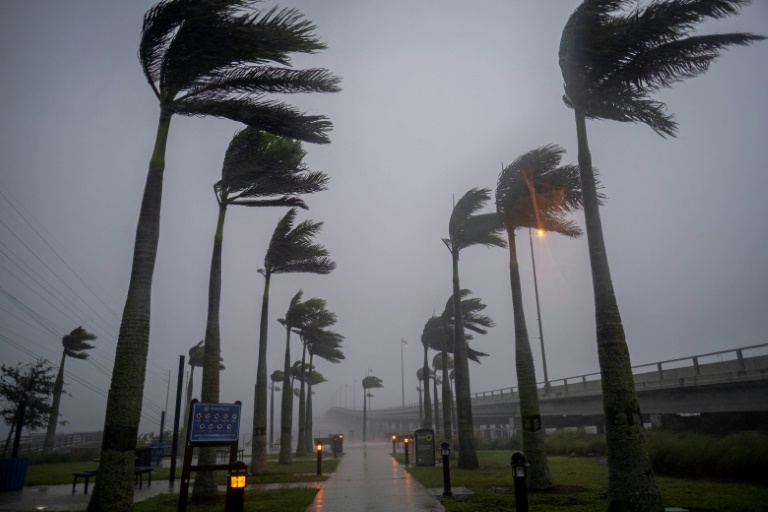
Heavy winds and rain pummelled Florida on Wednesday as Hurricane Ian intensified to just shy of the strongest Category 5 level, threatening to wreak “catastrophic” destruction on the southern US state.

Forecasters warned of a looming once-in-a-generation calamity, with life-threatening storm surges, extensive flooding and devastating winds promising what Florida Governor Ron DeSantis called a “nasty” natural disaster.

The National Hurricane Center (NHC) said in its latest advisory that the “extremely dangerous eyewall of Ian (was) moving onshore” and bringing sustained winds of 155 miles (250 kilometers) per hour, just two mph shy of Category 5 intensity — the strongest category on the Saffir-Simpson scale.

Some 2.5 million people were under mandatory evacuation orders in a dozen coastal Florida counties, with voluntary evacuation recommended in several others.

With the golden hour to flee having past — and hurricane force winds nearly touching southwestern Florida — authorities were advising residents to hunker down and stay indoors.

“Ian has strengthened into an extremely dangerous Category 4 hurricane,” the NHC said, warning of “catastrophic storm surge, winds, and flooding.”

Airports in Tampa and Orlando stopped all commercial flights, and some 337,000 households were already without power.

“This is going to be a nasty, nasty day, two days,” DeSantis said.

“It could make landfall as a Category 5, but clearly this is a very powerful major hurricane that’s going to have major impacts.”

With conditions rapidly deteriorating, some thrill-seekers were seen walking in the mud flats of Tampa Bay and in Charlotte Harbor, further south, ahead of Ian’s arrival.

The storm was expected to roar ashore in the coming hours near Fort Myers and Port Charlotte, along the state’s west coast, before moving across central Florida and emerging in the Atlantic Ocean by late Thursday.

With up to two feet (61 centimeters) of rain expected to fall on parts of the so-called Sunshine State, and a storm surge that could reach devastating levels of 12 to 18 feet (3.6 to 5.5 meters) above ground, authorities were warning of dire emergency conditions.

“This is a life-threatening situation,” the NHC warned.

– Widespread blackout –

Ian a day earlier had plunged all of Cuba into darkness after battering the country’s west as a Category 3 for more than five hours before moving back out over the Gulf of Mexico.

The storm damaged Cuba’s power network and left the island “without electrical service,” state electricity company Union Electrica said.

Only the few people with gasoline-powered generators had electricity on the island of more than 11 million people.

Others had to make do with flashlights or candles at home, and lit their way with cell phones as they walked the streets.

“Desolation and destruction. These are terrifying hours. Nothing is left here,” a 70-year-old resident of the western city of Pinar del Rio was quoted as saying in a social media post by his journalist son, Lazaro Manuel Alonso.

At least two people died in Pinar del Rio province, Cuban state media reported.

– ‘Historic event’ –

In the United States, the Pentagon said 3,200 national guardsmen had been called up in Florida, with another 1,800 on the way.

FEMA (Federal Emergency Management Agency) administrator Deanne Criswell warned that Ian’s “painful impacts” were being felt even before the hurricane’s landfall.

National Weather Service director Ken Graham echoed concerns about what lies ahead, expressing certainty Ian will leave a trail of destruction.

“This is going to be a storm we talk about for many years to come,” he said. “It’s a historic event.”

As climate change warms the ocean’s surface, the number of powerful tropical storms, or cyclones, with stronger winds and more precipitation is likely to increase. 

The total number of cyclones, however, may not.

According to Gary Lackmann, a professor of atmospheric science at North Carolina State University, studies have also detected a “potential link” between climate change and what is known as rapid intensification — when a relatively weak tropical storm surges to a Category 3 hurricane or higher in a 24-hour period, as happened with Ian.

“There remains a consensus that there will be fewer storms, but that the strongest will get stronger,” Lackmann told AFP.

Kremlin proxies in Ukraine plead to Putin for annexation

Kremlin-backed officials in Ukraine appealed to President Vladimir Putin Wednesday to annex the regions under their control, after the territories held votes denounced by Kyiv and the West as a “sham”.

Ukraine called on the EU to hit Russia with more sanctions and NATO to send more weapons to the frontline after the Kremlin-installed officials rolled out the alleged results late Tuesday.

The appeal came despite repeated warnings from Moscow that it could use its nuclear arsenal to defend the territories from a Ukrainian counter-offensive that has wrested back swathes of territory this month already.

The EU slammed the “illegal” vote and said results were “falsified”, while Chancellor Olaf Scholz said Germany would “never recognise the results of the sham referendums”.

Lugansk was the first Russian-controlled region of Ukraine to appeal to Putin to intervene, with recently captured southern regions of Zaporizhzhia and Kherson filling in shortly after.

“Our residents made a historic choice and have decided to become part of the multinational population of the Russian Federation,” the Kremlin-installed leader in Kherson, Vladimir Saldo, said in a statement published on social media.

Only Donetsk — which along with Lugansk make up the industrial Donbas region and have been partially controlled by pro-Kremlin separatists since 2014 — had yet to formally ask Putin for annexation.

The appeal to Putin represents a turning point in the seven-month invasion as Russian officials in Moscow suggest they could use nuclear weapons in Ukraine and Putin calls up thousands of Russian military draftees to cement the Kremlin’s authority in the territories.

– ‘What have we ended up with?’ –

Taken together, the four territories — Kherson and Zaporizhzhia in the south; Donetsk and Lugansk in the east — create a crucial land corridor between Russia and the Crimean peninsula, annexed by Moscow in 2014. 

Together, all five make up around 20 percent of Ukraine, whose forces in recent weeks have been clawing back ground.

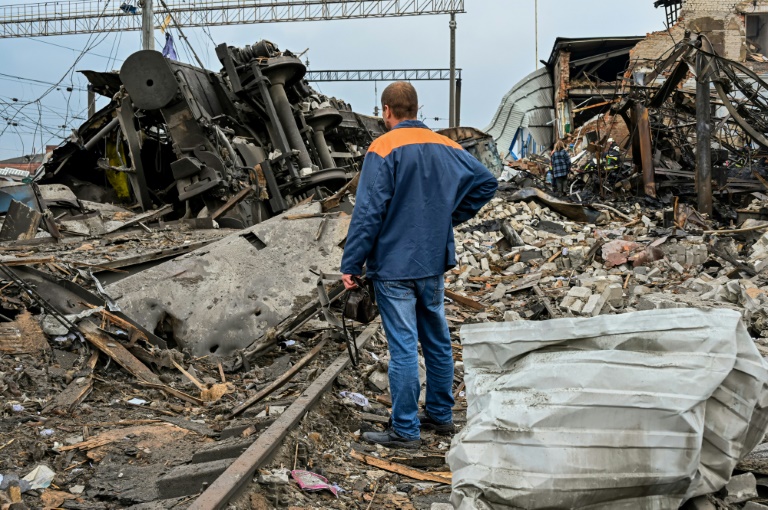
Despite those gains — particularly in the north east — Russian forces have battered the second-largest city of Kharkiv and overnight a salvo of missiles hit a railway yard, knocking out power to more than 18,000 households.

Iryna Mayor, 51, a machine operator in the rail wagon workshop, paused from shifting rubble and laying damp and torn record books out to dry, to angrily mock the invasion.

“We’re Russian-speaking people, and what have we ended up with? Have we got peace, brotherhood? No, you can see what we got,” she declared, pointing at the twisted debris surrounding the missile craters.

Lawmakers are expected to vote hastily to annex the territories now that the results have been announced, and Russian news agencies have said Putin could sign legislation formalising the land grab this week.

The EU slammed the “illegal” annexation votes and their “falsified” results, the bloc’s foreign policy chief Josep Borrell said and Scholz repeated that Germany believes the ballots carry no weight.

“Germany will never recognise the results of the sham referendums” in the regions of Donetsk, Lugansk, Kherson and Zaporizhzhia, Scholz told Ukrainian President Volodymyr Zelensky, according to the chancellor’s spokesman Steffen Hebestreit.

– ‘I’m in shock’ –

Putin’s threat to use nuclear weapons in Ukraine coincided with his decision to call up hundreds of thousands of military reservists to back up Russia’s struggling forces in eastern Ukraine.

The move has sparked panic, protests and an exodus among military-aged Russian men for neighbouring countries like Georgia and Kazakhstan.

Moscow announced Wednesday it would no longer issue passports to Russian men called up to serve and a region bordering Russia closed to passenger cars, with both moves fuelling fears in Russia that borders could close entirely.

But at a military recruitment office in Saint Petersburg there was confusion and resignation, as draftees and their families bid each other goodbye.

Nikita, a 25-year-old reservist, had tears in his eyes as he held hands with his 22-year-old fiance as he said goodbye.

“If you have to go, you have to,” he said. 

“I don’t know what to say. I am in shock,” Alina said, her gaze locked on Nikita.

Along the frontline of Ukraine, six people were injured in the Kharkiv region by Russian strikes, officials in Kyiv said, while five civilians were killed and 10 more wounded by Moscow’s forces. 

EU sees sabotage in gas pipe leaks

The EU said Wednesday that leaks from two Russia-Germany undersea gas pipelines appeared to be “a deliberate act”, as Moscow said it would call for a UN Security Council meeting over the incident.

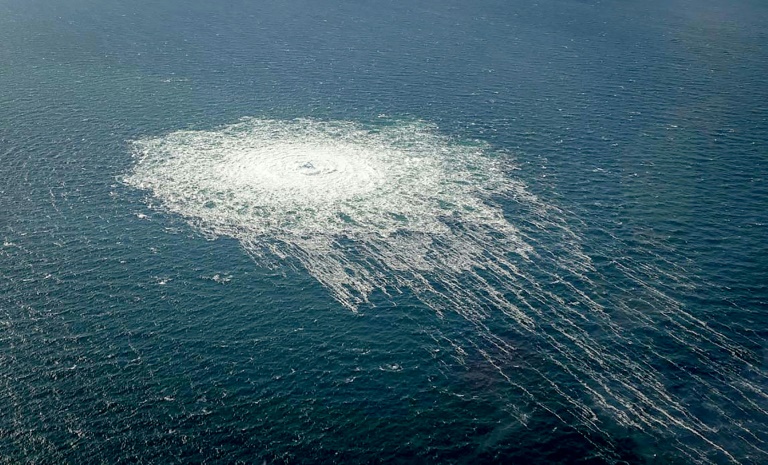
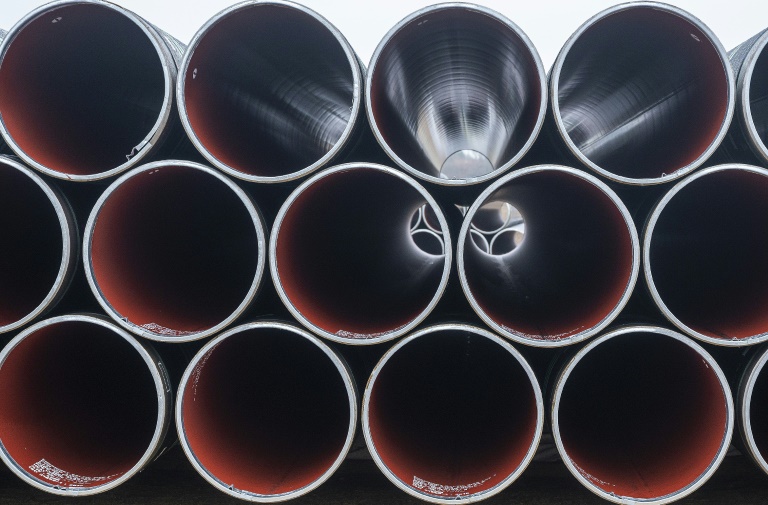
The three outflows from the Nord Stream 1 and 2 pipelines have sent natural gas prices soaring, exacerbating an energy crunch in Europe as it stands on the threshold to winter and fanning geopolitical tensions.

Methane gas from the leaks are bubbling to the surface of the Baltic Sea close to Denmark and Sweden in discharges expected to last for a week, until depletion of the gas in the pipelines.

Europe has alleged the leaks are from sabotage, and fossil fuel-rich Norway boosted security at its installations in response.

They “are not a coincidence,” EU foreign policy chief Josep Borrell said in a statement. “All available information indicates those leaks are the result of a deliberate act.”

He warned: “Any deliberate disruption of European energy infrastructure is utterly unacceptable and will be met with a robust and united response.”

Suspicion has focused on Russia, which has cut gas supplies to Europe in retaliation for severe Western sanctions over the war in Ukraine.

But the Kremlin hit back, saying it was “stupid and absurd” to accuse Russia of causing the leaks and calling instead for President Joe Biden to answer whether the US was behind them.

The Kremlin said it would ask for the United Nations Security Council to convene “in connection with provocations” over the pipeline.

EU chiefs Ursula von der Leyen and Charles Michel have both also blamed the Nord Stream leaks on sabotage, as have leaders of several European countries.

Michel tweeted that they “appear to be an attempt to further destabilise energy supply to EU”.

He added: “Those responsible will be held fully accountable and made to pay.”

The EU is currently mulling further sanctions on Russia for annexation votes imposed on four regions in Ukraine its forces occupy.

Neither of the Nord Stream pipelines are currently operational, but they were full with gas when they were hit with what Swedish seismologists said were “massive releases of energy”.

One of the seismologists told AFP “there isn’t much else than a blast that could cause it”.

Danish Defence Minister Morten Bodskov told reporters in Brussels that “it can easily take one or two weeks for the area to calm down enough” for an inspection to verify the cause.

Two Danish military vessels have been sent to the area.

Non-EU member Norway — which has now overtaken Russia as the biggest supplier of gas to Europe — said it will beef up security around its oil and gas facilities.

“The government has decided to put measures in place to increase security at infrastructure sites, land terminals and platforms on the Norwegian continental shelf,” Norwegian Energy Minister Terje Aasland said.

The Norwegian Petroleum Safety Authority earlier this week called for “increased vigilance from all operators and shipping companies on the continental shelf”.

Built in parallel to the Nord Stream 1 pipeline, Nord Stream 2 was intended to double the capacity for Russian gas imports to Germany.

But Berlin blocked newly completed Nord Stream 2 in the days before the war.

Germany, which has been highly dependent on imports of fossil fuels from Russia to meet its energy needs, has since come under acute stress as Moscow’s supplies dwindle.

Sweden and Poland agree sabotage is the most likely cause of the Nord Stream leaks, with Warsaw suggesting Russia was probably the culprit, to escalate the war in Ukraine.

Kwasi Kwarteng: baptism of fire for UK's new finance minister

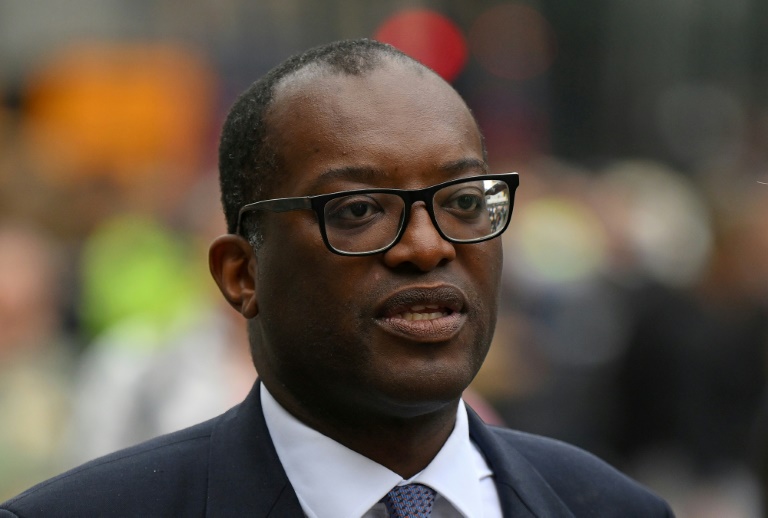
Kwasi Kwarteng has been finance minister for less than a month but is already in the firing line as Britain’s economy teeters on the brink following his first policy announcement.

The 47-year-old free-marketeer last week announced sweeping tax cuts, spooking currency and bond markets concerned about his mammoth spending commitments, and earning a rebuke from the IMF.

Kwarteng is a close ally of Liz Truss, who this month won the race to become prime minister following the resignation of scandal-hit Boris Johnson.

She was voted in by Conservative members on a promise to cut taxes, plans that her rival Rishi Sunak, who was finance minister under Johnson, said were a recipe for disaster in the face of spiralling inflation.

Kwarteng’s devout belief in liberal economics made him the obvious choice to carry out her plans, despite the warnings.

The pair were also at the forefront of urgent moves to help millions of Britons suffering under the strain of rocketing energy prices that have pushed UK inflation to a 40-year high.

Those spending plans allied with the tax cuts sent sterling plunging to its lowest-ever value against the dollar earlier this week, as critics decried the government’s “KamiKwasi” economics. 

– ‘Committed Thatcherite’ –

“There is lots of pressure on Kwasi Kwarteng,” said Tony Travers, a professor at the London School of Economics, who described the minister as a “committed Thatcherite” in reference to former leader and free-market proponent Margaret Thatcher.

“He might have started out as believing in a smaller state and a more deregulated economy, but he’s living in a world where the public expects almost exactly the opposite,” Travers told AFP.

An enthusiastic backer of Brexit, Kwarteng replaced Iraqi-born Nadhim Zahawi, who lasted only two months as chancellor.

Zahawi took over from Sunak, who resigned as finance minister in opposition to Johnson before then losing out to Truss in the contest for 10 Downing Street.

Four years before the 2016 Brexit vote, Kwarteng joined with Truss and other Tory right-wingers to write a free-market manifesto called “Britannia Unchained”, which described British workers as “among the worst idlers in the world”.

He has enthusiastically endorsed Truss’s plans for a “lean state” and to put “money back into people’s pockets”.

In presenting his controversial budget measures on September 23, Kwarteng declared it “a very good day for the UK, because we’ve got a growth plan”.

But disquiet among Tory MPs is growing ahead of the party’s annual conference next week, as opinion polls show voters strongly opposed to the budget plan including its tax cuts for the richest. 

– TV swearing –

In his previous role as energy minister, Kwarteng drew the ire of green groups after he said Russia’s invasion of Ukraine meant the UK needed further investment in North Sea drilling, to diversify its energy mix.

Britain’s first black chancellor of the exchequer, Kwarteng is the son of an economist and lawyer who emigrated to Britain from Ghana. 

The London-born Kwarteng won a scholarship to the elite school Eton, before attending both the University of Cambridge and Harvard University.

While at Cambridge, he represented Trinity College on the long-running quiz programme “University Challenge”, earning his first national media exposure for uttering an expletive when he got a question wrong.

Kwarteng worked as a financial analyst and newspaper columnist before being elected as a Tory MP in 2010.

A former department colleague, Mark Fletcher, said Kwarteng was “fiercely bright and serious” and also a huge cricket fan.

“If you can explain things to him in a cricket analogy you will always get his attention,” he told The Times.

Previously in a relationship with senior Tory MP Amber Rudd, Kwarteng is married to lawyer Harriet Edwards, who gave birth to a daughter last year.

Major energy supplier Norway ups security amid sabotage talk

After worrying drone reports and the “sabotage” of Nord Stream’s Baltic Sea pipelines, Europe’s biggest gas supplier Norway is beefing up security at its energy installations, which experts have singled out as vulnerable targets.

As spectacular as they may be, the gas leaks on the Nord Stream 1 and 2 pipelines linking Russia to Germany have no effect on Europe’s energy supply since they were not operational due to the war in Ukraine.

But a sabotage — the favoured theory among European leaders — of this type on Norwegian facilities would have a catastrophic impact on the continent, which is already struggling to meet its energy needs as winter approaches.

Norway has become Europe’s main gas supplier after Moscow cut deliveries in suspected retaliation against Western sanctions following its invasion of Ukraine.

The Scandinavian country has a vast network of pipelines linking it to the continent.

It is currently pumping at full capacity: according to official forecasts, its gas exports could set a record of 122 billion cubic metres this year.

That can be compared to the 150 billion cubic metres of gas per year that Russia supplied to the European Union before the war in Ukraine.

Faced with these stakes, Norwegian police announced Wednesday they were strengthening security measures already in place in the energy sector in a bid to reduce the risk of an attack.

“The situation is being taken very seriously and several measures have already been put in place to guarantee the best security possible”, police official Tone Vangen said in a statement.

She did not provide details, citing security reasons. 

On Tuesday, Petroleum and Energy Minister Terje Aasland made a similar announcement citing “reports of increased drone activity” near offshore oil platforms.

Norwegian energy giant Equinor has reported flights of “unidentified drones near certain installations”, a phenomenon not encountered before now.

“We are taking this very seriously and we have reported it to police,” Equinor spokesman Eskil Eriksen told AFP, providing no further details.

– Gas pipelines a weak link –

Echoing authorities, oil companies said they were taking extra precautions at their platforms, bases and land and sea installations.

Stretching over thousands of kilometres, sometimes at great depths, the oil and gas pipelines are a weak link in the energy supply chain that is so vital to Europe. 

“They are vulnerable, very exposed,” said Tor Ivar Strommen, a researcher at the Royal Norwegian Naval Academy.

He called for the introduction of additional security measures, including regular pipe inspections to ensure that explosives have not been placed there as well as closer monitoring of shipping near pipelines.

Prime Minister Jonas Gahr Store told Norwegian news agency NTB there was “no specific threat against Norway”.

But for professor and director of the Norwegian Institute for Defence Studies, Sven Holtsmark, it was “likely” that Moscow, often accused of using energy as a weapon, would try to sabotage Norwegian infrastructure.

“Before, the idea of Russia attacking Norwegian facilities would have seemed completely absurd, but we can no longer afford to exclude this possibility” in order to undermine European support for Ukraine, he told AFP.

“(Russian President) Vladimir Putin’s toolbox is running out and the war in Ukraine doesn’t seem to be going away any time soon. 

“So to me it makes sense for Putin to decide to sabotage Norwegian facilities, especially as it would be difficult to prove that Russia was behind it,” the expert added.

Experts encouraged by Alzheimer drug preliminary data

Experts on Wednesday said they were encouraged after preliminary data for a new Alzheimer’s drug showed it slowed cognitive decline, the first medicine to accomplish this goal.

The treatment, called lecanemab, was tested in a clinical trial of nearly 1,800 people, and slowed cognitive decline by 27 percent across an 18-month period, according to early results announced by makers Biogen and Eisai.

“This is the first drug that’s been shown to not only remove the build-up of a protein called amyloid in the brain, but to have a small but statistically significant impact on cognitive decline in people with early-stage disease,” said Susan Kohlhaas of Alzheimer’s UK.

But experts cautioned their comments were tempered by the preliminary nature of the results, which were announced by press release ahead of publication in a peer-reviewed journal, as the companies look to bring the treatment to market as early as January 2023 in the United States.

Biogen previously brought another Alzheimer’s drug to market called Aduhelm, but there was significant controversy over the evidence it worked, and its approval led to three high-level resignations in the US Food and Drug Administration.

According to a statement by Biogen and Eisai, in addition to slowing cognitive decline, the new treatment also slowed build-up in the brain of the protein amyloid, which forms sticky plaques and kills brain cells.

Side effects included higher rates of swelling and bleeding in the brain in the group that received the treatment compared to the group that received a placebo.

Both treatment and placebo groups had people of similar characteristics, including a broad range of underlying conditions. A quarter were either Hispanic or African American.

Michel Vounatsos, CEO of Biogen, said the announcement “gives patients and their families hope that lecanemab, if approved, can potentially slow the progression of Alzheimer’s disease.”

Masud Husain, a professor of neurology at the University of Oxford, said in a statement: “While the summary of the results certainly seems very encouraging, we have to be cautious until we are allowed to review the data fully. 

“It is also important to bear in mind that the trial results apply only to people with mild Alzheimer’s disease, not everyone with the condition, and that there were important side effects of the drug, including bleeds in the brain.”

Musk seeks to lift regulator 'muzzle' on Tesla tweets

Tesla chief Elon Musk has asked a New York court to overturn a provision in an agreement with the US securities regulator requiring a lawyer’s pre-approval of tweets related to the electric vehicle company.

In a court document filed Tuesday evening with a Manhattan federal appeals court, Musk’s lawyers described the provision as “a government-imposed muzzle.”

“The effect of the provision is to inhibit and chill Mr. Musk’s lawful speech,” they said, decrying the requirement as “unconstitutional.”

Billionaire Musk was reprimanded by the Securities and Exchange Commission after posting a tweet in 2018, in which he said he had acquired funding to take Tesla private, but did not provide proof or file paperwork with the SEC.

The tweet, which caused share prices to fluctuate wildly, was ruled to be “false and misleading” and shareholders accused Tesla of securities fraud.

The SEC also charged Musk with fraud and ordered him to step down as chair of Tesla’s board of directors, pay a $20 million fine and, after another controversial tweet in early 2019, demanded his tweets directly related to business of the company be vetted by a lawyer before posting.

An attempt by Musk to free himself from oversight was rejected in April, with US District Judge Lewis Liman ruling the “claim that he was the victim of economic duress is wholly unpersuasive.”

He found that Musk did not want to adhere to the agreement anymore as “his company has become, in his estimation, all but invincible.”

Musk, whose fortune is estimated by Forbes to be nearly $260 billion, is also locked in a lawsuit with Twitter over a potential acquisition of the micro-blogging platform, with the trial due to take place in October.

Stocks slump, dollar surges on recession fears

Global stock markets mostly sank Wednesday and the dollar soared as investors fretted over recession fears and heightened Ukraine tensions.

“With the prospect of a sharp economic slowdown, further pain for households and businesses, and investor sentiment on its knees, alas equities markets continue their descent,” said AJ Bell investment director Russ Mould.

The major Asian markets all closed down, and European stocks were down through afternoon trading.

The US was the exception, with markets edging up slightly at the open.

The British pound slumped 1.7 percent against the haven dollar — despite the Bank of England snapping up UK government bonds to try to bring calm to markets.

However, the UK government’s 30-year bond yield managed to retreat to 4.44 percent, having hit a 1998 peak at 5.14 percent.

The BoE intervention followed rare criticism Tuesday from the International Monetary Fund, which argued that Britain’s recent budget could increase inequality and worsen inflation.

Credit ratings agency Moody’s also waded in overnight with a warning about soaring debt.

New finance minister Kwasi Kwarteng’s tax-cutting plan last week sent shockwaves through markets, pushing the pound to a record low and leading to dire warnings for Britain’s economy.

“The BoE’s intervention is an attempt to soothe investor nerves after they were spooked by last week’s mini-budget,” said City Index analyst Fawad Razaqzada.

– Go-to dollar –

The dollar remains the go-to unit as the US Federal Reserve leads the way in raising interest rates.

Observers are betting that US borrowing costs will peak at around 4.75 percent next year, and are expected to remain elevated for some time.

The prospect of such tight monetary policy has battered equities, as US 10-year Treasury yields — a gauge of future rates — hit four percent for the first time since 2010.

“Fear of tightening-induced recessions has wiped out the recovery we saw in stock markets over the bulk of the summer as investors were once again burned by an over-eagerness to catch the bottom in the market, despite there being little evidence of it being justified,” said OANDA’s Craig Erlam.

“That fear has now gripped the markets and we may see a little more caution going forward,” he said.

Sentiment was also rattled by worries about developments in Ukraine, after Kremlin-installed authorities in four regions under Russian control claimed victory in annexation votes, with Moscow warning it could use nuclear weapons to defend the territories.

Ukraine and its allies have denounced the so-called referendums as a sham, saying the West would never recognise the results.

– Key figures at around 1345 GMT –

London – FTSE 100: DOWN 0.3 percent at 6,984.59 points

Frankfurt – DAX: DOWN 0.3 percent at 12104.37 

Paris – CAC 40: DOWN 0.5 percent at 5,728.16 

EURO STOXX 50: DOWN 0.4 percent at 3,315.49

New York – Dow: UP 0.2 percent at 29,193.25 

Tokyo – Nikkei 225: DOWN 1.5 percent at 26,173.98 (close)

Hong Kong – Hang Seng Index: DOWN 3.4 percent at 17,250.88 (close)

Shanghai – Composite: DOWN 1.6 percent at 3,045.07 (close)

Pound/dollar: DOWN at $1.0655 from $1.0730 on Tuesday

Euro/dollar: DOWN at $0.9587 from $0.9595

Euro/pound: UP at 90.67 pence from 89.39 pence 

Dollar/yen: DOWN at 144.43 yen from 144.81 yen

Brent North Sea crude: UP 0.1 percent at $85.67 per barrel

West Texas Intermediate: UP 1.0 percent at $79.46 per barrel

burs-rfj/rox/cdw

Close Bitnami banner
Bitnami