US Business

Russia to face UN heat as Zelensky urges punishment

Russia is set to face direct pressure Thursday at the United Nations over its invasion of Ukraine, whose leader Volodymyr Zelensky appealed to the world to punish Moscow.

As global leaders convened for the annual General Assembly, the Security Council will hold a special session among foreign ministers called by France on impunity for rights abuses in Ukraine.

The morning session is expected to bring Russian Foreign Minister Sergei Lavrov face to face with top Western diplomats including Secretary of State Antony Blinken, who has refused a one-on-one meeting since the February 24 invasion.

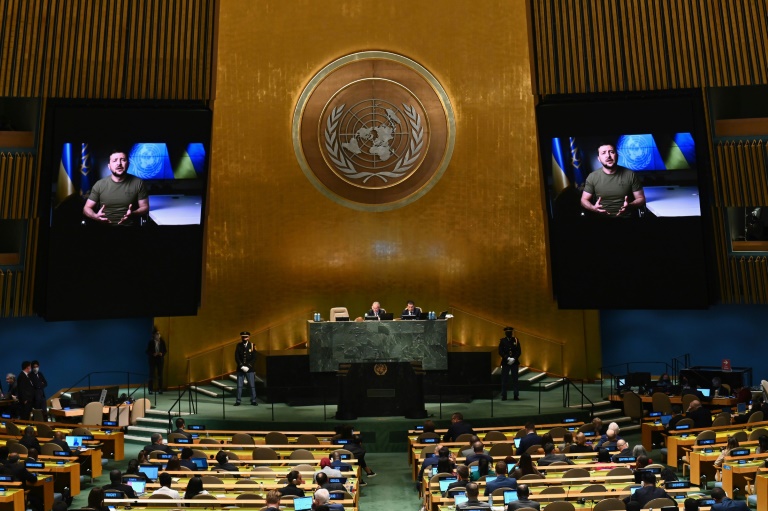
After two years of pandemic restrictions, only one leader was still allowed to address the General Assembly virtually — Zelensky, who in a pre-recorded video called 15 times for “punishment” of Russia and received a rare standing ovation.

“Ukraine demands punishment for trying to steal our territory. Punishment for the murders of thousands of people. Punishment for tortures and humiliations of women and men,” Zelensky said in English.

Zelensky called for a special tribunal to hold Russia accountable, saying it would be a “signal to all would-be aggressors.”

He also demanded a compensation fund, saying Russia “should pay for this war with its own assets.”

His address came hours after Russian President Vladimir Putin mobilized reservists and made a veiled threat to use nuclear weapons, signs that he is in no rush to end the war.

Zelensky made clear he saw no point to immediate talks, saying Russia only used diplomacy to buy time on the battlefield.

“Russia is afraid of real negotiations and does not want to fulfill any fair international obligations. It lies to everyone — as is typical for aggressors, for terrorists.”

– New pressure by West –

European Union foreign ministers held an emergency meeting late Wednesday in New York where the bloc’s top diplomat Josep Borrell said they considered new sanctions against Russia.

British Prime Minister Liz Truss, addressing the United Nations on her first foreign trip, vowed that her government “will not rest until Ukraine prevails.”

“At this crucial moment in the conflict, I pledge that we will sustain or increase our military support to Ukraine for as long as it takes,” she said.

As Western nations including top EU economy Germany try to wean themselves off dependence on Russian energy, Truss called as well for an “economic NATO” among the Group of Seven powers and their partners.

“If the economy of a partner is being targeted by an aggressive regime, we should act to support them — all for one, and one for all,” she said.

Zelensky has become a symbol of resistance in the West, which has responded with wide sanctions on Russia and billions of dollars in military equipment for Ukraine.

But the former actor appeared conscious of the resentment in the developing world about the focus on Ukraine. He pointed to the lack of African and Latin American representation on the Security Council as he called for Russia to be stripped of its veto power.

US President Joe Biden also sought to woo the developing world, announcing another $2.9 billion to address global food insecurity — which has worsened markedly since the invasion of Ukraine, a major grain exporter.

And he threw his support behind Security Council seats for Africa and Latin America.

“Russia has shamelessly violated the core tenets of the United Nations Charter,” Biden told the General Assembly.

“Let us speak plainly. A permanent member of the United Nations Security Council invaded its neighbor — attempted to erase the sovereign state from the map.”

The United States has previously offered verbal support but little enthusiasm for years of calls to reform the Security Council. It has earlier backed bids by Japan and India.

Biden also promised the United States would “refrain from the use of the veto, except in rare, extraordinary situations, to ensure the council remains credible and effective.”

Russia in recent years has been the most frequent user of its veto power. The United States, China, France and Britain also enjoy vetoes, a legacy of the power dynamics at the end of World War II.

Russia has previously scoffed at US high-mindedness on the Security Council, pointing to how former president George W. Bush circumvented it to invade Iraq.

Kenyan President William Ruto, addressing the General Assembly, welcomed Biden’s remarks on reform as a “significant step in the right direction.”

– No ‘Cold War’ with China –

Amid warnings of rising global division, Biden also sought to calm tensions with China, days after he again promised US support to Taiwan if Beijing invades the self-governing democracy.

“As we manage shifting geopolitical trends, the United States will conduct itself as a reasonable leader. We do not seek conflict, we do not seek a Cold War,” Biden said.

The Biden administration has been encouraged by what it sees as China’s less than full backing of Putin, who recently acknowledged that Beijing has concerns about the Ukraine war.


Trump, children sued for 'incredible' fraud in New York

Donald Trump and family members lied to tax collectors, lenders and insurers for years in a scheme that routinely misstated the value of his properties to enrich themselves, according to a suit filed by New York’s attorney general on Wednesday.

Top state prosecutor Letitia James said that with the help of his children and others at the Trump Organization, the former president provided fraudulent statements of his net worth and false asset valuations “to obtain and satisfy loans, get insurance benefits, and pay lower taxes.”

“In short, he lied to gain massive financial benefits for himself.”

The sweeping investigation is one of many criminal, civil and congressional probes into Trump, who is eyeing another run for the White House in 2024.

Trump repeated his oft-used defense that the suit is “another witch hunt” against him, while his spokesperson denounced it as a political move by Democrats against the Republican businessman.

James’ office requested that the former president pay at least $250 million in penalties — a sum she says he made from the fraud — and that his family be banned from running businesses in the state. 

She also urged that Trump along with his children Donald Trump Jr, Eric Trump and Ivanka Trump be barred from purchasing property in the state for five years.

“The very foundation of his purported net worth is rooted in incredible fraud and illegality,” James said in a statement.

Referring the title of Trump’s book “The Art of Deal,” she said that “Mr. Trump thought he could get away with the art of the steal, but today, that conduct ends.”

– ‘Staggering’ overvaluations –

James said her office, which lacks authority to file criminal charges, was making a criminal referral to the US Justice Department as well as the Internal Revenue Service based on the three-year investigation.

The lawsuit filed with the New York State Supreme Court includes allegations that Trump’s annual financial statements for at least a decade grossly inflated property values across his assets — from his Mar-a-Lago resort in Florida to Manhattan’s Trump Tower — to a “staggering” degree.

He did so to obtain favorable loans with lower interests and premiums, said James, who is running to be re-elected to her post in November.

The suit details tactics used by Trump and his associates, saying they would represent that he had cash on hand when he didn’t, change valuation properties wildly, and use “objectively false numbers to calculate property values” including at his famous triplex on Fifth Avenue.

“White collar financial crime is not a victimless crime,” James said.

“When the well-connected break the law to take in more money than they are entitled to, it reduces resources available to working people, to regular people, to small businesses and to all tax payers.”

James’ lawsuit requests that a judge appoint an independent authority to monitor the Trump Organization’s financial practices, and remove the Trumps from their own family business.

– Web of investigations –

New York authorities have been probing Trump and his family business since 2018, when the Manhattan district attorney opened a probe into the then-president who has long vied to present himself as a self-made billionaire.

James’ civil inquiry began the next year, after Trump’s former lawyer gave testimony that indicated the company had engaged in misconduct.

The DA’s criminal probe has not resulted in any charges as of yet.

Last month Allen Weisselberg, the Trump Organization’s long-time finance chief, pleaded guilty to tax fraud and agreed to testify at an upcoming criminal trial of the former US president’s real estate company.

He is to serve five months in prison contingent on his testifying truthfully at the October criminal trial of the Trump Organization on tax fraud charges, the Manhattan District Attorney Alvin Bragg said last month.

FBI agents separately searched Trump’s palatial Mar-a-Lago residence in Florida on August 8 and seized numerous boxes of documents, including some marked “Top Secret,” “Secret” and “Confidential.”

His lawyers have tried to block the government’s access to those files, requesting that an independent arbiter sort through the documents to determine if any fall under special legal privileges.

A federal judge sided with Trump and allowed the appointment of a so-called special master, though the government appealed her decision to block their access to those documents marked as classified.

A three-judge appellate panel, two of whom were nominated by Trump, agreed on Wednesday that government should regain access to the classified documents.

Trump is also facing legal scrutiny for his efforts to overturn the results of the November 2020 election and over the January 6, 2021 attack on the US Capitol by his supporters.

Swiss mull banning factory farms

The Swiss will vote Sunday on whether to ban intensive livestock farming in the largely rural country, which already has some of the world’s strictest animal welfare laws.

The animal rights and welfare organisations behind the initiative want to make protecting the dignity of farm animals like cattle, chickens or pigs a constitutional requirement.

Their proposal, which received more than the 100,000 signatures needed to put any issue to a popular vote under Switzerland’s famous direct democracy system, would essentially eradicate all factory farming.

“We believe animal agriculture is one of the defining problems of our time,” animal welfare group Sentience, which presented the initiative, says on its website.

It points to the “immense suffering experienced by animals on factory farms,” but also to scientific studies showing that “industrial animal husbandry is disastrous for the environment and detrimental to our health”.

If accepted, the initiative — which has the backing of left-leaning parties, Greenpeace and other environmental organisations — would impose stricter minimum requirements for animal-friendly housing and care, access to outdoors, and slaughtering practices.

It would also significantly shrink the maximum number of animals per pen.

– Price hikes –

The government and parliament oppose the initiative, insisting that Switzerland already has strict animal welfare laws defining how much living space each animal should have.

The initiative “goes too far,” Swiss Health Minister Alain Berset told reporters in June, maintaining that the government for the past quarter century had been promoting “respectful animal husbandry”.

According to the current laws, farms cannot keep more than 1,500 fattening pigs, 27,000 broiler chickens or 300 calves, basically ruling out the kinds of massive factory farms seen in other countries.

“There is no factory farming in Switzerland,” insisted Marcel Dettling, a farmer and parliamentarian with the populist right-wing Swiss People’s Party.

Pointing out that limits in neighbouring Germany for instance can be 100 times higher, he told Swissinfo.ch that the initiative would only serve to hike prices. 

Sentience campaign manager Philipp Ryf, however, said that when you have 27,000 chickens crammed into a pen and only 12 percent of farm animals ever go outside, “we do think that is factory farming”.

He acknowledged to AFP that the law in Switzerland “is quite strong compared to other countries”, but added: “We don’t necessarily think that’s a good metric.”

“We want to look at what we are doing… We think we could be doing more.”

The government has also warned that if the initiative passes, prices would swell, and has cautioned it could also impact relations with trading partners.

This is because the requirements would also apply to the import of animals and animal products, which the government says would force Switzerland to violate its World Trade Organization obligations and to renegotiate trade agreements.

The Swiss would also have to invest large amounts in costly inspections of foreign farms, it argues.

– ‘Misconception’ –

Such arguments appear to have convinced a growing number of Swiss.

While early polls indicated that a slim majority was in favour of the initiative, the latest gfs.bern poll last week saw the “no” camp take the lead, with 52 percent of those questioned opposed to the move.

The farmers themselves appear particularly sceptical. 

The latest poll showed 62 percent of those questioned in rural areas rejecting the proposal, while 53 percent of city-dwellers surveyed said they would vote in favour.

Ryf said the strong opposition in rural areas was largely due to a well-funded campaign by the initiative’s opponents that had spread the “misconception” it would be bad for farmers.

“We regret that, because we do believe that our initiative will be good for farmers,” he said, pointing out that it would provide them support and 25 years to implement the changes.

While Switzerland’s largest farmers association is staunchly opposed to the initiative, many of those running smaller farms support it. 

David Rotzler, who has a small, diverse livestock farm in Sonvilier in northern Switzerland, told the Journal du Jura daily that “animal welfare does not depend on the size of the farm, but on the farmer”.

But, he said, it is certainly “easier to care for animals when you are smaller”.

Embattled Suns owner Sarver to sell NBA club

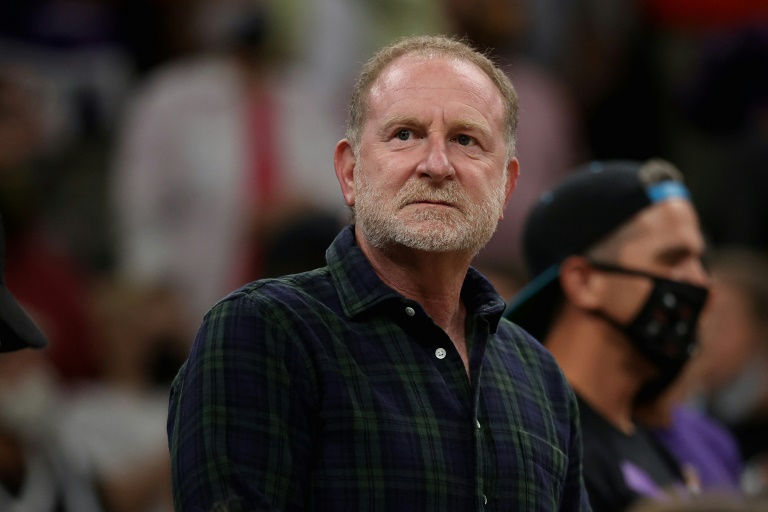
Phoenix Suns owner Robert Sarver, banned for a year and fined $10 million by the NBA for racist and misogynist remarks and workplace bullying, said Wednesday he will sell the team.

Following the punishments imposed last week, NBA players union executive director Tamika Tremaglio called for Sarver to be banned for life, and NBA stars LeBron James and Chris Paul declared the penalties too light.

Major sponsor PayPal said it would not renew its deal with the team if Sarver were still involved, and Suns vice chairman Jahm Najafi called for Sarver to resign.

“In our current unforgiving climate, it has become painfully clear… whatever good I have done, or could still do, is outweighed by things I have said in the past,” Sarver said in a statement.

“For those reasons, I am beginning the process of seeking buyers for the Suns and (Women’s NBA) Mercury.”

Sarver’s decision was welcomed by NBA commissioner Adam Silver as well as Sarver’s co-owners and the NBA Players’ Association.

“I fully support the decision by Robert Sarver to sell the Phoenix Suns and Mercury,” Silver said in a statement. “This is the right next step for the organization and community.”

Added NBPA president CJ McCollum: “We thank Mr. Sarver for making a swift decision that was in the best interest of our sports community.”

Silver had said when the sanctions were announced that he didn’t think the violations rose to the level of forcing Sarver, the Suns managing partner, to sell the club, as was done in 2014 with former Los Angeles Clippers owner Donald Sterling over racist remarks.

Los Angeles Lakers superstar James, a four-time NBA Most Valuable Player, had said the league “got this wrong” with that decision.

On Wednesday, he tweeted his approval that Sarver will sell.

“I’m so proud to be a part of a league committed to progress!” James said.

In announcing the sale, Sarver declared it “the best course of action for everyone”.

Sarver was banned and fined after a 10-month probe into his 18-year tenure at the Suns.

The NBA had commissioned the investigation in the wake of a damning ESPN report on the club’s “toxic” work environment.

Investigators found that Sarver “engaged in conduct that clearly violated common workplace standards, as reflected in team and League rules and policies”.

“This conduct included the use of racially insensitive language; unequal treatment of female employees; sex-related statements and conduct; and harsh treatment of employees that on occasion constituted bullying,” their report said.

– Courage to come forward –

Investigators, from the law firm of Wachtell, Lipton, Rosen & Katz, said multiple witnesses told them Sarver’s aggressive behavior often seemed intended “solely to provoke a reaction from employees — to embarrass them or assert dominance over them.”

Sarver said Wednesday he thought the one-year suspension would give him time to “focus, make amends and remove my personal controversy from the teams that I and so many fans love.”

Amid the ongoing criticism, however, he decided that he didn’t want to be “a distraction.”

Suns Legacy Partners, the group that manages the Suns and Mercury, said the decision was “in the best interest of the organization and community.”

The group acknowledged the “courage of the people who came forward” and said Sarver’s departure was only part of the task of reshaping the work environment of the franchise.

“While we are proud of our progress and the culture of respect and integrity we are building, we know there remains work to do and relationships to rebuild,” their statement said.

US jury orders Meta to pay $174.5 mn for violating patents

A US jury on Wednesday ordered Meta to pay $174.5 million for violating live-streaming patents developed by a US Army veteran seeking to fix shortcomings in battlefield communications.

A trial in Texas federal court ended with jurors deciding that “live” features at Facebook and Instagram used technology patented by Voxer, a company co-founded by Tom Katis, legal documents showed.

“We believe the evidence at trial demonstrated that Meta did not infringe Voxer’s patents,” a company spokesperson said in response to an AFP inquiry.

“We intend to seek further relief, including filing an appeal.”

Katis had reenlisted in the army after the September 11, 2001 attacks in the United States and served as a Special Forces communications sergeant in Afghanistan, court filings said.

When his combat unit was ambushed in Kunar province, he felt that the systems for coordinating reinforcements, medical evacuations and more “were ill-suited for time-sensitive communications with multiple groups in a highly disruptive environment,” the complaint said.

“Mr. Katis and his team began developing communications solutions in 2006 to remedy these shortcomings,” his lawyers said.

“The new technologies enabled transmission of voice and video communications with the immediacy of live communication and the reliability and convenience of messaging.”

Facebook approached San Francisco-based Voxer about potential collaboration after it launched a Walkie Talkie app in 2011, but no agreement was reached, according to legal documents.

Instead, the lawsuit argued, Facebook went on to launch Facebook Live and Instagram Live, incorporating Voxer technology into the features.

US jury orders Meta to pay $174.5 mn for violating patents

A US jury on Wednesday ordered Meta to pay $174.5 million for violating live-streaming patents developed by a US Army veteran seeking to fix shortcomings in battlefield communications.

A trial in Texas federal court ended with jurors deciding that “live” features at Facebook and Instagram used technology patented by Voxer, a company co-founded by Tom Katis, legal documents showed.

“We believe the evidence at trial demonstrated that Meta did not infringe Voxer’s patents,” a company spokesperson said in response to an AFP inquiry.

“We intend to seek further relief, including filing an appeal.”

Katis had reenlisted in the army after the September 11, 2001 attacks in the United States and served as a Special Forces communications sergeant in Afghanistan, court filings said.

When his combat unit was ambushed in Kunar province, he felt that the systems for coordinating reinforcements, medical evacuations and more “were ill-suited for time-sensitive communications with multiple groups in a highly disruptive environment,” the complaint said.

“Mr. Katis and his team began developing communications solutions in 2006 to remedy these shortcomings,” his lawyers said.

“The new technologies enabled transmission of voice and video communications with the immediacy of live communication and the reliability and convenience of messaging.”

Facebook approached San Francisco-based Voxer about potential collaboration after it launched a Walkie Talkie app in 2011, but no agreement was reached, according to legal documents.

Instead, the lawsuit argued, Facebook went on to launch Facebook Live and Instagram Live, incorporating Voxer technology into the features.

IAEA, Western powers air growing worries on Ukraine nuclear plant

The UN nuclear watchdog and Western powers voiced alarm Wednesday over the safety of Ukraine’s Zaporizhzhia atomic power plant as Kyiv accused Russia of new shelling.

The strike by Russian “terrorists” damaged a power line at the facility, forcing a brief launch of emergency generators, Ukrainian nuclear operator Energoatom said on Telegram.

But it said radiation levels remained normal.

Rafael Grossi, director of the UN’s International Atomic Energy Agency (IAEA), renewed his warning of “playing with fire” at the plant.

“The situation is still getting worse and we can’t wait for something regrettable to happen,” Grossi said at United Nations headquarters in New York.

“I’ve proposed technical parameters to give the necessary protection to this installation,” he told reporters after a meeting led by French President Emmanuel Macron.

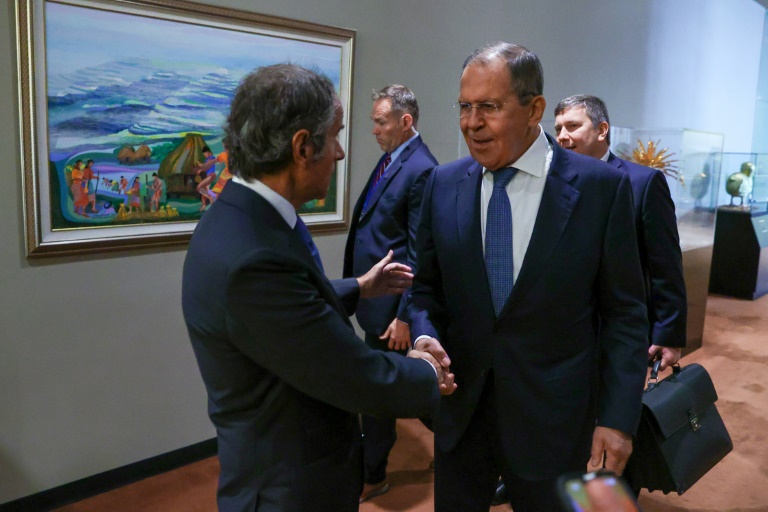
Grossi said he had met in New York with Russian Foreign Minister Sergei Lavrov on Wednesday and was speaking later with Ukraine’s top diplomat Dmytro Kuleba.

But he acknowledged the lack of progress in his recommendation of a security zone around the plant.

“Demilitarizing is an objective but for now it’s about protecting the plant,” Grossi said.

Ukrainian President Volodymyr Zelensky, in a video address Wednesday to the UN General Assembly, warned that Russian President Vladimir Putin has turned the Zaporizhzhia plant “into a target,” something he said should raise profound alarm worldwide.

“Russian radiation blackmailing is something that should concern each and every one of you, because none of you will find a vaccine against radiation sickness,” he said.

In a joint statement, top diplomats from powers including the United States, France, Britain and Germany said they had “grave concern” over Ukraine’s nuclear facilities.

They laid out seven “indispensable pillars” for nuclear safety including that safety and security systems “remain fully functional at all times.”

Energoatom called for “more resolute actions” against Russia, saying that even “the presence of IAEA inspectors does not stop” them.

Europe’s largest atomic facility was seized by Russian troops in March, and shelling around it has spurred calls from Kyiv and its Western allies to demilitarize areas around nuclear plants in Ukraine.

Early in the war, there was fighting around Chernobyl in the north, where an explosion in 1986 left swaths of the surrounding territory contaminated.

Putin has warned of “catastrophic” consequences of fighting there, leading Ukraine to charge that Moscow is using the security of Zaporizhzhia as blackmail.

Russia was accused on Monday of bombing a third nuclear plant, Pivdennoukrainsk, in the southern Mykolaiv region.

Pressure grows after World Bank chief dodges climate questions

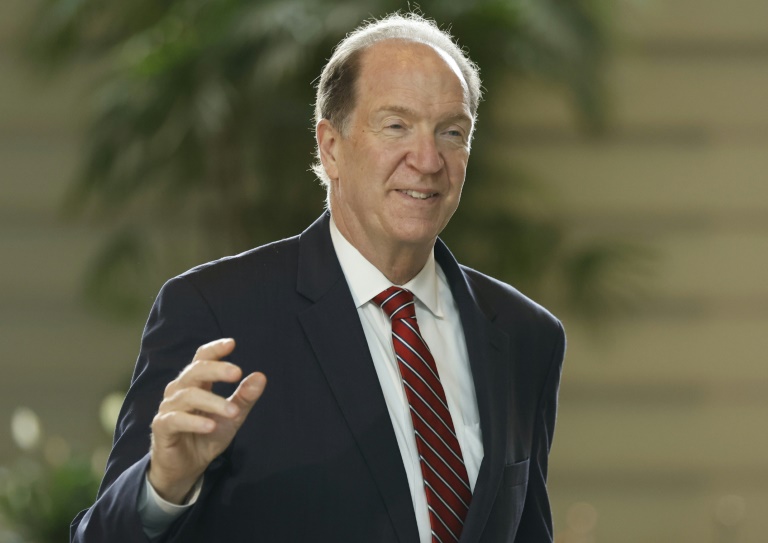
Climate groups called Wednesday for the World Bank’s president to be removed after he refused multiple times to say if he believed man-made emissions contributed to global warming.

Activists have previously called for David Malpass to resign or be removed for what they say is an inadequate approach to the climate crisis.

The head of the World Bank is traditionally an American while the other big international lender in Washington, the IMF, tends to be European. Malpass is a veteran of Republican administrations in the United States and was appointed in 2019 while Donald Trump, who famously and repeatedly denied the science behind climate change, was president.

The chorus against Malpass grew louder after his appearance Tuesday at a New York Times conference on climate finance.

Asked by a journalist to respond to former US vice president Al Gore’s claim that he was a climate denier, Malpass said that some of his critics “may not know what the World Bank is doing.” He boasted that its climate funding is “by far the biggest” among international financial institutions.

After another attempt failed to get a straight answer, the journalist, David Gelles, said: “Let me just be as clear as I can: Do you accept the scientific consensus that the man made burning of fossil fuels is rapidly and dangerously warming the planet?”

Malpass again pointed to the World Bank’s work on the issue, at which point multiple people in the audience shouted: “Answer the question!”

“I don’t even know. I’m not a scientist,” responded a clearly frustrated Malpass.

The Big Shift, a consortium of climate groups, called Wednesday for the World Bank’s board to remove Malpass over the comments.

“For the World Bank to maintain any shred of decency Malpass cannot remain as President,” said Tasneem Essop, executive director of the Climate Action Network, a Big Shift member group.

A separate group of activist organizations said they would on Thursday unveil a banner at the World Bank’s headquarters in Washington that reads: “The World Bank Group is Run by a Climate Denier.”

Malpass’s term ends in 2024 and he can only be removed by a vote of the World Bank’s board.

Climate groups have called on President Joe Biden to up the outside pressure.

Biden’s climate change envoy, former US secretary of state John Kerry, declined during an appearance at the same Times event to comment on Malpass’s future, saying “that’s the president’s decision.”

The World Bank declined to comment on the situation when reached by AFP.

NASA says delayed Moon rocket passed fueling test

NASA said Wednesday it had successfully trialed the fueling process for its new rocket, after technical issues a few weeks ago halted two attempts to get the behemoth off the ground and headed towards the Moon.

“All of the objectives that we set out to do we were able to accomplish today,” said Charlie Blackwell-Thompson, launch director of the program called Artemis 1.

The unmanned mission hopes to test the new 30-story SLS rocket as well as the unmanned Orion capsule that sits atop it, in preparation for future Moon-bound journeys with humans aboard.

The last attempt in early September to launch NASA’s most powerful rocket yet had to be aborted because of a leak while its cryogenic fuels — liquid hydrogen and oxygen — were being pumped into the rocket’s tanks.

Repairs were carried out and Wednesday’s test involved filling those tanks again.

Though a small hydrogen leak was detected during the test, NASA engineers were able to get it under control.

Last week NASA said it is now aiming for September 27 as the next date for liftoff. October 2 was set as a backup date.

“Teams will evaluate the data from the test, along with weather and other factors, before confirming readiness to proceed into the next launch opportunity,” NASA said.

Asked about the timing of the next launch attempt, Blackwell-Thompson declined to comment, though she said she was “extremely encouraged by the test today.”

US officials are also keeping a close eye on Hurricane Fiona’s trajectory off the coast in the Atlantic.

For the September 27 date to be possible, NASA must receive a waiver to avoid retesting the batteries on a detonation system used to destroy the rocket if it strays uncontrollably off course.

The next mission, Artemis 2, would take astronauts to the Moon without landing on its surface, while the third — set for the mid-2020s — would see the first woman and person of color on lunar soil.

NASA wants to build a lunar space station called Gateway and keep a sustained presence on the Moon to gain insight into how to survive very long space missions, ahead of a mission to Mars in the 2030s.

Global Fund raises $14.25 billion to end HIV, TB and malaria

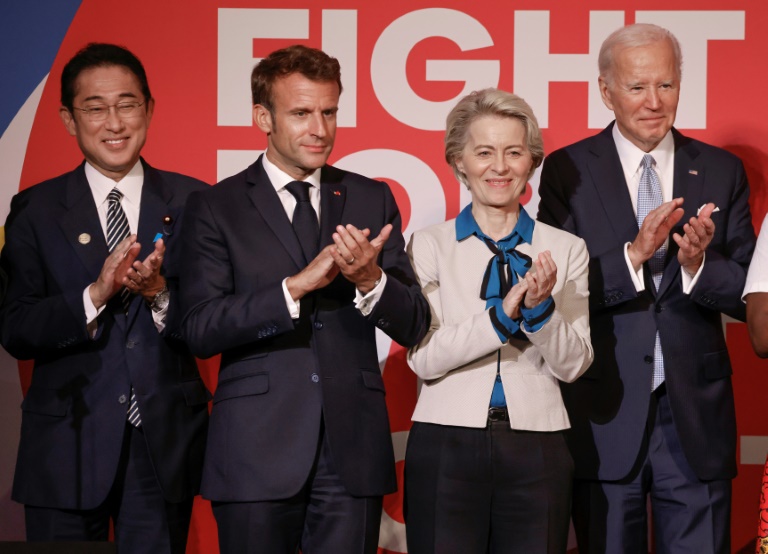
The Global Fund to Fight AIDS, Tuberculosis and Malaria raised $14.25 billion Wednesday at a donor conference led by US President Joe Biden, as decades of progress against the diseases are set back by Covid.

It was the highest amount ever pledged for a multilateral health organization — but fell far short of the ambitious goal of $18 billion after the United Kingdom and Italy said their announcements would come later.

The Global Fund was created in 2002, bringing together governments, multilateral agencies, civil society groups and the private sector. Funding cycles last three years.

“What’s happened today is actually an unparalleled mobilization of resources for global health,” said Global Fund executive director Peter Sands, adding he expected Britain and Italy to make their pledges in due course.

“Thank you all for stepping up, especially in a challenging global economic environment, and I ask you, keep it going,” urged Biden. 

Among countries, the United States pledged the highest amount, $6 billion, followed by France with 1.6 billion euros, 1.3 billion euros by Germany, $1.08 billion by Japan, Can$1.21 billion by Canada and 715 million Euros by the European Union.

The Gates Foundation pledged $912 million.

The $18-billion goal was based on getting back on track to end AIDS, TB and malaria by 2030, recovering ground lost during the Covid pandemic and saving 20 million lives over the next three years.

The target was 30 percent more than that raised during the organization’s sixth and most recent replenishment, hosted by President Emmanuel Macron of France in 2019, which raised a then-record $14 billion.

Camille Spire, president of the French non-profit AIDES, told AFP that when the UK and Italy make their pledges, the sum would still be unlikely to reach the original goal.

“While some are counting their pennies, some are counting the dead,” she said, adding she was “angry” and the outcome would mean fewer screening campaigns than had been hoped for, fewer treatments, less funding for community health centers and less strengthening of health systems.

There was also criticism within the UK. Shadow foreign secretary David Lammy tweeted the delay in pledging “will slow the fight against AIDS, TB and malaria and damage the UK’s national interest.”

– Signs of recovery – 

The fund estimates it has reduced the death toll from AIDS, TB, and malaria by 50 percent, saving more than 50 million lives over the past two decades.

Last year, it warned that the Covid pandemic was having a devastating impact on its work, leading to declining results across the board for the first time in its history.

It said in its latest report, however, that the massive resources it had pumped into countering the downturn had paid off and “recovery is underway” against all three diseases.

The Global Fund provides 30 percent of all international financing for HIV programs, 76 percent of funding for TB, and 63 percent of funding for malaria.

Its other areas of focus include improving the resilience of local health systems, and raising funds against Covid-19.

According to US law, the country cannot provide more than one-third of funding for the Global Fund — a limit that serves as a matching challenge to other nations to double the American pledge.

Close Bitnami banner
Bitnami