US Business

UK probes Microsoft's $69 bn bid for gaming giant

Britain on Thursday announced an “in-depth investigation” into Microsoft’s planned $69-billion takeover of US gaming giant Activision Blizzard, citing UK competition concerns.

US technology giant Microsoft in January announced a bid to create the world’s third biggest gaming company by revenue, behind China’s Tencent and Japan’s Sony, by purchasing the owner of hit games “Candy Crush” and “Call Of Duty”.

The proposed deal, already controversial owing to allegations of sexual harassment against women at Activision, now faces a probe by Britain’s Competition and Markets Authority.

“The CMA has referred the anticipated acquisition by Microsoft Corporation of Activision Blizzard, Inc. for an in-depth investigation,” a statement said. 

It added that the “merger may be expected to result in a substantial lessening of competition within a market or markets in the United Kingdom”.

Activision Blizzard’s portfolio also includes the popular game “World Of Warcraft”.

Sorcha O’Carroll, senior director of mergers at the CMA, previously expressed concern that Microsoft could use its control over Call Of Duty and World Of Warcraft “to harm rivals, including recent and future rivals in multi-game subscription services and cloud gaming”.

Sony has expressed concerns that Call of Duty might no longer be accessible on its PlayStation console.

Microsoft dismissed such a suggestion, however, saying in a statement Thursday that “it makes zero business sense… to remove Call of Duty from PlayStation given its market leading console position”.

Stocks sag as inflation fears persist

Stock markets retreated on Thursday as investors fret over red-hot inflation and the prospect of tighter monetary policy.

Wall Street’s three main indices spent part of the morning in positive territory, but then sank lower.

If the Dow was off only marginally, the broader S&P 500 shed 0.6 percent and the tech-heavy Nasdaq Composite fell 1.1 percent.

London dipped less than a tenth of a percent, but both Frankfurt and Paris fell further.

“The markets remain skittish following recent hot inflation readings that led to a sharp selloff on Tuesday,” analysts at US firm Schwab said in a note.

The data showed US annual consumer price inflation slowing by 8.3 percent in August from 8.5 percent in July but markets had expected a bigger fall.

The reading sparked a rout on equities as it stoked concern of more hefty Federal Reserve interest rate hikes.

While higher borrowing costs help to cool inflation, they can also put a brake on economic growth.

Global consumer prices have soared this year on Russia’s invasion of Ukraine — which has hiked energy and food costs — and because of supply chain strains worsened by Covid lockdowns in China.

Investors were also tracking US government data on Thursday which showed a surprise, 0.3 percent bounce in retail sales in August.

But while the headline gain was much better than the flat result economists had projected, the figure for July was revised down to show a 0.4 percent drop, so the August increase means the total remains below the level in June.

“The key takeaway from the report is that it does not connote much vigor in retail spending activity in August,” said analyst Patrick O’Hare at Briefing.com.

First-time jobless claims also fell last week, indicating the US labour market remains tight, and giving Fed policymakers more latitude to continue aggressively raising interest rates.

“Today’s US data dump did little to change the market’s view of what the Fed might do next week,” said Forex.com analyst Fawad Razaqzada.

“Investors are confident the US central bank will tighten monetary policy by 75 basis points on Wednesday, something which could push the economy into slowdown and cause earnings to decline.”

– Oil, yen tumble –

Razaqzada said in this economic environment investors are finding it difficult to hold onto stocks which pay low dividends and are taking profits when they can.

Eventually, though, equities will “price in” or reflect the expectations of interest rate hikes. 

“Until this happens, it is unlikely that the stock market will be able to shine very brightly,” said Razaqzada.

Asian bourses mostly logged cautious gains Thursday, but Shanghai and Seoul dipped.

The yen was under pressure as weak Japanese data further fuelled speculation of possible intervention from the Bank of Japan to support the unit.

Crude prices tumbled nearly four percent following a warning from the International Energy Agency that growth in demand could halt in the final months of this year. 

– Key figures at around 1530 GMT –

New York – DOWN less than 0.1 percent at 31,124.96 points

EURO STOXX 50: DOWN 0.9 percent at 3,534.08

London – FTSE 100: DOWN less than 0.1 percent at 7,274.08 (close)

Frankfurt – DAX: DOWN 0.7 percent at 12,937.69 (close)

Paris – CAC 40: DOWN 1.2 percent at 6,147.37 (close)

Tokyo – Nikkei 225: UP 0.2 percent at 27,875.91 (close) 

Hong Kong – Hang Seng Index: UP 0.4 percent at 18,930.38 (close)

Shanghai – Composite: DOWN 1.2 percent at 3,199.92 (close)

Dollar/yen: UP at 143.43 yen from 143.08 yen late Wednesday

Euro/dollar: UP at $0.9992 from $0.9981

Pound/dollar: DOWN at $1.1493 from $1.1539

Euro/pound: UP at 86.97 pence from 86.49 pence 

Brent North Sea crude: DOWN 3.8 percent at $90.74 per barrel

West Texas Intermediate: DOWN 3.8 percent at $85.09 per barrel

burs-rl/lth

Indonesia investigating Google over app store payment system

Indonesia has launched an anti-trust investigation into Google over the tech firm’s insistence that its payment system be used for purchases from its app store, authorities said Thursday, accusing it of unfair business practices.

The US internet giant has been under legal scrutiny in a number of countries over its stipulation that its billing system be used by all buyers on Google Play.

Authorities in Jakarta said in a statement they suspected “Google has abused its dominant position by imposing conditional sales and discriminatory practices in digital application distribution in Indonesia”.

Google Play is the largest app distribution platform in Indonesia, a country of 270 million people.

Third party developers offering their apps on Google Play are charged a 15 to 30 percent service fee, higher than the five percent imposed by other payment systems, according to an initial probe by the nation’s anti-trust agency.

“The respective developers cannot refuse the obligation because Google can impose sanctions by removing their applications from the Google Play store and preventing them from making updates to their applications,” the agency said.

Google did not immediately reply to a request for comment from AFP.

The American multinational has faced a barrage of legal cases in the United States, Europe and Asia based on similar accusations.

Google has also faced claims that it unfairly forced its search engine and Chrome internet browser on phone makers using the Android operating system.

On Wednesday, the European Union’s second-highest court ruled that “Google imposed unlawful restrictions on manufacturers of Android mobile devices”.

That case was the third of three major cases brought against Google by the EU’s competition czar Margrethe Vestager, whose legal challenges were the first worldwide to directly take on Silicon Valley tech giants.

South Korea fined Google nearly $180 million last year for abusing its dominant market position in a similar case regarding the Android system.

Putin, Xi hail 'great power' ties at talks defying West

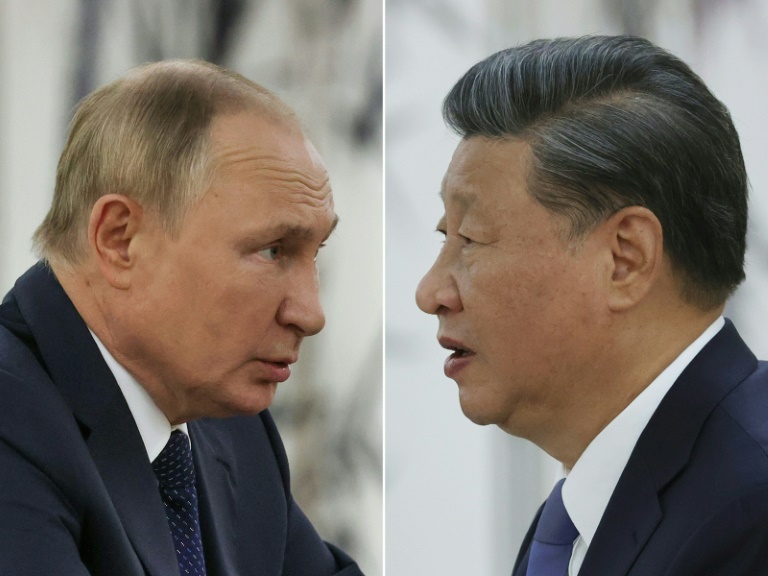
Russian President Vladimir Putin and Chinese leader Xi Jinping met for their first face-to-face talks since the start of the conflict in Ukraine on Thursday, hailing their strategic ties in defiance of the West.

Sitting across from each other at two long rounded tables and flanked by aides, the two leaders met on the sidelines of a summit of the Shanghai Cooperation Organisation (SCO) in ex-Soviet Uzbekistan. 

The meeting was part of Xi’s first trip abroad since the early days of the pandemic and for Putin a chance to show Russia has not been fully isolated despite Western efforts.

“China is willing to make efforts with Russia to assume the role of great powers, and play a guiding role to inject stability and positive energy into a world rocked by social turmoil,” Xi told Putin at the talks.

Chinese state broadcaster CCTV also quoted Xi as saying China was willing to work with Russia to support “each other’s core interests”.

Putin took a clear broadside at the United States, which has been leading efforts to support Ukraine and impose sanctions on Russia.

“Attempts to create a unipolar world have recently acquired an absolutely ugly form and are completely unacceptable,” Putin said.

“We highly appreciate the balanced position of our Chinese friends in connection with the Ukrainian crisis,” Putin told Xi, while reiterating Moscow’s backing for China on Taiwan.

“We adhere to the principle of one China. We condemn the provocation of the US and their satellites in the Taiwan Strait,” Putin said, after a US Senate committee on Wednesday took the first step towards Washington directly providing billions of dollars in military aid to Taiwan.

– ‘Alternative’ to West –

It was the first in-person meeting between the two leaders since Putin saw Xi in early February for the Winter Olympic Games, days before the Russian leader launched the military offensive in Ukraine.

The Kremlin has touted the SCO summit in the ancient Silk Road city of Samarkand as showing there is an “alternative” to Western dominated international institutions.

The SCO — made up of China, India, Pakistan, Russia and the ex-Soviet Central Asian nations of Kazakhstan, Kyrgyzstan, Tajikistan and Uzbekistan — was set up in 2001 as a political, economic and security organisation to rival Western institutions.

The leaders of those countries were to attend, as well as Iranian President Ebrahim Raisi, Turkish President Recep Tayyip Erdogan and President Alexander Lukashenko of Belarus.

Putin met with the leaders of Kyrgyzstan and Turkmenistan earlier Thursday, as well as with Raisi and Pakistani Prime Minister Shehbaz Sharif. 

With both Raisi and Sharif he said ties were “developing positively”, while the Iranian leader told Putin that US-backed sanctions on both countries would only make their relationship “stronger”.

“The Americans think whichever country they impose sanctions on, it will be stopped, their perception is a wrong one,” Raisi said.

For Putin, the summit comes at an important time, as his forces face major battlefield setbacks in Ukraine and amid a continued Western push to make Russia an international pariah.

For Xi, it is an opportunity to shore up his credentials as a global statesman ahead of a pivotal congress of the ruling Communist Party in October.

The Chinese leader also met Thursday with Belarus’s strongman leader Lukashenko, who was quoted by state news agency Belta as thanking Xi for China’s “serious support in these difficult times”.

Lukashenko has been shunned by Western leaders after a fierce crackdown on the opposition two years ago and for backing Russia on Ukraine.

– ‘No-limits’ relationship –

Formerly Cold War allies with a tempestuous relationship, China and Russia have drawn closer in recent years as part of what they call a “no-limits” relationship acting as a counterweight to the global dominance of the United States.

The two countries have also stepped up military cooperation, with China sending hundreds of troops to take part in military exercises last month in Russia’s Far East.

The defence ministry in Moscow said Thursday that Russian and Chinese warships were on a joint patrol in the Pacific and planning a live-fire artillery exercise at sea. 

The main day of the SCO summit will be on Friday, with sessions involving all the attending leaders. 

Putin was also set to hold talks Friday with Erdogan and Indian premier Narendra Modi.

Security was tight in Samarkand, a city of grand tiled mosques that was one of the hubs of Silk Road trade routes between China and Europe, with a huge police presence on the streets and armoured vehicles parked downtown.

Florida governor flies migrants to toney Martha's Vineyard

Florida Governor Ron DeSantis took credit Thursday for sending two planeloads of undocumented Venezuelans to wealthy Martha’s Vineyard, Massachusetts, as Republicans play up immigration issues before the November election.

Around 50 of the migrants, including children, landed Wednesday on the island, where Democratic presidents from John F. Kennedy to Bill Clinton and Barack Obama have summered.

According to Dylan Fernandes, a local state legislator, they were flown on chartered flights that took off from Texas.

And on Thursday two buses reportedly also from Texas deposited dozens of migrants in front of the Washington residence of Vice President Kamala Harris, the latest of such moves by Texas Republican Governor Greg Abbott.

“Immigrants are being dropped off on Martha’s Vineyard by chartered flights from Texas. Many don’t know where they are. They say they were told they would be given housing and jobs,” Fernandes wrote on Twitter.

“Republicans who call themselves Christians have been plotting for some time to use human lives — men, women, and children — as a political pawns. It is evil and inhumane,” he said.

The moves came as DeSantis and Abbott, two of the country’s most prominent and combative Republican governors, have sought to highlight politically the issues of tens of thousands of migrants trying to cross the southwest border into the United States each month.

Abbott, whose state is the first destination for most of the migrants crossing from Mexico,  has been sending buses of them northward, mainly to Washington, Chicago and New York, since April. 

Abbott says the action is to provide relief to Texas border communities.

The Texas governor said Thursday that Vice President Harris claims the border is secure and denies the existence of an immigration crisis.

“We’re sending migrants to her backyard to call on the Biden administration to do its job & secure the border,” he tweeted.

DeSantis has supported Abbott and his aides said he was behind the flight to Martha’s Vineyard.

While his state is not on the southwest border, it is a destination for many migrants entering the country legally and illegally.

DeSantis is also seeking reelection in the November midterm vote, and is also a top contender to run for president under the Republican banner in 2024.

“States like Massachusetts, New York, and California will better facilitate the care of these individuals who they have invited into our country,” DeSantis spokesperson Taryn Fenske told US media when asked about the flights to Martha’s Vineyard.

US rail companies, unions reach 'tentative' deal to avert strike

US President Joe Biden announced Thursday that railroad companies and unions had reached a tentative deal to avert a strike that had threatened to disrupt travel and supply chains.

The agreement was reached after marathon talks at the Labor Department in Washington that began Wednesday and stretched late into the night.

Biden, in a statement released by the White House, said the deal, which comes two months before midterm elections, “is an important win for our economy and the American people.

“The hard work done to reach this tentative agreement means that our economy can avert the significant damage any shutdown would have brought,” the president said.

“These rail workers will get better pay, improved working conditions, and peace of mind around their health care costs: all hard-earned.”

Unions representing freight company workers had threatened to go on strike at midnight on Friday if a deal had not been reached.

The Association of American Railroads, which represents the nation’s freight railroads, welcomed the agreement, which calls for a 24 percent wage increase between 2020 and 2024.

Major freight carrier Union Pacific said it “looks forward to the unions ratifying these agreements and working with employees as we focus on restoring supply chain fluidity.”

– Amtrak restoring services –

Amtrak, the US rail passenger operator, which had announced plans to cancel long-distance train services if freight workers went on strike, said it would immediately get trains rolling again.

“Amtrak is working to quickly restore canceled trains and reaching out to impacted customers to accommodate on first available departures,” it said in a statement.

In his statement, Biden called the deal a “win for tens of thousands of rail workers who worked tirelessly through the pandemic to ensure that America’s families and communities got deliveries.”

“I thank the unions and rail companies for negotiating in good faith and reaching a tentative agreement that will keep our critical rail system working and avoid disruption of our economy,” he said.  

Biden regularly expresses strong support for workers but is also struggling to avoid further economic damage ahead of the midterm congressional elections in early November.

Voters already are worried about soaring prices in the post-pandemic economy, where supply chain issues have been a constant scourge and annual inflation has surged to a 40-year high.

The Association of American Railroads had warned that a strike would bring 7,000 trains to a halt, costing $2 billion a day.

Biden in July appointed an arbitration panel to facilitate the discussions and head off a work stoppage. 

Farmers and retailers had warned that a strike would hit US supply chains already battered by the Covid-19 pandemic.

“There is no real substitute for moving agricultural goods,” warned American Farm Bureau Federation president Zippy Duvall.

US rail companies, unions reach 'tentative' deal to avert strike

US President Joe Biden announced Thursday that railroad companies and unions had reached a tentative deal to avert a strike that had threatened to disrupt travel and supply chains.

The agreement was reached after marathon talks at the Labor Department in Washington that began Wednesday and stretched late into the night.

Biden, in a statement released by the White House, said the deal, which comes two months before midterm elections, “is an important win for our economy and the American people.

“The hard work done to reach this tentative agreement means that our economy can avert the significant damage any shutdown would have brought,” the president said.

“These rail workers will get better pay, improved working conditions, and peace of mind around their health care costs: all hard-earned.”

Unions representing freight company workers had threatened to go on strike at midnight on Friday if a deal had not been reached.

The Association of American Railroads, which represents the nation’s freight railroads, welcomed the agreement, which calls for a 24 percent wage increase between 2020 and 2024.

Major freight carrier Union Pacific said it “looks forward to the unions ratifying these agreements and working with employees as we focus on restoring supply chain fluidity.”

– Amtrak restoring services –

Amtrak, the US rail passenger operator, which had announced plans to cancel long-distance train services if freight workers went on strike, said it would immediately get trains rolling again.

“Amtrak is working to quickly restore canceled trains and reaching out to impacted customers to accommodate on first available departures,” it said in a statement.

In his statement, Biden called the deal a “win for tens of thousands of rail workers who worked tirelessly through the pandemic to ensure that America’s families and communities got deliveries.”

“I thank the unions and rail companies for negotiating in good faith and reaching a tentative agreement that will keep our critical rail system working and avoid disruption of our economy,” he said.  

Biden regularly expresses strong support for workers but is also struggling to avoid further economic damage ahead of the midterm congressional elections in early November.

Voters already are worried about soaring prices in the post-pandemic economy, where supply chain issues have been a constant scourge and annual inflation has surged to a 40-year high.

The Association of American Railroads had warned that a strike would bring 7,000 trains to a halt, costing $2 billion a day.

Biden in July appointed an arbitration panel to facilitate the discussions and head off a work stoppage. 

Farmers and retailers had warned that a strike would hit US supply chains already battered by the Covid-19 pandemic.

“There is no real substitute for moving agricultural goods,” warned American Farm Bureau Federation president Zippy Duvall.

Schiphol CEO quits over Amsterdam airport chaos

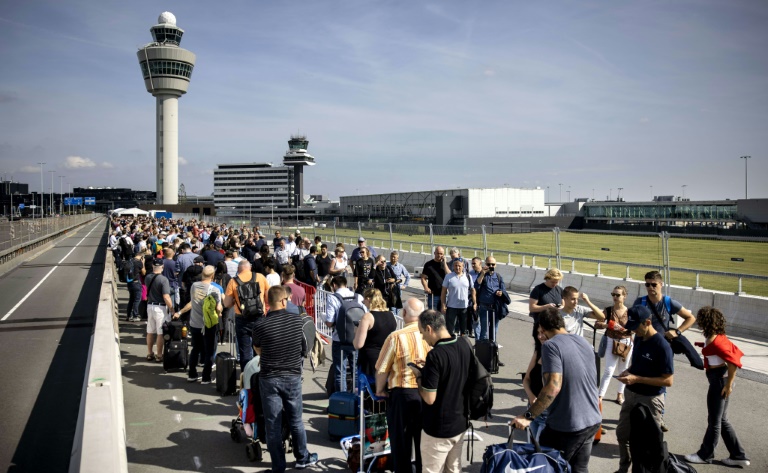
Amsterdam’s Schiphol airport chief executive Dick Benschop announced his resignation on Thursday following months of chaos at one of Europe’s largest transport hubs, plagued by long queues and baggage handling issues.

The troubles at Schiphol were among the worst in a summer where the global aviation industry struggled to cope with a surge in travel due to staff shortages after laying off thousands during the Covid pandemic. 

Benschop’s decision comes as Europe’s second-largest airport again on Monday asked airlines to cancel flights and passengers had to stand in line for hours before catching flights.

“There is a lot of attention, and also criticism, for the way in which Schiphol is tackling the problems and for my responsibility as CEO,” Benschop said in a statement.

“I am making room on my own initiative to give Schiphol the space to make a new start,” he said.

Benschop warned that Schiphol was due to announce further “bad news” measures “today or tomorrow for the coming weeks” which will lead to further disruption at the airport, which at its peak in 2019 handled almost 72 million passengers.

Benschop, a former top manager at Shell and deputy minister announced his resignation at a meeting of the airport’s supervisory board on Wednesday night.

“He will remain in his function until a successor has been appointed,” Schiphol added in the statement.

Benschop last month blamed the long queues over the summer, which saw numerous passengers miss flights despite arriving hours ahead of departure — on staff shortages.

Baggage handlers earlier this year walked off the job in a wildcat strike and lost and unclaimed luggage remains a problem.

The airport reduced passenger numbers since July in an effort to bring down waiting times. 

Schiphol also paid staff bonuses for the busy summer months, but many of those are set to finish at the end of September, while others had already ended.

“Improvements have been made over the summer, but these are not enough,” said Jaap Winter, who chairs Schiphol’s supervisory board.

He too warned further limitations on capacity may be necessary and that Schiphol more measures were needed to guarantee the airport’s security.

“As a national and international airport, Schiphol must return to the level of quality that passengers and airlines are accustomed to,” Winter said.

– ‘Need action’ –

Aviation companies as well as trade unions said they were sorry to see Benschop go, but understood that his position at the airport was untenable. 

KLM chief executive Marjan Rintel told the NOS public broadcaster she understood why Benschop made the decision “given the ongoing chaos.”

The FNV umbrella labour federation, which represents many of Schiphol’s employees, said it was “surprised by Benschop’s decision” but understood why he stepped down.

“I’m not sure a resignation is necessarily going to bring us closer to a solution,” FNV spokesman Jaap van Doesburg said.

“What we rather see is action to solve the problem,” he told the NOS.

“Benschop, over the long-term took steps to go for quality rather than quantity at the airport,” said the ANVR, the umbrella organisation for Dutch travel companies.

“But this means that the problems have not been solved in the short term — and that is terrible,” ANVR director Frank Oostdam said. 

Passenger numbers at Schiphol plummeted from over 70 million in 2019 to 20.8 million in 2020, the first year of the pandemic and to 23 million last year.

In August, however, 5.2 million passengers passed through Schiphol’s gates, as opposed to 3.8 million last year at the same time and 1.8 million in 2020.

US industrial output dips in August on drop in electricity output

A drop in electric power generation and a modest uptick in manufacturing led to a small decline in overall US industrial production in August, the Federal Reserve said Thursday.

Total output slipped 0.2 percent, worse than economists expected, on the 2.3 percent drop in utilities, which was the second straight decline.

Manufacturing edged up 0.1 percent, while mining output was flat after five consecutive months of gains, the report said.

Rubeela Farooqi of High Frequency Economics noted the downside surprise in the data.

“Momentum in factory activity has slowed,” she said. “Supply chain constraints and price pressures appear to be easing, which is a positive for manufacturing.

“But factory activity is likely to moderate in response to slowing demand amid a rising interest rate backdrop,” she added.

Production of vehicles and parts fell 1.4 percent, and the big gain in July was cut in half after revisions, the data showed.

A 3.5 percent jump in petroleum output and a 2.1 percent increase in aerospace and other transportation equipment helped offset other losses, the report showed.

Overall industrial production is up 3.7 percent compared to August 2021, while manufacturing output is 3.3 percent higher, according to the figures.

Industrial capacity in use slipped to 80 percent, from 80.2 percent, in the prior month, the report said.

US industrial output dips in August on drop in electricity output

A drop in electric power generation and a modest uptick in manufacturing led to a small decline in overall US industrial production in August, the Federal Reserve said Thursday.

Total output slipped 0.2 percent, worse than economists expected, on the 2.3 percent drop in utilities, which was the second straight decline.

Manufacturing edged up 0.1 percent, while mining output was flat after five consecutive months of gains, the report said.

Rubeela Farooqi of High Frequency Economics noted the downside surprise in the data.

“Momentum in factory activity has slowed,” she said. “Supply chain constraints and price pressures appear to be easing, which is a positive for manufacturing.

“But factory activity is likely to moderate in response to slowing demand amid a rising interest rate backdrop,” she added.

Production of vehicles and parts fell 1.4 percent, and the big gain in July was cut in half after revisions, the data showed.

A 3.5 percent jump in petroleum output and a 2.1 percent increase in aerospace and other transportation equipment helped offset other losses, the report showed.

Overall industrial production is up 3.7 percent compared to August 2021, while manufacturing output is 3.3 percent higher, according to the figures.

Industrial capacity in use slipped to 80 percent, from 80.2 percent, in the prior month, the report said.

Close Bitnami banner
Bitnami