US Business

In Louisiana, the first US climate refugees find new safe haven

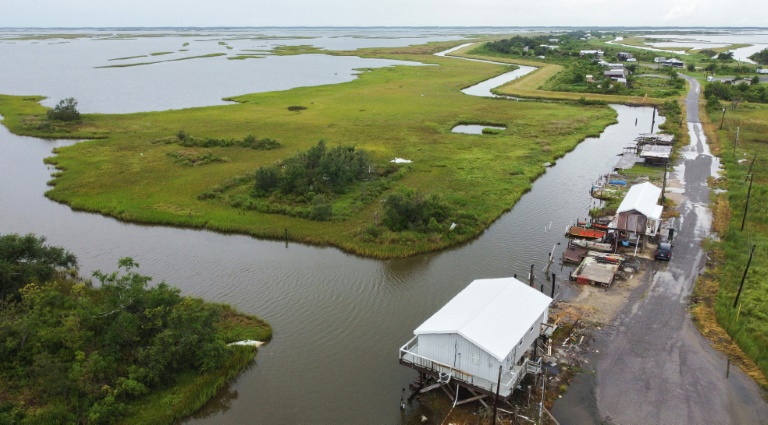
Joann Bourg stands in front of her new home, about an hour’s drive from the low-lying Louisiana island where she grew up — an area gradually sinking into the Gulf of Mexico.

“I’m very excited. I can’t wait to just move on in,” Bourg told AFP. “I’ve been waiting for this day forever.”

Bourg is one of about a dozen Native Americans from the Isle de Jean Charles who have been relocated to Schriever, less than 40 miles (60 kilometers) to the northwest — the maiden beneficiaries of a federal resettlement grant awarded in 2016.

They are the first so-called “climate refugees” in the United States, forced from their homes due to the consequences of climate change.

“The house we had back there on the island — well, that has been home forever. Me and my siblings all grew up there, went to school down there,” Bourg recalls. “It was peaceful.”

But the family home — as with many others on the island — was destroyed.

There is only one road connecting Isle de Jean Charles to the mainland, and it is sometimes impassable due to high winds or tides.

Residents are mainly of Native American descent — several tribes sought shelter on the island from rampant government persecution in the 1800s.

But climate change has transformed the island into a symbol of the scourge that plagues much of hurricane-prone Louisiana — coastal erosion.

– 90 percent under water –

Eventually, 37 new homes will be built in Schriever to accommodate about 100 current or former residents of Isle de Jean Charles, thanks to a $48 million federal grant initially allocated in 2016.

“This is the first project of its kind in our nation’s history,” state Governor John Bel Edwards, who was on site to see the residents close on their new properties, told AFP.

“We’ve had people over the years that we would buy their homes out and move them. But we’ve not done whole communities like this and moved them to one place before because of climate change.”

Since the 1930s, Isle de Jean Charles has lost “about 90 percent” of its surface area to the encroaching bayou waters, explains Alex Kolker, an associate professor at the Louisiana Universities Marine Consortium.

The island was already fragile, but climate change heightens the risks, he says — sea levels are rising, the ground is sinking and erosion is rampant. More frequent and fiercer storms intensify the problem.

“This community is one of the most vulnerable communities in Louisiana, and Louisiana is one of the most vulnerable places in the US,” Kolker says.

– Dead trees –

The road to Isle de Jean Charles is lined with dozens of homes, many of which are stripped down to the pilings.

A year ago, Hurricane Ida slammed into Louisiana as a dangerous category 4 storm; it was the second most damaging hurricane on record in the state, after the devastation of Katrina in 2005.

The storm ripped part of Chris Brunet’s roof off his home. 

The 57-year-old placed a sign in front of his home: “Climate change sucks.”

Seemingly indifferent to the voracious and omnipresent mosquitos, and occasionally speaking the old Acadian French associated with the area, Brunet says hurricanes are nothing compared to so-called “saltwater intrusion” destroying canals and other waterways.

A few years ago, he finally agreed to relocation, adopting the view of the leader of his Choctaw tribe that it was the only way to preserve the island’s dwindling community.

But those whose homes remain upright do not want to completely abandon their ancestral land.

Bert Naquin, who is moving into one of the new federally funded houses in Schriever, hopes to repaint her family dwelling in Isle de Jean Charles, despite her joy at being a first-time full homeowner.

“I plan on being down there a lot, because it’s still my home,” the 64-year-old Naquin said.

“This house up here is my house. But the island is always going to be my home in my heart.”
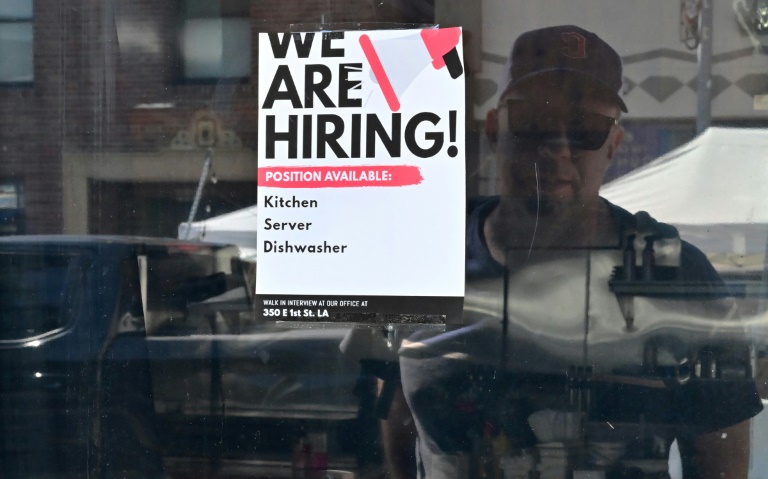
Slowdown or not? US job market walking a tight rope

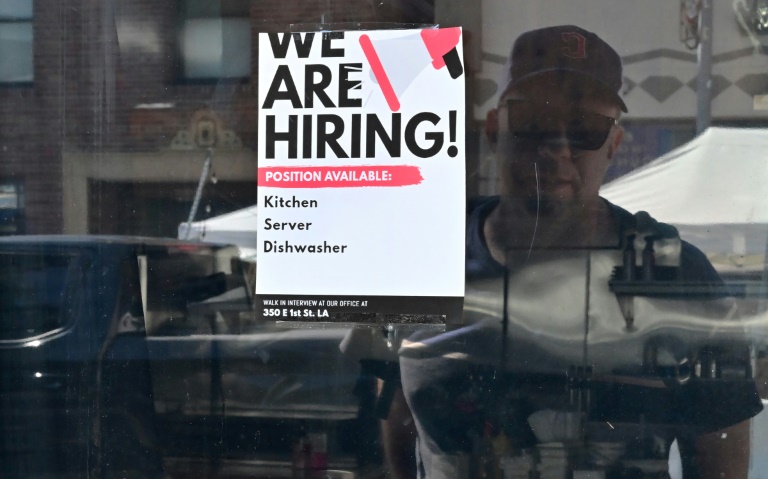
The number of “Help Wanted” signs may have decreased across the United States in August, but the job situation still remains tense, official figures are expected to show Friday.

According to consensus, the unemployment rate for August should fall somewhere around 3.5 percent when official data is released at 8:30 am (1230 GMT).

If the estimate turns out to be true, it would be the same rate as July when unemployment first returned to its pre-pandemic levels, which had been the lowest in 50 years.

Job creation, on the other hand, is expected to have slowed sharply, falling to 300,000 — almost half July’s number.

Data for private sector jobs created in August already disappointed: American employers ratcheted back their hiring in the month to 132,000, according to data published Wednesday by payroll firm ADP, a far cry from the 315,000 jobs that had been expected.

“We think that these numbers suggest a shift to a more moderate pace of hiring,” Nela Richardson, chief economist for ADP, said in a conference call.

Firms of all sizes are trying “to read what has become a complex economic picture” due to high inflation and a lack of workers at a moment when employers are looking to hire on a large scale.

Neither an economic slowdown, fears of recession nor action taken by the Federal Reserve to curb soaring inflation have deflated the hot job market. 

In July, the labor market demonstrated particular dynamism when it returned to its pre-pandemic level.

The unemployment rate fell to a historically low 3.5 percent as the 22 million jobs lost due to Covid-19 returned.

By the end of the month, there were more than 11 million job openings, or two for every job seeker. Just over four million Americans quit their jobs in July, and the same held true for June.

– ‘Some pain’ –

Meanwhile, weekly jobless claims — which provide insight into layoffs — fell almost every week in August and remain at historically low levels.

“Labor market conditions remain tight despite fairly weak economic growth,” said Nancy Vanden Houten, chief economist for Oxford Economics, in a note released Thursday.

US GDP contracted in the first two quarters of 2022, which falls under the classic definition of a recession.

But because of its glaringly robust job market, the US economy doesn’t quite seem to fall under the recession label for the moment.

The August jobs report data is expected to strengthen the Federal Reserve’s commitment to raising interest rates.

The Fed’s rate-hiking fight against high inflation will likely result in an employment slowdown and even a rise in the unemployment rate.

Federal Reserve chair Jerome Powell hammered home this point last week at a conference in Jackson Hole, Wyoming, warning of “some pain to households and businesses,” as well as a “softer labor market.”

With companies having faced a labor shortage for more than a year, many are offering higher wages, which is in turn driving up prices.

Amid the soaring inflation, the Fed has been gradually raising its key rate, making credit more expensive and thus slowing consumption as well as pressure on prices.

It is expected to raise rates again at its next meeting on September 20 and 21. To determine the extent of the rate hike, it will take Friday’s employment figures into serious consideration.

A slowdown in the labor market could indicate that the Fed’s rate hikes are finally bearing fruit, whereas a tight labor market would lead the Fed to act more forcefully.

Inflation, at its highest in 40 years, slowed to 8.5 percent over the previous year in July, according to the CPI index.

Slowdown or not? US job market walking a tight rope

The number of “Help Wanted” signs may have decreased across the United States in August, but the job situation still remains tense, official figures are expected to show Friday.

According to consensus, the unemployment rate for August should fall somewhere around 3.5 percent when official data is released at 8:30 am (1230 GMT).

If the estimate turns out to be true, it would be the same rate as July when unemployment first returned to its pre-pandemic levels, which had been the lowest in 50 years.

Job creation, on the other hand, is expected to have slowed sharply, falling to 300,000 — almost half July’s number.

Data for private sector jobs created in August already disappointed: American employers ratcheted back their hiring in the month to 132,000, according to data published Wednesday by payroll firm ADP, a far cry from the 315,000 jobs that had been expected.

“We think that these numbers suggest a shift to a more moderate pace of hiring,” Nela Richardson, chief economist for ADP, said in a conference call.

Firms of all sizes are trying “to read what has become a complex economic picture” due to high inflation and a lack of workers at a moment when employers are looking to hire on a large scale.

Neither an economic slowdown, fears of recession nor action taken by the Federal Reserve to curb soaring inflation have deflated the hot job market. 

In July, the labor market demonstrated particular dynamism when it returned to its pre-pandemic level.

The unemployment rate fell to a historically low 3.5 percent as the 22 million jobs lost due to Covid-19 returned.

By the end of the month, there were more than 11 million job openings, or two for every job seeker. Just over four million Americans quit their jobs in July, and the same held true for June.

– ‘Some pain’ –

Meanwhile, weekly jobless claims — which provide insight into layoffs — fell almost every week in August and remain at historically low levels.

“Labor market conditions remain tight despite fairly weak economic growth,” said Nancy Vanden Houten, chief economist for Oxford Economics, in a note released Thursday.

US GDP contracted in the first two quarters of 2022, which falls under the classic definition of a recession.

But because of its glaringly robust job market, the US economy doesn’t quite seem to fall under the recession label for the moment.

The August jobs report data is expected to strengthen the Federal Reserve’s commitment to raising interest rates.

The Fed’s rate-hiking fight against high inflation will likely result in an employment slowdown and even a rise in the unemployment rate.

Federal Reserve chair Jerome Powell hammered home this point last week at a conference in Jackson Hole, Wyoming, warning of “some pain to households and businesses,” as well as a “softer labor market.”

With companies having faced a labor shortage for more than a year, many are offering higher wages, which is in turn driving up prices.

Amid the soaring inflation, the Fed has been gradually raising its key rate, making credit more expensive and thus slowing consumption as well as pressure on prices.

It is expected to raise rates again at its next meeting on September 20 and 21. To determine the extent of the rate hike, it will take Friday’s employment figures into serious consideration.

A slowdown in the labor market could indicate that the Fed’s rate hikes are finally bearing fruit, whereas a tight labor market would lead the Fed to act more forcefully.

Inflation, at its highest in 40 years, slowed to 8.5 percent over the previous year in July, according to the CPI index.

Biden slams Trump 'extremist' assault on democracy

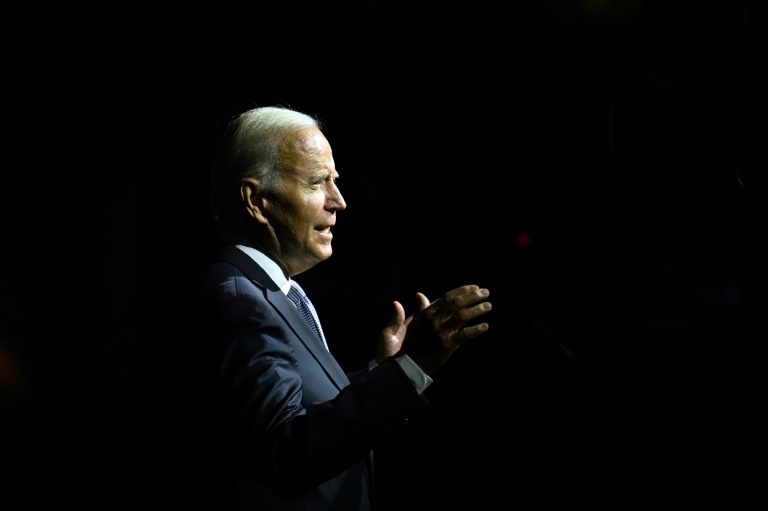
US President Joe Biden took fierce aim Thursday at Donald Trump and his “extremist” supporters, labeling them enemies of American democracy in a prime-time address that sought to fire up voters ahead of key midterm elections.

Speaking in Philadelphia, the cradle of US democracy, the president launched an extraordinary assault on those Republicans who embrace Trump’s “Make America Great Again” ideology — and urged his own supporters to fight back.

“Donald Trump and the MAGA Republicans represent an extremism that threatens the very foundations of our republic,” thundered Biden, speaking near the spot where the Declaration of Independence and the US Constitution were adopted more than two centuries ago.

“They embrace anger. They thrive on chaos. They live not in the light of truth but in the shadow of lies.” 

“There is no place for political violence in America. Period. None. Ever,” warned the 79-year-old Democrat — in a reference to last year’s assault on the US Capitol by hardline Trump supporters refusing to accept his defeat.

Citing the nationwide assault on abortion rights by hardline conservatives — and fears for other freedoms from contraception to same-sex marriage — the US leader charged that “MAGA forces” were “determined to take this country backwards.” 

With control of Congress in the balance come November, Biden appealed directly to mainstream Republicans to join forces with Democrats and repudiate Trump’s brand of politics — which still holds sway over much of his party.

And he made it clearer than ever that Democrats intended to make the midterms a referendum on Trump, saying the Republican Party was wholly “dominated, driven and intimidated” by the former president and his MAGA agenda.

“And that is a threat to this country,” he said, insisting American democracy had to be defended. 

“Protect it. Stand up for it,” Biden urged.

– ‘Semi-fascism’ –

Biden’s speech — billed as an address on the “battle for the Soul of the Nation” — harked back to an article he published in The Atlantic magazine in 2017, after a deadly white nationalist rally in Charlottesville, Virginia that he says spurred his presidential run. 

“We are living through a battle for the soul of this nation,” Biden wrote then.

After his election in 2020, the veteran politician initially planned to wage this battle through dialogue with moderate Republican lawmakers, and through economic and social policies aimed at the middle class.

But the talk of reconciliation has died down, as polls seem to indicate the Democratic leader is better served by being more aggressive.

Last week, Biden accused Trump’s supporters of being consumed by “semi-fascism.”

The term sparked indignation in conservative ranks — with Republican Senate Minority Leader Kevin McCarthy charging that it “vilifies” millions of “hardworking, law-abiding citizens.

“With all due respect Mr President, there’s nothing wrong with America’s soul,” retorted Republican senator and longtime Trump loyalist Lindsey Graham after Biden’s speech. “The American people are hurting because of your policies.”

A new poll published Thursday by The Wall Street Journal shows that if the midterm elections were held today, 47 percent of eligible voters would cast ballots for Democrats, and 44 percent would vote Republican. 

In March, the Republicans had a five-point advantage.

The Democrats are hoping for an upset in November’s elections, in which all of the seats in the House of Representatives and a third of the Senate seats are on the ballot. Traditionally, the midterms don’t favor the ruling party.

Things have been going well for Biden lately, however, with inflation slowing, a series of his landmark reforms finally pushed through Congress and Trump fighting off a series of criminal investigations. Polls show widespread support for abortion rights, which could put many Republicans on the back foot.

This would be enough to give hope to the Democrats, who are battling to keep their hold on the House and preserve their Senate majority — or even strengthen it.

And Pennsylvania will be crucial for any of that to happen.

Historically a key battleground state in US politics, the Keystone State will likely prove vital to both parties in the midterms — and Biden will visit three times this week alone.

Trump is also planning an appearance in the state on Saturday to support his candidate in the Senate race, TV physician Mehmet Oz.

US official rejects Amazon challenge to New York union vote

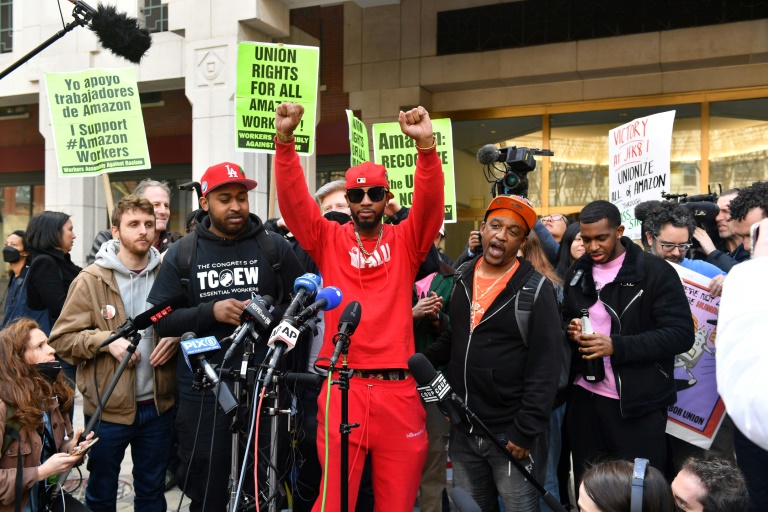
A US official Thursday rejected Amazon’s efforts to overturn a worker vote in favor of unionization at a New York warehouse, dismissing the retailer’s election complaints as groundless.

Lisa Dunn, a hearing officer with the National Labor Relations Board (NLRB), who oversaw a 24-day hearing on Amazon’s complaints earlier this summer, concluded the firm’s objections “should be overruled in their entirety,” according to a statement released by the NLRB’s press office.

“The Employer has not met its burden of establishing that Region 29, the Petitioner, or any third parties have engaged in objectionable conduct affecting the results of the election,” the NLRB said, adding that Amazon should recognize Amazon Labor Union as the bargaining representative for the facility, JFK8.

Amazon has until September 16 to contest Dunn’s conclusion. The NLRB regional director would then decide whether to rerun the election or certify the vote in a determination that could be appealed to the board itself.

Dunn’s decision is the latest development since Amazon Labor Union’s (ALU) shock victory in April in which New York workers voted to establish the first Amazon union in America at a facility in Staten Island, New York.

Amazon criticized the decision and said it intends to appeal.

“As we showed throughout the hearing with dozens of witnesses and hundreds of pages of documents, both the NLRB and the ALU improperly influenced the outcome of the election and we don’t believe it represents what the majority of our team wants,” spokesperson Kelly Nantel said.

Amazon has asserted that union members intimidated workers into voting for the union and that local NLRB staff were biased against the retail colossus.

But the ALU has said these claims are groundless, accusing the company of using delay tactics to put off talks on a on a contract in an attempt to quash the labor movement.

US official rejects Amazon challenge to New York union vote

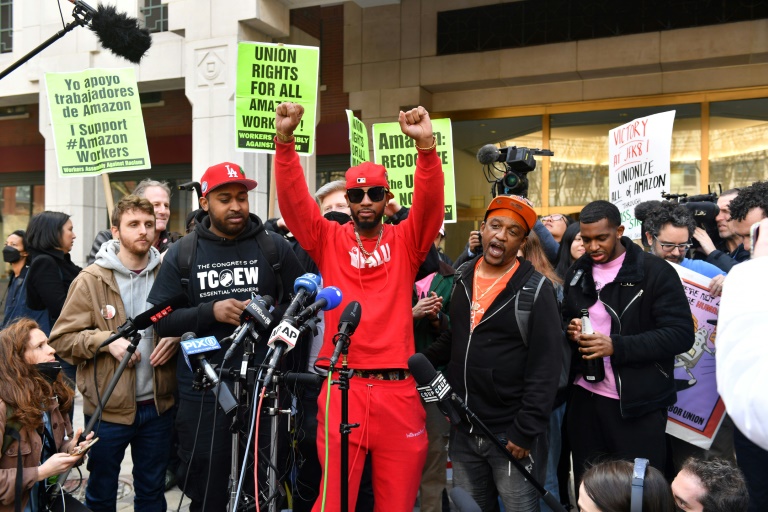
A US official Thursday rejected Amazon’s efforts to overturn a worker vote in favor of unionization at a New York warehouse, dismissing the retailer’s election complaints as groundless.

Lisa Dunn, a hearing officer with the National Labor Relations Board (NLRB), who oversaw a 24-day hearing on Amazon’s complaints earlier this summer, concluded the firm’s objections “should be overruled in their entirety,” according to a statement released by the NLRB’s press office.

“The Employer has not met its burden of establishing that Region 29, the Petitioner, or any third parties have engaged in objectionable conduct affecting the results of the election,” the NLRB said, adding that Amazon should recognize Amazon Labor Union as the bargaining representative for the facility, JFK8.

Amazon has until September 16 to contest Dunn’s conclusion. The NLRB regional director would then decide whether to rerun the election or certify the vote in a determination that could be appealed to the board itself.

Dunn’s decision is the latest development since Amazon Labor Union’s (ALU) shock victory in April in which New York workers voted to establish the first Amazon union in America at a facility in Staten Island, New York.

Amazon criticized the decision and said it intends to appeal.

“As we showed throughout the hearing with dozens of witnesses and hundreds of pages of documents, both the NLRB and the ALU improperly influenced the outcome of the election and we don’t believe it represents what the majority of our team wants,” spokesperson Kelly Nantel said.

Amazon has asserted that union members intimidated workers into voting for the union and that local NLRB staff were biased against the retail colossus.

But the ALU has said these claims are groundless, accusing the company of using delay tactics to put off talks on a on a contract in an attempt to quash the labor movement.

GM driverless car unit recalls vehicles after accident

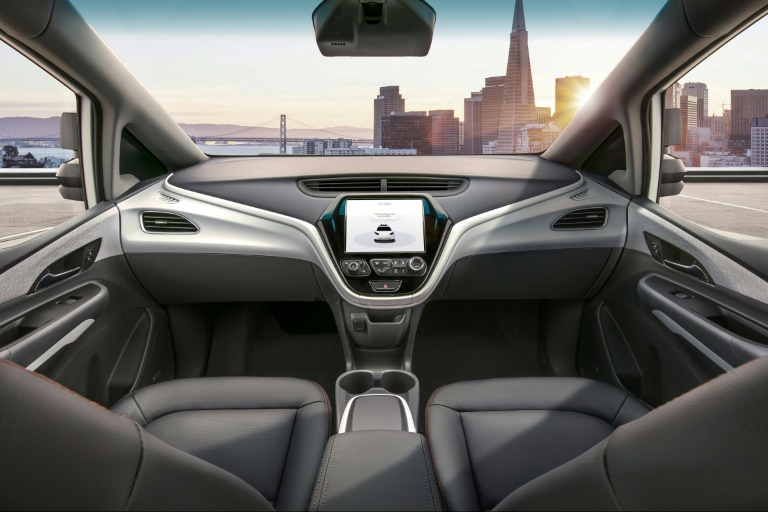
General Motor’s autonomous vehicle unit Cruise recalled 80 cars and updated their software after one failed to properly predict the trajectory of an oncoming vehicle.

The company, which is the first to have deployed driverless taxis in San Francisco in June, sent a notice this week to the US agency in charge of road safety, the National Highway Traffic Safety Administration (NHTSA).

In filings which came to public attention Thursday, Cruise explains that on June 3 one of its cars was hit from the rear by another vehicle after breaking sharply while making an unprotected left turn.

The self-driving vehicle decided “a hard brake was necessary to avoid a severe front-end collision with an oncoming vehicle,” the document said.

Two people were slightly injured, according to a report submitted to the California Department of Motor Vehicles.

Police determined that the other vehicle was primarily responsible for the incident as it was not in the correct lane and was traveling over the speed limit.

The NHTSA, however, did not fully exonerate Cruise from liability, stating that the software could, “in certain circumstances when making an unprotected left, cause the ADS (automated driving system) to incorrectly predict another vehicle’s path or be insufficiently reactive.”

Cruise has modified the software and says were the vehicle to be in the same situation again, it would act differently to avoid error.

Carmakers, led by Tesla, have been working for several years on development of autonomous driving and driving assistance systems, but progress has been slower than initially hoped.

Waymo, a Cruise rival and subsidiary of Google’s parent company Alphabet, has offered a ride-hailing program in Phoenix, Arizona for several years.

Cruise is the first company to be granted permission to transport passengers for a fee in a larger city.

GM driverless car unit recalls vehicles after accident

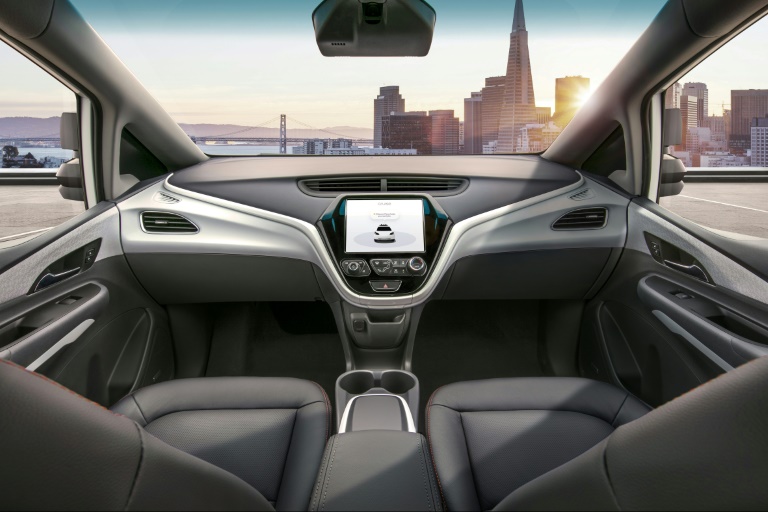
General Motor’s autonomous vehicle unit Cruise recalled 80 cars and updated their software after one failed to properly predict the trajectory of an oncoming vehicle.

The company, which is the first to have deployed driverless taxis in San Francisco in June, sent a notice this week to the US agency in charge of road safety, the National Highway Traffic Safety Administration (NHTSA).

In filings which came to public attention Thursday, Cruise explains that on June 3 one of its cars was hit from the rear by another vehicle after breaking sharply while making an unprotected left turn.

The self-driving vehicle decided “a hard brake was necessary to avoid a severe front-end collision with an oncoming vehicle,” the document said.

Two people were slightly injured, according to a report submitted to the California Department of Motor Vehicles.

Police determined that the other vehicle was primarily responsible for the incident as it was not in the correct lane and was traveling over the speed limit.

The NHTSA, however, did not fully exonerate Cruise from liability, stating that the software could, “in certain circumstances when making an unprotected left, cause the ADS (automated driving system) to incorrectly predict another vehicle’s path or be insufficiently reactive.”

Cruise has modified the software and says were the vehicle to be in the same situation again, it would act differently to avoid error.

Carmakers, led by Tesla, have been working for several years on development of autonomous driving and driving assistance systems, but progress has been slower than initially hoped.

Waymo, a Cruise rival and subsidiary of Google’s parent company Alphabet, has offered a ride-hailing program in Phoenix, Arizona for several years.

Cruise is the first company to be granted permission to transport passengers for a fee in a larger city.

Ex-cop gets 10 years prison for joining January 6 Capitol assault

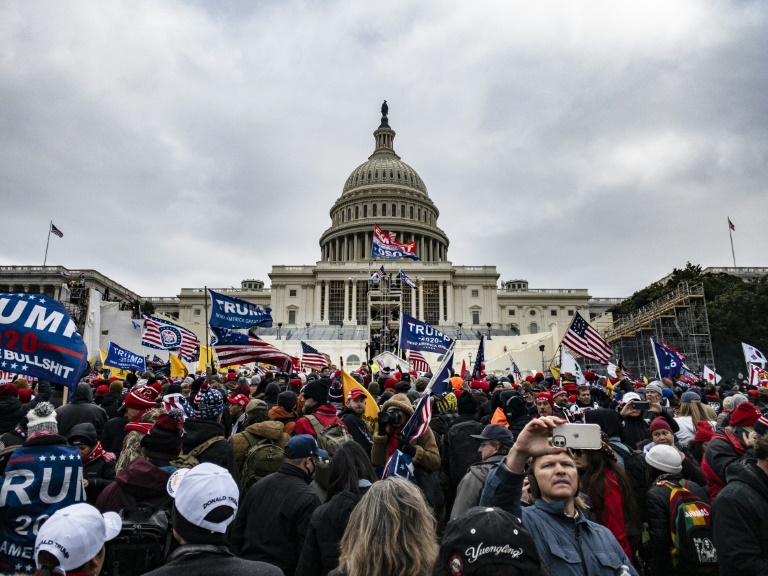
A retired New York policeman was sentenced to 10 years in prison Thursday for joining the violent January 6, 2021 assault on the US Capitol, the stiffest punishment yet for those who took part in the riot.

Thomas Webster, 56, a former marine, earned the heavy punishment after having joined the uprising by supporters of then-president Donald Trump and attacking police officers guarding the Capitol with a flagpole, the Justice Department said.

Webster wrestled one officer to the ground, held him down, choking the officer by his gas mask, while others in the mob kicked the officer, leaving him with multiple injuries.

“As a former police officer and US Marine who took an oath to defend the Constitution against all enemies foreign and domestic, Thomas Webster knew the severity of his actions on January 6th,” FBI officer Steven D’Antuono said in a statement.

“When he assaulted an officer at the US Capitol that day, Mr. Webster betrayed not only his oath but also his fellow law enforcement officers, who risk their lives every day to protect the American people,” he said.

Clearly identified in photographs and videos, Webster was arrested six weeks after the assault and in May was found guilty on five felony charges relating to an assault on a law enforcement officer and one misdemeanor.

Prosecutors said his background, and his wearing of body armor designed to stop gunfire,  justified a stiffer sentence.

They said he went into the event planning for violence.

“Webster did not just anticipate violence on January 6; he instigated it,” prosecutors said in sentencing hearings.

“In so doing, he knew that he was risking a violent confrontation with someone armed with a gun who would have been authorized to use force, including potentially deadly force, against attacking rioters,” they said.

Scores of others in the more than 860 arrested in the Capitol attack have been charged with assaulting officers.

But around a dozen of those sentenced for assaulting officers so far have opted to plead guilty, while Webster maintained his innocence and his case went to trial.

Prosecutors had asked for a sentence of between 17 and 22 years.

Trump, who has been accused of instigating the attack on the Capitol to stop Democratic rival Joe Biden from being certified as president-elect, has not condemned the violence carried out in his name. 

He told a radio interviewer Thursday that if he runs for president again in 2024 and is elected, he will pardon those charged in the violence.

“I mean full pardons with an apology to many,” Trump said in the interview with Wendy Bell Radio.

Starbucks names outgoing Reckitt leader as next CEO

Starbucks named Laxman Narasimhan, a veteran of PepsiCo and other consumer brands, as its next chief executive on Thursday.

Narasimhan, who was most recently chief executive of Anglo-Dutch multinational Reckitt, will relocate to Seattle from London and join Starbucks on October 1, the company said in a news release.

Following a stretch working with longtime Starbucks CEO and interim boss Howard Schultz, Narasimhan will take over the top spot on April 1, 2023.

The transition comes as Starbucks navigates a burgeoning US unionization push following a difficult stretch for workers during Covid-19.

Starbucks has responded to the drive by boosting investments in worker pay and stores as Schultz has undertaken a “listening tour” to hear out employee concerns.

Narasimhan “is uniquely positioned to shape this work and lead the company forward with his partner-centered approach,” Schultz said, calling him “the right leader to take Starbucks into its next chapter.”

Starbucks Workers United organizing member Michelle Eisen called on Narasimhan to end the company’s “scorched earth union-busting campaign and work with all Starbucks partners to make Starbucks a better company and better place to work.”

Neil Saunders, analyst at GlobalData Retail, said the appointment was a “good move” in light of  Narasimhan’s record in overseas markets and experience in retail operations.

“One of Mr Narasimhan’s tasks will be to ensure that Starbucks remains on the front foot. Howard Schultz has already set out some embryonic plans for doing this,” Saunders said. 

“Given that Mr Schultz has been involved in the recruitment process we believe the transition will be relatively seamless as Starbucks moves to its next chapter.”

Reckitt had announced Narasimhan’s departure earlier Thursday, saying he had been motivated to relocate back to the United States for “personal and family reasons.”

Close Bitnami banner
Bitnami