US Business

Facebook agrees to settle Cambridge Analytica privacy suit

Facebook has reached a preliminary agreement in a long-running lawsuit seeking damages from the social network for allowing third parties, including the company Cambridge Analytica, to access users’ private data. 

According to a document filed Friday in a San Francisco court, Facebook says it is submitting a draft “agreement in principle” and has requested a stay of proceedings for 60 days to finalize it. 

The social network did not indicate the amount or terms of the agreement in the class action. 

When asked by AFP, Facebook said late Saturday night they had “no comment to share at this time.”

The deal comes as Meta boss Mark Zuckerberg and former chief operating officer Sheryl Sandberg, who announced her resignation in June, were due to testify in court in September as part of the scandal. 

In a lawsuit initiated in 2018, Facebook users accused the social network of violating privacy rules by sharing their data with third parties including the firm Cambridge Analytica, which was linked to Donald Trump’s 2016 presidential campaign. 

Cambridge Analytica — which has since shut down — had collected and exploited, without their consent, the personal data of 87 million Facebook users, to which the platform had given it access. 

This information was allegedly used to develop software steering US voters in favor of Trump. 

In 2019, federal authorities fined Facebook $5 billion for misleading its users and imposed independent oversight of its personal data management. 

Since the Cambridge Analytica scandal broke, Facebook has removed access to its data from thousands of apps suspected of abusing it, restricted the amount of information available to developers, and made it easier for users to calibrate restrictions on personal data sharing.

Facebook agrees to settle Cambridge Analytica privacy suit

Facebook has reached a preliminary agreement in a long-running lawsuit seeking damages from the social network for allowing third parties, including the company Cambridge Analytica, to access users’ private data. 

According to a document filed Friday in a San Francisco court, Facebook says it is submitting a draft “agreement in principle” and has requested a stay of proceedings for 60 days to finalize it. 

The social network did not indicate the amount or terms of the agreement in the class action. 

When asked by AFP, Facebook said late Saturday night they had “no comment to share at this time.”

The deal comes as Meta boss Mark Zuckerberg and former chief operating officer Sheryl Sandberg, who announced her resignation in June, were due to testify in court in September as part of the scandal. 

In a lawsuit initiated in 2018, Facebook users accused the social network of violating privacy rules by sharing their data with third parties including the firm Cambridge Analytica, which was linked to Donald Trump’s 2016 presidential campaign. 

Cambridge Analytica — which has since shut down — had collected and exploited, without their consent, the personal data of 87 million Facebook users, to which the platform had given it access. 

This information was allegedly used to develop software steering US voters in favor of Trump. 

In 2019, federal authorities fined Facebook $5 billion for misleading its users and imposed independent oversight of its personal data management. 

Since the Cambridge Analytica scandal broke, Facebook has removed access to its data from thousands of apps suspected of abusing it, restricted the amount of information available to developers, and made it easier for users to calibrate restrictions on personal data sharing.

In Germany, the stuttering bid to jumpstart coal plants

A year after the last wisps of smoke disappeared into the skies from the imposing chimneys of the Moorburg coal plant, hopes had grown that the mothballed site would see new life as Germany scrambles to secure energy supplies.

Russia’s curtailing of gas exports to Germany in the wake of the Ukraine war has forced Berlin to make the radical decision to restart coal power stations, at least temporarily.

But infrastructure issues, manpower shortages and logistical problems are proving to be major obstacles for the restart.

At Moorburg, operator Vattenfall has dashed hopes of new operations, saying simply that “restarting it would be neither technically, economically nor legally feasible”. 

“Many parts have been dismantled and sold,” said Robert Wacker, director of the site.

Even power plants that had not been completely shut, but put in reserve to generate power only occasionally, are struggling with a complete reboot.

Further south from Moorburg, energy group Uniper will on Monday fire up its Heyden 4 site, which had been a reserve plant since mid-2021.

But the company warned that its output would be affected by railway capacity limits in ferrying hard coal to the site.

– Dismantled –

Germany began winding down its coal-fired power plants in the last few years, in view of meeting a target to end usage of the fossil fuel by 2030. 

But Russia’s invasion of Ukraine has upended plans as Moscow reduced energy exports to Germany in what Berlin believes is retaliation for its support for Kyiv.

Chancellor Olaf Scholz’s government has said it would stick to the 2030 coal exit timetable, but in the meantime, it authorised the restart of 27 mothballed plants or those put in reserve to help fill the energy gap until March 2024.

With a capacity of 875 megawatts (MW), Uniper’s Heyden 4 figures as the largest on the list. 

But the Moorburg plant, located in the suburb of Hamburg, had been one of the most modern in the world.

It was shut down in the summer of 2021, just six years after it was put into service, in exchange for a public subsidy programme aimed at cutting coal from Germany’s energy mix.

Since then, the operator has started dismantling and selling the parts that are not necessary for hydrogen — a priority for Germany’s future energy sources. 

Before it closed, the plant churned out around 11 billion kilowatts per year — the equivalent of the electricity consumption for the city of Hamburg.

But now, the installation is no longer complete.

In the turbines hall, thousands of small components have been packed away into boxes. A rotor, an element that allows the turbine to turn, is packed in aluminium, ready to be sent off.

The transformer is also no longer functioning.

“Without the transformer, the power plant is no longer linked to the network and cannot produce any electricity,” said Vattenfall. 

Pointing at rust that has accumulated on the components over the last year, the operator’s spokesman Gudrun Bode said: “We can’t restart a plant just like that.”

– Retired –

With winter round the corner, the race is getting tighter for Germany to ramp up its power generation capacity.

But so far, only one — the Mehrum plant with a capacity of 690 MW, has restarted. 

Besides technical issues, power suppliers are struggling with an acute worker shortage.

In Moorburg, “most of those who left have found a job, or are retired,” said Wacker.

Energy giant RWE told AFP it is seeking several hundreds of workers as it prepares to reopen three plants with a capacity each of 300 MW.

Logistics was also turning out to be tricky, with a drought further putting pressure on the distribution network.

The river Rhine has been a key route for coal transport to power plants in the west of the country. 

But record low water levels over the last week have limited shipments and forced suppliers to turn to rail transport — putting further pressure on strained cargo trains.

Uniper has said Heyden 4’s operation will be “limited partly by limits of rail transport capacity bringing coal to the site.”

Energy supplier STEAG has also said that it would bring into operation two coal-fire plants from its reserve.

It has targeted November as a possible restart date, but it also noted that current rules require sites to have coal supplies for 30 days — something that would be unachievable “given the current tight logistics situation on rail transport”.

In a bid to unblock the jam, Berlin decided Wednesday to prioritise coal and oil cargo over passenger travel this winter.

China's jobless youth left in the lurch

China’s slowing economy has left millions of young people fiercely competing for an ever-slimming raft of jobs and facing an increasingly uncertain future.

Official data released this month showed one in five young people in Chinese cities was out of work in July — more than three times the national average and the highest recorded since January 2018.

Nearly 11 million graduates entered China’s bleak job market this summer with the economy growing at 0.4 percent in the second quarter, the weakest in two years.

Zhao Yuting, 22, told AFP companies were reluctant to hire as the economy cools — and that experienced workers were now jostling for entry-level jobs, elbowing out green hands such as her.

Since graduating in July, she submitted her CV to dozens of companies.

Only a handful called her back for an interview, only to turn her down saying she lacked experience.

Armed with a degree in English, Zhao thought she could earn a living as a tutor until she found full-time work.

But recent crackdowns on the tech and education sectors, which usually absorb fresh talent, have evaporated such jobs.

“I’ve been job hunting for two or three months but the prospects of being hired look slim,” said Zhao, who has been forced to move back in with her parents while she hunts for work.

“The longer it takes, the greater the pressure.”

– Slim prospects –

Analysts blame a slowing economy crippled by Covid lockdowns, as well as the large cohort entering the labour force during the graduating season in July and August, for the slim prospects facing China’s youth.

Official data does not track unemployment among rural youth, and the real jobless population could be more than double the official number, estimated Zhuang Bo, an economist at research group TS Lombard.

Blue-collar workers, too, are struggling to find work as growth in the manufacturing and construction sectors cools.

“The reality is more serious than what the data shows,” said Ho-fung Hung, who specialises in China’s political economy at Johns Hopkins University.

“If the problem continues without remedy, it will easily spread social disorders.”

At a job fair in the tech hub Shenzhen, long lines of anxious parents and young graduates waited for a chance to chat with recruiters.

But headhunters at the fair said they were cherry-picking graduates from top universities, because only a few positions were available.

“My goal was to work in Shenzhen, in China’s Silicon Valley,” Luo Wen, a computer science graduate, told AFP.

“But after more than four months of searching, I’m ready to work even in a smaller city, for less pay.”

– ‘I can’t see the future’ –

Graduates who managed to find work this year were offered salaries that were on average 12 percent less than last year, data from online recruitment firm Zhaopin showed.

And while some job seekers were lowering their ambitions, others were biding their time pursuing further studies.

Experts warned that this may lead to “degree inflation”, where employers demand higher and higher qualifications for jobs that do not necessarily require them.

Analysts blamed government policies that saw a rapid rise in college students over the past decade as the economy failed to accommodate more knowledge workers.

“The pandemic and lockdowns simply aggravated the problem,” Hung said.

The government has pledged to shore up employment by offering tax relief for small businesses and more start-up funding.

Premier Li Keqiang has said China’s employment crisis is “complex and grave” and called on state-owned companies to step up to stabilise the economy.

And as growth in the private sector slows, job seekers have flocked to cram schools to prepare for highly competitive civil service exams.

A record-breaking two million people signed up for the national civil service exam last fall.

A recent survey by 51job, one of China’s biggest job search services, found that 40 percent of respondents preferred stable state jobs over corporate careers.

But for Zhao, who cannot afford to study further and does not have the connections to secure a government job, few options remain.

“I feel that I can’t see the future,” she said. 

“I haven’t made any progress. It’s miserable.”

'Sight to behold': tourists flock to Florida for Moon rocket launch

Seeing a rocket blast off to the Moon is “a once-in-a-lifetime thing to experience,” says Joanne Bostandji. 

The 45-year-old has traveled all the way from northern England to Florida with her husband and two children for a space-themed vacation, and they’re prepared to make sure they don’t miss a second of the action as NASA’s newest and most powerful rocket is scheduled to launch for the first time Monday. 

“The plan is to drive very early in the morning and get a spot” on Cocoa Beach, she said, not far from the Kennedy Space Center. 

“I know it’s going be from a far distance, but I still think it’s going be a sight to behold,” Bostandji told AFP as the family waited to enter a park dedicated to space exploration.  

Between 100,000 and 200,000 visitors are expected to attend the launch of the mission, called Artemis 1, which will propel an empty capsule to the Moon as part of a test for future crewed flights.

The “historic nature” of Monday’s flight, the first of several as the United States returns to the Moon, “certainly has increased public interest,” Meagan Happel of Florida’s Space Coast Office of Tourism told AFP.

Traffic jams are expected to start by 4 am, with the launch scheduled at 8:33 am (1233 GMT). 

And even more people might show up if the launch faces a weather delay, as the make-up date falls on a weekend. 

– Space cruise –

Sabrina Morley was able to find an apartment to rent not far from the beach, and plans to bring her two children and a few dozen other people on a boat chartered for the occasion by a company called Star Fleet Tours. 

For $95 a ticket, “we’ll go out into the ocean as close as they can get to the launch and we’ll watch the launch from the boat,” she said

“I’ve never been this close to a launch before,” said the 43-year-old, who grew up in Orlando, less than an hour away. 

As a child, she could see space shuttles taking off from her backyard, like “an orange ball of smoke” rising into the sky.

“We would hear the sonic booms,” she remembered. 

Morley likes that NASA’s Artemis program aims to land a woman on the Moon for the first time, with a crew to head up in 2025 at the earliest.

“Representation matters,” she said, glancing at her two-year-old daughter, who is already wearing an imitation astronaut helmet on her head. 

– Good for business – 

The return of prestigious space launches is an economic boon for the region. A family of three will spend an average of $1,300 over four or five days, according to the tourism office. 

On the main road to Merritt Island, the peninsula where the Kennedy Space Center is located, Brenda Mulberry’s space memorabilia shop is packed with tourists. 

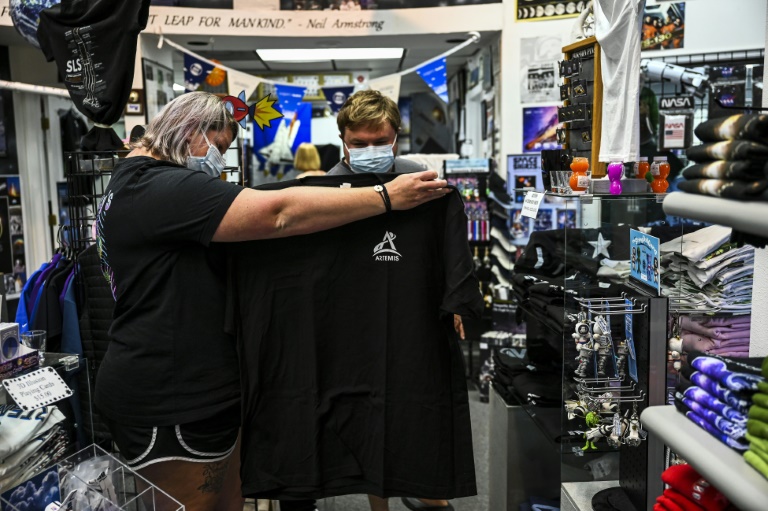
As soon as they enter, visitors are greeted with Artemis T-shirts for sale, printed in-house — there were 1,000 copies made Saturday alone. 

The last few days has seen an influx of customers, Mulberry, who founded “Space Shirts” in 1984, told AFP. 

“They’re just excited I think to see a NASA launch because the private space business is not so motivating to the people,” she said.

This rocket, called the SLS — a large model of which is displayed in front of her shop — “belongs to the people,” Mulberry said. 

“It’s their rocket. It’s not SpaceX rocket,” she added.

There is an air of nostalgia for the Apollo rocket program — it’s been 50 years since the last time a crewed mission went to the Moon, in 1972.

“My family, they had to go to the neighbor’s house to watch (the Apollo missions) because they didn’t have a television,” Bostandji, who was not yet born, said. 

“Now we’re going to see it hopefully for real.”

'Sight to behold': tourists flock to Florida for Moon rocket launch

Seeing a rocket blast off to the Moon is “a once-in-a-lifetime thing to experience,” says Joanne Bostandji. 

The 45-year-old has traveled all the way from northern England to Florida with her husband and two children for a space-themed vacation, and they’re prepared to make sure they don’t miss a second of the action as NASA’s newest and most powerful rocket is scheduled to launch for the first time Monday. 

“The plan is to drive very early in the morning and get a spot” on Cocoa Beach, she said, not far from the Kennedy Space Center. 

“I know it’s going be from a far distance, but I still think it’s going be a sight to behold,” Bostandji told AFP as the family waited to enter a park dedicated to space exploration.  

Between 100,000 and 200,000 visitors are expected to attend the launch of the mission, called Artemis 1, which will propel an empty capsule to the Moon as part of a test for future crewed flights.

The “historic nature” of Monday’s flight, the first of several as the United States returns to the Moon, “certainly has increased public interest,” Meagan Happel of Florida’s Space Coast Office of Tourism told AFP.

Traffic jams are expected to start by 4 am, with the launch scheduled at 8:33 am (1233 GMT). 

And even more people might show up if the launch faces a weather delay, as the make-up date falls on a weekend. 

– Space cruise –

Sabrina Morley was able to find an apartment to rent not far from the beach, and plans to bring her two children and a few dozen other people on a boat chartered for the occasion by a company called Star Fleet Tours. 

For $95 a ticket, “we’ll go out into the ocean as close as they can get to the launch and we’ll watch the launch from the boat,” she said

“I’ve never been this close to a launch before,” said the 43-year-old, who grew up in Orlando, less than an hour away. 

As a child, she could see space shuttles taking off from her backyard, like “an orange ball of smoke” rising into the sky.

“We would hear the sonic booms,” she remembered. 

Morley likes that NASA’s Artemis program aims to land a woman on the Moon for the first time, with a crew to head up in 2025 at the earliest.

“Representation matters,” she said, glancing at her two-year-old daughter, who is already wearing an imitation astronaut helmet on her head. 

– Good for business – 

The return of prestigious space launches is an economic boon for the region. A family of three will spend an average of $1,300 over four or five days, according to the tourism office. 

On the main road to Merritt Island, the peninsula where the Kennedy Space Center is located, Brenda Mulberry’s space memorabilia shop is packed with tourists. 

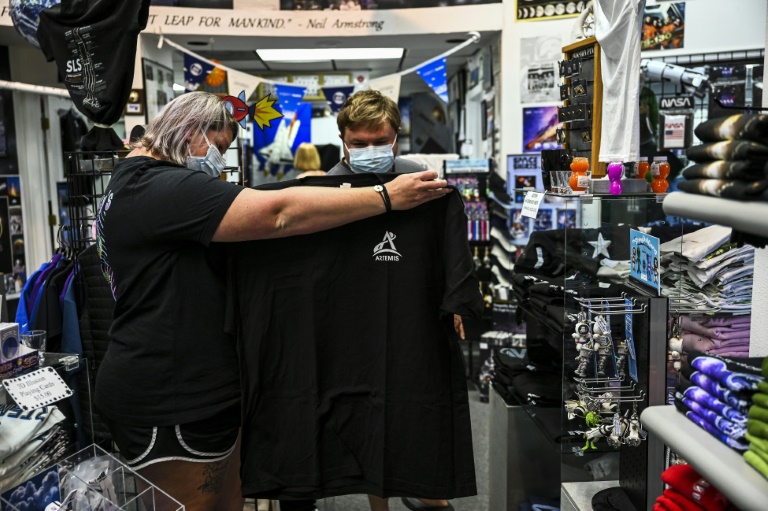
As soon as they enter, visitors are greeted with Artemis T-shirts for sale, printed in-house — there were 1,000 copies made Saturday alone. 

The last few days has seen an influx of customers, Mulberry, who founded “Space Shirts” in 1984, told AFP. 

“They’re just excited I think to see a NASA launch because the private space business is not so motivating to the people,” she said.

This rocket, called the SLS — a large model of which is displayed in front of her shop — “belongs to the people,” Mulberry said. 

“It’s their rocket. It’s not SpaceX rocket,” she added.

There is an air of nostalgia for the Apollo rocket program — it’s been 50 years since the last time a crewed mission went to the Moon, in 1972.

“My family, they had to go to the neighbor’s house to watch (the Apollo missions) because they didn’t have a television,” Bostandji, who was not yet born, said. 

“Now we’re going to see it hopefully for real.”

To the Moon and beyond: NASA's Artemis program

The Artemis program is NASA’s plan to return humans to the Moon as a stepping stone for an eventual voyage to Mars.

Twelve men walked on the Moon between 1969 and 1972 and one of the goals of Artemis is to put the first woman and person of color on the lunar surface.  

The first test flight of an uncrewed Artemis rocket is to take place on Monday.

The name Artemis was chosen to echo that of the Apollo program.

Artemis, in Greek mythology, was the twin sister of Apollo and a goddess associated with the Moon.

Here is an overview of the Artemis program:

– Artemis 1: test flight –

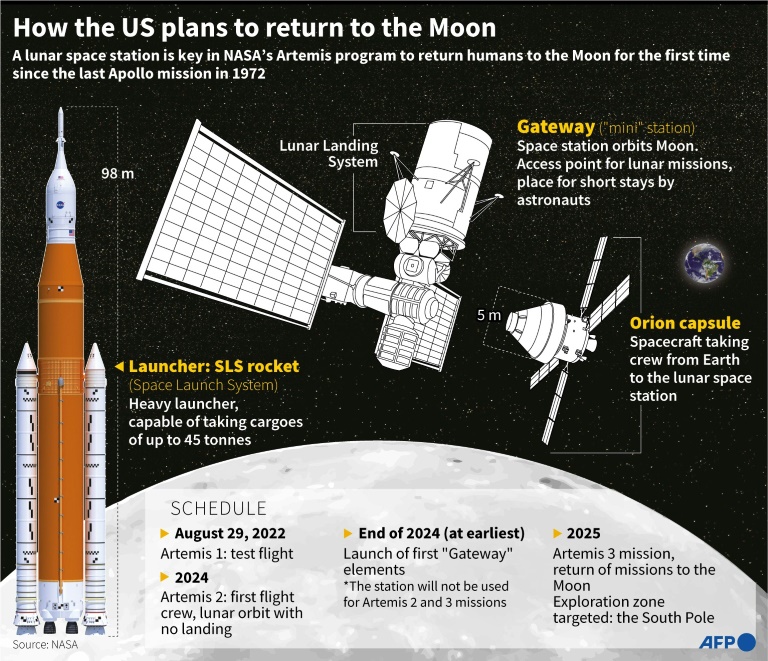
Artemis 1 is a test flight of the 322-foot (98-meter) Space Launch System rocket and the Orion crew capsule that sits on top.

Blastoff is scheduled for 8:33 am (1233 GMT) on Monday from the Kennedy Space Center in Florida.

Mannequins equipped with sensors will take the place of crew members on the flight, recording vibration, acceleration and radiation levels.

Orion will orbit the Moon before splashing down in the Pacific Ocean.

– Artemis 2: first crew –

Planned for 2024, Artemis 2 will be a crewed flight that will orbit the Moon but not land on the surface, similar to what Apollo 8 did.

The four members of the crew will be named before the end of the year. A Canadian is expected to be among them.

– Artemis 3: Moon landing –

The third Artemis mission will be the first to put astronauts on the Moon since Apollo 17 in December 1972.

NASA, for the first time, will land a crewed spacecraft on the southern pole of the Moon, where water in the form of ice has been detected.

Previous Moon landings took place near the equator.

Artemis 3 is scheduled for 2025 but may not take place until 2026 at the earliest, according to an independent audit of the program.

Starting with Artemis 3, NASA plans to launch crewed missions about once a year.

– SpaceX Moon lander –

NASA has selected Elon Musk’s SpaceX to build the Moon lander for Artemis 3.

SpaceX’s Starship, which is still under development, will serve as a shuttle from the Orion crew capsule to the lunar surface and back.

– Gateway space station –

The Artemis program also calls for the construction of a space station called Gateway that will orbit the Moon.

The launch of the first two elements — the living quarters module and power and propulsion system — is planned for late 2024 at the earliest by a SpaceX Falcon Heavy rocket.

Orion crews would be responsible for assembly of Gateway.

Astronauts would spend between 30 to 60 days in Gateway and would eventually have access to a lander that would allow them to travel to the Moon and back.

Gateway would also serve as a stopping point for any future trip to Mars.

– Destination Mars –

The ultimate objective of the Artemis program is what NASA calls the “next giant leap — human exploration of Mars.”

NASA will use knowledge gained from Artemis about next generation spacesuits, vehicles, propulsion, resupply and other areas to prepare for a trip to Mars.

The goal is to learn how to maintain a human presence in deep space for a long period.

Creating a “base camp” on the Moon is part of the plan with astronauts staying on the lunar surface for up to two months.

While a trip to the Moon takes just a few days, a voyage to Mars would take a minimum of several months.

As her tennis career fades, Serena Williams joins endorsement elite

Since returning to tennis as a mother in 2018, Serena Williams has not ruled the courts with the same dominance she once displayed, but has overtaken her pre-pregnancy mark in one key category: off-court endorsements. 

For many years, Williams’ rank on the list of elite athlete endorsements lagged behind her remarkable career accomplishments.

But over the last few years, as she has become more identified with motherhood and non-tennis pursuits such as venture capital, Williams has at last become a superstar endorser not limited to athletic brands.

“She has no issues with polarizing anyone, which makes her a good marketing celebrity,” said Henry Schafer, executive vice president of Q Scores, whose ratings are a well-known benchmark for measuring A-lister consumer appeal.

Williams’ television spots have been diverse: for JPMorgan Chase, she read the lyrics of an LL Cool J classic; for DirecTV, she battled monsters in Wonder Woman garb; and for Michelob, she starred in a pricey 2022 Super Bowl ad.

The 23-time Grand Slam champion earned $45 million in endorsements in 2022, about four times her level in 2014, when she was the world’s number one player, according to Forbes’ annual list of top-paid athletes.

Advocates for women in sports celebrate Williams for breaking through the glass ceiling in marketing as a woman of color, but note that only two of the top 50 Forbes athletes are female. 

“Much like anything with women’s sports and marketing, we have a long way to go,” said Danette Leighton, chief executive officer of the Women’s Sports Foundation. 

“We’re thankful Serena’s been able to do what she’s done and received the accolades and notoriety, but there’s still a lot of work to be done.”

Leighton cited one study that said women represent 40 percent of all athletes, but women’s sports receive only four percent of the media coverage.

– Hitting obstacles –

From the start, Williams and her elder sister Venus — a seven-time Grand Slam champion — commanded significant clothing endorsements even before they won major championships.

In Serena’s case, her first big apparel contract was with Puma, which outfitted her through her initial Grand Slam triumphs, including her first “Serena Slam,” a 12-month stretch over 2002 and 2003 in which she held all four major titles.

Williams then signed a major contract with Nike in 2003, when the Forbes list of the 50 best-paid athletes did not include any women at all.

She has often pushed the envelope in tennis fashion, donning edgy outfits such as a black Puma catsuit at the 2002 US Open, and a one-legged Nike version in Australia in 2021 to honor track legend Florence Griffith-Joyner.

But she also has suffered very public meltdowns that might have dampened marketing enthusiasm for her, the worst of which came at the 2009 US Open when she threatened a line judge in a semifinal defeat to Kim Clijsters.

By the second time she accomplished the “Serena Slam” over the 2014 and 2015 seasons, Williams’ endorsement profile drew attention for its relative modesty.

“Williams is arguably the greatest female athlete of all-time, but sponsors have often eschewed” her, Forbes said in 2015, noting that she trailed Maria Sharapova in endorsements for the 11th straight year, despite dominating the Russian tennis star and owning many more titles.

“Williams’ skin color, muscular body type and one memorable outburst at the US Open of 2009 have all been blamed by pundits for the endorsement gap between Williams and Sharapova,” the magazine said.

“The reality is that there is no one magic answer for the disparity.”

– Iconic figure –

Marketing experts say Williams’ recent leap into the endorsement stratosphere reflects her greater relatability since becoming a mother and being forced to juggle work and family life.

With Margaret Court’s record of 24 Slam titles in her sights, Williams has reached four major finals as a mother, but lost all of them — setbacks that have perhaps endeared her to the public.

The twilight of Williams’s career has dovetailed with societal pushes for better racial and gender equality, and many brands are now more eager to be associated with a successful Black woman. 

Q Scores rates Williams a 78 in terms of recognition, well above other female athletes. Her “positive” Q rating of 17 is now better than her “negative” rating of 14, said Schafer.

That means Williams has a more favorable ratio than athletes like NBA superstar LeBron James and NFL legend Tom Brady.

Leslie Allen, a former top US tennis player who is African American, said the business world has long underestimated the ability of people like Williams to appeal to consumers of all races, calling her marketing success “overdue.”

Allen rejoices that the other woman on the Forbes list of top athletes is four-time Grand Slam champion Naomi Osaka, who is of Haitian and Japanese descent.

“I love the fact that the top two women on that list are women of color, which means we have come a long way in terms of being able to be universally accepted as viable brand ambassadors,” Allen said.

“That was impossible 20 years ago.”

Plenty of roadblocks for automakers seeking EV success

The world’s top automakers — motivated either by governmental regulations or pure profit — have made a sharp turn away from fossil fuel vehicles. But there are plenty of obstacles on the road to a future full of eco-friendly cars.

Will there be enough lithium and other vital raw materials to make electric car batteries? Will there be sufficient charging stations? How will carmakers ensure that their offerings are affordable for the average driver?

Following the success of Elon Musk’s Tesla, built solely on electric vehicles, most of the biggest names in the sector are planning to invest tens of billions of dollars to reorient their businesses toward clean energy.

Stellantis, the world’s fifth-largest automaker, plans to sell only electric cars in Europe by 2030. Toyota expects to release about 30 electric models in that same timeframe. GM hopes to stop making cars with combustion engines by 2035.

These corporate ambitions have dovetailed with efforts by national and local governments to go green.

On Thursday, California announced that from 2035, all new cars sold in the Golden State — the most populous in America — must be zero-emission.

The European Union also has taken steps to ban the sale of gas- or diesel-fueled cars — and even hybrids — by 2035, while China wants at least half of all new cars to be electric, plug-in hybrid or hydrogen-powered by that time.

– Built-in demand –

Automakers are on notice that “they are going to have to figure out how to put cars on the market,” said Jessica Caldwell, executive director of insights for the automotive research firm Edmunds.

“We used to say that the challenges for electric vehicles would be consumer acceptance and price,” she added.

With car buyers increasingly attuned to the environment and the woes of climate change, selling the concept of electric vehicles is no longer an issue.

In the United States, General Motors says it has more than 150,000 pre-orders for the electric version of its Silverado pickup truck, which will be available next year. The wait time for a Tesla these days is several months.

For Caldwell, the bigger issue now is whether automakers “can get the raw materials” they need to make the cars.

– Scarce raw materials –

Karl Brauer, an executive analyst for used car search engine iseecars.com, agrees, saying that no matter what government incentives are offered for would-be buyers of electric vehicles, the rare elements needed may simply be unavailable.

“Right now, we have a lack of palladium, and nickel, and lithium. Everything you need to build an electric car is harder to get than it was six or 12 months ago,” he told AFP.

The supply issue is linked partly to Russia’s invasion of Ukraine six months ago.

But Brauer said that “nobody, a year ago, would have predicted the kind of price escalation for those raw materials, and the difficulty of getting them.”

The situation “can change drastically” at any given moment, he added.

Automakers are determined to leave as little as possible to chance.

They are building their own factories to produce car batteries, setting up joint ventures with specialized parts makers and sealing partnerships with mining firms.

German auto manufacturers Volkswagen and Mercedes-Benz on Monday signed memorandums of understanding with the Canadian government to ensure their access to rare metals such as lithium, nickel and cobalt.

But, as with oil, the market for these raw materials is a global one, and the normal rules of economics apply, noted Brauer.

“If there is a certain amount of global demand for raw materials, if there is a certain amount of global supply for them, someone will always pay the price,” he said.

For Brauer, shifting production lines to accommodate electric vehicle components is, by comparison, quite easy, as the automakers “have control over that.”

– Help, but with conditions –

Local regulations could make things more complicated for automakers.

In the United States, new legislation championed by the administration of President Joe Biden allots up to $7,500 in tax credits to every American who buys an electric vehicle.

But there are conditions: for example, final assembly of those cars must take place within US borders.

The Alliance for Automotive Innovation, a US lobbying group, estimates that about 70 percent of the 72 electric, plug-in hybrid or hydrogen-powered cars now on the market would not qualify for the tax credit.

For Garrett Nelson, an analyst for the CFRA research firm, the new law will clearly give Tesla, GM and Ford an advantage in the United States over their European and Asian rivals.

Following California’s announcement, the Alliance for Automotive Innovation said it would be “extremely challenging” to meet the sales requirements due to external factors such as inflation, supply chains and charging infrastructure.

The ongoing semiconductor shortage will also play a role, it said in a statement.

“These are complex, intertwined and global issues well beyond the control” of authorities in California or the auto industry,” it warned.


NFL Bills cut punter Araiza after gang-rape lawsuit

The NFL’s Buffalo Bills released punter Matt Araiza on Saturday, two days after a civil lawsuit was filed alleging he was among those who gang raped a minor.

Araiza, 22, was kept out of the Bills’ pre-season game Friday at Carolina, not appearing on the sidelines or in the locker room after the game, and he was not involved in a Saturday workout.

“This afternoon, we decided that releasing Matt Araiza was the best thing to do,” Bills general manager Brandon Beane said. “Our culture in Buffalo is more important than winning football games.”

Araiza and two others were accused of raping a 17-year-old girl during an off-campus party at San Diego State University last year.

The lawsuit filed in San Diego County Superior Court alleges that Araiza had sex with the girl, identified in the lawsuit only as “Jane Doe”, last October outside a home and brought her into a room where she was repeatedly raped by all three men.

The others named in the lawsuit were teammates of Araiza at San Diego State.

Araiza was named the top US college punter and was chosen by the Bills in the sixth round of this year’s NFL Draft.

Bills coach Sean McDermott said he decided not to play Araiza, calling the situation “extremely serious.”

Araiza released a statement on Friday challenging the lawsuit details.

“The facts of the incident are not what they are portrayed in the lawsuit or in the press,” Araiza said. “I look forward to quickly setting the record straight.”

Close Bitnami banner
Bitnami