US Business

Alleged shooter of Lady Gaga's dog walker freed by mistake

US authorities were on Wednesday searching for the suspect accused of shooting Lady Gaga’s dog walker in 2021, months after he was accidentally released from custody.

James Howard Jackson, 19, is charged with shooting Ryan Fischer with a handgun near Sunset Boulevard in Los Angeles during an attempted kidnapping of the star’s valuable French bulldogs.

Jackson was released in April due to a “clerical error,” the US Marshals Service admitted, describing him as armed and dangerous.

It offered $5,000 for information about Jackson, one of three men charged with attempted murder and robbery over the attack.

Two of the suspects got out of a vehicle and demanded Fischer hand over the pets at gunpoint. Fisher was shot in a struggle before the men fled with two of the dogs, Koji and Gustav.

A third dog, Miss Asia, ran away during the encounter before returning to the badly-wounded Fischer.

Police said they don’t believe the suspects targeted the dogs because of their famous owner, but because they are a coveted breed that can sell for thousands of dollars.

A 50-year-old woman turned the two missing pets over to police two days after the theft.

At the time, the three were described by Los Angeles police as “documented gang members.” Lady Gaga had offered a $500,000 reward for their safe return.

Why Biden's climate agenda has faltered

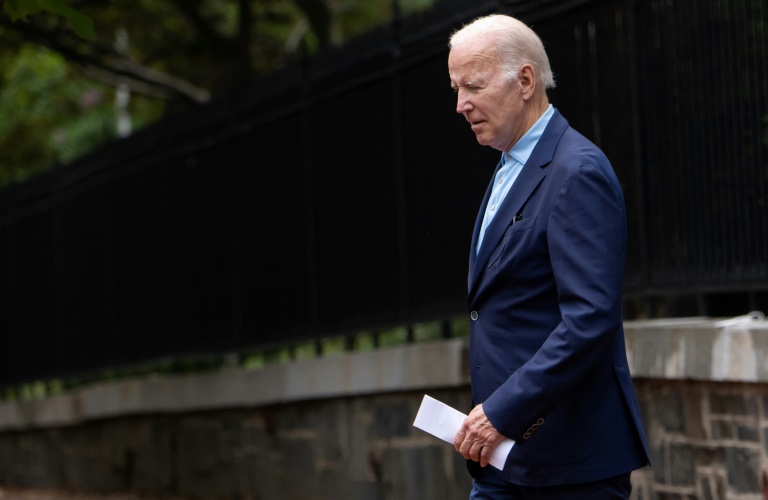
President Joe Biden ran for office on a pledge to tackle the global climate crisis. 

Instead, he has seen his legislative ambitions defeated by Congress, the Supreme Court has delivered a hammer blow to the federal government’s ability to regulate greenhouse gasses, and the Ukraine crisis has been a boon for fossil fuels.

As the Democrat is poised to announce a series of new executive measures, including additional funding to help protect communities from extreme heat and boosting wind production, here is an overview of his term so far.

– What’s at stake – 

Shortly after taking office, Biden announced he was targeting a 50-52 percent reduction from 2005 levels in US economy-wide net greenhouse gas pollution in 2030, before achieving net zero in 2050, as part of the country’s Paris Agreement goals.

“Biden has said he thinks that climate change is the existential issue of our time,” and has been more emphatic than any of his predecessors including Barack Obama, Paul Bledsoe of the Progressive Policy Institute told AFP.

The president has framed the issue as key to the economic and national security of the United States, as well as public safety — and climate scientists are sounding the alarm now more than ever.   

“I think that more and more people are realizing that we’re living through what could eventually cause us to lose everything in terms of habitability and everything that we value in life,” climate scientist Peter Kalmus told AFP.

Europe’s punishing heatwave serves as a timely reminder that warming won’t be an issue confined to the Global South, but instead threatens civilization as we know it, he added.

– Congress, the Supreme Court, and Ukraine –  

The main legislative plank of Biden’s agenda was to have been the Build Back Better bill, which would have plowed $550 billion into the clean energy and climate businesses — much coming from tax credits and incentives.

That effort is now in tatters after Democratic Senator Joe Manchin, a fossil fuel booster who wields outsized power in the evenly split Senate, walked away last week from the bill that he’d promised to back.

At the end of June, the conservative supermajority Supreme Court found that the federal Environmental Protection Agency cannot issue broad limits on greenhouse gasses, such as cap-and-trade schemes, without Congressional approval.

“So we’re on two strikes,” said Bledsoe, who served as a climate aide to former president Bill Clinton.

What’s more, the oil industry has pushed for more drilling in the wake of Russia’s invasion of Ukraine, casting the issue as one of energy security. 

A recent analysis by the Institute for Energy Research said that Biden’s government picked up the pace of drilling permits on public land from March onward “to mollify the political pressure rising along with pump prices.”

Biden had vowed to end new drilling on public lands, but his “pause” was overturned by a Trump-appointed judge in 2021.

On the other hand, there have been some partial wins: the administration has promulgated tighter emissions standards for vehicles, and toughened regulations on super-polluting methane emissions, said Bledsoe.

The bipartisan infrastructure law, passed last November, also contained some climate provisions, including $7.5 billion for a nationwide network of electric vehicle chargers and investments in carbon capture and hydrogen technologies.

– What’s next? – 

But without the big ticket items, the United States is falling far short of its goals. 

The Rhodium Group, an independent research firm, finds that “as of June 2022, we find that the US is on track to reduce emissions 24 percent to 35 percent below 2005 levels by 2030 absent any additional policy action.”

The White House has not ruled out declaring a “climate emergency,” which would grant Biden additional policy powers, but given a hostile judiciary, this would likely be subject to legal challenge.

Bledsoe said to achieve real change, Biden should instead push for broad public backing.

“Democrats should make popular consumer clean energy tax breaks a key election issue to gain seats in Congress, and pass the bill in January 2023.”

Biden to announce climate action as heatwave hits Europe

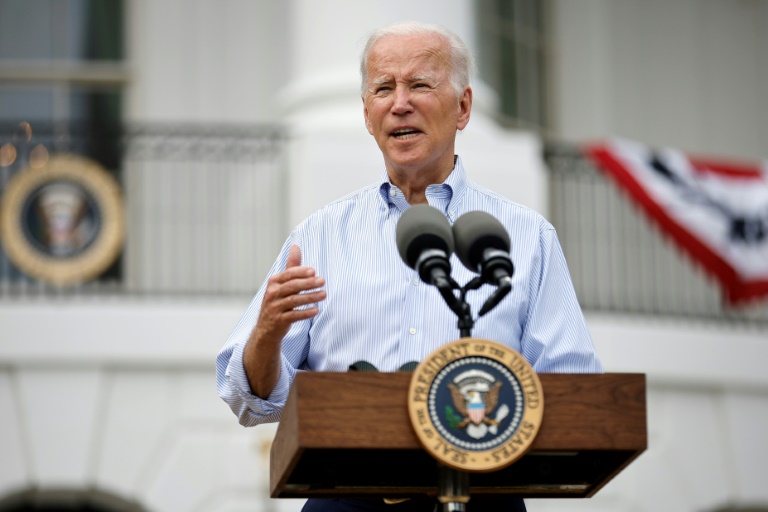
US President Joe Biden will announce Wednesday a series of executive measures to combat climate change, in an effort to push forward an environmental agenda stalled by an unsupportive Congress and a conservative Supreme Court.

Biden — who will deliver his address from a former coal power plant in Massachusetts — will make clear that time is running out to tackle global warming, highlighted by a devastating heatwave in Europe that has sparked fires, melted runways and spelled misery for millions.

But he will stop short of declaring a formal emergency, which would grant him additional policy powers.

“The president… is going to make it clear that just because Congress couldn’t get it done, he is going to move forward with every power available to him to make the change and the shift to clean energy,” White House climate advisor Gina McCarthy told CNN.

“The president will make very clear again that this is an emergency and we are going to act. But the president is going to outline that at his pace.”

For now, he is expected to use executive orders to provide additional funding for communities dealing with extreme heat and actions to boost US production of wind power.

The efforts are part of the administration’s goals to move “the US power sector away from the pollution, environmental injustice, and volatile price swings of the past,” a White House official said, and “toward the good-paying jobs, lower costs, and energy security of the future.”

-Repeated setbacks –

Biden began his term last year promising to fulfill campaign pledges to tackle the global climate crisis, but his agenda has faced blow after blow.

His first day in office, Biden signed an executive order to bring the United States back into the Paris Climate Agreement, followed later by an ambitious announcement that he was targeting a 50-52 percent reduction from 2005 levels in US net greenhouse gas pollution by 2030.

But his signature Build Back Better legislation, which would have included $550 billion for clean energy and other climate initiatives, is all but dead after failing to receive the necessary backing in Congress as Democratic Senator Joe Manchin said he would not support the bill.

And last month, the Supreme Court ruled that the Environmental Protection Agency (EPA) cannot issue broad greenhouse gas regulations without congressional approval.

McCarthy insisted however that “regulatory action is still strong,” saying: “We are going to move, not just with the EPA, but with others.”

The Biden administration has framed climate policies as a national security issue, made all the more urgent by soaring fuel prices in the wake of Russia’s invasion of Ukraine. 

“Not only does it affect our infrastructure… It has an impact on our readiness,” White House spokesman John Kirby said Tuesday. 

State Department spokesman Ned Price pointed to the extreme heat wave tormenting Europe this week — with Britain recording a temperature of 104 degrees Fahrenheit (40 degrees Celsius) — as more proof that climate action cannot wait. 

“We are committed to taking advantage of this moment and doing everything we can, including on the world stage,” Price told reporters, “to ensure that this decisive decade does not go by without us taking appropriate action.”

US home sales fall again in June as prices hit new record

US home prices hit another new peak in June amid short supply, while existing home sales fell for the fifth straight month amid the ongoing rise in mortgage rates, according to industry data released Wednesday.

Sales sank 5.4 percent compared to May, toppling to a 5.12 million annual rate, far below what economists were projecting, the National Association of Realtors (NAR) reported.

That was the weakest sales pace since January 2019, excluding the start of the pandemic in 2020, NAR Chief Economist Lawrence Yun told reporters.

After topping $400,000 for the first time ever, the median national home price continued to rise, hitting $416,000 last month, the data showed.

“A combination of higher prices and higher mortgage rates clearly has shifted the dynamics in the housing market,” Yun said. “Even people who want to buy are simply priced out, given these affordability challenges.”

With inflation soaring and American families struggling to make ends meet, the Federal Reserve has been aggressively raising interest rates to try to cool demand and ease the pressure. But that has put homes out of reach for many.

Separate data from the Mortgage Bankers Association released Wednesday showed demand for home loans fell 6.3 percent last week, in the third consecutive decline.

The Fed is watching the housing market closely for signs that scorching inflation might be easing.

While sales increased for homes above $500,000, NAR said there were large double-digit declines in the lower price categories, reflecting the affordability challenge and the fact rising prices are pushing some homes into higher price buckets.

Yun noted that price increases are slowing, while weakening demand is allowing inventories to build up, reaching 2.7 months’ supply in June from just 1.8 in January.

But, he said, even if the housing market returns to something more like normal by year end, with “more manageable” price increases, “I don’t foresee a nationwide price decline.”

Sales fell 14.2 percent compared to June 2021, while the median price is up 13.4 percent, according to the data.

Existing home sales make up 90 percent of the real estate market.

US home sales fall again in June as prices hit new record

US home prices hit another new peak in June amid short supply, while existing home sales fell for the fifth straight month amid the ongoing rise in mortgage rates, according to industry data released Wednesday.

Sales sank 5.4 percent compared to May, toppling to a 5.12 million annual rate, far below what economists were projecting, the National Association of Realtors (NAR) reported.

That was the weakest sales pace since January 2019, excluding the start of the pandemic in 2020, NAR Chief Economist Lawrence Yun told reporters.

After topping $400,000 for the first time ever, the median national home price continued to rise, hitting $416,000 last month, the data showed.

“A combination of higher prices and higher mortgage rates clearly has shifted the dynamics in the housing market,” Yun said. “Even people who want to buy are simply priced out, given these affordability challenges.”

With inflation soaring and American families struggling to make ends meet, the Federal Reserve has been aggressively raising interest rates to try to cool demand and ease the pressure. But that has put homes out of reach for many.

Separate data from the Mortgage Bankers Association released Wednesday showed demand for home loans fell 6.3 percent last week, in the third consecutive decline.

The Fed is watching the housing market closely for signs that scorching inflation might be easing.

While sales increased for homes above $500,000, NAR said there were large double-digit declines in the lower price categories, reflecting the affordability challenge and the fact rising prices are pushing some homes into higher price buckets.

Yun noted that price increases are slowing, while weakening demand is allowing inventories to build up, reaching 2.7 months’ supply in June from just 1.8 in January.

But, he said, even if the housing market returns to something more like normal by year end, with “more manageable” price increases, “I don’t foresee a nationwide price decline.”

Sales fell 14.2 percent compared to June 2021, while the median price is up 13.4 percent, according to the data.

Existing home sales make up 90 percent of the real estate market.

European stocks, euro drop awaiting Russia gas move, ECB

European stocks and the euro retreated Wednesday as the EU took precautionary measures in the face of reduced Russian gas supplies.

Traders were also looking ahead to a key ECB meeting Thursday.

European assets headed south despite sizeable gains in Asia and Tuesday’s surge on Wall Street.

US stocks rebounded strongly Tuesday as companies’ earnings soothed concerns about the impact on their bottom lines from soaring inflation and rising interest rates.

While several firms — such as Apple and Johnson & Johnson — have indicated they have concerns about the outlook, there is a feeling that the sell-off across markets could be reaching a bottom.

And some commentators have suggested the second half could see a healthy rally, despite official data continuing to show inflation rising strongly worldwide.

UK annual inflation hit a new 40-year high at 9.4 percent in June on surging motor fuel and food prices.

The same month, inflation in South Africa soared to its highest level in 13 years at 7.4 percent.

Against a backdrop of decades-high inflation also in the eurozone, all eyes were on the European Central Bank, which is Thursday widely expected to announce its first rate hike in more than a decade.

Officials have their work cut out for them as they must also try not to drive a stake through the eurozone economy, which has also been hammered by an energy crisis.

Talk of a half-point hike — instead of the quarter-point lift most expect — has boosted the euro against the dollar since last week falling below parity for the first time in 20 years.

The European single currency had risen earlier Wednesday, helped also by a Bloomberg News article saying Russia’s Gazprom would resume deliveries through the Nord Stream 1 pipeline Thursday, albeit at reduced capacity.

Moscow shut down deliveries to Germany for technical reasons last week, but there had been fears it would keep the taps off in retaliation for European sanctions over its invasion of Ukraine.

Taking no chances, the European Commission on Wednesday urged EU countries to reduce their demand for natural gas by 15 percent over the coming winter months to overcome Russia’s energy supply “blackmail”.

In a statement, the EU’s executive arm also asked member states to give it special powers to force through needed demand cuts if Russia cuts the Europe’s gas lifeline.

“Russia is blackmailing us. Russia is using energy as a weapon and therefore, in any event, whether it’s a partial major cut off of Russian gas or total cut off… Europe needs to be ready,” Commission president Ursula von der Leyen told reporters.

– Key figures at around 1100 GMT –

London – FTSE 100: DOWN 0.3 percent at 7,274.05 points

Frankfurt – DAX: DOWN 0.5 percent at 13,249.05

Paris – CAC 40: DOWN 0.4 percent at 6,178.59

EURO STOXX 50: DOWN 0.4 percent at 3,571.50

Tokyo – Nikkei 225: UP 2.7 percent at 27,680.26 (close)

Hong Kong – Hang Seng Index: UP 1.1 percent at 20,890.22 (close)

Shanghai – Composite: UP 0.8 percent at 3,304.72 (close)

New York – Dow: UP 2.4 percent at 31,827.05 (close)

Euro/dollar: DOWN at $1.0180 from $1.0226 Tuesday

Pound/dollar: DOWN at $1.1966 from $1.2002 

Euro/pound: DOWN at 85.09 pence from 85.19 pence

Dollar/yen: DOWN at 138.20 yen from 138.21 yen

West Texas Intermediate: DOWN 1.7 percent at $102.50 per barrel

Brent North Sea crude: DOWN 1.4 percent at $105.80 per barrel

Russian fire pounds Ukraine, as Putin announces 'progress' on grain exports

Russian shelling pounded eastern and southern Ukraine as President Vladimir Putin said Moscow would only ease the path for Black Sea exports of Ukrainian grain if the West lifts sanctions on Russia’s shipments.

Russian strikes hit the eastern city of Kramatorsk on Tuesday, killing one person, local authorities said.

AFP journalists said a four-story residential building had been hit in the city in the Donbas region. One man with a bloodied head lay on the ground, before being taken away by the emergency services.

“He was just walking by and was hit,” said one woman, who declined to give her name, visibly shaken after the bombardment.

Russia’s invasion of Ukraine in February has killed thousands and displaced millions, but also hampered shipments from one of the world’s biggest exporters of wheat and other grain, sparking fears of global food shortages.

Putin, in Tehran for talks with his Turkish counterpart Recep Tayyip Erdogan, on Tuesday said “progress” had been made in discussions towards exporting grain from Ukraine.

After talks with both Erdogan and Iran’s president, Putin told reporters that any deal hinged on the West’s willingness to yield some ground.

“We will facilitate the export of Ukrainian grain, but we are proceeding from the fact that all restrictions related to possible deliveries for the export of Russian grain will be lifted,” he said.

NATO member Turkey has been using its good relations with both the Kremlin and Kyiv to try and broker an agreement on a safe way to deliver the grain.

– ‘Victory before winter’ –

On Wednesday, Russian and Ukrainian delegations are due to meet in Istanbul alongside Turkish and UN representatives, with hopes rising for an announced accord.

The EU’s foreign policy chief Josep Borrell warned this week that the grain impasse was “an issue of life and death for many human beings”.

And a document consulted by AFP Tuesday showed that the European Commission is proposing to unblock assets at Russian banks linked to trade in food and fertiliser.

Along the Black Sea coast, Kyiv said that a barrage of seven cruise missiles had wounded at least six people, including a child, in the southern coastal region of Odessa.

The Russian defence ministry claimed that strikes on Odessa had destroyed a stockpile of Western-supplied weapons.

Russian Defence Minister Sergei Shoigu ordered troops earlier this week to prioritise the destruction of long-range artillery supplied by the United States and Ukraine’s other Western allies.

Observers credit the weapons with altering battlefield dynamics, giving Ukraine the capacity to hit Russian arms depots and command posts deep inside territory controlled by Moscow.

Ukrainian Defence Minister Oleksiy Reznikov, during a visit to the United States, urged the West to drastically step up its supply of precision rocket systems, calling them a “game-changer”.

In Washington, National Security Council spokesman John Kirby said the United States believes that Russia is moving ahead with plans to annex more Ukrainian territory. 

“Russia is beginning to roll out a version of what you could call an annexation playbook, very similar to the one we saw in 2014,” when it invaded and annexed Crimea, Kirby said.

Zelensky’s chief of staff Andriy Yermak underlined in an interview published Tuesday that Ukraine had to win its war with Russia before winter, telling Ukrainian weekly Novoye Vremya that if Moscow has time to regroup, it will be “more difficult”.

– Suspected treason –

On the diplomatic front, Russia’s close ally Syria announced Wednesday it was severing ties with Ukraine, according to an unidentified foreign ministry official, cited by state news agency SANA.

Kyiv had already announced it was cutting ties with Syria late last month, after Damascus recognised the Russian-backed breakaway republics of Donetsk and Lugansk in eastern Ukraine.

Ukrainian lawmakers on Tuesday endorsed the president’s decision to sack the country’s top prosecutor and security chief, backing Ukraine’s largest political shake-up since Russia invaded.

Several Ukrainian deputies said lawmakers at the parliamentary session in Kyiv had overwhelmingly backed President Volodymyr Zelensky’s shock call to remove the senior officials.

“Parliament voted to dismiss Iryna Venediktova as prosecutor general,” said David Arakhamia, a lawmaker affiliated with Zelensky.

Other deputies said the plea to remove security chief Ivan Bakanov had secured the required 226 votes.

Zelensky late Sunday said he was suspending the senior law enforcement officials — and that 650 cases of suspected treason were under investigation.

He replaced Bakanov on Monday and described the shake-up in the security services as an “audit”, saying 28 security officials were facing dismissal.

The governor of Mykolaiv, a southern region under constant Russian rocket fire, meanwhile on Tuesday promised a $100 reward for anyone who could help to identify people who have been collaborating with Russia by providing it with the locations of Ukrainian troops or coordinates of potential targets. 

burs-sst-ah-sr/dva

Stock markets rally on tech bounce, earnings hope

Equities piled higher Wednesday following a surge on Wall Street, as investors grow hopeful in the ongoing earnings season, while sentiment was also boosted by news that Russian gas flows to Europe will not be cut off.

Markets also reacted positively to a report saying China will fine ride-hailing giant Didi $1 billion but bring an end to its year-long probe, reinforcing optimism that a long-running tech crackdown is nearing an end.

After a hefty drop Monday, all three main indexes on Wall Street posted solid gains Tuesday as companies’ earnings soothed concerns about the impact on their bottom lines from soaring inflation and rising interest rates.

Analysts said that with many investors having priced in a weak reporting season, above-forecast readings were giving a lift to stocks.

While several firms — such as Apple and Johnson & Johnson — have indicated they have concerns about the outlook, there is a feeling that the sell-off across markets could be reaching a bottom.

And some commentators have suggested the second half could see a healthy rally.

“Stocks have been beaten down,” said Kristina Hooper, a strategist at Invesco. 

“That doesn’t mean we won’t see more downside for some stock markets around the world, especially given that earnings expectations are likely to be adjusted downward. But I believe we are far closer to the bottom than the top.”

A surge in tech giants helped the Nasdaq jump more than three percent while the Dow and S&P 500 climbed more than two percent.

And the positive vibes flowed through to Asia, where Hong Kong was among the best performers thanks to big advances in the city’s tech titans, including Alibaba and Tencent.

Traders there were given a much-needed lift by a Wall Street Journal report saying Beijing is expected to hit Didi Global with the billion dollar fine before bringing the curtain down on a long-running investigation.

The firm will then be able to restart its key apps and add customers again, while also being allowed to resume its stalled Hong Kong listing.

The report was music to the ears of investors who have been battered by a regulation clampdown on the tech industry and a range of other sectors including private education. The Hong Kong tech index rose more than two percent Tuesday.

– Europe gas relief –

Elsewhere, Tokyo, Shanghai, Sydney, Seoul, Singapore, Mumbai, Taipei, Bangkok, Jakarta and Wellington also rallied.

London rose as data showed UK inflation hit a new 40-year high of 9.4 percent in June, putting further pressure on the Bank of England to ramp up borrowing costs.

Paris and Frankfurt were also up in early trade.

All eyes are now on the European Central Bank’s policy decision Thursday, where it is expected to announce its first rate hike in more than a decade as it looks to rein in soaring inflation.

Officials have their work cut out for them as they must also try not to drive a stake through the eurozone economy, which has also been hammered by an energy crisis.

Talk of a half-point hike — instead of the quarter-point lift most expect — has lifted the euro against the dollar, having fallen to parity last week for the first time in 20 years.

The currency was also helped by a Bloomberg News article saying Russia’s Gazprom would resume deliveries through the Nord Stream 1 pipeline Thursday, albeit at reduced capacity.

Moscow shut down deliveries to Germany for technical reasons last week, but there had been fears it would keep the taps off in retaliation for European sanctions over its invasion of Ukraine.

CMC Markets analyst Michael Hewson said: “This is certainly welcome news if true, given that earlier in the day European Commission officials were making the assumption the pipeline would not restart.”

But he added: “They would probably be wise to continue on this basis given the predilection for Moscow to weaponise gas flows as they already have been doing.”

While the mood among traders is positive, observers remained cautious.

“Recession fears certainly haven’t gone away and the rebound in equities over the past week could as much reflect a recovery from oversold levels and extreme levels of pessimism,” said SPI Asset Management’s Stephen Innes.

– Key figures at around 0810 GMT –

Tokyo – Nikkei 225: UP 2.7 percent at 27,680.26 (close)

Hong Kong – Hang Seng Index: UP 1.1 percent at 20,890.22 (close)

Shanghai – Composite: UP 0.8 percent at 3,304.72 (close)

London – FTSE 100: UP 0.4 percent at 7,327.75

Euro/dollar: UP at $1.0232 from $1.0226 on Monday

Pound/dollar: UP at $1.2004 from $1.2002 

Euro/pound: UP at 85.22 pence from 85.19 pence

Dollar/yen: DOWN at 138.19 yen from 138.21 yen

West Texas Intermediate: DOWN 1.8 percent at $102.40 per barrel

Brent North Sea crude: DOWN 1.4 percent at $105.89 per barrel

New York – Dow: UP 2.4 percent at 31,827.05 (close)

Russian fire pounds Ukraine, as Putin announces 'progress' on grain exports

Russian shelling pounded eastern and southern Ukraine as President Vladimir Putin said Moscow would only ease the path for Black Sea exports of Ukrainian grain if the West lifts sanctions on Russia’s shipments.

Russian strikes hit the eastern city of Kramatorsk on Tuesday, killing one person, local authorities said.

AFP journalists said a four-story residential building had been hit in the city in the Donbas region. One man with a bloodied head lay on the ground, before being taken away by the emergency services.

“He was just walking by and was hit,” said one woman, who declined to give her name, visibly shaken after the bombardment.

Russia’s invasion of Ukraine in February has killed thousands and displaced millions, but also hampered shipments from one of the world’s biggest exporters of wheat and other grain, sparking fears of global food shortages.

Putin, in Tehran for talks with his Turkish counterpart Recep Tayyip Erdogan, on Tuesday said “progress” had been made in discussions towards exporting grain from Ukraine.

After talks with both Erdogan and Iran’s president, Putin told reporters that any deal hinged on the West’s willingness to yield some ground.

“We will facilitate the export of Ukrainian grain, but we are proceeding from the fact that all restrictions related to air deliveries for the export of Russian grain will be lifted,” he said.

NATO member Turkey has been using its good relations with both the Kremlin and Kyiv to try and broker an agreement on a safe way to deliver the grain.

– ‘Victory before winter’ –

On Wednesday, Russian and Ukrainian delegations are due to meet in Istanbul alongside Turkish and UN representatives, with hopes rising for an announced accord.

The EU’s foreign policy chief Josep Borrell warned this week that the grain impasse was “an issue of life and death for many human beings”.

And a document consulted by AFP Tuesday showed that the European Commission is proposing to unblock assets at Russian banks linked to trade in food and fertiliser.

Along the Black Sea coast, Kyiv said that a barrage of seven cruise missiles had wounded at least six people, including a child, in the southern coastal region of Odessa.

The Russian defence ministry claimed that strikes on Odessa had destroyed a stockpile of Western-supplied weapons.

Russian Defence Minister Sergei Shoigu ordered troops earlier this week to prioritise the destruction of long-range artillery supplied by the United States and Ukraine’s other Western allies.

Observers credit the weapons with altering battlefield dynamics, giving Ukraine the capacity to hit Russian arms depots and command posts deep inside territory controlled by Moscow.

Ukrainian Defence Minister Oleksiy Reznikov, during a visit to the United States, urged the West to drastically step up its supply of precision rocket systems, calling them a “game-changer”.

In Washington, National Security Council spokesman John Kirby said the United States believes that Russia is moving ahead with plans to annex more Ukrainian territory. 

“Russia is beginning to roll out a version of what you could call an annexation playbook, very similar to the one we saw in 2014,” when it invaded and annexed Crimea, Kirby said.

Zelensky’s chief of staff Andriy Yermak underlined in an interview published Tuesday that Ukraine had to win its war with Russia before winter, telling Ukrainian weekly Novoye Vremya that if Moscow has time to regroup, it will be “more difficult”.

– Suspected treason –

On the diplomatic front, Russia’s close ally Syria announced Wednesday it was severing ties with Ukraine, according to an unidentified foreign ministry official, cited by state news agency SANA.

Kyiv had already announced it was cutting ties with Syria late last month, after Damascus recognised the Russian-backed breakaway republics of Donetsk and Lugansk in eastern Ukraine.

Ukrainian lawmakers on Tuesday endorsed the president’s decision to sack the country’s top prosecutor and security chief, backing Ukraine’s largest political shake-up since Russia invaded.

Several Ukrainian deputies said lawmakers at the parliamentary session in Kyiv had overwhelmingly backed President Volodymyr Zelensky’s shock call to remove the senior officials.

“Parliament voted to dismiss Iryna Venediktova as prosecutor general,” said David Arakhamia, a lawmaker affiliated with Zelensky.

Other deputies said the plea to remove security chief Ivan Bakanov had secured the required 226 votes.

Zelensky late Sunday said he was suspending the senior law enforcement officials — and that 650 cases of suspected treason were under investigation.

He replaced Bakanov on Monday and described the shake-up in the security services as an “audit”, saying 28 security officials were facing dismissal.

The governor of Mykolaiv, a southern region under constant Russian rocket fire, meanwhile on Tuesday promised a $100 reward for anyone who could help to identify people who have been collaborating with Russia by providing it with the locations of Ukrainian troops or coordinates of potential targets. 

burs-sst-ah-sr/dva

China speeding up approvals for new coal plants: Greenpeace

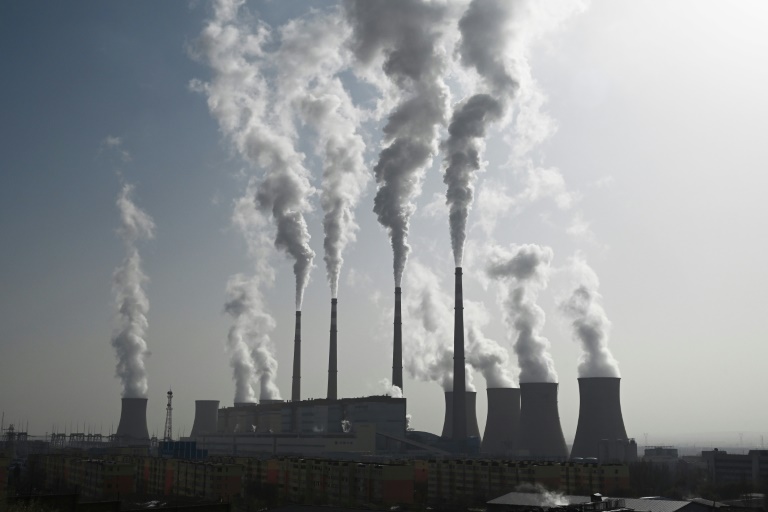
China has ramped up approvals for new coal power plants this year, Greenpeace said Wednesday, with authorities trying to lower the risk of economically painful electricity shortages.

China is the world’s biggest emitter of the greenhouse gases driving global warming, and President Xi Jinping last year vowed to phase down coal use from 2026 as part of an ambitious set of national climate commitments.

But campaigners fear those targets are under threat with the government focused on economic challenges, even as the deadly impact of climate change is felt around the world.

In the first quarter of 2022, Chinese regulators gave the green light to coal plants with a total capacity of 8.63 gigawatts, according to research conducted by Greenpeace.

That is nearly half of the entire coal-fired capacity approved last year, the environmental campaigners said.

“Building more coal-fired power capacity will not provide energy security for China,” said Wu Jinghan, climate and energy campaigner with Greenpeace in Beijing.

“China has an overcapacity of coal-fired power plants. Power inadequacies originate from poor integration of generation, grid, load and storage.”

The figure for new coal plant approvals dipped in mid-2021 but rebounded later in the year as China experienced widespread power outages due to a supply crunch.

Electricity consumption has surged this summer as China suffers through an intense heatwave, with air conditioning cranked up at homes and businesses to try and keep people cool.

China relies on coal for around 60 percent of its electricity, and has asked domestic miners to increase capacity by 300 million tons this year.

The State Council, China’s cabinet, in May announced 10 billion yuan ($1.5 billion) of investment in coal power generation, as coal producers were pressured to ramp up output before the 2025 threshold. 

“An overcapacity of this one energy source is a major hurdle for energy security, as well as China’s energy transition,” Wu warned.

Skyrocketing global commodity prices in the wake of Russia’s invasion of Ukraine have renewed China’s focus on energy security.

As the Chinese economy stalls under strict Covid policies and prolonged supply chain disruptions, authorities are looking to boost growth through a massive infrastructure construction push — which relies overwhelmingly on coal power.

China is the world’s biggest coal consumer and producer, and analysts worry that economic targets will derail its pledge to peak carbon emissions by 2030.

Close Bitnami banner
Bitnami