US Business

French music streamer Deezer flops at stock market debut

French music streaming service Deezer’s shares failed to strike the right note with investors at its Tuesday launch on the Paris stock market, plunging in morning trading by over 35 percent.

The steep fall — as low as 5.52 euros ($5.70) before a slight rebound — was a blow for the Spotify competitor, whose 9.6 million subscribers account for around two percent of the global streaming market, according to Midia Research.

That makes it a minnow compared with the Swedish streaming giant, which boasts market share of around 31 percent.

But as one of the few French digital firms to become a household name, Deezer’s flotation event in Paris was attended by Economy Minister Bruno Le Maire, who told bosses “you have to grow” after chief executive Jeronimo Folgueira rang the opening bell.

“I don’t accept seeing all the American firms coming to Europe without seeing European firms go to the US, to explain to our American friends that European firms are the best,” Le Maire said.

As well as Spotify, Deezer has yet to catch up with other giants in the streaming world, including Apple, Amazon and China’s Tencent.

The firm is doubling down on music, rather than expanding into neighbouring fields like podcasting and audio books as Spotify and Amazon have done.

Deezer hopes deals with mobile network operators like France’s Orange and Brazil’s Tim, as well as broadcaster RTL in Germany, will help it reach more listeners in a global streaming market growing at more than 25 percent per year by users.

“With the right distribution, we know we can win market share and become rivals to the major players,” CEO Folgueira told AFP ahead of the stock market launch.

Compared with 2015, when a first attempt to float the company had to be postponed because of hostile market conditions, “the business has changed, the market has changed: it’s the right moment to take this step,” he added.

“Music streaming is really established, it makes up almost two-thirds of revenue for recorded music, which wasn’t true back then.”

Deezer’s top investor before its arrival on the market was British-American billionaire Len Blavatnik, with 43 percent, while French businesspeople including billionaire Francois Pinault have also bet on the firm.

burs/tgb/spm

Euro slumps as recession risk stalks eurozone

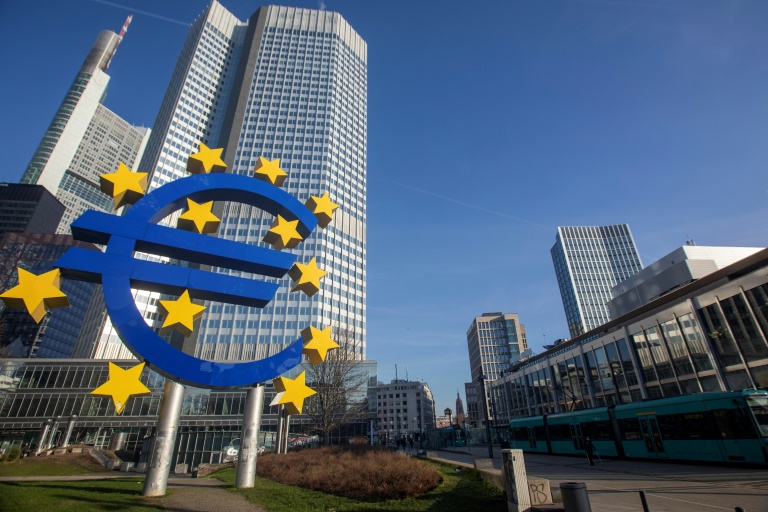
The euro on Tuesday slumped to its lowest level since 2002 and European stock markets sank as growing recession risks sent shockwaves around the region.

The shared currency fell as low as $1.0298, threatening a push towards dollar parity.

It also dived as investors eyed aggressive interest rate hikes by the US Federal Reserve in its fight against inflation, in contrast with the European Central Bank which plans more modest increases.

Stocks indices in Frankfurt, London and Paris shed more than one percent in late morning deals on heightened fears of a prolonged economic downturn across Europe.

Economic growth in the eurozone floundered in June, a key survey showed Tuesday, hit by soaring consumer prices.

S&P Global’s closely-watched monthly purchasing managers’ index (PMI), which measures corporate confidence, fell to 52.0 in June from 54.8 in May.

Nevertheless, the reading, which was a 16-month low, remains above the 50-point level signalling expansion.

“Growing fears of a recession are hammering the euro lower, whilst the dollar is soaring on bets that the Fed will keep hiking rates aggressively to tame inflation,” City Index analyst Fiona Cincotta told AFP.

“Today’s PMI data from Europe have highlighted the risk of slowing growth at the end of the second quarter and raise the prospect of a contraction in activity in the coming months.”

By contrast, most Asian stock markets closed higher on growing speculation that US President Joe Biden is about to roll back some of the Trump-era tariffs on Chinese goods.

The mood on trading floors has nevertheless become increasingly gloomy in recent months as observers warn that sharp interest rate hikes aimed at curbing price rises could cause a contraction, compounding uncertainty caused by Russia’s war in Ukraine.

Oil prices were mixed as traders assessed the market with demand outstripping supplies.

Investors were keeping tabs also on fresh Covid outbreaks in China that have triggered City lockdowns.

US markets were set to reopen later Tuesday following July 4 celebrations.

– Key figures at around 1000 GMT –

Euro/dollar: DOWN at $1.0301 from $1.0431 Monday

Pound/dollar: DOWN at $1.2040 from $1.2116

Euro/pound: DOWN at 85.59 pence from 86.09 pence

Dollar/yen: UP at 135.76 yen from 135.69 yen

London – FTSE 100: DOWN 1.2 percent at 7,144.11 points

Frankfurt – DAX: DOWN 1.1 percent at 12,637.22

Paris – CAC 40: DOWN 1.3 percent at 5,878.26

EURO STOXX 50: DOWN 1.0 percent at 3,417.26

Tokyo – Nikkei 225: UP 1.0 percent at 26,423.47 (close)

Hong Kong – Hang Seng Index: UP 0.1 percent at 21,853.07 (close)

Shanghai – Composite: FLAT at 3,404.03 (close)

New York – Dow: Closed for public holiday

Brent North Sea crude: DOWN 1.4 percent at $111.88 per barrel

West Texas Intermediate: UP 0.4 percent at $108.90 per barrel

Struggling SAS files for Chapter 11 bankruptcy proceedings in US

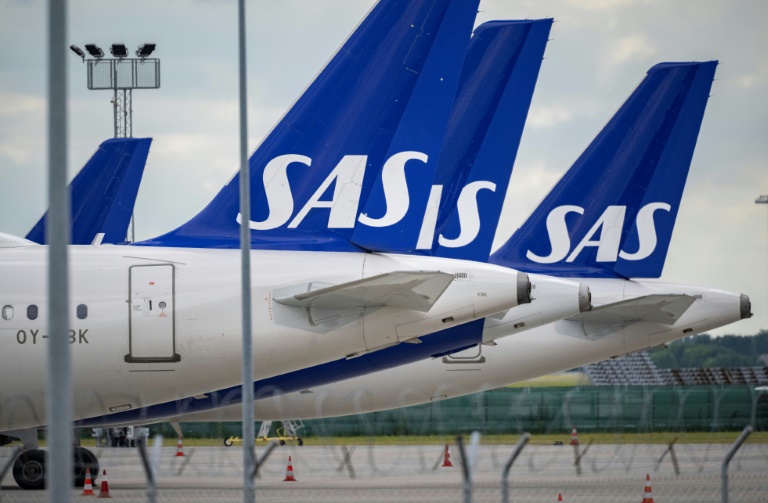
Faced with financial difficulties and a massive pilot strike, Scandinavian airline SAS said Tuesday it has filed for so-called Chapter 11 bankruptcy proceedings in the United States, as a part of restructuring plan.

“We simply need to do much more and do it much faster,” SAS chairman Carsten Dilling told a press conference where defended what he called “a well thought-through decision.”

In the US, Chapter 11 is a mechanism allowing a company to restructure its debts under court supervision while continuing to operate.

The move was made in order “to proceed with the implementation of key elements” of its business transformation plan, the troubled carrier, which employs nearly 7,000 people, said in a statement.

Asked why the company chose initiate the proceedings in the US, rather than Sweden where it is headquartered, Dilling said they had considered several countries where they could file, but “ended up concluding that the US framework is the right one for the company.”

Chief executive Anko van der Werff said they expected “to complete the Chapter 11 process in nine to 12 months.”

SAS said its “operations and flight schedule are unaffected by the Chapter 11 filing, and SAS will continue to serve its customers as normal,” while noting that the ongoing strike by Scandinavian pilot unions would continue to impact operations.

– ‘Last thing SAS needs’ –

“A strike is the last thing the company needs right now,” van der Werff told reporters.

Pilots walked out on Monday after negotiations between the unions and the company broke down.

The pilots are protesting against salary cuts demanded by management as part of a restructuring plan aimed at ensuring the survival of the company, which has suffered a string of losses since the start of the coronavirus pandemic in early 2020. 

On Monday, SAS said that the strike “is estimated to lead to the cancellation of approximately 50 percent of all scheduled SAS flights,” impacting around 30,000 passengers a day.

SAS management announced in February the savings plan to cut costs by 7.5 billion Swedish kronor ($700 million), dubbed “SAS Forward”, which was supplemented in June by a plan to increase capital by nearly one billion euros ($1.04 billion). 

Denmark and Sweden are the biggest shareholders with 21.8 percent each. 

Denmark said in June it was ready to increase its stake to 30 percent. Sweden has refused to provide fresh funds, but is willing to turn debt into capital. 

Norway, which left SAS in 2018, has said it is ready to return to the airline, but only by converting debt into equity. 

Suffering, like the rest of the sector, from the impact of Covid-19, SAS cut 5,000 jobs, or 40 percent of its workforce, in 2020. The carrier now had around 6,900 employees at the end of May, a number which fell below 5,000 at the height of the pandemic.

Shares in SAS, already at all-time lows, fell by more than 11 percent in the early hours of trading on the Stockholm Stock Exchange.

SAS’s troubles comes as the summer is shaping up to be difficult for European airlines and airports, faced with staff shortages affecting traffic. 

After widespread job losses linked to Covid-19, airlines and airports are struggling to recruit new staff in many countries. 

China mulls dipping into pork reserves to rein in costs

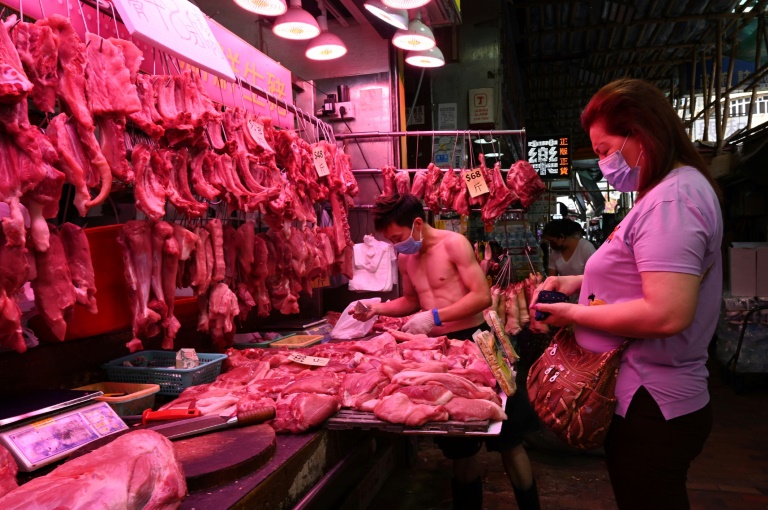
Chinese authorities said Tuesday they could dip into pork reserves and ordered suppliers to slaughter more pigs in a bid to rein in the cost of the staple meat, after prices soared by almost a third year-on-year.

Beijing’s top economic planner was forced to respond after pork prices in the country spiked, with regulators blaming suppliers for “blindly holding supplies” and being reluctant to sell.

The National Development and Reform Commission (NDRC) said that reluctance was aimed at boosting profits, ordering major suppliers to kill pigs at a “regular pace” and stop hoarding, Xinhua said.

Late last month the meat sold for 32 percent more than in June 2021, it added.

On Tuesday, the commission said it was “looking into a release of central pork reserves”.

It has also instructed local governments to release supplies “in a timely manner” to guard against sharp price increases.

The Chinese government keeps massive stores of frozen pork in warehouses, occasionally releasing reserve meat to stabilise prices, especially during periods of peak demand including Lunar New Year.

Pork is the most commonly consumed meat in China, with the average person in the country eating more than 25 kilogrammes per year, according to OECD data.

The world’s second largest economy has mostly been spared the impact of a global surge in food prices caused by Russia’s war in Ukraine.

But pork prices were hit hard after the country’s herds were devastated by African swine fever in recent years, causing consumer inflation to spike.

In 2019, authorities said they would free up land to restore production to pre-swine fever levels, and officials have since released supplies from stockpiles to rein in costs.

“As the prices of hogs continue to rise, pig farmers are turning losses into profits… farmers are now profiting about 60 yuan (about $9) per head,” Ministry of Agriculture and Rural Affairs hog expert Wang Zuli told state broadcaster CCTV in an interview in June.

“We can say the darkest days for pig farmers are over,” Wang said, adding that supplies were expected to grow.

Even Pay, an agriculture analyst at consultancy Trivium China, told AFP it was common during periods of rising pork prices for pig farmers to “delay sales of pigs that are ready for slaughter now, assuming they’ll be able to make more next week, and the week after”.

“But if the rise in pig prices is driven by real market factors rather than mostly by speculation, the reserve releases won’t have much of an impact,” Pay said, pointing to high feed and energy costs as well as rebounding demand from restaurants post-lockdown.

Beijing is keeping a close eye on food prices as Covid disruptions, on top of higher fertiliser and fuel costs and issues with access to equipment, threaten the autumn harvest of key crops such as soybean and corn.

Hacker claims major Chinese citizens' data theft

A hacker claiming to have stolen personal data from hundreds of millions of Chinese citizens is now selling the information online.

A sample of 750,000 entries posted online by the hacker showed citizens’ names, mobile phone numbers, national ID numbers, addresses, birthdays and police reports they had filed. 

AFP and cybersecurity experts have verified some of the citizen data in the sample as authentic, but the scope of the entire database is hard to determine.

Advertised on a forum late last month but only picked up by cybersecurity experts this week, the 23-terabyte database — which the hacker claims contains the records of a billion Chinese citizens — is being sold for 10 bitcoin (approximately $200,000).

“It looks like it’s from multiple sources. Some are facial recognition systems, others appear to be census data,” said Robert Potter, co-founder of cybersecurity firm Internet 2.0. 

“There is no verification of the total number of records and I’m sceptical of the one billion citizens number,” he added.

China maintains an extensive nationwide surveillance infrastructure that siphons massive amounts of data from its citizens, ostensibly for security purposes. 

Growing public awareness of data privacy has led to stronger data protection laws targeting individuals and private firms in recent years, although there is little citizens can do to stop the state from collecting their data. 

Some of the leaked data appeared to be from express delivery user records, while other entries contained summaries of incidents reported to police in Shanghai over a span of more than a decade, with the most recent from 2019.

The incident reports ranged from traffic accidents and petty theft to rape and domestic violence.

– ‘Heads will roll’ –

At least four people out of over a dozen contacted by AFP confirmed their personal details, such as names and addresses, as listed in the database.

“So that’s why so many people have been adding my WeChat over the past few days. Should I report this to the police?” said one woman surnamed Hao.

“I’m really confused about why my personal data has been leaked,” said another woman surnamed Liu.

In replies to the original post, users speculated that the data may have been hacked from an Alibaba Cloud server where it was apparently being stored by the Shanghai police. 

Potter, the cybersecurity analyst, confirmed that the files were hacked from Alibaba Cloud, which did not respond to an AFP request for comment.

If confirmed, the breach would be one of the largest in history and a major violation of the recently approved Chinese data protection laws.

“Heads will roll over this one,” tweeted Kendra Schaefer, tech partner at research consultancy Trivium China.

China’s cybersecurity administration did not respond to a fax requesting comment.

Markets mostly up on talk Biden to roll back some China tariffs

Most markets rose Tuesday on growing speculation US President Joe Biden is about to roll back some of the Trump-era tariffs on Chinese goods as he looks for ways to rein in inflation, though sentiment remains at a premium owing to fears of a recession.

The mood on trading floors has become increasingly gloomy in recent months as observers warn that sharp interest rate hikes aimed at curbing price rises could cause a contraction, compounding uncertainty caused by Russia’s war in Ukraine.

Still, equities were on the up Tuesday on talk that the White House is about to remove duties on some of the hundreds of billions of dollars worth of imports from China, with reports saying an announcement could come this week.

With some of the tariffs due to expire soon, officials in Washington have been discussing the measures with an eye on inflation, which is sitting at four-decade highs.

And in a sign that something could be on the cards, China’s state-run Xinhua news agency said Treasury Secretary Janet Yellen and Vice Premier Lui He had held discussions.

“The two sides agree that as the world economy is facing severe challenges, it is of great significance to strengthen macro-policy communication and coordination between China and the United States,” it said. 

“And jointly maintaining the stability of the global industrial and supply chains is in the interests of both countries and the whole world.”

Reports also said that Biden was considering launching new probes into industrial subsidies — allowing for more targeted measures in strategic areas — to appease China hawks.

Hong Kong, Tokyo, Sydney, Seoul, Taipei, Mumbai, Wellington, Manila and Jakarta were all in positive territory. However, Shanghai gave up early gains and ended marginally down, while Singapore was also off.

London dipped but Paris and Frankfurt were up in early trade.

US markets were closed Monday for a holiday.

“Given that inflation remains the White House public enemy number one, (investors are) leaning toward a gradual rollback of some China tariffs as it would reduce end costs to US consumers,” said SPI Asset Management’s Stephen Innes.

However, some commentators said that while the removal of some tariffs would be widely welcomed by traders, they were unlikely to have a long-lasting effect on inflation.

“Markets are likely to react positively on a knee-jerk because at this point we are hungry for any signs of positive news,” Charu Chanana, of Saxo Capital Markets, said.

“But we don’t see the move impacting the global growth and inflation dynamics in a significant way.”

Oil prices were mixed as traders assess the market with demand outstripping supplies as the Ukraine war rages with no sign of an end, while investors are keeping tabs on China as it sees fresh Covid outbreaks that have led to some cities being put into lockdown.

Months-long flare-ups in Shanghai and Beijing earlier in the year saw millions of people ordered to stay home, sending shockwaves through the domestic economy and battering supply chains.

“China is the real wildcard here: it’s going to be two steps forward, one step back,” said Australia & New Zealand Banking Group’s Daniel Hynes.

“A demand recovery in China could potentially offset weakness in developed economies as central banks tighten monetary policy.”

– Key figures at around 0810 GMT –

Tokyo – Nikkei 225: UP 1.0 percent at 26,423.47 (close)

Hong Kong – Hang Seng Index: UP 0.1 percent at 21,853.07 (close)

Shanghai – Composite: FLAT at 3,404.03 (close)

London – FTSE 100: DOWN 0.3 percent at 7,208.64

Dollar/yen: UP at 136.00 yen from 135.69 yen Monday

Euro/dollar: DOWN at $1.0400 from $1.0431 

Pound/dollar: DOWN at $1.2068 from $1.2116

Euro/pound: UP at 85.09 pence from 86.09 pence

West Texas Intermediate: UP 1.7 percent at $110.26 per barrel

Brent North Sea crude: DOWN 0.4 percent at $113.00 per barrel

New York – Dow: Closed for public holiday

Police arrest suspect after gunman kills six at US July 4 parade

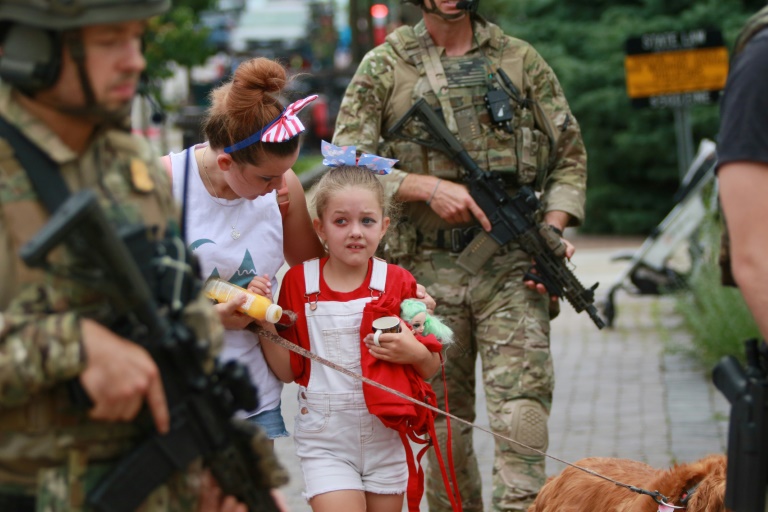
Police arrested a suspect Monday after a mass shooting left six dead at a US Independence Day parade in a wealthy Chicago suburb, casting a dark shadow over the country’s most patriotic holiday. 

Robert Crimo, 22, was identified as a “person of interest” and became the target of a massive manhunt across the town of Highland Park in Illinois, where a rooftop gunman with a high-powered rifle turned a family-focused July 4 parade celebration into a scene of death and trauma.

Firing into the holiday crowd, the shooter caused scenes of chaos as panicked onlookers ran for their lives, leaving behind a parade route strewn with chairs, abandoned balloons and personal belongings.

Emergency officials said around two dozen people, including children, were treated for gunshot injuries, with some in critical condition.

After a brief car chase, Crimo was taken into custody “without incident,” Highland Park police chief Lou Jogmen told reporters.

Earlier, police had warned that he was armed and “very dangerous.” 

Crimo bills himself as a musician, and goes by the online moniker “Awake the Rapper.” 

The shooting is part of a wave of gun violence plaguing the United States, where approximately 40,000 deaths a year are caused by firearms, according to the Gun Violence Archive website.

And it cast a pall over America’s Independence Day, in which towns and cities across the country hold similar parades and people — many dressed in variations on the US flag — hold barbecues, attend sports events and gather for firework displays.

In another July 4 shooting, two police officers were wounded when they came under fire during a fireworks display in Philadelphia, local officials said.

CBS News aired video taken from a high-rise building showing crowds fleeing in panic as fireworks burst in the sky. 

Philadelphia police commissioner Danielle Outlaw said both officers had been released from hospital after receiving treatment, and that authorities were still investigating the exact circumstances of the incident.

In Highland Park, Emily Prazak, who marched in the parade, described the mayhem.

“We were getting ready to march down the street and then all the sudden waves of these people started running after, like running towards us. And right before that happened, we heard the pop, pop, pop, pop, pop, and I thought it was fireworks,” Prazak told AFP.

She added: “This is the day that we celebrate our country. This is also a day that our freedom got stolen from us — because many of us residents here, in this building even, we’re all locked down.”

– Spectators ‘targeted’ –

Don Johnson, who attended the parade, said he initially thought the gunshots were a car backfiring.

“And finally, I heard the screams from a block down and people running and carrying their kids and everything, and we ran into the gas station, and we were in there for three hours,” he told AFP.

“I’ve seen scenes like this over and over again on the TV and in different communities, and didn’t think it was going to happen here ever,” he said.

Police officials said the shooting began at 10:14 am, when the parade was approximately three-quarters of the way through.

“It sounds like spectators were targeted… So, very random, very intentional and very sad,” said Lake County Major Crime Task Force spokesman Christopher Covelli.

Five of the six people killed, all adults, died at the scene. The sixth was taken to the hospital but succumbed to wounds there.

Dr Brigham Temple of Highland Park Hospital, where most of the victims were taken, said it had received 25 people with gunshot wounds aged eight to 85.

“Four or five” children were among them, he said, and that 16 people were later discharged.

Police said the shooter used a “high-powered rifle,” and “firearm evidence” had been located on the rooftop of a nearby business.

“All indications is he was discreet, he was very difficult to see,” said Covelli.

US media reported that Crimo’s online postings included violent content that alluded to guns and shootings. His YouTube and other social media accounts were not viewable Monday night.

One YouTube video posted eight months ago features images of a young man in a bedroom and a classroom along with cartoons of a gunman and people being shot, the Chicago Tribune reported.

A voice-over says “I need to just do it.”

It adds: “It is my destiny. Everything has led up to this. Nothing can stop me, not even myself,” the newspaper said.

– 311 mass shootings so far –

In a statement, Highland Park Mayor Nancy Rotering said the town had been “devastated” by the shooting. 

“A mass shooting such as this casts a much wider net of agony than what the public is typically exposed to; it’s a crisis that devastates entire families and communities in a single moment and we know will take time to heal,” she said.

President Joe Biden voiced his shock and vowed to keep fighting “the epidemic of gun violence” sweeping the country. 

“I’m not going to give up,” he said.

Last week, Biden signed the first significant federal bill on gun safety in decades, just days after the Supreme Court ruled that Americans have a fundamental right to carry a handgun in public.

The deeply divisive debate over gun control was reignited by two massacres in May that saw 10 Black supermarket shoppers gunned down in upstate New York and 21 people, mostly young children, slain at an elementary school in Uvalde, Texas.

According to the Gun Violence Archive, there have been 311 mass shootings carried out in the US so far in 2022 — including at least five other incidents on July 4.


I.Coast eyes cassava for its bread as wheat prices surge

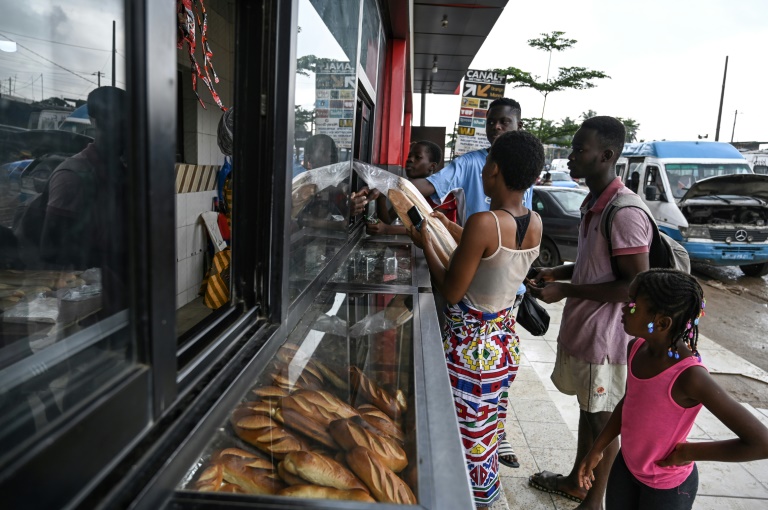
As wheat prices are driven upwards by the war in Ukraine, bakers in the West African state of Ivory Coast are starting to use locally produced cassava flour to bake bread.

The baguette, the stick of bread that is much loved in the former French colony, is commonly seen as a benchmark of the cost of living.

But Ivory Coast does not produce wheat domestically, instead importing up to a million tonnes of the grain per year, mainly from France.

Surging wheat prices have stoked concern about the impact in a country of 25 million where the average wage is less than 250,000 CFA francs ($400) per month, and which was shaken by a wave of violence less than two years ago.

Both Ukraine and Russia are large wheat producers, and lost harvests and other uncertainties have driven up prices of the global staple.

In response, Ivorian authorities have pegged the price of a baguette at between 150 and 200 CFA francs ($0.25 and $0.30) depending on weight, channelling subsidies worth 6.4 billion CFA francs (about $10 million) to the country’s 2,500 bakeries. 

Bakers, with the government’s support, are also starting to substitute a small portion of wheat flour with flour from cassava, a root vegetable.

Cassava, also called manioc, is Ivory Coast’s second largest crop after yam, with 6.4 million tonnes produced each year.

– ‘New flavours’ –

The cassava substitution plan ticks the boxes for economy and sustainability. But what do Ivorians think?

“Everything has become expensive in the market,” said Honorine Kouamee, a food vendor in Abidjan’s Blockhaus district who was cooking pancakes made of wheat mixed with coconut flour. 

“If we can make bread with local cassava flour it will be better. People are willing to eat local products.”

The national consumers’ confederation has thrown its support behind the cassava substitute.

“It will provide a stimulus for manioc producers and maintain the price of bread,” said its president, Jean-Baptiste Koffi.

But image and taste are important and some bakers are cautious.

“It’s not a done deal,” said Rene Diby, a baker.  

“For Ivorians, bread made with cassava is associated with poor-quality bread. Consumers will have to be made aware of these new flavours.”

The authorities will have to run a promotional campaign, he said.

Cassava is high in starch and is a good source of dietary fibre.

But high proportions of cassava flour lower the mineral and protein content in bread, compared with traditional wheat, a 2014 study in Nigeria found.

Financially, even using just a small portion of cassava flour would provide the government with some relief.

Last year, 10 percent of the national budget of around $16 billion was spent on food imports, despite the country’s fertile soil.

Ranie-Didice Bah Kone, executive secretary of the state-run National Council for the Fight against the High Cost of Living (CNLCV), says it is time to unlock Ivory Coast’s rch agricultural potential. 

“It’s a question of thinking long term, about our food security, it’s a question of thinking about how Ivory Coast will ensure it is less dependent on world prices,” she said.

During a visit to a cassava flour processing plant in Abidjan, she called for immediate measures to increase the supply of local flours, in addition to subsidies for the wheat sector.

– ‘Africanise baking’ –

Concerns in West Africa about dependence on imported wheat are not confined to Ivory Coast. 

On July 19, bakers from across West Africa will meet in Senegal’s capital Dakar to launch an association to lobby for setting a regional benchmark of up to 15 percent of local content in bread products.

Using local products in bread could “solve food crises,” said Marius Abe Ake, who leads a bakers’ association.

“We need to Africanise baking to help lower manufacturing costs, fight poverty and avoid damaging unrest.”

Ivory Coast has a history of turbulence.

In 2020 scores died in pre-election violence — an episode that revived traumatic memories of a brief civil conflict in 2011 in which several thousand people were killed. 

In 2008 riots broke out when the cost of rice, milk and meat soared.

Tunisia struggles to grow more wheat as Ukraine war bites

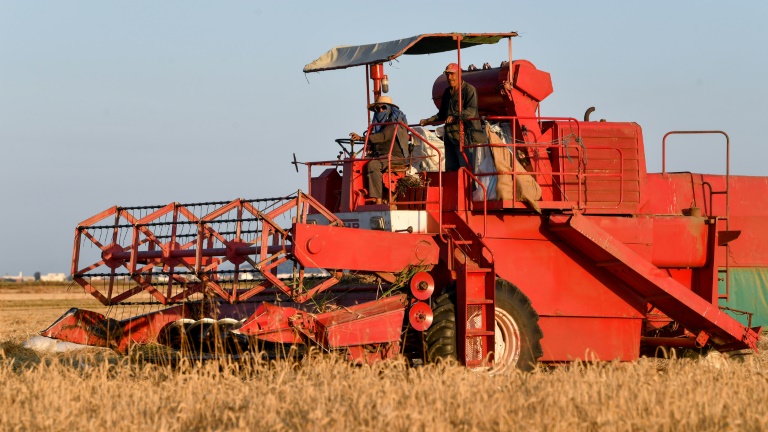
Tunisian farmer Mondher Mathali surveys a sea of swaying golden wheat and revs his combine harvester, a rumbling beast from 1976 which he fears could break down at any moment.

Since the Ukraine war sent global cereal prices soaring, import-dependent Tunisia has announced a push to grow all its own durum wheat, the basis for local staples like couscous and pasta.

The small North African country, like its neighbours, is desperate to prevent food shortages and social unrest — but for farmers on the sun-baked plains north of Tunis, even the basics are problematic.

“I’d love to buy a new combine harvester, but I could only do it with help from the government,” said Mathali, 65.

He reckons his outdated machine wastes almost a third of the crop. With spare parts hard to find, he fears a breakdown could cost him his entire harvest.

But even a second-hand replacement would cost him an unimaginable sum: $150,000.

“Our production and even the quality would go up by maybe 50 percent, even 90 percent” with government help, he said.

“But our situation is getting worse and the state isn’t helping us.”  

– ‘No continuity’ –

Tunisia’s wheat production has suffered from years of drought and a decade of political instability, with 10 governments since the country’s 2011 revolution.

That has exacerbated its reliance on imports. Last year, it bought almost two-thirds of its cereal from overseas, much of it from the Black Sea region.

Those supply chains have been rocked first by the coronavirus pandemic and then by the war in Ukraine, which last year provided around half of Tunisia’s imports of the soft wheat used in bread.

While it still plans to import soft wheat, the country is pushing for self-sufficiency in durum wheat by the 2023 harvest. 

That would be a valuable contribution to the national diet: the average Tunisian eats 17 kilograms (37 pounds) of pasta per year, second only to Italians.

In April, the government unveiled a programme to help farmers access better seeds, technical assistance and state-backed loans.

It also plans to devote 30 percent more farmland to wheat, and has dramatically boosted the prices it pays growers.

But the agriculture ministry’s chief of staff acknowledged Mathali’s problems.

“Tunisia has about 3,000 combine harvesters, 80 percent of which are old and very wasteful, which represents a major loss,” said Faten Khamassi. 

She said the state plans to fund farmers’ collectives to buy shared equipment.

– ‘Need to choose’ –

Agricultural technician Saida Beldi, who has worked with farmers in the northern Ariana governorate for three decades, says political instability has gutted the sector.

With each new minister, “the policy changes”, she said. “There’s no continuity.” 

She said many farmers struggled to obtain state-subsidised fertilisers, which trade on the black market at inflated prices.

Khamassi said it was “certainly possible to reach self-sufficiency in durum wheat”.

But she said Tunisia faces another dilemma: “develop cereal production to reach self-sufficiency, or develop other crops like strawberries and tomatoes for export? We need to choose.”

International organisations have long pushed poorer countries to focus on specific cash crops for export, rather than growing essentials.

A 2014 World Bank report argued that Tunisia “does not have a strong comparative advantage in cereals” and should instead focus on “labour intensive” crops because of cheap labour.

But in June, announcing a $130 million loan for emergency cereal imports, the lender said it was providing “incentives to sustainably increase domestic grain production” and cut import dependency.

Today, Khamassi said, comparative advantage is “no longer relevant”.

“We need to return to much more self-sufficient policies, local production,” she said.

– Changing times –

The ministry also said in June that it would allow foreign investors to own agricultural firms outright, instead of requiring at least one-third Tunisian ownership.

Khamassi said this would attract investment and create jobs.

But economist Fadhel Kaboub said this strategy would make Tunisia even more vulnerable.

“Small-scale Tunisian farmers operating on small plots of land will not be able to compete with big foreign investors with access to cheap loans from European banks,” he said. 

“These companies’ business model is to push for cash crops for export, to earn dollars and euros — not to produce wheat to sell for dinars in the local market.”

For farmer Mathali, who hopes to pass his business on to his son, the stakes couldn’t be higher.

“Tunisia was the Roman Empire’s main supplier of wheat,” he said, squinting under the summer sun.

“Why can’t we revive that?”

Police arrest suspect after gunman kills six at US July 4 parade

Police arrested a suspect Monday after a mass shooting left six dead at a US Independence Day parade in a wealthy Chicago suburb, casting a dark shadow over the country’s most patriotic holiday. 

Robert Crimo, 22, was identified as a “person of interest” and became the target of a massive manhunt across the town of Highland Park in Illinois, where a rooftop gunman with a high-powered rifle turned a family-focused July 4 parade celebration into a scene of death and trauma.

Firing into the holiday crowd, the shooter caused scenes of total chaos as panicked onlookers ran for their lives, leaving behind a parade route strewn with chairs, abandoned balloons and personal belongings.

Emergency officials said around two dozen people, including children, were treated for gunshot injuries, with some in critical condition.

After a brief car chase, Crimo was taken into custody “without incident,” Highland Park police chief Lou Jogmen told reporters.

Earlier, police had warned that he was armed and “very dangerous.” 

Crimo bills himself as a musician, and goes by the online moniker “Awake the Rapper.” 

The shooting is part of a wave of gun violence plaguing the United States, where approximately 40,000 deaths a year are caused by firearms, according to the Gun Violence Archive website.

And it cast a pall over America’s Independence Day, in which towns and cities across the country hold similar parades and people — many dressed in variations on the US flag — hold barbecues, attend sports events and gather for firework displays.

In another July 4 shooting, two police officers were wounded when they came under fire during a fireworks display in Philadelphia, major US news outlets reported.

CBS News aired video taken from a high-rise building showing crowds fleeing in panic as fireworks burst in the sky. The circumstances of that shooting were not immediately known and police were not reachable Monday night. 

In Highland Park, Emily Prazak, who marched in the parade, described the mayhem.

“We were getting ready to march down the street and then all the sudden waves of these people started running after, like running towards us. And right before that happened, we heard the pop, pop, pop, pop, pop, and I thought it was fireworks,” Prazak told AFP.

She added: “This is the day that we celebrate our country. This is also a day that our freedom got stolen from us — because many of us residents here, in this building even, we’re all locked down.”

– Spectators ‘targeted’ –

Don Johnson, who attended the parade, said he initially thought the gunshots were a car backfiring.

“And finally, I heard the screams from a block down and people running and carrying their kids and everything, and we ran into the gas station, and we were in there for three hours,” he told AFP.

“I’ve seen scenes like this over and over again on the TV and in different communities, and didn’t think it was going to happen here ever,” he said.

Police officials said the shooting began at 10:14 am, when the parade was approximately three-quarters of the way through.

“It sounds like spectators were targeted… So, very random, very intentional and very sad,” said Lake County Major Crime Task Force spokesman Christopher Covelli.

Five of the six people killed, all adults, died at the scene. The sixth was taken to the hospital but succumbed to wounds there.

Dr Brigham Temple of Highland Park Hospital, where most of the victims were taken, said it had received 25 people with gunshot wounds aged eight to 85.

“Four or five” children were among them, he said, and that 16 people were later discharged.

Police said the shooter used a “high-powered rifle,” and “firearm evidence” had been located on the rooftop of a nearby business.

“All indications is he was discreet, he was very difficult to see,” said Covelli.

US media reported that Crimo’s online postings included violent content that alluded to guns and shootings. His YouTube and other social media accounts were not viewable Monday night.

One YouTube video posted eight months ago features images of a young man in a bedroom and a classroom along with cartoons of a gunman and people being shot, the Chicago Tribune reported.

A voice-over says “I need to just do it.”

It adds: “It is my destiny. Everything has led up to this. Nothing can stop me, not even myself,” the newspaper said.

– 309 mass shootings so far –

President Joe Biden voiced his shock and vowed to keep fighting “the epidemic of gun violence” sweeping the country. 

“I’m not going to give up,” he said.

Last week, Biden signed the first significant federal bill on gun safety in decades, just days after the Supreme Court ruled that Americans have a fundamental right to carry a handgun in public.

The deeply divisive debate over gun control was reignited by two massacres in May that saw 10 Black supermarket shoppers gunned down in upstate New York and 21 people, mostly young children, slain at an elementary school in Uvalde, Texas.

According to the Gun Violence Archive, there have been 309 mass shootings carried out in the US so far in 2022 — including at least three others on July 4, though without any fatalities.

Close Bitnami banner
Bitnami