US Business

China mulls dipping into pork reserves to rein in costs

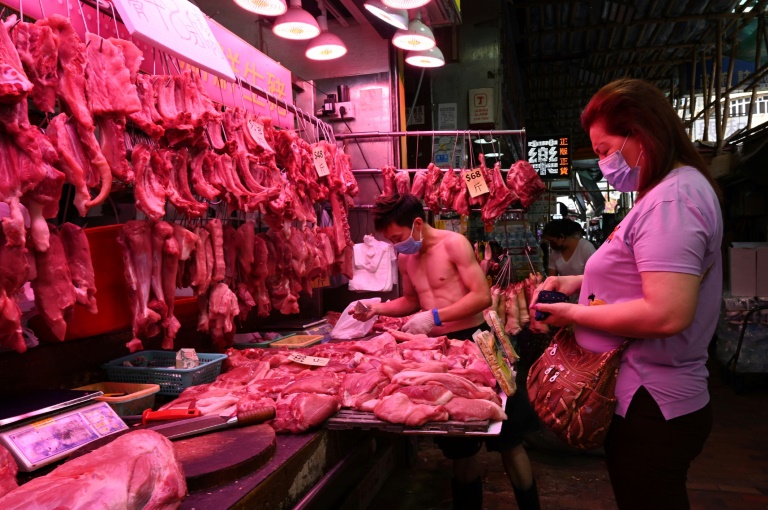
Chinese authorities could dip into strategic pork reserves in a bid to rein in prices of the staple meat, Beijing’s top economic planner said Tuesday.

Pork prices in the world’s second-biggest economy spiked late last month, with the meat selling for 32 percent more than in June 2021 as market supplies dropped, state media Xinhua News Agency reported.

The spike came on the back of “irrational behaviours such as blindly holding supplies and reluctance to sell in the live pig market,” the National Development and Reform Commission (NDRC) said in a notice on social media.

The NDRC said that reluctance was aimed at boosting profits and ordered major suppliers to slaughter pigs at a “regular pace”, warning them against hoarding, Xinhua said.

On Tuesday, the commission added that it was “looking into a release of central pork reserves”.

It has also instructed local governments to release supplies “in a timely manner” to guard against sharp price hikes.

China has largely been spared the impact of a global surge in food prices caused by Russia’s war in Ukraine.

But pork prices were hit hard after the country’s herds were devastated by African swine fever in recent years, causing consumer inflation to spike.

In 2019, authorities said they would free up land to restore pork production to pre-swine fever levels, and officials have since released supplies from reserves to rein in rising costs.

“As the prices of hogs continue to rise, pig farmers are turning losses into profits… farmers are now profiting about 60 yuan (about $9) per head,” Ministry of Agriculture and Rural Affairs hog expert Wang Zuli told state broadcaster CCTV in an interview in June.

“We can say the darkest days for pig farmers are over,” Wang said, adding that pork supplies were expected to grow.

US, China discuss 'severe' economic challenges, supply chains

Top officials from the United States and China held a “candid” video call on Tuesday to discuss global economic challenges, especially regarding supply chains.

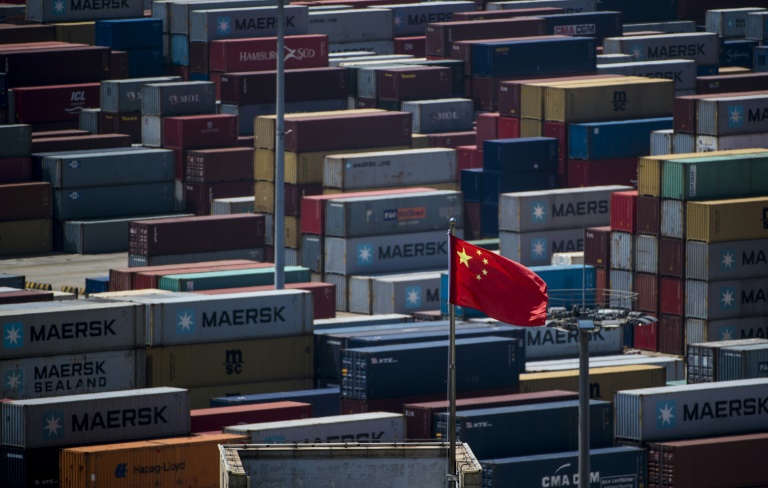
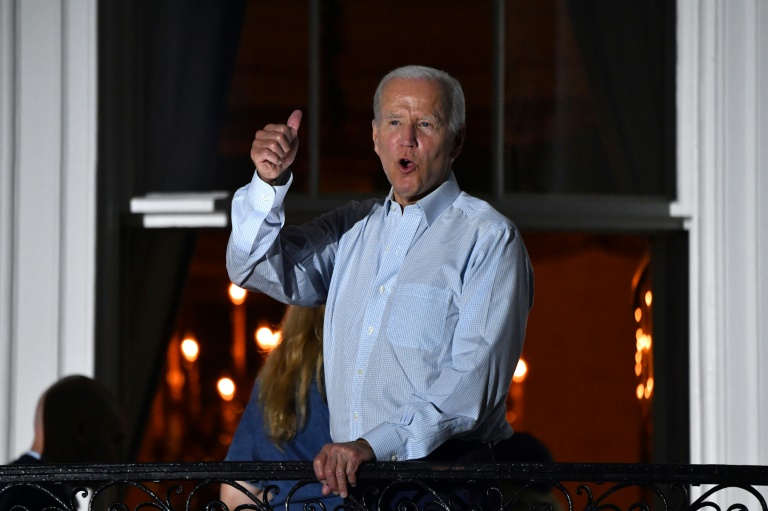
The exchange between Chinese Vice Premier Liu He and US Treasury Secretary Janet Yellen came as President Joe Biden considers lifting some tariffs on imports from China to try and ease soaring inflation.

The world’s two biggest economies are also grappling with Covid-snarled supply chains and rising global energy prices.

“The two sides agree that as the world economy is facing severe challenges, it is of great significance to strengthen macro-policy communication and coordination between China and the United States,” China’s official Xinhua news agency reported.

“And jointly maintaining the stability of the global industrial and supply chains is in the interests of both countries and the whole world.”

The Xinhua report said the video call took place at the request of the United States, and described the conversation as “constructive”.

Yellen and Liu “discussed macroeconomic and financial developments in the United States and China, the global economic outlook amid rising commodity prices and food security challenges”, the US Treasury Department said in a readout.

“Secretary Yellen frankly raised issues of concern including the impact of the Russia’s war against Ukraine on the global economy and unfair, non-market (Chinese) economic practices.”

China has repeatedly refused to condemn the Russian invasion, and has been accused of providing diplomatic cover for Moscow by blasting Western sanctions and arms sales to Ukraine.

With inflation in the United States at 40-year highs, authorities there are rushing to try and find ways to ease price pressures.

Among the options is lifting some of the trade tariffs imposed on China by Biden’s predecessor Donald Trump.

Any decision is likely to come soon as some of the Trump duties are set to expire from July 6 unless renewed.

The penalties were aimed at punishing what the United States says are China’s unfair trade practices.

In the call with Yellen Tuesday, China “expressed its concern about issues including the lifting of additional tariffs on China and sanctions by the US side”, according to Xinhua.

Contact is expected in the coming weeks between Biden and Chinese President Xi Jinping.

Asian markets rise on talk Biden to roll back some China tariffs

Asian markets rose Tuesday on growing speculation US President Joe Biden is about to roll back some of the Trump-era tariffs on Chinese goods as he looks for ways to rein in inflation, though sentiment remains at a premium owing to fears of a recession.

The mood on trading floors has become increasingly gloomy in recent months as observers warn that sharp interest rate hikes aimed at curbing price rises could cause a contraction, compounding uncertainty caused by Russia’s war in Ukraine.

Still, equities were on the up Tuesday on talk that the White House is about to remove duties on some of the hundreds of billions of dollars worth of imports from China, with reports saying an announcement could come this week.

With some of the tariffs due to expire soon, officials in Washington have been discussing the measures with an eye on inflation, which is sitting at four-decade highs.

And in a sign that something could be on the cards, China’s state-run Xinhua news agency said Treasury Secretary Janet Yellen and Vice Premier Lui He had held discussions.

“The two sides agree that as the world economy is facing severe challenges, it is of great significance to strengthen macro-policy communication and coordination between China and the United States,” it said. 

“And jointly maintaining the stability of the global industrial and supply chains is in the interests of both countries and the whole world.”

Reports also said that Biden was considering launching new probes into industrial subsidies — allowing for more targeted measures in strategic areas — to appease China hawks.

Hong Kong, Shanghai, Tokyo, Sydney, Seoul, Taipei, Wellington, Manila and Jakarta were all in positive territory.

“Given that inflation remains the White House public enemy number one, (investors are) leaning toward a gradual rollback of some China tariffs as it would reduce end costs to US consumers,” said SPI Asset Management’s Stephen Innes.

However, some commentators said that while the removal of some tariffs would be widely welcomed by traders, they were unlikely to have a long-lasting effect on inflation.

“Markets are likely to react positively on a knee-jerk because at this point we are hungry for any signs of positive news,” Charu Chanana, of Saxo Capital Markets, said.

“But we don’t see the move impacting the global growth and inflation dynamics in a significant way.”

Oil prices rose on expectations that demand will continue to outstrip supplies as the Ukraine war rages with no sign of an end, while investors are keeping tabs on China as it sees fresh Covid outbreaks that have led to some cities being put into lockdown.

Months-long flare-ups in Shanghai and Beijing earlier in the year saw millions of people ordered to stay home, sending shockwaves through the domestic economy and battering supply chains.

“China is the real wildcard here: it’s going to be two steps forward, one step back,” said Australia & New Zealand Banking Group’s Daniel Hynes.

“A demand recovery in China could potentially offset weakness in developed economies as central banks tighten monetary policy.”

– Key figures at around 0230 GMT –

Tokyo – Nikkei 225: UP 0.8 percent at 26,369.24 (break)

Hong Kong – Hang Seng Index: UP 1.0 percent at 22,037.88

Shanghai – Composite: UP 0.2 percent at 3,412.73

Dollar/yen: UP at 136.20 yen from 135.69 yen Monday

Euro/dollar: DOWN at $1.0430 from $1.0431 

Pound/dollar: DOWN at $1.2106 from $1.2116

Euro/pound: UP at 86.16 pence from 86.09 pence

West Texas Intermediate: UP 2.3 percent at $110.87 per barrel

Brent North Sea crude: UP 0.6 percent at $114.16 per barrel

London – FTSE 100: UP 0.9 percent at 7,232.65 points (close)

New York – Dow: Closed for public holiday

'Guerrilla' sales, crowdsourcing: Japan's game console crunch

It’s still dark when the line starts forming outside an electronics store in Tokyo, as desperate gamers try to snag the latest PlayStation or Xbox despite chronic shortages in Japan.

The consoles made by Sony and Microsoft have been hard to buy since their November 2020 release, as has Nintendo’s Switch, with supply chain issues exacerbated by lockdowns in China.

Shortages have struck worldwide but are particularly acute in Japan because Sony and Microsoft have prioritised other markets.

That has left consumers and stores in a game of cat-and-mouse as customers hunt coveted consoles and sellers battle chaos that has sometimes required police intervention.

Tetsuya, 50, has been trying to get a console since February and lined up before 6:30 am with dozens of other people outside a store in the electronics district of Akihabara.

But around 8 am, an employee emerged to announce the store had not received either PS5s or Xboxes and the crowd quickly dispersed.

“It’s a shame, but I’ll keep trying my chances if I can,” said Tetsuya, who declined to give his second name.

Hoping to discourage crowding, many stores have moved sales online, using lottery systems, while others have shifted to low-profile sales that take place without prior warning, with consoles arriving on a random schedule.

The phenomenon is known as “guerrilla sales” in Japan, a term that first emerged with the Nintendo DS console, which was a victim of its own success during the 2000s

Some gamers are fighting back with their own tactics, including one who has set up a website gathering crowdsourced information.

“Last summer, I spent three months trying to buy a PlayStation 5, but every time I went to a store, they were sold out,” said the 40-year-old Japanese man, a researcher in artificial intelligence who asked to remain anonymous.

“The only option was to phone each store or find information on Twitter,” he told AFP.

“I thought to myself that everyone must have the same problem, and that creating a site to share information would help the community.”

– ‘There’s no line’ –

The site’s creator says he spends hours on weekends sorting and verifying up to 500 daily messages posted on its forum.

“For PS5s in Yokohama, they are now selling both the disc edition and the digital edition. It’s unclear how many units they have. There’s no line,” reads one post.

The information gives gamers real-time leads but is also fed into a calendar to highlight trends and analysed by an algorithm designed to predict when stores will have supplies.

Japan’s console drought is the result of various factors, says analyst Hideki Yasuda of Toyo Securities.

Microsoft’s Xbox has never been as popular in Japan as elsewhere, so in times of short supply, the country isn’t a priority market.

And Sony has targeted PS5 sales in Europe and North America, according to Yasuda, who estimates just five to eight percent of the 20 million PS5s sold worldwide were in Japan.

When the PS4 launched in 2013, “the smartphone game market in Japan was exploding while the console market was stalling”, he told AFP.

“Sony must have thought it was going to disappear in the 2020s, especially with the shrinking Japanese population.”

As a result, a PS5 bought for 55,000 yen ($400) can now easily fetch 80,000-100,000 yen when resold, and there have even been fistfights involving alleged resellers at stores.

Despite promises from PlayStation boss Jim Ryan in May of a “significant ramp up” in production, Yasuda doesn’t expect a major boost to deliveries before the second half of 2023.

The crowdsourcing site founder says he will keep going, determined to help those “who really love video games” against “scalpers”.

“I have no life on the weekend, but if I stop, people who want to buy a console will be stuck.”

Mecca businesses see hajj boom ending pandemic slump

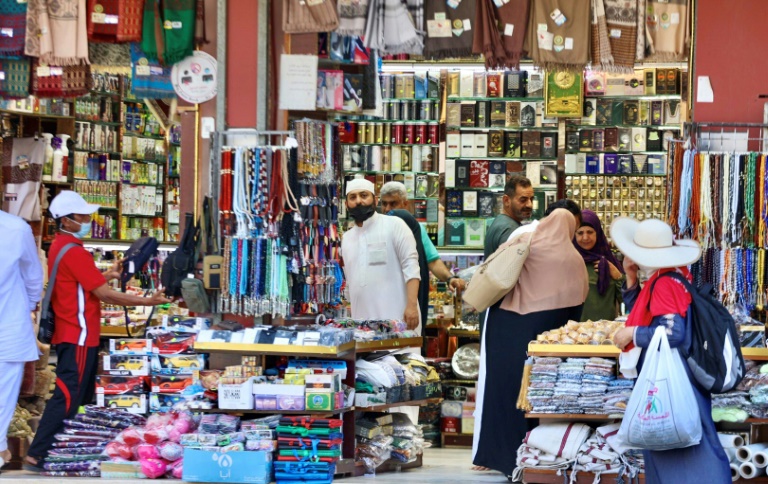
“Business is back”, exclaims Abdullah Mekhlafi at the shop where he sells prayer mats in Islam’s holiest city, which is preparing for the biggest influx of hajj pilgrims since the coronavirus pandemic began.

Two years of drastic restrictions on the number of pilgrims who could perform the hajj emptied shops and hotels across the Saudi Arabian city of Mecca. But business owners are hoping for a quick recovery as hundreds of thousands of worshippers flock to the region this week.

“We had few customers (during the last two hajj seasons), but today business is back, thanks to God. It’s the same as before, and even better,” 30-year-old Mekhlafi told AFP.

One million people, including 850,000 from abroad, will be allowed at this year’s hajj, one of five pillars of Islam which all able-bodied Muslims with the means are required to perform at least once in their lives.

In 2019, about 2.5 million people took part in the rituals, which include circling the Kaaba at the Grand Mosque in Mecca, gathering at Mount Arafat and “stoning the devil” in Mina.

The following year, after the pandemic took hold, foreigners were barred and the total number of worshippers was capped at 10,000 to stop the hajj from turning into a global super-spreader.

That figure rose to 60,000 fully vaccinated Saudi citizens and residents in 2021.

– Restoring old glory –

The hajj, which costs at least $5,000 per person, and umrah pilgrimages that occur at other times of year are usually a significant revenue earner for Saudi Arabia, especially its tourism sector.

In normal times, they generate about $12 billion (11.5 billion euros) annually, keeping the economy humming in Mecca.

The city has seen a construction boom in recent years that has brought new shopping malls, apartment buildings and luxury hotels — some offering spectacular views of the sacred Kaaba, the large black cubic structure at the centre of the Grand Mosque towards which all Muslims pray.

But these projects were starved for clients during the pandemic, meaning their owners were cheered by scenes already unfolding in Mecca on Monday, two days before the hajj officially begins. 

White-robed worshippers were flocking to souvenir and barber shops across the city of two million.

And the main shopping centre near the Grand Mosque, where many hotels are located, was buzzing with pilgrims again, a far cry from a year ago when the area looked nearly abandoned. 

Amin, a perfume shop owner, was bullish about his prospects, telling AFP his losses could be recovered this year.

“There is a huge difference between this year and past ones. This year we can see a lot of pilgrims who are bringing back the glory to the Grand Mosque,” he said. 

“The losses were big, but now things are better.”

– Boom times –

The changes in Mecca track the recent economic fortunes of Saudi Arabia.

During the pandemic, the kingdom faced a sharp downturn in oil prices due to a collapse in global demand, which triggered austerity measures including the tripling of a value added tax and cuts to civil servants’ allowances.

Particularly after Russia’s invasion of Ukraine in February, things seem to have changed.

In early May, Saudi Arabia reported its fastest economic growth rate in a decade, as a surging oil sector fuelled a 9.6 percent rise in the first quarter over the same period of 2021.

“The impact of the losses during the last two years was significant, but we are starting to see a recovery on the business level, and this year’s (hajj) is good news,” said Salem Ali Shahran, operations manager at the biggest hotel chain in Mecca.

“The current numbers have reached 40 percent of their 2019 levels. We hope for bigger numbers in the coming years.”

Saudi Arabia’s GDP is expected to grow by 7.6 percent in 2022, the International Monetary Fund said in April.

The world’s biggest oil exporter is trying to diversify its economy, a main pillar of the Vision 2030 reform agenda pushed by Crown Prince Mohammed bin Salman, the de facto ruler. 

Tourism is a crucial component of that plan, making a booming hajj all the more important.

The current goal is for Saudi Arabia to triple foreign tourism this year as pandemic restrictions ease, Ahmed Al Khateeb, the tourism minister, told AFP in an interview last month.

Of the 100 million foreign and domestic tourists targeted for 2030, 30 million are expected to be making religious trips, largely to Mecca and Medina, Islam’s two holiest sites.

Deadpool: US mega drought spells trouble at Hoover Dam

Millions of gallons of Colorado River water hurtle through the Hoover Dam every day, generating electricity for hundreds of thousands of homes.

But the mega drought affecting the western United States is sending reservoir levels plummeting towards deadpool — the point at which the dam can no longer produce power.

“We are 23rd year of drought here in the Colorado River Basin and Lake Mead has dropped down to 28 percent,” explains Patti Aaron of the US Bureau of Reclamation, which operates the dam. She was referring to the vast lake created by the building of the dam.

“There isn’t as much head so there isn’t as much pressure pushing the water into the turbines, so there’s less efficiency and we aren’t able to produce as much power.”

Hoover Dam was a feat of American hope and engineering.

Construction began in 1931 as the country was withering under the Great Depression.

Thousands of workers toiled 24 hours a day to build what was then the largest hydroelectricity facility in the world. 

The dam stopped up the Colorado River, creating Lake Mead, the biggest reservoir in the United States.

At its height, the lake surface sits over 1,200 feet (365 meters) above sea level. But after more than two decades of drought it is now less than 1,050 feet — the lowest since the lake was filled, and falling about a foot a week.

If it drops to 950 feet, the intakes for the dam will no longer be under water and the turbines will stop.

“We’re working very hard for that not to happen,” said Aaron. “It’s just not an option to not produce power or not deliver water.”

– Melting snowpack –

The Colorado River rises in the Rocky Mountains and snakes its way through Colorado, Utah, Arizona, Nevada, California and northern Mexico, where it empties into the Gulf of California.

It is fed chiefly by the huge snowpack that gets dumped at high altitudes, melting slowly throughout the warmer months.

But reduced precipitation and the higher temperatures caused by humanity’s unchecked burning of fossil fuels means less snow is falling, and what snow there is, is melting faster.

As a consequence, there is not as much in a river that supplies water to tens of millions of people and countless acres of farmland.

Boaters on Lake Mead, many of whom come from Las Vegas and its surrounding towns, say they are doing their part to protect supplies.

They point to the drought-tolerant landscapes they have installed instead of lawns, and the high percentage of indoor water that is recycled in desert towns.

“But you’ve got farmers in California growing almonds for export,” said Kameron Wells, who lives in nearby Henderson, Nevada.

Householders in southern California have grumbled about the fate of their luscious lawns since being ordered to limit their outdoor watering to one or two days a week at the start of the summer.

But there, like in the desert periphery of Las Vegas, there is plenty of new construction, with huge houses being put up in the resort settlement of Lake Las Vegas.

And from the air, the vibrant green of dozens of golf courses mark an otherwise dust bowl landscape.

– ‘Out of sight, out of mind’ –

Climatologist Steph McAfee of the University of Nevada, Reno, says the US west has always been something of an improbability.

“The average precipitation in Las Vegas is something like four inches (10 centimeters) a year,” she told AFP.

“And to make it possible to have cities like Las Vegas and Phoenix and Los Angeles we rely on water that falls in the mountains as snow in parts of the West that are obviously much, much wetter.”

The last two decades of drought are not, McAfee says, actually that unusual in climatic terms, according to tree ring reconstructions.

But “what’s going on now is that we’re having a drought, and temperatures are much warmer and when temperatures are high, things dry out faster.

“That is a consequence of climate change… driven by human greenhouse gas emissions.”

On Lake Mead, boat seller Jason Davis manoeuvers his craft towards Hoover Dam, where thousands of tonnes of concrete loom over the water in graceful modernist lines, and a ring of mineral deposits shows where the water level used to be.

For him, the lake is not just a battery for the huge generators in the dam, but a waterscape whose beauty and peacefulness are worth protecting.

“You know, people who haven’t been here don’t appreciate it,” he says as a sunset rages in the desert sky above.

“It’s like, out of sight, out of mind. Hey, we’re using too much water.

“Well, if you if you haven’t seen these rings, you don’t quite comprehend. 

“Hopefully it’s not too late.”

Hot dog eating champ wins again in July 4 contest in New York

A man with the playful name Joey Chestnut wolfed down 63 hot dogs in 10 minutes Monday to win the annual July 4 competitive eating contest featuring America’s quintessential cookout food on Coney Island in New York.

Chestnut has now won 15 times but on Monday he fell way short of the record he set in 2020 when he downed 76 hotdogs, buns included, also in just 10 minutes.

So he apologized to the crowd and said he would do better next year.

Chestnut told AFP he trains by eating hot dogs often and taking part in eating contests featuring them about once a week.

After Monday’s virtuoso performance, he said he will not touch food again for a day.

Chestnut was the undisputed winner of the Nathan’s Famous Fourth of July Hot Dog Eating Contest, finishing far ahead of the field.

Second place went to one Geoffrey Esper with 47.5 franks and buns, and third to James Webb at 41.

“Joey Chestnut is a force from beyond who defies the laws of physics,” said contest host George Shea.

In the women’s category, Miki Sudo triumphed with 40 hot dogs in 10 minutes.

Sudo returned after sitting out last year because she was pregnant. This time she showed off her new baby. She fell short of her record of 48 franks.

Competitors from all over America and as far away as Australia tend to dunk their hotdogs in water or soda to make them easier to swallow in such rapid succession without gagging.

“The Nathan’s Famous Fourth of July Hot Dog Eating Contest is arguably the most iconic sporting event in American history,” Shea said. 

“The event is a crucible through which greatness is forged.”

'Terrified' Griner asks for freedom in letter to Biden

American basketball star Brittney Griner asked US President Joe Biden to free her from a Russian prison in a handwritten letter Monday, portions of which were made public by her family.

Two-time Olympic champion Griner, detained in Russia since February on drug smuggling charges, told Biden she fears she might never be freed.

“As I sit here in a Russian prison, alone with my thoughts and without the protection of my wife, family, friends, Olympic jersey, or any accomplishments, I’m terrified I might be here forever,” Griner wrote.

Griner’s trial began Friday on charges she tried to smuggle vape cartridges with hashish oil into Russia. She faces up to 10 years in prison. The next hearing in her case is set for Thursday.

US officials have said Griner is being wrongfully detained by Russia, where she has played in the Women’s NBA off-season in previous years.

Griner, arrested only days before Russian troops invaded Ukraine, won a 2014 WNBA crown with the Phoenix Mercury. She’s a two-time league scoring champion and eight-time All-Star center.

The 31-year-old told Biden in her letter she understands there are many matters he is handling but implored him not to forget her and other Americans being held in Russia.

“I realize you are dealing with so much, but please don’t forget about me and the other American Detainees,” Griner wrote. “Please do all you can to bring us home.

“I voted for the first time in 2020 and I voted for you. I believe in you. I still have so much good to do with my freedom that you can help restore. I miss my wife! I miss my family! I miss my teammates! It kills me to know they are suffering so much right now. I am grateful for whatever you can do at this moment to get me home.”

Griner’s letter was presented to the White House on the US Independence Day holiday, which Griner says has an all-new meaning for her this year.

“On the 4th of July, our family normally honors the service of those who fought for our freedom, including my father who is a Vietnam War Veteran,” Griner said.

“It hurts thinking about how I usually celebrate this day because freedom means something completely different to me this year.”

Putin orders Russians to fight on after key Ukraine city falls

President Vladimir Putin on Monday ordered Russian troops to press their offensive deeper into the Donbas region of eastern Ukraine after Moscow’s forces seized the strategic city of Lysychansk.

Russian Defence Minister Sergei Shoigu told Putin at a meeting that Moscow’s forces were now in full control of the Lugansk region. 

In a sign there would be no let-up in the fighting and that Russia now had its eyes on the entire Donetsk region, Putin told Shoigu that troops stationed there must continue their operations.

“Military units, including the East group and the West group, must carry out their tasks according to previously approved plans,” Putin said.

“I hope that everything will continue in their direction as has happened in Lugansk so far.” 

The Ukrainian army said on Sunday it was retreating from Lysychansk to preserve the lives of its troops who were outnumbered and outgunned by Russian forces.

“The enemy continues to terrorise the border areas of the Sumy region, the city of Kharkiv and the (Donbas) region,” Ukrainian President Volodymyr Zelensky said in his nightly address, describing Russia’s intensifying offensive.

“We need to break them. This is a difficult task, it requires time and superhuman efforts. But we have no alternative.”

With the war now well into its fifth month, Ukraine told a reconstruction conference in Switzerland on Monday that it would already cost $750 billion to rebuild the country.

“The key source of recovery should be the confiscated assets of Russia and Russian oligarchs,” Prime Minister Denys Shmyhal told leaders of dozens of countries in Lugano.

In a video address, Zelensky described rebuilding Ukraine as the “common task of the whole democratic world” and the “biggest contribution to the support of global peace.”

– ‘Most modern weapons’ –

The loss of Lysychansk over the weekend prompted Zelensky to step up calls for an increased supply of weapons from the West so Kyiv can keep up the resistance and regain lost territories.

After giving up on its initial war aim of capturing Kyiv following tough Ukrainian resistance, Russia has focused its efforts on securing control of the Donetsk and Lugansk areas which make up the Donbas region.

Moscow’s capture of Lysychansk — one week after the Ukrainian army also retreated from the neighbouring city of Severodonetsk — frees up Russian forces to advance on Kramatorsk and Sloviansk in Donetsk.

Lugansk region governor Sergiy Gayday said on Telegram that there was still fighting in the town of Bilogorivka outside Lysychansk.

“We keep defending a small part of the Lugansk region so that our army could build protective redoubts,” he added.

In his address late Sunday, Zelensky vowed Kyiv would fight on and ensure the military had “the most modern weapons”.

“Ukraine will reach the level when the fire superiority of the occupiers will be levelled.”

In a symbolic boost, the Ukrainian flag was raised on Snake Island, an rocky outcrop in the Black Sea, after Russia withdrew from the strategically important Ukrainian territory last week.

In Sloviansk, about 75 kilometres (45 miles) west of Lysychansk, there were few people on the streets on Monday, the day after Russian strikes that left at least six dead, among them a nine-year-old girl, and 19 injured. 

In the large downtown market largely ravaged by a fire caused by a Russian strike, a few vendors offered basic goods while others cleared charred debris. 

Vendors and residents who spoke to AFP, some still in shock, expressed concern for the days and weeks to come, as sounds of shelling were heard again.

The city of Siversk, 30 kilometres west of Lysychansk, also saw overnight shelling, residents and an official told AFP.

– Reconstruction –

But Zelensky’s address Sunday evening was defiant, predicting Ukrainian troops would “win back” territory in the Donbas just has they had in other regions earlier in the war.

On Monday, leaders from dozens of countries and international organisations met in the Swiss city of Lugano with the aim of hashing out a roadmap for Ukraine’s reconstruction.

Lugano is not a pledging conference but will instead attempt to lay out the principles and priorities for a rebuilding process aimed to begin even as the war rages.

“Ukraine can emerge from this on a path towards a stronger and more modern country,” European Commission President Ursula von der Leyen said.

But for residents in Bucha — a Ukrainian town synonymous with war crimes blamed on Moscow’s forces after their retreat in April — fear remains even as talk begins of reconstruction. 

“We’re going to bed without knowing if we’ll wake up tomorrow,” said Vera Semeniouk, 65. 

“Everyone has come back, is starting to repair houses, many are putting in new windows. It would be terrible if it started again, and we had to leave everything again.”

Swedish Prime Minister Magdalena Andersson, making her first visit to Ukraine, visited Bucha on Monday.

Six killed in shooting during US July 4 parade

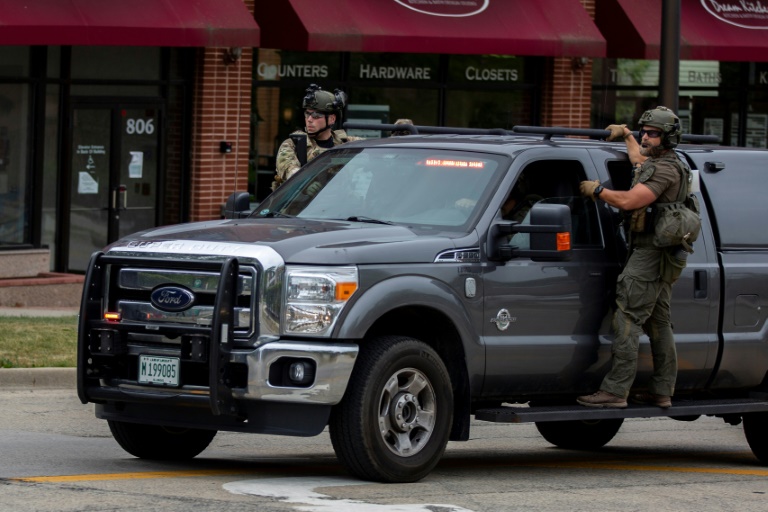
A shooter opened fire during a parade to mark US Independence Day in the state of Illinois, killing at least six people, officials said.

“At this time, two dozen people have been transported to Highland Park hospital. Six are confirmed deceased,” Commander Chris O’Neil of the city’s police told journalists.

The suspected shooter, who is still at large, has been described as a white male aged 18-20 with longer black hair, O’Neil said.

“All individuals are still urged to shelter in place at this time,” he added.

Nancy Rotering — the mayor of Highland Park, which is located near Chicago — gave the same toll and condemned the holiday violence.

“On a day that we came together to celebrate community and freedom, we’re instead mourning the tragic loss of life and struggling with the terror that was brought upon us,” she said.

Both officials said the shooting began at around 10:14 am (1514 GMT).

Multiple law enforcement agencies, including the FBI, the state police and the local sheriff’s office, are assisting with the response.

Highland Park announced that all July 4 festivities had been canceled as a result of the violence, as did nearby Evanston.

“While there is no known threat to Evanston residents, the shooter is still at large; therefore, cancelations are taking place in an abundance of caution,” the city said.

– ‘Enough is enough’ –

US Representative Brad Schneider, who was at the parade, said on Twitter that “a shooter struck in Highland Park during the Independence Day parade.” 

“Hearing of loss of life and others injured. My condolences to the family and loved ones; my prayers for the injured and for my community,” he wrote, adding: “Enough is enough!”

The shooting is part of a wave of gun violence plaguing the United States, where approximately 40,000 deaths a year are caused by firearms, including suicides, according to the Gun Violence Archive website.

The debate over gun control — a deeply divisive issue in the country — was reignited by two massacres in May that saw 10 Black supermarket shoppers gunned down in upstate New York and 21 people, mostly young children, slain at an elementary school in Texas.

Congress passed the first significant bill on gun safety in decades in the wake of those killings. President Joe Biden signed it into law in late June, saying that while it falls short of what is really needed, it will still save lives.

But a day earlier, proponents of tougher firearms laws suffered a setback when the US Supreme Court ruled that Americans have a fundamental right to carry a handgun in public, a landmark decision with far-reaching implications for states and cities across the country trying to rein in gun violence.

Close Bitnami banner
Bitnami