US Business

Putin orders Russians to fight on after key Ukraine city falls

President Vladimir Putin on Monday ordered Russian troops to press their offensive deeper into the Donbas region of eastern Ukraine after Moscow’s forces seized the strategic city of Lysychansk.

Russian Defence Minister Sergei Shoigu told Putin at a meeting that Moscow’s forces were now in full control of the Lugansk region. 

In a sign there would be no let-up in the fighting and that Russia now had its eyes on the entire Donetsk region, Putin told Shoigu that troops stationed there must continue their operations.

“Military units, including the East group and the West group, must carry out their tasks according to previously approved plans,” Putin said.

“I hope that everything will continue in their direction as has happened in Lugansk so far.” 

The Ukrainian army said on Sunday it was retreating from Lysychansk to preserve the lives of its troops who were outnumbered and outgunned by Russian forces.

With the war now well into its fifth month, Ukraine told a reconstruction conference in Switzerland on Monday that it would already cost $750 billion to rebuild the country.

“The key source of recovery should be the confiscated assets of Russia and Russian oligarchs,” Prime Minister Denys Shmyhal told leaders of dozens of countries in Lugano.

In a video address, Ukrainian President Volodymyr Zelensky described rebuilding Ukraine as the “common task of the whole democratic world” and the “biggest contribution to the support of global peace.”

– ‘Most modern weapons’ –

The loss of Lysychansk over the weekend prompted Zelensky to step up calls for an increased supply of weapons from the West so Kyiv can keep up the resistance and regain lost territories.

After giving up on its initial war aim of capturing Kyiv following tough Ukrainian resistance, Russia has focused its efforts on securing control of the Donetsk and Lugansk areas which make up the Donbas region.

Moscow’s capture of Lysychansk — one week after the Ukrainian army also retreated from the neighbouring city of Severodonetsk — frees up Russian forces to advance on Kramatorsk and Sloviansk in Donetsk.

Lugansk region governor Sergiy Gayday said on Telegram that there was still fighting in the town of Bilogorivka outside Lysychansk.

“We keep defending a small part of the Lugansk region so that our army could build protective redoubts,” he added.

In his address late Sunday, Zelensky vowed Kyiv would fight on and ensure the military had “the most modern weapons”.

“Ukraine will reach the level when the fire superiority of the occupiers will be levelled.”

In a symbolic boost, the Ukrainian flag was raised on Snake Island, an rocky outcrop in the Black Sea, after Russia withdrew from the strategically important Ukrainian territory last week.

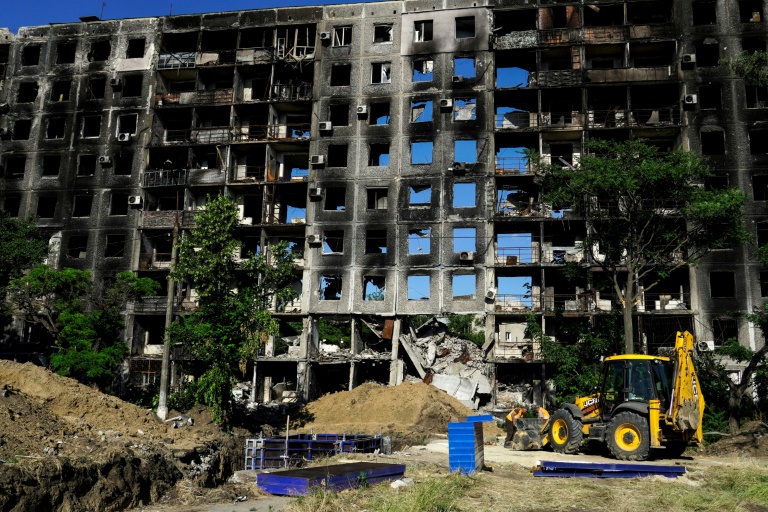
In Sloviansk, about 75 kilometres (45 miles) west of Lysychansk, there were few people on the streets on Monday, the day after Russian strikes that left at least six dead, among them a nine-year-old girl, and 19 injured. 

In the large downtown market largely ravaged by a fire caused by a Russian strike, a few vendors offered basic goods while others cleared charred debris. 

Vendors and residents who spoke to AFP, some still in shock, expressed concern for the days and weeks to come, as sounds of shelling were heard again.

The city of Siversk, 30 kilometres west of Lysychansk, also saw overnight shelling, residents and an official told AFP.

– Reconstruction –

But Zelensky’s address Sunday evening was defiant, predicting Ukrainian troops would “win back” territory in the Donbas just has they had in other regions earlier in the war.

On Monday, leaders from dozens of countries and international organisations met in the Swiss city of Lugano with the aim of hashing out a roadmap for Ukraine’s reconstruction.

Lugano is not a pledging conference but will instead attempt to lay out the principles and priorities for a rebuilding process aimed to begin even as the war rages.

“Ukraine can emerge from this on a path towards a stronger and more modern country,” European Commission President Ursula von der Leyen said.

But for residents in Bucha — a Ukrainian town synonymous with war crimes blamed on Moscow’s forces after their retreat in April — fear remains even as talk begins of reconstruction. 

“We’re going to bed without knowing if we’ll wake up tomorrow,” said Vera Semeniouk, 65. 

“Everyone has come back, is starting to repair houses, many are putting in new windows. It would be terrible if it started again, and we had to leave everything again.”

Swedish Prime Minister Magdalena Andersson, making her first visit to Ukraine, visited Bucha on Monday.

Stocks mostly advance as optimism creeps back in

European and Asian stocks mostly advanced Monday as investors tentatively regained some optimism following the heavy losses in the financial markets last week on fears that rising interest rates could spark a recession.

London stocks won 0.9 percent, with rising crude prices supporting the share prices of energy firms BP and Shell.

Paris added 0.4 percent but Frankfurt slipped 0.3 percent. 

Tokyo and Shanghai also advanced but Hong Kong nudged lower. The dollar traded mixed.

Wall Street was closed for the Independence Day holiday.

– ‘Sliver of optimism’ –

“A sliver of optimism has broken through on global markets at the start of the week,” said Susannah Streeter, senior investment and markets analyst at Hargreaves Lansdown.

Europe’s investors on Friday absorbed news of record-high eurozone inflation that reinforced expectations of a major European Central Bank interest rate hike in July.

Markets have suffered sharp losses in recent weeks on fears that global rate hikes — aimed at fighting soaring inflation — could send economies into a downturn.

“Overall caution is still the name of the game as investors nurse wounds from a bruising first half of the year,” Streeter said.

City Index analyst Fawad Razaqzada cautioned that global markets might yet have further to fall.

– ‘Pinch of salt’ –

“Nothing has changed fundamentally to suggest the markets have bottomed out,” Razaqzada told AFP.

“It is a quiet day with the US out and economic calendar light. So anything we see today should be taken with a pinch of salt.”

Chris Beauchamp, chief market analyst at online trading platform IG, said investors were also watching what US President Joe Biden does as some of the punishing tariffs imposed under Donald Trump start to expire on July 6.

The imposition of tariffs to protect US manufacturers from what Washington said were unfair Chinese trade practices was politically popular.

But with US inflation now at 40-year highs, Biden is scrambling to find ways to relieve price pressure and has said that lifting some tariffs is under consideration. 

“A potential easing of China tariffs by the US might be the kind of thing to give equities a much-needed break,” said Beauchamp.

“President Biden hopes that a rollback of restrictions might give a lifeline to both economies, as well as repair some of the diplomatic fallout from China’s pro-Russian stance over the Ukraine war,” he added.

Back in Asia, data showing a flare-up of fresh Covid-19 cases in China revived concerns about the government’s policy of locking down towns and cities to eradicate the disease, despite the economic cost.

The jump in new Covid cases weighed on sentiment among investors who fear a return to the painful lockdowns in major cities including Shanghai, which hammered the world’s number-two economy.

– Key figures at around 1530 GMT –

London – FTSE 100: UP 0.9 percent at 7,232.65 points (close)

Frankfurt – DAX: DOWN 0.3 percent at 12,773.38 (close)

Paris – CAC 40: UP 0.4 percent at 5,954.65 (close)

EURO STOXX 50: UP 0.9 percent at 3,470.62

New York – Dow: Closed for public holiday

Tokyo – Nikkei 225: UP 0.8 percent at 26,153.81 (close)

Hong Kong – Hang Seng Index: DOWN 0.1 percent at 21,830.35 (close)

Shanghai – Composite: UP 0.5 percent at 3,405.43 (close)

Euro/dollar: UP at $1.0431 from $1.0414 Friday

Pound/dollar: UP at $1.2116 from $1.2095

Euro/pound: DOWN at 86.09 pence from 86.10 pence

Dollar/yen: UP at 135.69 yen from 135.21 yen

Brent North Sea crude: UP 1.9 percent at $113.78 per barrel

West Texas Intermediate: UP 1.8 percent at $110.37 per barrel

burs-rl/imm

Kellogg's loses court challenge against UK obesity strategy

Cereals giant Kellogg’s on Monday lost a High Court challenge against new UK rules limiting the prominence of sugary foods in English shops to tackle child obesity.

At a hearing in April, the Frosties and Rice Krispies maker argued against the government’s strategy to calculate fat, salt and sugar content of cereals when eaten dry, not when taken with milk.

But in a ruling on Monday, the court noted that no breakfast cereal manufacturer raised objections to the methodology during the consultation period about the rules.

The judge, Thomas Linden, said there was “no dispute” that breakfast cereals could be part of a healthy diet.

“But the argument that there are nutritional benefits to the consumption of a given breakfast cereal does not affect the point that if it contains excess fat, sugar or salt, that feature of the product is adverse to a child’s health,” he said.

Linden said 54.7 percent of Kellogg’s cereals would be classed as less healthy under the new regulations that take effect from October.

Kellogg’s claimed the change would hit annual profits by about £5 million ($6.1 million).

Welcoming the ruling, the government said it was “committed to tackling obesity, which is the second biggest cause of cancer in the UK” and costs the state-funded National Health Service “billions of pounds a year”.

Kellogg’s said it did not intend to appeal but urged the government to rethink its strategy, especially amid soaring inflation.

“By restricting the placement of items in supermarkets, people face less choice and potentially higher prices,” said the group’s UK managing director, Chris Silcock. 

“That’s why, in the midst of a cost-of-living crisis, we would strongly urge the government to rethink these regulations and put the consumer first.”

Putin orders Russians to fight on after key Ukraine city falls

President Vladimir Putin on Monday ordered Russian troops to press their offensive deeper into the Donbas region of eastern Ukraine after Moscow’s forces seized the strategic city of Lysychansk.

With the war now well into its fifth month after Russia’s invasion of Ukraine, Ukraine told a reconstruction conference in Switzerland that it would already cost $750 billion to rebuild the country.

The loss of Lysychansk over the weekend prompted Ukrainian President Volodymyr Zelensky to step up calls for an increased supply of weapons from the West so Kyiv can keep up the resistance and regain lost territories.

After giving up on its initial war aim of capturing Kyiv following tough Ukrainian resistance, Russia has focused its efforts on securing control of the Donetsk and Lugansk areas which make up the Donbas region.

Russian Defence Minister Sergei Shoigu told President Vladimir Putin at a meeting that Moscow’s forces were now in full control of the Lugansk region. 

In a sign there would be no let-up in the fighting and that Russia now had its eyes on the entire Donetsk region, Putin told Shoigu that troops stationed there must continue their operations.

“Military units, including the East group and the West group, must carry out their tasks according to previously approved plans,” Putin said.

“I hope that everything will continue in their direction as has happened in Lugansk so far.” 

The Ukrainian army said on Sunday it was retreating from Lysychansk to preserve the lives of its troops after finding itself outnumbered and outgunned by Russian forces there.

– ‘Most modern weapons’ –

But in a symbolic boost for Ukraine, the Ukrainian flag was raised on Snake Island, an rocky outcrop in the Black Sea, after Russia withdrew from the strategically important Ukrainian territory last week.

Moscow’s capture of Lysychansk — one week after the Ukrainian army also retreated from the neighbouring city of Severodonetsk — frees up Russian forces to advance on Kramatorsk and Sloviansk in Donetsk.

Lugansk region governor Sergiy Gayday said on Telegram that there was still fighting in the town of Bilogorivka outside Lysychansk.

“We keep defending a small part of the Lugansk region so that our army could build protective redoubts,” he added.

In an address late Sunday, Zelensky vowed Kyiv would fight on and ensure the military had “the most modern weapons”.

“Ukraine will reach the level when the fire superiority of the occupiers will be levelled.”

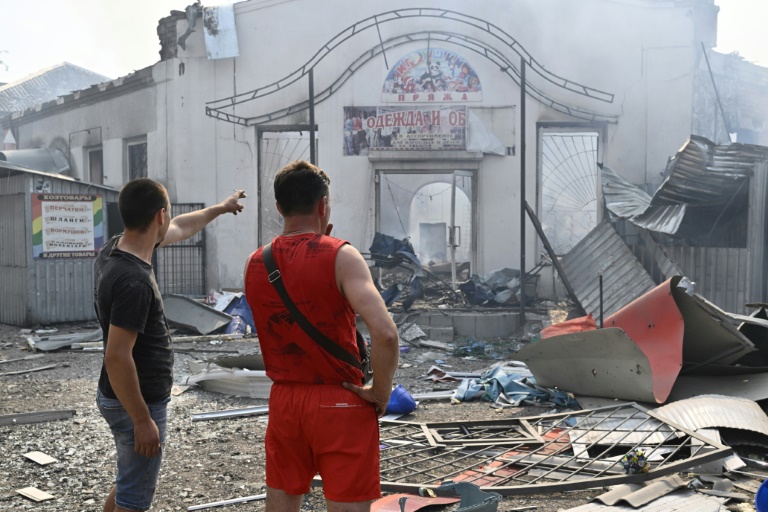
In Sloviansk, about 75 kilometres (45 miles) west of Lysychansk, there were few people on the streets on Monday, the day after Russian strikes that left at least six dead, among them a nine-year-old girl, and 19 injured. 

In the large downtown market largely ravaged by a fire caused by a Russian strike, a few vendors offered basic goods while others cleared charred debris. 

Vendors and residents who spoke to AFP, some still in shock, expressed concern for the days and weeks to come, as sounds of shelling were heard again.

– ‘Task of democratic world’ –

The city of Siversk, 30 kilometres west of Lysychansk, also saw overnight shelling, residents and an official told AFP.

But Zelensky’s address Sunday evening was defiant, pointing to Ukrainian troops would “win back” territory in the Donbas just has they had in other regions earlier in the war.

On Monday, leaders from dozens of countries and international organisations met in the Swiss city of Lugano with the aim of hashing out a roadmap for Ukraine’s reconstruction.

At the gathering Prime Minister Denys Shmyhal put the cost of rebuilding Ukraine at $750 billion and said: “the key source of recovery should be the confiscated assets of Russia and Russian oligarchs”.

Lugano is not a pledging conference but will instead attempt to lay out the principles and priorities for a rebuilding process aimed to begin even as the war rages.

The meeting could help usher in a modern version of “The Marshall Plan”, the US-devised giant economic rescue scheme to rebuild Europe after World War II.

In a video address to the conference Zelensky described rebuilding Ukraine as the “common task of the whole democratic world” and the “biggest contribution to the support of global peace.”

But for residents in Bucha — a Ukrainian town synonymous with war crimes blamed on Moscow’s forces after their retreat in April — fear remains even as talk begins of reconstruction. 

“We’re going to bed without knowing if we’ll wake up tomorrow,” said Vera Semeniouk, 65. 

“Everyone has come back, is starting to repair houses, many are putting in new windows. It would be terrible if it started again, and we had to leave everything again.”

UK drivers in go-slow protest over surging fuel prices

Protesters snarled up major UK roads on Monday with a slow-moving procession of vehicles to demand government action against rocketing fuel prices.

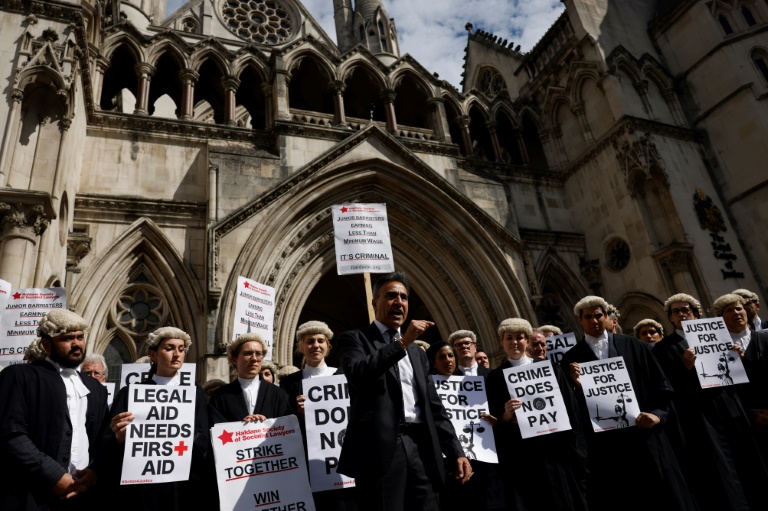
The action came as senior criminal lawyers staged a second walkout in England and Wales against years of government cuts to their fees, intensifying a “summer of discontent” as strikes sweep Britain.

Rail workers have already staged a series of stoppages to press for better pay as Britain’s headline inflation reaches a 40-year high of just under 10 percent, driven in part by the war in Ukraine.

On the roads, a social media campaign called Fuel Price Stand Against Tax mobilised drivers to drive deliberately slowly on motorways and other arterial routes, demanding the government slash fuel duty.

One of the motorways affected was the M4 including the Prince of Wales Bridge, which links England and Wales.

Welsh police said they had arrested 12 people for driving under 30 miles (48 kilometres) per hour for “a prolonged amount of time”.

Vicky Stamper lost her job as a truck driver last month after the company was forced to cut costs in the face of the surging fuel costs.

“I’m here because I’ve lost my job because of the fuel, and the greedy people at the top taking all of our money,” she told AFP just over the border in England.

Addressing any members of the public inconvenienced by the action, Stamper said “we’re doing this for everyone”. 

“If they want to have a whinge, instead of whinging, join us.”

– ‘No choice’ –

The government insists it has already cut fuel duty once, and is offering other financial support for the public, while blaming Russia for igniting the rapid rise in energy prices.

“People’s day-to-day lives should not be disrupted,” a spokesperson said.

The government also says it is addressing the demands of the criminal barristers by offering a 15-percent rise in fees from the end of September.

But the increase will only apply to new cases, not to tens of thousands piling up in a backlog as British courts wrestle with the fallout of the Covid pandemic.

Outside the Royal Courts of Justice in central London, barristers in black gowns and wigs insisted the government significantly raise its offer as they walked out for a second week and vowed more strikes ahead.

Protesting barrister Emma Heath, 34, said defence lawyers could spend eight hours in preparation for a client receiving legal aid and get paid only £126 ($153) by the government. 

“We fully appreciate the impact it’s having, but until the government wake up and see what’s actually happening to criminal legal aid funding, we’re left with no choice,” she told AFP.

Justice Secretary Dominic Raab — a former lawyer — has called the strike action “regrettable” and said it would “only delay justice for victims”.

Central African Republic dives into crypto with the Sango

Undeterred by the turmoil hitting crypto, the Central African Republic (CAR) — one of the poorest and most troubled countries in the world — has unveiled plans to launch its own digital currency.

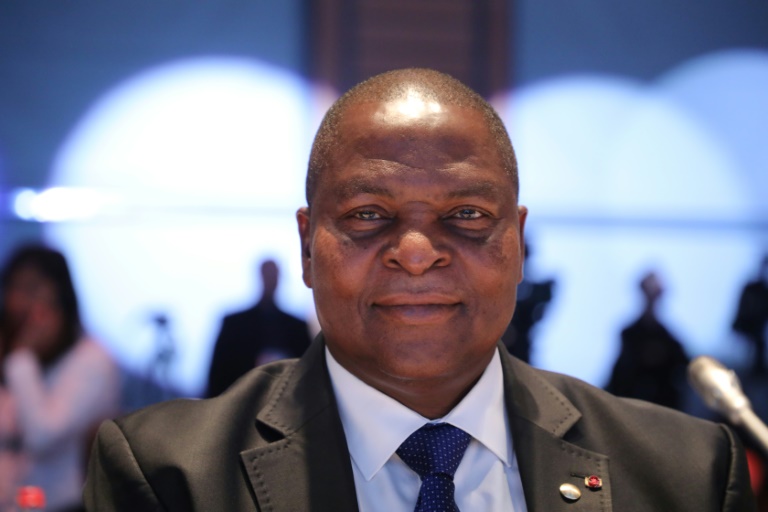
President Faustin Archange Touadera, in an “online event” on Sunday, announced CAR would create the Sango Coin and a zero-taxation “crypto-hub”, the first in Africa.

The currency is named after Sango, which with French is one of the two official languages in the landlocked country, rated the world’s second poorest nation under the UN’s Human Development Index.

Through a platform called Crypto Island, the Sango will become “the catalyst for tokenising (CAR’s) vast natural resources,” Touadera declared, providing no timeline or other details.

He hailed Sango and Crypto Island as “a new digital system fed by blockchain,” the internet-based ledger that underpins crypto currencies.

“Sango Coin will give the whole world direct access to our resources,” attracting investors and “getting the engines of the economy going,” he enthused.

On April 27, Touadera’s office abruptly announced that the CAR had adopted Bitcoin as legal tender alongside the CFA franc, a currency the country shares with five other central African economies.

It became the first country in Africa to embrace Bitcoin as a national currency, and the second in the world after El Salvador last September.

The April announcement sparked bemusement among analysts, given the entrenched poverty and lack of infrastructure in the CAR, where only one person in seven has access to mains electricity. 

They also voiced concern about the impact of crypto volatility on savings.

Virtual currencies have gone into a tailspin as investors look to safer havens at a time of inflation and uncertainty sparked by the Ukraine war.

Bitcoin has lost nearly 60 percent of its value over the past six months.

– ‘Digital gold’ –

Touadera on Sunday said 57 percent of Africa’s population does not have access to a bank.

“The solution,” he said, was “the smartphone, the alternative to the traditional bank, cash and financial red tape”.

On Twitter, he said, “gold served as the engine of our civilisation for ages! In this new age, digital gold will serve the same for the future.”

The CAR’s rush to crypto has been seen by some critics in the context of its closer ties with Russia.

Touadera has been accused of using Russian paramilitaries to buttress his regime and offering CAR’s natural resources in exchange. 

The country has a treasure chest of minerals, ranging from copper and gold to diamonds and uranium.

The CAR, a former French colony, plunged into a civil war along sectarian lines in 2013 after the then-president, Francois Bozize, was ousted.

Touadera was first elected in 2016 after an interim period and re-elected in disputed circumstances in 2020.

Violence diminished in 2018 but rebel forces remain active.

European equities recover as optimism creeps back in

Europe’s stocks recovered somewhat Monday as investors tentatively regained some optimism following the heavy losses in the financial markets last week on fears that rising interest rates could spark recession.

London stocks won 1.1 percent at midday, while Frankfurt and Paris gained 0.5 percent and 1.0 percent respectively in afternoon deals.

Tokyo and Shanghai also advanced but Hong Kong nudged lower. The dollar traded mixed while oil prices were subdued.

– ‘Sliver of optimism’ –

“A sliver of optimism has broken through on global markets at the start of the week,” said Susannah Streeter, senior investment and markets analyst at Hargreaves Lansdown.

Europe’s investors on Friday absorbed news of record-high eurozone inflation that reinforced expectations of a European Central Bank interest rate hike in July.

Markets have suffered sharp losses in recent weeks on fears that global rate hikes — aimed at fighting soaring inflation — could send economies into a downturn.

“Overall caution is still the name of the game as investors nurse wounds from a bruising first half of the year,” Streeter said.

Wall Street meanwhile remains shut for the Independence Day holiday on Monday.

City Index analyst Fawad Razaqzada cautioned that global markets might yet have further to fall.

– ‘Pinch of salt’ –

“Nothing has changed fundamentally to suggest the markets have bottomed out,” Razaqzada told AFP.

“It is a quiet day with the US out and economic calendar light. So anything we see today should be taken with a pinch of salt.”

Back in Asia, data showing a flare-up of fresh Covid-19 cases in China revived concerns about the government’s policy of locking down towns and cities to eradicate the disease, despite the economic cost.

The jump in new Covid cases weighed on sentiment among investors who fear a return to the painful lockdowns in major cities including Shanghai, which hammered the world’s number-two economy.

In a sign of the struggle officials will have in controlling rising prices, data showed Friday that eurozone inflation hit a record 8.6 percent in June. 

The European Central Bank is due to lift rates this month for the first time in more than a decade.

– Key figures at around 1100 GMT –

London – FTSE 100: UP 1.1 percent at 7,247.24 points

Frankfurt – DAX: UP 0.5 percent at 12,870.48

Paris – CAC 40: UP 1.0 percent at 5,991.47

EURO STOXX 50: UP 0.7 percent at 3,472.61

Tokyo – Nikkei 225: UP 0.8 percent at 26,153.81 (close)

Hong Kong – Hang Seng Index: DOWN 0.1 percent at 21,830.35 (close)

Shanghai – Composite: UP 0.5 percent at 3,405.43 (close)

New York – Dow: UP 1.1 percent at 31,097.26 (close)

Euro/dollar: UP at $1.0454 from $1.0414 Friday

Pound/dollar: UP at $1.2130 from $1.2095

Euro/pound: UP at 86.20 pence from 86.10 pence

Dollar/yen: UP at 135.43 yen from 135.21 yen

Brent North Sea crude: UP 0.4 percent at $112.04 per barrel

West Texas Intermediate: FLAT at $108.44 per barrel

Russia holds key Ukraine city in setback for Kyiv

Russian troops were on Monday holding the strategic Ukrainian city of Lysychansk after Kyiv’s forces retreated, in a major boost for Russia’s campaign to seize the entire Donbas region of eastern Ukraine.

With the war now well into its fifth month after Russia’s invasion of Ukraine on February 24, governments and organisations gathered for a conference in Switzerland to launch a plan to rebuild the country even as the conflict shows no sign of abating.

The loss of Lysychansk over the weekend prompted Ukrainian President Volodymyr Zelensky to step up calls for an increased supply of weapons from the West so Kyiv can keep up the resistance and regain lost territories.

After giving up on its initial war aim of capturing Kyiv following tough Ukrainian resistance, Russia has focused its efforts on securing control of the Donetsk and Lugansk areas which make up the Donbas region.

Russian Defence Minister Sergei Shoigu told President Vladimir Putin at the weekend that Moscow’s forces were now in full control of the Lugansk region. 

Moscow’s capture of Lysychansk — one week after the Ukrainian army also retreated from the neighbouring city of Severodonetsk — frees up Russian forces to advance on Kramatorsk and Sloviansk in Donetsk.

“The continuation of the defence of the city (Lysychansk) would lead to fatal consequences” in the face of Russia’s superiority in numbers and equipment, the Ukrainian army said on Sunday, announcing its retreat. 

“In order to preserve the lives of Ukrainian defenders, a decision was made to withdraw.”

– ‘Most modern weapons’ –

Lugansk region governor Sergiy Gayday said on Telegram that there was still fighting in the town of Bilogorivka outside Lysychansk.

“We keep defending a small part of the Lugansk region so that our army could build protective redoubts,” he added.

In an address late Sunday, Zelensky vowed Kyiv would fight on and ensure the military had “the most modern weapons”.

“Ukraine will reach the level when the fire superiority of the occupiers will be levelled.”

In Sloviansk, about 75 kilometres (45 miles) west of Lysychansk, there were few people on the streets on Monday, the day after Russian strikes that left at least six dead, among them a nine-year-old girl, and 19 injured. 

In the large downtown market largely ravaged by a fire caused by a Russian strike, a few vendors offered basic goods while others cleared charred debris. 

Vendors and residents who spoke to AFP, some still in shock, expressed concern for the days and weeks to come, as sounds of shelling were heard again.

– ‘Win back the land’ –

The city of Siversk, 30 kilometres west of Lysychansk, also saw overnight shelling, residents and an official told AFP.

But Zelensky’s address Sunday evening was defiant, pointing to Ukrainian troops progressing in the Kharkiv and Kherson regions, and vowed “there will be a day when we will say the same about Donbas”.

“We will rebuild the walls, we will win back the land, and people must be protected above all else,” Zelensky said. 

“Ukraine does not give anything up.”

On Monday, leaders from dozens of countries and international organisations were meeting in the Swiss city of Lugano, where they aim to hash out a roadmap for Ukraine’s reconstruction — expected to cost hundreds of billions of dollars.

Lugano is not a pledging conference but will instead attempt to lay out the principles and priorities for a rebuilding process aimed to begin even as the war rages.

– ‘Democracy over autocracy’ –

Ukraine will also face demands for broad reforms, especially in cracking down on corruption after Brussels recently granted Kyiv candidate status in its push to join the 27-member European Union.

Zelensky will address the conference by video, but the event is also being attended by Ukrainian Prime Minister Denys Shmyhal in a rare trip outside the country. 

British Foreign Secretary Liz Truss is due to pledge both immediate humanitarian assistance as well as access to British financial and economic expertise, the foreign office said.

She will tell delegates that Ukraine’s recovery “will be a symbol of the power of democracy over autocracy”, it added.

But for residents in Bucha — a Ukrainian town synonymous with war crimes blamed on Moscow’s forces after their retreat in April — fear remains even as talk begins of reconstruction. 

“We’re going to bed without knowing if we’ll wake up tomorrow,” said Vera Semeniouk, 65. 

“Everyone has come back, is starting to repair houses, many are putting in new windows. It would be terrible if it started again and we had to leave everything again.”

Trial of Chinese-Canadian tycoon who disappeared in 2017 begins in China

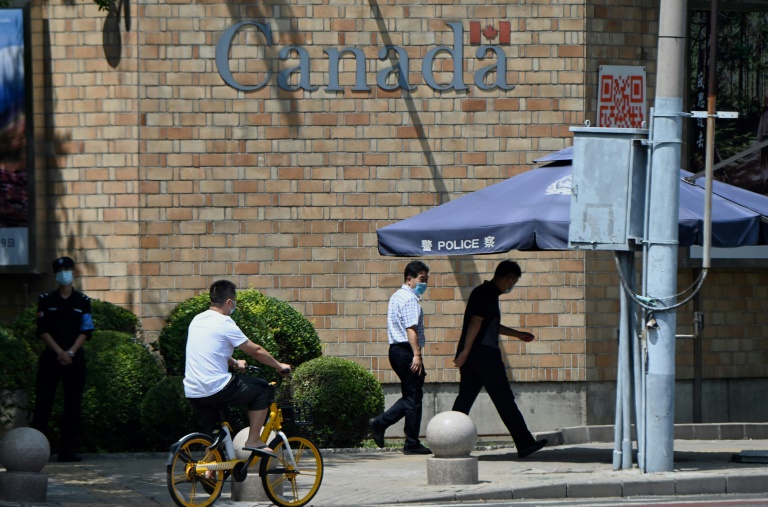
Canadian-Chinese tycoon Xiao Jianhua is standing trial on Monday, Ottawa’s embassy in Beijing said in a statement, after the businessman disappeared from a Hong Kong hotel five years ago.

Xiao vanished from Hong Kong’s Four Seasons hotel in January 2017, with local media reporting that he was snatched by mainland Chinese agents — fuelling fear at the time over Beijing’s tightening influence in the financial hub.

The tycoon, one of China’s richest people at the time of his disappearance, reportedly had close connections to the upper echelons of the ruling Communist Party.

Nothing more had been known about Xiao, who is a Canadian citizen, since his disappearance, until the embassy confirmed Monday that he was facing trial.

“Global Affairs Canada is aware that a trial in the case of Canadian citizen, Mr. Xiao Jianhua, will take place on July 4, 2022,”  the Canadian embassy told AFP, without specifying the location of the trial or charges against him.

“Canadian consular officials are monitoring this case closely, providing consular services to his family and continue to press for consular access.”

Hong Kong police said at the time that he had crossed the border into mainland China. 

His company Tomorrow Group also later said that he was in the mainland.

But Chinese authorities have been silent about the case, reportedly linked to an anti-corruption drive championed by President Xi Jinping since he came to power.

Xiao’s alleged abduction came at a time when mainland Chinese agents were not permitted to operate in Hong Kong, and it sparked fear in the city about residents being forcibly disappeared.

These fears were at the heart of massive pro-democracy protests that shook Hong Kong in 2019, prompted by a government bill that would have allowed extraditions to mainland China’s opaque, Communist Party-controlled judicial system.

Xiao’s disappearance also followed the alleged kidnapping into mainland custody of five people working for a bookstore which published salacious titles about China’s leaders.

The booksellers later appeared on mainland Chinese TV admitting to a variety of crimes.

In response to the protests, China imposed a national security law on Hong Kong in 2020.

That law allowed its security agencies to operate in the city and toppled the legal firewall between mainland and Hong Kong courts.

– Rags to riches –

Xiao rose from a poor family to become one of China’s richest men, founding the Beijing-based Tomorrow Group.

He was head of the official student union at the prestigious Peking University in 1989 when the Chinese government used troops and tanks to crush peaceful demonstrations.

Xiao had tried and failed to defuse the protests, with his company later denying a report in The New York Times that he had been rewarded by the government for his role.

After university, Xiao began selling computers and in the years that followed built an empire with diverse interests, including in banking and insurance.

According to the Hurun Report, which ranks China’s wealthiest people, Xiao was worth almost $6 billion in 2017.

He had reportedly denied allegations that he fled to Hong Kong in 2014 to escape the corruption crackdown in China.

Xiao is said to have acted as a broker for the Chinese leadership, including for President Xi’s family. 

“After five years of quietly waiting, our family is still, based on my brother’s strict instructions, putting faith in the Chinese government and Chinese law,” Xiao’s elder brother Xinhua told The Wall Street Journal last month.

“It’s very complicated and full of drama,” he said of the case, according to the WSJ.

The years after his disappearance have also been marked by plummeting relations between China and Canada, sparked by the arrest in Vancouver of Meng Wanzhou — the chief financial officer of telecoms giant Huawei — at the request of the United States.

Following Meng’s arrest, Beijing detained two Canadians in China and targeted Canadian agricultural exports.

All three were released in September 2021 after Meng reached a deal with US prosecutors on the fraud charges, ending her extradition fight.

Since then there have been hopes of a thaw in diplomatic relations, with Beijing lifting a ban on Canadian canola imports earlier this year.

Turkish inflation hits two-decade high of 78.6%

Inflation in Turkey in June soared to an annual rate of 78.6 percent — the highest in 24 years, according to official data released Monday — as President Recep Tayyip Erdogan’s unconventional economic policies continued to take their toll.

But independent estimates published by Turkish economists showed prices rising at more than double that figure.

The inflation rate reported by Turkey’s state statistics agency was the highest since the emerging market suffered a currency meltdown during a global financial crisis in 1998.

Inflation had stood at 73.5 percent in May and at 15.0 percent at the start of last year.

Economy Minister Nureddin Nebati on Friday vowed that consumer prices will start dropping in December.

“I promise to you and to the president, we will see a drop in inflation starting in December,” he was quoted as saying by Turkish media.

According to the official data, the surge in inflation in June was driven by a jump of 123.4 percent in the cost of transportation and a 94-percent increase in non-alcoholic drinks.

Turkey’s latest problems began when Erdogan forced the central bank to go through with a series of interest rate cuts last year that he said were part of his “new economic model”.

The policy rate went down despite rising consumer prices.

But the Turkish leader rejects conventional economics and affirms that high interest rates cause prices to rise.

Economists believe his approach has exacerbated the pain felt world-wide from the jump in food and energy prices caused by Russia’s invasion of Ukraine. 

– Questions over data –

However, more and more economists are starting to question Turkey’s official data.

A monthly report release Monday by Turkey’s ENAG group of independent economists showed consumer prices rising by 175 percent in June.

ENAG said prices had risen by 71.4 percent since the start of the year alone.

The Istanbul chamber of commerce said inflation in Turkey’s largest city has reached an annual rate of 94 percent.

“No one actually believes official Turkish data anymore,” said BlueBay Asset Management economist Timothy Ash.

“There is no expectation of anything like a credible policy response.”

Turkey’s official data are turning into a hot political issue ahead of next year’s general election — widely viewed as the toughest of Erdogan’s two-decade rule.

Opposition leader Kemal Kilicdaroglu accused the state statistics agency of “lying”.

“Stop committing crimes for the benefit of President Erdogan,” Kilicdaroglu told the agency on Twitter.

A survey published by the Metropol polling agency on Friday showed 69 percent of respondents believed the unofficial ENAG figure and just 24 percent the one reported by the government.

– ‘Cost-of-living problem’ –

Erodgan has doubled down on his economic approach and hinted that he may want the benchmark interest rate to move even lower in the months to come.

He has also tried to reverse the accompanying drop in his public approval by announcing a rapid series of wage hikes to large parts of the population.

He has bumped up the minimum wage earned by roughly 40 percent of the working Turks from 2,826 liras in late December to 5,500 liras ($325) this month.

The wage is used as the benchmark for a wide range of social benefits across the economy.

Economists warn that substantially raising the pay of so many people is an inflationary measure that should be accompanied by interest hikes or other means of limiting spending.

But Erdogan rejects the very idea that Turkey is suffering from inflation.

“We do not have an inflation problem. We have a cost-of-living problem,” Erdogan said last month.

Close Bitnami banner
Bitnami