US Business

Turkish inflation hits two-decade high of 78.6%

Inflation in Turkey in June soared to an annual rate of 78.6 percent — the highest in 24 years, according to official data released Monday — as President Recep Tayyip Erdogan’s unconventional economic policies continued to take their toll.

But unofficial estimates published by Turkish economists showed prices rising at more than double that figure.

The inflation rate reported by Turkey’s state statistics agency was the highest since January 1998.

Inflation had stood at 73.5 percent in May and at 15.0 percent at the start of last year.

Economy Minister Nureddin Nebati on Friday vowed that consumer prices will start dropping in December.

“I promise to you and to the president, we will see a drop in inflation starting in December,” he was quoted as saying by Turkish media.

According to the official data, the surge in inflation in June was driven by a jump of 123.4 percent in the cost of transportation and a 94-percent increase in non-alcoholic drinks.

Turkey’s crisis started when Erdogan forced the central bank to go through with a series of interest rate cuts last year that he said were part of his “new economic model”.

The policy rate went down despite rising consumer prices.

But the Turkish leader rejects conventional economics and affirms that high interest rates cause prices to rise.

Economists believe his approach has exacerbated the pain felt world-wide from the jump in food and energy prices caused by Russia’s invasion of Ukraine. 

– Questions over data –

However, more and more economists are starting to question Turkey’s official data.

A monthly report release Monday by Turkey’s ENAG group of independent economists showed consumer prices rising by 175 percent in June.

ENAG said prices had risen by 71.4 percent since the start of the year alone.

The Istanbul chamber of commerce said inflation in Turkey’s largest city has reached an annual rate of 94 percent.

“No one actually believes official Turkish data anymore,” said BlueBay Asset Management economist Timothy Ash.

“There is no expectation of anything like a credible policy response.”

Turkey on Friday substantially raised the minimum wage for the second time in a year to cushion the blow on households ahead of next year’s general election.

The hike of the net monthly take-home pay to 5,500 liras ($330) means the nominal minimum wage has nearly doubled since the end of last year.

It stood at 2,826 liras in late December and 4,253 liras in January.

Economists warn that substantially raising the pay of a large swathe of the population is an inflationary measure that should be accompanied by interest hikes or other means of limiting spending.

Official data show that more than 40 percent of Turks earned the minimum wage at the start of the year.

Stocks fluctuate as traders fret over recession

Markets swung Monday as traders fret over a possible recession caused by central bank interest rate hikes aimed at fighting soaring inflation.

Data showing a flare-up of fresh Covid-19 cases in China revived concerns about the government’s policy of locking down towns and cities to eradicate the disease, despite the economic cost.

After the S&P 500’s worst January-June since 1970, Wall Street got the second half off to a healthy start Friday as a below-forecast reading on US manufacturing provided hope banks will not go on an extended period of monetary tightening.

That followed a drop in confidence among consumers — a key driver of the world’s top economy.

However, National Australia Bank’s Rodrigo Catril said the Federal Reserve and other global financial chiefs might not ease back on their rate hikes too soon as inflation remains stuck around multi-decade highs.

“While the data is suggesting a US economic slowdown is coming, we are not yet seeing signs of an ease in inflationary pressures, an important distinction given the Fed will continue with its aggressive tightening approach until it sees evidence of the latter,” he said in a commentary.

In a sign of the struggle officials will have in controlling rising prices, figures showed eurozone inflation hit a record 8.6 percent in June. The European Central Bank is due to lift rates this month for the first time in more than a decade.

Still, while surging prices remain a huge problem, Chris Weston, at Pepperstone Group, said the psychology is “shifting radically from inflation concerns to one now where we’re firmly focused on growth”.

While New York provided a strong lead, Asia struggled.

Hong Kong dropped as investors returned from a long weekend to play catch-up with Friday’s losses, while Seoul, Taipei, Bangok and Jakarta were also down.

However, Tokyo, Shanghai, Mumbai, Sydney, Singapore, Taipei and Wellington rose.

London, Paris and Frankfurt rose in early trade, though US futures were in the red.

A rise in new Covid cases in China over the weekend weighed on sentiment among investors who fear a return to the painful lockdowns in major cities including Shanghai, which hammered the world’s number two economy.

The country saw more than 700 new infections Saturday and Sunday, having held below 50 a day for the previous two weeks.

Macau saw its first two Covid deaths at the weekend and authorities said they would consider a city-wide lockdown to fight the disease. The comments sent Hong Kong-listed shares in Macau casinos plunging.

Oil prices wobbled with concerns about recession weighing on sentiment as traders bet on a drop in demand, while the head of Asia at crude trading giant Vitol said he saw signs consumers were beginning to feel the pressure of high commodity costs.

“There’s very clear evidence out there of economic stress being caused by the high prices, what some people refer to as demand destruction,” said Mike Muller. It is “not just oil, but also liquefied natural gas”. 

– Key figures at around 0810 GMT –

Tokyo – Nikkei 225: UP 0.8 percent at 26,153.81 (close)

Hong Kong – Hang Seng Index: DOWN 0.1 percent at 21,830.35 (close)

Shanghai – Composite: UP 0.5 percent at 3,405.43 (close)

London – FTSE 100: UP 0.9 percent at 7,231.42

Dollar/yen: UP at 135.37 yen from 135.28 yen Friday

Pound/dollar: DOWN at $1.2116 from $1.2098

Euro/dollar: DOWN at $1.0424 from $1.0433 

Euro/pound: DOWN at 86.03 pence from 86.21 pence

West Texas Intermediate: DOWN 0.1 percent at $108.36 per barrel

Brent North Sea crude: DOWN 0.1 percent at $111.51 per barrel

New York – Dow: UP 1.1 percent at 31,097.26 (close)

— Bloomberg News contributed to this story —

Trial of Chinese-Canadian tycoon who disappeared in 2017 begins in China

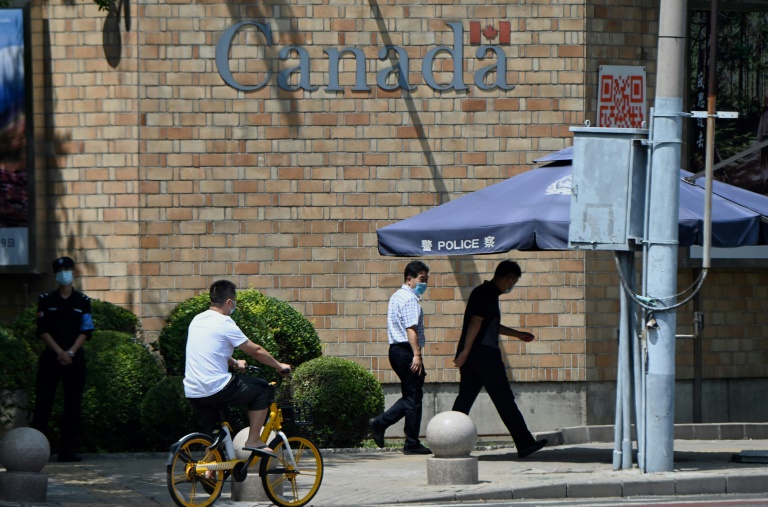
Canadian-Chinese tycoon Xiao Jianhua is standing trial on Monday, Ottawa’s embassy in Beijing said in a statement, after the businessman disappeared from a Hong Kong hotel in 2017.

“Global Affairs Canada is aware that a trial in the case of Canadian citizen, Mr. Xiao Jianhua, will take place on July 4, 2022,”  the embassy told AFP, without specifying the location of the trial or charges against him.

“Canadian consular officials are monitoring this case closely, providing consular services to his family and continue to press for consular access.”

Xiao, who is a Canadian citizen, disappeared from Hong Kong’s Four Seasons hotel in January 2017, with local media reporting that he was snatched by mainland Chinese agents.

One of China’s richest people at the time of his alleged abduction, Xiao reportedly had close connections to the upper echelons of the ruling Communist Party.

Hong Kong police said at the time that he had crossed the border into mainland China. His company Tomorrow Group also later said that he was in the mainland.

But Chinese authorities have been silent about the case, which is reportedly linked to an anti-corruption drive championed by President Xi Jinping since he came into power.

Xiao’s alleged abduction came at a time when mainland Chinese agents were not permitted to operate in Hong Kong, and it sparked fear in the city about residents being forcibly disappeared.

These fears were at the heart of massive pro-democracy protests that shook Hong Kong in 2019, prompted by a government bill that would have allowed extraditions to mainland China’s opaque, Communist Party-controlled judicial system.

Xiao’s disappearance also followed the alleged kidnapping into mainland custody of five people working for a bookstore which published salacious titles about China’s leaders.

The booksellers later appeared on TV in mainland China admitting to a variety of crimes.

In response to the protests, China imposed a national security law on Hong Kong in 2020.

That law allowed its security agencies to operate in the city and toppled the legal firewall between mainland and Hong Kong courts.

– Rags to riches –

Xiao rose from a poor family to become one of China’s richest men, founding the Beijing-based Tomorrow Group.

He was head of the official student union at the prestigious Peking University in 1989 when the Chinese government used troops and tanks to crush peaceful demonstrations.

Xiao had tried and failed to defuse the protests, with his company later denying a report in The New York Times that he had been rewarded by the government for his role.

After university, Xiao began selling computers and in the years that followed built an empire with diverse interests, including in banking and insurance.

According to the Hurun Report, which ranks China’s wealthiest people, Xiao was worth almost $6 billion in 2017.

He had reportedly denied allegations that he fled to Hong Kong in 2014 to escape the corruption crackdown in China.

Xiao is said to have acted as a broker for the Chinese leadership, including for President Xi’s family. 

“After five years of quietly waiting, our family is still, based on my brother’s strict instructions, putting faith in the Chinese government and Chinese law,” Xiao’s elder brother Xinhua told The Wall Street Journal last month.

“It’s very complicated and full of drama,” he said of the case, according to the WSJ.

Ukraine retreats from key city in major Russian gain

The Ukrainian army retreated from the strategic city of Lysychansk over the weekend, as Russia claimed a major victory by seizing control of the entire eastern Lugansk region.

The Ukrainian withdrawal followed weeks of fierce fighting and marked a decisive breakthrough for Moscow’s forces more than four months after their invasion and after turning their focus away from the capital Kyiv.

Leaders from dozens of countries and international organisations will meet Monday in Switzerland to map out a “Marshall Plan” to rebuild Ukraine — aimed to begin even as Russia’s war efforts continue to rage.

A major flashpoint in the conflict, Lysychansk had been the final holdout in the Lugansk area of the eastern Donbas region and Moscow’s capture of it frees up Russian forces to advance on Kramatorsk and Sloviansk in neighbouring Donetsk. 

“The continuation of the defence of the city would lead to fatal consequences” in the face of Russia’s superiority in numbers and equipment, the Ukrainian army said in a statement announcing its retreat Sunday evening. 

“In order to preserve the lives of Ukrainian defenders, a decision was made to withdraw.

“Unfortunately, steel will and patriotism are not enough for success — material and technical resources are needed.”

The fall of Lysychansk comes after Russian forces seized its twin city of Severodonetsk last week after bouts of intense fighting. 

In an address late Sunday, Zelensky vowed Kyiv would fight on and ensure the military had “the most modern weapons”.

“Ukraine will reach the level when the fire superiority of the occupiers will be levelled.”

The latest country to provide aid was Australia, whose Prime Minister Anthony Albanese on Sunday pledged further military support — including armoured vehicles and drones during a meeting with Zelensky in Kyiv. 

– ‘Shooting from all sides’ –

On Sunday, Moscow accused Kyiv of firing three cluster missiles at the Russian city of Belgorod near the Ukrainian border, which came a day after neighbouring Belarus said it had intercepted Ukrainian missiles.

In what would represent an escalation of the conflict, Russia said its anti-aircraft defences shot down three Tochka-U cluster missiles launched by “Ukrainian nationalists” against Belgorod.

Eleven residential buildings and 39 houses had been damaged, Belgorod governor Vyacheslav Gladkov said. 

Moscow has previously accused Kyiv of conducting strikes on Russian soil, particularly in the Belgorod region.

On Saturday, Belarusian leader Alexander Lukashenko accused Kyiv of provocation and said his army intercepted missiles fired at his country by Ukrainian forces “around three days ago”.

Belarus, a Russian ally, supported the February 24 invasion and has been accused by Kyiv of launching its own attacks on Ukrainian territory.

Lukashenko denied any involvement in a recent cross-border incident, and said Belarus does “not intend to fight in Ukraine”.

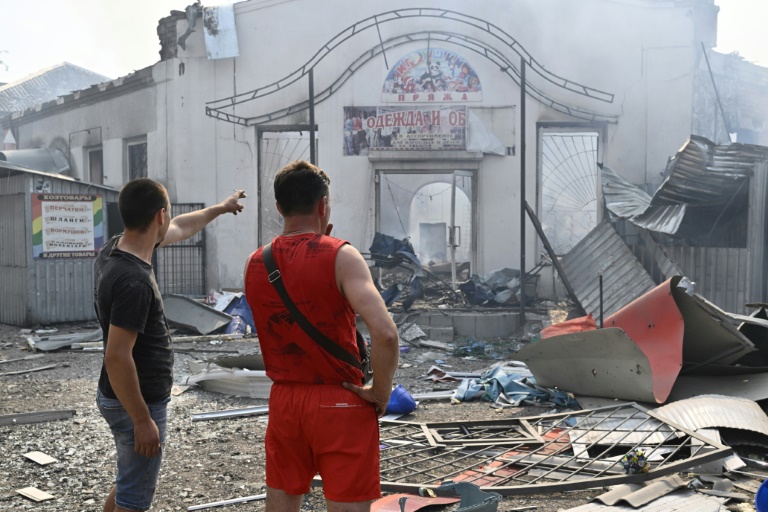
About 75 kilometres (45 miles) west of Lysychansk, the city Sloviansk saw heavy Russian shelling which left six people dead — among them a nine-year-old girl, Zelensky said Sunday evening. 

About 20 others were wounded as “the Russian army once again brutally shelled” the city, as well as Kramatorsk and Kharkiv.

A strike on the town of Dobropillia — just southwest of Sloviansk — killed two people and wounded three, including two children, Donetsk authorities said.

The city of Siversk, 30 kilometres west of Lysychansk, also saw overnight shelling, residents and an official told AFP.

“It was intense, and it was shooting from all sides,” said a woman sheltering in a cellar.

Zelensky’s address Sunday evening was defiant — he pointed to Ukrainian troops progressing in the Kharkiv and Kherson regions, and vowed “there will be a day when we will say the same about Donbas”.

“We will rebuild the walls, we will win back the land, and people must be protected above all else,” Zelensky said. 

“Ukraine does not give anything up.”

By Monday, the overall death toll of children “as a result of armed aggression” from Russia stood at 345, Ukraine’s parliament said. 

Its army warned in an early morning report that “the enemy is regrouping troops to resume the offensive”. 

– ‘Democracy over autocracy’ –

Four months into the war, Ukraine has seen devastating destruction across about 10 regions. 

On Monday, leaders from dozens of countries and international organisations will meet in the Swiss city of Lugano, where they aim to hash out a roadmap for Ukraine’s reconstruction — expected to cost hundreds of billions of dollars.

Ukraine will also face demands for broad reforms, especially in cracking down on corruption after Brussels recently granted Kyiv candidate status in its push to join the 27-member European Union.

British Foreign Secretary Liz Truss is due to pledge both immediate humanitarian assistance as well as access to British financial and economic expertise, the foreign office said.

She will tell delegates that Ukraine’s recovery “will be a symbol of the power of democracy over autocracy”, it added.

But for residents in Bucha — a Ukrainian town synonymous with war crimes blamed on Moscow’s forces after their retreat in April — fear remains even as talk begins of reconstruction. 

“We’re going to bed without knowing if we’ll wake up tomorrow,” said Vera Semeniouk, 65. 

“Everyone has come back, is starting to repair houses, many are putting in new windows. It would be terrible if it started again and we had to leave everything again.”

Protests in US after release of video of police killing Black man

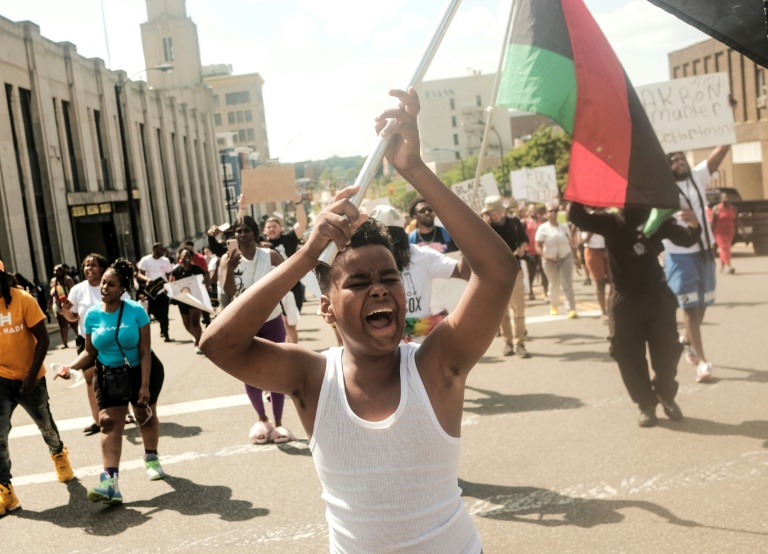
Several hundred protesters marched Sunday in Akron, Ohio after the release of body camera footage that showed police fatally shooting a Black man with several dozen rounds of bullets.

As anger rose over the latest police killing of a Black man in the United States, and authorities appealed for calm, a crowd marched to City Hall carrying banners with slogans such as “Justice for Jayland.”

The slogan refers to Jayland Walker, 25, who was killed Monday after officers tried to stop his car over a traffic violation, police said.

Sunday marked the fourth straight day of protests in the city of 190,000 people. Demonstrations during the day were peaceful but for a tense moment in which some protesters got close to a line of police and shouted at them.

Derrick Johnson, president of the NAACP, denounced the shooting as “murder… point blank” as the civil rights group led a daytime rally. 

“This Black man was killed… for a possible traffic violation. This doesn’t happen to white people in America,” he said in a statement, also slamming the police department’s response. 

Protests continued into the evening, with a hundred-strong crowd still in the streets in front of the justice center, an AFP reporter said.

Despite calls from some protesters for calm, tensions mounted as the night wore on. 

Some protesters set dumpsters alight and broke windows of the snowplows and other heavy equipment authorities had moved near the police department as a barrier in anticipation of unrest.

Police in riot gear deployed and fired tear gas at the crowd to push it back from the justice center. 

After initially providing few details of the shooting, Akron authorities released two videos Sunday: a compilation of body-camera footage, body-cam still frames and voiceover, and another of the complete body-cam footage of the entire chase and shooting.

The voiceover explained that Walker did not stop and drove off. Police engaged in a car chase and said a shot had been fired from Walker’s vehicle.

After being chased for several minutes, Walker got out of his car while it was still moving and fled on foot. Officers tried to subdue him with their tasers, but he kept running.

Several officers finally chased Walker to a parking lot. The body-cam footage is too blurry to see clearly what happens, but an initial police statement released after the shooting says Walker behaved in a way that caused officers to believe he posed a “deadly threat.”

– ‘Over 60 wounds’ to body –

All of the officers at the scene opened fire on Walker, shooting multiple times in rapid succession.

He was pronounced dead at the scene.

The incident was the latest death of an African-American citizen at the hands of police, events that have sparked mass protests over racism and police brutality.

“Many will wish to air their grievances in public, and I fully support our residents’ right to peacefully assemble,” Akron mayor Dan Horrigan told a press conference, saying he was “heartbroken” over the events.

“But I hope the community can agree that violence and destruction are not the answer.”

He also said an independent investigation was being conducted.

Bobby DiCello, a lawyer for the Walker family, told The New York Times: “I’ve been a trial lawyer for 22 years and I’ve never seen anything remotely close to what that video is going to show.”

Police chief Steve Mylett said he didn’t know the exact number of bullets fired at Walker, but the medical examiner’s report “indicates over 60 wounds to Mr. Walker’s body.”

He added that the eight officers involved in Walker’s death have been placed on paid administrative leave until the investigation is complete.

Authorities canceled a festival planned for the July 4th Independence Day holiday weekend.

Basketball star LeBron James, an Akron native, said in a tweet Sunday he was praying for his city.

Chinese developer Shimao misses $1 bn bond payment

Chinese developer Shimao Group said it has failed to make payment on a $1 billion bond that matured Sunday, one of the biggest such defaults so far this year in the country’s troubled property sector.

China’s real estate sector has been struggling since authorities began a crackdown on excessive debt and rampant consumer speculation in 2020, with giants such as Evergrande and Sunac scrambling to make payments and renegotiate with creditors.

The crisis has sparked fears that the industry’s struggles could spread to the wider economy, and the latest jolt came Sunday when Shimao said it had not paid the principal and interest on a $1 billion offshore note.

In a filing to the Hong Kong Stock Exchange, where it is listed, Shimao said it has experienced a noticeable decline in contracted sales due to “significant changes to the macro environment of the property sector in China since the second half of 2021 and the impact of Covid-19”.

The firm added that it had attempted to negotiate refinancing and waivers but was unable to make some payments because of “challenging” market conditions.

It said it has not received notice from creditors for accelerated repayment, and that lenders have indicated they will not take enforcement action at this point.

Shimao develops residential, hotel, office and commercial properties in China, with projects in major cities such as Beijing and Shanghai.

It was China’s 14th biggest developer by contracted sales last year, according to Bloomberg News.

China’s developers have been struggling as homebuyers tightened their purse strings owing to an uncertain economic outlook.

One company in the eastern city of Nanjing said it would accept truckloads of watermelons as downpayment from local farmers, according to Chinese media.

“The contagion has spread from Evergrande to Sunac and now Shimao,” said Bloomberg Intelligence analyst Kristy Hung.

“That raises our concerns that the extent of the debt crisis is beyond any market watcher’s imagination.”

Ukraine retreats from key city in major Russian gain

The Ukrainian army retreated from the strategic city of Lysychansk over the weekend, as Russia claimed a major victory by seizing control of the entire eastern Lugansk region.

The Ukrainian withdrawal followed weeks of fierce fighting and marked a decisive breakthrough for Moscow’s forces more than four months after their invasion and after turning their focus away from the capital Kyiv.

Leaders from dozens of countries and international organisations will meet Monday in Switzerland to map out a “Marshall Plan” to rebuild Ukraine — aimed to begin even as Russia’s war efforts continue to rage.

A major flashpoint in the conflict, Lysychansk had been the final holdout in the Lugansk area of the eastern Donbas region and Moscow’s capture of it frees up Russian forces to advance on Kramatorsk and Sloviansk in neighbouring Donetsk. 

“The continuation of the defence of the city would lead to fatal consequences” in the face of Russia’s superiority in numbers and equipment, the Ukrainian army said in a statement announcing its retreat Sunday evening. 

“In order to preserve the lives of Ukrainian defenders, a decision was made to withdraw.

“Unfortunately, steel will and patriotism are not enough for success — material and technical resources are needed.”

The fall of Lysychansk comes after Russian forces seized its twin city of Severodonetsk last week after bouts of intense fighting. 

In an address late Sunday, Zelensky vowed Kyiv would fight on and ensure the military had “the most modern weapons”.

“It requires many negotiations, but we will ensure such a supply. Ukraine will reach the level when the fire superiority of the occupiers will be levelled.”

The latest country to provide aid was Australia, whose Prime Minister Anthony Albanese on Sunday pledged further military support — including armoured vehicles and drones during a meeting with Zelensky in Kyiv. 

– ‘Shooting from all sides’ –

On Sunday, Moscow accused Kyiv of firing three cluster missiles at the Russian city of Belgorod near the Ukrainian border, which came a day after neighbouring Belarus said it had intercepted Ukrainian missiles.

In what would represent an escalation of the conflict, Russia said its anti-aircraft defences shot down three Tochka-U cluster missiles launched by “Ukrainian nationalists” against Belgorod.

Eleven residential buildings and 39 houses had been damaged, Belgorod governor Vyacheslav Gladkov said. 

Russia has previously accused Kyiv of conducting strikes on Russian soil, particularly in the Belgorod region.

On Saturday, Belarusian leader Alexander Lukashenko accused Kyiv of provocation and said his army intercepted missiles fired at his country by Ukrainian forces “around three days ago”.

Belarus, a Russian ally, supported the February 24 invasion and has been accused by Kyiv of launching its own attacks on Ukrainian territory.

Lukashenko denied any involvement in a recent cross-border incident.

“We do not intend to fight in Ukraine,” he said, according to state news agency Belta on Saturday.

About 75 kilometres (45 miles) west of Lysychansk, the city Sloviansk saw heavy Russian shelling which left six people dead — among them a nine-year-old girl, Zelensky said Sunday evening. 

About 20 others were wounded as “the Russian army once again brutally shelled” the city, as well as Kramatorsk and Kharkiv.

A strike on the town of Dobropillia — just southwest of Sloviansk — killed two people and wounded three, including two children, Donetsk authorities said.

The city of Siversk, 30 kilometres west of Lysychansk, also saw overnight shelling, residents and an official told AFP.

“It was intense, and it was shooting from all sides,” said a woman sheltering in a cellar.

Russian forces “have now gathered their largest firepower in Donbas, and they can use tens of thousands of artillery shells every day on one section of the front,” Zelensky said. 

But Ukrainian troops had progressed in Kharkiv and Kherson regions, he added, vowing that “there will be a day when we will say the same about Donbas.”

“We will rebuild the walls, we will win back the land, and people must be protected above all else,” Zelensky said. “Ukraine does not give anything up.”

A Ukrainian official said Sunday that Kyiv’s forces had seen another success in Melitopol where they had “put out of action” a Russian military base, while the army said the air force had destroyed around 20 Russian units and two ammunition depots.

“The town of Melitopol is covered in smoke,” said the city’s exiled mayor Ivan Fedorov.

– ‘Democracy over autocracy’ –

Four months into the war, Ukraine has seen devastating destruction across about 10 regions. 

On Monday, leaders from dozens of countries and international organisations will meet in the Swiss city of Lugano, where they aim to hash out a roadmap for Ukraine’s reconstruction — expected to cost hundreds of billions of dollars.

Ukraine will also face demands for broad reforms, especially in cracking down on corruption after Brussels recently granted Kyiv candidate status in its push to join the 27-member bloc.

British Foreign Secretary Liz Truss is due to pledge both immediate humanitarian assistance as well as access to British financial and economic expertise, the foreign office said.

She will tell delegates that Ukraine’s recovery “will be a symbol of the power of democracy over autocracy”, it added.

US drought exposes murky mob past of Las Vegas

Mobsters who end up sleeping with the fishes are usually never seen again.

But climate change has a way of messing even with the mafia, and a watery grave outside Las Vegas is starting to cough up Sin City’s darkest secrets.

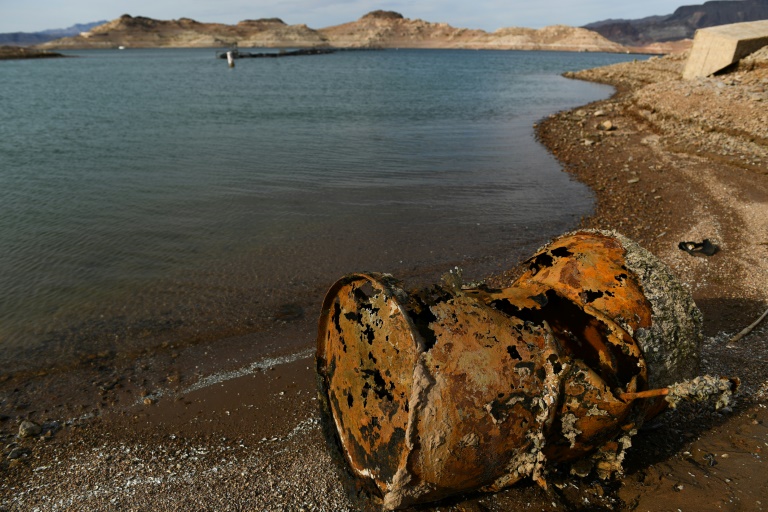
Lake Mead, which can be reached from the Las Vegas Strip by a short ride in the trunk of a car with your hands and feet bound, is drying up in a grueling decades-long drought.

Its receding waters are leaving behind the usual flotsam and jetsam of a lake heavily trafficked by weekend boaters.

But also bodies.

One particular find caught the attention of mob-watchers: the skeletal remains of a man who had been shot in the head, stuffed in a barrel and tossed in the lake four decades ago.

“The mob had a propensity to put people in barrels, whether they’re burying them in a lake, or dumping them out in the field,” said Geoff Schumacher of The Mob Museum in Las Vegas.

“That’s number one. Number two, the person was shot in the head, typical mob hit style.

“And third, we know that this happened in the late ’70s, early ’80s (when) the mob was very prominent in Las Vegas.”

– Oasis –

An improbable oasis of hotels, casinos and vice sprouted in the baking Nevada desert in the 20th century.

Las Vegas had been founded in 1905, but it wasn’t until work began on the nearby Hoover Dam in the 1930s that its population swelled.

The influx of construction workers — mostly single men — created a market for entertainment, which was filled by sex workers, showgirls and legalized gambling.

And where there is flesh, casinos and booze, organized crime is lurking in the background.

“The mob played a pretty big role in the development of Las Vegas from the 1940s through the 1980s,” said Schumacher.

“There was a lot of behind-the-scenes activity where the mob was controlling the management of the casinos, but also building and expanding the casinos, using in many cases, Teamsters union money.”

The city grew rich in the post-World War II boom that fueled the American dream, becoming the global capital of gambling.

And for every $100 that a hapless tourist lost at the blackjack table in a fug of free booze, a mafia boss in Chicago or New York wanted his cut.

The skimming, which doubtless cost the city millions of dollars in lost taxes, was a double-edged sword.

“They also sort of created this mystique about Las Vegas,” said Schumacher. 

“People wanted to come to Las Vegas, on the idea that ‘oh, maybe when I sit down at the bar, there’s going to be a mob guy sitting next to me.'”

– ‘Cold-blooded killers’ –

But it wasn’t all glamour. 

“The reality was that these guys were cold-blooded killers; they were thieves. If you were to cross the mob in some way… there definitely were consequences.”

Las Vegas police are still investigating the body found in the barrel at Lake Mead earlier this year, and in response to AFP inquiries would only say there is an ongoing probe.

But Schumacher has his theories about the identity of the dead man.

One suggestion is that he was Jay Vandermark, who worked at the Stardust Hotel, an operation run by Frank “Lefty” Rosenthal on behalf of the Chicago Mob.

Rosenthal — who was played by Robert De Niro in the movie “Casino” — was funneling cash back to his bosses, until the scheme drew the attention of local authorities.

Vandermark disappeared shortly thereafter.

A more likely candidate for the body in the barrel, however, is a man named Harry Pappas who was also connected to the Chicago Mob.

“One of the extra perks for visitors to Las Vegas, if you were a high roller… was they would take you out on the boat at Lake Mead,” Schumacher said.

“The Stardust had a boat out there and Harry Pappas was in charge of that whole operation.

“Right before he disappeared, he told his wife he was going to lunch with someone who was interested in buying his boat. We’ve never seen Harry Pappas again.”

Lake Mead is a massive reservoir on the Colorado River created by the Hoover Dam. It is now just a quarter full — the result of a drought and warming temperatures fueled by man-made climate change — and shows no sign of stabilising.

As its shoreline retreats, revealing more of the lake bed, it may yield more mob secrets, said Schumacher.

“I don’t know if we find another body in a barrel, but I have to believe that there could very well be a second murder victim out there.”

Covid-19 misinformation bolsters anti-vaccine movement

More parents are questioning the necessity of routine vaccinations for young children. Adults are skipping shots as well, even for vaccines with a long safety record.

The trend comes amid a wave of misinformation and disinformation about Covid-19 and the vaccines that helped to stem pandemic deaths. Politicization of the Covid-19 shots has bolstered the anti-vaccine movement, contributing to the decline in routine immunizations for measles, polio and other dangerous diseases.

“They ask if these are truly necessary, or if we can give them at later times,” said Jason Terk, a Texas pediatrician and spokesperson for the American Academy of Pediatrics. 

“This is not the majority of parents, but we are seeing a higher number.”

The anti-vaccine movement has mushroomed as its messages on social media are amplified by conservative political figures as well as foreign influence operations, whose vaccine disinformation efforts pre-date the pandemic.

With routine immunization rates falling, concerns are growing about a resurgence of diseases which had largely been eradicated in many parts of the world.

In the United States, the percentage of kindergarten children with recommended immunizations fell a percentage point to 94 percent in the 2020-21 school year, representing some 35,000 children unvaccinated. 

“I refer to it as the parallel contagion,” Terk said. “This seems to have at its origin hesitancy in Covid-19 vaccinations and increasing distrust of vaccines and the bodies we’ve relied on to keep us healthy and well.”

Dramatic changes were seen in some states, especially during the height of the pandemic: researchers found a 47 percent drop in immunization rates in Texas among five-month-olds and a 58 percent decline for 16-month-olds between 2019 and 2020.

The researchers, writing in the scientific journal Vaccine, said the declines resulted from shelter-in-place restrictions and vaccine exemptions, but also to “an aggressive anti-vaccine movement in Texas.”

Washington state reported a 13 percent decline in childhood immunization rates in 2021 compared with pre-pandemic levels and Michigan’s vaccination rate for toddlers fell last year to 69.9 percent, the lowest in a decade.

– Adults too –

Adult and adolescent inoculation rates have also dropped for vaccines protecting against diseases such as influenza, hepatitis, measles, tetanus and shingles, according to health consultancy Avalere, which analyzes insurer claims.

This has led to an estimated 37 million missed vaccination doses from January 2020 to July 2021 for adults and children ages seven and older, Avalere found.

Declines early in the pandemic can be attributed to shelter-in-place orders and social distancing, but “there is a risk of a bleed-over” of Covid vaccine misinformation, which affects other vaccines which have a longstanding safety record, noted Avalere managing director Jason Hall.

Social media have helped create a coalition that includes true anti-vaccine believers, libertarians and conservative political figures. These segments have been amplified by disinformation actors from Russia and elsewhere, said David Broniatowski, a George Washington University professor and associate director of the school’s Institute for Data, Democracy and Politics.

“People have been opposing vaccines for as long as there have been vaccines, but they’ve gotten more sophisticated over the past 10 years and a lot of that has been because of the ability to organize on social media across boundaries,” said Broniatowski, who researches vaccine disinformation.

He noted that while anti-vaccine activists, libertarians and foreign agents are not necessarily coordinating, “they have found common cause” in opposing vaccine mandates.

“One of the main changes we’ve seen is a pivot away from focusing on vaccines per se as a health issue to a civil rights and a political issue,” he added.

Conspiracy theories have surged during the pandemic, according to a 2021 YouGov poll, which found 28 percent of Americans and significant numbers in other countries say the truth about the harmful effects of vaccines is being “deliberately hidden.”

– Foreign actors –

Broniatowski said that foreign disinformation agents “use vaccines as a wedge issue that can mobilize a segment of the population.” 

A 2018 paper co-authored by Broniatowski in the American Journal of Public Health found anti-vaccine Twitter activity was amplified by Russian trolls from 2014 to 2017 as part of an effort to promote discord and undermine confidence in the health system.

Research from the Center for European Policy Analysis showed both China and Russia have promoted Covid-19 vaccine misinformation, in part to show that Western governments are incompetent and can’t be trusted.

“There’s been a concerted effort on the part of these actors to diminish the standing of science because it serves their political purposes,” Broniatowski said.

The problem is growing globally as well. A United Nations report last year found 23 million children worldwide missed out on routine immunizations in 2020. In the Americas region, the percentage of fully inoculated children fell to 82 percent from 91 percent in 2016 due to factors including funding shortfalls, vaccine misinformation and instability.

This is likely to create more health risks down the road from diseases which have been mostly contained.

“We had certain thresholds of protection to keep these diseases from being relevant from a public health point of view,” Terk said.

“The more people pushing back, the more likely we’ll have pockets of vulnerability.”

Protests in US after release of video of police killing Black man

Several hundred protesters marched Sunday in Akron, Ohio after the release of body camera footage that showed police fatally shooting a Black man with several dozen rounds of bullets.

As anger rose over the latest police killing of a Black man in the United States, and authorities appealed for calm, a crowd marched to City Hall carrying banners with slogans such as “Justice for Jayland.”

The slogan refers to Jayland Walker, 25, who was killed Monday after officers tried to stop his car over a traffic violation, police said.

Sunday marked the fourth straight day of protests. Demonstrations were peaceful but for a tense moment in which some protesters got close to a line of police and shouted at them.

After the first rally, a crowd of people remained in the street protesting as evening fell but it was in a less organized fashion. There were no reports of violence.

But fearing unrest, authorities in the city of 190,000 people moved snowplows and other heavy equipment near the police department to serve as a barrier.

After initially providing few details of the shooting, Akron authorities released two videos Sunday: one that was a compilation of body-camera footage, body-cam still frames and voiceover, and another of the complete body-cam footage of the entire chase and shooting.

The voiceover explained that Walker did not stop and drove off. Police engaged in a car chase and said a shot had been fired from Walker’s vehicle.

After being chased for several minutes, Walker got out of his car while it was still moving and fled on foot. Officers tried to subdue him with their tasers, but he kept running.

Several officers finally chased Walker to a parking lot. The body-cam footage is too blurry to see clearly what happens, but an initial police statement released after the shooting says he behaved in a way that caused officers to believe he posed a “deadly threat.”

– ‘Over 60 wounds’ to body –

All of the officers at the scene opened fire on Walker, shooting multiple times in rapid succession.

He was pronounced dead at the scene.

The incident was the latest death of an African-American citizen at the hands of police, events that have sparked mass protests over racism and police brutality.

“Many will wish to air their grievances in public, and I fully support our residents’ right to peacefully assemble,” Akron mayor Dan Horrigan told a press conference, saying he was “heartbroken” over the events.

“But I hope the community can agree that violence and destruction are not the answer.”

He also said an independent investigation was being conducted.

Bobby DiCello, a lawyer for the Walker family, told The New York Times: “I’ve been a trial lawyer for 22 years and I’ve never seen anything remotely close to what that video is going to show.”

Police chief Steve Mylett said he didn’t know the exact number of bullets fired at Walker, but the medical examiner’s report “indicates over 60 wounds to Mr. Walker’s body.”

He added that the eight officers involved in Walker’s death have been placed on paid administrative leave until the investigation is complete.

Authorities canceled a festival planned for the July 4th weekend.

Basketball star LeBron James, an Akron native, said in a tweet Sunday he was praying for his city.

Close Bitnami banner
Bitnami