US Business

Protests in US after release of video of police killing Black man

Several hundred protesters marched Sunday in Akron, Ohio after the release of body camera footage that showed police fatally shooting a Black man with several dozen rounds of bullets.

As anger rose over the latest police killing of a Black man in the United States, and authorities appealed for calm, a crowd marched to City Hall carrying banners with slogans such as “Justice for Jayland.”

The slogan refers to Jayland Walker, 25, who was killed Monday after officers tried to stop his car over a traffic violation, police said.

Sunday marked the fourth straight day of protests. Demonstrations were peaceful but for a tense moment in which some protesters got close to a line of police and shouted at them.

After the first rally, a crowd of people remained in the street protesting.

Fearing potential unrest, authorities in the city of 190,000 people moved snowplows and other heavy equipment near the police department to serve as a barrier.

After initially providing few details of the shooting, Akron authorities released two videos Sunday: one that was a compilation of body-camera footage, body-cam still frames and voiceover, and another of the complete body-cam footage of the entire chase and shooting.

The voiceover explained that Walker did not stop and drove off. Police engaged in a car chase and said a shot had been fired from Walker’s vehicle.

After being chased for several minutes, Walker got out of his car while it was still moving and fled on foot. Officers tried to subdue him with their tasers, but he kept running.

Several officers finally chased Walker to a parking lot. The body-cam footage is too blurry to see clearly what happens, but an initial police statement released after the shooting says he behaved in a way that caused officers to believe he posed a “deadly threat.”

All of the officers at the scene opened fire on Walker, shooting multiple times in rapid succession.

He was pronounced dead at the scene.

The incident was the latest death of an African-American citizen at the hands of police, events that have sparked mass protests over racism and police brutality.

“Many will wish to air their grievances in public, and I fully support our residents’ right to peacefully assemble,” Akron mayor Dan Horrigan told a press conference, saying he was “heartbroken” over the events.

“But I hope the community can agree that violence and destruction are not the answer.”

He also said an independent investigation was being conducted.

Police chief Steve Mylett said he didn’t know the exact number of bullets fired at Walker, but the medical examiner’s report “indicates over 60 wounds to Mr. Walker’s body.”

He added that the eight officers involved in Walker’s death have been placed on paid administrative leave until the investigation is complete.

Authorities canceled a festival planned for the July 4th weekend.

Basketball star LeBron James, an Akron native, said in a tweet Sunday he was praying for his city.
Bezos slams Biden appeal for lower gasoline prices

Amazon founder Jeff Bezos has criticized President Joe Biden for calling on oil companies to lower sky-high gasoline prices, prompting the White House to come to the US leader’s defense on Sunday.

“My message to the companies running gas stations and setting prices at the pump is simple: this is a time of war and global peril,” Biden tweeted Saturday.

“Bring down the price you are charging at the pump to reflect the cost you’re paying for the product. And do it now,” Biden added.

Bezos said Biden’s remarks amounted to “either straight ahead misdirection or a deep misunderstanding of basic market dynamics.”

“Ouch. Inflation is far too important a problem for the White House to keep making statements like this,” the US billionaire tweeted Saturday.

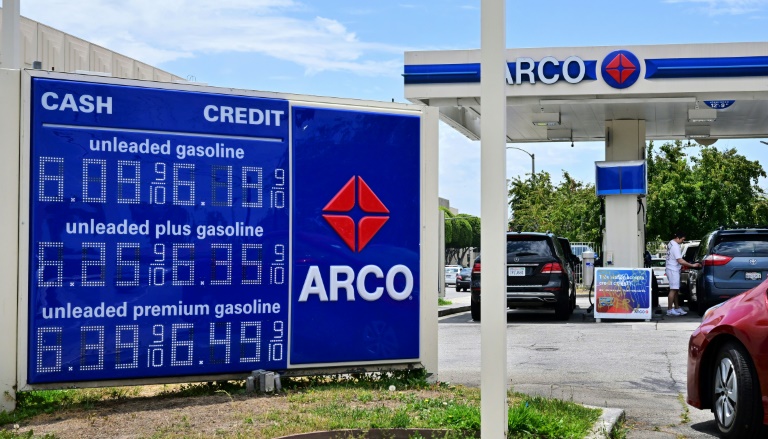
Gasoline prices at the pump have become a symbol of broader price rises in the United States, and they are sapping Biden’s approval rating ahead of legislative elections in November.

Biden has regularly attacked oil companies, saying they only care about profits and not the well-being of the average consumer.

The companies say in turn they have increased production to try to tame prices but that these are set on the world market and are subject to dynamics that are not under the control of US oil giants.

White House Press Secretary Karine Jean-Pierre said on Twitter Sunday that oil prices have dropped about $15 a barrel over the past month.

“But prices at the pump have barely come down. That’s not ‘basic market dynamics.’ It’s a market that is failing the American consumer,” she wrote.

Gasoline prices have been above $5 a gallon since early June, which is unprecedented in the car-crazy nation. Prices have fallen slightly since, but remain far from the $3 a gallon level of a year ago.

John Kirby, White House spokesman on national security issues, also defended the president Sunday in an appearance on Fox News.

“The president is working very, very hard across many fronts… to try to bring that price down,” Kirby said. 

He cited Biden’s proposal to suspend the federal gas tax this summer — this would need congressional approval — and his decision to tap the US strategic oil reserves to put more product on the market.

“He knows that it is not going to solve all the problems, but it will help if everybody cooperates on this. We could bring the price down at least by about one dollar a gallon,” Kirby said.

Bezos slams Biden appeal for lower gasoline prices

Amazon founder Jeff Bezos has criticized President Joe Biden for calling on oil companies to lower sky-high gasoline prices, prompting the White House to come to the US leader’s defense on Sunday.

“My message to the companies running gas stations and setting prices at the pump is simple: this is a time of war and global peril,” Biden tweeted Saturday.

“Bring down the price you are charging at the pump to reflect the cost you’re paying for the product. And do it now,” Biden added.

Bezos said Biden’s remarks amounted to “either straight ahead misdirection or a deep misunderstanding of basic market dynamics.”

“Ouch. Inflation is far too important a problem for the White House to keep making statements like this,” the US billionaire tweeted Saturday.

Gasoline prices at the pump have become a symbol of broader price rises in the United States, and they are sapping Biden’s approval rating ahead of legislative elections in November.

Biden has regularly attacked oil companies, saying they only care about profits and not the well-being of the average consumer.

The companies say in turn they have increased production to try to tame prices but that these are set on the world market and are subject to dynamics that are not under the control of US oil giants.

White House Press Secretary Karine Jean-Pierre said on Twitter Sunday that oil prices have dropped about $15 a barrel over the past month.

“But prices at the pump have barely come down. That’s not ‘basic market dynamics.’ It’s a market that is failing the American consumer,” she wrote.

Gasoline prices have been above $5 a gallon since early June, which is unprecedented in the car-crazy nation. Prices have fallen slightly since, but remain far from the $3 a gallon level of a year ago.

John Kirby, White House spokesman on national security issues, also defended the president Sunday in an appearance on Fox News.

“The president is working very, very hard across many fronts… to try to bring that price down,” Kirby said. 

He cited Biden’s proposal to suspend the federal gas tax this summer — this would need congressional approval — and his decision to tap the US strategic oil reserves to put more product on the market.

“He knows that it is not going to solve all the problems, but it will help if everybody cooperates on this. We could bring the price down at least by about one dollar a gallon,” Kirby said.

Don't look up: no fireworks for some cities on US independence holiday

Fireworks buffs in some US cities are in for a dud of a July 4 holiday as supply chain disruptions deny them the traditional pyrotechnic shows lighting up the summer sky, industry representatives said Sunday.

Displays have been canceled in cities across the United States, including Phoenix, Arizona; Sacramento, California; Minneapolis, Minnesota and College Park, Maryland.

Steve Houser, president of the National Fireworks Association, said on CNN: “I think a lot of the really big shows, the companies are obviously working very hard to keep those open because they draw such a level of attention. You know, things like Washington, Chicago, New York.” 

“A lot of the mid-market sizes… they’re the ones that are suffering, I think, the most.”

Among other things, he said, prices have surged.

Shipping used to cost $9,800 per container, but has spiked to $36,000, Houser said.

Supply chain snarls throughout the pandemic have been exacerbated by strict Covid-19 lockdowns abroad and Russia’s invasion of Ukraine, limiting product supply and driving up costs for what is available.

Fireworks are only the latest casualty of this mess.

College Park near Washington DC cited “Covid-19’s continued impact on the supply chain” as the reason for calling off the show, as did Phoenix.

The Cal Expo state fair in Sacramento said it was also facing staffing shortages.

Ocean City, Maryland and Tempe, Arizona have also called off the fireworks on America’s birthday. And many communities in Texas have been banned from setting off fireworks because of wildfire hazards due to recent hot, dry weather.

'Minions' rule N.American theaters on July 4th weekend

“Minions: The Rise of Gru,” the latest installment in the animated “Despicable Me” franchise, crushed the competition at the North American box office in its opening weekend, with an expected $127.9 million take over the four-day July 4th holiday.

Universal’s “Minions” far outpaced the number two film, “Top Gun: Maverick,” which came in at $32.5 million, industry watcher Exhibitor Relations said Sunday.

“This is a sensational opening,” said analyst David A. Gross of Franchise Entertainment Research.

“Family animation, more than any other genre, has struggled to find its footing during the pandemic,” he said. “This weekend, ‘Minions’ is breaking through and big animation is back in business.”

According to Variety, if confirmed, the box office haul would make the fifth chapter in the “Despicable Me” series about reformed super-villain Gru and his yellow Minions the highest film opening over Independence Day, besting 2011’s “Transformers: Dark of the Moon.”

Rolling along in second place is Paramount’s “Top Gun: Maverick,” the crowd-pleasing sequel to the original 1986 film that once again features Tom Cruise as cocky US Navy test pilot Pete “Maverick” Mitchell.

The film has raked in more than $1.1 billion worldwide.

Baz Luhrmann’s music biopic “Elvis” — starring relative newcomer Austin Butler as the King alongside Tom Hanks as his exploitative manager, Colonel Tom Parker — dropped to third place in its second weekend of release, at $23.7 million.

Fourth place went to “Jurassic World Dominion,” Universal’s sixth installment in the “Jurassic Park” franchise, at $19.2 million.

The latest dinosaur frightfest stars Chris Pratt and Bryce Dallas Howard alongside franchise originals Sam Neill, Laura Dern and Jeff Goldblum.

Rounding out the top five was horror film “The Black Phone” starring Ethan Hawke as a serial killer, which earned $14.6 million in its second weekend in theaters.

Completing the top 10 were: 

“Lightyear” ($8.1 million)

“Mr Malcolm’s List” ($1 million)

“Everything Everywhere All At Once” ($673,000)

“Doctor Strange in the Multiverse of Madness” (482,000)

“Marcel the Shell with Shoes On” ($307,750)

Ukraine retreats from key city in major Russian gain

The Ukrainian army retreated from the strategic city of Lysychansk Sunday as Russia claimed a major victory by seizing control of the entire eastern Lugansk region.

The Ukrainian withdrawal followed weeks of fierce fighting and marked a decisive breakthrough for Moscow’s forces more than four months after their invasion and after turning their focus away from the capital Kyiv.

Lysychansk had been the last major city in the Lugansk area of the eastern Donbas region still in Ukrainian hands and frees up Moscow’s forces to advance on Kramatorsk and Sloviansk in neighbouring Donetsk.

President Volodymyr Zelensky had earlier denied Russian claims of Lysychansk’s fall before the Ukrainian army announced the retreat on Sunday evening.

“The continuation of the defence of the city would lead to fatal consequences” in the face of Russia’s superiority in numbers and equipment, the army said in a statement. 

“In order to preserve the lives of Ukrainian defenders, a decision was made to withdraw.

“Unfortunately, steel will and patriotism are not enough for success — material and technical resources are needed.”

Russian forces seized Lysychansk’s twin city of Severodonetsk last week following weeks of intense fighting.

The latest blow to Ukrainian resistance came after Australian Prime Minister Anthony Albanese on Sunday pledged further military support including armoured vehicles and drones during a meeting with Zelensky in Kyiv.

– ‘Shooting from all sides’ –

On Sunday, Russia accused Ukraine of firing three cluster missiles at the city of Belgorod near the Ukrainian border, which came after Belarus on Saturday said it had intercepted Ukrainian missiles.

In what would represent an escalation of the conflict, Moscow said its anti-aircraft defences shot down three Tochka-U cluster missiles launched by “Ukrainian nationalists” against Belgorod, close to the Ukrainian border.

Belgorod governor Vyacheslav Gladkov said 11 residential buildings and 39 houses had been damaged.

Russia has previously accused Kyiv of conducting strikes on Russian soil, particularly in the Belgorod region.

On Saturday, Belarusian leader Alexander Lukashenko accused Kyiv of provocation and said his army intercepted missiles fired at his country by Ukrainian forces “around three days ago”.

Belarus, a Russian ally, supported the February 24 invasion and has been accused by Kyiv of launching its own attacks on Ukrainian territory.

Lukashenko denied any involvement in a recent cross-border incident.

“We do not intend to fight in Ukraine,” he was quoted as saying by state news agency Belta on Saturday.

Elsewhere, the mayor of Sloviansk, 75 kilometres (45 miles) west of Lysychansk, reported the heaviest Russian shelling “for a long time”, saying a child had been among six people killed, with another 15 people wounded.

The city of Siversk, 30 kilometres west of Lysychansk, saw overnight shelling, residents and an official told AFP.

“It was intense, and it was shooting from all sides,” said a woman sheltering in a cellar.

– ‘Fierce fighting’ –

“Fierce fighting continues along the entire frontline, in Donbas,” Zelensky said in an address late Saturday, accusing “enemy activity” of “intensifying” in the wider region around Ukraine’s second city of Kharkiv.

Two people were killed and three wounded — including two children — in a strike on the town of Dobropillya, local authorities in Donetsk said.

On Monday, leaders from dozens of countries and international organisations gather in the Swiss city of Lugano for a conference on Ukraine’s reconstruction. The aim is to provide a roadmap for the war-ravaged country’s recovery.

Zelensky said “colossal investments” would be needed as 10 regions of Ukraine had been affected in the war, with many towns and villages needing to be “rebuilt from scratch”.

Ukraine will also face demands for broad reforms, especially in cracking down on corruption after Brussels recently granted Kyiv candidate status in its push to join the 27-member bloc.

– ‘Out of action’ –

A Ukrainian official said Sunday that his country’s forces had “put out of action” a Russian military base in Melitopol, while the Ukrainian army said the air force had destroyed around 20 Russian units and two ammunition depots.

“The town of Melitopol is covered in smoke,” said the city’s exiled mayor Ivan Fedorov.

In peacetime, Ukraine is a major agricultural exporter, but Russia’s invasion has damaged farmland and seen Ukraine’s ports seized, razed or blockaded — sparking concerns about food shortages, particularly in poor countries.

Farmer Sergiy Lyubarsky, whose fields are close to the frontline, warned time was running out to harvest this year’s crop. 

“We can wait until August 10 at the latest, but after that, the grains are going to dry out and fall to the ground,” he said.

Western powers have accused Putin of using the trapped harvest as a weapon to increase pressure on the international community, and Russia has been accused of stealing grain.

Russia claims key Ukraine city, shelling kills 6 in Sloviansk

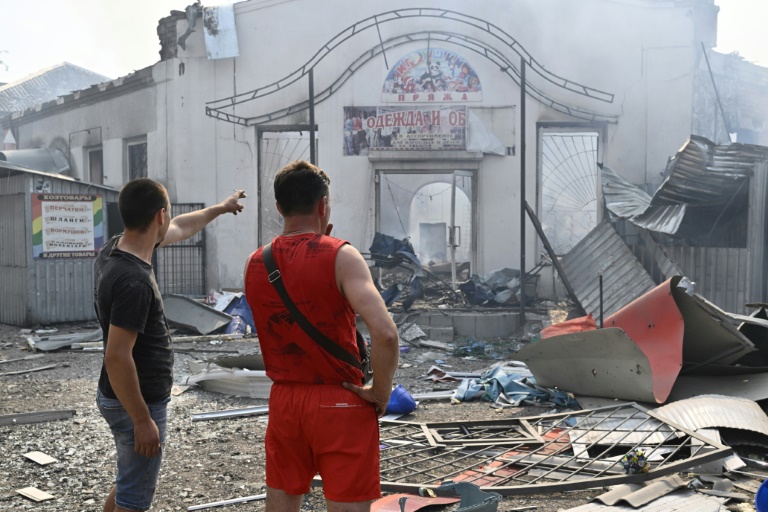
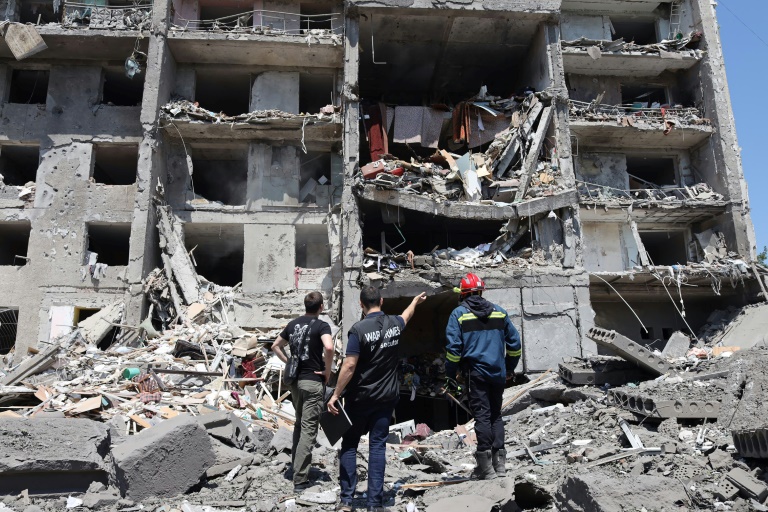
Russia claimed on Sunday to have captured the strategic Ukrainian city of Lysychansk and the entire frontline Lugansk region as a mayor said six people were killed by Russian shelling to the west.

The gains claimed by Russia would mark a decisive breakthrough for Moscow’s forces seeking control of eastern Ukraine, more than four months into their invasion and after turning their focus away from the capital Kyiv.

The mayor of Sloviansk, 75 kilometres (45 miles) west of Lysychansk, reported the heaviest Russian shelling “for a long time,” saying that a child was among six people killed, with another 15 people wounded and 15 fires sparked.

On Sunday, Russia accused Ukraine of firing three cluster missiles at the city of Belgorod, near the Ukrainian border and late Saturday, Belarus said it intercepted Ukrainian missiles.

Lysychansk had been the last major city in the Lugansk area of the Donbas still in Ukrainian hands and its capture would signal a deeper push into the eastern region.

“Sergei Shoigu has informed the commander in chief of the Russian armed forces, Vladimir Putin, of the liberation of the People’s Republic of Lugansk,” the Russian defence ministry said in a statement quoted by Russian news agencies.

A few minutes prior to the announcement, which AFP has not verified, a spokesman for the Russian defence ministry had said fighting was ongoing in Lysychansk and that Ukrainian forces were “completely” surrounded.

Ukraine has yet to comment on the Russian claim that Lysychansk has fallen.

– ‘Shooting from all sides’ –

On Saturday, there were conflicting reports about Lysychansk’s status with Ukraine denying Moscow’s claim to have encircled the entire city, which lies just across the river from neighbouring Severodonetsk which Russian forces seized last week.

The city of Siversk, 30 kilometres west of Lysychansk, saw overnight shelling, residents and an official told AFP.

“It was intense and it was shooting from all sides,” said a woman sheltering in a cellar.

“Fierce fighting continues along the entire frontline, in Donbas,” Ukrainian President Volodymyr Zelensky said in an address late Saturday, accusing “enemy activity” of “intensifying” in the wider region around Ukraine’s second city of Kharkiv.

Two people were killed and three wounded — including two children — in a strike on the town of Dobropillya, local authorities in Donetsk said.

On Monday, leaders from dozens of countries and international organisations set to gather in the Swiss city of Lugano for a conference on Ukraine’s reconstruction with the aim of providing a roadmap for the war-ravaged country’s recovery.

Zelensky said “colossal investments” would be needed and that 10 regions of Ukraine had been affected in the war, with many towns and villages needing to be “rebuilt from scratch”.

– ‘Fierce fighting’ –

Ukraine will also face demands for broad reforms, especially in cracking down on corruption after Brussels recently granted Kyiv candidate status in its push to join the 27-member bloc.

On Sunday, Moscow said its anti-aircraft defences shot down three Tochka-U cluster missiles launched by “Ukrainian nationalists” against Belgorod, close to the Ukrainian border.

Belgorod governor Vyacheslav Gladkov said 11 residential buildings and 39 houses were damaged.

Russia has previously accused Kyiv of conducting strikes on Russian soil, particularly in the Belgorod region.

On Saturday, Belarusian leader Alexander Lukashenko accused Kyiv of provocation and said his army intercepted missiles fired at his country by Ukrainian forces “around three days ago”.

Belarus, a Russian ally, supported the February 24 invasion and has been accused by Kyiv of launching its own attacks on Ukrainian territory.

Lukashenko denied any involvement in a recent cross-border incident, which would represent an escalation of the conflict. 

– ‘Out of action’ –

“We do not intend to fight in Ukraine,” he was quoted as saying by state news agency Belta on Saturday.

A Ukrainian official said Sunday that his country’s forces had “put out of action” a Russian military base in Melitopol, while the Ukrainian army said the air force had taken out around 20 Russian units and two ammunition depots.

“The town of Melitopol is covered in smoke,” said the city’s exiled mayor Ivan Fedorov.

In peacetime, Ukraine is a major agricultural exporter, but Russia’s invasion has damaged farmland and seen Ukraine’s ports seized, razed or blockaded — sparking concerns about food shortages, particularly in poor countries.

Farmer Sergiy Lyubarsky, whose fields are close to the frontline, warned time was running out to harvest this year’s crop. 

“We can wait until August 10 at the latest, but after that, the grains are going to dry out and fall to the ground,” he said.

Western powers have accused Putin of using the trapped harvest as a weapon to increase pressure on the international community, and Russia has been accused of stealing grain.

Trump foe Liz Cheney has not ruled out 2024 US presidential run

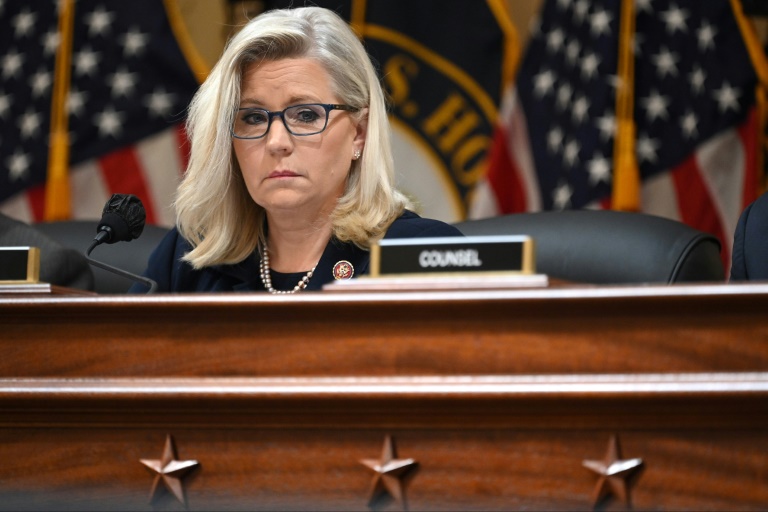
Congresswoman Liz Cheney, a rising Republican star until she refused to accept Donald Trump’s false claims of a stolen election, says she has not ruled out a US presidential run in 2024.

“I’ll make a decision about ’24 down the road,” she said in an interview Sunday with ABC talk show “This Week.”

“The single most important thing is protecting the nation from Donald Trump.”

Wyoming representative Cheney was one of just 10 Republicans in the House of Representatives who voted to impeach the former president for inciting the January 6, 2021 insurrection by his supporters.

The 55-year-old is now vice chair of the special House committee investigating whether Trump was responsible for the attack on the US Capitol, as he sought to stay in power after losing the 2020 election to Democrat Joe Biden.

“A man as dangerous as Donald Trump can absolutely never be anywhere near the Oval Office ever again,” Cheney said, telling ABC she thinks her Republican Party “can’t survive” if the real estate mogul wins the nomination again in 2024.

“Those of us who believe in Republican principles and ideals have a responsibility to try to lead the party back to what it can be,” she said.

Trump, who still holds outsize influence in the Republican Party, has discussed a potential new candidacy with increasing openness, with some outlets reporting he could announce his campaign by the end of July.

Even as Cheney — daughter of former vice president Dick Cheney — mulls a White House bid she is fighting for her political life in Wyoming, where a Trump-backed rival is challenging her in the state’s Republican primary, to be held next month ahead of November’s midterm elections.

Sri Lanka grinds to a halt as fuel reserves shrink

Sri Lanka has less than a day’s worth of fuel left, the energy minister said Sunday, with public transport grinding to a halt as the country’s economic crisis deepened.

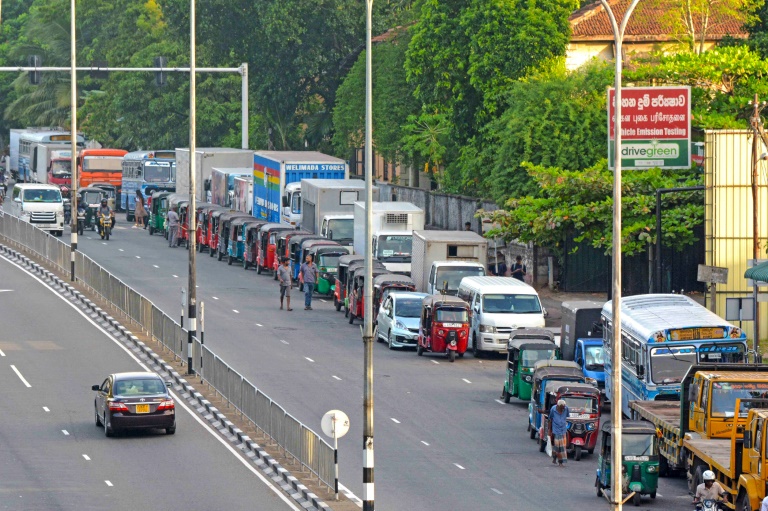
Petrol and diesel queues snaked through the capital for kilometres, though most pumping stations have been without fuel for days.

Energy minister Kanchana Wijesekera said petrol reserves in the country were about 4,000 tonnes, just below one day’s worth of consumption.

“The next petrol shipment is expected between the 22nd and 23rd (of July),” Wijesekera told reporters in Colombo. 

“We have contacted other suppliers, but we can’t confirm any new supplies before the 22nd.”

Last week, cash-strapped Sri Lanka announced a two-week halt to all fuel sales except for essential services to save petrol and diesel for emergencies.

Most shops were closed Sunday, with the situation expected to worsen when banks and offices reopen on Monday. 

Desperate people were seen trying to flag down the few vehicles on the road hoping for a ride.

Privately owned buses, which account for two-thirds of the country’s fleet, said they operated a skeleton service on Sunday as they were badly affected by the fuel shortage.

“We operated about 1,000 busses across the country out of the 20,000 owned by our members,” Private Bus Operators Association chairman Gemunu Wijeratne said.

“The situation will certainly get worse tomorrow because we have no way of getting diesel.”   

He said services would be curtailed further on Monday and saw no immediate solution.

Three-wheel taxis — a popular last-mile transport — were also off the streets, with most seen in days-long queues to get a ration of six litres of petrol.

A shortage of foreign currency to finance even the most essential imports has led to the country’s worst economic crisis, with its 22 million people facing severe hardships daily.

The country has also faced record-high inflation and lengthy power blackouts since late last year.

All non-essential government institutions and schools have been ordered shut until July 10 to reduce commuting and save energy. 

Local media reported there had been sporadic clashes outside fuel stations. 

Last week, troops opened fire to disperse a mob protesting against the military jumping the queue.

Sri Lanka is currently in talks with the International Monetary Fund for a possible bailout after the country defaulted on its $51 billion external debt in April.

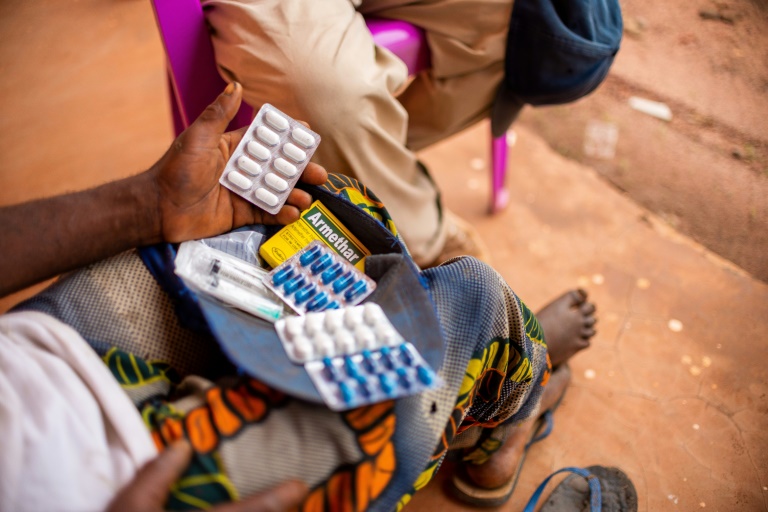
DR Congo drug manufacturing plan sparks safety concerns

Sitting at his desk overlooking a pharmaceutical factory floor on the outskirts of the Congolese capital Kinshasa, Joss Ilunga Dijimba, 52, cracked a jovial smile.

“It’s not easy doing business in Congo,” he said.

His family was forced to relocate the factory in the 1990s to survive bouts of mass looting. And nowadays, there are onerous taxes, customs duties, and problems retaining talented staff. 

His company, which employs about 40 people and produces generics such as paracetamol, is one of a tiny number of drug manufacturers in the Democratic Republic of Congo, an impoverished nation roughly the size of Western Europe. 

But a government plan to require hospitals and NGOs to buy more locally produced drugs could soon boost the fledgling pharmaceutical industry — despite fears in some quarters that safety standards are far below international norms.

Several NGOs, some of which provide medical care in the DRC’s conflict-torn east, have requested opt-outs.

At the small Pharmagros plant, behind barbed-wire walls near the Congo river, men in hairnets and white coats formulate medicines with imported precursor using lab equipment in airconditioned rooms. 

“Promoting local industry’s a good thing,” said Dijimba, a University of Texas graduate, insisting that several Congolese firms, including his, maintained high standards. 

“It could grow the middle class.”

About 73 percent of the DRC’s population of 90 million lives on under $1.9 a day, according to the World Bank. Most products in the African country are imported.

– ‘At your own peril’ –

The Congolese government has designated 35 drug molecules, including paracetamol, that medical facilities will be required to purchase in locally made form.

The government wants to stimulate business without banning imports, said Donatien Kabamb Kabey, the pharmaceuticals director at the DRC’s health ministry.

He explained that all the molecules can be replaced with imported equivalents, suggesting that ibuprofen could replace paracetamol, for example.

Although not yet implemented, the policy already appears to be working.

Fifteen new pharma businesses are setting up in the DRC ahead of the new rules, Kabey said, which will add to the existing 24.

The policy was partly designed to encourage factories to return after fleeing the country in the 1990s, he added, when unpaid soldiers went on the rampage towards the end of ex-dictator Mobutu Sese Seko’s reign. 

But experts warn that Congolese-made medicines face a major challenge: reassuring doctors and patients that they meet regulatory standards.

“When you go to the private sector in Congo, you do it at your own peril,” said Ed Vreeke, who runs the Belgium-based independent pharmaceutical auditing firm Quamed.

“They know darn well that the quality they produce is not good.”

Vreeke said Congolese regulators had improved, but the country lacked the massive resources needed to properly perform audits, check labels, and inspect the chemical composition of drugs for safety.

Kabey, whose department at the health ministry oversees inspections, said standards had improved “enormously” in recent years, but did not provide further details.

He said the government was establishing a national quality-control lab.

– ‘A huge thing’ –

Shoddy or falsified medicines kill hundreds of thousands of people every year, according to the World Health Organization, mostly in poor countries. 

The DRC’s hot and humid climate also poses storage problems.

A 2021 study of both imported and locally produced eye drops sold in Kinshasa, for example, showed that three out of the seven products tested were substandard. The one sample manufactured in the DRC was contaminated.

Outside a pharmacy in Kinshasa’s upmarket Gombe district, clutching a bag of medicines, 29-year-old corporate lawyer Joelle Mamputu said she didn’t pay attention to where drugs were made but said she had “no prejudice”. 

However, a 52-year-old public servant named Olivier said there was “quite a difference” between Congolese and foreign drugs. 

He added he would buy Congolese drugs were the quality the same.

Despite official assurances, major international NGOs such as Doctors Without Borders (MSF) and Medecins du Monde (MDM) have requested opt-outs from the purchasing  requirements, several humanitarian workers said.

MSF declined to comment.

MDM confirmed it had asked for an exemption due to concerns over quality and capacity to meet demand.

“It’s a huge thing,” said one humanitarian who asked for anonymity, explaining that the new rules will affect all non-governmental organisations, hospitals and pharmacies. 

Many aid workers understand the need to promote enterprise, he said, but there are internal disagreements about whether to compromise on quality.

“We need to have high quality standards for everyone, but the reality of the country is that sometimes it’s impossible”.

Close Bitnami banner
Bitnami