US Business

Kerry vows US to meet climate goal despite court setback

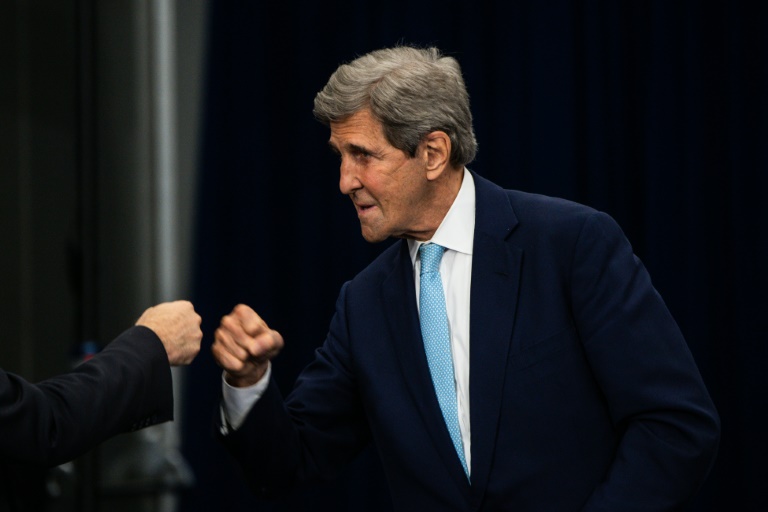
US climate envoy John Kerry vowed Friday the United States will meet goals it submitted to the United Nations on slashing greenhouse gas emissions, despite a Supreme Court ruling that curtailed the government’s powers.

“We are determined to achieve our goals. We can achieve our goals,” Kerry told AFP.

“But obviously it would help if we had a majority of the Supreme Court in the United States of America that actually understood the gravity of the situation and was more willing to try to be helpful rather than present a hurdle of one kind or another,” he said.

President Joe Biden, after defeating the climate-skeptic Donald Trump, in April last year said the United States would reduce greenhouse gas emissions by 50 to 52 percent by 2030 from 2005 levels, dramatically increasing the climate ambitions of the world’s largest economy.

He submitted the so-called nationally determined contribution to the UN climate body in line with the 2015 Paris Agreement, the landmark deal brokered by Kerry when he was secretary of state.

China, the world’s largest carbon emitter, called Friday on all nations to live up to Paris commitments, with foreign ministry spokesman Zhao Lijian saying of the United States, “it is not enough to just chant slogans.”

Kerry, who has worked with Chinese officials in his climate role despite soaring tensions between Beijing and Washington, said that he was “not surprised by the messaging” from the Asian power.

“We will show China precisely how we’re going to get the job done,” Kerry said.

Stephane Dujarric, the spokesman for UN Secretary-General Antonio Guterres, called the Supreme Court decision “a setback in our fight against climate change.”

– Biden proposes drilling –

Despite Biden’s pledges to wean the United States off fossil fuels, the Interior Department on Friday released a five-year proposal that would authorize offshore oil and gas drilling in federal waters in the Gulf of Mexico and Alaska, although it would still ban drilling in the Atlantic and Pacific Oceans.

The proposal comes amid soaring gas prices and as Biden seeks to woo Senator Joe Manchin, a Democrat from coal-producing West Virginia with the crucial vote, to back a package that would also boost clean energy. 

Environmentalists see the legislation as a last hope amid expectations that Trump’s Republican Party will make advances in November congressional elections.

The Supreme Court, finishing a term in which three justices nominated by Trump pushed it sharply to the right, on Thursday cut the wings off a key way in which the government could have tackled climate change without fresh legislation.

In a 6-3 ruling branded “devastating” by Biden, the top court said the Environmental Protection Agency did not have authority to order sweeping cuts on emissions from coal-fired power plants.

“I am convinced — and our legal people are looking at it very carefully — that this decision leaves plenty of latitude for us to be able to do a lot of things that we need to do,” Kerry said.

Asked about calls by some lawmakers from his Democratic Party for Biden to declare a climate emergency, Kerry said, “I think the president needs to evaluate every option available.”

– ‘Pin into balloon’ –

Coal accounts for around 20 percent of US electricity generation — still roughly on par with renewables. China, despite investing heavily in wind and solar, has also kept building coal production capacity.

But Kerry said that the marketplace showed that coal was not the future.

“Nobody’s going to fund any new coal power in the United States — no bank, no private lender. Coal is the dirtiest fuel in the world,” he said.

Scientists warn that the world is far off track in avoiding the worst ravages of climate change including severe heatwaves, floods, droughts, rising sea levels and storm surges. 

The Paris accord set the goal of limiting end-of-century warming to two degrees Celsius (3.6 Fahrenheit) above pre-industrial levels — and preferably not beyond 1.5 degrees — but the planet has already warmed by nearly 1.2 Celsius.

Ruth Greenspan Bell, a climate expert at the Woodrow Wilson International Center for Scholars, said it was difficult for the United States to show climate leadership while also fighting internally on whether it is a priority.

“It’s kind of putting a pin into a balloon. There’s a little bit less air in the balloon than there was before,” she said of the court decision. 

“The times call for a moonshot but imagine trying to pull off a moonshot when you are at the same time in a defensive crouch.”


Global stocks mixed as eurozone inflation hits record

Wall Street stocks shrugged off early weakness to begin the second half of 2022 on a solid note Friday, but record eurozone inflation underscored the potential for more turbulence ahead.

New York equities spent much of the morning in the red, absorbing an industry survey showing slowing growth in the manufacturing sector.

But US markets reversed course in the final hours of trading, rallying into the Independence Day holiday weekend amid hopes for a better second half of the year.

Investors are coming off the worst six-month start to a year for the S&P 500 since 1970.

Earlier, both Paris and Frankfurt stocks ended the day with small gains despite news of record-high eurozone inflation that reinforced expectations of a European Central Bank interest rate hike later this month.

The EU’s Eurostat data agency said annual consumer price inflation in the 19 countries that use the euro soared to 8.6 percent in June, up from the prior record of 8.1 percent in May.

“With eurozone inflation now becoming more broad-based in nature, the outlook for the eurozone for the rest of 2022 continues to look bleak,” warned Pushpin Singh, Economist at the Centre for Economics and Business Research.

“This comes amid a mounting possibility of a severe gas crisis in Europe, with Russia using gas exports as a means to counter sanctions,” he added.

The ECB stated last month that it will deliver its first interest rate hike in more than a decade in July to combat inflation. 

With the war in Ukraine showing no sign of ending — keeping energy costs elevated — there is an expectation that borrowing costs will continue to rise and send economies into recession.

Comments from top finance chiefs, including Federal Reserve boss Jerome Powell, suggest they are willing to endure the pain of a contraction as long as they can rein in prices — which are rising at their fastest pace in 40 years on both sides of the Atlantic.

“Investors know that inflation is high and is likely to push higher,” City Index analyst Fiona Cincotta told AFP.

“Instead, the market’s obsession is turning from inflation to recession fears. Given the steep declines in stock prices this week, much of the bad news is priced in for now, until it starts again next week,” she added.

The dollar, a safe-haven currency, advanced against the pound and the euro on rising expectations of a recession.

Oil rebounded on tight supplies despite persistent recession concerns.

– Key figures at around 2030 GMT –

New York – Dow: UP 1.1 percent at 31,097.26 (close)

New York – S&P 500: UP 1.1 percent at 3,825.33 (close)

New York – Nasdaq: UP 0.9 percent at 11,127.85 (close)

London – FTSE 100: FLAT at 7,168.65 (close) 

Frankfurt – DAX: UP 0.2 percent at 12,813.03 (close)

Paris – CAC 40: UP 0.1 percent at 5,931.06 (close)

EURO STOXX 50: DOWN 0.2 percent at 3,448.31 (close)

Tokyo – Nikkei 225: DOWN 1.7 percent at 25,935.62 (close)

Shanghai – Composite: DOWN 0.3 percent at 3,387.64 (close)

Hong Kong – Hang Seng Index: Closed for a holiday

Brent North Sea crude: UP 2.4 percent at $111.63 per barrel

West Texas Intermediate: UP 2.5 percent at $108.43 per barrel

Euro/dollar: DOWN at $1.0433 from $1.0484 Thursday

Pound/dollar: DOWN at $1.2098 from $1.2178

Euro/pound: UP at 86.21 pence from 86.09 pence

Dollar/yen: DOWN at 135.28 yen from 135.72 yen

burs-jmb/to

Global stocks mixed as eurozone inflation hits record

Wall Street stocks shrugged off early weakness to begin the second half of 2022 on a solid note Friday, but record eurozone inflation underscored the potential for more turbulence ahead.

New York equities spent much of the morning in the red, absorbing an industry survey showing slowing growth in the manufacturing sector.

But US markets reversed course in the final hours of trading, rallying into the Independence Day holiday weekend amid hopes for a better second half of the year.

Investors are coming off the worst six-month start to a year for the S&P 500 since 1970.

Earlier, both Paris and Frankfurt stocks ended the day with small gains despite news of record-high eurozone inflation that reinforced expectations of a European Central Bank interest rate hike later this month.

The EU’s Eurostat data agency said annual consumer price inflation in the 19 countries that use the euro soared to 8.6 percent in June, up from the prior record of 8.1 percent in May.

“With eurozone inflation now becoming more broad-based in nature, the outlook for the eurozone for the rest of 2022 continues to look bleak,” warned Pushpin Singh, Economist at the Centre for Economics and Business Research.

“This comes amid a mounting possibility of a severe gas crisis in Europe, with Russia using gas exports as a means to counter sanctions,” he added.

The ECB stated last month that it will deliver its first interest rate hike in more than a decade in July to combat inflation. 

With the war in Ukraine showing no sign of ending — keeping energy costs elevated — there is an expectation that borrowing costs will continue to rise and send economies into recession.

Comments from top finance chiefs, including Federal Reserve boss Jerome Powell, suggest they are willing to endure the pain of a contraction as long as they can rein in prices — which are rising at their fastest pace in 40 years on both sides of the Atlantic.

“Investors know that inflation is high and is likely to push higher,” City Index analyst Fiona Cincotta told AFP.

“Instead, the market’s obsession is turning from inflation to recession fears. Given the steep declines in stock prices this week, much of the bad news is priced in for now, until it starts again next week,” she added.

The dollar, a safe-haven currency, advanced against the pound and the euro on rising expectations of a recession.

Oil rebounded on tight supplies despite persistent recession concerns.

– Key figures at around 2030 GMT –

New York – Dow: UP 1.1 percent at 31,097.26 (close)

New York – S&P 500: UP 1.1 percent at 3,825.33 (close)

New York – Nasdaq: UP 0.9 percent at 11,127.85 (close)

London – FTSE 100: FLAT at 7,168.65 (close) 

Frankfurt – DAX: UP 0.2 percent at 12,813.03 (close)

Paris – CAC 40: UP 0.1 percent at 5,931.06 (close)

EURO STOXX 50: DOWN 0.2 percent at 3,448.31 (close)

Tokyo – Nikkei 225: DOWN 1.7 percent at 25,935.62 (close)

Shanghai – Composite: DOWN 0.3 percent at 3,387.64 (close)

Hong Kong – Hang Seng Index: Closed for a holiday

Brent North Sea crude: UP 2.4 percent at $111.63 per barrel

West Texas Intermediate: UP 2.5 percent at $108.43 per barrel

Euro/dollar: DOWN at $1.0433 from $1.0484 Thursday

Pound/dollar: DOWN at $1.2098 from $1.2178

Euro/pound: UP at 86.21 pence from 86.09 pence

Dollar/yen: DOWN at 135.28 yen from 135.72 yen

burs-jmb/to

Flights cancelled in Spain due to Ryanair, EasyJet strikes

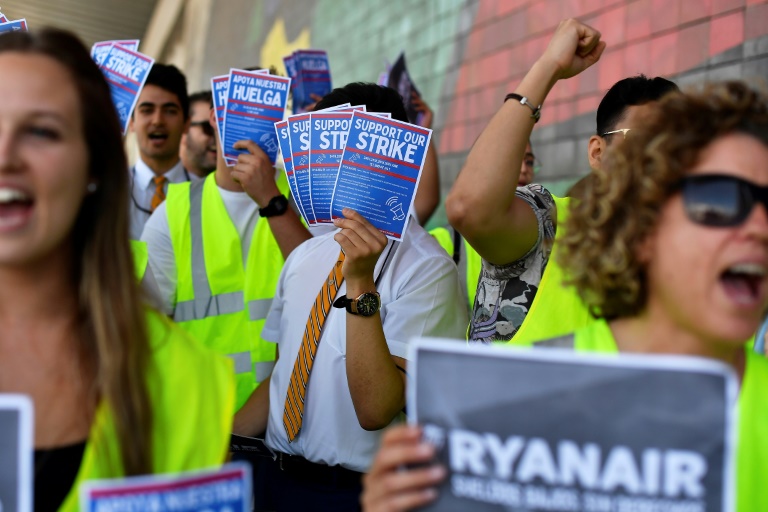
Fifteen flights to and from Spain were cancelled on Friday and dozens of others delayed due to the latest strike by cabin crew at low-cost airlines Ryanair and EasyJet.

The work stoppage over pay and working conditions comes as European schools are breaking up for the summer.

The strikes add more headaches to passengers and the aviation sector, which has struggled to recruit people after massive layoffs during the Covid pandemic.

By 7:00 pm (1700 GMT) nine EasyJet flights had been cancelled and 54 delayed, the USO union which called the strike said.

Six Ryanair flights were cancelled and 277 were delayed, it added.

EasyJet crew are set to strike during the first three weekends of July to demand parity in working conditions in line with other European airlines.

The strike by Ryanair cabin crew in Spain, where there are some 1,900 employees, began on June 24 and is due to run until Saturday. It is affecting 10 of the airline’s bases in Spain.

On Thursday, over 50 Ryanair flights to and from the country were cancelled because of the job action. 

A strike by the airline’s crew between June 24 and 26 cancelled 129 flights.

Flights from Paris’ two largest airports, Charles de Gaulle and Orly, were disrupted on Friday for the second day in a row due to a strike by airport workers.  

Automakers reports lower Q2 US sales as supply chain woes persist

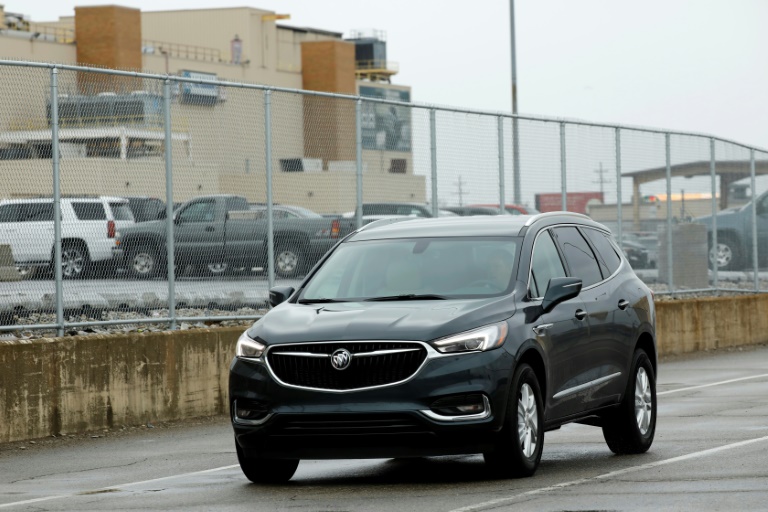
General Motors, Toyota and other automakers suffered a hit to US sales in the latest quarter as supply chain woes continued to crimp inventories, according to results released Friday.

GM sold 582,401 autos in the three months ending June 30, a drop of 15 percent from the same period a year ago. 

The Detroit giant said it is holding 95,000 partially-built vehicles in need of components that it expects to deliver by the end of 2022. 

Such maneuvers have become the norm over the last year as manufacturers try to make headway on as many high-margin vehicles as possible amid limited supply of semiconductors and other key items. 

On the positive side, GM said it scored strong sales for its pickup trucks, the Chevrolet Silverado and GMC Sierra, despite low inventories. And “pent-up demand” drove sales growth in other vehicles, including the Chevrolet Camaro and Chevrolet Colorado.

GM reaffirmed its full-year profit outlook, but its second-quarter net income range of between $1.6 billion and $1.9 billion lagged consensus estimates.

Meanwhile, Toyota reported sales of 531,105 over the same period, a drop of 23 percent compared with the 2021 quarter, and the Japanese company also cited “ongoing inventory challenges” hindering its dealerships.

A bright spot has been a jump in sales of Toyota’s electric vehicles, which have comprised more than 25 percent of Toyota’s sales so far this year.

Cox Automotive has forecast a 19.3 percent drop in US auto sales for the second quarter.

“Even though economic conditions have worsened in the past months, the lack of supply is still the greatest headwind facing the auto industry today,” said Charlie Chesbrough, senior economist at Cox.

Hyundai Motor America reported a drop of 23 percent sales drop to 184,191 units.

Automakers reports lower Q2 US sales as supply chain woes persist

General Motors, Toyota and other automakers suffered a hit to US sales in the latest quarter as supply chain woes continued to crimp inventories, according to results released Friday.

GM sold 582,401 autos in the three months ending June 30, a drop of 15 percent from the same period a year ago. 

The Detroit giant said it is holding 95,000 partially-built vehicles in need of components that it expects to deliver by the end of 2022. 

Such maneuvers have become the norm over the last year as manufacturers try to make headway on as many high-margin vehicles as possible amid limited supply of semiconductors and other key items. 

On the positive side, GM said it scored strong sales for its pickup trucks, the Chevrolet Silverado and GMC Sierra, despite low inventories. And “pent-up demand” drove sales growth in other vehicles, including the Chevrolet Camaro and Chevrolet Colorado.

GM reaffirmed its full-year profit outlook, but its second-quarter net income range of between $1.6 billion and $1.9 billion lagged consensus estimates.

Meanwhile, Toyota reported sales of 531,105 over the same period, a drop of 23 percent compared with the 2021 quarter, and the Japanese company also cited “ongoing inventory challenges” hindering its dealerships.

A bright spot has been a jump in sales of Toyota’s electric vehicles, which have comprised more than 25 percent of Toyota’s sales so far this year.

Cox Automotive has forecast a 19.3 percent drop in US auto sales for the second quarter.

“Even though economic conditions have worsened in the past months, the lack of supply is still the greatest headwind facing the auto industry today,” said Charlie Chesbrough, senior economist at Cox.

Hyundai Motor America reported a drop of 23 percent sales drop to 184,191 units.

French police bust gang selling fake Bordeaux wine

French police have broken up a gang that had allegedly produced hundreds of thousands of bottles of fake Bordeaux wine in an elaborate counterfeiting operation, prosecutors said on Friday.

Officers investigating drug dealing in the southwestern French region discovered printing machinery being used to create the labels for the bottles last September, sparking a wider criminal probe.

It led to the arrest of around 20 people on Monday during an operation in seven different areas of France, with three of them charged with organised fraud, counterfeiting and money laundering.

The main suspect is a winemaker and broker in the Medoc region near Bordeaux who was buying low-grade wine from other areas including Spain, then bottling it up as more expensive local produce, a statement from Bordeaux prosecutors’ office said.

“Major orders” had been placed for the wine “destined for supermarkets and foreign countries”, the statement added.

Bottling operations were being run at night to avoid detection, it said.

“If the allegations are proven, we hope that the culprits will be heavily punished because these practices undermine the image of Bordeaux wines and those who work properly and respect the rules,” the local wine industry body told AFP.

French wine makers, customs and police are constantly on the lookout for cheats who pass off budget plonk as top vintages.

In 2016, police busted a Bordeaux vintner who was blending poor-quality wine with high-end Saint-Emilions, Lalande-de-Pomerols and Listrac-Medocs to sell to major supermarkets under prestigious labels.

The owner of several domains, Francois-Marie Marret, was handed a prison sentence and a fine of eight million euros after being found bringing in cheap wine at night.

In 2010, 12 French winemakers and dealers were convicted of selling millions of bottles of fake Pinot Noir to the US firm E&J Gallo.

Before that, in 2006 legendary Beaujolais winemaker Georges Duboeuf was fined more than 30,000 euros for blending grapes from different vineyards to disguise the poor quality of certain prized vintages.

Stocks choppy, dollar frothy

Stock markets wobbled on Friday while the dollar shot higher against the euro and pound as investors fretted about interest rate hikes and a possible recession.

Both Paris and Frankfurt stocks ended the day with small gains despite news of record-high eurozone inflation that reinforced expectations of a European Central Bank interest rate hike later this month.

The EU’s Eurostat data agency said annual consumer price inflation in the 19 countries that use the euro soared to 8.6 percent in June, up from the prior record of 8.1 percent in May.

“Today’s figures bolster the European Central Bank’s intended decision to start raising interest rates at its next Governing Council meeting in July,” noted economist Pushpin Singh at research group CEBR.

The ECB stated last month that it will deliver its first interest rate hike in more than a decade in July to combat inflation. 

Eurostat added Friday that core inflation — stripping out volatile components like energy and food — slowed to 3.7 percent from 3.8 percent, helping equities to calm heading into the weekend pause.

Wall Street’s main indices were marginally lower in late morning trading, having bounced around since the opening bell.

– ‘Another big leg lower’ – 

Chris Beauchamp, chief market analyst at online trading platform IG, said there was little buying interest at the start of the second half of the year, even though the sharp drops suffered by stocks in the first half open up the possibility for gains.

New York’s S&P 500 index suffered its worst first-half performance since 1970.

“There is a growing unease about the summer, especially with a potentially very gloomy (second-quarter) earnings season nearly upon us,” he said in a note to clients. 

“It really does look like we have another big leg lower before this bear market is done,” added Beauchamp.

With the war in Ukraine showing no sign of ending — keeping energy costs elevated — there is an expectation that borrowing costs will continue to rise and send economies into recession.

Losses across world markets this week come after a rally last week fuelled by hopes that an economic slowdown or signs of recession would lead central banks to ease off their monetary tightening drive.

But comments from top finance chiefs, including Federal Reserve boss Jerome Powell, suggest they are willing to endure the pain of a contraction as long as they can rein in prices — which are rising at their fastest pace in 40 years on both sides of the Atlantic.

“Investors know that inflation is high and is likely to push higher,” City Index analyst Fiona Cincotta told AFP.

“Instead, the market’s obsession is turning from inflation to recession fears. Given the steep declines in stock prices this week, much of the bad news is priced in for now, until it starts again next week,” she added.

The dollar, a safe-haven currency, jumped one percent against the pound and the euro on rising expectations of a recession.

“The US dollar looks set to end the week stronger against most major currencies, nearing its strongest level since 2002 as ‘risky’ assets remained under pressure,” said economist James Reilly at Capital Economics.

The euro slid to a low of $1.0369 before rebounding back above the $1.04 level. The pound touched a low of $1.1979.

Oil rebounded on tight supplies despite persistent recession concerns.

– Key figures at around 1530 GMT –

New York – Dow: DOWN 0.3 percent at 30,693.52 points

EURO STOXX 50: DOWN 0.2 percent at 3,448.31

London – FTSE 100: FLAT at 7,168.65 (close) 

Frankfurt – DAX: UP 0.2 percent at 12,813.03 (close)

Paris – CAC 40: UP 0.1 percent at 5,931.06 (close)

Tokyo – Nikkei 225: DOWN 1.7 percent at 25,935.62 (close)

Shanghai – Composite: DOWN 0.3 percent at 3,387.64 (close)

Hong Kong – Hang Seng Index: Closed for a holiday

Brent North Sea crude: UP 1.9 percent at $111.12 per barrel

West Texas Intermediate: UP 2.2 percent at $108.08 per barrel

Euro/dollar: DOWN at $1.0405 from $1.0484 Thursday

Pound/dollar: DOWN at $1.2037 from $1.2178

Euro/pound: UP at 86.46 pence from 86.09 pence

Dollar/yen: DOWN at 135.19 yen from 135.72 yen

burs-rl/imm

Stocks choppy, dollar frothy

Stock markets wobbled on Friday while the dollar shot higher against the euro and pound as investors fretted about interest rate hikes and a possible recession.

Both Paris and Frankfurt stocks ended the day with small gains despite news of record-high eurozone inflation that reinforced expectations of a European Central Bank interest rate hike later this month.

The EU’s Eurostat data agency said annual consumer price inflation in the 19 countries that use the euro soared to 8.6 percent in June, up from the prior record of 8.1 percent in May.

“Today’s figures bolster the European Central Bank’s intended decision to start raising interest rates at its next Governing Council meeting in July,” noted economist Pushpin Singh at research group CEBR.

The ECB stated last month that it will deliver its first interest rate hike in more than a decade in July to combat inflation. 

Eurostat added Friday that core inflation — stripping out volatile components like energy and food — slowed to 3.7 percent from 3.8 percent, helping equities to calm heading into the weekend pause.

Wall Street’s main indices were marginally lower in late morning trading, having bounced around since the opening bell.

– ‘Another big leg lower’ – 

Chris Beauchamp, chief market analyst at online trading platform IG, said there was little buying interest at the start of the second half of the year, even though the sharp drops suffered by stocks in the first half open up the possibility for gains.

New York’s S&P 500 index suffered its worst first-half performance since 1970.

“There is a growing unease about the summer, especially with a potentially very gloomy (second-quarter) earnings season nearly upon us,” he said in a note to clients. 

“It really does look like we have another big leg lower before this bear market is done,” added Beauchamp.

With the war in Ukraine showing no sign of ending — keeping energy costs elevated — there is an expectation that borrowing costs will continue to rise and send economies into recession.

Losses across world markets this week come after a rally last week fuelled by hopes that an economic slowdown or signs of recession would lead central banks to ease off their monetary tightening drive.

But comments from top finance chiefs, including Federal Reserve boss Jerome Powell, suggest they are willing to endure the pain of a contraction as long as they can rein in prices — which are rising at their fastest pace in 40 years on both sides of the Atlantic.

“Investors know that inflation is high and is likely to push higher,” City Index analyst Fiona Cincotta told AFP.

“Instead, the market’s obsession is turning from inflation to recession fears. Given the steep declines in stock prices this week, much of the bad news is priced in for now, until it starts again next week,” she added.

The dollar, a safe-haven currency, jumped one percent against the pound and the euro on rising expectations of a recession.

“The US dollar looks set to end the week stronger against most major currencies, nearing its strongest level since 2002 as ‘risky’ assets remained under pressure,” said economist James Reilly at Capital Economics.

The euro slid to a low of $1.0369 before rebounding back above the $1.04 level. The pound touched a low of $1.1979.

Oil rebounded on tight supplies despite persistent recession concerns.

– Key figures at around 1530 GMT –

New York – Dow: DOWN 0.3 percent at 30,693.52 points

EURO STOXX 50: DOWN 0.2 percent at 3,448.31

London – FTSE 100: FLAT at 7,168.65 (close) 

Frankfurt – DAX: UP 0.2 percent at 12,813.03 (close)

Paris – CAC 40: UP 0.1 percent at 5,931.06 (close)

Tokyo – Nikkei 225: DOWN 1.7 percent at 25,935.62 (close)

Shanghai – Composite: DOWN 0.3 percent at 3,387.64 (close)

Hong Kong – Hang Seng Index: Closed for a holiday

Brent North Sea crude: UP 1.9 percent at $111.12 per barrel

West Texas Intermediate: UP 2.2 percent at $108.08 per barrel

Euro/dollar: DOWN at $1.0405 from $1.0484 Thursday

Pound/dollar: DOWN at $1.2037 from $1.2178

Euro/pound: UP at 86.46 pence from 86.09 pence

Dollar/yen: DOWN at 135.19 yen from 135.72 yen

burs-rl/imm

Biles, Denzel Washington, Rapinoe among winners of top US honor

Gymnastics star Simone Biles, actor Denzel Washington and the late tech visionary Steve Jobs have been named as recipients of America’s highest civilian honor, the White House said Friday.

President Joe Biden designated 17 Americans to receive the Presidential Medal of Freedom, three of them posthumous.

The White House said the medal recognizes “exemplary contributions to the prosperity, values, or security of the United States, world peace, or other significant societal, public or private endeavors.”

Among the recipients is Megan Rapinoe, the Olympic gold medalist soccer star, two-time Women’s World Cup champion and outspoken advocate on equality, race and LGBTQ issues.

Ahead of a ceremony on July 7, the White House said those honored had “overcome significant obstacles… and acted with bravery to drive change in their communities —  and across the world — while blazing trails for generations to come.”

One posthumous recipient this year is John McCain, a one-time Republican presidential nominee, long-time senator from Arizona, and Vietnam War veteran who won a Purple Heart.

Previous winners of the presidential medal include the basketball legend Kareem Abdul-Jabbar, Motown singer Diana Ross and the actor Robert De Niro.

Close Bitnami banner
Bitnami