US Business

S.Leone slashes 'zeros of shame' from banknotes

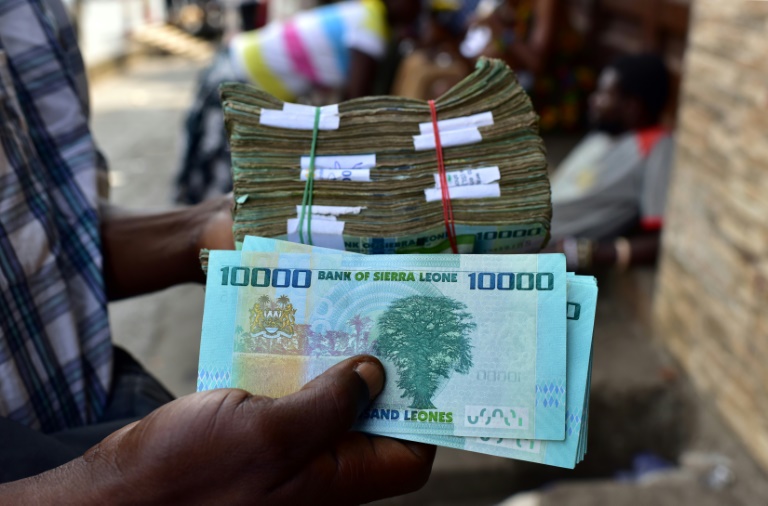
Sierra Leone on Friday introduced a new family of banknotes, stripping three zeros off the leone, in a bid to restore confidence in the inflation-hit national currency.

The Bank of Sierra Leone announced the move last August, insisting the public’s purchasing power would not be affected by the change.

“We have removed three zeros from our banknotes but the money yesterday is the same value as today,” President Julius Maada Bio said at ceremonies at the central bank where the new bills were unveiled.

A note of 10 new leones is the equivalent of a note of 10,000 old leones, which changes hands for around 75 US cents.

Year-on-year inflation in the West African state was 24.87 percent in May, according to the national statistics agency.

Rising prices had driven the printing of banknotes, resulting in a mountain of paper money that is costly to sustain and unwieldly for the public.

Shoppers need huge quantities of banknotes for the simplest transactions, and unscrupulous bank tellers sometimes pilfer notes from sealed bundles of bills.

“We are removing the ‘zeros of shame’ to get the currency properly aligned,” Morlai Bangura, a central bank director, told AFP earlier in the week.

He said the bank had begun distributing the new paper notes to commercial banks last week.

On Friday, customers braving the rain queued at commercial banks to swap their old banknotes for new ones.

“The changing of our currency is necessary — we were used to carrying bags to the bank to withdraw our money, but not anymore,” Alice Frazer, 70, said after exchanging her notes at the Sierra Leone Commercial Bank, a state-owned bank in central Freetown.

The new banknotes have a similar design to the old ones but are smaller in size.

“Our current currency is too big to fit into a wallet and we spend too much money printing oversized banknotes,” Kelfala Murana Kallon, the central bank governor, told reporters last August as he announced the move.

The central bank declined to comment on the cost of the operation.

Sierra Leone’s eight million people live in one of the poorest nations in the world, ranking 182 out of 189 countries in the UN’s Human Development Index.

Its economy, heavily dependent on minerals, was devastated by a civil war that ran from 1991-2002 and left about 120,000 dead.

Efforts at rebuilding were set back by an Ebola epidemic in 2014-2016, a fall in world commodity prices and the coronavirus epidemic — all of which have disrupted trade and investment and hit exports.

Sierra Leoneans will be able to use both the old and new notes during a transition period until September 30. 

From October 1, the old currency will cease to be legal tender.

The public will be able to swap the old currency for the new one until November 15, Kallon said in a statement.

Trial of US basketball star Griner opens in Russia

The trial of US basketball star Brittney Griner, detained in Russia since February, opened on Friday as tensions rage over Moscow’s offensive in Ukraine.

Griner, a two-time Olympic gold medallist and WNBA champion, faces up to 10 years in prison on charges of drug smuggling. 

Her case has become one of many sticking points in relations between the United States and Russia, with Washington saying the 31-year-old Griner has been “wrongfully detained” and putting its special envoy in charge of hostages on the case.

“The trial has started,” Polina Vdovtsova, the spokeswoman for the court in the town of Khimki outside Moscow, told reporters.

The proceedings were partially closed, with a limited media presence, which Vdovtsova said was “on the request of the defence, the request of Griner herself”.

The six-foot-nine (2.06 metres) star was brought into court in handcuffs. She wore a white T-shirt with an image of US music icon Jimi Hendrix.

Griner came to Russia in February to play club basketball during the US off-season — a common path for American stars seeking additional income. 

She was detained at a Moscow airport after she was found carrying vape cartridges with cannabis oil in her luggage — just days before Russian President Vladimir Putin defied US warnings and sent troops into Ukraine.

US authorities initially kept a low profile on the case, which was not made known to the general public until March 5, but has since upped the ante.

“The US embassy and the country cares very deeply about this case,” Elisabeth Rood, deputy chief to the US embassy in Moscow, told reporters outside the court. 

“She asked me to convey that she is in good spirits and she is keeping up faith.”

Griner’s lawyer Alexander Boikov said she had “no complaints about the conditions of her detention.”

He added that she is working out “in her cell and on walks”.

The WNBA has also said it is working to bring Griner home.

But Griner’s wife Cherelle told CNN that she feels not enough is being done, despite good intentions.

“I don’t think the maximum amount of effort is being done because again, the rhetoric and the actions don’t match,” she said in an interview, citing the example of a phone call the couple was meant to have that she says was botched by the US Embassy.

“It would have been in her best interest for her phone calls to have been answered. It would be in her best interest for her to be back on US soil. So until I see things like that, no.”

Cherelle Griner said she hoped to meet with President Joe Biden to “humanise” her wife and because he has the “power” to bring her home.

The next hearing will take place on July 7.

– Tough sentences –

Russian law is strict in such cases and other foreigners have recently been handed heavy sentences on drug-related charges.

Last month, a Moscow court sentenced a former US diplomat, Marc Fogel, to 14 years in prison for “large-scale” cannabis smuggling.

Russia and the United States regularly clash over the detention of each other’s citizens and sometimes exchange them in scenes reminiscent of the Cold War.

In April, former US Marine Trevor Reed, serving a nine-year sentence in Russia for violence, was exchanged for Russian pilot Konstantin Yaroshenko, imprisoned in the United States since 2010 for drug trafficking.

Other exchanges of this type could be the subject of possible talks, observers say.

Among the names most mentioned are Paul Whelan, an American sentenced to 16 years in prison for espionage, and the Russian arms trafficker Viktor Bout, nicknamed “The Merchant of Death”, who is serving a 25-year sentence in the United States.

In January 2020, Putin pardoned a young Israeli-American woman, Naama Issachar, imprisoned in Russia for “drug trafficking” after then-Israeli leader Benjamin Netanyahu met with him in Moscow and brought her home.

She was stopped in April 2019 during a transit at Moscow’s Sheremetyevo airport while flying between India and Israel via the Russian capital.

Authorities said they found nine grams of cannabis in her luggage.

After Griner’s hearing, US Secretary of State Antony Blinken tweeted: “We — and I personally — have no higher priority than bringing her and other wrongfully detained Americans, including Paul Whelan, home.

“We won’t stop working until they are reunited with their loved ones.”

GM reports lower Q2 sales as supply chain woes persist

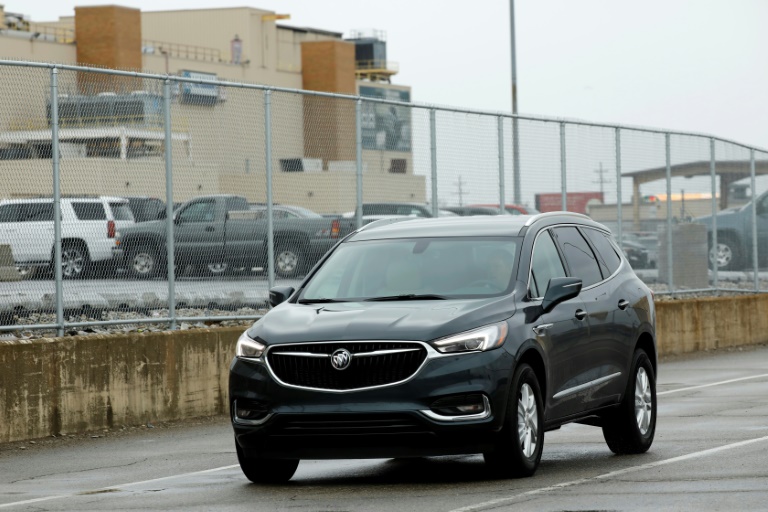
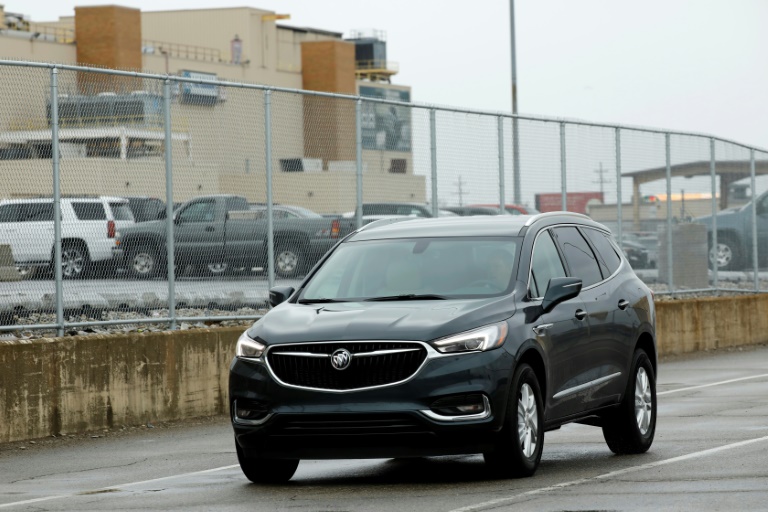
General Motors reported a 15 percent drop in US auto sales in the second quarter as supply chain woes continued to crimp inventories.

The Detroit giant said it is holding 95,000 partially built vehicles in need of components that it expects to deliver by the end of 2022.

For the quarter ending June 30, GM sold 582,401 autos, citing a strong performance for the pickup trucks, the Chevrolet Silverado and GMC Sierra, despite low inventories.

The automaker said “pent-up demand” drove sales growth in other vehicles, including the Chevrolet Camaro and Chevrolet Colorado. 

GM reaffirmed its full-year profit outlook, but its second-quarter net income range of between $1.6 billion and $1.9 billion lagged consensus estimates.

The auto industry has been plagued by supply chain woes over the last year, with a shortage of semiconductor chips especially impactful.

Cox Automotive has forecast a 19.3 percent drop in US auto sales for the second quarter.

“Even though economic conditions have worsened in the past months, the lack of supply is still the greatest headwind facing the auto industry today,” said Charlie Chesbrough, senior economist at Cox.

GM reports lower Q2 sales as supply chain woes persist

General Motors reported a 15 percent drop in US auto sales in the second quarter as supply chain woes continued to crimp inventories.

The Detroit giant said it is holding 95,000 partially built vehicles in need of components that it expects to deliver by the end of 2022.

For the quarter ending June 30, GM sold 582,401 autos, citing a strong performance for the pickup trucks, the Chevrolet Silverado and GMC Sierra, despite low inventories.

The automaker said “pent-up demand” drove sales growth in other vehicles, including the Chevrolet Camaro and Chevrolet Colorado. 

GM reaffirmed its full-year profit outlook, but its second-quarter net income range of between $1.6 billion and $1.9 billion lagged consensus estimates.

The auto industry has been plagued by supply chain woes over the last year, with a shortage of semiconductor chips especially impactful.

Cox Automotive has forecast a 19.3 percent drop in US auto sales for the second quarter.

“Even though economic conditions have worsened in the past months, the lack of supply is still the greatest headwind facing the auto industry today,” said Charlie Chesbrough, senior economist at Cox.

Assange lodges UK appeal against US extradition

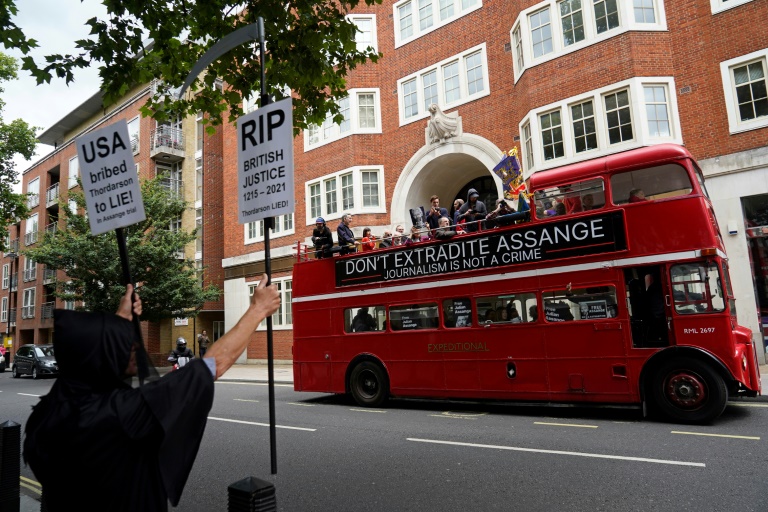
WikiLeaks founder Julian Assange on Friday filed an appeal against his extradition to the United States, as supporters denounced the British government.

Assange, who turns 51 on Sunday, has been held in a high-security prison since 2019.

On Friday his wife Stella was among dozens of people who demonstrated outside Britain’s interior ministry to demand his release.

Home Secretary Priti Patel approved the extradition last month, but court officials confirmed to AFP an application to appeal had been received on Friday.

“We’re not at the end of the road here,” Stella Assange, who married the Australian publisher earlier this year, told reporters when Patel announced her decision.

“We’re going to fight this. We’re going to use every appeal avenue.” 

Assange is wanted to face trial for allegedly violating the US Espionage Act by publishing military and diplomatic files in 2010, related to the Afghanistan and Iraq wars.

He could face decades in jail if found guilty, but supporters portray him as a martyr to press freedom after he was taken into UK custody following a years-long stay in Ecuador’s embassy.

“He’s been in prison for telling the truth,” supporter Gloria Wildman, 79, told AFP at Friday’s protest.

“If Julian Assange is not free, neither are we, none of us is free,” she said.

Google to pay $90 mn in settlement with app developers

Google will fund a $90-million settlement to small app developers who had alleged the technology giant abused its market position, according to statements seen by AFP Friday.

The funds are expected to result in payments of $200,000 or more to some developers among the 48,000 in a class action lawsuit, according to the plaintiffs’ attorney, Hagens Berman.

The case centered on charges that Google violated antitrust laws with its Google Play app store, alleging the technology giant maintained a monopoly in the US market on its Android smartphone system that penalized developers.

The settlement will cover developers with annual Google Play earnings of $2 million or less between 2016 and 2021.

In addition, Google agreed to allow developers to pay a 15 percent service fee on the first $1 million in annual revenues, down from the prior 30 percent.

Other measures will highlight apps from independent developers and make it easier to use these alternatives within the Android ecosystem.

Wilson White, a Google vice president for government affairs, said he was pleased with the agreement.

“As the agreement notes, we remain confident in our arguments and case, but this settlement will avoid protracted and unnecessary litigation with developers, whom we see as vital partners in the Android ecosystem,” White said.

Hagens Berman, which had secured a $100-million settlement from Apple in 2020 in a similar case, hailed the agreement as an example of holding Big Tech to account.

“Today, nearly 48,000 hardworking app developers are receiving the just payment they deserve for their work product — something Google sought to profit from, hand over fist,” said Steve Berman, co-founder of the firm.

Google to pay $90 mn in settlement with app developers

Google will fund a $90-million settlement to small app developers who had alleged the technology giant abused its market position, according to statements seen by AFP Friday.

The funds are expected to result in payments of $200,000 or more to some developers among the 48,000 in a class action lawsuit, according to the plaintiffs’ attorney, Hagens Berman.

The case centered on charges that Google violated antitrust laws with its Google Play app store, alleging the technology giant maintained a monopoly in the US market on its Android smartphone system that penalized developers.

The settlement will cover developers with annual Google Play earnings of $2 million or less between 2016 and 2021.

In addition, Google agreed to allow developers to pay a 15 percent service fee on the first $1 million in annual revenues, down from the prior 30 percent.

Other measures will highlight apps from independent developers and make it easier to use these alternatives within the Android ecosystem.

Wilson White, a Google vice president for government affairs, said he was pleased with the agreement.

“As the agreement notes, we remain confident in our arguments and case, but this settlement will avoid protracted and unnecessary litigation with developers, whom we see as vital partners in the Android ecosystem,” White said.

Hagens Berman, which had secured a $100-million settlement from Apple in 2020 in a similar case, hailed the agreement as an example of holding Big Tech to account.

“Today, nearly 48,000 hardworking app developers are receiving the just payment they deserve for their work product — something Google sought to profit from, hand over fist,” said Steve Berman, co-founder of the firm.

Europe stocks steady as eurozone inflation hits record high

European stock markets steadied Friday with traders digesting news of record-high eurozone inflation that reinforced expectations of a European Central Bank interest rate hike this month.

The dollar, the safe-haven currency, jumped one percent against the pound on rising expectations of a recession, while oil rebounded on tight supplies.

Eurozone inflation accelerated to another record high in June, official data showed Friday, fuelled by rising energy and food prices amid Russia’s war in Ukraine.

The EU’s Eurostat data agency said annual consumer price inflation in the 19 countries that use the euro soared to 8.6 percent in June, up from the prior record of 8.1 percent in May.

“Today’s figures bolster the European Central Bank’s intended decision to start raising interest rates at its next Governing Council meeting in July,” noted economist Pushpin Singh at research group CEBR.

The ECB stated last month that it will deliver its first interest rate hike in more than a decade in July to combat inflation. 

Eurostat added Friday that core inflation — stripping out volatile components like energy and food — slowed to 3.7 percent from 3.8 percent, helping equities to calm heading into the weekend pause.

Earlier Friday, Asian stock markets closed lower after another Wall Street selloff.

New York stocks opened little changed.

Data showing US consumers — the backbone of the world’s top economy — were growing increasingly reticent about spending dealt a fresh blow, with New York’s S&P 500 index suffering its worst first-half performance since 1970.

With the war in Ukraine showing no sign of ending — keeping energy costs elevated — there is an expectation that borrowing costs will continue to rise and send economies into recession.

Losses across world markets this week come after a rally last week fuelled by hopes that an economic slowdown or signs of recession would lead central banks to ease off their monetary tightening drive.

But comments from top finance chiefs, including Federal Reserve boss Jerome Powell, suggest they are willing to endure the pain of a contraction as long as they can rein in prices — which are rising at their fastest pace in 40 years on both sides of the Atlantic.

“Investors know that inflation is high and is likely to push higher,” City Index analyst Fiona Cincotta told AFP.

“Instead, the market’s obsession is turning from inflation to recession fears. Given the steep declines in stock prices this week, much of the bad news is priced in for now, until it starts again next week,” she added.

The grim global economic outlook has also weighed on bitcoin, which has dropped back under $20,000.

– Key figures at around 1330 GMT –

London – FTSE 100: UP less than 0.1 percent at 7,174.12 points

Frankfurt – DAX: FLAT at 12,780.98

Paris – CAC 40: UP 0.1 percent at 5,928.80

EURO STOXX 50: DOWN 0.4 percent at 3,441.87

New York – Dow: FLAT at 30,747.54

Brent North Sea crude: UP 2.4 percent at $111.68 per barrel

West Texas Intermediate: UP 2.6 percent at $108.53 per barrel

Tokyo – Nikkei 225: DOWN 1.7 percent at 25,935.62 (close)

Shanghai – Composite: DOWN 0.3 percent at 3,387.64 (close)

Hong Kong – Hang Seng Index: Closed for a holiday

Euro/dollar: DOWN at $1.0404 from $1.0484 Thursday

Pound/dollar: DOWN at $1.2010 from $1.2178

Euro/pound: UP at 86.66 pence from 86.09 pence

Dollar/yen: DOWN at 135.48 yen from 135.72 yen

burs-rl/lth

Flights cancelled in Spain due to Ryanair, EasyJet strikes

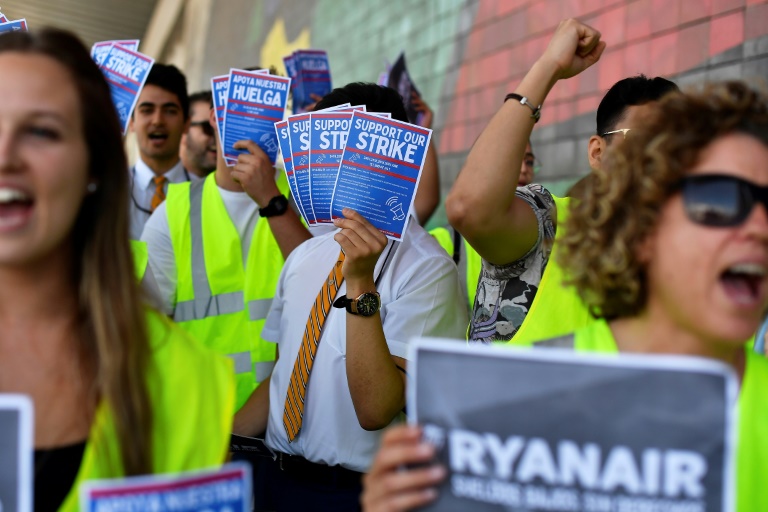
Nine flights to and from Spain were cancelled on Friday and dozens of others delayed due to the latest strike by cabin crew at low-cost airlines Ryanair and EasyJet.

The work stoppage over pay and working conditions comes as European schools are breaking up for the summer.

The strikes add more headaches to passengers and the aviation sector, which has struggled with staff shortages as it struggles to recruit people after massive layoffs during the Covid pandemic.

By 1:00 pm (1100 GMT) eight EasyJet flights had been cancelled and 21 delayed, the USO union which called the strike said.

One Ryanair flight was cancelled and 113 were delayed, it added.

EasyJet crew are set to strike during the first three weekends of July to demand parity in working conditions in line with other European airlines.

The strike by Ryanair cabin crew in Spain, where there are some 1,900 employees, began on June 24 and is due to run until Saturday. It is affecting 10 of the airline’s bases in Spain.

On Thursday over 50 Ryanair flights to and from the country were cancelled because of the job action. 

A strike by the airline’s crew between June 24 and 26 cancelled 129 flights.

Flights from Paris’ two largest airports, Charles de Gaulle and Orly, were disrupted on Friday for the second day in a row due to a strike by airport workers.  

Europe stocks steady as eurozone inflation hits record high

European stock markets steadied Friday with traders having expected news of record-high eurozone inflation that reinforced expectations of an ECB interest rate hike this month.

On the upside, the haven dollar jumped one percent against the pound on rising expectations of a recession, while oil rebounded on tight supplies.

Eurozone inflation accelerated to another record high in June, official data showed Friday, fuelled by fallout from the Ukraine war.

The EU’s Eurostat data agency said annual consumer price inflation in the 19 countries that use the euro soared to 8.6 percent in June, up from the prior record of 8.1 percent in May.

“Today’s figures bolster the European Central Bank’s (ECB) intended decision to start raising interest rates at its next Governing Council meeting in July,” noted economist Pushpin Singh at research group CEBR.

The ECB stated last month that it will deliver its first interest rate hike in more than a decade in July to combat inflation. 

Eurostat added Friday that core inflation — stripping out volatile components like energy and food — slowed to 3.7 percent from 3.8 percent, helping equities to calm heading into the weekend pause.

Earlier Friday, Asian stock markets closed lower after another Wall Street selloff.

Data showing US consumers — the backbone of the world’s top economy — were growing increasingly reticent about spending dealt a fresh blow, with New York’s S&P 500 index suffering its worst first-half performance since 1970.

With the war in Ukraine showing no sign of ending — keeping energy costs elevated — there is an expectation that borrowing costs will continue to rise and send economies into recession.

Losses across world markets this week come after a rally last week fuelled by hopes that an economic slowdown or signs of recession would lead central banks to ease off their monetary tightening drive.

But comments from top finance chiefs, including Federal Reserve boss Jerome Powell, suggest they are willing to endure the pain of a contraction as long as they can rein in prices — which are rising at their fastest pace in 40 years on both sides of the Atlantic.

The grim global economic outlook has also weighed on bitcoin, which has dropped back under $20,000.

– Key figures at around 1100 GMT –

London – FTSE 100: DOWN 0.1 percent at 7,159.16 points

Frankfurt – DAX: FLAT at 12,785.72

Paris – CAC 40: UP 0.1 percent at 5,953.69

EURO STOXX 50: DOWN 0.2 percent at 3,448.68

Brent North Sea crude: UP 2.4 percent at $111.61 per barrel

West Texas Intermediate: UP 2.2 percent at $108.13 per barrel

Tokyo – Nikkei 225: DOWN 1.7 percent at 25,935.62 (close)

Shanghai – Composite: DOWN 0.3 percent at 3,387.64 (close)

Hong Kong – Hang Seng Index: Closed for a holiday

New York – Dow: DOWN 0.8 percent at 30,775.43 (close)

Euro/dollar: DOWN at $1.0456 from $1.0484 Thursday

Pound/dollar: DOWN at $1.2062 from $1.2178

Euro/pound: UP at 86.69 pence from 86.09 pence

Dollar/yen: DOWN at 135.32 yen from 135.72 yen

Close Bitnami banner
Bitnami