US Business

Man gored by bison in US national park

A man was gored by a bison in Yellowstone National Park, despite warnings for people to keep their distance from the animals, officials said.

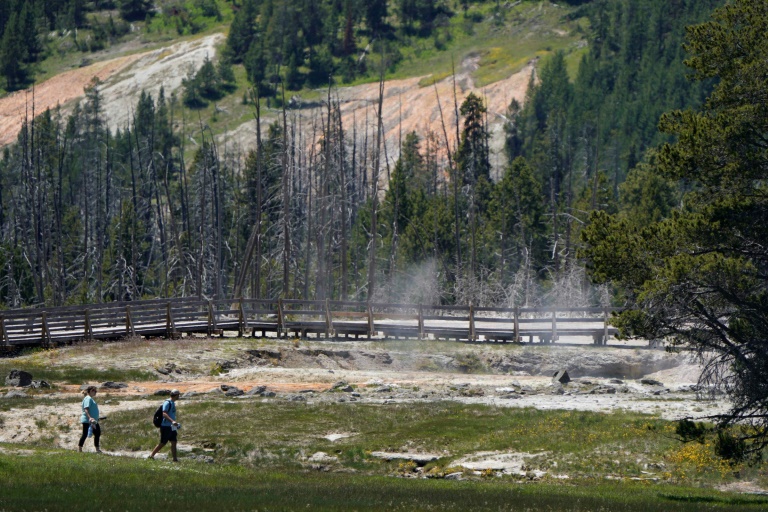
The 34-year-old man was walking with his family on a boardwalk in the park in Wyoming when a bison charged at the group, the National Park service said in a statement Tuesday.

“Family members did not leave the area, and the bull bison continued to charge and gored the male,” the statement said.

The man sustained an injury to his arm and was transported by ambulance to a hospital.

A video, said to have been filmed by a park goer and published by local media, showed a bull bison charging at a small group of people, who don’t appear to retreat right away. The bull then lunges at an adult and a child, before they run away trying to escape.

The agency said this was the second incident this year of a bison goring a visitor who got too close.

Bison are unpredictable animals that can run three times faster than humans, and people should always stay some 25 meters (yards) away from them, the agency added.

Recession fears haunt markets

Asian and European stock markets nursed losses Wednesday on resurgent fears that sharp interest rate hikes, aimed at tackling runaway inflation, could spark recession, dealers said.

The losses came after a gloomy US consumer confidence report had sent Wall Street tumbling on Tuesday.

US stocks stabilised on Wednesday, with the Dow adding 0.2 percent while the S&P 500 and the tech-heavy Nasdaq dipped slightly, as fresh data showed consumers pulling back on spending.

European sentiment was rocked also by data showing Spanish inflation rocketed to a 37-year peak of 10.2 percent in June on rising energy and food prices. 

The news sent the Madrid stock market down 1.6 percent, with Frankfurt falling 1.7 percent. Paris gave up 0.9 percent and London shed 0.2 percent.

“So much for the big stock market comeback. Another day, another sea of red on the market,” said AJ Bell investment director Russ Mould.

“It does look like we are still in the first phase of this bear market, where indices are prepared to drop on the slightest bit of bad news, and any rally is short-lived,” said Chris Beauchamp at online trading platform IG.

The selloff followed more than a week of global gains caused by hopes that any signs of contraction could give central banks room to ease up on their pace of monetary tightening.

But New York stocks tanked Tuesday on data showing confidence among US consumers — a key driver of the world’s top economy — had fallen to its lowest level in more than a year.

The data re-ignited stubborn worries over the strength of the world economy, and eclipsed news of a surprise move by China to slash the quarantine period for incoming travellers.

That had raised hopes for further relaxations that can allow the country’s giant economy to recover more quickly.

Updated first quarter US GDP data released Wednesday chopped the personal consumption growth figure to 1.8 percent, from 3.1 percent, in an indication that even at the beginning of the year consumers were feeling crimped by rising prices.

– ‘Down the drain’ –

“With signs that consumer confidence is seeping away, worries that global growth will go down the drain have returned to rattle financial markets,” said Susannah Streeter, senior investment and markets analyst at Hargreaves Lansdown.

“Covid restrictions may have eased for international travellers to China as infections rates slow, but one global problem is being replaced by another — fear that recessions are looming around the world.”

Fed officials on Tuesday tried to play down the chances of a recession, expressing hope of a soft landing.

City Index analyst Fawad Razaqzada said there is a threat of high inflation and recession, a phenomenon economists call stagflation.

“That is where the global economy is headed, and central banks won’t be able to do much about it,” he said in a note to clients. 

“If they fasten their belts too tightly, this will hit GDP, while if they loosen their belts again, this will only fuel inflationary pressures further.”

Oil prices advanced on expectations of demand growth as China lifts Covid restrictions and owing to tight supplies following bans on Russian imports.

Observers warned that G7 plans for a price cap on Russian crude was unlikely to have a massive impact on benchmark values.

– Key figures at around 1530 GMT –

New York – Dow: UP 0.2 percent at 31,008.81 points

EURO STOXX 50: DOWN 1.0 percent at 3,512.29

London – FTSE 100: DOWN 0.2 percent at 7,312.32 (close)

Frankfurt – DAX: DOWN 1.7 percent at 13,003.35 (close)

Paris – CAC 40: DOWN 0.9 percent at 6,031.48 (close)

Tokyo – Nikkei 225: DOWN 0.9 percent at 26,804.60 (close)

Hong Kong – Hang Seng Index: DOWN 1.9 percent at 21,996.89 (close)

Shanghai – Composite: DOWN 1.4 percent at 3,361.52 (close)

Brent North Sea crude: UP 0.3 percent at $118.29 per barrel

West Texas Intermediate: UP 0.3 percent at $112.12 per barrel

Euro/dollar: DOWN at $1.0468 from $1.0519 Tuesday

Pound/dollar: DOWN at $1.2125 from $1.2184

Euro/pound: UP at 86.35 pence from 86.33 pence

Dollar/yen: UP at 136.73 yen from 136.14 yen

burs-rl//pvh

California beachfront property to return to Black family

Los Angeles county officials have approved a plan to return California beachfront property to the descendants of a Black family who had the land seized from them a century ago, in a move hailed as a step towards atoning for racial injustice.

The Los Angeles County Board of Supervisors voted Tuesday to transfer ownership of a piece of land in the city of Manhattan Beach to the great-grandsons of Charles and Willa Bruce, who had operated a resort for Black residents there until it was taken away from them in the 1920s in what the board called “an act of racism.”

“We can’t change the past and we will never be able to make up for the injustice that was done to Willa and Charles Bruce a century ago, but this is a start,” said Supervisor Janice Hahn, who led the effort to return the 7,000 square foot (650 square meters) property to the family.

Hahn added that the move will allow the descendants “to start rebuilding the generational wealth that was denied to them.”

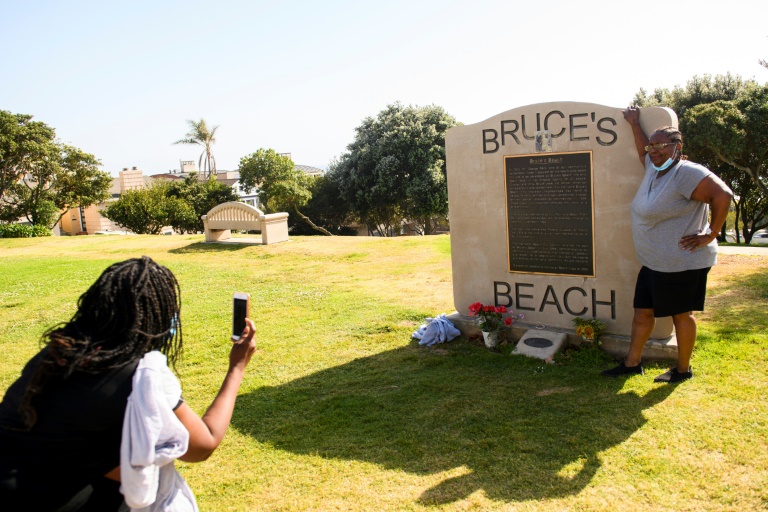
Willa and Charles Bruce purchased the land in 1912 and after adding a few other adjacent plots created a beach resort, which came to be known as Bruce’s Beach, catering to Black residents, who had few options at the time for enjoying the California coast.

Complete with a bath house, dance hall and cafe, the resort attracted other Black families who purchased land nearby.

But the resort quickly became a target of vandalism and racial attacks from local residents. In 1924, it was seized by the city under the pretext of needing to build a city park and the Bruces as well as other Black families ultimately lost their businesses.

The city park, built on a portion of the seized land, took decades to materialize.

“The experience of Willa and Charles Bruce is an example of how racism against Black people has reached crisis proportions,” the board said in a statement, “and has resulted in large disparities in family stability, health and mental wellness, education, employment, economic development, public safety, criminal justice, and housing.”

The Bruces plan to lease the land to the city for $413,000 a year and will have the option to sell it back to the county for a price not to exceed $20 million.

The United States is in the midst of a historic reckoning on racism, with Confederate symbols from the Civil War removed across the country, and mass protests calling for racial justice following the high-profile killings of a number of unarmed Black people by police and other manifestations of racial disparities.

Expanding NATO squares up to Russia threat

The United States vowed on Wednesday to shore up Europe’s defences in the wake of Russia’s invasion of Ukraine, as NATO declared Moscow the West’s greatest threat.

Meeting in Madrid, alliance leaders said Russia “is the most significant and direct threat to allies’ security and to peace and stability in the Euro-Atlantic area”.

This came as NATO welcomed Sweden and Finland as invitees to join the alliance and US President Joe Biden announced new deployments of US troops, ships and planes.

Biden boasted the US announcement was exactly what President Vladimir Putin “didn’t want” and Moscow, facing fierce resistance from Ukrainian forces equipped with Western arms, reacted with predictable fury.

Deputy Foreign Minister Sergei Ryabkov denounced the US military build-up, and warned NATO members that the shifting balance of power “would lead to compensatory measures on our part”.

“I think that those who propose such solutions are under the illusion that they will be able to intimidate Russia, somehow restrain it — they will not succeed,” he said.

NATO leaders have funnelled billions of dollars of arms to Ukraine and faced a renewed appeal from President Volodymyr Zelensky for more long-range artillery.

“Ukraine can count on us for as long as it takes,” NATO chief Jens Stoltenberg said, announcing a new NATO strategic overview that focuses on the Moscow threat.

“We cannot discount the possibility of an attack against allies’ sovereignty and territorial integrity,” the document, updated for the first time since 2010, said. 

In a summit statement, they said: “Russia’s appalling cruelty has caused immense human suffering and massive displacements, disproportionately affecting women and children.”

Zelensky had earlier addressed the NATO chiefs by videoconference, calling for stricter economic sanctions, but afterwards his foreign minister Dmytro Kuleba thanked Ukraine’s western friends.

– ‘What needs to be done’ –

“Today in Madrid, NATO proved it can take difficult but essential decisions. We welcome a clear-eyed stance on Russia, as well as the accession for Finland and Sweden,” he said. 

“An equally strong and active position on Ukraine will help protect Euro-Atlantic security and stability.”

As Western leaders met in Madrid, in Ukraine officials complained that Russian missiles had hit civilian housing and businesses in and around the cities of Dnipro, Mykolaiv and Kharkiv, leaving at least seven dead and 14 wounded.

In Kremenchuk, the town where a Russian missile on Monday destroyed a shopping centre and — according to local officials — killed at least 18 civilians, clearing operations continued.

A giant crane was working near the site of the impact and in the rubble-strewn parking area shopping trolleys piled with clothes and household goods lay abandoned.

Western leaders have dubbed the Kremenchuk strike a war crime, and Zelensky has demanded that UN investigators visit. Russia says it hit a depot storing Western arms. 

– Foreign ‘mercenaries’ –

The Russian defence ministry said it had inflicted severe casualties on Ukrainian troops defending the town of Lysychansk, in the eastern Donbas region, and said the Kharkiv attack had hit Ukrainian command centres and a training base for foreign “mercenaries”.

Moscow’s February 24 invasion of pro-Western Ukraine triggered massive economic sanctions and a wave of support for Zelensky’s government, including deliveries of advanced weapons. 

At NATO, two formerly military non-aligned European countries — Sweden and Russia’s north-western neighbour Finland — will be accepted as candidates and Washington has announced that it will shift the headquarters of its 5th Army Corps to Poland.

An army brigade will rotate in and out of Romania, two squadrons of F-35 fighters will deploy to Britain, US air defence systems will be sent to Germany and Italy and the fleet of US Navy destroyers in Spain will grow from four to six.

“That’s exactly what he didn’t want but exactly what needs to be done to guarantee security for Europe,” Biden said, of Putin’s efforts to roll back Western influence and re-establish influence or control over territories of the former Russian empire.

– Missile artillery –

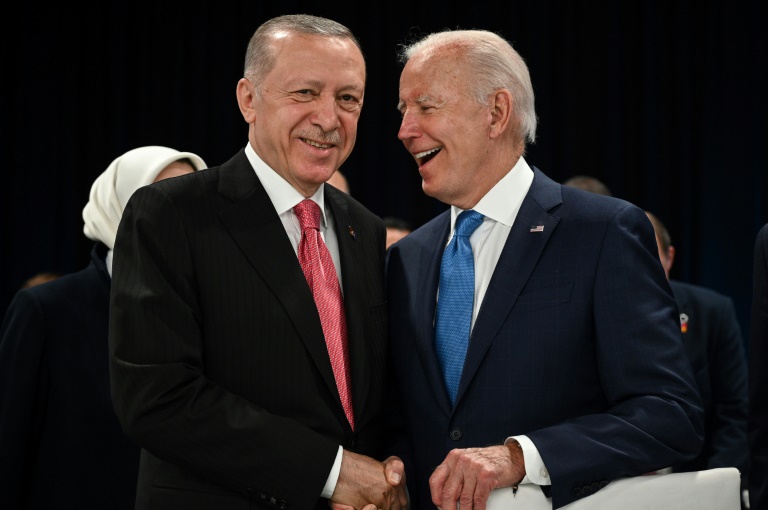
Sweden and Finland’s path to NATO membership was opened after Turkey’s President Recep Tayyip Erdogan agreed to lift his threat of a veto — the ally accuses Stockholm and Helsinki of harbouring wanted Kurdish militants.

Turkey announced Wednesday that it would request the extradition of 33 alleged “terrorists” under the terms of the agreement signed Tuesday with Sweden and Finland to allow them to make membership bids.

A sanctions task force of leading Ukraine allies has frozen more than $330 billion in financial resources owned by Russia’s elite and its central bank since Moscow’s invasion, it announced Wednesday. 

The Russian Elites, Proxies, and Oligarchs Task Force (REPO) said the allies had blocked $30 billion in assets belonging to Russian oligarchs and officials, and immobilised $300 billion owned by the Russian central bank.

Norway said it would donate three multiple-launch rocket systems to Ukraine, following similar decisions made by Britain, Germany and the United States.

burs-dc/kjm

Turkey seeks extraditions from Finland, Sweden under NATO deal

Turkey said Wednesday it would seek the extradition of 33 alleged Kurdish militants and coup plot suspects from Sweden and Finland under a deal to secure Ankara’s support for the Nordic countries’ NATO membership bids.

President Recep Tayyip Erdogan dropped weeks of resistance to the two countries’ NATO ambitions at crunch talks held on the eve of an alliance summit Wednesday focused on Russia’s invasion of Ukraine.

Erdogan emerged from the meeting declaring victory after securing a 10-point agreement under which the two countries vowed to join Turkey’s fight against banned Kurdish militants and to swiftly extradite suspects.

Turkey put the deal to the immediate test by announcing that it would seek the extradition of 12 suspects from Finland and 21 from Sweden.

“We will seek the extradition of terrorists from the relevant countries within the framework of the new agreement,” Justice Minister Bekir Bozdag said in a statement.

“We ask them to fulfil their promises.”

The unnamed suspects were identified as being members of the outlawed Kurdistan Workers’ Party (PKK) and a group led by a US-based Muslim preacher that Erdogan blames for a failed 2016 coup attempt.

The European Union and Washington both recognise the PKK as a “terrorist” organisation because of the brutal tactics it employed during a decades-long insurgency against the Turkish state.

But the agreement also stipulates that Sweden and Finland vow to “not provide support” to the YPG — a PKK offshoot in Syria that played an instrumental role in the US-led alliance against the Islamic State group.

Sweden and Finland abandoned decades of military non-alignment in response to Russia’s invasion of Ukraine and were formally invited into the alliance at Wednesday’s summit in Madrid.

– ‘Got what it wanted’ –

Their applications appeared to be headed for swift approval until Erdogan stepped in.

The Turkish leader accused Finland and particularly Sweden of providing a haven to Kurdish fighters and financing terror.

Erdogan also wanted the two countries to lift embargoes on weapons deliveries they imposed in response to Turkey’s 2019 military incursion into Syria.

The memorandum appears to address many of Erdogan’s concerns.

It says Finland and Sweden pledge to “address Turkey’s pending deportation or extradition requests of terror suspects expeditiously and thoroughly”.

“Finland and Sweden confirm that the PKK is a proscribed terrorist organisation,” says the agreement.

“Finland and Sweden commit to prevent activities of the PKK and all other terrorist organisations and their extensions, as well as activities by individuals… linked to these terrorist organisations.”

Erdogan’s office hailed the agreement as a full victory.

“Turkey got what it wanted,” his office declared in a statement.

Erdogan also secured the promise of a long-sought meeting with US President Joe Biden on the sidelines of the NATO talks.

A US official told reporters that Biden was “keen” to improve relations with Turkey after a difficult spell caused in part by Turkey’s crackdown on human rights.

– ‘Loose and aggressive’ –

Most of Turkey’s demands and past negotiations have involved Sweden because of its more robust ties with the Kurdish diaspora.

Sweden keeps no official ethnicity statistics but is believed to have 100,000 Kurds living in the nation of 10 million people.

Stockholm recognised the PKK as a “terrorist” organisation in the 1980s but has adopted a more supportive stance toward the YPG.

Pro-government Turkish media were outraged by two meetings Swedish Foreign Minister Ann Linde held last year with Ilham Ahmad — the leader of the political wing of the YPG-led forces that expelled IS from a large swathe of Syria.

Linde called her two meetings “good” and “fruitful” on Twitter.

It was not immediately apparent whose extradition Turkey sought.

Finnish President Sauli Niinisto told reporters that his country has “not been presented with any list so far, at least as far as I know”.

But the Brookings Institution warned that problems may arise from Turkey’s “loose and often aggressive framing” of the term “terrorist”.

“The complication arises from a definition of terrorism in Turkish law that goes beyond criminalising participation in violent acts and infringes on basic freedom of speech,” the US-based institute said in a report.

UK extends steel tariffs, breaching WTO obligations

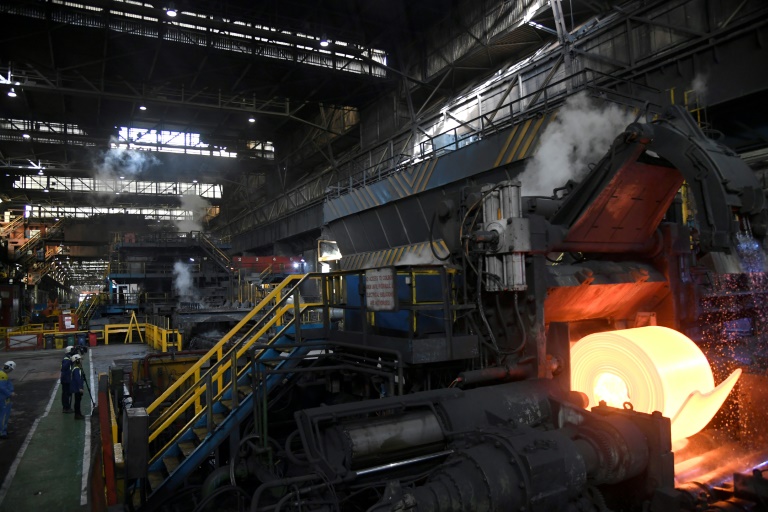
Britain has extended steel tariffs for another two years to protect its ailing industry, the government said Wednesday, breaching World Trade Organization obligations.

Trade minister Anne-Marie Trevelyan cited “global disruptions to the energy markets and supply chains” for the decision.

“A strategic steel industry is of the utmost importance to the UK, especially given the uncertainty of political and economic waters that we are currently all charting,” Trevelyan told parliament.

“Trade remedies are one of the ways that government can protect their businesses.

“They tackle issues of dumping, of unfair government subsidies, or … give businesses time to adjust to unforeseen increases in imports,” the minister added.

The energy-intensive steel sector in Britain, already suffering at the hands of cheap Chinese imports, now faces sky-rocketing production costs as fuel prices surge.

Tariffs for certain steel product categories imposed on developed countries and China have now been extended to June 2024.

“It is in the economic interest of the UK to maintain these safeguards, to reduce the risk of material harm if they were not maintained,” Trevelyan told lawmakers.

After Britain’s departure from the European Union, the country rolled over quotas and tariffs on 10 steel products until mid-2024.

The UK has now decided to extend temporary safeguards on five other categories for “a further two years”, Trevelyan said.

“I have… concluded there would be serious injury, or the threat of serious injury to UK steel producers, if the safeguards on the five additional categories were to be removed at this time,” the minister added.

– WTO breach –

Wednesday’s decision sets the government on a collision course with the WTO.

“The decision to extend the safeguards on the five product categories departs from our international legal obligations under the relevant WTO agreement,” Trevelyan conceded.

Prime Minister Boris Johnson on Sunday said the government had to make “tough choices” to support the production of steel, used heavily in construction.

Johnson’s political standing is in peril after two crushing by-election defeats last week.

One was in the former industrial city of Wakefield, a seat in northern England that had switched to the Conservatives at the previous general election.

The government hopes action on steel will bolster support in such areas, observers say.

Britain’s steel industry has been severely depleted in recent decades, with former state-owned British Steel struggling to survive in the face of international competition.

Among the nation’s remaining producers is Indian-owned Tata Steel.

Anger, pain at vigil for migrants who died in tractor trailer in Texas

Dozens of people held a vigil for 51 migrants who died when they were abandoned in a suffocatingly hot tractor-trailer in Texas near the border with Mexico.

A heavy downpour of rain forced organizers to hold the Tuesday night ceremony under cover in a park rather than out in the open air. Cell phone flashlights took the place of the candles that mourners had hoped to light.

People expressed anger and sadness over the death of these travelers who, like many thousands every year, make a very dangerous trek seeking a better life in the United States.

President Joe Biden blamed professional people-smugglers for the tragedy near San Antonio. 

US officials did not give any breakdown of the dead by age, gender or nationality. Mexican President Andres Manuel Lopez Obrador said that of the dead whose identities are known, 22 were from Mexico, seven from Guatemala, and two from Honduras.

At the vigil people formed a circle and took turns speaking, asking US authorities to change their immigration policy or calling on others to pray for the dead migrants.

“This hurts a lot,” said Andrea Osorio, a 48-year-old Mexican.

“I have lived here for 33 years without papers, in fear every day,” she said. “And I know why we come. We do not come to commit crimes, we only come for a better future.”

People of all ages — elderly, young and small children with their parents — attended the ceremony.

So did San Antonio Mayor Ron Nirenberg, who listened to other people’s remarks but did not himself say anything publicly.

– ‘Breaks my heart’ –

Carlos Eduardo Espina, 23 and originally from Uruguay but here since he was five years old, criticized US immigration policy as cruel.

“This is terrible, and breaks my heart,” said Espina, whose father is Uruguayan and mother Mexican. “But every day people are drowning in the river, every day people are dying in the desert. Death is the norm in immigration in the United States.”

He said US immigration policy should be more humanitarian and allow for more entry visas each year.

“We have to keep fighting because this is going to continue,” said Espina, who is an activist on immigration issues. He accused the governments of emigration source countries in Latin America of not caring about their people.

Not far from the circle of people at the vigil, Guillermina Barron, a 38-year-old Mexican, listened in silence.

“Unfortunately I identify a lot with what is happening because I am Mexican, although I emigrated here 20 years ago,” she told AFP, with tears in her eyes.

“I feel pain and very powerless. A lot of things have to change because many lives have been lost.”

Aquaculture drives aquatic food yields to new high

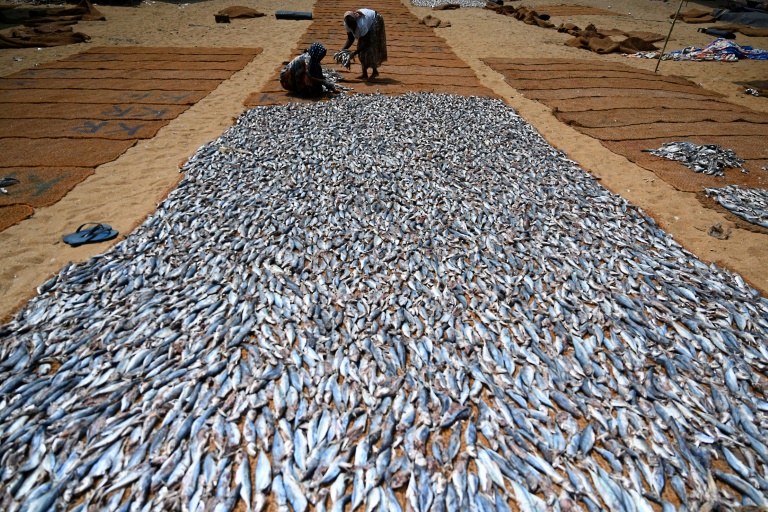
The production of wild and farm-raised fish, shellfish and algae reached record levels in 2020, and future increases could be vital to fighting world hunger, the Food and Agriculture Organization said Wednesday.

Driven by sustained growth in aquaculture, global fisheries and aquatic farming together hauled in 214 million tonnes, the UN agency said in a report.

The total first-sale value of 2020 production topped $400 million, with $265 million coming from aquaculture, a sector poised for further expansion.

These trend lines are good news for a world facing price hikes and food shortages due to the war in Ukraine, disrupted supply chains, and inflation. 

“The growth of fisheries and aquaculture is vital in our efforts to end global hunger and malnutrition,” said FAO director Qu Dongyu. 

But overfished oceans, climate change and pollution — if left unaddressed — could threaten that potential, the UN agency warned.

“Aquaculture growth has often occurred at the expense of the environment,” Qu noted. 

Many shrimp farms in Vietnam, China and Cambodia, for example, have displaced mangrove forests that are nurseries for marine life and critical barriers against storm surges. 

Climate change poses additional challenges, experts say. 

“Warming waters will create environments where there’s more likelihood of bacterial disease,” said Josh Madeira, director of fisheries and aquaculture policy at the Monterey Bay Aquarium.

That means a sector already highly reliant on antibiotics will likely become even more so, he told AFP.

Production of aquatic animals in 2020 — totalling 178 million tonnes — was evenly divided between fisheries and aquaculture, according to the FAO report.

The remaining 36 million tonnes was algae production.

– Overfished stocks –

Yields of fish, shrimp and other shellfish destined for human consumption are more than 60 percent higher than during the 1990s, far outpacing population growth, according to the report, released during the UN Ocean Conference in Lisbon.

On average, people worldwide consume over 20 kilos (44 pounds) of aquatic foods per year today, more than double the amount 50 years ago.

Globally, 17 percent of the protein consumed by humans comes from aquatic sources. In many Asian and African countries, that figure rises to more than 50 percent.

Wild and farmed food from the seas and inland waters are also a critical source of essential omega-3 fatty acids and micronutrients, recent research has shown.

“Aquatic foods are increasingly recognised for their key role in food security and nutrition,” Qu said. 

Nearly 90 percent of aquatic animal production is for human consumption, with the rest destined for non-food uses such as fishmeal and fish oil.

Asian countries were the source of 70 percent of the world’s fisheries and aquaculture of aquatic animals in 2020.

China remaines by far the top fisheries producer, followed by Indonesia, Peru, Russia, the United States and Vietnam.

So-called capture fisheries of commercial species in the wild — including tuna, cod, salmon and especially anchoveta — dropped by four percent in 2020 compared to the average of the previous three years.

Part of the drop can be attributed to covid-related disruptions, but long-term decline is due to the pressures of overfishing, experts say. 

Catch levels peaked in the mid-1990s, and have — with fluctuations — stagnated since then.

“The FAO estimates that 34 percent of caught fish come from overfished stocks,” University of British Columbia economist and fisheries expert Rashid Sumaila told AFP.

“But they are very conservative,” he added. “Independent studies put that figure at 50 percent.”

Aggravating the problem is some $34 billion dollars annually in government subsidies. 

Earlier this month, the World Trade Organization (WTO) took preliminary steps to reduce these handouts to industry, but experts say the measures will have limited effect and take years to implement.

World equities slide on recession fear

Global stock markets nursed steep losses Wednesday on resurgent fear that sharp interest rate hikes, aimed at tackling runaway inflation, could spark recession, dealers said.

Asia and Europe slumped after a gloomy US consumer confidence report had sent Wall Street tumbling on Tuesday.

European sentiment was rocked also by data showing Spanish inflation rocketed to a 37-year peak of 10.2 percent in June on rising energy and food prices. 

The news sent the Madrid stock market down 1.8 percent, mirroring losses in Frankfurt and Hong Kong.

“So much for the big stock market comeback. Another day, another sea of red on the market,” said AJ Bell investment director Russ Mould.

The selloff followed more than a week of global gains caused by hopes that any signs of contraction could give central banks room to ease up on their pace of monetary tightening.

But New York stocks tanked Tuesday on data showing confidence among US consumers — a key driver of the world’s top economy — had fallen to its lowest level in more than a year.

The data re-ignited stubborn worries over the strength of the world economy, and eclipsed news of a surprise move by China to slash the quarantine period for incoming travellers.

That had raised hopes for further relaxations that can allow the country’s giant economy to recover more quickly.

– ‘Down the drain’ –

“With signs that consumer confidence is seeping away, worries that global growth will go down the drain have returned to rattle financial markets,” said Susannah Streeter, senior investment and markets analyst at Hargreaves Lansdown.

“Covid restrictions may have eased for international travellers to China as infections rates slow, but one global problem is being replaced by another — fear that recessions are looming around the world.”

Fed officials on Tuesday tried to play down the chances of a recession, expressing hope of a soft landing.

Oil prices advanced on expectations of demand growth as China lifts Covid restrictions and owing to tight supplies following bans on Russian imports.

Observers warned that G7 plans for a price cap on Russian crude was unlikely to have a massive impact on benchmark values.

– Key figures at around 1100 GMT –

London – FTSE 100: DOWN 0.5 percent at 7,288.04 points

Frankfurt – DAX: DOWN 1.9 percent at 12,985.01

Paris – CAC 40: DOWN 1.2 percent at 6,012.53

EURO STOXX 50: DOWN 1.3 percent at 3,504.94

Tokyo – Nikkei 225: DOWN 0.9 percent at 26,804.60 (close)

Hong Kong – Hang Seng Index: DOWN 1.9 percent at 21,996.89 (close)

Shanghai – Composite: DOWN 1.4 percent at 3,361.52 (close)

New York – Dow: DOWN 1.6 percent at 30,946.99 (close)

Brent North Sea crude: UP 0.6 percent at $118.65 per barrel

West Texas Intermediate: UP 0.7 percent at $112.55 per barrel

Euro/dollar: UP at $1.0525 from $1.0519 Tuesday

Pound/dollar: DOWN at $1.2159 from $1.2184

Euro/pound: UP at 86.57 pence from 86.33 pence

Dollar/yen: UP at 136.48 yen from 136.14 yen

US boosts Europe forces as expanding NATO squares up to Russia

The United States will reinforce Europe’s defences with a wave of new military deployments, President Joe Biden announced Wednesday, as more Russian missiles smashed into Ukrainian cities.

News of the US plan came as NATO leaders met to welcome Sweden and Finland as candidates to join the alliance, a double blow to Russia’s President Vladimir Putin and his bid to redraw Europe’s security map.

Biden boasted that the US announcement was exactly what Putin “didn’t want” and Moscow reacted with predictable fury, denouncing Sweden and Finland’s entry plan as “destabilising” and accusing an “aggressive” NATO of seeking to contain Russia.

As Western leaders met in Madrid, in Ukraine officials complained that Russian missiles had hit civilian housing and businesses in and around the cities of Dnipro, Mykolaiv and Kharkiv, leaving at least seven dead and 14 wounded.

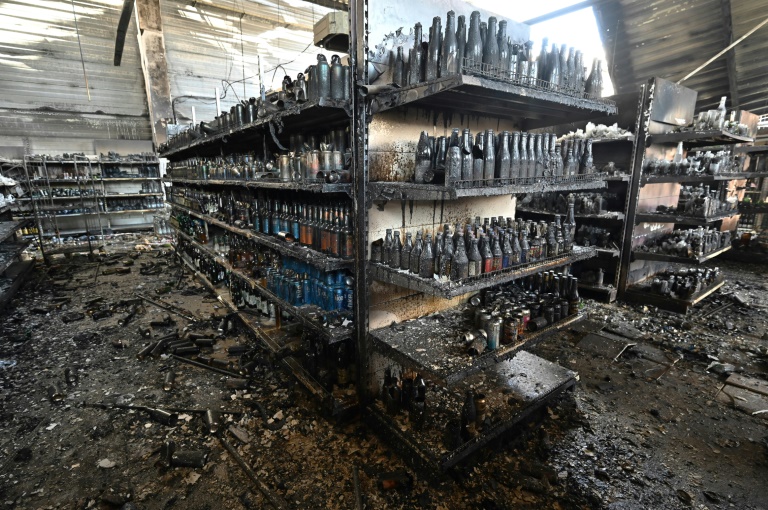
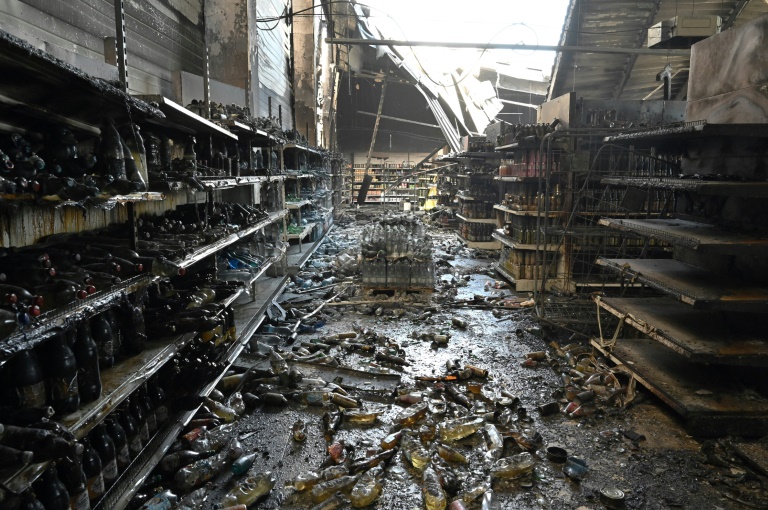
In Kremenchuk, the town where a Russian missile on Monday destroyed a shopping centre and — according to local officials — killed at least 18 civilians, clearing operations continued.

A giant crane was working near the near the site of the impact and in the rubble-strewn parking area shopping trolleys piled with clothes and household goods lay abandoned.

Western leaders have dubbed the Kremenchuk strike a war crime, and Ukraine’s President Volodymyr Zelensky has demanded that UN investigators visit. Russia said it targeted a Ukrainian depot storing Western arms. 

– ‘What needs to be done’ –

The Russian defence ministry said it had inflicted severe casualties on Ukrainian troops defending the town of Lysychansk, in the eastern Donbas region, and said the Kharkiv attack had hit Ukrainian command centres and a training base for foreign “mercenaries”.

Moscow’s February 24 invasion of pro-Western Ukraine triggered massive economic sanctions and a wave of support for Zelensky’s government, including deliveries of advanced weapons. 

At this week’s summit, two formerly neutral European countries — Sweden and Russia’s north-western neighbour Finland — will be accepted as candidates to join NATO and Washington has announced that it will shift the headquarters of its 5th Army Corps to Poland.

An army brigade will rotate in and out of Romania, two squadrons of F-35 fighters will deploy to Britain, US air defence systems will be sent to Germany and Italy and the fleet of US Navy destroyers in Spain will grow from four to six.

“That’s exactly what he didn’t want but exactly what needs to be done to guarantee security for Europe,” Biden said, of Putin’s efforts to roll back Western influence and re-establish influence or control over territories of the former Russian empire.

NATO Secretary General Jens Stoltenberg said NATO’s expansion was “the opposite” of what Putin hoped for, and said that the leaders meeting at the summit would “state clearly that Russia poses a direct threat to our security”.

Moscow rose to the bait.

– Weapons shipments –

“The summit in Madrid confirms and consolidates this bloc’s policy of aggressive containment of Russia,” Deputy Foreign Minister Sergei Ryabkov said, Russian news agencies reported. 

“We consider the expansion of the North Atlantic alliance to be a purely destabilising factor in international affairs.”

The Swedish and Finnish leaders are to be welcomed as candidates for full membership in the alliance, after Turkey’s President Recep Tayyip Erdogan agreed to lift his threat of a veto — the NATO ally accuses Stockholm and Helsinki of harbouring wanted Kurdish militants.

Turkey announced Wednesday that it would request the extradition of 33 alleged “terrorists” under the terms of the agreement signed Tuesday with Sweden and Finland to allow them to make membership bids.

On Tuesday, Zelensky addressed the NATO summit via video link, asking for modern artillery and financial support.

“We need much more modern systems, modern artillery,” he said, calling financial support “no less important than aid with weapons”.

NATO countries, which have already committed billions of dollars in military assistance to Kyiv, will agree a large military and economic support package to help them fend off the Russian invasion.

A sanctions task force of leading Ukraine allies has frozen more than $330 billion in financial resources owned by Russia’s elite and its central bank since Moscow’s invasion, it announced Wednesday. 

– Missile artillery –

The Russian Elites, Proxies, and Oligarchs Task Force (REPO) said the allies had blocked $30 billion in assets belonging to Russian oligarchs and officials, and immobilised $300 billion owned by the Russian central bank.

Norway said it would donate three multiple-launch rocket systems to Ukraine, following similar decisions made by Britain, Germany and the United States.

Kyiv wants the long-range missile artillery to counter Russia’s superiority in shorter range canons on Ukraine’s eastern battlefield.

Earlier this week, at their summit in Germany, the G7 leaders of the world’s richest democracies agreed to impose new sanctions targeting Moscow’s defence industry, raising tariffs and banning gold imports from the country.

But the Kremlin was unfazed, insisting that Ukrainian forces had to surrender to end the fighting.

“The Ukrainian side can stop everything before the end of today,” Kremlin spokesman Dmitry Peskov said.

“An order for the nationalist units to lay down their arms is necessary,” he said, adding Kyiv had to fulfil a list of Moscow’s demands.

burs-dc/jm

Close Bitnami banner
Bitnami