US Business

Funerals to begin for Uvalde victims as Biden vows action on guns

Grieving families were to hold the first funerals Tuesday for Texas shooting victims one week after a school massacre left 19 children and two teachers dead, with President Joe Biden vowing to push for stricter US gun regulation.

Mourners attended wakes in the town of Uvalde on Monday for some of the child victims gunned down by a local 18-year-old man who was then killed by police.

At one funeral home — just across the street from Robb Elementary School where the shooting occurred — friends, family and strangers attended a closed-casket visitation for 10-year-old victim Amerie Jo Garza. Pictures of the young girl decorated the space.

Esther Rubio, who described the scene as “very somber,” came from nearby San Antonio with her husband.

“I don’t know what else to say, because there’s no words to describe (it),” she said.

Remembrances for another slain student, Maite Rodriguez, began just hours later. 

In Washington, Biden — who visited the small town about an hour’s drive from the Mexico border earlier in the weekend — responded to desperate calls for weapons reform.

“I’ve been pretty motivated all along” to act on guns, Biden told reporters Monday.

“I’m going to continue to push,” he said, adding, “I think things have gotten so bad that everybody is getting more rational about it.”

A bipartisan group of US lawmakers worked through the Memorial Day weekend to pursue possible areas of compromise. 

They reportedly were focusing on laws to raise the age for gun purchases or to allow police to remove guns from people deemed at risk — but not on an outright ban on high-powered rifles like the weapon used Tuesday in Uvalde or the one used 10 days earlier in Buffalo, New York.

Uvalde’s first funerals are set for Tuesday, with others scheduled through mid-June. The huge number of victims, many with horrific wounds, has left the town’s two funeral homes turning to embalmers and morticians from across Texas for help.

One anonymous donor has pledged $175,000 to help cover funeral costs, Texas Governor Greg Abbott said.

– ‘Rational action’ –

The Uvalde massacre — the deadliest school attack since 20 children and six staff were killed in Newtown, Connecticut in 2012 — came less than two weeks after 10 people died in the attack at a Buffalo grocery store by a young gunman targeting African Americans.

While mass shootings draw anguished attention and spur momentary demands for change, most US gun violence passes with scant notice.

The country’s Memorial Day weekend — Monday is a national holiday — has been marked by yet more graphic violence. 

At least 132 gun deaths and 329 injuries were recorded nationwide from Saturday to Monday evening, according to the Gun Violence Archive website.

Gun-control advocates hoped the shock over the Uvalde tragedy, coming even as people in Buffalo were burying victims of the attack there, might finally prompt politicians to act.

A few key lawmakers, including a Democratic senator involved in the weekend talks in Washington, have expressed guarded optimism that the group might make progress, even in the face of deep resistance from most Republicans and some rural-state Democrats.

“There are more Republicans interested in talking about finding a path forward this time than I have seen since Sandy Hook,” Senator Chris Murphy of Connecticut told TV interviewers Sunday, adding that bipartisan “serious negotiations” were underway.

Biden said Monday he is deliberately “not negotiating with any of the Republicans yet.”

But, he added, “I know what happened when we had rational action before” on gun regulation.

“It did significantly cut down mass murders.”

Mourners in Uvalde — a mostly Latino town of 15,000 — have echoed calls for change.

“At the end of the day, if this child cannot even sip a glass of wine because he’s too young, then guess what? He’s too young to purchase a firearm,” said Pamela Ellis, who traveled from Houston to pay her respects.

Asian markets swing on new inflation, rates concerns

Asian markets fluctuated Tuesday as investors struggled to maintain a global rally, with inflation continuing to niggle owing to a pick-up in oil prices while a top Federal Reserve official pressed for a series of sharp interest rate hikes.

With Wall Street closed for a holiday there were few catalysts to help extend the gains enjoyed in recent days, allowing inflation and borrowing costs to take centre stage.

Crude prices built on Monday’s advance after the European Union reached a deal on a partial embargo of Russian imports as part of a punishment for its invasion of Ukraine.

Brent broke above $122 for the first time in two months and WTI was sitting around $117 as European chiefs said the latest sanction would ban purchases of Russian oil delivered by sea, though there would be a temporary exemption for pipelines.

While widely expected, the agreement adds further upside to crude just as China begins to ease Covid restrictions in Shanghai and Beijing, raising the likelihood of a jump in demand from the world’s number two economy.

The lift in oil prices will help fan already elevated inflation and pile further pressure on central banks to tighten monetary policy to prevent it running out of control.

In a sign of the struggle policymakers face, German prices are rising at their fastest pace ever while Spain’s topped forecasts. 

In the United States, the chances of an extended period of rate hikes were increased after Federal Reserve Governor Christopher Waller said he favoured half-point hikes “for several meetings” until inflation slows towards the bank’s two percent target. 

He added that his goal was in line with market expectations, which is about 2.75 percent in December. 

Joe Biden is due to hold talks with Fed boss Jerome Powell on Tuesday to discuss the inflation situation. US jobs data Friday will provide an update on the state of the US economy in light of soaring prices and rising rates.

The prospect of a period of rates rising higher for longer lifted the dollar against the euro, pound and yen as well as other currencies. 

Asian equity markets swung through the morning, though there was some cheer from data showing China’s manufacturing shrunk in May at a slower rate than expected.

Hong Kong edged slightly lower after two days of gains that saw it put on around five percent, while Shanghai was also marginally off.

Sydney, Taipei and Manila were also in the red, though Tokyo, Seoul, Singapore, Jakarta and Wellington rose.

But AXA Investment Managers’ Chris Iggo warned that another 10-15 percent retreat for stocks could still be a possibility.

“The mood is temporarily better in markets,” he said, adding that “I think the worst is over for bond markets but picking the bottom in equities is trickier.”

– Key figures at around 0230 GMT –

Tokyo – Nikkei 225: UP 0.1 percent at 27,404.14 (break)

Hong Kong – Hang Seng Index: DOWN 0.2 percent at 21,092.51

Shanghai – Composite: DOWN 0.1 percent at 3,147.12

Euro/dollar: DOWN at $1.0754 from $1.0779 on Monday

Pound/dollar: DOWN at $1.2621 from $1.2650

Euro/pound: DOWN at 85.20 pence from 85.21 pence

Dollar/yen: UP at 128.10 yen from 127.59 yen

Brent North Sea crude: UP 0.4 percent at $122.20 per barrel

West Texas Intermediate: UP 2.2 percent at $117.54

New York – Dow: Closed for a holiday

London – FTSE 100: UP 0.2 percent at 7,600.06 points (close)

Mexico president's tourist train suffers new legal blow

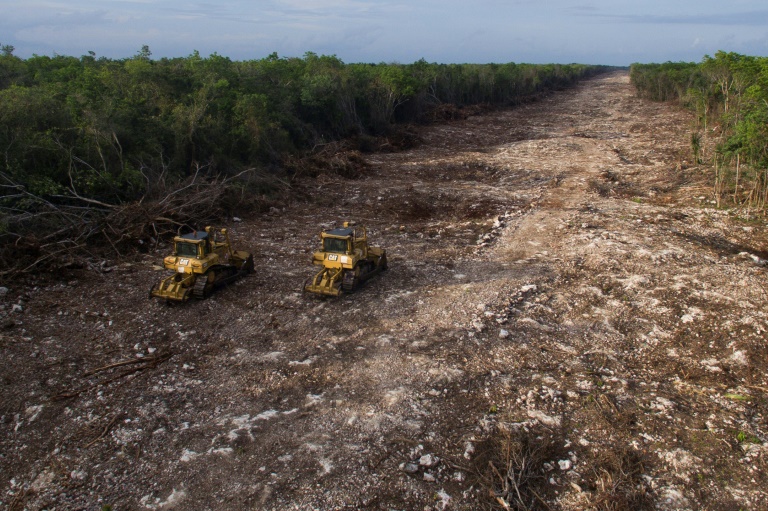
A Mexican judge has indefinitely suspended construction of part of President Andres Manuel Lopez Obrador’s flagship tourist train project in the Yucatan peninsula on environmental grounds, campaigners said Monday.

The ruling follows a legal challenge brought by opponents, including scuba divers, who are concerned about the impact of the Mayan Train on wildlife, caves and water-filled sinkholes known as cenotes.

The indefinite halt to work on the 60-kilometer (37-mile) section between the resorts of Playa del Carmen and Tulum goes a step further than a provisional suspension order issued in April.

The federal judge cited the “imminent danger” of causing “irreversible damage” to ecosystems, according to one of the plaintiffs, the non-governmental group Defending the Right to a Healthy Environment.

Authorities were found to have failed to carry out the necessary environmental impact studies before starting construction of the section, one of several being built by the military, it said in a statement.

The National Fund for the Promotion of Tourism, the government agency overseeing the project, said that it expected the work to be allowed to continue after the environmental impact statement is finalized.

It said the document would contain “numerous mitigation actions in favor of the environment.”

Lopez Obrador hopes to inaugurate the roughly 1,500-kilometer (950 mile) rail loop linking popular Caribbean beach resorts and archeological ruins by the end of 2023.

The original plan for the disputed section was for an overpass over a highway, but the route was modified early this year to go through jungle at ground level.

Opponents fear that the construction will cause irreparable damage to a subterranean network of caves, rivers and freshwater sinkholes connected to the Caribbean Sea.

Lopez Obrador has insisted the railroad will not affect the cenotes and alleged that environmentalists have been infiltrated by “impostors.”

EU leaders agree ban on most Russian oil imports

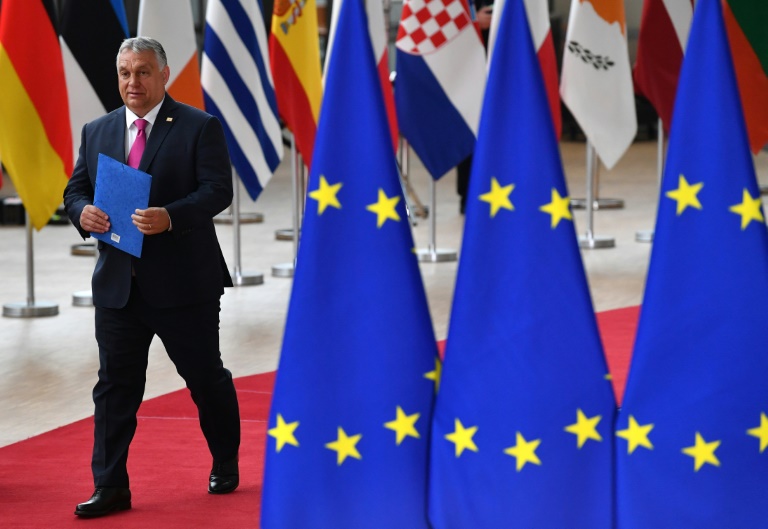
EU leaders on Monday backed a ban on most Russian oil imports, after a compromise deal with Hungary to punish Moscow for the war in Ukraine.

The 27-nation bloc has spent weeks haggling over a proposed total embargo on Russian oil but came up against stubborn resistance from Hungarian Prime Minister Viktor Orban.

EU leaders meeting in Brussels hatched a compromise deal to exempt deliveries arriving in Europe by pipeline from the ban, after Budapest warned halting supplies would wreck its economy.

“Agreement to ban export of Russian oil to the EU. This immediately covers more than two thirds of oil imports from Russia, cutting a huge source of financing for its war machine,” European Council chief Charles Michel tweeted during the summit. 

“Maximum pressure on Russia to end the war.”

The head of the EU’s executive, Ursula von der Leyen, said the move “will effectively cut around 90 percent of oil imports from Russia to the EU by the end of the year” as Germany and Poland had committed to renounce deliveries via a pipeline to their territory. 

“Russia has chosen to continue its war in Ukraine. Tonight, as Europeans, united and in solidarity with the Ukrainian people, we are taking new decisive sanctions,” French President Emmanuel Macron tweeted, echoing the figure of 90 percent by the end of 2022. 

The wrangling over the sixth package of sanctions has rocked European unity in the face of the Kremlin’s attack on Ukraine after five waves of unprecedented economic punishment on Russia.

The compromise excluded the Druzhba pipeline from the oil embargo and only imposed sanctions on crude shipped to the EU by tanker vessel.

Despite the gap in the embargo left by Hungary’s opposition, the latest round of sanctions represents some of the most damaging measures taken by the EU so far.

The EU imports some 26 percent of its oil from Russia and has been criticised for keeping money flowing to Moscow’s coffers at the same time as it seeks to halt the Kremlin’s war. 

Michel said the sanctions package also involved disconnecting Russia’s biggest bank Sberbank from the global SWIFT system, banning three state broadcasters and blacklisting individuals blamed for war crimes.

He also said that the EU had agreed to to send Ukraine nine billion euros ($9.7 billion) to support Kyiv’s “immediate liquidity needs” as it grapples with Russia’s invasion. 

– Stop ‘quarrels’ –

The negotiations over the oil ban had dogged the EU for weeks and the bloc’s leaders got chivvied along Monday by Ukraine’s President Volodymyr Zelensky.

Zelensky, in a video address, called on them to adopt “effective” sanctions against Russian oil to make the Kremlin pay the price for its war on Ukraine.

“All quarrels in Europe must end, internal disputes that only encourage Russia to put more and more pressure on you,” Zelensky told the EU summit.

“It is time for you to be not separate, not fragments, but one whole.”

Orban, often the odd man out in EU decision making, had called the proposal only to stop oil deliveries to the EU by ship a “good solution” before the talks began.

“It means that an atomic bomb won’t be thrown on the Hungarian economy,” he said. 

But he warned that Budapest needed a “guarantee” it could keep on receiving Russian oil by sea if anything happened to the pipeline crossing Ukraine.

Michel said the EU had “decided to take the appropriate measures to react and to make sure that we will protect the security of supply”.

– Return to Hungary issue? –

Landlocked Hungary imports 65 percent of its oil from Russia through the Druzhba pipeline and, along with Slovakia and the Czech Republic, had asked for an exception from the import ban.

Diplomats said a two-year delay to the embargo had been offered to the countries concerned, but that Budapest wanted at least four years and nearly 800 million euros ($860 million) in EU funding to adapt its refineries.

Von der Leyen said that the EU would return “as soon as possible in one way or the other” to the issue of trying to ban oil through the Druzhba pipeline to Hungary.

Budapest’s intransigence came on the back of Orban’s recent resounding re-election to a fourth term and some experts are sceptical about the official claims of alarm over a Russian oil ban.

Further complicating the stand-off had been Hungary’s share of the EU’s 800-billion-euro recovery fund, which Brussels has yet to approve due to disagreements over Budapest’s respect for the rule of law.

burs-del/dc/mtp

Giants' Kapler suspends Uvalde anthem protest on Memorial Day

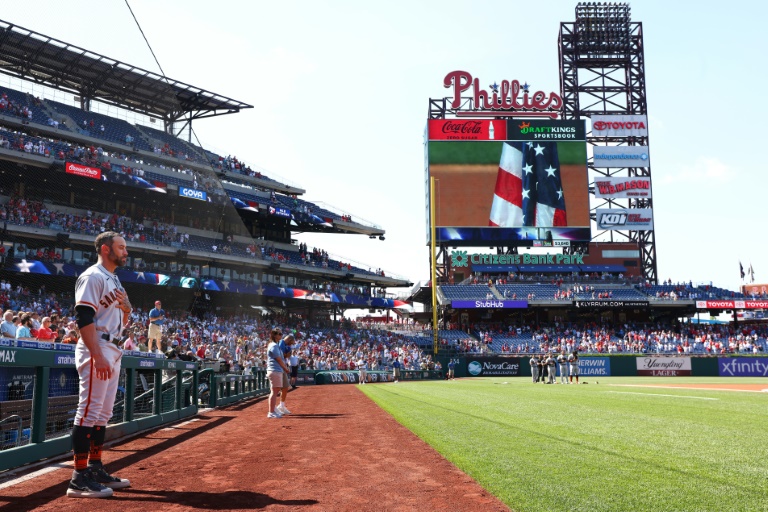
San Francisco Giants manager Gabe Kapler stood on the field for the pre-game national anthem Sunday, suspending his protest of US gun violence for the Memorial Day holiday.

Kapler, also a former Phillies skipper, said over the weekend he wouldn’t take the field for the anthem following the shooting deaths of 19 children and two teachers last week at a Uvalde, Texas elementary school.

But on his personal blog he explained Monday that he would make an exception for Memorial Day, when the Giants played in Philadelphia.

“Today, I’ll be standing for the anthem,” Kapler wrote. 

“While I believe strongly in the right to protest and the importance of doing so, I also believe strongly in honoring and mourning our country’s servicemen and women who fought and died for that right,” he added.

“Those who serve in our military, and especially those who have paid the ultimate price for our rights and freedoms, deserve that acknowledgement and respect, and I am honored to stand on the line today to show mine.”

On Friday, Kapler said he would stay in the clubhouse during the anthem performance “until I feel better about the direction of our country.”

Kapler wrote that he knew the decision would be divisive, with many preferring sports to offer a respite from “the horrors of the world.”

“But I am not OK with the state of this country,” he wrote. “I learned from my dad, that when you’re dissatisfied with your country, you let it be known through protest. The home of the brave should encourage this.”

Chicago White Sox manager Tony La Russa disagreed with that stance, but others in baseball, including New York Mets manager Buck Showalter, Texas Rangers manager Chris Woodward and Boston Red Sox manager Alex Cora said they supported him.

Steve Kerr, coach of the NBA’s Golden State Warriors, said peaceful protest such as Kapler’s was “what our country is founded on.”

Kerr had used his basketball team’s pre-game press conference Tuesday to make a powerful plea for gun control just hours after the shooting at Uvalde’s Robb Elementary School.

Boston Celtics coach Ime Udoka kept the matter at the forefront Sunday night, even as his team celebrated a victory over the Miami Heat to reach the NBA Finals.

As he took questions about the game and his team’s championship prospects, Udoka interjected remarks saying it was too soon to let the Uvalde shooting slip from mind.

“We talk about this game that we love and put all our passion into, and it’s not life or death,” Udoka said. “We win or we lose, we go home and kiss our kids, and you move on either way.

“But you sit back and think about 19 children and two adults that don’t get that. That’s life or death. That’s real,” he said.

“That’s something that I don’t want to be forgotten. The awareness of that. It just happened a week ago, and it seems to be pushed in people’s memory already. Change is needed.”

EU leaders seek to break oil ban deadlock as Russia advances in Donbas

European Union leaders met in Brussels on Monday seeking to overcome Hungarian opposition to an embargo on Russian oil, as Moscow’s forces made gains in the eastern Donbas region of Ukraine.

Ukrainian President Volodymyr Zelensky urged the 27-nation bloc to end internal “quarrels” and adopt more sanctions against Moscow, including an embargo on Russian oil.

“All quarrels in Europe must end, internal disputes that only encourage Russia to put more and more pressure on you,” he told the emergency EU summit via video-link.

“It is time for you to be not separate, not fragments, but one whole.” 

In Washington, US President Joe Biden said he would not send rocket systems to Ukraine that could hit Russian territory, despite urgent requests from Kyiv for such weapons and extensive US military aid for Ukraine since the war began.

EU diplomats have drafted a watered-down agreement that would see pipeline oil exempted from the ban, in the hopes of unblocking talks on the bloc’s sixth round of Russian sanctions.

Ahead of the meeting, Hungarian Prime Minister Viktor Orban told reporters the proposal was a “good solution” but warned there was “no agreement at all” as things stood.

On the ground, Russian forces pressed their offensive in Donbas.

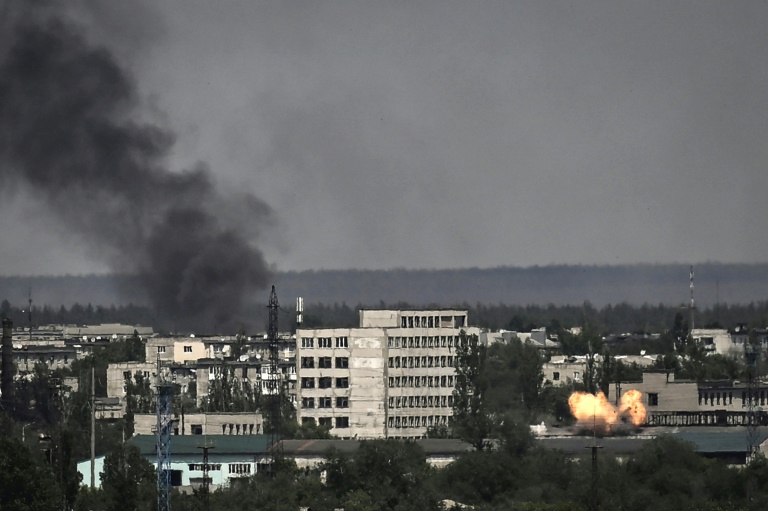
“The situation in Severodonetsk is as complicated as possible,” Lugansk regional governor Sergiy Gaiday said on Telegram, saying the whole region was under continuous bombardment — “air bombs, and artillery, and tanks. Everything”.

In Severodonetsk, street battles were being fought as the Russians advanced into the city, he added.

– Weapons supplies –

In Washington, Biden told reporters: “We are not going to send to Ukraine rocket systems that can strike into Russia.”

Ukraine has received extensive US military aid since with legislators approving another $40 billion (37.1 billion euros) assistance package earlier in May.

France’s new foreign minister Catherine Colonna said on a visit to Kyiv that Paris was ready to boost military aid to Ukraine to help it counter Russia’s invasion.

France will “continue to reinforce arms deliveries,” Colonna said at a news conference with her Ukrainian counterpart Dmytro Kuleba.

The arms would arrive “in the coming weeks”, she said.

The highest-ranking French official to visit the capital since Russia invaded Ukraine on February 24, Colonna also visited Bucha, near Kyiv, where Russian troops have been accused of committing war crimes against civilians.

“This should never have happened,” Colonna told reporters after visiting an Orthodox church in the town. “It must never happen again.”

Her visit came as a French journalist was killed while working in Ukraine.

Frederic Leclerc-Imhoff was “on board a humanitarian bus” when “he was mortally wounded,” French president Emmanuel Macron wrote on Twitter on Monday.

Governor Gaiday said evacuations there had been halted after the death of the journalist.

– Oil sanctions –

A sixth wave of EU measures against Moscow was put on the table weeks ago, but has been rejected by Orban and resisted by neighbouring countries also reliant on pipelined Russia oil.

Macron cautiously told reporters that a long-sought-after deal was “getting closer”, but others doubted that the Hungarian leader was ready to sign on at this stage.

“I don’t think we’ll reach an agreement today,” Estonian Prime Minister Kaja Kallas said at a political meeting ahead of the summit

Hungary has asked for at least four years and 800 million euros ($860 million) in EU funds to adapt its refineries and increase pipeline capacity for alternative suppliers, like Croatia.

But under the compromise proposal the Druzhba pipeline could be excluded from a sanctions package “for the time being”, an EU official told AFP.

– ‘We’re close!’ –

Since failing to capture Kyiv in the war’s early stages, Russia’s army has narrowed its focus, hammering Donbas cities with relentless artillery and missile barrages as it seeks to consolidate its control.

But Ukrainian forces pushed back over the weekend in the southern region of Kherson, the country’s military leadership said.

The Ukrainian general staff claimed the move had put their adversary into “unfavourable positions” around the villages of Andriyivka, Lozovo and Bilohorka and forced Moscow to send reserves to the area.

“Kherson, hold on. We’re close!” it tweeted Sunday.

At the same time, two people were injured following an explosion in the Moscow-controlled city of Melitopol in south-eastern Ukraine, with local pro-Kremlin authorities blaming Kyiv.

Russia-installed authorities said the city had been targeted by a “terrorist attack”.

“The Ukrainian government continues its war on the civilian population and the infrastructure of cities,” a statement said.

At least five people died following strikes on civilian infrastructure in Ukraine’s separatist-controlled city of Donetsk, according to Russian investigators.

Authorities in the DNR said on Telegram that two apartment blocks and three schools were hit in the attack, accusing Kyiv of using artillery and rockets with cluster munitions.

burs-sea/imm/jj

Zelensky urges EU end 'quarrels', adopt oil sanctions on Russia

Ukraine’s President Volodymyr Zelensky urged the European Union Monday to stop its “quarrels” and adopt fresh sanctions on Russia as the bloc’s leaders sought a compromise deal with Hungary to target Moscow’s key oil exports.

The 27-nation EU has spent weeks haggling over a proposed embargo on Russian oil but come up against stubborn resistance from Hungarian premier Viktor Orban.

Leaders meeting in Brussels were hoping to persuade Orban to accept a watered-down version of the ban that would keep the oil flowing by pipeline to a handful of countries, including Hungary. 

Zelensky, in a video address, called on them to adopt “effective” sanctions against Russian oil to make the Kremlin pay the price for its war on Ukraine.

“All quarrels in Europe must end, internal disputes that only encourage Russia to put more and more pressure on you,” Zelensky told the EU summit. 

“It is time for you to be not separate, not fragments, but one whole.”

Orban, often the odd man out in EU decision making, said a proposal only to stop oil deliveries to the EU by ship was a “good solution” as he arrived for the talks.

“It means that an atomic bomb won’t be thrown on the Hungarian economy,” he said. 

But he warned that Budapest still needed a “guarantee” it could keep on receiving Russian oil by sea if anything happened to the pipeline crossing Ukraine.

Orban said “there is no agreement at all” yet. 

He did not, however, threaten to veto the leaders’ planned summit statement, arguing that it was the European Commission’s job to fine-tune the sanctions package.

– ‘Getting closer’ –

A sixth wave of EU measures against Moscow was put on the table four weeks ago, but EU unity shown in implementing five earlier waves of unprecedented sanctions on Moscow appeared to have hit its limit.

The latest proposed compromise would exclude the Druzhba pipeline from the oil embargo and only impose sanctions on crude shipped to the EU by tanker vessel, which counts for two-thirds of Russian oil imports.

While French President Emmanuel Macron told reporters that a long-sought-after deal was “getting closer”, others doubted that.

“I don’t think we’ll reach an agreement today,” Estonian Prime Minister Kaja Kallas said ahead of the summit.

“Of course, we’re going to have discussions, but everybody needs to be on board,” she said, adding that she did not expect a solution before another summit to be held in late June. 

An EU official said the leaders would attempt to find a “political agreement” on the Russian oil ban, with exceptions for specific countries worked out “as soon as possible”.

EU sanctions require the backing of all member states and ambassadors fell short of finalising a deal just hours before the start of the summit. 

– ‘Orban’s antics’ –

Landlocked Hungary imports 65 percent of its oil from Russia through the Druzhba pipeline and, along with Slovakia and the Czech Republic, has asked for an exception from the import ban.

Diplomats said a two-year delay to the embargo had been granted to the countries concerned, but that Budapest wanted at least four years and nearly 800 million euros ($860 million) in EU funding to adapt its refineries.

“There is quite a lot of sympathy for Hungary’s oil supply issues, which are great, despite the antics by Orban,” an EU diplomat said on condition of anonymity.

Hungary’s intransigence comes on the back of Orban’s recent resounding re-election to a fourth term and some experts are sceptical about the official claims of alarm over a Russian oil ban.

Further complicating the stand-off is Hungary’s share of the EU’s 800-billion-euro recovery fund, which Brussels has yet to approve due to disagreements over Budapest’s respect for the rule of law.

burs-del/rmb/jj

After Uvalde, Biden vows to keep up pressure for gun regulation

Under pressure to act after the latest US mass shooting that left 21 people dead, President Joe Biden vowed on Monday to push for stricter gun regulation, an uphill battle given the Democrats’ narrow congressional majority.

“I’ve been pretty motivated all along” to act on guns, Biden told reporters in Washington.

“I’m going to continue to push,” he said, adding, “I think things have gotten so bad that everybody is getting more rational about it.”

Biden spoke as the grieving Texas town of Uvalde was holding its first wakes for some of the 19 children and two teachers gunned down last week at their elementary school by a local teenager who was then killed by police.

The first funerals are set for Tuesday, with others scheduled through mid-June. The huge number of victims, many with horrific wounds, has left the town’s two funeral homes turning to embalmers and morticians from across Texas for help.

One anonymous donor has pledged $175,000 to help cover funeral costs, Texas Governor Greg Abbott said.

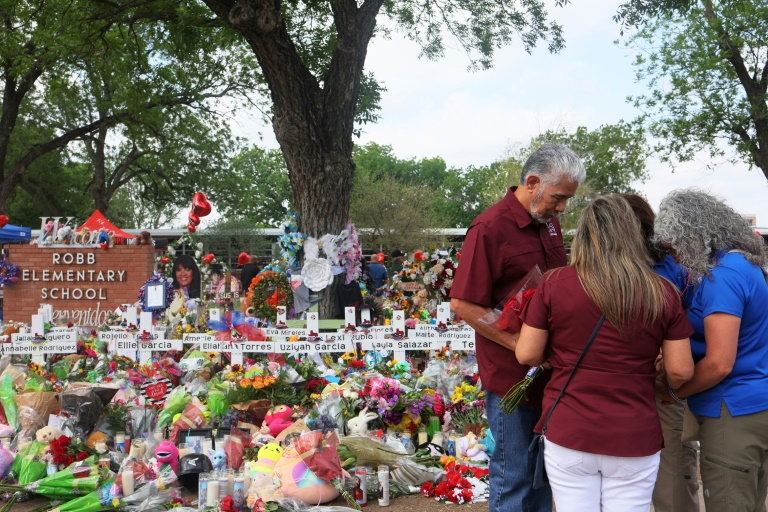
An impromptu memorial in the heart of Uvalde, a town of 15,000 about an hour’s drive from the Mexican border, has drawn a steady stream of mourners. So have churches in the mostly Latino city, including the Sacred Heart Catholic Church, where Biden and First Lady Jill Biden prayed when they visited on Sunday. 

– ‘Rational action’ –

The Uvalde massacre — the deadliest school attack since 20 children and six staff were killed in Newtown, Connecticut in 2012 — came less than two weeks after 10 people died in an attack at a grocery store in Buffalo, New York by a young gunman targeting African Americans.

Congress has repeatedly failed to agree on tighter gun regulations despite the grim recurrence of mass shootings, but the latest killings in the country’s epidemic of gun violence have sparked a push for new measures. 

While mass shootings draw anguished attention and spur momentary demands for change, most gun violence in this country passes with scant notice.

The country’s Memorial Day weekend — Monday is a national holiday — has been marked by shootings that killed at least four people and wounded dozens, according to the Gun Violence Archive website.

Gunfire Sunday at a festival in Taft, Oklahoma left one person dead and seven, including an infant, wounded; while in Chattanooga, Tennessee, six adolescents were wounded Saturday during an apparent altercation, Mayor Tim Kelly tweeted. 

Gun-control advocates hoped the shock over the Uvalde shooting, coming even as people in Buffalo were burying victims of the attack there, might finally prompt politicians to act.

A few key lawmakers did express guarded optimism on Sunday — though any gun-control effort faces deep resistance from most Republicans and some rural-state Democrats in a country where guns outnumber people.

“There are more Republicans interested in talking about finding a path forward this time than I have seen since Sandy Hook,” Democratic Connecticut Senator Chris Murphy told local TV on Sunday, adding that bipartisan “serious negotiations” were underway.

Biden said Monday he is deliberately “not negotiating with any of the Republicans yet.”

But, he added, “I know what happened when we had rational action before” on gun regulation.

“It did significantly cut down mass murders.”

Norwegian buys 50 Boeing 737 MAX, ending dispute

Low-cost carrier Norwegian Air Shuttle said Monday it would buy 50 Boeing 737 MAX 8 planes, ending a dispute between the companies and helping revive the US-made aircraft after two deadly crashes.

The jets will be delivered between 2025 and 2028, or around the same time that Norwegian’s aircraft leasing deals come to an end, and the contract includes an option for 30 more, the company said in a statement.

The order is welcome news for the US manufacturer’s flagship Boeing 737 MAX 8, which was grounded for 20 months following two fatal accidents and has been gradually returning to service since late 2020. 

Norwegian’s order is part of “the resolution of a dispute we have” with Boeing, the company’s chief executive Geir Karlsen told broadcaster TV2.

The Nordic low-cost carrier and Boeing have been locked in a legal battle for several years, with the Norwegian carrier launching legal proceedings against the US giant for compensation following setbacks related to its 737 MAX and 787 Dreamliner long-range jets.

Without giving further details, Karlsen mentioned “a compensation of two billion kroner ($212 million, 197 million euros) that we used to buy planes under advantageous conditions.”

According to Karlsen, the price paid is “much lower” than the one Norwegian had to pay a few years ago for its first 737 MAX — which it has since sold — but also than the one offered by European competitor Airbus.

Norwegian said the deal remains subject to “various closing conditions” that it hopes will be concluded by the end of June.

The company, which currently operates 61 aircraft, plans to ramp up operations to have 70 in service this summer and 85 in the summer of 2023. 

– ‘Becoming more normal’ –

Plagued by over-ambitious expansion, technical problems and the Covid pandemic, the company narrowly avoided bankruptcy last year via an extensive restructuring that led it, among other things, to give up its long-haul flight, reduce its fleet and cancel numerous orders.

Securing the 50 aircraft means Norwegian is also returning to fully owning its own fleet after it was forced to rely on leased aircraft due to its financial woes.

Unless the option to buy more aircraft is implemented, Norwegian’s flight capacity is not expected to increase beyond what has already been announced. 

“This is rather a sign of an airline that is becoming more normal, that no longer lives exclusively on leased aircraft but owns part of its fleet itself,” Sydbank analyst Jacob Pedersen commented to business website e24.no. 

For Boeing, this order solidifies the revival of the 737 MAX aircraft.

The 737 MAX was temporarily grounded worldwide following two crashes in Indonesia and Ethiopia, in 2018 and 2019, that killed a combined 346 people.

After Caribbean Arajet and American Allegiant Air put in orders for the aircraft, British carrier IAG — parent company of British Airways — also just ordered 50 planes with an option for 100 more.

Norwegian on Monday also noted that the Boeing 737 MAX 8 is “approximately 14 percent more fuel-efficient compared to the previous-generation aircraft,” thus limiting emissions and cutting energy costs in view of rising fuel prices.

Game over for English tech jargon as France overhauls rules

French officials on Monday continued their centuries-long battle to preserve the purity of the language, overhauling the rules on using English video game jargon.

While some expressions find obvious translations — “pro-gamer” becomes “joueur professionnel” — others seem a more strained, as “streamer” is transformed into “joueur-animateur en direct”.

The culture ministry, which is involved in the process, told AFP the video game sector was rife with anglicisms that could act as “a barrier to understanding” for non-gamers.

France regularly issues dire warnings of the debasement of its language from across the Channel, or more recently the Atlantic.

Centuries-old language watchdog the Academie Francaise warned in February of a “degradation that must not be seen as inevitable”.

It highlighted terms including train operator SNCF’s brand “Ouigo” (pronounced “we go”) along with straightforward imports like “big data” and “drive-in”.

However, Monday’s changes were issued in the official journal, making them binding on government workers.

Among several terms to be given official French alternatives were “cloud gaming”, which becomes “jeu video en nuage”, and “eSports”, which will now be translated as “jeu video de competition”.

The ministry said experts had searched video game websites and magazines to see if French terms already existed.

The overall idea, said the ministry, was to allow the population to communicate more easily.

Close Bitnami banner
Bitnami