US Business

'Hulk' star Ruffalo joins call for global wealth tax

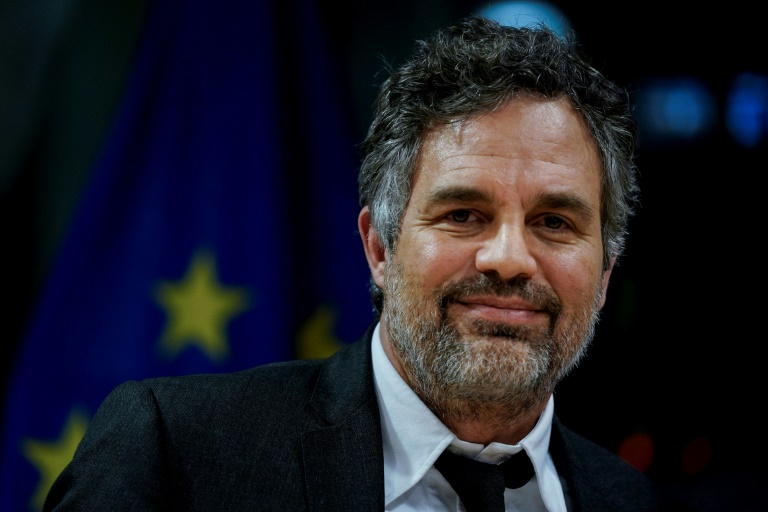
US actor Mark Ruffalo on Tuesday joined a call by over 150 wealthy people for governments to tax them more, as global elites and policymakers met at the World Economic Forum in Swiss resort Davos.

The face of Hulk in a decade of Marvel movies was one of dozens of new millionaires to put their names to an open letter titled “In Tax We Trust”, which was first delivered to attendees at a virtual WEF conference in January.

“While the world has gone through an immense amount of suffering in the last two years, we have actually seen our wealth rise during the pandemic — yet few if any of us can honestly say that we pay our fair share in taxes,” the letter read.

The Patriotic Millionaires group said it had boosted the number of signatories to over 150 by May, from 100 in January.

Its chairman Morris Pearl, a former managing director at mammoth asset manager BlackRock, vowed in a statement to “continue to pressure global leaders to heed our call: tax the rich before it’s too late”.

But Organisation for Economic Cooperation and Development (OECD) secretary-general Mathias Cormann said that wealth taxes could be less effective than other revenue-raising options.

“They don’t necessarily raise that much revenue,” he told a panel discussion at Davos. 

“In terms of the politics of it, it’s attractive, but in terms of the substance of what it achieves it’s not that attractive.”

Cormann did suggest that “property taxes are probably the most efficient, least distorting” form of wealth tax.

“There’s huge scope in wealth taxation… it’s been tried and in some countries it works,” Oxfam executive director Gabriela Bucher responded.

“These amounts that are being accumulated. You could not spend them in several lifetimes”.

Cormann and the OECD are betting on a deal struck by over 130 countries last year to tax multinational companies at a minimum of 15 percent to boost revenue for hard-up governments.

Asked if Washington might walk back its commitment should Republicans win control of Congress at November mid-term elections, Cormann said that “it’s in the rational self-interest of the United States to be part of this deal”.

For companies, it’s “much better for them to be operating in a globally consistent framework” rather than navigate conflicting tax regimes, he added.

“I can’t imagine that any country or any side of politics in any country would make a judgement that would put themselves at that sort of disadvantage.”
UAE firm inks airport deal as Afghanistan eyes international flights

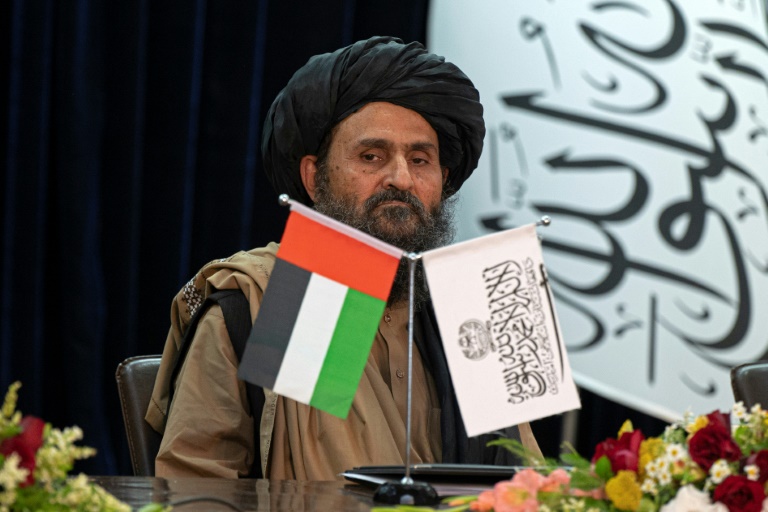
A United Arab Emirates company signed a contract with the Taliban authorities Tuesday to provide ground handling services at Afghanistan’s three airports, officials said, as the country seeks to resume international transit.

Capital Kabul’s only airport was trashed in August when tens of thousands of people rushed to evacuate as the US-led forces withdrew.

While some domestic and international flights are still operating out of the facility, it needs significant upgrades for major foreign airlines to restart full service.

The full operation of Kabul airport is crucial for reviving Afghanistan’s shattered economy.

But no country has yet formally recognised the Taliban government, with nations watching to see how the Islamists -– notorious for human rights abuses during their 1996-2001 stint in power -– will rule.

UAE firm GAAC, which was previously operating in Afghanistan, signed a new 18-month contract covering three airports: Kabul, Kandahar and Herat.

“The current contract is only for offering ground handling services,” Hameedullah Akhundzada, Minister of Transport and Civil Aviation said at a press conference.

GAAC has provided these services at Kabul airport since November 2020, and played a key role in rehabilitating the facility in August.

“We are not a new face here,” Ibrahim Morafi, regional director of GAAC, told AFP.

“But GAAC signing the new contract will give confidence to international airlines to resume flights to Afghanistan,” he said, without specifying when such flights — including from the UAE — were expected to resume.

A Qatar-Turkey consortium has been in talks with the aviation ministry for months over operating airports at Kabul, Kandahar, Herat, Mazar-i-Sharif and Khost.

But the talks snagged as the Taliban insisted its fighters will guard the facilities.

Qatar and Turkey want a say in managing security, at least at Kabul airport, experts tracking the negotiations say.

On Tuesday, Afghan officials refused to comment on whether the consortium was still open to operating the five airports.

GAAC officials also declined to comment on whether its new ground handling contract would be expanded into other services.

Currently, two Afghan airlines — Kam Air and Ariana Afghan — fly to Dubai, Doha, Islamabad, and Tehran from Kabul airport.

Iran’s Mahan Air also operates flights to Kabul. 

Biden, Albanese swap jokes in first meeting

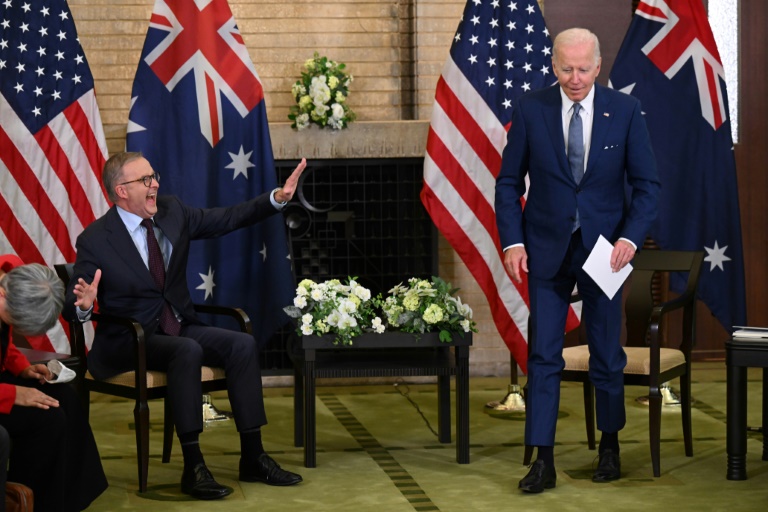
US President Joe Biden and Anthony Albanese swapped banter, reminiscences, and even sleeping advice in their first meeting since the Australian’s election win.

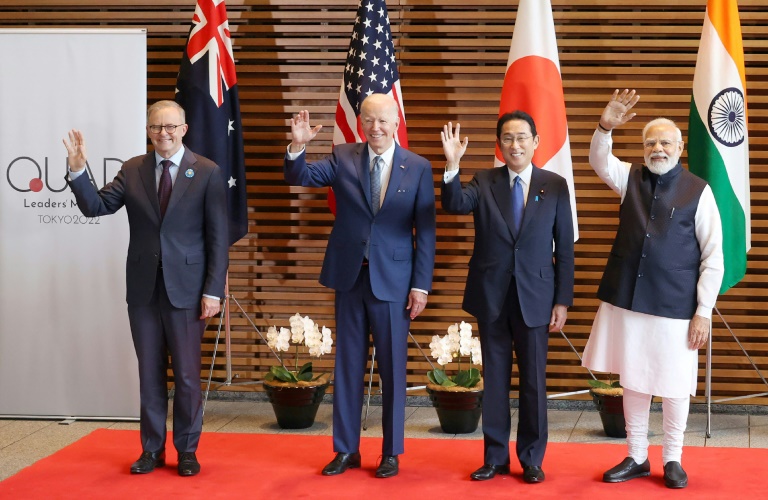
The light-hearted exchanges came as the two men met in Tokyo where they were attending the Quad summit —  a grouping that includes Australia, India, Japan and the United States.

Biden, who has deepened US ties with Australia as part of a strategy to contain China, called the US-Australian alliance “an anchor of stability and prosperity” in the Asia-Pacific.

According to a readout from the White House, their behind-doors discussions covered topics such as the AUKUS security pact between Australia, Britain and the United States, and efforts to punish Russia for its invasion of Ukraine.

In public exchanges, however, Biden opened by joking that his counterpart, elected just last weekend, has “been on the job a long time”.

He expressed admiration that Albanese decided to fly to Tokyo for the Quad meeting so soon after his election win, saying it showed Australia is “all-in” on the relationship.

Then, instead of the more typical good-luck wish to the newbie leader, Biden suggested good night.

“You were sworn in and got on a plane,” Biden said, admiringly.

So “if you fall asleep while you’re here, it’s OK, because I don’t know how you’re doing it. It’s really quite extraordinary — just getting off the campaign trail as well.”

Albanese showed no fatigue as he launched into his own banter.

Lauding how the two countries are “great friends”, he recalled visiting the United States many years ago as a “young fellow” on a State Department invitational programme to experience the country.

While on the trip, he conducted research into the diversity of US society, studying groups ranging from the National Rifle Association gun lobby to Planned Parenthood, which promotes abortion access.

It was, Albanese said to laughter, “the full kit and caboodle across the spectrum”.

“You’re a brave man,” exclaimed Biden, who has tried with varying success to battle against deepening right-left divisions in US society.

Albanese noted that he would host the next Quad summit in Australia in 2023, but said he hoped to be “visiting the US before then”.

Biden suggested they “work out a time sooner than later”.

Returning to his concerns over Albanese’s travel schedule, the US president quipped: “But you’re probably going to have to be home at some point.”

Albanese brings a centre-left government to Australia, his Labor party ending the era of polarising conservative leader Scott Morrison.

Under Morrison, Australia entered the AUKUS deal crafted by Biden, with a plan for Australia to acquire nuclear-powered submarines. However, Albanese’s strong focus on fighting climate change is likely to see his administration dovetail with the Biden White House on another key issue.

Stock markets retreat on weak global growth worries

Stock markets retreated Tuesday on renewed concerns over weak global growth, with a profit warning from the owner of Snapchat spooking investors and further shocking the tech sector.

It comes amid concerns over the impact of China’s Covid-19 restrictions on the world’s second-largest economy after the United States.

Monday’s strong Wall Street rally, where the Dow closed up two percent, did not carry over into Asian and European trading.

Snap, the parent of social media app Snapchat, saw its share price slump more than a quarter in futures trading ahead of Tuesday’s reopening of Wall Street.

“Snap provided a shock,” noted Neil Wilson, chief market analyst at Markets.com.

The company “spooked the market with a macroeconomic warning that dented tech the most and pointed to earnings revisions that could drag the market lower for longer”, he added. 

The biggest faller in London Tuesday was however energy group SSE, whose share price dived around 10 percent on reports that the UK government may impose a windfall tax on excess profits enjoyed by electricity producers.

Prime Minister Boris Johnson has so far indicated he does not want to impose such a tax on oil and gas producers despite them also earning vast sums as prices soar.

Johnson argues an exceptional levy on the likes of BP and Shell would harm their efforts to invest in greener fuels like solar and wind power.

In China, Beijing’s announcement Monday of a fresh raft of measures to stimulate the economy did little to calm investors’ nerves.

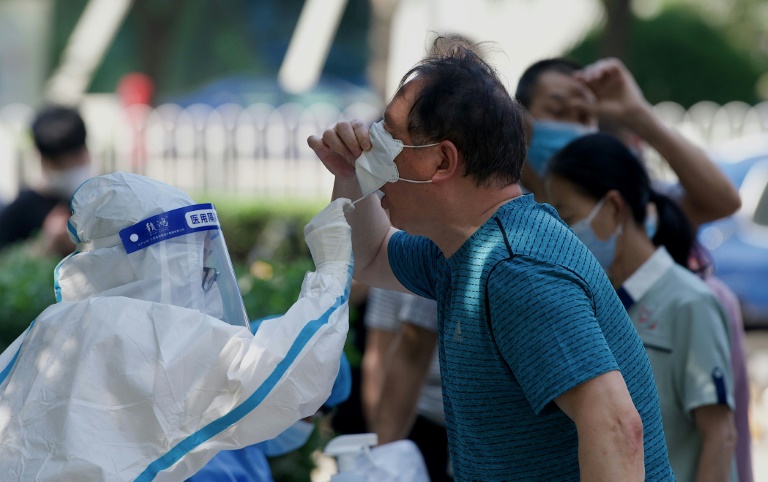
China’s economy has taken a hit from Beijing’s zero-Covid approach to the pandemic, which has resulted in lengthy lockdowns of major cities and mass testing of millions of people.

Prolonged virus lockdowns have constricted supply chains, dampened demand and stalled manufacturing.

Investment banks UBS Group and JPMorgan Chase have responded by cutting their China economic growth forecasts.

“The lingering restrictions and lack of clarity on an exit strategy from the current Covid policy will likely dampen corporate and consumer confidence and hinder the release of pent-up demand,” UBS economists including Tao Wang wrote in a research note.

Concerns over the Chinese economy and its impact on oil demand weighed on crude prices Tuesday.

– Key figures at around 1000 GMT –

London – FTSE 100: DOWN 0.3 percent at 7,488.05 points

Frankfurt – DAX: DOWN 0.8 percent at 14,056.39

Paris – CAC 40: DOWN 1.2 percent at 6,283.96

EURO STOXX 50: DOWN 1.1 percent at 3,669.62

Tokyo – Nikkei 225: DOWN 0.9 percent at 26,748.14 (close)

Hong Kong – Hang Seng Index: DOWN 1.8 percent at 20,112.10 (close)

Shanghai – Composite: DOWN 2.4 percent at 3,070.93 (close)

New York – Dow: UP 2.0 percent at 31,880.24 (close)

Euro/dollar: UP at $1.0711 from $1.0692 at 2030 GMT Monday

Pound/dollar: DOWN at $1.2489 from $1.2587

Euro/pound: UP at 85.77 pence from 84.92 pence

Dollar/yen: DOWN at 127.32 yen from 127.90 yen 

Brent North Sea crude: DOWN 0.4 percent at $112.96 per barrel

West Texas Intermediate: DOWN 0.3 at $109.98 per barrel

Samsung commits $356 bn in investments with 80,000 new jobs

South Korean conglomerate Samsung Group on Tuesday unveiled a massive 450 trillion won ($356 billion) investment blueprint for the next five years aimed at making it a frontrunner in a wide range of sectors from semiconductors to biologics.

The new figure is an increase of more than a third over its investments spent over the past five years.

The tech giant is South Korea’s largest chaebol — the family-run conglomerates that dominate the economy — and its overall turnover is equivalent to a fifth of the national gross domestic product.

Samsung Electronics, its flagship subsidiary, is the world’s biggest smartphone maker. 

The investment plan would bring “long-term growth in strategic businesses and help strengthen the global industrial ecosystem of crucial technology”, Samsung said in a statement.

The 80,000 new jobs would be created “primarily in core businesses including semiconductors and biopharmaceuticals” through 2026.

It also noted the investment would “bring forward the mass production of chips based on the 3-nanometer process”, the latest technology to further shrink the size of semiconductors and boost computing power.

It will also invest heavily in biopharmaceuticals with its affiliates Samsung Biologics and Samsung Bioepis.

The new plan represents a 36 percent increase in investment over its total investments over the past five years. 

Of the 450 trillion won Samsung plans to spend over the next five years, it will commit 360 trillion won to South Korea.

– Biden visit –

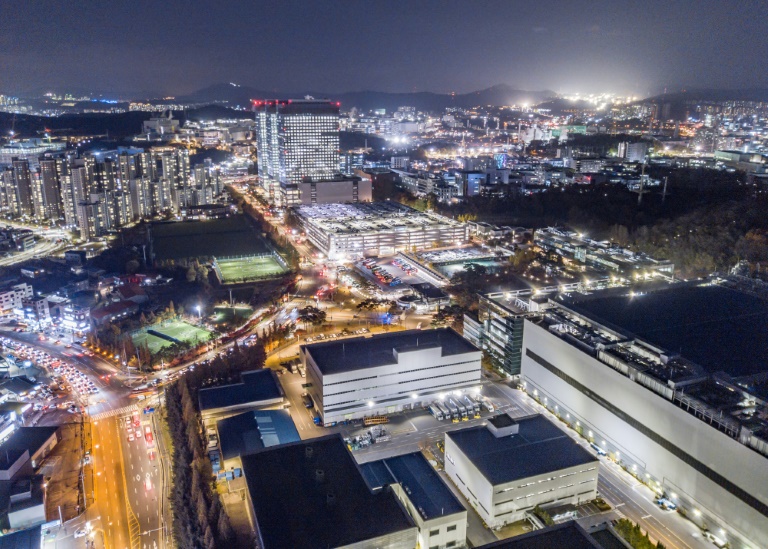
The announcement comes after US President Joe Biden toured Samsung Electronics’ massive Pyeongtaek semiconductor factory on Friday, underscoring the South Korean giant’s role in securing global supply chains of microchips.

South Korea and the United States need to work to “keep our supply chains resilient, reliable and secure,” Biden said, calling semiconductors manufactured there as “a wonder of innovation” and crucial to the global economy.

Lee Jae-yong, the firm’s vice-chairman and the de facto leader of the wider Samsung conglomerate, escorted Biden and newly sworn-in South Korean President Yoon Suk-yeol inside the assembly line, and introduced the two to an audience in English.

It was Lee’s highest-profile public appearance since his release on parole in August.

He had served more than half of a two-and-a-half-year sentence for bribery, embezzlement and other offences in connection with a corruption scandal that brought down ex-South Korean president Park Geun-hye.

Samsung employs about 20,000 people in the United States and work is under way to build a new semiconductor plant in Texas, scheduled to open in 2024.

The vast majority of the world’s most advanced microchips are made by just two companies — Samsung and Taiwan’s TSMC — both of which are running at full capacity to alleviate a global shortage.

Many major industrial powers such as the United States, Europe, China and Japan are scrambling to build semiconductor plants on their own soil to diversify supplies.

Samsung’s massive infrastructure promise comes two weeks after Yoon, a fiscal conservative and a vocal supporter of the chaebols, was sworn in as South Korea’s new president. 

“It’s a classic way of Korean companies to appeal to a new president,” Park Ju-gun, head of Leaders Index, a Seoul-based research institute, told Bloomberg News in reference to Samsung’s investment announcement. 

“Investors need to check whether the promised amount of investments are actually executed or not.” 

Google marks 15 years of Street View

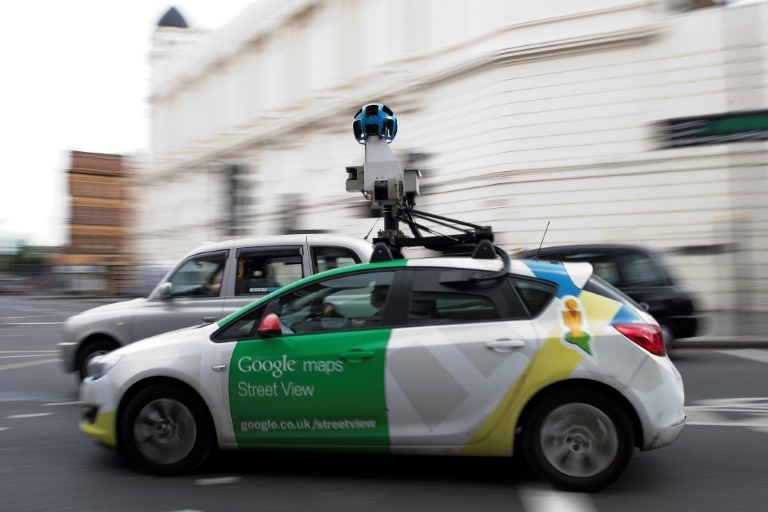
Google celebrated on Tuesday 15 years since it kicked off its mammoth and hugely controversial effort to photograph streets in minute detail across the globe.

The panoramic images of Google Street View have slipped into daily life for millions — but during its early years it attracted countless court cases and howls of anguish from privacy campaigners.

The US tech giant is marking the anniversary by releasing a slew of new features, including an improved version of the “time travel” tool that allows users to see previous photos taken by Google’s cameras.

The firm also published lists of the most popular destinations for users — with Burj Khalifa in Dubai taking the top spot for buildings, followed by the Eiffel Tower and the Taj Mahal.

Google said Indonesia was the most popular country for Street View, ahead of the United States, Japan, Mexico and Brazil.

The Indonesian capital Jakarta was the most searched city, beating Tokyo, Mexico City, Sao Paolo and Buenos Aires.

The firm boasted in a blog post that it had collected 220 billion images and travelled more than 10 million miles since the first images were released of cities including San Francisco, New York and Miami.

It has since provided armchair travellers with panoramic views everywhere from the peak of Everest to the depths of the Great Barrier Reef.

But as Google expanded its reach, it drew widespread criticism and years of scrutiny from regulators in several European countries — large parts of Germany are still absent from the tool.

It has also faced several embarrassing moments when inadvertently capturing images of a private nature.

In 2013, the firm photographed a couple having sex next to their car on an otherwise deserted road in Australia, and the picture briefly made it onto the platform. 

London's long-delayed commuter rail link opens

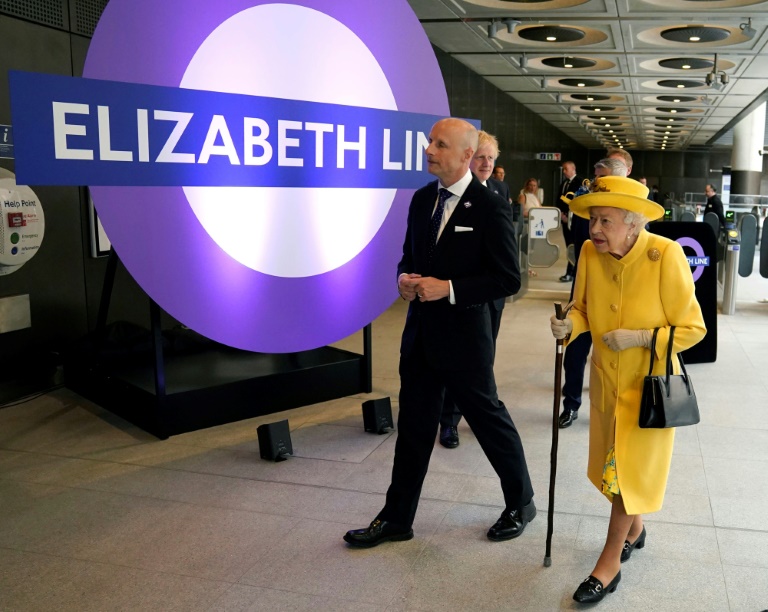
The long-delayed and over-budget Elizabeth line rail link finally opened in London on Tuesday, with hopes it will speed up journeys across the British capital and provide an economic boost.

Hundreds of people queued outside Paddington station in west London to be on the first train when it left at 6:33 am (0533 GMT).

London Mayor Sadiq Khan called the opening “historic” and “the most significant addition to our transport network in decades”.

“The Elizabeth line is much more than just a new railway –- it will provide a crucial economic boost to the whole country and help to turbo-charge our recovery from the pandemic,” he added.

Khan’s predecessor as mayor, Prime Minister Boris Johnson, said the project is forecast to boost the UK economy by £42 billion ($52 billion, 49 billion euros).

Only one of the line’s three branches has opened, from Paddington to Abbey Wood in southeast London.

Sections from Shenfield, east of London to Liverpool Street and Heathrow Airport and Reading, west of the capital, to Paddington will open by May next year.

Trains are currently scheduled to run from 6:30 am to 11:00 pm Monday to Saturday, with a Sunday service expected to start later this year.

The line, named after Queen Elizabeth II, is projected to carry up to 200 million passengers a year, adding 10 percent more capacity to London’s transport network.

Work started on the project back in 2009 and was initially called Crossrail. It was originally due to open in 2018.

But it was hit by problems with construction and complex signalling systems. Costs ballooned to £18.9 billion — some £3 billion over budget.

Quad nations warn against 'change by force' with eyes on China

Leaders of Japan, India, Australia and the United States warned Tuesday against attempts to “change the status quo by force” as concerns grow about whether China could invade self-ruled Taiwan.

A joint statement by the so-called Quad bloc avoided any direct mention of China’s growing military power in the region, but left little doubt about where its concerns lie.

The carefully worded document also made reference to the conflict in Ukraine, but without offering any joint position on the Russian invasion that India has pointedly declined to condemn.

The Quad’s other members have been less coy about their view that a strong response to Russia’s war is needed, one that would a message that will deter other countries, including China.

“As Russia’s invasion of Ukraine is shaking the fundamental principles of the international order… (we) confirmed that unilateral attempts to change the status quo by force will never be tolerated anywhere, particularly in the Indo-Pacific region,” Japan’s Prime Minister Fumio Kishida said, using another term for the Asia-Pacific.

The group’s statement made no mention of Russia, or China, but listed a range of activities that Beijing has regularly been accused of in the region.

“We strongly oppose any coercive, provocative or unilateral actions that seek to change the status quo and increase tensions in the area, such as the militarisation of disputed features, the dangerous use of coast guard vessels and maritime militia and efforts to disrupt other countries’ offshore resource exploitation activities,” it said.

The four nations are attempting to build their loose grouping into a more substantive counterweight to China’s rising military and economic power, despite their differences.

They unveiled plans to invest at least $50 billion into regional infrastructure projects over the next five years and a maritime monitoring initiative seen as intended to bolster surveillance of Chinese activities.

The moves come with worries over recent efforts by China to build ties with Pacific nations including the Solomon Islands, which signed a security pact with Beijing last month.

China’s foreign minister will visit the Solomon Islands this week, with reports suggesting he could add stops in other Pacific nations including Vanuatu, Samoa, Tonga and Kiribati.

– ‘Democracies versus autocracies’ –

In a nod to those concerns, Kishida earlier urged Quad members to “listen carefully” to regional neighbours, including the Pacific islands.

“Without walking together with countries in the region, the Quad cannot be successful,” he said.

Australia’s newly elected Prime Minister Anthony Albanese also said the bloc needed to “push our shared values in the region at a time when China was clearly seeking to exert more influence”.

The Quad met a day after US President Joe Biden raised eyebrows and the regional temperature by saying Washington was ready to intervene militarily to defend Taiwan against any Chinese attack.

He insisted Tuesday that his comments did not mean a change to Washington’s longstanding “strategic ambiguity” on how it might respond to a Chinese invasion, prompting another fierce response from Beijing.

Foreign ministry spokesman Wang Wenbin accused Washington of playing “word games” on Taiwan.

“If (the United States) carries on down the wrong path, it will not only cause irredeemable consequences for the US-China relationship, but also eventually incur an unbearable cost to the United States,” he said.

There is growing regional discomfort with Chinese military activity including sorties, naval exercises and encroachments by fishing vessels that are viewed as probing regional defences and red lines.

The bloc said its new maritime monitoring programme would “promote stability and prosperity in our seas and oceans”, again avoiding pointing the finger at Beijing while referencing illegal fishing — an accusation frequently levelled at China.

And if Biden was keen to avoid being seen as changing policy on Tuesday, he left little doubt about where the Quad’s focus lies.

“This is about democracies versus autocracies, and we have to make sure we deliver,” he said as the summit began.

The leaders are set to meet again in person next year, in Australia.

Asian markets fall on China growth concerns

Asian stocks retreated Tuesday on concerns over the impact of China’s Covid-19 restrictions on the world’s second-largest economy as investment banks slashed their forecasts.

A strong rally on Wall Street, where the Dow closed 2.0 percent higher, did not carry over to Asia, and Beijing’s announcement of a fresh raft of measures to stimulate the economy did little to calm nerves.

The package announced on Monday includes more than 140 billion yuan ($21 billion) in additional tax rebates, bringing the total amount of tax relief this year to 2.64 trillion yuan, Xinhua news agency reported following a meeting of the State Council chaired by Premier Li Keqiang.

China’s economy has taken a hit from Beijing’s zero-Covid approach to the pandemic, which has resulted in lengthy lockdowns of major cities and mass testing of millions of people.

Prolonged virus lockdowns have constricted supply chains, dampened demand and stalled manufacturing.

Investment banks UBS Group and JPMorgan Chase cut their China economic growth forecasts due to the impact of the coronavirus strategy.

UBS on Tuesday cut its 2022 GDP growth forecast to 3.0 percent from 4.2 percent while JPMorgan on Monday trimmed its forecast to 3.7 percent from 4.3 percent, Bloomberg News reported.

“The lingering restrictions and lack of clarity on an exit strategy from the current Covid policy will likely dampen corporate and consumer confidence and hinder the release of pent-up demand,” UBS economists including Tao Wang wrote in a research note, according to Bloomberg.

China has targeted full-year growth of around 5.5 percent, but data published in April showed that first-quarter growth slowed to 4.8 percent after its economy lost steam in the latter half of last year.

Concerns over the economic fallout from China’s dogged pursuit of a zero-Covid approach and its knock-on impact on supply chains and the wider global economy spooked investors, with Asian markets well into the red on Tuesday.

Tokyo lost 0.9 percent and Shanghai closed 2.4 percent lower while Hong Kong slipped 2.0 percent after the city’s leader Carrie Lam said there would likely be no relaxation of quarantine travel restrictions for the remainder of her term, which ends on June 30.

Seoul was off 1.6 percent, while Taipei, Sydney, Singapore and Manila were all lower. Bangkok was flat while Jakarta was one of the few markets to post gains.

The sell-off continued in Europe, with London and Frankfurt falling 1.0 percent, and Paris sliding 1.2 percent at the start of trade.

Later in the week, investors will be eyeing the minutes from the latest Federal Reserve rate-setting meeting for clues about further hikes aimed at reining in inflation. A raft of economic figures will also provide insights into the state of the US economy.

“The contradictory signals pouring into markets from all directions mean we can expect to see plenty of volatility across asset classes in the weeks ahead, even if we don’t get a thematic directional move,” said OANDA senior market analyst Jeffrey Halley.

“I’m still not sure how that environment is going to be constructive for equities though.”

Concerns over the Chinese economy and its impact on oil demand sent both contracts sharply lower, with Brent falling 1.4 percent to below $112 and WTI also down 1.4 percent to below $109.

– Key figures at around 0710 GMT –

Tokyo – Nikkei 225: DOWN 0.9 percent at 26,748.14 (close)

Hong Kong – Hang Seng Index: DOWN 2.0 percent at 20,053.02

Shanghai – Composite: DOWN 2.4 percent at 3,070.93 (close)

London – FTSE 100: DOWN 1.0 percent at 7,442.20

Dollar/yen: DOWN at 127.39 yen from 127.90 yen at 2030 GMT Monday

Euro/dollar: UP at $1.0724 from $1.0692

Pound/dollar: UP at $1.2594 from $1.2587

Euro/pound: UP at 85.15 pence from 84.92 pence

Brent North Sea crude: DOWN 1.4 percent at $111.79 per barrel

West Texas Intermediate: DOWN 1.4 at $108.74 per barrel

New York – Dow: UP 2.0 percent at 31,880.24 (close)

Samsung commits $356 bn in investments with 80,000 new jobs

Samsung Group on Tuesday unveiled a massive 450 trillion won ($356 billion) investment blueprint for the next five years aimed at making it a frontrunner in a wide range of sectors from semiconductors to biologics.

The new figure is an increase of more than a third over its investments spent over the past five years.

The tech giant is South Korea’s largest conglomerate and its overall turnover is equivalent to a fifth of the national gross domestic product.

Samsung Electronics, its flagship subsidiary, is the world’s biggest smartphone maker. 

The investment plan would bring “long-term growth in strategic businesses and help strengthen the global industrial ecosystem of crucial technology”, Samsung said in a statement.

The 80,000 new jobs would be created “primarily in core businesses including semiconductors and biopharmaceuticals” through 2026.

It also noted the investment would “bring forward the mass production of chips based on the 3-nanometer process,” the latest technology to further shrink down the size of semiconductors and boost computing power.

It will also invest heavily in biopharmaceuticals with its affiliates Samsung Biologics and Samsung Bioepis in the field.

The new plan represents a 36 percent increase in investment over its total investments over the past five years. 

Of the 450 trillion won Samsung plans to spend over the next five years, it will commit 360 trillion won to South Korea.

The announcement comes after US President Joe Biden toured Samsung Electronics’ massive Pyeongtaek semiconductor factory on Friday, underscoring the South Korean giant’s role in securing global supply chains of microchips, on his first Asia trip as US leader.

South Korea and the United States need to work to “keep our supply chains resilient, reliable and secure,” Biden said, calling semiconductors manufactured there as “a wonder of innovation” and crucial to the global economy.

Lee Jae-yong, the firm’s vice-chairman and the de facto leader of the wider Samsung conglomerate, escorted Biden and newly-sworn in South Korean President Yoon Suk-yeol inside the assembly line, and introduced the two to an audience in English in his highest-profile public appearance since his release on parole in August. 

Lee had spent over half of a two and a half year sentence for bribery, embezzlement and other offences in connection with a corruption scandal that brought down ex-South Korean president Park Geun-hye before his release.  

Samsung employs about 20,000 people within the United States and work is underway to build a new semiconductor plant in Texas, scheduled to open in 2024.

Close Bitnami banner
Bitnami