US Business

Boeing's Starliner spaceship docks with ISS in high-stakes test mission

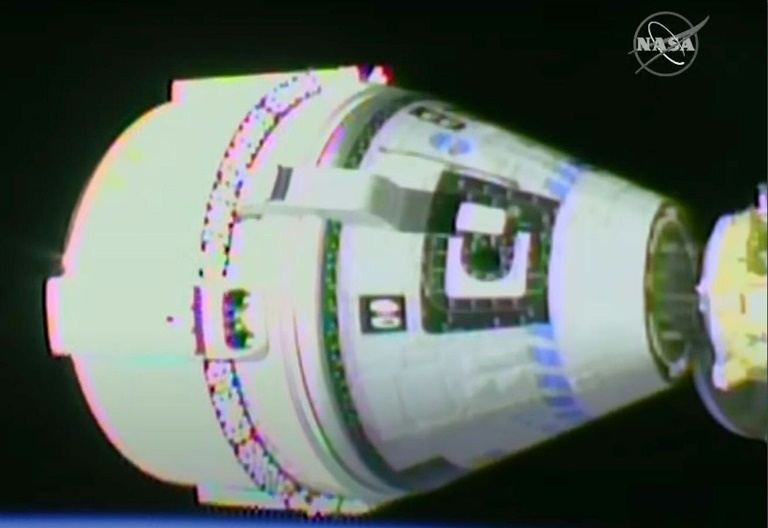
Boeing’s Starliner capsule docked with the International Space Station Friday, a major milestone in a high-stakes uncrewed test flight as the US aerospace giant seeks to restore its reputation following past failures.

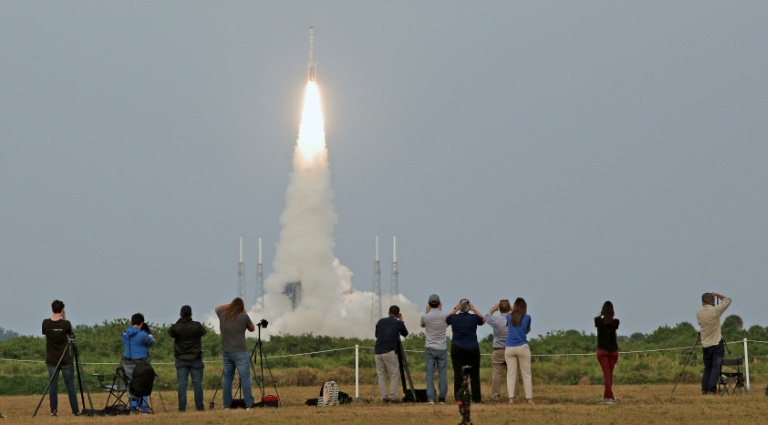
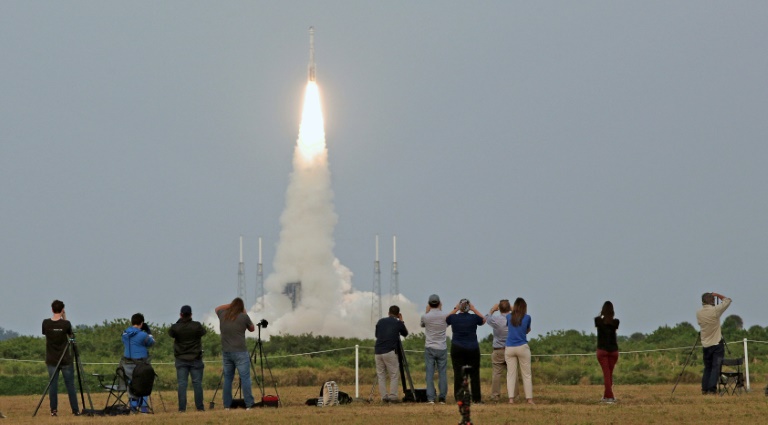
The spaceship made contact at 8:28 pm Eastern time (0028 GMT Saturday), a little over 24 hours after it blasted off from the Kennedy Space Center in Florida on a mission to prove itself capable of providing safe rides for NASA astronauts.

“Starliner spacecraft completes its historic first docking to the International Space Station, opening a new avenue of access for crews to the orbiting laboratory,” said an announcer.

But the vessel missed the scheduled rendezvous time by more than an hour due to technical issues — including a problem that required ground control to retract its docking system then re-deploy it.

Starliner also encountered some propulsion problems early on in its journey, with two thrusters responsible for placing it in a stable orbit failing, though officials insisted these were non-critical systems.

One of 12 orbital maneuvering and attitude control (OMAC) thrusters located on Starliner’s aft side shut off after one second, at which point a second thruster kicked in and took over, but also cut out after 25 seconds. 

The ship’s software then engaged a third thruster that completed the necessary burn. 

“That system operated normally during all of the propulsion system demonstrations, and with redundancies in place, does not pose a risk to the rest of the flight test,” a NASA blog post about the issue said.

Starliner’s success is key to re-establishing Boeing’s credibility after its first launch, back in 2019, failed to dock with the ISS due to software bugs — one that led to it burning too much fuel to reach its destination, and another that could have destroyed the vehicle during re-entry. 

A second try was scheduled in August 2021, but the capsule was rolled back from the launchpad to address sticky valves that weren’t opening as they should and the vessel was eventually sent back to the factory for fixes.

NASA is looking to certify Starliner as a second “taxi” service for its astronauts to the space station — a role that Elon Musk’s SpaceX has provided since succeeding in a test mission for its Dragon capsule in 2020.

– Seeking redemption –

Both companies were awarded fixed-price contracts — $4.2 billion to Boeing and $2.6 billion to SpaceX — in 2014, shortly after the end of the Space Shuttle program, during a time when the United States was left reliant on Russian Soyuz rockets for rides to the orbital outpost. 

Boeing, with its hundred-year history, was considered by many as the sure shot, while then-upstart SpaceX was less proven. 

In reality, it was SpaceX that rocketed ahead and recently sent its fourth routine crew to the research platform, while Boeing’s development delays have cost the company hundreds of millions of dollars.

Starliner is delivering more than 800 pounds of cargo to the ISS as part of this mission.

Its sole passenger is a mannequin named Rosie the Rocketeer — a play on the World War II campaign icon Rosie the Riveter — whose job is to collect flight data with her sensors to learn what human astronauts would experience.

“We are a little jealous of Rosie,” NASA astronaut Mike Fincke, who is expected to be among the first crew selected for a manned demonstration mission later this year should OFT-2 succeed, said at a press conference this week.

The gumdrop-shaped capsule will spend about five days in space, then undock and return to Earth on May 25, using giant parachutes to land in the desert of the western United States. 

NASA sees a second provider to low Earth orbit as a vital backup, should SpaceX encounter problems. 
Trump pays $110,000 fine for blocking New York state tax probe

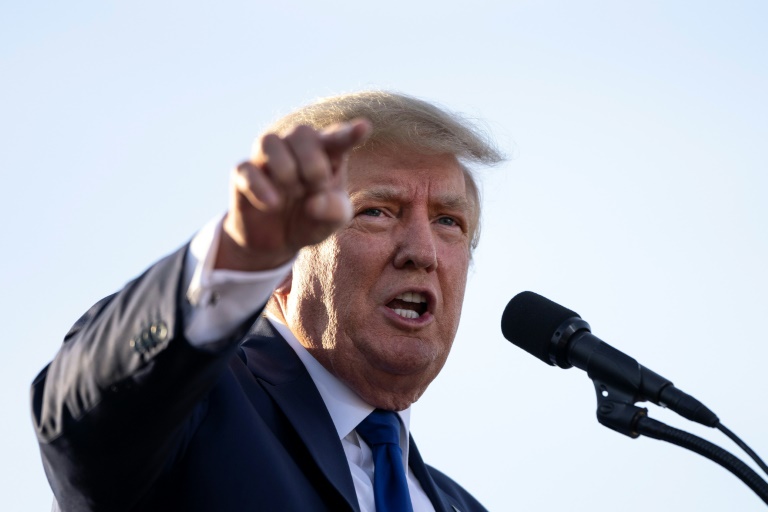
Former US President Donald Trump has paid a $110,000 fine for obstructing a major tax evasion investigation led since 2019 by New York state authorities, a spokesperson announced Friday.

Trump was ordered April 25 by New York state’s Supreme Court to pay $10,000 a day for as long as he refused to provide accounting and tax documents as part of a civil investigation by the Attorney General of the state, Letitia James, against the Trump Organization family business. 

“On May 19, Donald Trump paid the attorney general’s office $110,000,” a spokesperson for James’s office said.

James and the Republican billionaire have been engaged in a fierce procedural battle for months.

On February 17, James was able to get a New York judge to order Trump and his children Donald Trump Jr. and Ivanka Trump to testify under oath in the context of this investigation, in which she suspects fraudulent tax practices. 

The Trumps — who accuse James of a “political witch hunt” — have appealed the ruling.

But New York state had also demanded accounting and tax documents from the Trump Organization before March 31. 

Faced with Donald Trump’s refusal, James demanded obtained a ruling on April 25 that he be charged with obstruction. 

On May 6, however, the New York judge suspended the counting of days for which he should be fined and decided that Donald Trump would have until Friday May 20 to pay for the period from April 25 to May 6, or 110,000 for 11 days — which is what he did on Thursday. 

According to James’ spokesperson, the Trump camp also had until Friday to submit sworn statements relating to the Trump Organization’s request for accounting and tax records. 

These documents were indeed collected and produced by a third-party firm on Thursday, according to the same source. 

The judge must now decide whether the Trump camp have met all the demands. 

James suspects the Trump Organization fraudulently overstated the value of real estate properties when applying for bank loans, while understating them with the tax authorities in order to pay less in taxes. 

Donald Trump is also facing a criminal investigation by the Manhattan prosecutor: the Trump Organization and its financial director Allen Weisselberg have been charged with tax evasion. 

They have pleaded not guilty and the trial is due to begin this year. 

Hyundai to build $5.5 bn electric vehicle plant in US

South Korean automaker Hyundai will build a $5.5 billion electric vehicle and battery plant in the southern US state of Georgia, its governor announced Friday, as President Joe Biden pursued his trip to Seoul.

Brian Kemp made the announcement alongside Hyundai Motor Company president Jay Chang at the future factory site near Savannah, hailing the more than 8,000 jobs the venture is expected to create.

“We are proud to welcome Hyundai Motor Group to Georgia as we forge an innovative future together,” Kemp said, according to a statement released by his office.

He called the plant “the largest economic development project in our state’s history.”

Hyundai suppliers are expected to invest an additional $1 billion in the factory, which will have an annual capacity of 300,000 units, according to the statement.

The automaker said it plans to begin construction in January 2023 and to complete the plant in the first half of 2025. It did not yet give any details on which of its electric models will be produced at the Georgia location.

“This new EV plant is the future of our business, and it will help us meet the growing demands of our US customers,” Chang said in the statement.

Hyundai has projected that 27 percent of its global fleet will be electric within seven years.

By building battery production into the new factory, Hyundai “aims to establish a stable supply chain for EV battery and other EV components in the US market,” the statement said.

Biden arrived on Friday in South Korea, on a trip aimed at cementing economic ties with Seoul. He is due to meet with Chang on Sunday, according to the White House.

The Hyundai plant will be the second electric vehicle factory in Georgia: electric truck maker Rivian announced in December that it will invest $5 billion to build its second US assembly plant there.

Hyundai aims to be the third-largest provider of electric vehicles in the United States by 2026, but it faces stiff competition.

The sector is currently dominated by Tesla, but traditional automakers General Motors and Ford plan to invest tens of billions of dollars to increase their electric offerings in the coming years, and many start-ups are also trying to break into the industry.

US archbishop bans Pelosi from communion over abortion rights support

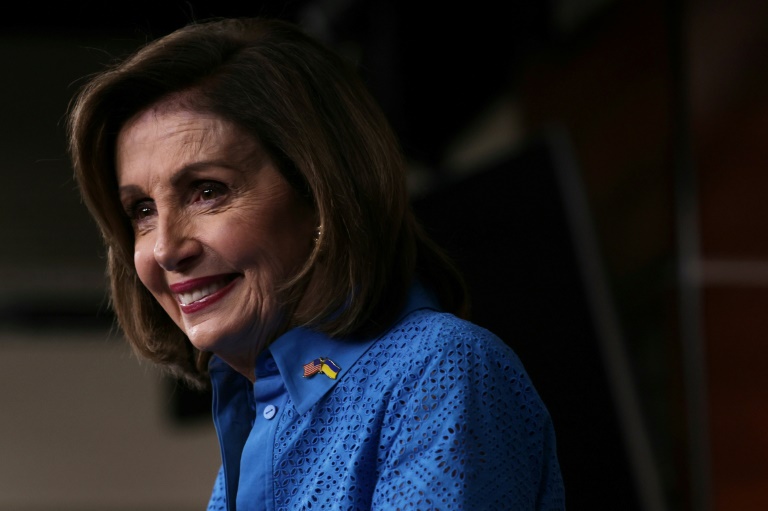
The archbishop of San Francisco told US Speaker of the House Nancy Pelosi that she is barred from receiving communion over her support for abortion rights, the archdiocese said in a letter released Friday. 

Archbishop Salvatore Cordileone said he in the letter that he had previously asked Pelosi to “publicly repudiate your advocacy for abortion ‘rights’ or else refrain from referring to your Catholic faith in public and receiving Holy Communion” — or face the consequence of being denied access to the rite.

“As you have not publicly repudiated your position on abortion, and continue to refer to your Catholic faith in justifying your position and to receive Holy Communion, that time has now come,” the archbishop said.

“I am hereby notifying you that you are not to present yourself for Holy Communion and, should you do so, you are not to be admitted to Holy Communion, until such time as you publicly repudiate your advocacy for the legitimacy of abortion and confess and receive absolution of this grave sin in the sacrament of Penance,” he added.

Pelosi, a lifelong Catholic from California, said she would work to pass a law to confirm women’s continued right to abortions after the leak of a draft Supreme Court opinion overturning Roe v Wade, the 1973 ruling that guaranteed access to the procedure nationwide.

Pelosi’s office made no immediate comment to AFP after the archbishop’s letter was made public.

Communion — the rite in which the faithful ritually consume bread and wine blessed by a priest — is a central rite in the Catholic Church.

China rate cut boosts Asian, European stocks

Asian and European stocks rebounded Friday on China’s interest rate cut, but US equities gyrated amid fears that sky-high inflation will spark a recession.

“Markets have been looking for an excuse to bounce, and a China rate cut provided the reason,” IG analyst Chris Beauchamp told AFP.

The People’s Bank of China announced it would lower its five-year loan prime rate — a key interest rate governing how lenders base their mortgage rates — to 4.45 percent from 4.6 percent.

The move is in contrast to other major central banks — like the US Federal Reserve and the Bank of England — that are raising borrowing costs to combat rocketing consumer prices.

The Chinese move sparked optimism among traders that it could boost the world’s second-largest economy from its Covid-induced stupor.

“The rate cut announced by the PBOC is obviously good news and is clearly targeted at revitalising the ailing property market which continues to suffer due to the crackdown last year and Covid lockdowns this year,” said Craig Erlam, senior market analyst at OANDA.

“This could help to revive a hugely important part of the economy,” he added, but “whether it’s enough to help China hit its 5.5 percent growth target this year is another thing.” 

Asian stocks closed with gains, as did Europe’s main markets although those faded as the day wore on. 

Wall Street also opened higher but later tumbled, with the S&P 500 temporarily sinking into a “bear market,” a drop of more than 20 percent from a recent peak.

The broad-based S&P 500 finished at 3,901.36, basically unchanged for the day, but down three percent for the week and off 19 percent from its January high point.

“Stocks remain on a shaky footing,” said market analyst Fawad Razaqzada at City Index and FOREX.com.

He said investors are worried about inflation, interest rate hikes, low economic growth, stagflation, and recession.

“Perhaps most importantly for stocks, the Fed is not there to provide cushion, like before,” he added, as the US central bank is raising interest rates to combat inflation.

Downcast earning reports from retailers have heightened market uncertainty at a time of rising interest rates, surging energy prices, China’s Covid lockdowns and Russia’s ongoing war on Ukraine.

Major stock indices have lost huge portions of their value in recent months.

In Europe, Paris and Frankfurt stocks are down between 14 and 15 percent, while London’s main index has shed a modest 3.9 percent.

– Key figures at around 2040 GMT –

New York – Dow: FLAT at 31,261.90 (close)

New York – S&P 500: FLAT at 3,901.36 (close)

New York – Nasdaq: DOWN 0.3 percent at 11,354.62 (close)

London – FTSE 100: UP 1.2 percent at 7,389.98 (close)

Frankfurt – DAX: UP 0.7 percent at 13,981.91 (close)

Paris – CAC 40: UP 0.2 percent at 6,285.24 (close)

EURO STOXX 50: UP 0.5 percent at 3,657.03 (close)

Hong Kong – Hang Seng Index: UP 3.0 percent at 20,717.24 (close)

Shanghai – Composite: UP 1.6 percent at 3,146.57 (close)

Tokyo – Nikkei 225: UP 1.3 percent at 26,739.03 (close)

Brent North Sea crude: UP 0.4 percent at $112.55 per barrel

West Texas Intermediate: UP 2.7 percent at $113.23 per barrel

Euro/dollar: DOWN at $1.0564 from $1.0588

Pound/dollar: UP at $1.2497 from $1.2467

Euro/pound: DOWN at 84.50 pence from 84.93 pence

Dollar/yen: UP at 127.86 yen from 127.79

burs-jmb/hs

Biden opens SKorea trip at Samsung plant as NKorea nuclear fears mount

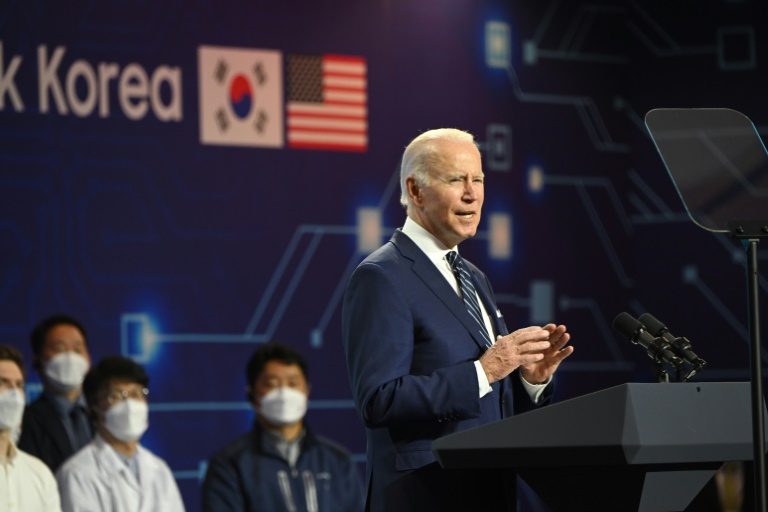
President Joe Biden has arrived in South Korea on his first Asia trip as US leader, aiming to cement economic and security ties with regional allies despite growing fears of a North Korean nuclear test.

His first stop on Friday was a massive Samsung semiconductor factory, where he received a warm welcome from South Korea’s new President Yoon Suk-yeol, with global supply chain issues topping the agenda.

Biden, in his first remarks since arriving in South Korea at the start of a trip meant to demonstrate US resolve to lead in Asia, said the two countries’ alliance was “a lynchpin of peace, stability and prosperity” in the world.

Speaking at the factory in Pyeongtaek alongside Yoon, Biden described the advanced semiconductors manufactured there as “a wonder of innovation” and crucial to the global economy.

The tiny, smart wafers “enable our modern lives” and are “the key to propelling us into the next era of humanity’s technological development”, he added.

Semiconductors — the microchips essential to most modern devices from phones to cars and high-tech weapons — are at the heart of a global supply chain slowdown that threatens to disrupt the world’s post-Covid economic recovery.

South Korea and the United States need to work to “keep our supply chains resilient, reliable and secure”, Biden said.

“Putin’s brutal, unprovoked war in Ukraine has further spotlighted the need to secure our critical supply chain,” he said.

The United States needs to ensure “our economic and our national security are not dependent on countries that don’t share our values,” he added.

Biden and Yoon are to hold talks and give a press conference in Seoul on Saturday before attending a state dinner.

– Don’t forget to vote –

For the US leader, whose Democratic Party fears a possible trouncing in midterm elections in November, the issue is also an acute domestic political challenge, with Americans increasingly frustrated over rising prices and stuttering economic reopening.

Ahead of the speech, Biden toured the huge Samsung plant, taking in lengthy presentations from staff clad in hazmat suits on the equipment used to produce semiconductors.

After a briefing from a US representative from a California company working with Samsung, Biden quipped: “Don’t forget to vote, Peter”.

Samsung employs about 20,000 people within the United States and work is underway to build a new semiconductor plant in Texas, opening in 2024.

South Korea is a semiconductor powerhouse, supplying about 70 percent of chips globally, Yoon said in his speech, asking Biden to take a “special interest” in South Korean chip firms.

Biden’s visit could help the two allies forge a new “economic and security alliance based on advanced technology and supply-chain cooperation”, Yoon said.

Semiconductors are now “something akin to a strategic commodity”, Vladimir Tikhonov, professor of Korean studies at the University of Oslo, told AFP.

China is trying to reduce reliance on US-influenced Dutch and Taiwanese suppliers, and the United States is trying to rebuild its domestic industry, he said.

Biden “needs Samsung’s collaboration in this regard”, he added.

– North Korea test? –

Biden wants the trip to boost a years-long US pivot to Asia, where rising Chinese commercial and military power is undercutting Washington’s dominance — but it risks being overshadowed by North Korea’s nuclear ambitions.

“We remain concerned that the DPRK may attempt to undertake another provocation during the course of the president’s visit to Northeast Asia or in the days following,” State Department spokesman Ned Price said in Washington, referring to North Korea by its official acronym.

South Korean intelligence has warned that Pyongyang had recently completed preparations for a nuclear test, while Price said another possibility was a new launch of an intercontinental missile.

Security issues were not top of the agenda Friday, but the fact that Biden is visiting Seoul first on his Asia tour indicates that Washington is looking to refocus on the Korean Peninsula, former CIA analyst Soo Kim told AFP.

“Should Kim proceed with a test during Biden’s visit, he will effectively be helping the two countries find greater justification to work together on the North Korea issue,” she said.

Biden heads to Japan from South Korea on Sunday. He will also join a regional summit of the Quad — a grouping of Australia, India, Japan and the United States — while in Tokyo.

Even so, the whole point of Biden’s Asia tour is China, Katharine Moon, a political science professor at Wellesley College, told AFP.

“It’s an effort to strengthen economic and security relationships with the Asia-Pacific region and block China’s growing influence,” she said.

Washington is hoping the united Western response to Russia’s almost three-month-long invasion of Ukraine will give Beijing pause on its Taiwan ambitions.

National Security Advisor Jake Sullivan said the aim of the trip is not to confront China, but to highlight that the West and its Asian partners will not be divided and weakened.

But China said Friday that the United States should “build an open and inclusive circle of friends in the Asia-Pacific, instead of assembling closed and exclusive small cliques.”

Musk, Bolsonaro talk free speech, deforestation in Brazil

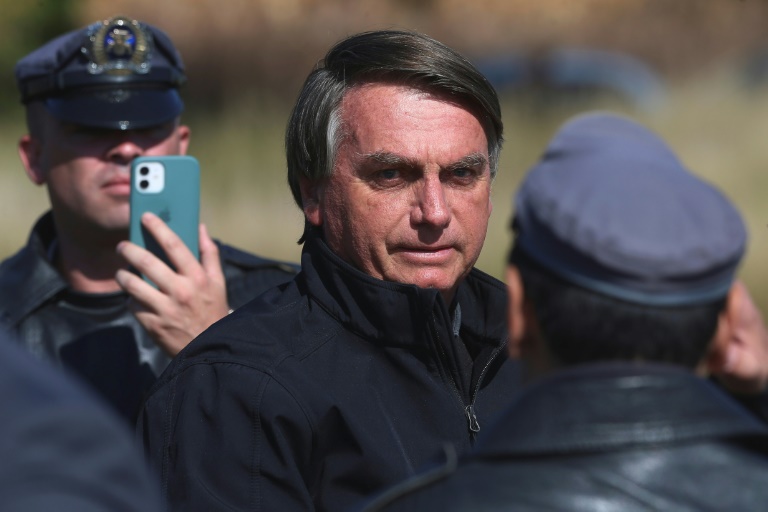
Billionaire Elon Musk jetted into Brazil Friday to meet far-right President Jair Bolsonaro and unveil a project to link thousands of Amazonian schools to the internet and expand satellite monitoring of the rainforest.

The two men met at a luxury hotel in Porto Feliz, some 100 kilometers (60 miles) outside Sao Paulo, with executives of several Brazilian companies present. 

“Super excited to be in Brazil for launch of Starlink for 19,000 unconnected schools in rural areas & environmental monitoring of Amazon!” tweeted Musk of the project. 

In comments made at the meeting, snippets of which were shared on social media, the CEO of SpaceX and Tesla said the project would be “really good” for “deforestation… for education (and), environmental reasons.”

No further details were released of the deal, and journalists were kept at a distance from the meeting venue.

Amazon destruction has risen sharply under the government of Bolsonaro, who is accused of promoting impunity for gold miners, farmers and timber traffickers who illegally clear the rainforest.

The president, however, claimed Friday the new project would reveal the “truth” about the state of the Amazon: “the exuberance of this region, how it is preserved by us.”

Experts point out there are already projects in place to monitor Brazilian deforestation.

“What is missing is action, not monitoring,” said Tasso Azevedo, coordinator of Mapbiomas — a consortium of NGOs, universities and startups that does exactly such work with satellite images.

– Free speech? –

Bolsonaro told Musk his announcement last month of a $44 billion bid for Twitter had come as a “ray of hope.”

The offer has since been suspended, with Musk demanding proof of the number of Twitter spam accounts.

Bolsonaro has had several social media posts deleted over the years amid accusations that he uses fake news as a political weapon, and has welcomed Musk’s statements on loosening restrictions in the name of free expression.

The billionaire had vowed, among other things, to reinstate the account of ex-president Donald Trump — a political idol of Bolsonaro’s.

“Musk has become in recent weeks a kind of hero of Bolsonarism,” said Oliver Stuenkel, an international relations expert at Sao Paulo’s Getulio Vargas foundation.

“His possible acquisition of Twitter was seen as good news because it would supposedly end the restrictions” ahead elections in October.

Bolsonaro, who will seek re-election, is lagging behind leftist Luiz Inacio Lula da Silva in opinion polls.

Bolsonaro tweeted a photograph of him and Musk shaking hands, and said they had also discussed “the use of technology… in the realization of Brazil’s economic potential.”

The meeting was kept under wraps until just hours before it happened.

– High-speed internet- 

Musk is listed by Forbes as the world’s wealthiest person, with a fortune of more than $200 billion.

“Since we are going to connect the Amazon, we brought one of the largest entrepreneurs in the world to help us in this mission,” tweeted Communications Minister Fabio Faria, who met Musk in Texas last November.

At the time, the government announced it was negotiating with SpaceX for satellite access.

SpaceX has thousands of Starlink satellites in orbit to provide high-speed internet, especially to areas underserved by fixed and mobile networks. 

Many more launches are planned to expand the service that has more than 100,000 subscribers worldwide.

Friday’s meeting came hours after Musk rejected allegations on Twitter that he had groped a flight attendant and exposed himself to her six years ago.

Musk tweeted that the latest “attacks” on him were related to his plans to “restore free speech to Twitter & vote Republican.”

Lebanon cabinet passes financial recovery plan during last session

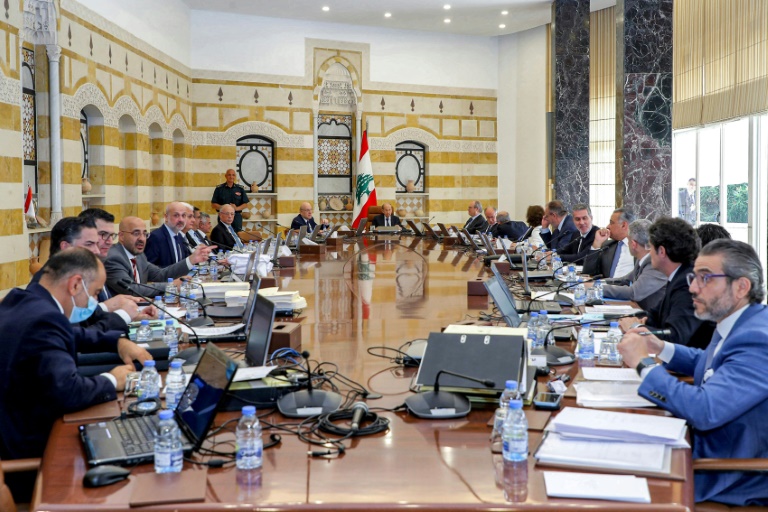
The cabinet of bankrupt Lebanon, at its final session on Friday, passed a financial recovery plan needed to secure international aid, but its implementation will depend on the fractious incoming parliament.

The session came five days after Lebanon held its first election since an economic crisis, widely blamed on corruption and negligence by the ruling elite, dragged the country to the brink of becoming a failed state.

“Any delay in implementing the financial recovery plan will be very costly to Lebanese,” Prime Minister Najib Mikati said at a press conference after cabinet met.

The International Monetary Fund and Lebanon in April struck a conditional deal for $3 billion in aid. Enacting reforms, including a financial recovery plan, is one of many prerequisites for the package, and analysts have expressed scepticism that the reforms can take place.

It will be up to the new government and parliament to implement the plan approved by the outgoing cabinet.

The financial plan passed by ministers includes restructuring and recapitalising the banking system, and protecting small depositors “as much as possible”, according to an official five-page document seen by AFP.

Sunday’s election yielded a polarised and fragmented legislature likely prone to the kind of deadlock that has characterised Lebanese politics for decades.

This could complicate the formation of a new government and delay implementation of the reforms.

Lebanon has been battered by triple-digit inflation, soaring poverty rates and the collapse of its currency since a 2020 debt default.

In a move adding to the economic pain, cabinet also raised telecom prices. Starting July, the internet bill of Lebanon residents will more than double, as will mobile phone bills.

Telecommunications Minister Johnny Corm warned Thursday the cash-strapped sector might collapse if there were no hikes, because current prices were set according to pre-inflation rates. 

The outgoing Lebanese cabinet will continue to function with limited caretaker powers until a new one is formed, a process that could take months.

“I call on elected lawmakers to expedite the formation of a new government,” Mikati said.

Also on Friday, Saudi Arabia’s de facto ruler Crown Prince Mohammed bin Salman and French President Emmanuel Macron reiterated their call for “structural reforms” in Lebanon.

“They reaffirmed the need to implement the structural reforms necessary for the country’s recovery, as expected by the Lebanese population and the international community,” the French presidency announced after a telephone conversation between the two leaders.

Macron and Salman also “reaffirmed their willingness to continue their coordination to support the Lebanese population”.

Boeing's Starliner approaching ISS in high-stakes test mission

Boeing’s Starliner capsule was preparing to dock with the International Space Station Friday, in a high-stakes uncrewed test flight key to reviving the US aerospace giant’s reputation after a series of failures.

The spaceship blasted off from the Kennedy Space Center in Florida on Thursday evening, and is now set to rendezvous with the ISS at 7:10 pm Eastern Time (2310 GMT), as part of a mission to prove it is capable of providing safe rides for NASA astronauts.

Starliner encountered some propulsion problems early in its journey, with two thrusters responsible for placing it in a stable orbit failing for unclear reasons — though officials insisted everything remained on track.

“Overall, the spacecraft is doing really well,” Steve Sitch, program manager for  NASA’s Commercial Crew Program told reporters at a post-launch press conference, in which he nonetheless flagged anomalies that engineers are working to understand.

One of 12 orbital maneuvering and attitude control (OMAC) thrusters located on Starliner’s aft side failed after one second, at which point a second thruster kicked in and took over, but also cut out after 25 seconds. 

The ship’s software then engaged a third thruster that completed the necessary burn. 

The OMAC thrusters are set to be used to bring Starliner closer to the ISS, and to help de-orbit the spacecraft near the end of the mission.

“We’ll go look at the data and try to understand what happened. And then from a redundancy perspective, can we recover those thrusters?” said Sitch.

Starliner’s success is key to repairing Boeing’s frayed reputation after its first launch, back in 2019, failed to dock with the ISS due to software bugs — one that led to it burning too much fuel to reach its destination, and another that could have destroyed the vehicle during re-entry. 

A second try was scheduled in August 2021, but the capsule was rolled back from the launchpad to address sticky valves that weren’t opening as they should, and the vessel was eventually sent back to the factory for fixes.

NASA is looking to certify Starliner as a second “taxi” service for its astronauts to the space station — a role that Elon Musk’s SpaceX has provided since succeeding in a test mission for its Dragon capsule in 2020.

– Seeking redemption –

Both companies were awarded fixed-price contracts — $4.2 billion to Boeing, and $2.6 billion to SpaceX — in 2014, shortly after the end of the Space Shuttle program, during a time when the United States was left reliant on Russian Soyuz rockets for rides to the orbital outpost. 

Boeing, with its hundred-year history, was considered by many as the sure shot, while then-upstart SpaceX was less proven. 

In reality, it was SpaceX that rocketed ahead, and recently sent its fourth routine crew to the research platform — while Boeing’s development delays have cost the company hundreds of millions of dollars.

Starliner should dock with the ISS about 24 hours after launch, and deliver more than 800 pounds of cargo.

Its sole passenger is a mannequin named Rosie the Rocketeer — a play on the World War II campaign icon Rosie the Riveter — whose job is to collect flight data with her sensors in order to learn what human astronauts would experience.

“We are a little jealous of Rosie,” NASA astronaut Mike Fincke, who is expected to be among the first crew selected for a manned demonstration mission should OFT-2 succeed, said at a press conference this week.

The gumdrop-shaped capsule will spend about five days in space, then undock and return to Earth on May 25, using giant parachutes to land in the desert of the western United States. 

NASA sees a second provider to low Earth orbit as a vital backup, should SpaceX encounter problems. 
Boeing's Starliner approaching ISS in high-stakes test mission

Boeing’s Starliner capsule was preparing to dock with the International Space Station Friday, in a high-stakes uncrewed test flight key to reviving the US aerospace giant’s reputation after a series of failures.

The spaceship blasted off from the Kennedy Space Center in Florida on Thursday evening, and is now set to rendezvous with the ISS at 7:10 pm Eastern Time (2310 GMT), as part of a mission to prove it is capable of providing safe rides for NASA astronauts.

Starliner encountered some propulsion problems early in its journey, with two thrusters responsible for placing it in a stable orbit failing for unclear reasons — though officials insisted everything remained on track.

“Overall, the spacecraft is doing really well,” Steve Sitch, program manager for  NASA’s Commercial Crew Program told reporters at a post-launch press conference, in which he nonetheless flagged anomalies that engineers are working to understand.

One of 12 orbital maneuvering and attitude control (OMAC) thrusters located on Starliner’s aft side failed after one second, at which point a second thruster kicked in and took over, but also cut out after 25 seconds. 

The ship’s software then engaged a third thruster that completed the necessary burn. 

The OMAC thrusters are set to be used to bring Starliner closer to the ISS, and to help de-orbit the spacecraft near the end of the mission.

“We’ll go look at the data and try to understand what happened. And then from a redundancy perspective, can we recover those thrusters?” said Sitch.

Starliner’s success is key to repairing Boeing’s frayed reputation after its first launch, back in 2019, failed to dock with the ISS due to software bugs — one that led to it burning too much fuel to reach its destination, and another that could have destroyed the vehicle during re-entry. 

A second try was scheduled in August 2021, but the capsule was rolled back from the launchpad to address sticky valves that weren’t opening as they should, and the vessel was eventually sent back to the factory for fixes.

NASA is looking to certify Starliner as a second “taxi” service for its astronauts to the space station — a role that Elon Musk’s SpaceX has provided since succeeding in a test mission for its Dragon capsule in 2020.

– Seeking redemption –

Both companies were awarded fixed-price contracts — $4.2 billion to Boeing, and $2.6 billion to SpaceX — in 2014, shortly after the end of the Space Shuttle program, during a time when the United States was left reliant on Russian Soyuz rockets for rides to the orbital outpost. 

Boeing, with its hundred-year history, was considered by many as the sure shot, while then-upstart SpaceX was less proven. 

In reality, it was SpaceX that rocketed ahead, and recently sent its fourth routine crew to the research platform — while Boeing’s development delays have cost the company hundreds of millions of dollars.

Starliner should dock with the ISS about 24 hours after launch, and deliver more than 800 pounds of cargo.

Its sole passenger is a mannequin named Rosie the Rocketeer — a play on the World War II campaign icon Rosie the Riveter — whose job is to collect flight data with her sensors in order to learn what human astronauts would experience.

“We are a little jealous of Rosie,” NASA astronaut Mike Fincke, who is expected to be among the first crew selected for a manned demonstration mission should OFT-2 succeed, said at a press conference this week.

The gumdrop-shaped capsule will spend about five days in space, then undock and return to Earth on May 25, using giant parachutes to land in the desert of the western United States. 

NASA sees a second provider to low Earth orbit as a vital backup, should SpaceX encounter problems. 
Close Bitnami banner
Bitnami