US Business

Rising prices, interest rates cool US home sales in April

Rising prices and higher mortgage rates slowed US existing home sales for the third consecutive month in April, according to an industry survey released Thursday.

Sales fell 2.4 percent compared to March to an annual rate of 5.61 million, seasonally adjusted, which was 5.9 percent lower than April 2021, the National Association of Realtors (NAR) reported.

“Higher home prices and sharply higher mortgage rates have reduced buyer activity,” NAR Chief Economist Lawrence Yun said. “It looks like more declines are imminent in the upcoming months, and we’ll likely return to the pre-pandemic home sales activity after the remarkable surge over the past two years.”

Bargain borrowing rates helped fuel the strong demand for home buying during the pandemic, which has driven prices ever higher while builders have struggled to keep up due to supply backlogs for lumber and other materials amid a shortage of workers.

But the Federal Reserve has embarked on an aggressive campaign to tamp down inflation pressures by raising interest rates, which has sent mortgage costs sharply higher.

The average rate on a 30-year, fixed-rate mortgage was 4.98 percent in April, up from 4.17 percent in March, and far above the 2021 average of 2.96 percent, according to Freddie Mac.

The median existing-home price for all housing types jumped to $391,200, up 14.8 percent from April 2021, according to NAR. Prices have risen for 122 consecutive months of year-over-year increases, the longest-running streak on record.

Slowing sales in recent months have allowed the inventory of unsold homes to recover — at what Yun called a “sluggish pace” — and was back to a 2.2-month supply, nearly where it was a year ago.

Single family home sales fell 2.5 percent last month, while sales of condos fell 1.6 percent, according to the survey.

Yun noted that despite rising prices, homes still do not stay on the market long, selling in an average of 17 days, and the report showed all-cash buyers accounted for more than a quarter of the sales in the month.

Nancy Vanden Houten of Oxford Economics said strong demand is likely to remain a feature of the housing market but “we expect existing home sales to lose more momentum as a sharp erosion in homebuying affordability weighs on sales.”

Rising prices, interest rates cool US home sales in April

Rising prices and higher mortgage rates slowed US existing home sales for the third consecutive month in April, according to an industry survey released Thursday.

Sales fell 2.4 percent compared to March to an annual rate of 5.61 million, seasonally adjusted, which was 5.9 percent lower than April 2021, the National Association of Realtors (NAR) reported.

“Higher home prices and sharply higher mortgage rates have reduced buyer activity,” NAR Chief Economist Lawrence Yun said. “It looks like more declines are imminent in the upcoming months, and we’ll likely return to the pre-pandemic home sales activity after the remarkable surge over the past two years.”

Bargain borrowing rates helped fuel the strong demand for home buying during the pandemic, which has driven prices ever higher while builders have struggled to keep up due to supply backlogs for lumber and other materials amid a shortage of workers.

But the Federal Reserve has embarked on an aggressive campaign to tamp down inflation pressures by raising interest rates, which has sent mortgage costs sharply higher.

The average rate on a 30-year, fixed-rate mortgage was 4.98 percent in April, up from 4.17 percent in March, and far above the 2021 average of 2.96 percent, according to Freddie Mac.

The median existing-home price for all housing types jumped to $391,200, up 14.8 percent from April 2021, according to NAR. Prices have risen for 122 consecutive months of year-over-year increases, the longest-running streak on record.

Slowing sales in recent months have allowed the inventory of unsold homes to recover — at what Yun called a “sluggish pace” — and was back to a 2.2-month supply, nearly where it was a year ago.

Single family home sales fell 2.5 percent last month, while sales of condos fell 1.6 percent, according to the survey.

Yun noted that despite rising prices, homes still do not stay on the market long, selling in an average of 17 days, and the report showed all-cash buyers accounted for more than a quarter of the sales in the month.

Nancy Vanden Houten of Oxford Economics said strong demand is likely to remain a feature of the housing market but “we expect existing home sales to lose more momentum as a sharp erosion in homebuying affordability weighs on sales.”

Pakistan bans import of luxury items to boost economy

Pakistan’s new government on Thursday said it would ban the import of over 30 luxury items including cars and fruit jams in an austerity move to help boost the country’s faltering economy.

Cash-strapped Pakistan has been hit by a storm of crippling debt, dwindling foreign currency reserves and galloping inflation.

The national currency hit a historic low on Thursday, with 200 rupees fetching $1.

“My decision to ban (the) import of luxury items will save the country precious foreign exchange,” Prime Minister Shehbaz Sharif tweeted.

The move was an effort to target the country’s elite, with the banned goods including mobile phones and cars — which make up the largest share of import bills on the list — as well as cosmetics and jams.

“We will be able to save $6 billion by imposing a ban on import of the luxury items,” information minister Marriyum Aurangzeb said at a press conference, adding that the ban would be effective immediately. 

“The decision will give a boost to the local economy and industry”.

However, business leaders said the country must seek consent from the World Trade Organization, which regulates international trade. 

“I think it is a prudent step by the government… it would help save much needed foreign exchange to pay off our international trade debts,” said Khalid Tawab, the former senior vice president of the Pakistan Chamber of Commerce.

“The government has not declared a financial emergency yet, but that is the situation we are facing, and so under such circumstances the WTO could be persuaded to relax its rules.”

Pakistan’s current trade deficit stands at $39.2 billion.

Former leader Imran Khan was ousted in a no-confidence vote last month, largely as a result of failing to reverse the soaring cost of living and prices of basic goods.

The announcement comes as Pakistan officials are locked in negotiation with the IMF in the Qatari capital Doha over the release of funds as part of an agreed loan programme. 

A six billion dollar IMF bailout package signed by former prime minister Imran Khan in 2019 has never been fully implemented because his government reneged on agreements to cut or end some subsidies and to improve revenue and tax collection.

Islamabad has so far received $3 billion, with the programme due to end later this year.

Officials are seeking an extension to the programme through to June 2023, as well as the release of the next tranche of $1 billion.

A major sticking point is likely to be over costly subsidies — notably for fuel and electricity — and Finance Minister Miftah Ismail said he wants the two sides to “find a middle ground”.

US supermarket shooting suspect back in court

The white teenager accused of gunning down 10 Black people during a racist rampage at a supermarket in New York state was back in court Thursday.

Payton Gendron, 18, wore orange prison fatigues and a white face mask as he appeared for the pre-trial felony hearing at the county court in Buffalo.

He said nothing during the hearing, which lasted just a few minutes. 

Several of the suspect’s family members were in the courtroom, according to tweets by reporters with local media.

An audience member shouted “Payton, you’re a coward,” as he was led away in handcuffs, a video posted on the website of Buffalo news channel WGRZ showed.

Judge Craig Hannah adjourned the case until June 9 for further proceedings.

“The defendant continues to remain held without bail,” the prosecutor, Erie County District Attorney John Flynn, said in a statement.

“There will be no further comment from our office until there is a report following an investigation by the Grand Jury,” he added.

Gendron is accused of killing ten people and wounding three others during the mass shooting at Tops Friendly Market in Buffalo on Saturday.

Wearing heavy body armor and wielding an AR-15 assault rifle, the self-declared white supremacist allegedly livestreamed his attack.

He reportedly planned it for months, targeting the grocery store because of its large surrounding African American population.

Gendron pleaded not guilty to a single count of first-degree murder. Authorities are weighing the possibility of adding hate crime and terrorism charges.

McDonald's reaches deal to sell Russia business

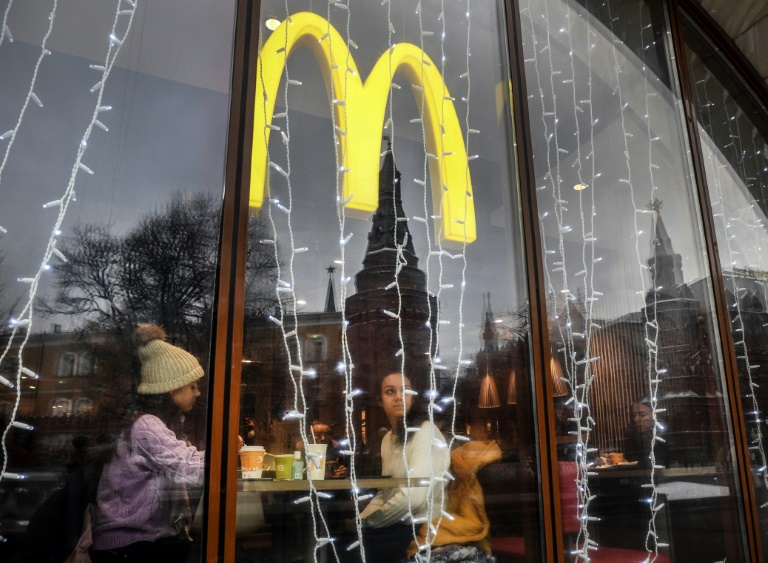
McDonald’s has reached a deal to sell its Russia business to Russian businessman Alexander Govor, a licensee of the chain, the restaurant company said Thursday.

The announcement comes three days after McDonald’s announced it was exiting the Russian market in the wake of the Ukraine invasion.

Govor agreed to retain employees for at least two years and fund exiting liabilities to suppliers, landlords and utilities, McDonald’s said.

The price of the transaction was not disclosed. 

McDonald’s said Monday it would sell the entire Russian portfolio of 850 restaurants employing 62,000 workers, citing the humanitarian crisis in the wake of the Ukraine invasion, which has also sparked international sanctions. 

“The business in Russia is no longer tenable, nor is it consistent with McDonald’s values,” the company said in a statement that announced plans to take a one-time charge of $1.2 billion to $1.4 billion to write off the investment.

Govor, a licensee since 2015, has operated 25 restaurants in Siberia. He is co-founder of Neftekhimservice, a refining company, and a board member of another firm hat owns the Park Inn hotel and private clinics in Siberia.

Global stocks slump on recession fears

Global markets took a beating Thursday after Wall Street suffered one of its worst batterings in two years over recession fears after decades-high inflation.

Downcast earnings reports from retailers have exacerbated worries about consumer resilience and experts sounded gloomy.

“Inflation is catching up and profit margins are taking a hit. Soon enough though, those higher costs will continue to be passed on and consumers will stop dipping into savings and start being more careful with their spending,” said Craig Erlam, senior market analyst at OANDA.

“The question is whether we’re going to see a slowdown or a recession,” he said.

The Nasdaq and Dow fell around one percent in early trade while European markets were down around two percent in afternoon deals after leading Asian indices closed in the red.

Among the biggest losers were tech giants after Chinese giant Tencent reported lacklustre profits, fuelling wider concerns over China’s economic outlook.

Tencent shares plunged more than eight percent in early trading before paring losses slightly, a day after it posted its slowest revenue gain since going public in 2004.

Among other tech titans, Alibaba dropped more than six percent.

“Sentiment… is highly negative as traders and investors are largely concerned about an economic downturn and soaring inflation,” said AvaTrade analyst Naeem Aslam.

On Wall Street Wednesday, all three major US indices dived, with the Dow sinking more than 1,150 points or 3.6 percent.

The Nasdaq plunged 4.7 percent by the close.

North American-focused big-box retailer Target plunged about 25 percent in value after group earnings missed expectations despite higher sales.

The company reported higher operating costs in results that echoed those of bigger rival Walmart.

The retailers said consumers were avoiding discretionary purchases as prices for food, gasoline and other household staples jump.

In some of his most hawkish remarks to date, Federal Reserve Chair Jerome Powell this week said the US central bank would raise interest rates until there is “clear and convincing” evidence that inflation is in retreat. 

But higher borrowing costs increases debt, heaping further pressure on consumers and businesses.

The United States is facing the fastest inflation in four decades, as is Britain, causing the Bank of England to also raise interest rates.

– Key figures at around 1330 GMT –

London – FTSE 100: DOWN 2.3 percent at 7,264.51 points

Frankfurt – DAX: DOWN 1.7 percent at 13,760.82 points

Paris – CAC 40: DOWN 1.9 percent at 6,228.51 points

EURO STOXX 50: DOWN 2.1 percent at 3,611.07 points

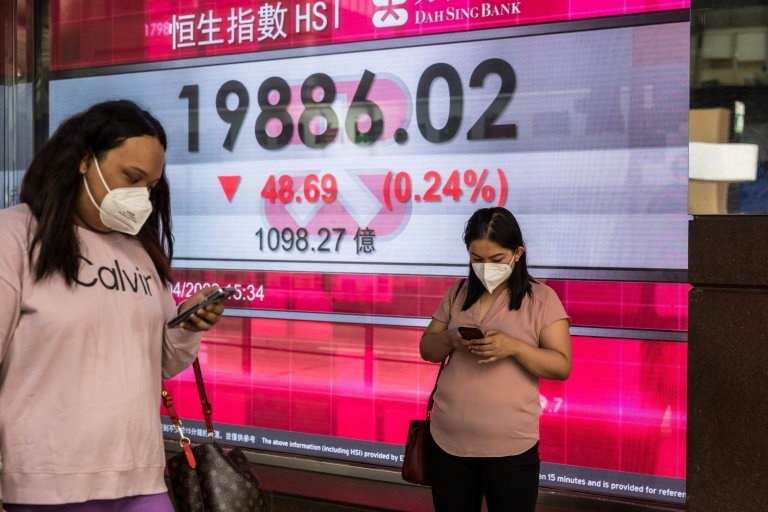
Hong Kong – Hang Seng Index: DOWN 2.5 percent at 20,120.60 (close)

Shanghai – Composite: UP 0.4 percent at 3,096.96 (close)

Tokyo – Nikkei 225: DOWN 1.9 percent at 26,402.84 (close)

New York – Dow: DOWN 1.1 percent at 31,490.07

Brent North Sea crude:  DOWN 2.4 percent at $ 106.63 per barrel

West Texas Intermediate: DOWN 3.6 percent at $ 105.91 per barrel

Euro/dollar: UP at $1.0550 from $1.0479

Pound/dollar: UP at $1.2459 from $1.2346

Euro/pound: DOWN at 84.65 pence from 84.88 pence

Dollar/yen: DOWN at 127.13 yen from 128.58

Ukraine war puts Indian diamond polishers out of work

India’s huge diamond-polishing industry has furloughed around 250,000 of its roughly two million workers because of sanctions on Russia hitting supplies, a trade union said Thursday.

The South Asian nation cuts and polishes 90 percent of the world’s diamonds, with Russian diamond miners such as Alrosa traditionally accounting for 30-40 percent of India’s imported rough gems.

“This problem has started ever since the Russia-Ukraine war began,” Ramesh Zilariya, president of the Diamond Workers’ Union Gujarat, told AFP.

“Western countries like the United States and Europe have stopped accepting Russian diamonds that have been polished in India,” he said.

Workers were furloughed this month in the western state of Gujarat, the main hub of the industry, Zilariya added, as companies struggle with cash flow and supply disruptions.

Traders say Russian supply has fallen short since Western sanctions forced Moscow out of the SWIFT cross-border payments system, plunging the supply chain into uncertainty.

“Supply is still disrupted and payments are mostly on hold,” Sripal Dholakia, director at the All India Gem and Jewellery Domestic Council, told AFP.

Dholakia said imports from Russia are “not adequate” at present, and Indian traders are facing higher bank charges while making direct payments in rupees or rubles.

An industry pitch to the Indian government to make future payments via India’s Unified Payments Interface system has gone unanswered.

India exported cut and polished diamonds worth $24 billion in the year ended March 31, data from the Gems and Jewellery Export Promotion Council showed.

Top export destinations included the United States, Hong Kong and the United Arab Emirates.

Many Western buyers are now refusing to accept diamonds sourced in Russia for fear of violating sanctions.

“They have started asking for a bill which specifies that the goods we are supplying are not Russian,” a Mumbai-based jeweller told AFP on condition of anonymity.

Prices too have turned volatile.

“Fifteen to 20 percent instability is a big thing for us because we work on a margin of two to five percent… It becomes difficult,” the jeweller said.

The Gujarat diamond union has asked the state government to provide financial aid and re-skilling training to out-of-work polishers to help tide over the crisis.

“(We) asked the government to support workers in the diamond industry because this issue is not going to be resolved in one month,” Zilariya said.

“This issue will go on for at least five, six or seven months.”

India has called for a cessation of violence but has stopped short of condemning Russia’s invasion of Ukraine.

The two countries have historically had close ties, with Moscow supplying most of New Delhi’s arms.

Bush gaffe on 'unjustified' war draws Iraqi ire

An embarrassing slip of the tongue by former US president George W. Bush may have drawn laughter from his American audience, but it raised the ire of Iraqis.

In a speech Wednesday evening in Dallas about Russia’s war on Ukraine, Bush called the invasion of Iraq, which he himself ordered, “unjustified and brutal” — before quickly correcting himself.

The 2003 US-led invasion of Iraq toppled dictator Saddam Hussein and ushered in one of the bloodiest periods in the country’s modern history, marked by sectarian warfare and the rise of jihadists.

Between 2003 and 2011, when the US withdrew its troops, more than 100,000 civilians were killed, according to the Iraq Body Count tracker. The invasion cost the lives of nearly 4,500 Americans.

But on Wednesday it was the war in Ukraine that Bush talked about during an event organised by his foundation.

“The decision of one man to launch a wholly unjustified and brutal invasion of Iraq, I mean of Ukraine,” he said in a speech, drawing laughter from the audience.

“Anyway — 75,” he added, referring to his own age, to another burst of laughter.

Video footage of the gaffe has since gone viral online, with one post on Twitter having been viewed more than 14 million times in less than half a day.

It was also picked widely up by Arab media, stoking anger among Iraqis.

“The spectre of Iraq’s invasion and destruction haunts Bush Jr. His subconscious exposed it when it took over his tongue,” Iraqi journalist Omar al-Janabi tweeted.

“Yes it is a brutal and unjustified invasion which will remain your worst nightmare”, he added.

Iraqis also took to Facebook to criticise the former US president.

“The moment of truth has come — the invasion of Iraq is a lifelong nightmare that plagues your conscience,” Hamza Qusai wrote.

“The crime of your occupation of Iraq and its destruction will remain a nightmare that haunts your sleep and torments your dead criminal consciences,” added Nahedh al-Tamimi.

The US-led invasion of Iraq was launched on March 20, 2003 after accusations that the Saddam regime had weapons of mass destruction. None were ever found.

Indonesia to lift ban on palm oil exports from Monday

Indonesia will lift its ban on palm oil exports next week, President Joko Widodo said Thursday, relieving pressure on the global vegetable oil market after prices spiked because of the suspension and the war in Ukraine.

The archipelago nation issued the ban last month to secure supplies of the commodity, used in a range of goods from chocolate spreads to cosmetics, in the face of a domestic shortage.

“Based on the supply… of cooking oil and considering there are 17 million people in the palm oil industry — farmers and other supporting workers — I decided that cooking oil exports will reopen on Monday, May 23,” Widodo told an online briefing.

“The government will still be monitoring everything strictly to ensure the demand will be met with affordable prices,” he said.

Authorities had rigorously enforced the export ban, with the Indonesian navy seizing a tanker carrying palm oil out of the country in violation of the order earlier this month.

After the ban came into force, Widodo said supplying the country’s 270 million people was the “highest priority” of his government.ere are yo

But Jakarta came under pressure for further saddling prices that were already skyrocketing after Russia’s invasion of agricultural powerhouse Ukraine.

Palm oil producers staged protests last week in the centre of Jakarta and several towns in Indonesia complaining that the prices for palm oil fruits had dropped dramatically.

– ‘Return to normal’ –

The Indonesian leader said he was reversing the suspension because the domestic supply and price of cooking oil had improved since the ban came into effect on April 28.

Widodo said prices had fallen from 19,800 rupiah ($1.35) per litre to about 17,200 rupiah ($1.17) since the ban.

Domestic supplies of cooking oil also tripled after the ban from 64,500 tonnes per month to 211,000 tonnes, he said.

Industry figures hailed the decision to resume exports.

Eddy Martono, secretary general of the Indonesian Palm Oil Association (GAPKI), said the organisation “is very grateful to the government, especially to the president” for lifting the ban.

“It is a fact that the condition on the ground is very difficult because the tanks have been all full. We hope with the export reopening, the palm oil production can return to normal.”

Oil Palm Farmers Association chairman Gulat Manurung thanked Widodo and said oil palm farmers would repay his decision by boosting domestic supplies. 

“We, oil palm farmers, pledge to help ensure that domestic supplies of cooking oil will be available,” he told AFP.

Palm oil is the most widely used vegetable oil in Indonesia and, despite being the world’s biggest producer, the country has been facing a cooking oil shortage for months because of poor regulation and producers reluctant to sell at home.

The shortages have in some cases forced consumers to spend hours in queues at distribution centres.

Indonesia produces about 60 percent of the world’s palm oil, with one-third consumed by its domestic market. India, China, the European Union and Pakistan are among its major export customers.

Ukraine steelworks defenders surrender as Russian pleas for forgiveness

Russia said Thursday that 1,730 Ukrainian soldiers had surrendered this week at the Azovstal steel plant in Mariupol, showing some emerging on crutches after an all-out battle that has become emblematic of the nearly three-month-old war.

The number included 80 who were wounded and taken to a hospital in Russia-controlled territory in eastern Ukraine, the defence ministry in Moscow said.

The ministry released a video appearing to show the surrendered soldiers hobbling out of the sprawling plant after it was besieged for weeks. Russian troops patted them down and inspected their bags as they exited.

The International Committee of the Red Cross said it had registered “hundreds of Ukrainian prisoners of war” from the plant in Mariupol, a port city levelled by Russian shelling.

Ukraine accuses Moscow’s forces of war crimes against civilians in Mariupol and elsewhere, and has begun the first prosecution of a Russian soldier. 

Vadim Shishimarin, a shaven-headed Russian sergeant from Irkutsk in Siberia, pleaded guilty to a war crime and faces a life sentence.

He admitted to shooting dead Oleksandr Shelipov, an unarmed 62-year-old man, in Ukraine’s Sumy region on February 28 — four days into the invasion. 

Shishimarin was remorseful as he took the dock for a second day on Thursday.

“I know that you will not be able to forgive me, but nevertheless I ask you for forgiveness,” he said, addressing Shelipov’s wife in the cramped courtroom in Kyiv.

– Folk celebration –

But while Mariupol has fallen, Ukraine’s President Volodymyr Zelensky said the wider invasion was an “absolute failure” as he marked “Vyshyvanka Day”, an annual celebration of Ukrainian folk traditions.

Wearing an embroidered shirt instead of his usual military khaki top, Zelensky said on the Telegram social media platform that his people remained “strong, unbreakable, brave and free”.

Zelensky’s defiance, and his army’s dogged resistance, have earned the West’s admiration and a steady flow of military support. G7 finance ministers were meeting in Germany to thrash out more cash support.

G7 partners have to “assure Ukraine’s solvency within the next days, few weeks”, German Finance Minister Christian Lindner told the newspaper Die Welt.

But German Chancellor Olaf Scholz said there could be “no shortcuts” to membership of the European Union for Ukraine. Ukraine’s Foreign Minister Dmytro Kuleba condemned the “second-class treatment” of his country.

– Famine warning –

Russia’s actions are already redrawing the security map of Europe. 

US President Joe Biden was to host the leaders of Finland and Sweden later Thursday to discuss their bids to join NATO, after the Nordic neighbours decided to abandon decades of military non-alignment.

“I warmly welcome and strongly support the historic applications from Finland and Sweden for membership in NATO,” Biden said, offering US support against any “aggression” while their bids are considered.

Beyond Europe, the invasion also threatens to bring famine, UN Secretary-General Antonio Guterres said.

“Malnutrition, mass hunger and famine” could follow “in a crisis that could last for years,” Guterres warned, urging Russia to release grain exports from occupied Ukraine.

Russia and Ukraine produce 30 percent of the global wheat supply, and the war has already sent food prices surging around the world.

– ‘Time to run’ –

Despite their last-ditch resistance in places such as Mariupol, and the successful defence of Kyiv, Ukrainian forces are retreating in the east.

The losses often come after weeks of battles over towns and small cities that are pulverised by the time the Russians surround them in a slow-moving wave.

“I tell everyone that there is no reason to worry when the banging is from outgoing fire,” Volodymyr Netymenko said as he packed up his sister’s belongings before evacuating her from the burning village of Sydorove in eastern Ukraine.

“But when it is incoming, it is time to run. And things have been flying at us pretty hard for the past two or three days.”

In the Russian region of Kursk, one person died and others were injured in an attack on a village on the border with Ukraine, the local governor said.

– War crimes trials –

A second war crimes trial was due to open in Ukraine Thursday.

The International Criminal Court is deploying its largest-ever field team to Ukraine, with 42 investigators, forensic experts and support staff to gather evidence of alleged war crimes.

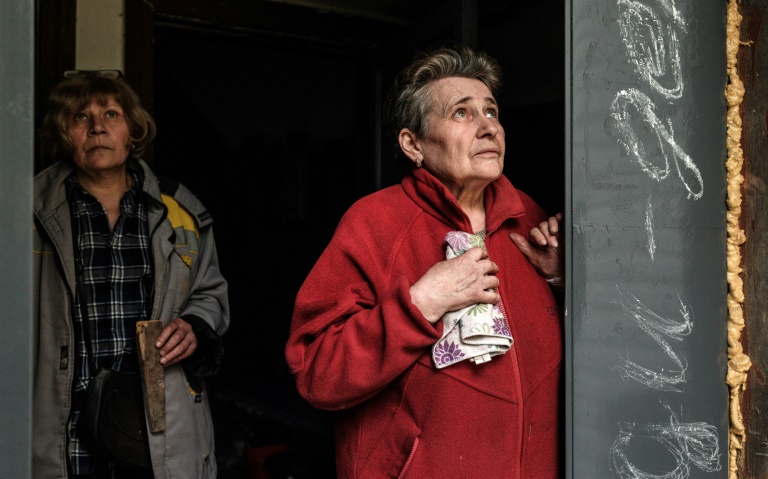
Ukrainian civilians are bearing the brunt of incessant Russia mortar fire raining down on the eastern city of Severodonetsk.

Nella Kashkina sat in the basement next to an oil lamp and prayed.

“I do not know how long we can last,” the 65-year-old former city worker said.

“We have no medicine left and a lot of sick people — sick women — need medicine. There is simply no medicine left at all.”

burs-jit/lc

Close Bitnami banner
Bitnami