US Business

Goldman Sachs to cut up to 8% of staff: reports

Goldman Sachs could cut up to eight percent of its staff, or around 4,000 jobs, according to reports Friday, as the financial giant eyes sluggish global growth in 2023.

The job cuts are expected early in 2023, according to reports in Semafor and CNBC that said the final figure could ultimately be smaller than eight percent.

Goldman Sachs typically trims about one to five percent of headcount each year, targeting underperforming staff.

This year’s culling will be deeper than usual in light of the uncertain economic outlook and the growth in Goldman’s staffing in recent years, a person familiar with the matter told AFP.

Goldman’s staff stood at 49,100 at the end of October, up nearly 30 percent from the end of 2019 after hiring campaigns and acquisitions.

The move comes as Goldman Sachs and other investment banks have seen a big drop in fees tied to initial public offerings and described a cloudy outlook for merger and acquisition advising in 2023 due to economic uncertainty.

At a financial conference last week, Goldman Chief Executive David Solomon said capital markets activity had also been weaker than expected, with clients “taking risk down” after a volatile year.

“At the same time, we continue to see headwinds on our expense lines, especially in the near term,” Solomon said. “Ultimately, we will remain nimble and we will size the firm to reflect the opportunity set that we see in front of us.”

Goldman Sachs to cut up to 8% of staff: reports

Goldman Sachs could cut up to eight percent of its staff, or around 4,000 jobs, according to reports Friday, as the financial giant eyes sluggish global growth in 2023.

The job cuts are expected early in 2023, according to reports in Semafor and CNBC that said the final figure could ultimately be smaller than eight percent.

Goldman Sachs typically trims about one to five percent of headcount each year, targeting underperforming staff.

This year’s culling will be deeper than usual in light of the uncertain economic outlook and the growth in Goldman’s staffing in recent years, a person familiar with the matter told AFP.

Goldman’s staff stood at 49,100 at the end of October, up nearly 30 percent from the end of 2019 after hiring campaigns and acquisitions.

The move comes as Goldman Sachs and other investment banks have seen a big drop in fees tied to initial public offerings and described a cloudy outlook for merger and acquisition advising in 2023 due to economic uncertainty.

At a financial conference last week, Goldman Chief Executive David Solomon said capital markets activity had also been weaker than expected, with clients “taking risk down” after a volatile year.

“At the same time, we continue to see headwinds on our expense lines, especially in the near term,” Solomon said. “Ultimately, we will remain nimble and we will size the firm to reflect the opportunity set that we see in front of us.”

France confirms contract to develop next-generation fighter jet

The French army on Friday officially awarded the contract to develop a new European combat jet, a key project in the push to integrate the continent’s military capabilities and reduce its reliance on American equipment.

French and German officials announced the deal last month, burying the hatchet after months of dispute over how the industrial work would be shared out for the stealth delta-wing aircraft.

European planemaker Airbus and France’s Dassault Aviation, joined by Spain’s Indra and a host of subcontractors, will collaborate on the so-called Future Combat Air System against a rival project, Tempest, pursued by Britain, Italy, Sweden and Japan.

“This historic contract, worth 3.2 billion euros [$3.4 billion], will cover the work on a demonstrator of the FCAS and its components for around three and a half years,” the companies said in a statement.

Analysts estimate it will cost 100 billion euros to develop the new jet and its cutting-edge technologies including artificial intelligence for a linked “combat cloud” of drones, scheduled to be operational in 2040.

“This is a major step forward with an important project to protect our strategic interests,” French Defence Minister Sebastien Lecornu said in a statement.

Upon completion of the development phase, known as 1B, the countries will negotiate the actual construction phase for the jets, with the first flight demonstrations expected in 2028 or 2029.

“The political agreement on the FCAS is a big step forward and — especially in the current international context — an important signal of the excellent cooperation between France, Germany and Spain,” the office of French President Emmanuel Macron said when the deal was announced last month. 

So far no other European nations have signed on to build the new plane, and a previous French-German plan to build a common fighter failed, leading to the development of the Rafale and Eurofighter jets currently in use.

Germany had also worried many in Paris last March when it announced a deal to buy 35 F-35 jets from US firm Lockheed Martin. 

The planes are certified to carry US nuclear warheads kept in Europe as part of the NATO defence alliance — which the new French-German jets are also expected to do.

Stocks, oil prices extend losses on recession fears

Stock markets dropped further Friday on prospects of more aggressive rises in interest rates to fight inflation, renewing concerns over the global economy entering recession next year.

After a healthy rally in recent weeks fuelled by signs that price rises were slowing, the US Federal Reserve, European Central Bank and Bank of England this week crushed any Christmas spirit by hiking borrowing costs again by sizeable amounts and warning of more pain.

While inflation in most countries has started coming down — helped by a drop in energy costs — it remains at multi-decade highs.

Observers have warned that economies could be heading for a period of stagflation where prices keep rising but growth stalls.

“In a nutshell, it is all about fears over a sharper economic slowdown in 2023 than previously expected,” noted Fawad Razaqzada, market analyst at City Index trading group.

“While macro data have been weak of late, there was still hope that the downturn might be short-lived and that a recession might be avoided in some regions altogether, amid signs of inflation peaking in some regions like the US.”

The latest rate hikes came as data showed US and UK retail sales dropping in November as consumers — key drivers of growth — feel the pinch from high prices and rate hikes.

– Recession on horizon? –

Eurozone and London shares all closed firmly in the red.  

Wall Street stocks meanwhile extended losses too, dropping more than one percent by mid-session.

OANDA analyst Craig Erlam said the prospect of a “Santa rally” was fading.

“Going into December, there was growing optimism that policymakers could be a source of optimism going into the new year but instead, they’ve taken on the role of grinch, bringing a swift end to the celebrations,” he added.

Earlier, Asia had also seen losses, with Tokyo closing down 1.9 percent.

On the upside, Hong Kong rose on progress in talks over allowing US officials to audit Chinese firms listed in New York, easing concerns about a possible delisting of some big names such as Alibaba and Tencent.

The news provided a little more help to Hong Kong traders, whose sentiment has been lifted also by China’s shift away from the economically damaging zero-Covid policy as well as moves to open the city further to overseas visitors.

And a report in Hong Kong’s South China Morning Post said the border with mainland China would be fully reopened next month, providing another much-needed boost to the beleaguered economy.

However, the mood was soured a little by a US decision to put 36 Chinese companies including top producers of advanced computer chips on a trade blacklist, severely restricting their access to any US technology.

– Key figures around 1645 GMT –

London – FTSE 100: DOWN 1.3 percent at 7,332.12  points (closing)

Frankfurt – DAX: DOWN 0.7 percent at 13,893.07 (closing)

Paris – CAC 40: DOWN 1.1 percent at 6,452.63 (closing)

EURO STOXX 50: DOWN 0.8 percent at 3,804.02  

New York – Dow: DOWN 1.2 percent at 32,800.82 

Tokyo – Nikkei 225: DOWN 1.9 percent at 27,527.12 (close)

Hong Kong – Hang Seng Index: UP 0.4 percent at 19,450.67 (close)

Shanghai – Composite: FLAT at 3,167.86 (close)

West Texas Intermediate: DOWN 2.6 percent at $74.13 per barrel

Brent North Sea crude: DOWN 2.9 percent at $78.84 per barrel

Euro/dollar: DOWN at $1.0605 from $1.0627 on Thursday

Pound/dollar: DOWN at $1.2163 from $1.2175

Euro/pound: DOWN at 87.18 pence from 87.26 pence

Dollar/yen: DOWN at 136.60 yen from 137.80 yen

'So good to be home:' Griner speaks out after release from Russia

US basketball star Brittney Griner said Friday in her first remarks since being released from a Russian prison that it was “so good to be home” and vowed to play again for the WNBA’s Phoenix Mercury.

The 32-year-old Griner, in an Instagram post, thanked a long list of people for securing her release with a “special thank you” to President Joe Biden.

“It feels so good to be home!” Griner said. “The last 10 months have been a battle at every turn. I dug deep to keep my faith and it was the love from so many of you that helped keep me going.”

A two-time Olympic gold medalist, WNBA champion and LGBTQ trailblazer, Griner was arrested on drug charges at a Moscow airport in February, against a backdrop of soaring tensions over Ukraine.

Griner — who was swapped last week for Viktor Bout, a notorious Russian arms dealer — said she would do what she can to help secure the release of Paul Whelan, another American held in Russia.

“President Biden, you brought me home and I know you are committed to bringing Paul Whelan and all Americans home too,” she said. “I will use my platform to do whatever I can to help you. Every family deserves to be whole.”

Griner also said she planned to be back on the court.

“I also want to make one thing very clear: I intend to play basketball for the WNBA’s Phoenix Mercury this season,” she said.

The 2023 WNBA season begins in May. Griner’s Mercury are scheduled to play their first game against the Los Angeles Sparks on May 19.

– Home for the holidays –

Griner was taken to a US Army base in Texas for a medical checkup after being swapped in Abu Dhabi for Bout, an arms dealer known as the “Merchant of Death” who had been serving a 25-year sentence in a US prison.

It was not immediately clear from Griner’s Instagram if she had already left the military base, but she said she would be “home to enjoy the holidays with my family.”

Her Instagram post was accompanied by a picture of Griner stepping off a plane on US soil and another of her embracing her wife, Cherelle Griner.

At the time of her arrest, Griner had been playing for a professional team in Russia, as a number of WNBA players do in the off-season.

She was accused of possessing vape cartridges with a small quantity of cannabis oil and sentenced in August to nine years in prison.

She pleaded guilty to the charges against her, but said she did not intend to break the law or use the banned substance in Russia.

Griner testified that she had permission from a US doctor to use medicinal cannabis to relieve pain from her many injuries.

The use of medical marijuana is not allowed in Russia.

Kyiv warns of long cuts after Russian missiles batter grid

A barrage of deadly Russian strikes battered Ukraine’s grid on Friday, worsening dire conditions for Ukrainians across the winter-worn country by knocking out water and electricity services in several regions.

The national energy provider warned Ukrainians already braving near freezing temperatures that it could take longer to restore electricity after dozens of Russian missiles targeted key infrastructure sites in the north, south and centre of the country.

“Priority will be given to critical infrastructure: hospitals, water supply facilities, heat supply facilities, sewage treatment plants,” Ukrenergo said in a statement Friday.

Residents of the capital wrapped in winter coats crammed into underground metro stations after air raid sirens rang out early Friday: the ninth wave of Russian aerial bombardments since October.

“I woke up, I saw a rocket in the sky,” Kyiv resident 25-year-old Lada Korovai said. “I saw it and understood that I have to go to the tube.”

“We live in this situation. It’s a war, it’s real war,” she told AFP.

The onslaught is the latest brought by Russian forces to target what Moscow says are military-linked facilities. The air assaults follow a series of embarrassing battlefield defeats for Russia.

– ‘Biggest’ missile attack of invasion –

Ukraine’s second largest city Kharkiv, near the border with Russia, was left without electricity, its mayor said. Oleg Synegubov, head of Kharkiv’s regional adminstration, said later they planned to have power restored by midnight.

The central cities of Poltava and Kremenchuk were also without power and regional officials in Kryvyi Rig, where Ukraine President Volodymyr Zelensky was born, said the airstrikes had hit a residential building.

“A 64-year-old woman and a young couple died. Their little son still remains under the rubble of the house,” the region’s governor Valentyn Reznichenko said, adding that 13 more were injured.

Oleksandr Starukh, head of the frontline Zaporizhzhia region, which houses Europe’s largest nuclear power plant, said more than a dozen Russian missiles had targeted territory under Ukrainian control.

Kyiv meanwhile “withstood one of the biggest missile attacks since the beginning of the full-scale invasion. About 40 missiles were recorded in the capital’s airspace,” regional authorities said in a statement. 

Air-defence forces had shot down 37 of them, they added.

Kyiv Mayor Vitali Klitschko said the water supply had been disrupted and that the metro had stopped running so people could shelter underground.

“Due to damage to the power system and emergency power outages, subway trains will not run until the end of the day today,” city officials later announced.

The Kyiv metro is a vital resource for the capital, which had a pre-war population of three million. It has been used as a city-wide bomb shelter since the Russian invasion.

– ‘Survive winter’ –

About half of Ukraine’s energy grid has been damaged in sustained attacks and the national provider warned Friday of emergency blackouts because of the “massive” wave of Russian attacks.

In Ukrainian-held Bakhmut — an eastern city at the epicentre of the war — some residents received wood stoves distributed by volunteers, AFP journalists said.

Bakhmut resident, 85-year-old Oleksandra was braving the cold to collect medication at a nearby pharmacy in the Donetsk region city.

“I’ll survive winter. I’ll just walk more to get warm,” the old woman told AFP. 

In the south, fresh Russian shelling in Kherson, recently recaptured by Ukraine, killed one person and wounded three more.

Kherson has been subjected to persistent Russian shelling since Moscow’s forces retreated in November and power was cut in the city earlier this week.

The UN humanitarian coordinator for Ukraine, Denise Brown, said a woman working as a paramedic for the Ukrainian Red Cross had been killed by Thursday’s strikes on Kherson.

Russian attacks overall killed 14 on Thursday, the deputy head of the Ukrainian presidency Kyrylo Tymoshenko said. 

In the Russian-controlled region of Lugansk in eastern Ukraine, Moscow-installed officials said shelling from Kyiv’s forces had killed eight and wounded 23.

– Putin to visit Belarus –

“The enemy is conducting barbaric shelling of cities and districts of the republic,” the Russian-installed leader of Lugansk Leonid Pasechnik said on social media.

Moscow has said the strikes on Ukrainian infrastructure are a response to an explosion on the Kerch bridge connecting the Russian mainland to the Crimean peninsula annexed by Moscow in 2014.

The Kremlin has said it holds Kyiv ultimately responsible for the humanitarian impact of the strikes for refusing to capitulate to Russian negotiation terms.

But Ukrainian defence officials said this week that its forces had shot down a swarm of more than a dozen Iranian-made attack drones launched at Kyiv, a sign that Western-supplied systems are having an impact.

Separately on Friday, Russian President Vladimir Putin announced he will visit Belarus next week for talks with his counterpart and ally Alexander Lukashenko.

Minsk said the pair would hold one-on-one talks as well as wider negotiations with their ministers on “Belarusian-Russian integration”. 

Timeline: Twitter mayhem since Musk takeover

Since buying Twitter, Elon Musk has made radical changes that have sparked fears for the future of the platform, from firing half the staff to restoring ex-president Donald Trump’s account and suspending those of several journalists.

AFP looks back at a rollercoaster two months at the Silicon Valley giant.

– Enter Elon –

Musk, the world’s second-richest richest man and CEO of Tesla and SpaceX, buys Twitter in late October for $44 billion after months of on-off negotiations.

“Let the good times roll,” he tweets after the deal is sealed on October 28. He becomes the sole director of the company after dissolving its corporate board.

– ‘Content moderation council’ –

In one of his first moves, the self-declared free speech absolutist announces he will form a “content moderation council”, in a nod to concerns that Twitter could become a free-for-all platform for disinformation and hate speech.

– Monthly charge –

On November 1, Musk announces the site will charge $8 per month to verify the accounts of celebrities and companies — a service that used to be free. But the November 6 launch of the Twitter Blue subscription plan goes awry. Musk is forced to suspend the move after an embarrassing rash of fake accounts alarm advertisers.

– Brands step back –

Top global companies, including General Mills and Volkswagen, suspend their advertising on Twitter on November 3 as they monitor the new direction the company will take.

– Massive layoffs –

On November 4, half of Twitter’s 7,500-strong staff are made redundant, sending shockwaves through Silicon Valley.

Musk tweets that “unfortunately there is no choice when the company is losing over $4M/day”.

– Regulator’s ‘concern’-

The chaos draws a rare warning on November 10 from the Federal Trade Commission (FTC), the US authority that oversees consumer safety.

“We are tracking recent developments at Twitter with deep concern,” says an FTC spokesperson.

– Ultimatum to staff –

Musk delivers an ultimatum to Twitter staff on November 16, asking them to choose between being “extremely hardcore” and working long hours, or losing their jobs. He gives them a day to decide.

Large numbers of staff quit.

– Trump reinstated –

Musk reinstates the account of banned former president Donald Trump after conducting a poll of users, a narrow majority of whom support the move. 

A few days later he announces an “amnesty” for all banned Twitter accounts.

– ‘War’ with Apple – 

On November 29, Musk tweets that he is going “to war’ with Apple, claiming it has threatened to oust Twitter from its App Store. After meeting with Apple boss Tim Cook he later says the clash was a misunderstanding.

– Covid controversy  –

In late November, Twitter says it is no longer enforcing a policy of combatting Covid-19 disinformation. Musk had fiercely opposed Covid restrictions. Days later he is rapped by the White House for calling for President Joe Biden’s chief Covid adviser Anthony Fauci to be prosecuted.

– Kanye suspended –

Musk revises his promises of unfettered free speech after rapper Kanye West tweets a picture that appears to show a swastika interlaced with a Star of David. His account is suspended for “incitement to violence”.

– Twitter Blue take two –

In mid-December Musk relaunches Twitter Blue. This time, Twitter conducts a review of the account before giving it the coveted blue check mark.

– Journalists’ accounts suspended –

On December 15, Twitter suspends the accounts of more than a half-dozen journalists, including reporters from CNN, The New York Times, and The Washington Post.

Musk accuses them of endangering his family through their reporting on Twitter’s shutdown of an account that tracked flights of his private jet. 

Media outlets criticise the move and says they are re-evaluating their use of Twitter.

EU threatens to sanction Twitter.

NASA launches satellite for landmark study of Earth's water

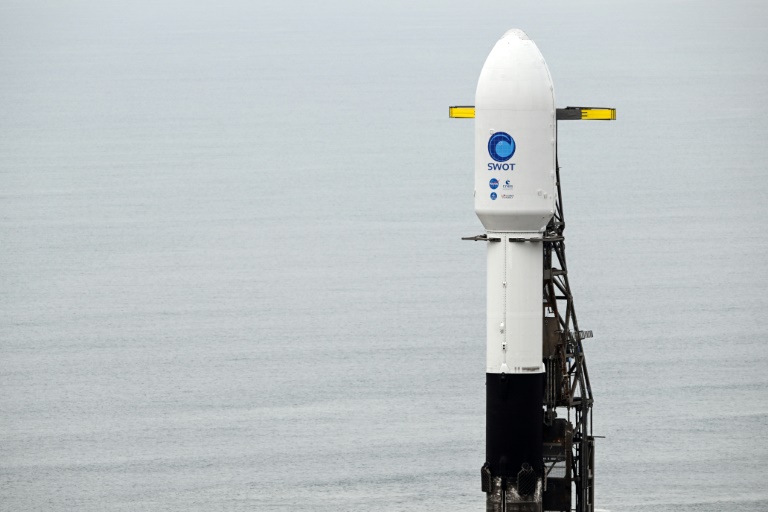
A satellite lifted off Friday from California on a mission to survey nearly all bodies of water on Earth, offering key insights on how they influence or are impacted by climate change.

The Surface Water and Ocean Topography (SWOT) satellite, a billion-dollar project jointly developed by NASA and France’s space agency CNES, took off at 1146 GMT atop a SpaceX rocket from the Vandenberg Space Force Base.

According to a statement from NASA, it will start collecting scientific data in about six months after undergoing checks and calibrations.

“SWOT will bring us a revolutionary advance in our understanding of how water moves around our planet,” said Karen St. Germain, NASA’s Earth Science Division director, ahead of the launch.

“We will be able to see detail in eddies and currents and circulation in the oceans that we have never been able to see before.”

She said this would help predict floods in areas with too much water, and manage water in regions prone to drought.

Selma Cherchali, of the French space agency CNES, told a press conference on Tuesday that the satellite represents a “revolution in hydrology. We are aiming to provide fine-scale observations ten times better than the current technology.”

From a height of 890 kilometers (550 miles), SWOT will have the clearest view yet of the world’s oceans, allowing it to track the rise in sea levels, as well as rivers and lakes.

The satellite will measure the height of water in freshwater bodies and the ocean on more than 90 percent of Earth’s surface — which it will track in its entirety at least once every 21 days.

Researchers will be able to get data on millions of lakes, rather than the few thousands currently visible from space.

NASA is currently operating some 25 space missions observing Earth, and SWOT will be like “putting on glasses. We will have a crisp picture,” said St. Germain.

– Understanding climate change –

The satellite will help scientists better understand climate change, and factors such as how much more heat and carbon dioxide oceans can absorb.

“We know with climate change that Earth’s water cycle is accelerating. What this means is that some locations have too much water, others don’t have enough,” said Benjamin Hamlington, a NASA research scientist.

“We’re seeing more extreme droughts, more extreme floods, precipitation patterns are changing, becoming more volatile. So it’s really important that we try to understand exactly what is happening.”

The mission is meant to last for three and a half years, but could be extended until five years, or even more, said SWOT’s project head at CNES, Thierry Lafon.

The breakthrough technology at the heart of the satellite mission is called KaRin, a Ka-band radar interferometer, which Lafon described as “the flagship for a new generation of altimeters in space.”

The radar sends down a signal which is reflected back by the water surface. This echo is received by two antennas, resulting in two sets of data providing high accuracy for water detection and resolution.

The US and French space agencies have worked together in the field for more than 30 years. A previous satellite developed by the partners, TOPEX/Poseidon, improved understanding of ocean circulation and its effect on global climate.

It also aided the forecast of the 1997-1998 El Nino weather phenomenon.

Stocks, oil prices extend losses on recession fears

Stock markets dropped further Friday on prospects of more aggressive rises to interest rates to fight sky-high inflation, renewing concerns over the global economy entering recession next year.

After a healthy rally in recent weeks fuelled by signs that price rises were slowing, the US Federal Reserve, European Central Bank and Bank of England this week crushed any Christmas spirit by hiking borrowing costs again by sizeable amounts and warning of more pain.

While inflation in most countries has started coming down — helped by a drop in energy costs — it remains at multi-decade highs.

Observers have warned that economies could be heading for a period of stagflation where prices keep rising but growth stalls.

“In a nutshell, it is all about fears over a sharper economic slowdown in 2023 than previously expected,” noted Fawad Razaqzada, market analyst at City Index trading group.

“While macro data have been weak of late, there was still hope that the downturn might be short-lived and that a recession might be avoided in some regions altogether, amid signs of inflation peaking in some regions like the US.”

The latest rate hikes came as data showed US and UK retail sales dropping in November as consumers — key drivers of growth — feel the pinch from high prices and rate hikes.

– Recession on horizon? –

“With central banks on both sides of the pond suggesting they have more work to tame inflation, hiking interest rates into a dimming macro environment will undoubtedly trigger a recession,” said SPI Asset Management’s Stephen Innes.

“The question is just how profound. Forget inflation; Asia traders are now worried about a global recession.”

Eurozone and London shares dropped in mid-afternoon trading, while Wall Street stocks also fell shortly after opening.

Earlier, Asia had also seen losses, with Tokyo closing down 1.9 percent.

On the upside, Hong Kong rose on progress in talks over allowing US officials to audit Chinese firms listed in New York, easing concerns about a possible delisting of some big names such as Alibaba and Tencent.

The news provided a little more help to Hong Kong traders, whose sentiment has been lifted also by China’s shift away from the economically damaging zero-Covid policy as well as moves to open the city further to overseas visitors.

And a report in the city’s South China Morning Post said the border with mainland China would be fully reopened next month, providing another much-needed boost to the beleaguered economy.

However, the mood was soured a little by a US decision to put 36 Chinese companies including top producers of advanced computer chips on a trade blacklist, severely restricting their access to any US technology.

– Key figures around 1445 GMT –

London – FTSE 100: DOWN 1.2 percent at 7,337.14 points

Frankfurt – DAX: DOWN 0.4 percent at 13,932.71

Paris – CAC 40: DOWN 1.0 percent at 6,456.45

EURO STOXX 50: DOWN 0.6 percent at 3,812.40 

New York – Dow: DOWN 0.6 percent at 33,005.58 

Tokyo – Nikkei 225: DOWN 1.9 percent at 27,527.12 (close)

Hong Kong – Hang Seng Index: UP 0.4 percent at 19,450.67 (close)

Shanghai – Composite: FLAT at 3,167.86 (close)

West Texas Intermediate: DOWN 3.2 percent at $73.65 per barrel

Brent North Sea crude: DOWN 3.1 percent at $78.73 per barrel

Euro/dollar: UP at $1.0645 from $1.0627 on Thursday

Pound/dollar: UP at $1.2216 from $1.2175

Euro/pound: DOWN at 87.15 pence from 87.26 pence

Dollar/yen: DOWN at 136.90 yen from 137.80 yen

Musk under fire as Twitter suspends journalists

Twitter-owner Elon Musk drew anger and stern warnings from regulators on Friday after suspending the accounts of half a dozen prominent journalists — accusing them of endangering his family.

Journalists from CNN, the New York Times and the Washington Post were cut off from the platform without warning on Friday, provoking the newest controversy since Musk took over the company on October 27.

“News about arbitrary suspension of journalists on Twitter is worrying,” EU commissioner Vera Jourova posted on Twitter, warning the influential platform could face hefty fines through European laws.

“Elon Musk should be aware of that. There are red lines. And sanctions, soon,” she added.

The latest controversy began when Musk on Wednesday suspended @elonjet, an account that tracked flights of his private jet.

Musk said the move was necessary after a car in Los Angeles carrying one of his children was followed by “a crazy stalker” and seemed to blame the tracking of his jet for this incident.

Some of the journalists had reported on the affair, including tweets linking to the suspended account, which Musk said amounted to “assassination coordinates” against he and his family.

In a chat hosted live on Twitter, Musk provided no evidence for his claim but told some of the suspended reporters that on Twitter “everyone’s going to be treated the same… they’re not special because you’re a journalist.”

Pressed further on his allegations, Musk ended the conversation. Twitter Spaces, the feature where the chat took place, was then suspended.

Media organizations criticized the move sharply and opened the door to re-evaluating their relationship with Twitter, which has become an essential tool for journalism in the past decade.

“The impulsive and unjustified suspension of a number of reporters, including CNN’s Donie O’Sullivan, is concerning but not surprising,” the news organization said in a tweet.

“Twitter’s increasing instability and volatility should be of incredible concern for everyone who uses the platform.”

The New York Times said in a statement it also wanted answers from Twitter regarding the “questionable” suspension of journalists.

– Twitter exodus? –

Twitter has lurched from one controversy to the next since Musk took control after paying $44 billion, mainly by selling shares in Tesla, his successful electric car company. 

The billionaire’s talk of unfettered speech has scared off major advertisers and caught the attention of regulators.

Musk has reinstated the account of former US president Donald Trump and lashed out against the outgoing key advisor for the US response to the Covid-19 pandemic, Anthony Fauci, a frequent target of vitriol on right-wing media.

CNN has reported that Twitter’s former head of trust and safety fled his home after baseless attacks on Twitter content moderation, endorsed by Musk.

Meanwhile, a purge initiated by Musk at Twitter left more than half of its 7,500 employees on the sidelines and now many of them are taking the SpaceX and Tesla tycoon to court.

Musk at one point signaled he was going to war with Apple over the App Store, only to later tweet that it was a “misunderstanding.”

Market tracker Insider Intelligence forecast that Twitter will experience an exodus of users.

“There won’t be one catastrophic event that ends Twitter,” said Insider Intelligence analyst Jasmine Enberg.

“Instead, users will start to leave the platform next year as they grow frustrated with technical issues and the proliferation of hateful or other unsavory content.”

Close Bitnami banner
Bitnami