US Business

Musk under fire as Twitter suspends journalists

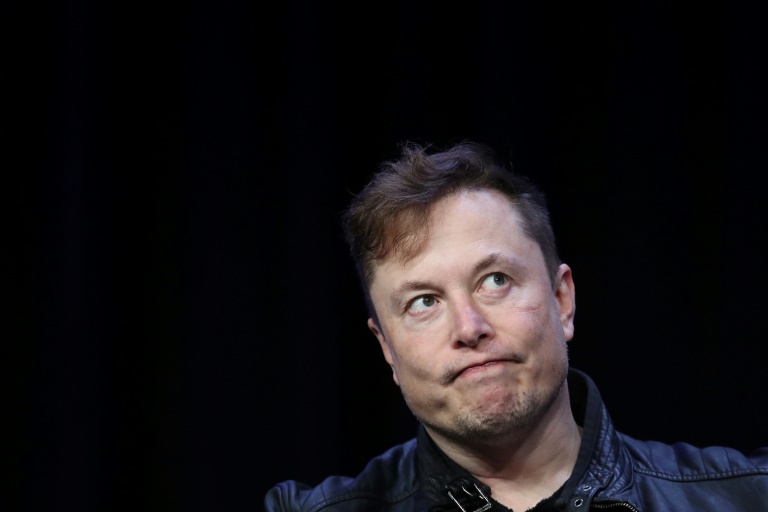
Twitter-owner Elon Musk drew anger and stern warnings from regulators on Friday after suspending the accounts of half a dozen prominent journalists — accusing them of endangering his family.

Journalists from CNN, the New York Times and the Washington Post were cut off from the platform without warning on Friday, provoking the newest controversy since Musk took over the company on October 27.

“News about arbitrary suspension of journalists on Twitter is worrying,” EU commissioner Vera Jourova posted on Twitter, warning the influential platform could face hefty fines through European laws.

“Elon Musk should be aware of that. There are red lines. And sanctions, soon,” she added.

The latest controversy began when Musk on Wednesday suspended @elonjet, an account that tracked flights of his private jet.

Musk said the move was necessary after a car in Los Angeles carrying one of his children was followed by “a crazy stalker” and seemed to blame the tracking of his jet for this incident.

Some of the journalists had reported on the affair, including tweets linking to the suspended account, which Musk said amounted to “assassination coordinates” against he and his family.

In a chat hosted live on Twitter, Musk provided no evidence for his claim but told some of the suspended reporters that on Twitter “everyone’s going to be treated the same… they’re not special because you’re a journalist.”

Pressed further on his allegations, Musk ended the conversation. Twitter Spaces, the feature where the chat took place, was then suspended.

Media organizations criticized the move sharply and opened the door to re-evaluating their relationship with Twitter, which has become an essential tool for journalism in the past decade.

“The impulsive and unjustified suspension of a number of reporters, including CNN’s Donie O’Sullivan, is concerning but not surprising,” the news organization said in a tweet.

“Twitter’s increasing instability and volatility should be of incredible concern for everyone who uses the platform.”

The New York Times said in a statement it also wanted answers from Twitter regarding the “questionable” suspension of journalists.

– Twitter exodus? –

Twitter has lurched from one controversy to the next since Musk took control after paying $44 billion, mainly by selling shares in Tesla, his successful electric car company. 

The billionaire’s talk of unfettered speech has scared off major advertisers and caught the attention of regulators.

Musk has reinstated the account of former US president Donald Trump and lashed out against the outgoing key advisor for the US response to the Covid-19 pandemic, Anthony Fauci, a frequent target of vitriol on right-wing media.

CNN has reported that Twitter’s former head of trust and safety fled his home after baseless attacks on Twitter content moderation, endorsed by Musk.

Meanwhile, a purge initiated by Musk at Twitter left more than half of its 7,500 employees on the sidelines and now many of them are taking the SpaceX and Tesla tycoon to court.

Musk at one point signaled he was going to war with Apple over the App Store, only to later tweet that it was a “misunderstanding.”

Market tracker Insider Intelligence forecast that Twitter will experience an exodus of users.

“There won’t be one catastrophic event that ends Twitter,” said Insider Intelligence analyst Jasmine Enberg.

“Instead, users will start to leave the platform next year as they grow frustrated with technical issues and the proliferation of hateful or other unsavory content.”

UK working 'flat out' for deal in N.Ireland: Sunak

UK Prime Minister Rishi Sunak said on Friday his government was working “flat out” to settle post-Brexit trading problems in Northern Ireland to end political paralysis in Belfast.

On his first visit to Northern Ireland as premier, Sunak said he was “really committed to resolving some of the issues with the protocol” and “protecting Northern Ireland’s place in the union”.

The UK and the EU have been working this year to resolve their differences over post-Brexit trade rules known as the Northern Ireland Protocol.

The deal keeps Northern Ireland in the European single market and customs union, mandating checks on goods heading to the province from the rest of the UK.

It has proven deeply unpopular with pro-British unionists who have said the arrangements drive a wedge between it and the three other UK nations.

Sunak said by working though the problems, Northern Ireland’s lawmakers should be able to restore power-sharing at the region’s devolved government.

“That is what the people in Northern Ireland need and deserve,” he added.

Northern Ireland’s government has been out of action since February because of a boycott by the Democratic Unionist Party (DUP).

The party withdrew its first minister from the executive at Stormont in February in protest over the protocol.

It has refused to return until the rules are overhauled or scrapped entirely.

Sunak said he would not put a “strict deadline” on talks between London and Brussels but vowed to “work as hard and as fast as I can to find a resolution”.

“I want to do that as soon as practically possible,” he added.

Sunak met the leaders of Northern Ireland’s five main political parties on Thursday evening.

DUP leader Jeffrey Donaldson said he was told by the prime minister there would likely be an “intensification at the political level” of negotiations over coming weeks.

Sunak also toured Belfast’s shipyards to highlight the revival of shipbuilding in the historic area where doomed liner the Titanic was built and launched over 100 years ago. 

Under a £1.6-billion ($1.9-billion) government contract, three new British naval vessels will be completed at the shipyards by a consortium led by Belfast shipbuilders Harland and Wolff.

NASA launches satellite for landmark study of Earth's water

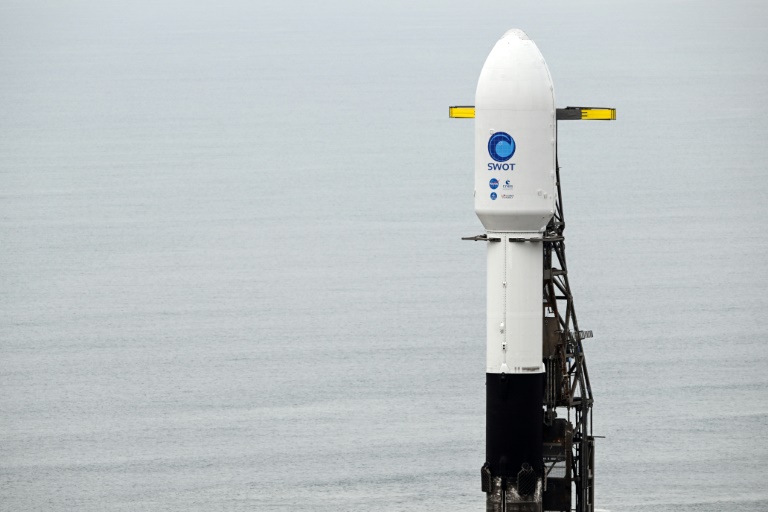
A satellite lifted off Friday from California on a mission to survey nearly all bodies of water on Earth, offering key insights on how they influence or are impacted by climate change.

The Surface Water and Ocean Topography (SWOT) satellite, a billion-dollar project jointly developed by NASA and France’s space agency CNES, took off at 1146 GMT atop a SpaceX rocket from the Vandenberg Space Force Base.

According to a statement from NASA, it will start collecting scientific data in about six months after undergoing checks and calibrations.

“SWOT will bring us a revolutionary advance in our understanding of how water moves around our planet,” said Karen St. Germain, NASA’s Earth Science Division director, ahead of the launch.

“We will be able to see detail in eddies and currents and circulation in the oceans that we have never been able to see before.”

She said this would help predict floods in areas with too much water, and manage water in regions prone to drought.

Selma Cherchali, of the French space agency CNES, told a press conference on Tuesday that the satellite represents a “revolution in hydrology. We are aiming to provide fine-scale observations ten times better than the current technology.”

From a height of 890 kilometers (550 miles), SWOT will have the clearest view yet of the world’s oceans, allowing it to track the rise in sea levels, as well as rivers and lakes.

Researchers will be able to get data on millions of lakes, rather than the few thousands currently visible from space.

“We know with climate change that Earth’s water cycle is accelerating. What this means is that some locations have too much water, others don’t have enough,” said Benjamin Hamlington, a NASA research scientist.

“We’re seeing more extreme droughts, more extreme floods, precipitation patterns are changing, becoming more volatile. So it’s really important that we try to understand exactly what is happening.”

The mission is meant to last for three and a half years, but could be extended until five years, or even more, said SWOT’s project head at CNES, Thierry Lafon.

The US and French space agencies have worked together in the field for more than 30 years. A previous satellite developed by the partners, TOPEX/Poseidon, improved understanding of ocean circulation and its effect on global climate.

Macau casino giants pledge $15 billion for 10-year licences

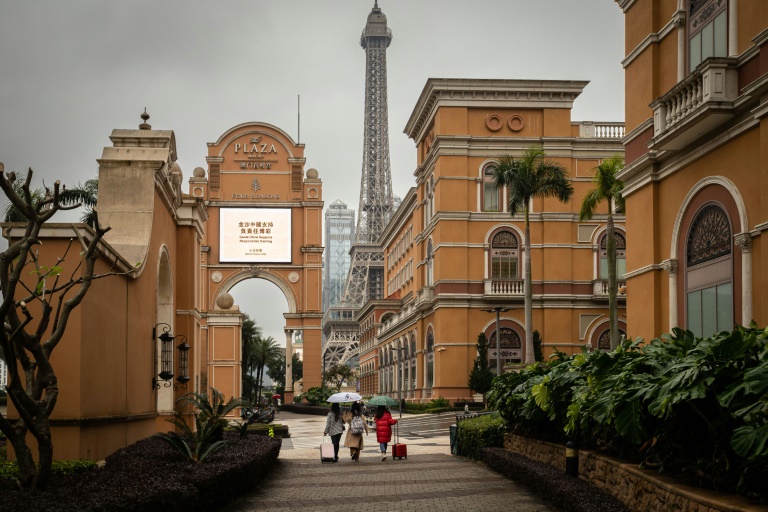
Six Macau casino firms agreed Friday to invest a total of 118.8 billion patacas ($15 billion) after being granted 10-year operating licences, with the bulk of the money pledged to non-gaming projects.

The former Portuguese colony is the only place in China where casinos are allowed, and issues just six operating concessions for a multi-billion-dollar industry that, until the pandemic hit, was bigger than Las Vegas.

Macau has been keen to diversify away from gambling into tourism and leisure for decades, but with mixed results.

The government confirmed last month that the six incumbents all won licence renewals, beating back a surprise bid from a newcomer firm linked to Malaysian gaming and resorts giant Genting.

The casino firms promised to spend 108.7 billion patacas — more than 90 percent of their investment total — on “exploring overseas customer markets and developing non-gaming projects”, the government said Friday.

Such projects would cover the “convention and exhibition business, entertainment and performances, sports events, culture and art, health care, and themed amusement”, the government added.

Macau’s leader Ho Iat-seng said he hoped the operators would contribute to Macau’s development and “deliver on their corporate social responsibilities regarding protection of local employment and promotion of upward mobility of local workers”.

The six firms — MGM China, Wynn Macau, Sands China, Galaxy Entertainment, Melco Resorts, and SJM Holdings — will begin their new contract period on January 1.

Shares in the operators have spiked more than 60 percent in the past three weeks, according to Bloomberg, as news of the licence renewals emerged and China loosens coronavirus restrictions.

But all are still trading well below where they were before the pandemic. 

Macau’s gaming sector, which has been limping for nearly three years, was further battered this year as the Omicron variant led to a cycle of lockdowns, testing and border closures for residents and kept mainland Chinese tourists away.

The casinos are on track for their weakest annual revenue on record, with only 38.7 billion patacas recorded between January and November — down 86 percent from the same period in 2019.

Even if pandemic measures are fully lifted, it is unlikely they will return to their headiest, freewheeling days.

Chinese President Xi Jinping has spearheaded an anti-corruption campaign that has increased scrutiny of the high rollers and officials who travel to gamble in Macau, where money laundering is common.

For decades, Macau’s gaming industry was run as a monopoly by casino magnate Stanley Ho, but in 2002 more operators were brought in and issued 20-year concessions as part of a liberalisation effort.

In January, authorities slashed the licence period to 10 years and unveiled regulations seeking to increase local ownership and government supervision.

Russia fires missile barrage at Ukraine grid

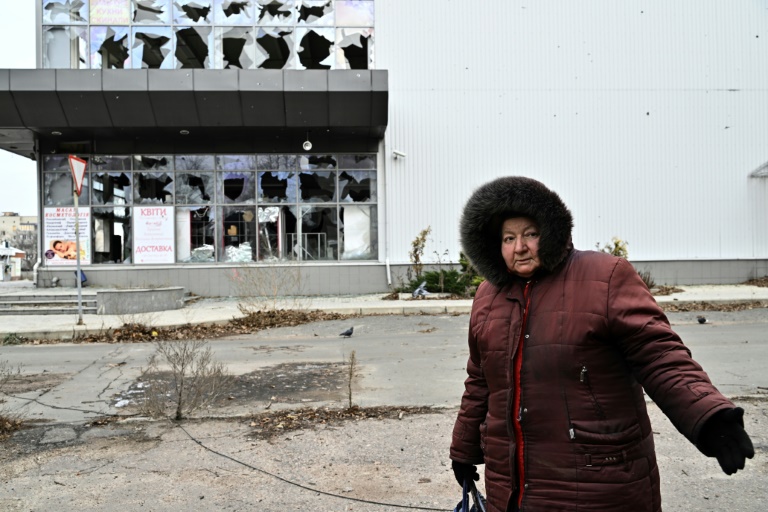
A fresh barrage of deadly Russian strikes battered Ukraine on Friday, cutting water and electricity in major cities and piling pressure on the grid in sub-zero temperatures.

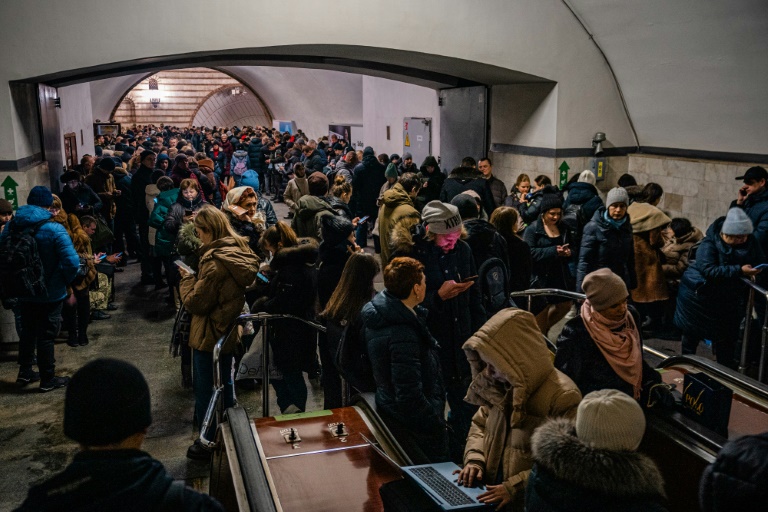
Kyiv residents in winter coats crammed into underground metro stations as air raid sirens rang out and Russian forces fired off dozens of missiles in one of the biggest broadsides targeting the Ukrainian capital since February.

AFP journalists reported loud explosions and Kyiv’s mayor said water supplies were disrupted in a wave of nationwide attacks that also killed two in President Volodymyr Zelensky’s hometown in the south.

Ukraine’s second largest city Kharkiv, near the border with Russia, was left without electricity, its mayor said.

“I woke up, I saw a rocket in the sky,” Kyiv resident 25-year-old Lada Korovai said. “I saw it and understood that I have to go to the tube.”

“We live in this situation. It’s a war, it’s real war,” she told AFP.

The onslaught is the latest of several waves of strikes targeting key infrastructure that began in October after a series of embarrassing battlefield defeats for Russia.

The central cities of Poltava and Kremenchuk were also without power and regional officials in Kryvyi Rig, where Zelensky was born, said rockets hit a residential building.

– Kyiv water cuts –

“Two people died,” governor Valentyn Reznichenko said. Eight were injured, he added.

Oleksandr Starukh, head of the frontline Zaporizhzhia region, which houses Europe’s largest nuclear power plant, said more than a dozen Russian missiles had targeted territory under Ukrainian control.

Kyiv meanwhile “withstood one of the biggest missile attacks since the beginning of the full-scale invasion. About 40 missiles were recorded in the capital’s airspace,” regional authorities said in a statement on social media. 

“Thirty-seven of them were destroyed by air defence forces!” they added.

Kyiv Mayor Vitali Klitschko said there were disruptions to water supplies and that the metro had stopped running so people could shelter underground.

“Due to damage to the power system and emergency power outages, subway trains will not run until the end of the day today,” city officials later announced online.

The Kyiv metro, a vital resource for the capital which had a pre-war population of three million, has been used as a city-wide bomb shelter since the Russian invasion.

About half of Ukraine’s energy grid has been damaged in sustained attacks and the national provider warned Friday of emergency blackouts because of the “massive” wave of Russian attacks.

– ‘Russian terror’ –

Temperatures in the Ukrainian capital hovered between minus one and three degrees Celsius (30 to 37 degrees Fahrenheit).

Foreign Minister Dmytro Kuleba called on Ukraine’s allies to bolster supplies of weapons.

“For each Russian missile or drone aimed at Ukraine and Ukrainians there must be a howitzer delivered to Ukraine, a tank for Ukraine, an armoured vehicle for Ukraine,” he said on social media. 

“This would effectively end Russian terror against Ukraine and restore peace and security in Europe and beyond.”

Fresh Russian shelling in the southern city of Kherson, recently recaptured by Ukraine, killed one person and wounded three more.

Kherson has been subjected to persistent Russian shelling since Moscow’s forces retreated in November and power was cut in the city on Thursday. 

The UN humanitarian coordinator for Ukraine, Denise Brown, said a woman working as a paramedic for the Ukrainian Red Cross was killed by Thursday’s strikes in Kherson.

In the Russian-controlled region of Lugansk in eastern Ukraine, Moscow-installed officials said shelling from Kyiv’s forces had killed eight and wounded 23.

– Putin to visit Belarus –

“The enemy is conducting barbaric shelling of cities and districts of the republic,” the Russian-installed leader of Lugansk Leonid Pasechnik said on social media.

Moscow has said the strikes on Ukrainian infrastructure are a response to an explosion on the Kerch bridge connecting the Russian mainland to the Crimean peninsula annexed by Moscow in 2014.

The Kremlin has said it holds Kyiv ultimately responsible for the humanitarian impact of the strikes for refusing to capitulate to Russian negotiation terms.

Ukrainian defence officials have credited systems newly supplied by Western allies for downing Russian missiles and drones.

Defence officials said this week that Ukraine had shot down a swarm of more than a dozen Iranian-made attack drones launched at Kyiv.

Separately on Friday, Russian President Vladimir Putin announced he will visit Belarus next week for talks with his counterpart and ally Alexander Lukashenko.

Minsk said the pair will hold one-on-one talks as well as wider negotiations with their ministers on “Belarusian-Russian integration”. 

Twitter suspends accounts of journalists covering Musk

Twitter suspended Thursday accounts of more than a half-dozen journalists who had been writing about the company and its new owner Elon Musk.

Silencing journalists at Twitter while claiming to be a free speech champion is the latest controversy provoked by Musk since he took over the company, which has seen staffing gutted and advertisers exit.

Some of the journalists had been tweeting about Twitter shutting down an @ElonJet account that tracked flights of billionaire Musk’s private jet and about versions of that account hosted at other social networks.

Twitter did not say why the reporters’ accounts were suspended.

“Nothing says free speech like suspending journalists who cover you,” Sarah Reese Jones of news commentary website PoliticusUSA said in a tweeted response to posts about the suspensions.

Checks at Twitter showed account suspensions included reporters from CNN, The New York Times, and The Washington Post as well as independent journalists.

“The impulsive and unjustified suspension of a number of reporters, including CNN’s Donie O’Sullivan, is concerning but not surprising,” the news organization said in a tweet.

“Twitter’s increasing instability and volatility should be of incredible concern for everyone who uses the platform.”

CNN said it has asked Twitter for an explanation of the suspension.

The New York Times said in a statement it also wanted answers from Twitter regarding the “questionable” suspension of journalists.

“I have no idea what rules I purportedly broke,” independent journalist Aaron Rupar, whose Twitter account was suspended, wrote in a Substack post.

“I haven’t heard anything from Twitter at all.”

In a tweet late Thursday, Musk appeared to allude to the suspension of the reporters’ accounts with this tweet: “If anyone posted real-time locations & addresses of NYT reporters, FBI would be investigating, there’d be hearings on Capitol Hill & Biden would give speeches about end of democracy!”

Musk on Wednesday tweeted that a car in Los Angeles carrying one of his children was followed by “a crazy stalker” and seemed to blame the tracking of his jet for this alleged incident. In the tweet, he said legal action is being taken against the person who ran ElonJet.

The Twitter account that tracked flights of Musk’s private jet was shut down Wednesday despite the billionaire’s statement that he is a free speech absolutist.

Twitter later sent out word that it updated its policy to prohibit tweets, in most cases, from giving away someone’s location in real time.

Musk had gone public saying he would not touch @ElonJet after buying Twitter in a $44 billion deal as part of his commitment to free speech at the platform.

The European Union warned Musk on Friday that Twitter could be subject to sanctions under a future media law after the “worrying” suspension of several journalists from the platform.

“News about arbitrary suspension of journalists on Twitter is worrying. EU’s Digital Services Act requires respect of media freedom and fundamental rights. This is reinforced under our Media Freedom Act,” EU commissioner Vera Jourova tweeted.

“Elon Musk should be aware of that. There are red lines. And sanctions, soon.”

– Exodus expected –

Twitter has lurched from one controversy to the next since Musk took control in late October.

The billionaire’s talk of unfettered speech scared off major advertisers and caught the attention of regulators.

Musk has reinstated the account of former US president Donald Trump and lashed out against the outgoing key advisor for the US response to the Covid-19 pandemic, Anthony Fauci, a frequent target of vitriol on right-wing media.

CNN has reported that Twitter’s former head of trust and safety fled his home after baseless attacks on Twitter content moderation, endorsed by Musk.

Meanwhile, a purge initiated by Musk at Twitter left more than half of its 7,500 employees on the sidelines and now many of them are taking the SpaceX and Tesla tycoon to court.

Musk at one point signaled he was going to war with Apple over the App Store, only to later tweet that it was a “misunderstanding.”

Market tracker Insider Intelligence forecast that Twitter will experience an exodus of users.

“There won’t be one catastrophic event that ends Twitter,” said Insider Intelligence analyst Jasmine Enberg.

“Instead, users will start to leave the platform next year as they grow frustrated with technical issues and the proliferation of hateful or other unsavory content.”
Stocks, oil prices extend losses on recession fears

Stock markets dropped further Friday on prospects of more aggressive rises to interest rates to fight sky-high inflation, renewing concerns over the global economy entering recession next year.

After a healthy rally in recent weeks fuelled by signs that price rises were slowing, the US Federal Reserve, European Central Bank and Bank of England this week crushed any Christmas spirit by hiking borrowing costs again by sizeable amounts and warning of more pain.

While inflation in most countries has started coming down — helped by a drop in energy costs — it remains at multi-decade highs.

And observers have warned that economies could be heading for a period of stagflation where prices keep rising but growth stalls.

“In a nutshell, it is all about fears over a sharper economic slowdown in 2023 than previously expected,” noted Fawad Razaqzada, market analyst at City Index trading group.

“While macro data have been weak of late, there was still hope that the downturn might be short-lived and that a recession might be avoided in some regions altogether, amid signs of inflation peaking in some regions like the US.”

The latest rate hikes came as data showed US and UK retail sales dropping in November as consumers — key drivers of growth — feel the pinch from high prices and rate hikes.

– Recession on horizon? –

“With central banks on both sides of the pond suggesting they have more work to tame inflation, hiking interest rates into a dimming macro environment will undoubtedly trigger a recession,” said SPI Asset Management’s Stephen Innes.

“The question is just how profound. Forget inflation; Asia traders are now worried about a global recession.”

Wall Street tumbled Thursday, with the Nasdaq losing more than three percent as tech firms took another blow.

And the losses carried through to Asia, where Tokyo closed down 1.9 percent.

Eurozone indices dropped approaching the half-way stage but less sharply compared with Thursday.

On the upside, Hong Kong rose on progress in talks over allowing US officials to audit Chinese firms listed in New York, easing concerns about a possible delisting of some big names such as Alibaba and Tencent.

The news provided a little more help to Hong Kong traders, whose sentiment has been lifted also by China’s shift away from the economically damaging zero-Covid policy as well as moves to open the city further to overseas visitors.

And a report in the city’s South China Morning Post said the border with mainland China would be fully reopened next month, providing another much-needed boost to the beleaguered economy.

However, the mood was soured a little by a US decision to put 36 Chinese companies including top producers of advanced computer chips on a trade blacklist, severely restricting their access to any US technology.

– Key figures around 1145 GMT –

London – FTSE 100: DOWN 1.3 percent at 7,333.40 points

Frankfurt – DAX: DOWN 0.8 percent at 13,870.08

Paris – CAC 40: DOWN 1.3 percent at 6,438.84

EURO STOXX 50: DOWN 1.1 percent at 3,795.35

Tokyo – Nikkei 225: DOWN 1.9 percent at 27,527.12 (close)

Hong Kong – Hang Seng Index: UP 0.4 percent at 19,450.67 (close)

Shanghai – Composite: FLAT at 3,167.86 (close)

New York – Dow: DOWN 2.3 percent at 33,202.22 (close)

West Texas Intermediate: DOWN 1.8 percent at $74.71 per barrel

Brent North Sea crude: DOWN 1.8 percent at $79.74 per barrel

Euro/dollar: UP at $1.0630 from $1.0627 on Thursday

Pound/dollar: UP at $1.2187 from $1.2175

Euro/pound: DOWN at 87.22 pence from 87.26 pence

Dollar/yen: DOWN at 137.04 yen from 137.80 yen

Deadly Russian shelling cuts off Kherson power

Russian forces bombarded Kherson on Thursday, killing two people and depriving the Ukrainian city of electricity as the European Union announced its latest slew of sanctions against Moscow and an 18-billion-euro aid package for Kyiv.

Moscow-allied officials in the Russian-occupied city of Donetsk, meanwhile, said they have come under some of the heaviest shelling in years from Ukrainian forces, leaving one person dead.

Despite Russia’s retreat from the southern port city in November, Kherson remains within reach of Moscow’s weaponry and under constant threat.

Ukrainian President Volodymyr Zelensky said Russian forces had attacked Kherson 16 times on Thursday alone.

The International Committee of the Red Cross confirmed that a Ukrainian Red Cross worker had been killed by the strikes and urged that humanitarian “personnel and property” be spared.

While winter temperatures plunge below freezing, the heavy shelling has left Kherson “completely without power”, according to regional governor Yaroslav Yanushevych.

Much of Ukraine is struggling without heat or power after Moscow started targeting electricity and water systems nearly two months ago.

The UN human rights chief warned the campaign has inflicted “extreme hardship” on Ukrainians this winter, and also decried likely war crimes as he described his office’s documentation of civilians killed by Russian forces.

“Winter is coming, how can people survive?,” Svetlana, a resident of the capital, told AFP. “Lord, what do they want from us? They do not let Ukrainians live.”

– Summary killings –

UN rights chief Volker Turk said his office has documented the executions and direct killings of 441 civilians across three regions of Ukraine from the start of Russia’s invasion on February 24 until April 6.

The “actual figures are likely to be considerably higher”, he said, adding “there are strong indications that the executions… may constitute the war crime of wilful killing.”

Beyond that initial period, Turk said his team had continued to document gross rights violations affecting both civilians and combatants, including arbitrary detention, enforced disappearances, torture and sexual violence.

So far, he added, “accountability remains sorely lacking”.

He also warned of further displacements as Russian attacks on critical infrastructure leave people without power or clean water. 

“Additional strikes could lead to a further serious deterioration in the humanitarian situation and spark more displacement,” he said.

An estimated 18 million Ukrainians are already in need of humanitarian aid. 

– Kyiv expected to be targeted again –

Ukrainian commander-in-chief General Valeriy Zaluzhny told British weekly The Economist they expected a fresh Russian assault on Kyiv in the early months of 2023.

Kyiv was the primary target when the Russians first invaded on February 24. But their northern campaign, launched from Belarus, was rebuffed by a gritty Ukrainian counter-offensive that preserved the seat of government.

“The Russians are preparing some 200,000 fresh troops. I have no doubt they will have another go at Kyiv,” Zaluzhny said.

Russia has appeared to pump up its presence anew in Belarus in recent weeks, according to US-based conflict monitor the Institute for the Study of War.

But it said exercises and deployments do not likely indicate plans by Belarusian forces to attack northern Ukraine themselves.

Instead, the actions “are likely part of ongoing Russian information operations” to keep Kyiv nervous and force it to maintain significant force levels in the north, far from the active front lines, according to ISW.

– Blasts in Donetsk –

Having retreated from parts of southern Ukraine, Moscow’s forces have since engaged in fierce battles in the east, particularly in the Donetsk region.

The region has been partly controlled by Moscow-backed separatists since 2014.

On Thursday, local Russia-aligned authorities reported “the most massive shelling since 2014” in the regional capital, Donetsk city.

At least one person was killed and nine more injured in the strikes, they said.

In Donetsk, “the epicentre of the fighting remains the Bakhmut and Avdiivka directions,” Ukraine deputy defence minister Ganna Malyar told a briefing. 

“The enemy is hard to beat,” Petro, a Ukrainian military unit chief in the area, told AFP.

“Staying on the frontline is very difficult. They sustain heavy losses, but so do we.”

– International support –

The EU unleashed its ninth wave of sanctions on Russia Thursday, blacklisting “almost 200” individuals and entities, targeting three banks, curbing mining investments and banning more TV channels.

But diplomats have warned that the bloc is increasingly running out of ways to hurt the Russian economy as the war drags towards its 10th month. 

The EU also cleared the way to giving Ukraine another 18 billion euros ($19 billion) in aid following an impassioned plea from Zelensky.

In Washington, the Pentagon announced it will expand training for Ukrainian forces in Germany to about 500 persons per month focused on larger-scale manoeuvres and specific weapons systems.

The new effort will “include joint maneuver and combined arms operations training while building upon the specialized equipment training that we’re already providing,” Pentagon press secretary Pat Ryder said.

Ryder would not confirm expectations that the United States will provide advanced Patriot air defence batteries to Ukraine, which would bring added protection against Russian cruise missiles as well as tactical ballistic missiles Moscow is believed to be seeking from Iran.

Most markets drop as central banks crush Christmas spirit

Most stock markets fell Friday as investors contemplated interest rates going higher than expected for an extended period after central banks reaffirmed their commitment to bringing down inflation.

After a healthy rally in recent weeks fuelled by signs that price rises were slowing, the US Federal Reserve and European Central Bank this week crushed any Christmas spirit by hiking borrowing costs again and warning of more pain to come.

While inflation in most countries has started coming down from the levels seen earlier this year — helped by a drop in energy costs — it remains at multi-decade highs.

And observers have warned that economies could be heading for a period of stagflation where prices keep rising but growth stalls.

After a rough week for markets, anxiety was enhanced on Wednesday after the Fed hiked rates as expected but indicated they would likely have to go higher than had been forecast, ramping up fears of a recession.

That was followed by similar moves by the ECB on Thursday, with its boss Christine Lagarde warning: “We have more ground to cover, we have longer to go and we are in for a long game.”

The Bank of England also lifted rates and said more hikes were on the cards.

The decisions came as data also showed that almost a year of monetary tightening was hitting the economy more and more, with US retail sales dropping in November as American consumers — the key driver of growth — began to feel the pinch.

– Recession on horizon? –

“With central banks on both sides of the pond suggesting they have more work to tame inflation, hiking interest rates into a dimming macro environment will undoubtedly trigger a recession,” said SPI Asset Management’s Stephen Innes.

“The question is just how profound. Forget inflation; Asia traders are now worried about a global recession.”

All three main indexes on Wall Street tumbled Thursday, with the Nasdaq losing more than three percent as tech firms took another blow.

And the losses carried through to Asia, where Tokyo gave up 1.9 percent while Sydney, Seoul, Singapore, Mumbai, Taipei, Bangkok and Manila were also in the red. Shanghai was barely moved.

However, the dollar eased back slightly after Thursday’s rally.

Hong Kong rose, supported by signs of progress in talks on allowing US officials to audit Chinese firms listed in New York, easing concerns about a possible delisting of some big names such as Alibaba and Tencent.

The news provided a little more help to Hong Kong traders, whose sentiment has been lifted by China’s shift away from the economically damaging zero-Covid policy as well as moves to open the city further to overseas visitors.

And a report in the city’s South China Morning Post said the border with mainland China would be fully reopened next month, providing another much-needed boost to the beleaguered economy.

However, the mood was soured a little by a US decision to put 36 Chinese companies including top producers of advanced computer chips on a trade blacklist, severely restricting their access to any US technology.

London, Paris and Frankfurt opened mixed a day after suffering hefty losses.

– Key figures around 0820 GMT –

Tokyo – Nikkei 225: DOWN 1.9 percent at 27,527.12 (close)

Hong Kong – Hang Seng Index: UP 0.4 percent at 19,450.67 (close)

Shanghai – Composite: FLAT at 3,167.86 (close)

London – FTSE 100: DOWN 0.1 percent at 7,418.88

Euro/dollar: UP at $1.0640 from $1.0627 on Thursday

Dollar/yen: DOWN at 137.16 yen from 137.80 yen

Pound/dollar: UP at $1.2200 from $1.2175

Euro/pound: DOWN at 87.25 pence from 87.26 pence

West Texas Intermediate: DOWN 0.5 percent at $75.77 per barrel

Brent North Sea crude: DOWN 0.3 percent at $80.99 per barrel

New York – Dow: DOWN 2.3 percent at 33,202.22 (close)

Kevin Spacey due in UK court on new sex offence charges

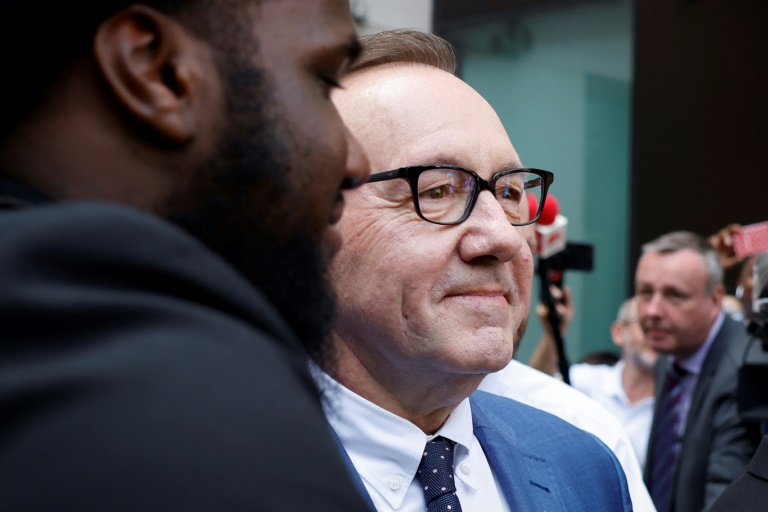
Oscar-winning Hollywood actor Kevin Spacey was due in court in London on Friday to face seven new sexual offence charges.

Prosecutors announced last month they had authorised additional charges against “The Usual Suspects” and “American Beauty” star.

In July, Spacey, 63, pleaded not guilty to five similar charges against three men between 2005 and 2013 in London and Gloucestershire, western England.

The latest allegations will be formally put to him at a hearing at Westminster Magistrates Court in central London from 1400 GMT, a court official told AFP.

They are three charges of indecent assault, three of sexual assault and one of causing a person to engage in sexual activity without consent.

Prosecutors said they related to one man and were allegedly committed between 2001 and 2004.

None of the alleged victims can be identified under English law. Reporting restrictions prevent further details being disclosed before trial.

Spacey, who was artistic director at London’s Old Vic Theatre between 2004 and 2015, in October saw a New York court dismiss a $40 million sexual misconduct lawsuit brought against him.

Anthony Rapp alleged the star targeted him when he was 14. But a judge ruled he had brought the case too late for a criminal charge.

Spacey’s acting career ended five years ago when the claims surfaced and he was dropped from the final season of political drama “House of Cards” and other projects.

Claims against the actor emerged in the wake of the #MeToo movement of sexual assault and harassment in the movie industry.

In 2019, charges of indecent and sexual assault were dropped against him in Massachusetts, in the US northeast.

Spacey has always denied allegations of sexual abuse.

Close Bitnami banner
Bitnami