World

UN team heads to Ukraine nuclear plant despite shelling

UN inspectors pressed on towards a Russian-held nuclear plant in southern Ukraine Thursday despite an early shelling attack, as the ICRC warned the consequences of a strike on the facility could be “catastrophic”.

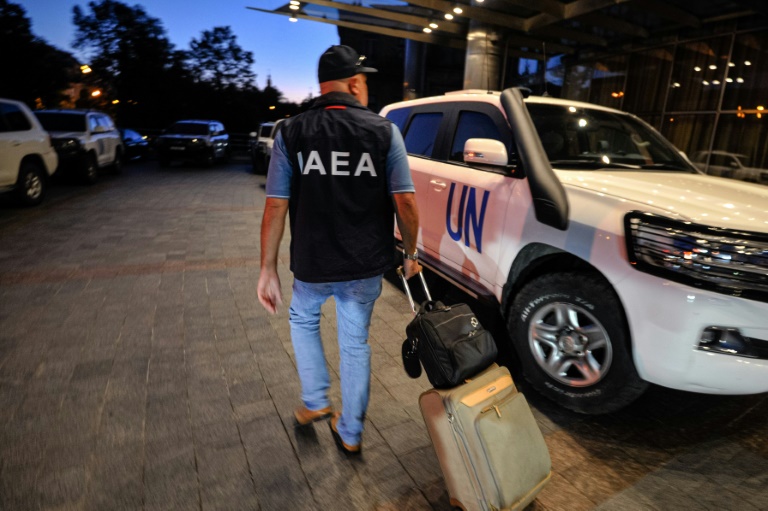
Just before the 14-strong team from International Atomic Energy Agency (IAEA) left for the Zaporizhzhia nuclear plant, Ukraine said Russian troops had shelled the town next door.

The area around the plant — Europe’s largest nuclear facility — has suffered repeated shelling, with both sides accusing the other of responsibility, sparking global concern over the risk of an accident. 

“It is high time to stop playing with fire and instead take concrete measures to protect this facility.. from any military operations,” ICRC chief Robert Mardini told reporters in Kyiv. 

“The slightest miscalculation could trigger devastation that we will regret for decades.”

Ukraine’s nuclear agency Energoatom said later that one of the six reactors at the Russian-held nuclear plant was shut down Thursday as an emergency protection measure following the shelling in the area.

“Today at 4:57 am (0157 GMT), due to another mortar shelling by the Russian occupying forces at the Zaporizhzhya nuclear power plant site, the emergency protection was activated and operating power unit 5 was shut down,” it said.

Mardini said it was “encouraging” that the IAEA team was en route to inspect the plant because the stakes were “immense”.

“When hazardous sites become battlegrounds, the consequences for millions of people and the environment can be catastrophic and last many years,” he said.

Just before leaving the southern city of Zaporizhzhia, IAEA chief Rafael Grossi said his team had been updated about the shelling but would press on anyway.

“We are not stopping,” he vowed, despite being aware there that in crossing the frontline into Russian-held territory, there was a security “grey area.. where the risks are significant”. 

“I believe we have to proceed with this. We have a very important mission to accomplish.”

– Fresh shelling attack –

Earlier, the mayor of Energodar, the town next to the plant, said it had come under sustained attack early on Thursday. 

In an 8:00 am (0500 GMT) update on Telegram, Mayor Dmytro Orlov said that since dawn, Russian troops had “shelled Energodar with mortars and used automatic weapons and rockets,” posting images of damaged buildings and spiralling smoke.

But Moscow accused Kyiv of smuggling in up to 60 military “saboteurs”, saying they reached the area near the plant just after dawn and that Russian troops had taken “measures to annihilate the enemy”. 

Grossi on Wednesday said the IAEA would seek to establish a “permanent presence” at the plant to avoid a nuclear disaster at the facility which is located on the frontline of the fighting.

“My mission is… to prevent a nuclear accident and preserve the largest nuclear power plant in Europe,” he said. 

– ‘Explicit safety guarantees’ –

Although Zaporizhzhia is normally about a two-hour drive from the plant, it was not immediately long it would take the IAEA team to get there after crossing the frontline into Russian-held areas.

The plant has been occupied by Russian troops since March and Ukraine has accused Russia of deploying hundreds of soldiers and storing ammunition there.

Both Moscow and Kyiv have accused each other of staging “provocations” aimed at disrupting the work of the IAEA mission. 

“Sadly, Russia is not stopping its provocations precisely in the direction the mission needs to travel to reach the plant,” President Volodymyr Zelensky said late Tuesday after meeting Grossi.

And in Moscow, the Russian defence ministry accused Kyiv of “continued provocations aimed at disrupting the work of the IAEA mission” saying it had shelled the area around the plant on Tuesday hitting a building containing “the solid radioactive waste processing complex”.

– Counteroffensive in the south –

Meanwhile, intensive fighting raged across the nearby southern region of Kherson where Ukraine began a counteroffensive on Monday. 

Most of the region and its provincial capital of the same name were seized by Russian forces at the start of the invasion six months ago.

With the war in the eastern Donbas region largely stalled, analysts have said for weeks that combat is likely to shift south to break the stalemate before winter comes.

Meanwhile, a British medic volunteering in Ukraine died in the fighting, the foreign ministry in London said on Thursday. It said he had died on August 24 but gave no further details. 
UN team heads to Ukraine nuclear plant despite shelling

UN inspectors pressed on towards a Russian-held nuclear plant in southern Ukraine Thursday despite an early shelling attack, as the ICRC warned the consequences of a strike on the facility could be “catastrophic”.

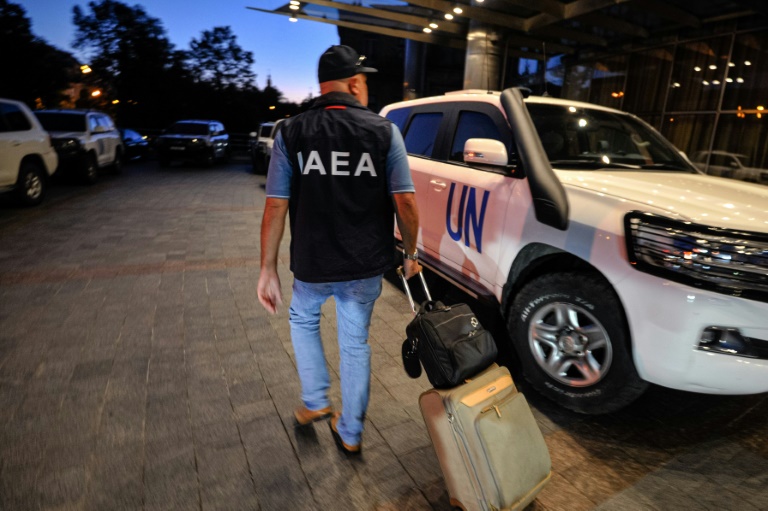
Just before the 14-strong team from International Atomic Energy Agency (IAEA) left for the Zaporizhzhia nuclear plant, Ukraine said Russian troops had shelled the town next door.

The area around the plant — Europe’s largest nuclear facility — has suffered repeated shelling, with both sides accusing the other of responsibility, sparking global concern over the risk of an accident. 

“It is high time to stop playing with fire and instead take concrete measures to protect this facility.. from any military operations,” ICRC chief Robert Mardini told reporters in Kyiv. 

“The slightest miscalculation could trigger devastation that we will regret for decades.”

Ukraine’s nuclear agency Energoatom said later that one of the six reactors at the Russian-held nuclear plant was shut down Thursday as an emergency protection measure following the shelling in the area.

“Today at 4:57 am (0157 GMT), due to another mortar shelling by the Russian occupying forces at the Zaporizhzhya nuclear power plant site, the emergency protection was activated and operating power unit 5 was shut down,” it said.

Mardini said it was “encouraging” that the IAEA team was en route to inspect the plant because the stakes were “immense”.

“When hazardous sites become battlegrounds, the consequences for millions of people and the environment can be catastrophic and last many years,” he said.

Just before leaving the southern city of Zaporizhzhia, IAEA chief Rafael Grossi said his team had been updated about the shelling but would press on anyway.

“We are not stopping,” he vowed, despite being aware there that in crossing the frontline into Russian-held territory, there was a security “grey area.. where the risks are significant”. 

“I believe we have to proceed with this. We have a very important mission to accomplish.”

– Fresh shelling attack –

Earlier, the mayor of Energodar, the town next to the plant, said it had come under sustained attack early on Thursday. 

In an 8:00 am (0500 GMT) update on Telegram, Mayor Dmytro Orlov said that since dawn, Russian troops had “shelled Energodar with mortars and used automatic weapons and rockets,” posting images of damaged buildings and spiralling smoke.

But Moscow accused Kyiv of smuggling in up to 60 military “saboteurs”, saying they reached the area near the plant just after dawn and that Russian troops had taken “measures to annihilate the enemy”. 

Grossi on Wednesday said the IAEA would seek to establish a “permanent presence” at the plant to avoid a nuclear disaster at the facility which is located on the frontline of the fighting.

“My mission is… to prevent a nuclear accident and preserve the largest nuclear power plant in Europe,” he said. 

– ‘Explicit safety guarantees’ –

Although Zaporizhzhia is normally about a two-hour drive from the plant, it was not immediately long it would take the IAEA team to get there after crossing the frontline into Russian-held areas.

The plant has been occupied by Russian troops since March and Ukraine has accused Russia of deploying hundreds of soldiers and storing ammunition there.

Both Moscow and Kyiv have accused each other of staging “provocations” aimed at disrupting the work of the IAEA mission. 

“Sadly, Russia is not stopping its provocations precisely in the direction the mission needs to travel to reach the plant,” President Volodymyr Zelensky said late Tuesday after meeting Grossi.

And in Moscow, the Russian defence ministry accused Kyiv of “continued provocations aimed at disrupting the work of the IAEA mission” saying it had shelled the area around the plant on Tuesday hitting a building containing “the solid radioactive waste processing complex”.

– Counteroffensive in the south –

Meanwhile, intensive fighting raged across the nearby southern region of Kherson where Ukraine began a counteroffensive on Monday. 

Most of the region and its provincial capital of the same name were seized by Russian forces at the start of the invasion six months ago.

With the war in the eastern Donbas region largely stalled, analysts have said for weeks that combat is likely to shift south to break the stalemate before winter comes.

Meanwhile, a British medic volunteering in Ukraine died in the fighting, the foreign ministry in London said on Thursday. It said he had died on August 24 but gave no further details. 
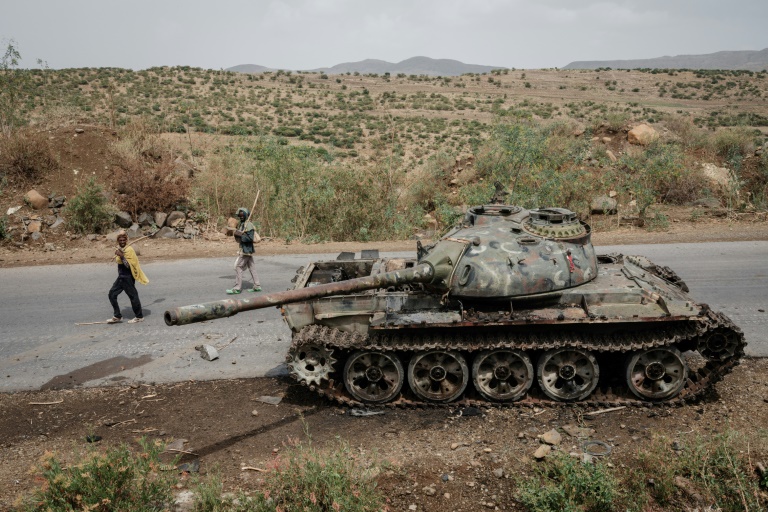
Ethiopia, Eritrea forces launch Tigray offensive: rebels

Ethiopian and Eritrean forces launched a “massive” joint offensive against the Tigray People’s Liberation Front (TPLF) in the northern region of Tigray on Thursday, the rebels said.

“The enemy, having already relocated a massive military force to Eritrea, has now begun a joint campaign with the foreign invading force of Eritrea to brutalise and exterminate the people of Tigray,” the rebels’ military command said in a statement.

AFP was not able to independently verify the claims. Access to northern Ethiopia is severely restricted and Tigray has been under a communications blackout for over a year.

TPLF spokesman Kindeya Gebrehiwot told AFP the attack was coming “from Eritrea”.  

Another TPLF spokesman, Getachew Reda, said on Twitter that the rebels were “defending their positions” and reported “heavy shelling” from some locations.

Addis Ababa has not responded to requests for comment about the reported offensive.

Fighting between government forces and the rebels resumed last week after a five-month lull.

Clashes on the ground and air raids over Tigray have dashed hopes of peacefully resolving the nearly two-year war.

Combat had been concentrated around the southeastern border of Tigray, with the rebels pushing into the neighbouring Amhara and Afar regions, sending residents fleeing.

The government on Wednesday accused the TPLF of launching a wider “invasion” into parts of western Tigray, and other areas west of the initial clashes.

The rebels in turn alleged that the government and its neighbour Eritrea — which backed federal forces during the war’s early phase — were responsible for opening a new front.

On Thursday, the government said TPLF attacks “had further continued to intensify”.

“Innocent civilians are being killed; many are being displaced and property is being destroyed,” the Government Communication Service said in a statement.

– International alarm –

Fighting has spread since fighting erupted over a week ago, while the capital of the war-torn Tigray region has been hit twice by air strikes.

The first air raid on Tigray’s capital Mekele killed at least four people, including children, in a strike UNICEF said “hit a kindergarten”.

The second, around midnight Tuesday, caused injuries and property damage, the TPLF said.

Both sides accused each other of firing first and shattering a March truce that had paused the worst of the bloodshed in northern Ethiopia.

The renewed fighting has alarmed the international community, with UN chief Antonio Guterres and senior diplomats from the European Union, Britain and the African Union (AU) among those to appeal for restraint.

US Secretary of State Antony Blinken on Thursday called on the Ethiopian government and the TPLF “to immediately halt military operations and redouble efforts to bring a permanent end to the conflict”.

“We remain deeply concerned at the resumption of fighting and the lives that it puts at risk,” he said on Twitter.

Legesse Tulu, a spokesman for the Ethiopian government, responded on Twitter, saying: “The US Government needs to cease the ‘both parties’ rhetoric and denounce the destructive path of TPLF affecting various Ethiopian communities.”

– Humanitarian crisis –

Prime Minister Abiy Ahmed, a Nobel Peace laureate, sent troops into Tigray to topple the TPLF in November 2020 in response to what he said were rebel attacks on federal army camps.

For months, his government denied the involvement of Eritrean forces in the conflict, though Abiy later admitted their presence in Ethiopia.

The TPLF recaptured most of Tigray in a surprise comeback in June 2021 and expanded into Afar and Amhara, before the fighting reached a stalemate.

Unknown numbers of civilians have died and millions are suffering from a humanitarian crisis in northern Ethiopia, with the conflict hindering efforts to assist those in need.

The government said Thursday that the TPLF was diverting aid supplies to its fighters.  

US aid chief Samantha Power said humanitarian workers in Tigray, Afar and Amhara were “facing unacceptable interference — including detentions, looting of fuel, and vehicle seizures”.

“USAID reiterates our call for all parties to respect humanitarian operations so that aid can reach those in need,” Power posted on Twitter on Wednesday.

Rosmah Mansor, wife of Malaysia's ex-leader, convicted of corruption

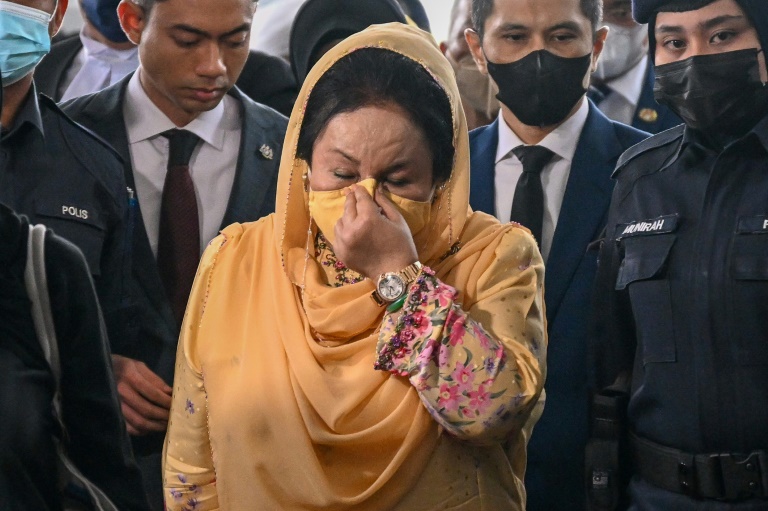
Rosmah Mansor, the wife of Malaysia’s ex-premier Najib Razak, was found guilty of graft on Thursday and sentenced to 10 years in jail with a $216 million fine, just over a week after her husband began serving a 12-year term after his own corruption conviction.

The 70-year-old has long been criticised by Malaysians for her reportedly vast collection of designer handbags, clothing and jewellery, acquired on overseas shopping trips.

Prosecutors said Rosmah had sought a 187.5 million-ringgit ($41.8 million) bribe and received 6.5 million-ringgit for helping a company secure a solar power project for rural schools in the Malaysian part of Borneo during her husband’s tenure.

“The accused is found guilty of all three charges,” High Court Judge Mohamed Zaini Mazlan said as Rosmah sat quietly in the dock.

After mitigation, he handed down a sentence of 10 years in jail for each of the three charges.

“The sentences are to run concurrently,” Zaini said, also imposing a fine of 970 million-ringgit.

During proceedings, a tearful Rosmah said she was “a victim”.

“My family has suffered. Have some humanity. Have some compassion.”

“The accused is not a hardened criminal,” her lawyer Jagjit Singh said. “She has never been involved in any malpractice. She has never had any convictions.”

But prosecutors sought maximum or near-maximum sentences for all three charges, calling corruption “the most vile of all diseases to affect society”.

Even having been sentenced, Rosmah will not go straight to jail, pending what could be a lengthy appeals process.

She remains on bail and still faces 17 other charges involving tax evasion and money laundering.

Born the only child of two teachers in the country’s south, Rosmah rose to become one of Malaysia’s most influential people.

She made headlines a decade ago for setting up a new unit under the prime minister’s office known as “FLOM”, an acronym for First Lady of Malaysia. The full-fledged department, which set critics’ tongues wagging, was tasked with handling Rosmah’s operational needs.

Her love for luxury, and in particular Hermes Birkin bags, came under the spotlight after 2018 raids in which police confiscated more than 500 handbags and 12,000 pieces of jewellery estimated to be worth $270 million.

This drew unflattering comparisons with one-time Philippines first lady and renowned shoe enthusiast Imelda Marcos — a big-spending woman who for years was a lightning rod for anger over alleged corruption.

– Multibillion-dollar scandal –

On Thursday, dressed in a peach-coloured traditional Malay dress and scarf with a floral print and matching face mask, Rosmah arrived in court escorted by police.

Her son and daughter also attended the court proceedings.

Najib was sent to prison nine days ago for an initial batch of charges linked to the multibillion-dollar financial scandal at state fund 1MDB that brought down his government in 2018.

He is currently on trial over four additional charges. He faces a maximum of 20 years in jail for abuse of power and up to 15 years for money laundering, if convicted.

Rosmah’s image had contributed to accusations that the ousted ruling establishment had lost touch with economically struggling and middle-class Malaysians.

“I think a lot of Malaysians will be happy that Rosmah has been found guilty,” said James Chin, professor of Asian studies at the University of Tasmania.

“Her image among the Malaysian public is bad. Many believe it was her lavish lifestyle that contributed to Najib’s downfall and subsequently landing himself in prison for corruption.”

The 1MDB scandal sparked investigations in the United States, Switzerland and Singapore, whose financial systems were believed to have been used to launder the money.

The US Justice Department has said more than $4.5 billion was stolen from 1MDB between 2009 and 2015 by high-level officials at the fund and their associates.

China slams UN report alleging litany of rights abuses in Xinjiang

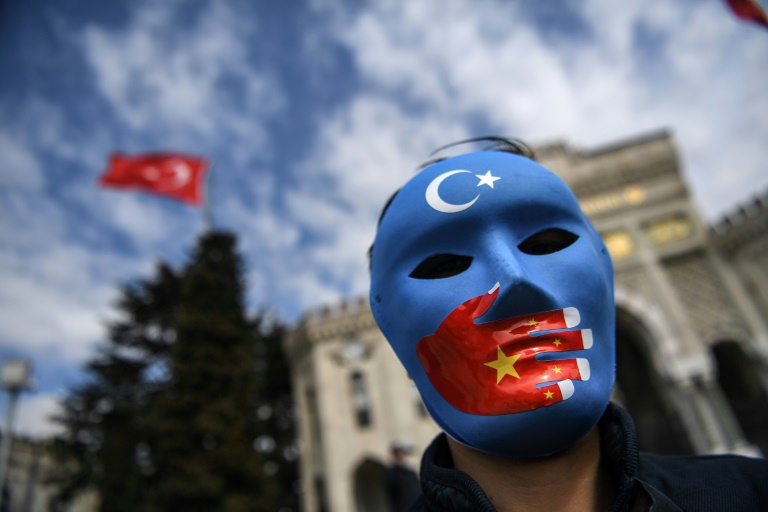
A UN report said claims of torture and forced labour in China’s Xinjiang are credible and warned crimes against humanity may have taken place, allegations condemned Thursday by Beijing as a “political tool” aimed at containing the country.

The landmark report detailed a string of rights violations against Uyghurs and other Muslim minorities in the far-western region, bringing the UN seal to many of the allegations long brought by activist groups, Western nations and the Uyghur community in exile.

However, the report stopped short of calling China’s actions in Xinjiang genocide — claims made by the United States and several Western lawmakers.

“The extent of arbitrary and discriminatory detention of members of Uyghur and other predominantly Muslim groups… may constitute international crimes, in particular crimes against humanity,” the report said.

It said the world must now pay “urgent attention” to the human rights situation in Xinjiang.

Beijing hit back hard against the report — over a year in the making — and maintained its firm opposition to its release, sharing an over-100-page document from the Xinjiang provincial government defending its policies in the region.

“The so-called critical report you mentioned is planned and manufactured firsthand by the US and some Western forces, it is wholly illegal and invalid,” foreign ministry spokesman Wang Wenbin told a regular briefing Thursday.

“The report is a hodgepodge of misinformation, and it is a political tool which serves as part of the West’s strategy of using Xinjiang to control China,” he added.

Wang also slammed the UN rights office as having “sunk to becoming the thug and accomplice of the US and the West” but said the report’s omission in calling China’s actions genocide shows their “lies… have fallen apart”.

Michelle Bachelet, the UN human rights chief, said she had decided that a full assessment was needed of the situation inside the Xinjiang Uyghur Autonomous Region (XUAR).

Bachelet was determined to release it before her four-year term as the UN High Commissioner for Human Rights expired at the end of August — and did so with 13 minutes to spare at 11:47 pm in Geneva.

“I said that I would publish it before my mandate ended and I have,” Bachelet said in an email sent to AFP on Thursday.

“The politicisation of these serious human rights issues by some states did not help.”

– ‘Serious human rights violations’ –

China has been accused for years of detaining more than one million Uyghurs and other Muslims in the region.

Beijing has vehemently rejected the claims, insisting it is running vocational centres designed to curb extremism.

“Serious human rights violations have been committed in XUAR in the context of the government’s application of counter-terrorism and counter-‘extremism’ strategies,” the UN report said.

The assessment raised concerns about the treatment of people held in China’s so-called Vocational Education and Training Centres (VETCs).

“Allegations of patterns of torture or ill-treatment, including forced medical treatment and adverse conditions of detention, are credible, as are allegations of individual incidents of sexual and gender-based violence,” the report said.

The UN Human Rights Office could not confirm how many people were affected by the VETCs but concluded that the system operated on a “wide scale” across the entire region.

The number in the VETCs, at least between the years 2017 and 2019, “was very significant, comprising a substantial proportion of the Uyghur and other predominantly Muslim minority populations”.

Campaigners have accused China of forcibly sterilising women, and the report cited “credible indications of violations of reproductive rights through the coercive enforcement of family planning policies”.

– ‘A game-changer’ –

Non-governmental organisations and campaign groups have said the report should act as a launchpad for further action.

Human Rights Watch’s China director Sophie Richardson said the “damning” findings of sweeping rights abuses showed why Beijing “fought tooth and nail” to prevent its publication.

The response from the Uyghur activist community was mixed, with some groups praising its work while others wished it had gone further in its condemnation of Beijing’s actions in Xinjiang.

“This is a game-changer for the international response to the Uyghur crisis,” said Uyghur Human Rights Project executive director Omer Kanat.

“Despite the Chinese government’s strenuous denials, the UN has now officially recognised that horrific crimes are occurring.”

And World Uyghur Congress president Dolkun Isa said the report paved the way for “meaningful and tangible action” by countries, businesses and the UN, adding: “Accountability starts now.”

But Salih Hudayar, a Uyghur-American who campaigns for Xinjiang independence, told AFP the report was “sadly not as strong as we had hoped”.

“Our people have been waiting years for the UN to speak out,” said Hudayar. 

“Unfortunately, because of Chinese government pressure the UN has long remained silent.”

IMF agrees to $2.9 bn bailout for bankrupt Sri Lanka

Bankrupt Sri Lanka will receive a conditional $2.9 billion bailout to repair its battered finances, the International Monetary Fund said Thursday, following a bruising economic crisis that saw the island nation’s president chased from the country.

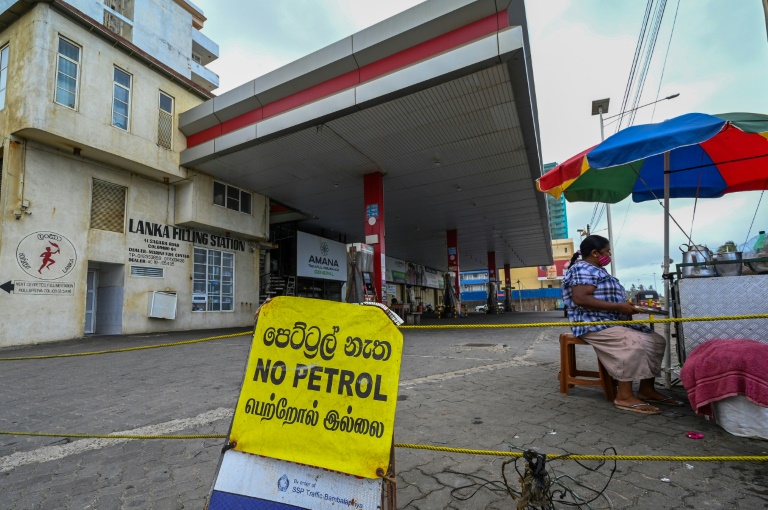
Months of acute food, fuel and medicine shortages, extended blackouts and runaway inflation have plagued the country after it ran out of dollars to finance even the most essential imports.

The country has defaulted on its $51 billion foreign debt and incensed protesters stormed the home of then-president Gotabaya Rajapaksa in July, with the leader subsequently fleeing the island and issuing his resignation from Singapore. 

“Sri Lanka has been facing an acute crisis… disproportionately borne by the poor and vulnerable,” the IMF said in a statement after nine days of talks in the capital Colombo. 

The IMF board will need to ratify Thursday’s staff agreement, which is conditional on the government striking a deal with creditors to restructure its borrowings.

But the lender’s head of mission, Peter Breuer, said creditors also needed to help Sri Lanka extricate itself from a “deep crisis” and return to servicing its debt. 

“It really is in the interest of all creditors to work with Sri Lanka on this front,” Breuer told reporters.

“If creditors are not willing to provide these assurances, that would indeed deepen the crisis in Sri Lanka and would undermine its repayment capacity.” 

China — the country’s biggest bilateral lender, accounting for over 10 percent of borrowings — has so far not publicly shifted from its offer of issuing more loans instead of taking a cut on outstanding loans.

– ‘The crucial issue’ –

Breuer could not say when the IMF financing would become available, but stressed that Sri Lanka’s needs were “urgent” and must be addressed immediately.

He added that IMF financing alone would not be enough to address Sri Lanka’s deep-seated structural economic problems.

“Additional financing from multilateral partners will be needed to close financing gaps,” Breuer said.

The IMF’s announcement of a $2.9 billion package, spread over four years, is short of the $3-4 billion sought by Sri Lanka.

Financial analyst W.A. Wijewardena, a former central bank deputy governor, said the government would need to implement more painful reforms to secure funding. 

“This shows that Sri Lanka should do a lot more to satisfy IMF requirements,” he told AFP. “Debt sustainability is the crucial issue.”

He said raising the government share of revenue, currently one of the world’s lowest, would be a serious challenge given the current state of the economy. 

The Central Bank expects a record eight percent GDP contraction this year, slightly below the IMF’s own forecast of 8.7 percent. 

– More taxes –

The IMF said Sri Lanka had agreed to increase revenues, remove subsidies, ensure a flexible exchange rate and rebuild its foreign reserves, which had hit rock bottom.

President Ranil Wickremesinghe, who took office after his predecessor fled, this week announced further tax hikes and sweeping reforms as part of efforts to bring debt under control.

His government had already raised prices on fuel and electricity more than threefold and removed energy subsidies, a key pre-condition for the IMF bailout. 

The coronavirus pandemic was a hammer-blow to the island’s tourism industry and dried up remittances from Sri Lankans working abroad — both key foreign exchange earners.

Rajapaksa’s government was criticised for introducing unsustainable tax cuts that drove up government debt and exacerbated the crisis. 

Inflation hit a fresh monthly record in August, with the country’s main benchmark showing price average rises of 64.3 percent, while the rupee has lost more than 45 percent of its value against the greenback this year. 

Authorities resisted approaching the IMF for relief until the country’s ballooning debt burden forced a default in April. 

At the peak of Sri Lanka’s petrol shortages, motorists had to wait for days and sometimes weeks to top up, althought strict fuel rationing has since shortened queues.

Public anger against government mismanagement of the crisis reached fever pitch in July, when protesters stormed Rajapaksa’s official residence and occupied several other government buildings.

Wickremesinghe has since restored order, with security forces cracking down on demonstrations and arresting protest leaders.

Kazakh leader says plans to call snap presidential vote this autumn

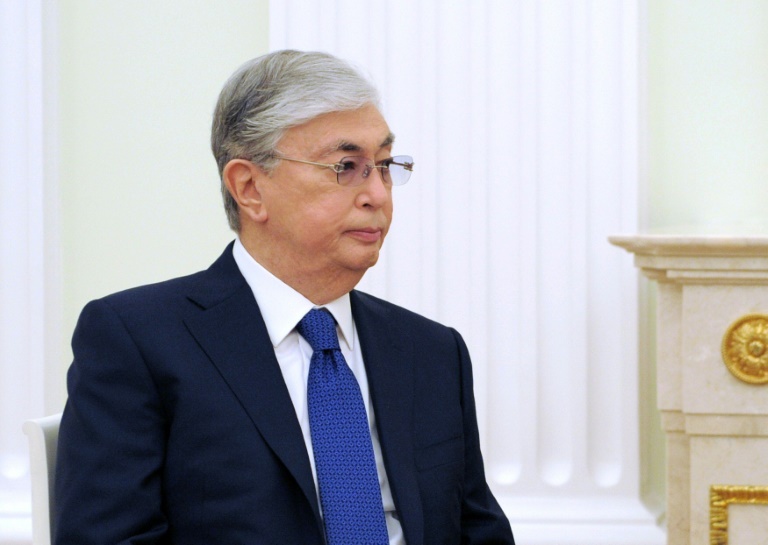
Kazakhstan’s President Kassym-Jomart Tokayev said Thursday he plans to call a snap presidential election this autumn and will reduce the presidency to one seven-year term.

In an address to the Central Asian country’s parliament, Tokayev also proposed holding snap parliamentary elections in the first half of 2023, after his country underwent a political crisis earlier this year that left more than 200 people dead.

“I propose that we hold early presidential elections in the autumn of 2022,” Tokayev said, saying measures were needed to “strengthen our statehood” and “maintain the momentum of reforms”.

A presidential vote had been due in Kazakhstan in 2024 and parliamentary elections in 2025.

Tokayev said he would move the parliamentary vote forward after constitutional changes earlier this year set “completely new standards for a political system with fair and open rules of the game”.

The term of the presidency would meanwhile be limited to one term of seven years, he said, from the current two five-year terms.

“For me, the interests of the state are above all. Therefore, I am ready to go to early presidential elections, even despite the reduction of my term in office,” Tokayev said. 

January’s unrest roiled energy-rich Kazakhstan, one of the most stable of the Central Asian countries that gained independence with the 1991 collapse of the Soviet Union.

The bloodshed — which grew out of peaceful protests over a spike in car fuel prices — left more than 230 people dead.

It came after career diplomat Tokayev, 69, was hand-picked in 2019 by Nursultan Nazarbayev, who had ruled Kazakhstan for close to three decades, to replace him in the presidency.

Kazakhstan in June voted in favour of changes to the constitution that Tokayev described as a shift from “super-presidential” rule.

Among the most eye-catching changes to the constitution was the absence of special privileges for 82-year-old Nazabayev.

Prior to January’s crisis, Tokayev was widely seen as ruling in the shadow of Nazarbayev and his super-rich relatives.

Even after stepping down as president, Nazarbayev retained the constitutional title of “Elbasy”, or “Leader of the Nation” — a role that afforded him influence over policymaking regardless of his formal position.

The new constitution does not acknowledge this status, while another amendment prevents relatives of the president from holding government positions.

Both former and current presidents are allies of neighbouring Russia, and the arrival of troops from a Moscow-led security bloc bolstered Tokayev’s control over the situation in January.

However there have been tensions between Russia and Kazakhstan since the launch of Moscow’s military campaign in Ukraine, with the Central Asian country seeking to balance ties with the West and ally Moscow. 

Asian investors step up selling as rate hikes loom

Investors further unloaded equities in Asia on Thursday as they girded themselves for more interest rate hikes aimed at quelling runaway inflation, with some analysts warning that markets could retest the lows touched in June.

Data showing prices rose at a record clip in the eurozone in August reinforced fears that central banks have a long road to run before they win their battle, which has fanned warnings of a recession in the world’s leading economies.

Another drop on Wall Street came as Treasury yields — a key gauge of future interest rates — rose further as a broadly healthy report on US private jobs showed there was still plenty of wiggle room for the Fed to continue tightening monetary policy.

Meanwhile, another top Fed official signalled the bank was determined to keep lifting borrowing costs, mirroring comments by head Jerome Powell last week that there would be no let-up in the fight against inflation.

“My current view is that it will be necessary to move the Fed funds rate up to somewhat above four percent by early next year and hold it there,” said Cleveland Fed President Loretta Mester in remarks prepared ahead of an event for the Dayton Area Chamber of Commerce.

“I do not anticipate the Fed cutting the Fed funds rate target next year.”

Interest rates are currently at 2.25-2.5 percent, and there is a growing expectation they will be hiked by a bumper 75 basis points for a third successive meeting later this month.

A government jobs report Friday will be closely watched by traders hoping for an idea about the next move by the bank, which has said it will make its decision based on data.

In a further warning that policymakers had a win-at-all-costs mentality, Mester later told the audience: “Even if the economy were to go into a recession, we have to get inflation down.”

The hawkish remarks out of the Fed have dealt a hefty blow to a rally in markets from their June lows.

And some have warned that more pain could be on the way, with Frances Stacy, of Optimal Capital Advisors, telling Bloomberg Radio: “I don’t think we’ve seen the bottom for this year.”

CMC markets analyst Michael Hewson added: “When you have the likes of a typical Fed dove like Minneapolis Fed President Neel Kashkari talk about the unlikely prospect of rate cuts in 2023, it’s hard to envisage a scenario of anything other than a 75-basis-point rate hike later this month, as the Fed continues to insist that their priority is to keep going on rates until the job is done.”

The downbeat mood in New York and Europe, which is also being buffeted by a major energy crisis, spread to Asia.

Tokyo, Hong Kong, Sydney, Seoul, Mumbai, Bangkok and Taipei were all deep in the red, though Singapore, Wellington, Manila and Jakarta eked out small gains.

Shanghai gave up an early advance following news that the Chinese city of Chengdu would effectively lock down around 16 million people in a bid to contain a Covid-19 outbreak, likely dealing another blow to an already stuttering economy.

London, Paris and Frankfurt fell further in early trade.

The prospect of more US rate hikes continued to press the dollar higher against all other currencies, with the psychological 140 yen mark well within sight for the first time since 1998.

And analysts are speculating that a breach of that barrier could see the Bank of Japan intervene, though they also warned it was unlikely to make much difference owing to Tokyo’s refusal to tighten its own monetary policy despite rising prices.

“There will likely be some sort of verbal intervention as 140 approaches,” said David Lu, of NBC Financial Markets Asia.

“But an actual intervention is likely to be ineffective at this point where the dollar is rising broadly on US monetary policy prospects while there is no support for the yen from the Bank of Japan.”

The greenback was also at its strongest level against the pound since the height of the pandemic in 2020, with sterling buying less than $1.16 in afternoon Asian trade.

– Key figures at around 0810 GMT –

Tokyo – Nikkei 225: DOWN 1.5 percent at 27,661.47 (close)

Hong Kong – Hang Seng Index: DOWN 1.8 percent at 19,597.31 (close)

Shanghai – Composite: DOWN 0.5 percent at 3,184.98 (close)

London – FTSE 100: DOWN 1.0 percent at 7,212.26

Euro/dollar: DOWN at $1.0026 from $1.0054 on Wednesday

Pound/dollar: DOWN at $1.1590 from $1.1619

Euro/pound: DOWN at 86.46 pence from 86.50 pence

Dollar/yen: UP at 139.40 yen from 138.98 yen

West Texas Intermediate: DOWN 0.6 percent at $88.99 per barrel

Brent North Sea crude: DOWN 0.6 percent at $95.09 per barrel

New York – Dow: DOWN 0.9 percent at 31,510.43 (close)

Villagers brave snakes and hunger to protect land in flooded Pakistan

The southern Pakistan village of Karim Bakhsh is almost entirely under muddy water after catastrophic monsoon rains — hardly any stable buildings are left for shelter, the wheat silos are empty and venomous snakes are a constant threat.

But unlike the tens of thousands of people who have fled their flooded homes, villages and towns across the country, several families here have refused to leave.

Without formal property deeds, many residents are worried that if they take off opportunists will seize their land, where their families have lived for generations.

“We had ownership papers from the British colonial government,” Intizar Ahmed, a 55-year-old farmer, told AFP Wednesday while standing on an elevated patch of land near his mostly submerged homestead in Sindh province.

“But we lost them many years ago in a flood like this… (besides) we have no place to go.”

Others said they worried about the fate of their livestock — a resource far too valuable for poor villagers to leave behind.

“We have buffaloes, cows and goats… if we leave the cattle behind they would be stolen,” said Shah Mohammad, 35.

Mohammad and others were scrambling to find food not just for themselves, but for their animals too.

There was enough for the animals to eat for now, he said, but villagers have been struggling to replenish empty wheat bins.

– Cut off from the world –

Aid delivered by boat by charities is the only lifeline for those who can’t or don’t want to leave Karim Bakhsh.

The village has been besieged by murky floodwaters extending for more than a kilometre in some spots.

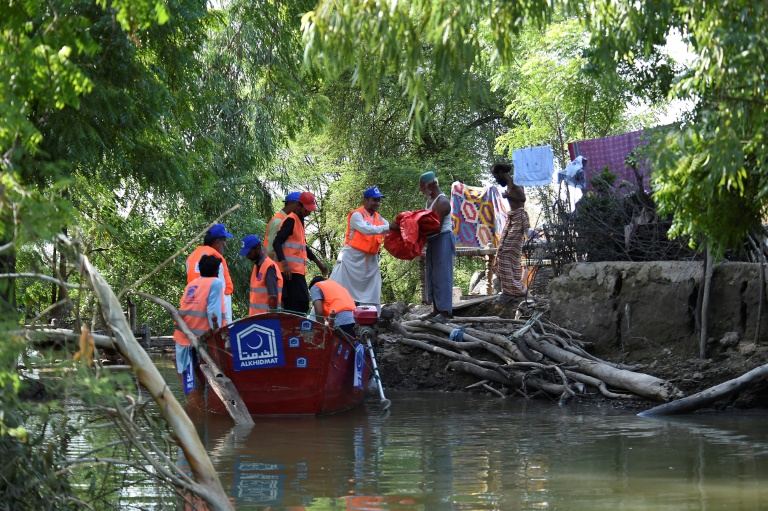
Villagers gathered on the few dry patches of land to wait for a boat operated by the Alkhidmat Foundation — a Pakistan-based humanitarian organisation — as it puttered through the waist-deep water in the streets.

It was the first aid delivery in days.

The boat made multiple stops in the village so relief workers could hand out tents, food packages and other supplies.

An aid worker said the charity had decided to make the deliveries after it found out that some families did not want to leave.

At every stop, there was evidence of the destruction wrought by the torrential rains and floods — the worst in decades.

Most homes and structures were ruined, and villagers were desperate for any material that might help build temporary shelter from both the rain and — when it came out — the scorching sun.

“Our homes fell… We cut down the trees and used that wood to hold up whatever was left of our walls,” said Gul Badshah, 70.

Maqbool Ahmed, another resident, prepared to face a different local threat especially common during floods: venomous snakes.

He connected a small lamp to a car battery, placing the setup on an earthen mound.

“We light it up in the night to guard against snakes,” he told AFP.

“Sometimes, cobras and vipers sneak into our place.”

Villagers brave snakes and hunger to protect land in flooded Pakistan

The southern Pakistan village of Karim Bakhsh is almost entirely under muddy water after catastrophic monsoon rains — hardly any stable buildings are left for shelter, the wheat silos are empty and venomous snakes are a constant threat.

But unlike the tens of thousands of people who have fled their flooded homes, villages and towns across the country, several families here have refused to leave.

Without formal property deeds, many residents are worried that if they take off opportunists will seize their land, where their families have lived for generations.

“We had ownership papers from the British colonial government,” Intizar Ahmed, a 55-year-old farmer, told AFP Wednesday while standing on an elevated patch of land near his mostly submerged homestead in Sindh province.

“But we lost them many years ago in a flood like this… (besides) we have no place to go.”

Others said they worried about the fate of their livestock — a resource far too valuable for poor villagers to leave behind.

“We have buffaloes, cows and goats… if we leave the cattle behind they would be stolen,” said Shah Mohammad, 35.

Mohammad and others were scrambling to find food not just for themselves, but for their animals too.

There was enough for the animals to eat for now, he said, but villagers have been struggling to replenish empty wheat bins.

– Cut off from the world –

Aid delivered by boat by charities is the only lifeline for those who can’t or don’t want to leave Karim Bakhsh.

The village has been besieged by murky floodwaters extending for more than a kilometre in some spots.

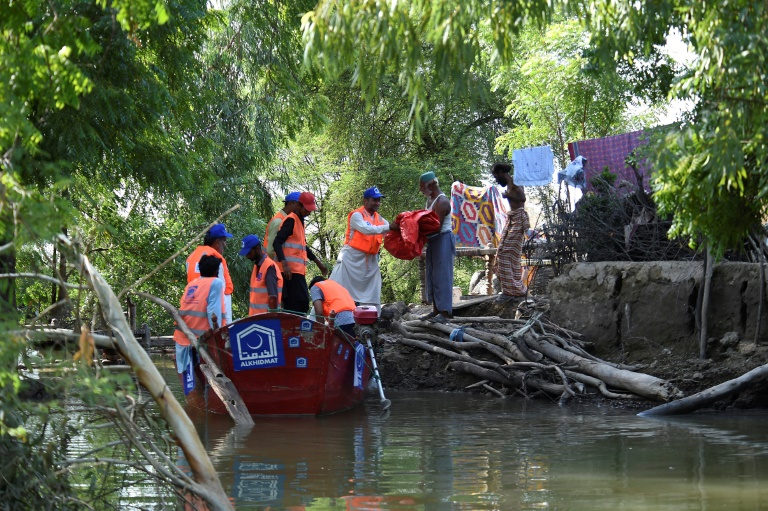
Villagers gathered on the few dry patches of land to wait for a boat operated by the Alkhidmat Foundation — a Pakistan-based humanitarian organisation — as it puttered through the waist-deep water in the streets.

It was the first aid delivery in days.

The boat made multiple stops in the village so relief workers could hand out tents, food packages and other supplies.

An aid worker said the charity had decided to make the deliveries after it found out that some families did not want to leave.

At every stop, there was evidence of the destruction wrought by the torrential rains and floods — the worst in decades.

Most homes and structures were ruined, and villagers were desperate for any material that might help build temporary shelter from both the rain and — when it came out — the scorching sun.

“Our homes fell… We cut down the trees and used that wood to hold up whatever was left of our walls,” said Gul Badshah, 70.

Maqbool Ahmed, another resident, prepared to face a different local threat especially common during floods: venomous snakes.

He connected a small lamp to a car battery, placing the setup on an earthen mound.

“We light it up in the night to guard against snakes,” he told AFP.

“Sometimes, cobras and vipers sneak into our place.”

Close Bitnami banner
Bitnami