World

Asian investors step up selling as rate hikes loom

Investors further unloaded equities in Asia on Thursday as they girded themselves for more interest rate hikes aimed at quelling runaway inflation, with some analysts warning that markets could retest the lows touched in June.

Data showing prices rose at a record clip in the eurozone in August reinforced fears that central banks have a long road to run before they win their battle, which has fanned warnings of a recession in the world’s leading economies.

Another drop on Wall Street came as Treasury yields — a key gauge of future interest rates — rose further as a broadly healthy report on US private jobs showed there was still plenty of wiggle room for the Fed to continue tightening monetary policy.

Meanwhile, another top Fed official signalled the bank was determined to keep lifting borrowing costs, mirroring comments by head Jerome Powell last week that there would be no let-up in the fight against inflation.

“My current view is that it will be necessary to move the Fed funds rate up to somewhat above four percent by early next year and hold it there,” said Cleveland Fed President Loretta Mester in remarks prepared ahead of an event for the Dayton Area Chamber of Commerce.

“I do not anticipate the Fed cutting the Fed funds rate target next year.”

Interest rates are currently at 2.25-2.5 percent, and there is a growing expectation they will be hiked by a bumper 75 basis points for a third successive meeting later this month.

A government jobs report Friday will be closely watched by traders hoping for an idea about the next move by the bank, which has said it will make its decision based on data.

In a further warning that policymakers had a win-at-all-costs mentality, Mester later told the audience: “Even if the economy were to go into a recession, we have to get inflation down.” 

The hawkish remarks out of the Fed have dealt a hefty blow to a rally in markets from their June lows.

And some have warned that more pain could be on the way, with Frances Stacy, of Optimal Capital Advisors, telling Bloomberg Radio: “I don’t think we’ve seen the bottom for this year.”

The downbeat mood in New York and Europe, which is also being buffeted by a major energy crisis, spread to Asia.

Tokyo, Hong Kong, Sydney, Seoul, Singapore, Wellington, Taipei and Jakarta were all deep in the red, though Shanghai eked out small gains with Manila.

The prospect of more US rate hikes continued to press the dollar higher against all other currencies, with the psychological 140 yen mark well within sight for the first time since 1998.

And analysts are speculating that a breach of that barrier could see the Bank of Japan intervene, though they also warned it was unlikely to make much difference owing to Tokyo’s refusal to tighten its own monetary policy despite rising prices.

“There will likely be some sort of verbal intervention as 140 approaches,” said David Lu, of NBC Financial Markets Asia.

“But an actual intervention is likely to be ineffective at this point where the dollar is rising broadly on US monetary policy prospects while there is no support for the yen from the Bank of Japan.”

– Key figures at around 0230 GMT –

Tokyo – Nikkei 225: DOWN 1.5 percent at 27,673.14 (break)

Hong Kong – Hang Seng Index: DOWN 0.8 percent at 19,795.76

Shanghai – Composite: UP 0.3 percent at 3,210.75

Euro/dollar: DOWN at $1.0026 from $1.0054 on Wednesday

Pound/dollar: DOWN at $1.1584 from $1.1619

Euro/pound: UP at 86.55 pence from 86.50 pence

Dollar/yen: DOWN at 139.62 yen from 138.98 yen

West Texas Intermediate: DOWN 0.2 percent at $89.35 per barrel

Brent North Sea crude: DOWN 0.3 percent at $95.34 per barrel

New York – Dow: DOWN 0.9 percent at 31,510.43 (close)

London – FTSE 100: DOWN 1.1 percent at 7,284.15 (close)

Cambodian opposition figure faces French defamation trial

Longstanding Cambodian opposition figure Sam Rainsy will face a French court on Thursday in defamation cases brought against him by top officials in his home country.

Rainsy, 73, was targeted with two separate complaints by Cambodian Prime Minister Hun Sen and his son-in-law and deputy national police chief, Dy Vichea, over Facebook posts dating back to 2019.

Hun Sen contests Rainsy’s allegation that he was behind the 2008 death in a helicopter crash of national police chief Hok Lundy, who was Dy Vichea’s father.

“Hun Sun killed Hok Lundy using a bomb placed inside his helicopter,” Rainsy claimed on Facebook.

The leader of Cambodia’s government “decided to murder Hok Lundy because he knew too much about Hun Sen’s misdeeds”, he added.

Dy Vichea has brought a second case against Rainsy over a separate 2019 Facebook post, which will also be heard on Thursday. The judges could take several weeks to deliver a verdict.

Luc Brussolet, a lawyer representing both Cambodian officials, said he expected the court to “find the remarks in question defamatory”.

But Rainsy’s lawyer Jessica Finelle told AFP that judges ought to “recognise that it is in the public interest for Sam Rainsy to denounce crimes committed by Hun Sen within a dictatorship”.

– ‘Exonerate him’ –

Her client “has been persecuted for 30 years by Hun Sen. The only weapon remaining to him is freedom of expression, to testify about what he has experienced and condemn what political opponents and human rights defenders are suffering in Cambodia”, she said.

Rainsy was one of the founders of the Cambodia National Rescue Party, the country’s main opposition movement.

He spent years fighting Hun Sen — who has ruled for the past 37 years — before seeking refuge in 2015 in France, where he is a dual national.

Rainsy is the target of many court cases in Cambodia, where he says he is being persecuted for political reasons.

The government there accused him of an attempted coup when he sought to return in 2019.

“In his home country, Sam Rainsy is the victim of a slew of trials, the regime is trying to muzzle him,” said another of his lawyers, Mathias Chichportich.

The French tribunal should “enshrine Sam Rainsy’s right to express his political struggle” and “exonerate him”, he added.

“His words are founded on a solid factual basis.”

Although Rainsy’s party performed strongly in the 2013 elections, it was dissolved four years later.

In 2018, Hun Sen’s movement swept every seat in Cambodia’s parliament, a result that was fiercely contested.

Since then, increasing numbers of dissidents have been arrested and prosecuted.

Dozens of opposition figures were sentenced in a mass trial in June, with Rainsy receiving an eight-year prison sentence in his absence.

He has already been jailed in his absence for terms of 25 and 10 years for trying to topple Hun Sen, who is expected to run again in new elections next July.

'Submit or quit': Teacher, student brain drain hits Hong Kong schools

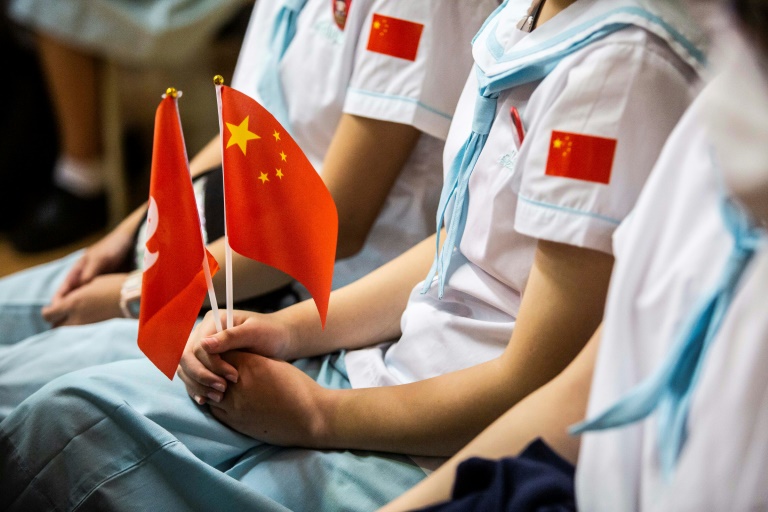
As Hong Kong students return for the new academic year, veteran teacher Wong is counting down the days until the political maelstrom sweeping the city leaves him no choice but to quit.

Wong, 34, fears he will soon join the exodus of teachers and students triggered by Beijing’s tightening grip on Hong Kong, which has started transforming local schools, according to multiple educators.

The latest government figures show more than 4,000 teachers left their jobs in the past school year, a five-year high and a 70 percent spike from the year before.

“I have no faith in the future of Hong Kong or that of the industry. It is hard to nurture a person in this environment,” Wong, who asked to use just his surname, told AFP.

The political crackdown has coincided with the coronavirus pandemic, during which Hong Kong has kept strict zero-Covid rules that have fuelled further departures. 

Students have pulled out of school in droves, with 30,000 fewer attending primary and secondary school in September 2021 compared to the preceding October.

Wong, who has taught for more than a decade, said five teenagers from his class of 32 withdrew halfway through a term to emigrate.

“The students are leaving not because they dislike the school, but because of Hong Kong’s environment.”

– Patriotic classrooms –

China is remoulding once outspoken Hong Kong in its own authoritarian image, following massive and sometimes violent democracy protests in 2019 in which youngsters played a key part.

Teachers have since been ordered to instil patriotism in students and comply with a Beijing-imposed national security law that has criminalised much dissent.

Curriculums are being tweaked to align more closely with Chinese Communist Party ideology.

Earlier this month teachers were told to “study and learn the key messages” of a recent speech by President Xi Jinping.

Students and parents have also been encouraged to report teachers who might be breaching the security law. 

Wong received a letter of reprimand from Hong Kong’s Education Bureau last year after his teaching materials analysing the pros and cons of civil disobedience drew anonymous complaints.

“It shattered the trust that was fundamental to teaching,” he recalled.

Between 2019 and 2021, Hong Kong authorities received 344 complaints against teachers in relation to the democracy protests, with 55 percent of cases found to be substantiated.

One high-school principal told AFP he would instruct staff to keep their heads down and comply with government guidelines to the letter.

“Everyone is being very careful… If some (teaching materials) may touch on political sensitivities, then we’ll skirt around it,” said the principal, who requested anonymity.

“Nobody wants trouble and the teachers don’t want to be held personally responsible.”

– Lower standards? –

Authorities have rejected the idea of an emigration wave and argue teachers choose to leave their posts for various reasons, including retirement and further study.

Hong Kong’s education chief said schools were generally operating smoothly and there were enough qualified teachers despite a “slightly higher” attrition rate.

But a recent survey of 140 schools showed each institution on average lost 32 students and seven teachers over the past year.

Newspaper Ming Pao surveyed its classified section and found at least 200 schools were still looking for teachers in late July. In previous years most vacancies would be filled by the end of May.

Administrators say some schools have been forced to hire less-qualified candidates.

Schools are also competing to poach students, as their headcount often determines their government subsidies and protects against closure.

And education is not the only sector affected by brain drain.

The city’s labour force has dropped about six percent since 2018 to 3.75 million people, according to the latest official figures, the lowest number in nearly a decade.

A new generation of Hong Kong teachers are now weighing options and assessing risks that come with their careers.

University graduate Mak, 23, has spent a year teaching English at a secondary school even though he does not have a teacher’s diploma — a fact his employer did not seem to mind.

“I’ll continue teaching for the next few years, but not necessarily in the long term,” he said.

Mak feels he has little control over what happens to his profession.

“There’s not much that can be changed,” he sighed. “You either submit, or quit.”

Secret files 'likely concealed' at Trump home to block FBI probe

Top secret documents found at Donald Trump’s Florida home were “likely concealed” to obstruct an FBI probe into the former US president’s potential mishandling of classified materials, the Department of Justice said in an explosive new court filing.

The filing released late Tuesday provides the most detailed account yet of a year-and-a-half long effort to recover hundreds of classified documents that were improperly taken to Trump’s Mar-a-Lago estate when he left office in January 2021.

And the claim of obstruction piles further legal pressure on the Republican ex-president — who denies all wrongdoing and has denounced an unprecedented FBI raid on his palatial home this month as part of a “witchhunt.”

Trump’s legal team responded Wednesday with a filing that described the government’s pursuit of the documents as “unjustified,” said the former president’s possession of sensitive information “should have never been cause for alarm,” and described the raid as “unprecedented, unnecessary, and legally unsupported.”

The August 8 raid was triggered by a review of “highly classified” records that Trump finally surrendered to authorities in January this year — after months of back and forth with the National Archives and Records Administration (NARA).

The Justice Department began investigating the matter after the 15 boxes were found to contain national defense information, including 184 documents marked as confidential, secret or top secret, a government affidavit showed.

After prompting from the FBI, Trump’s lawyer would eventually turn over an additional 38 classified documents — and provide “sworn certification” that they represented the last of the material.

But it did not stop there: the FBI went on to uncover “multiple sources of evidence” showing classified documents remained at Mar-a-Lago, the new filing says.

When agents conducted their court-ordered search, they found material so sensitive that “even the FBI counterintelligence personnel and DOJ attorneys conducting the review required additional clearances before they were permitted to review certain documents,” it says.

Strikingly, the filing included a photograph of color-coded documents spread out over a carpet, marked “SECRET” and “TOP SECRET.”

Now, as the filing made clear, prosecutors are seeking to determine whether Trump or anyone in his immediate orbit acted criminally to prevent federal agents from retrieving classified documents.

It cited “evidence that government records were likely concealed and removed from the Storage Room (at Trump’s estate) and that efforts were likely taken to obstruct the government’s investigation.” 

Trump hit back at the photo’s release in a post on his Truth Social network.

“Terrible the way the FBI, during the Raid of Mar-a-Lago, threw documents haphazardly all over the floor (perhaps pretending it was me that did it!), and then started taking pictures of them for the public to see,” he wrote.

– ‘Significantly harm’ government interest –

During the raid, the Tuesday filing says, agents found more than 100 documents with classification markings — taking the total number of secret documents recovered from the former president to more than 300.

Trump, who is weighing another White House run in 2024, has accused the Justice Department under Democratic President Joe Biden of pursuing a vendetta against him, and said the judge “should never have allowed the break-in of my home.”

The former president has taken legal action to seek the appointment of an independent party, or “special master,” to screen the seized files for materials protected by personal privilege.

The government argues that naming a special master, potentially blocking investigators’ access to the seized documents, “would significantly harm important governmental interests, including national security interests.”

In their response on Wednesday, Trump’s lawyers again insisted on the appointment of a special master.

“Assuring access by (Trump’s) counsel to the seized materials, sharing an actual (detailed) inventory, making independent attorney-client privilege assessments, and making executive privilege determinations are all responsibilities that are best served by appointment of a special master,” they wrote.

The Mar-a-Lago search warrant, personally approved by Attorney General Merrick Garland, was based on suspicions of violations of the US Espionage Act related to the illegal retention of sensitive defense documents, on suspicion of obstruction, and of illegal destruction of government documents.

Democratic congressman Adam Schiff, who chairs the House Intelligence Committee, said the actions outlined in the brief were “reckless in the extreme” and showed “deliberate” deception.

In addition to investigations in New York into his business practices, Trump faces legal scrutiny for his efforts to overturn results of the 2020 election, and for the January 6, 2021 attack on the US Capitol by his supporters.

Trump was impeached for a historic second time by the House of Representatives after the Capitol riot — he was charged with inciting an insurrection — but was acquitted by the Senate.

Lies, damn lies and social media: fake news stalks Brazil vote

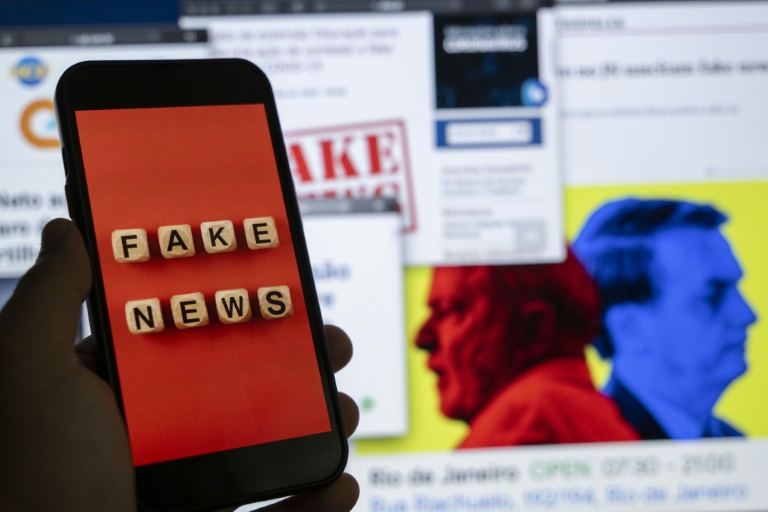
In a divisive election campaign blighted by fears of unrest if far-right President Jair Bolsonaro refuses to accept defeat, Brazil is waging an uphill battle against disinformation wielded as a political weapon.

Analysts say Bolsonaro’s 2018 electoral victory was in no small part due to an effective fake news smear campaign against his opponents.

Four years later, his backers have sought to replicate that feat, turning their attention to leftist ex-president and opinion poll frontrunner Luiz Inacio Lula da Silva.

“Disinformation has run wild” on newer platforms such as Telegram and TikTok, which allow for the rapid dissemination of easily manipulated video content, says Ana Regina Rego, coordinator of the National Network to Combat Disinformation.

Social media videos and other posts have sought to portray Lula, among other things, as an alcoholic who will shut down churches if elected in October.

Bolsonaro also has been targeted by fake news posts that have questioned, for example, whether he was really stabbed on the campaign trail in 2018. 

And despite nonstop work to debunk these and other false claims, such posts find fertile ground in a country where a 2018 study found that almost half of Brazilian voters relied on WhatsApp to read news about politics and elections.

The figure was even higher among Bolsonaro voters.

In 2022, spreaders of disinformation have even more avenues including Telegram, the fast-growing messaging system that Bolsonaro has publicly embraced after having posts blocked on Facebook, Twitter and YouTube.

Despite stricter rules adopted and better policing introduced against fake news, experts say new technology is complicating the task.

– Facts, lies, sensationalism –

The reach of fake news is impressive. 

Three TikTok videos alleging to show Lula getting drunk on a transparent liquid — which is actually water — were seen 6.6 million times, while another five on the same platform that try to cast doubt on Bolsonaro’s stabbing had 3.3 million views.

Content that combines “facts, lies and decontextualizations with sensationalism has a 70 percent greater chance to go viral than something informative,” Rego noted.

TikTok told AFP its policy is to withdraw content that violates its “community norms” and may affect the electoral process, and to avoid highlighting “potentially misleading information that cannot be verified.”

At the outset of the 2022 presidential campaign, Supreme Electoral Court president Alexandre de Moraes vowed the justice system would be “resolute” in the fight against fake news.

And there have been some successes.

Moraes has since ordered social networks to remove several Bolsonaro posts on grounds of disinformation, along with many others from his supporters.

The court oversaw the creation of a group with companies such as Facebook, Instagram, WhatsApp, Google and TikTok to screen out fake news and report offenders.

Campaigns have been rolled out to boost digital literacy among social media users. 

WhatsApp agreed to delay until after the election the launch in Brazil of a new “Communities” feature that would allow the creation of groups of groups, with administrators able to send messages to all — thus vastly increasing the potential for viral information spread.

Telegram bowed to pressure to take down disinformation content under threat of being blocked for not collaborating with the authorities.

“Without the collaboration of the platforms, it is very difficult” to pursue the spreaders of disinformation, said sociologist Marco Aurelio Ruediger of the Getulio Vargas Foundation, a Rio think tank.

“It takes a long time to adopt punitive measures, and by then the damage is already done, because the information has already circulated,” he said.

– ‘Even worse’ –

It is not only on social media, however, where lies are spread.

Bolsonaro himself has repeatedly criticized Brazil’s electronic voting system, which he alleges — without evidence — is riddled with fraud.

The president is under investigation for the claims.

Bolsonaro, who is fond of saying “only God” can remove him from office, has warned Brazil faces “an even worse problem than the United States.”

This has led to fears that his supporters might not accept the results, and that Brazil could see a burst of violence akin to the attack on the US Capitol in January 2021 in the wake of Donald Trump’s loss to Joe Biden.

Trump’s backers were riled up in part on social media, where Bolsonaro has tens of millions of followers.

“I fear that the results will not be accepted and that violence will be encouraged; we could experience a situation similar to that of the United States,” said Ruediger. 

Five things on Brazil's voting machines

Brazil has used electronic voting machines in its elections since 1996. But it is only recently they became controversial, with allegations by far-right President Jair Bolsonaro that they are plagued by fraud.

Here are five things to know about the squat beige computers fueling a raging debate on democracy in Latin America’s biggest country.

– How did they start? –

Ironically, given Bolsonaro’s bashing, the electronic voting machines were introduced partly to combat fraud.

Brazilians used to vote on paper ballots where they would check a box or write in a name, depending on the type of election.

In a country where 14 percent of the adult population was illiterate, the system was chaotic, slow and fraud-prone.

“There were always problems with the count. Illegible writing, names written in the wrong place, X’s outside the box — all that meant a ballot was declared null,” says Henrique Neves da Silva, a former judge on Brazil’s Superior Electoral Tribunal.

“There was also a lot of fraud and ballot-box stuffing.”

With help from the military, computer experts developed the country’s first electronic voting machine, rolled out in 57 cities for the 1996 local elections.

– How widespread are they? –

Celebrated as a success, the voting machines were expanded to 67 percent of the electorate for Brazil’s 1998 elections, and 100 percent for the 2000 elections.

Brazil is one of 23 countries using electronic voting for general elections, according to the International Institute for Democracy and Electoral Assistance.

Another 18 use them for regional elections.

– How do they work? –

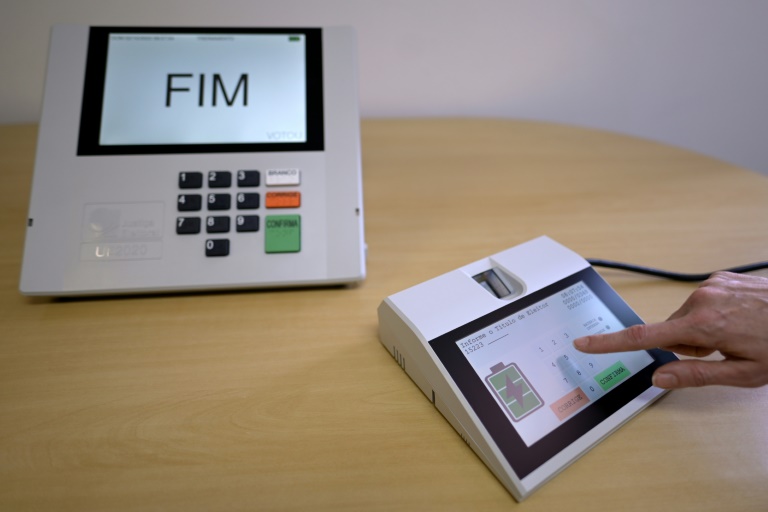
The machines are equipped with a number pad.

When voters type the two-digit code for their chosen candidate, his or her picture appears.

They then press a green button to confirm.

“It’s a very simple machine, with one function: to tally votes,” says Da Silva.

A key detail: the machines are not connected to the internet.

When voting closes, poll workers remove the memory card from each machine and send them to the local office of the electoral authority, which in turn sends the information to the central counting system in Brasilia via an independent network.

In remote regions such as the Amazon rainforest, a satellite connection is sometimes used.

Results are usually finalized in around two hours — not bad for a sprawling country with 156 million voters.

– How secure are they? –

The vote-counting software is updated for every election.

Political parties, the judiciary and the military are allowed to inspect the source code.

Security tests are also held in which IT experts attempt to hack into the system.

“They literally take the machines apart, touch whatever they want. There is way more leeway than what (a theoretical hacker) would actually have on election day,” says Da Silva.

No major security flaw has ever been detected.

– What does Bolsonaro say? –

Bolsonaro insists the system is plagued by fraud, but has provided scant evidence.

He claims he should have won the 2018 presidential election in the first round, instead of the runoff, but has offered no proof.

He is pushing for a paper print-out to be made of every vote, so the count can be checked.

But election authorities say that would only introduce an avenue for fraud.

Prosecutors are investigating the president on charges of spreading disinformation about the voting system, including during a meeting with foreign ambassadors in July that was spattered with falsehoods.

The US embassy said after that meeting that Brazil’s elections are “a model for the world.”

Bolsonaro has repeatedly threatened not to recognize the election result if the system is not changed.

Five things on Brazil's voting machines

Brazil has used electronic voting machines in its elections since 1996. But it is only recently they became controversial, with allegations by far-right President Jair Bolsonaro that they are plagued by fraud.

Here are five things to know about the squat beige computers fueling a raging debate on democracy in Latin America’s biggest country.

– How did they start? –

Ironically, given Bolsonaro’s bashing, the electronic voting machines were introduced partly to combat fraud.

Brazilians used to vote on paper ballots where they would check a box or write in a name, depending on the type of election.

In a country where 14 percent of the adult population was illiterate, the system was chaotic, slow and fraud-prone.

“There were always problems with the count. Illegible writing, names written in the wrong place, X’s outside the box — all that meant a ballot was declared null,” says Henrique Neves da Silva, a former judge on Brazil’s Superior Electoral Tribunal.

“There was also a lot of fraud and ballot-box stuffing.”

With help from the military, computer experts developed the country’s first electronic voting machine, rolled out in 57 cities for the 1996 local elections.

– How widespread are they? –

Celebrated as a success, the voting machines were expanded to 67 percent of the electorate for Brazil’s 1998 elections, and 100 percent for the 2000 elections.

Brazil is one of 23 countries using electronic voting for general elections, according to the International Institute for Democracy and Electoral Assistance.

Another 18 use them for regional elections.

– How do they work? –

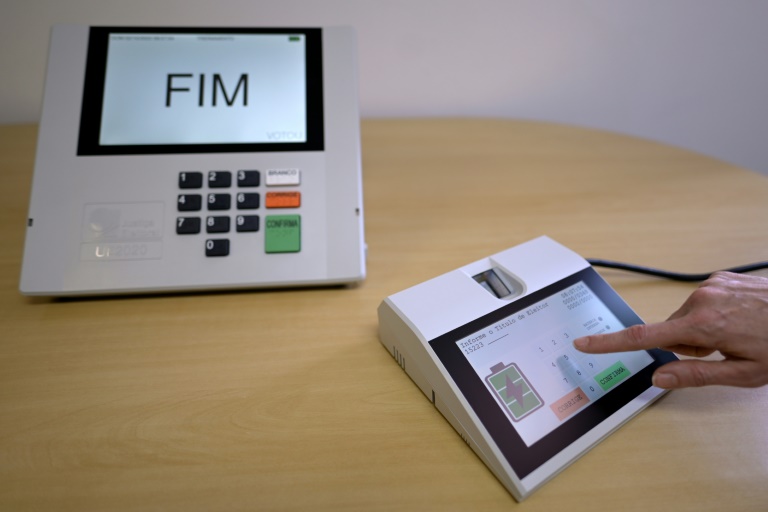
The machines are equipped with a number pad.

When voters type the two-digit code for their chosen candidate, his or her picture appears.

They then press a green button to confirm.

“It’s a very simple machine, with one function: to tally votes,” says Da Silva.

A key detail: the machines are not connected to the internet.

When voting closes, poll workers remove the memory card from each machine and send them to the local office of the electoral authority, which in turn sends the information to the central counting system in Brasilia via an independent network.

In remote regions such as the Amazon rainforest, a satellite connection is sometimes used.

Results are usually finalized in around two hours — not bad for a sprawling country with 156 million voters.

– How secure are they? –

The vote-counting software is updated for every election.

Political parties, the judiciary and the military are allowed to inspect the source code.

Security tests are also held in which IT experts attempt to hack into the system.

“They literally take the machines apart, touch whatever they want. There is way more leeway than what (a theoretical hacker) would actually have on election day,” says Da Silva.

No major security flaw has ever been detected.

– What does Bolsonaro say? –

Bolsonaro insists the system is plagued by fraud, but has provided scant evidence.

He claims he should have won the 2018 presidential election in the first round, instead of the runoff, but has offered no proof.

He is pushing for a paper print-out to be made of every vote, so the count can be checked.

But election authorities say that would only introduce an avenue for fraud.

Prosecutors are investigating the president on charges of spreading disinformation about the voting system, including during a meeting with foreign ambassadors in July that was spattered with falsehoods.

The US embassy said after that meeting that Brazil’s elections are “a model for the world.”

Bolsonaro has repeatedly threatened not to recognize the election result if the system is not changed.

UN report lists litany of rights abuses in China's Xinjiang

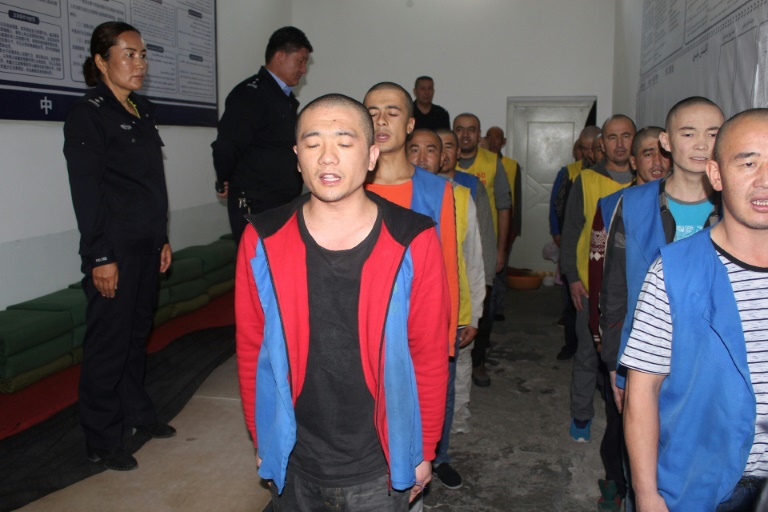
The United Nations released a bombshell report late Wednesday into serious human rights abuses in China’s Xinjiang region, saying torture allegations were credible and citing possible crimes against humanity.

The long-awaited report detailed a string of rights violations against Uyghurs and other Muslim minorities in the far-western region, but made no reference to genocide: one of the key allegations made by the United States and other critics.

“The extent of arbitrary and discriminatory detention of members of Uyghur and other predominantly Muslim groups… may constitute international crimes, in particular crimes against humanity,” the report said.

It said the world must now pay “urgent attention” to the human rights situation in the Xinjiang.

The assessment brings the UN seal to many of the allegations about China’s treatment of people in Xinjiang that have long been made by rights groups, Western nations and the Uyghur community in exile.

Michelle Bachelet, the UN human rights chief, decided that a full assessment was needed of the situation inside the Xinjiang Uyghur Autonomous Region (XUAR).

The report was in the making for around a year and its release was bitterly opposed by China.

Bachelet was determined to release it before her four-year term as the UN high commissioner for human rights expired at the end of August — and did so with 13 minutes to spare at 11:47pm in Geneva.

“I said that I would publish it before my mandate ended and I have,” Bachelet said in an email sent to AFP on Thursday.

“The politicisation of these serious human rights issues by some states did not help,” she added.

– Torture allegations ‘credible’ –

China has been accused for years of detaining more than one million Uyghurs and other Muslims in the region.

Beijing has vehemently rejected the claims, insisting it is running vocational centres designed to curb extremism.

“Serious human rights violations have been committed in XUAR in the context of the government’s application of counter-terrorism and counter-‘extremism’ strategies,” the UN report said.

The assessment raised concerns about the treatment of people held in China’s so-called “Vocational Education and Training Centres” (VETCs). 

“Allegations of patterns of torture or ill-treatment, including forced medical treatment and adverse conditions of detention, are credible, as are allegations of individual incidents of sexual and gender-based violence,” the report said. 

The UN Human Rights Office could not confirm how many people were affected by the VETCs but concluded that the system operated on a “wide scale” across the entire region.

The number in the VETCs, at least between 2017 and 2019, “was very significant, comprising a substantial proportion of the Uyghur and other predominantly Muslim minority populations”.

Campaigners have accused China of practicing forced sterilisation of women.

The report said there were “credible indications of violations of reproductive rights through the coercive enforcement of family planning policies”.

– ‘Disinformation and lies’ –

China’s mission in Geneva hit out at the report and maintained its firm opposition to its release.

“Based on the disinformation and lies fabricated by anti-China forces and out of presumption of guilt, the so-called ‘assessment’ distorts China’s laws and policies, and wantonly smears and slanders China, and interferes in China’s internal affairs,” it said.

“People of all ethnic groups in Xinjiang are living a happy life in peace and contentment. It is the greatest human rights protection and the best human rights practice,” the mission insisted.

Non-governmental organisations and campaign groups said the report should act as a launchpad for further action.

Human Rights Watch’s China director Sophie Richardson said the “damning” findings of sweeping rights abuses showed why Beijing “fought tooth and nail” to prevent its publication.

The UN Human Rights Council should now investigate China’s alleged crimes against humanity “and hold those responsible to account”, she said.

Amnesty International’s secretary general Agnes Callamard said the document “lays bare the scale and severity of the human rights violations taking place in Xinjiang”.

She echoed the call for criminal accountability and said China “must immediately release all individuals” arbitrarily detained in camps, “end the persecution” of minorities and allow investigators in unfettered.

“This is a game-changer for the international response to the Uyghur crisis,” said Uyghur Human Rights Project executive director Omer Kanat.

“Despite the Chinese government’s strenuous denials, the UN has now officially recognised that horrific crimes are occurring.”

World Uyghur Congress president Dolkun Isa said the report paved the wat for “meaningful and tangible action” by countries, businesses and the UN, adding: “Accountability starts now.”

'Beginning of the end': patients hail new treatment for drug-resistant TB

Volodymyr is celebrating a major milestone on Wednesday — it’s his final day of taking a new treatment hailed as a turning point in the fight against drug-resistant tuberculosis.

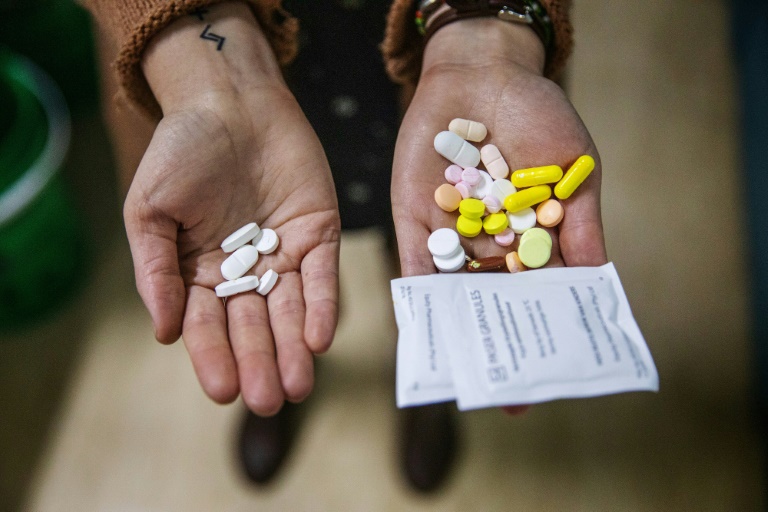
The 25-year-old doctor in Ukraine’s capital Kyiv said he had nasty neurological side effects when he was on a previous drug regimen, which takes up to two years, involves a huge number of pills and is less than 60-percent effective. 

But the new treatment course took just six months, and gave him very few side effects. “It was very easy,” he told AFP.

A scan on Wednesday showed he was clear of tuberculosis, and he plans to start work next week after eight months off sick.

“Now I can start life again,” said Volodymyr, who did not give his last name.

Tuberculosis, once called consumption, was the world’s biggest infectious killer before the arrival of Covid-19, with 1.5 million people dying from the disease each year.

Around five percent of new cases are resistant to commonly prescribed antibiotics, making them difficult to treat.

However a new drug regimen, called BPaL because it combines the antibiotics bedaquiline, pretomanid and linezolid, has been seen as a breakthrough since it was first approved by the US Food and Drug Administration in 2019.

– From 23 to five pills a day –

Research in 2020 showed that the BPaL regimen cured more than 90 percent of drug-resistant patients, however there was a high rate of side effects linked to linezolid, including nerve pain and bone marrow suppression.

But a study published in the New England Journal of Medicine on Wednesday indicated that the dosage of linezolid can be halved.

A trial involving 181 participants with drug-resistant tuberculosis was carried out in Russia, South Africa, Georgia and Moldova — all countries with high TB rates.

It found that while 1,200 milligrams of linezolid over six months had a cure rate of 93 percent, that number only dropped to 91 percent if the dosage was halved to 600 milligrams.

The number of participants with the side of peripheral neuropathy — which causes nerve pain — fell from 38 to 24 percent at the lower dosage, while the rate of bone marrow suppression dropped from 22 to two percent.

The study’s lead author, Francesca Conradie of South Africa’s University of the Witwatersrand, said she was “overwhelmed with how successful this regimen was”.

“This is the beginning of the end of drug-resistant TB,” she told AFP.

“The quicker you treat someone’s TB, the less infectious they are — it’s like Covid in many ways.”

It is also far easier for patients to take BPaL, she added, saying previous courses could involve 23 pills a day — and up to 14,000 total pills over the maximum two-year course. 

BPaL involves five pills a day — and fewer than 750 over six months.

– Could TB surpass Covid? –

Nataliia Lytvynenko, who has overseen BPaL treatments in Ukraine, said the more manageable amount of pills meant it was easier for patients to continue treatment after being displaced by the war in her country.

The World Health Organization indicated earlier this year that it would soon update its guidelines to recommend most patients with drug-resistant TB use BPaL with 600 milligrams of linezolid.

Two experts not involved in Wednesday’s study said the research and the WHO guidance were “major advances”.

The BPaL treatment “is one of the defining achievements of the tuberculosis research community in this century,” Guy Thwaites of Britain’s Oxford University and Nguyen Viet Nhung of Vietnam’s National Tuberculosis Control Programme wrote in an editorial in the New England Journal of Medicine.

The advances come amid warnings that the pandemic has stalled progress against tuberculosis.

“I very much worry that TB will — whether it’s this year or next — again become the largest single killer of any infectious disease in the world,” said Mel Spigelman, the president of the non-profit TB Alliance which funded the research.

Volodymyr meanwhile said he hoped that progress would continue so the treatment timeline gets even shorter.

“Maybe it will be two months — or even one,” he said with a smile.

Gorbachev and Reagan: a friendship that ended the Cold War

Mikhail Gorbachev stepped onto a Washington street and began shaking hands to cheers and applause in 1990 — a bit of unaccustomed political showmanship worthy of his friend Ronald Reagan.

Ana Maria Guzman was in the park on her lunch break that May when she saw the Soviet leader, who died on Tuesday at 91. 

“We knew he was in town and we saw his motorcade. Then he just got out of his limousine and began shaking hands,” she recalled. “It was very emotional. He was like a people’s person. Wow!”

It was the personal touch that Reagan, the Hollywood actor who became president and an icon of the American right, was known for.

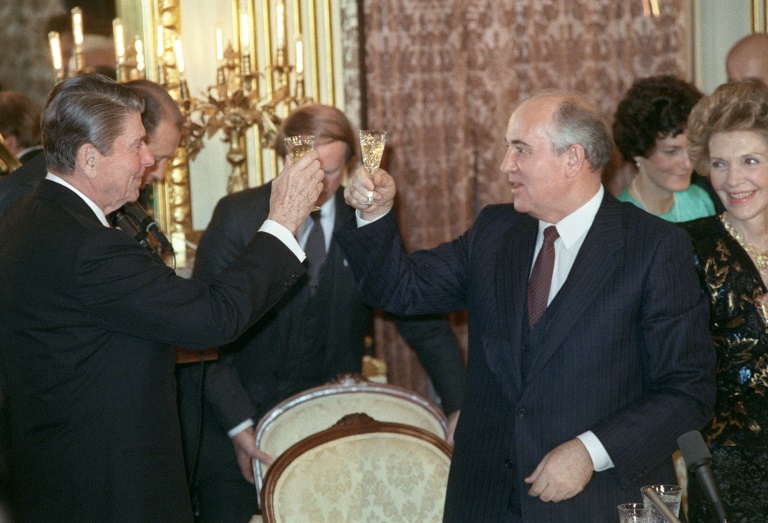
Reagan and Gorbachev broke through decades of tensions between their countries to form one of the unlikeliest relationships of the 20th century, bonding over their shared desire to reduce nuclear tensions and ultimately bringing about a momentous shift in world politics.

– Overcoming decades of mistrust –

At the beginning, the longtime Soviet apparatchik had almost nothing in common with his US counterpart.

The two came from countries where mistrust of the other was set in cement.

But when Reagan came to office in 1981, one of his primary — and secret — goals was to ease Cold War and nuclear tensions with Moscow. 

He made overtures to three Soviet leaders — Leonid Brezhnev, Turi Andropov, and Konstantin Chernenko — but all were change-resistant and none survived long enough to establish a relationship.

When Gorbachev became Communist party general secretary in March 1985 after Chernenko’s death, the White House sensed a potential opening, said Jack Matlock, then Reagan’s top negotiator with Moscow and later ambassador to Russia.

“Early in his term, Reagan referred to the Soviet Union as an evil empire,” Matlock told AFP.

“But from the very beginning, he talked about negotiating and the possibility of establishing a peaceful relationship if the Soviet leader was willing to get along with the free world.”

“There was very little response until Gorbachev. With Gorbachev, they finally began communicating, and within two or three years, they were almost, you might say, reading off the same piece of music.”

Gorbachev was no blind idealist, said John Lenczowski, who was principal Soviet affairs adviser on Reagan’s national security council. 

The White House understood he was inheriting a weakened economy, a military that saw the Pentagon as increasingly superior and threatening, and a Communist Party rotting from the inside out.

Gorbachev needed to ease the military competition with the United States first if he was to address the other two challenges and preserve the Soviet Union.

“He came in to the general secretaryship seeing that the Soviet Union was in a state of multiple crises. He was trying to overcome those crises in order to save the Soviet system,” said Lenczowski.

Reagan, for his part, saw Kremlin paranoia about the United States as dangerous for both.

“Reagan began to think that we really needed to tone it down, and to try to manage the relationship a little bit more gently,” said Lenczowski.

He saw “that we were in a position of strength to negotiate better with Moscow, and that we should explore some of the different venues.”

– Slow start –

Reagan had an invitation to visit Washington passed on to Gorbachev at Chernenko’s funeral, but nothing much happened for months. 

Still, the White House perceived a change in tone as the two sides discussed advancing nuclear arms control negotiations.

“Basically, they were both men of peace,” said Matlock.

“Gorbachev really realized, increasingly, he had a system that needed to change. But he couldn’t really change it as long as there was a Cold War going on, and you had the arms race.” 

“And I think that Reagan understood that. And Reagan was not out to bring down the Soviet Union.”

Their big ice-breaker was a summit in Geneva in November 1985. Talks were tense, and little was agreed. But the two leaders had several one-on-one conversations, sowing the seeds of trust.

One year later, the two met in Reykjavik for more talks, again with only slight progress. 

Media called the summit a failure, but in fact, Matlock recalled, both sides found more common ground. Detente was taking root.

When Gorbachev came to Washington in December 1987, he and Reagan were able to sign the landmark treaty on limiting intermediate range nuclear forces.

“At first he thought Reagan was very conservative,” Matlock said of Gorbachev. 

“But as time went on, and as they began to agree, more and more they actually became friends.” 

Long after he was shunted aside in Russian politics, Gorbachev would return to the United States in 2004 for Reagan’s funeral.

“I think they both had similar ideals. They both hated nuclear weapons, and hoped that they could abolish them, that’s the truth,” Matlock said.

“Very few on their staffs thought that that was going to be possible, but they did.”

Close Bitnami banner
Bitnami