World

Giant 200-year-old cactus toppled by heavy rain in US

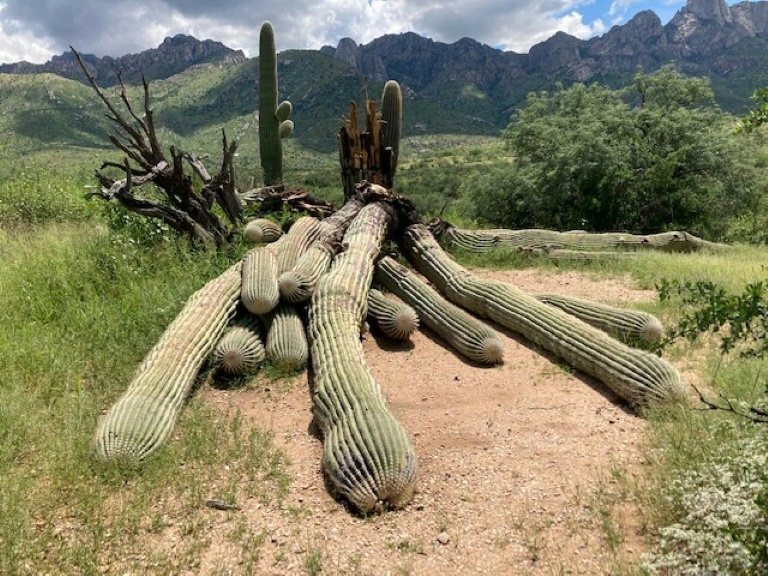
A giant Saguaro cactus that had lived for some 200 years was toppled by heavy rain in the southwestern US state of Arizona.

“Powerful seasonal rains can quickly make an impact on the desert landscape. The loss of this huge, iconic ~200 year old Saguaro on the Romero Ruins trail overlooking the Sutherland wash at Catalina State Park in Tucson is one change regular park visitors can’t miss,” Arizona State Parks said on Facebook.

A photo accompanying the post showed the cactus’s giant arms splayed on the ground, its trunk shattered.

The Saguaro cactus can reach more than 10 meters (32 feet) in height and weight more than two tons when full of water. The plant, which grows in the United States and Mexico, has become a symbol of the American West and particularly of the desert landscape of Arizona.

“Thankfully this giant has fallen off the trail and will stay where it landed, providing habitat and food for many creatures as it decomposes,” Arizona State Parks said.

Zelensky says Russia attacking nuclear plant environs ahead of UN visit

Ukrainian President Volodymyr Zelensky on Tuesday accused Russia of attacking the area near Europe’s biggest nuclear plant due to be visited by UN inspectors as intense battles raged in southern Ukraine.

International Atomic Energy Agency (IAEA) chief Rafael Grossi arrived in Kyiv late Monday together with a 13-strong team and headed for the Zaporizhzhia plant which has been occupied by Russian troops since early March.

“Sadly, Russia is not stopping its provocations precisely in the directions the mission needs to travel to arrive at the plant,” Zelensky said in his daily address to the nation.

“I hope the IAEA team will be able to start its work,” he said, adding that the situation in the plant was “extremely menacing”.

“The occupiers have not abandoned the plant, they are continuing bombardments and are not withdrawing arms and ammunition from the site. They are intimidating our personnel. The risk of a nuclear catastrophe due to Russian actions is not diminishing for even an hour”, he added.

“An immediate and total demilitarisation in Zaporizhzhia is necessary”.

The plant was targeted over the weekend by fresh shelling, Ukraine’s nuclear agency Energoatom said, with Moscow and Kyiv trading blame for attacks around the complex of six nuclear reactors located on the banks of the Dnipro River.

Meanwhile, intensive fighting raged across the nearby southern region of Kherson and Donbas, Zelensky said.

Most of the region of Kherson bordering the Black Sea and its provincial capital of the same name were seized by Russian forces at the start of the invasion six months ago.

With the war in the eastern Donbas region largely stalled, analysts have said for weeks that combat is likely to shift south to break the stalemate before winter comes.

Also Tuesday, fresh Russian strikes on the centre of the northeastern city of Kharkiv killed at least five people and injured seven. 

– A ‘long and complicated’ fight –

But much of the attention remained on the counter-offensive in the south. 

In Bereznehuvate, a town near the frontline some 70 kilometres (43 miles) north of Kherson city, AFP reporters could hear artillery fire and saw soldiers resting by the roadside.

“We forced them well back,” said Victor, an infantryman in his 60s who declined to give a surname.

But his commander Oleksandr, a veteran of the Soviet war in Afghanistan, predicted the fight to retake Kherson will be “long and complicated”.

Russia’s defence ministry claimed Tuesday that Ukraine had met “defeat” in its southern counterattack, suffering “large-scale losses” of more than 1,200 soldiers and some 150 military vehicles. 

For its part, the Ukrainian presidency claimed its forces had destroyed “almost all large bridges” over the Dnipro and that “only pedestrian crossings remain” in Kherson region.

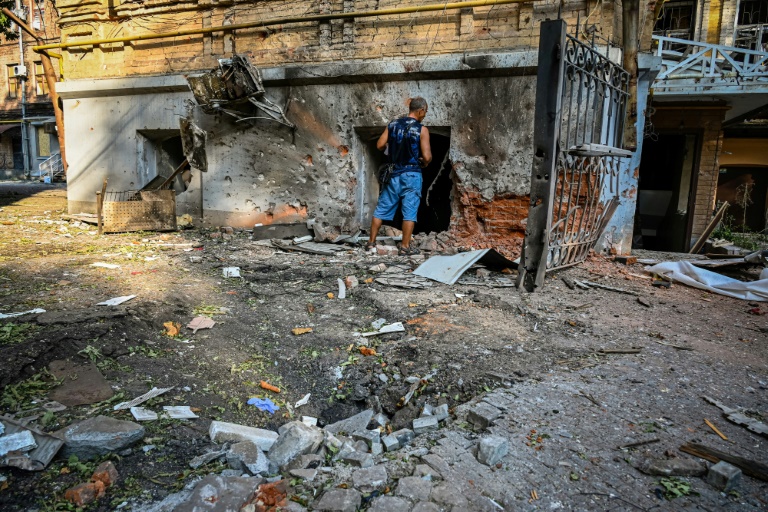
Overnight, the Ukrainian-held city of Mykolaiv, 80 kilometres (50 miles) northwest of Kherson, came under “massive bombardment” with Russian anti-aircraft missiles killing two civilians and injuring 24, the army’s southern command said. 

– ‘We are not afraid’ – 

The fresh fighting came as students across Ukraine prepared for the start of a new academic year after schools were shut by the Russian invasion, now in its seventh month.

Only those schools with air-raid bunkers will be permitted to reopen, with the rest reverting to online learning.

“We just want to live our life fully,” 16-year-old student Polina told AFP in Kyiv.

“We are not afraid, we have already lived enough. Our generation has decided to live in the present moment.”

European Union defence ministers meeting in Prague Tuesday began planning a training program for Ukrainian soldiers. 

“There are many training initiatives but the needs are enormous,” said EU foreign policy chief Josep Borrell, who says Ukrainian troops could be trained in nearby EU member states.

EU member states were meanwhile split over a proposal to ban Russian travellers from entering its territory with heavyweights Germany and France insisting on the need to differentiate between those who were responsible for the war and those who weren’t.

“We… have to retain our ties to the latter,” French foreign minister Catherine Colonna said, singling out Russian artists, students and journalists.

– Protection for Odessa –

Ukraine said it will ask the UN’s cultural watchdog to add the historic port city of Odessa to its World Heritage List of protected sites as Moscow’s forces approach the city, officials said Tuesday.

Russian forces are within several dozen kilometres (miles) of Odessa, which blossomed after empress Catherine the Great decreed in the late 18th century that it would be Russia’s modern gateway to the Black Sea.

“Odessa is in danger right now,” Ukraine’s Culture Minister Oleksandr Tkachenko told AFP after meeting with UNESCO director Audrey Azoulay in Paris.

Last month the city was struck by missiles just hours after Russia agreed to allow a shipment of Ukrainian grain exports from the port.

Zelensky says Russia attacking nuclear plant environs ahead of UN visit

Ukrainian President Volodymyr Zelensky on Tuesday accused Russia of attacking the area near Europe’s biggest nuclear plant due to be visited by UN inspectors as intense battles raged in southern Ukraine.

International Atomic Energy Agency (IAEA) chief Rafael Grossi arrived in Kyiv late Monday together with a 13-strong team and headed for the Zaporizhzhia plant which has been occupied by Russian troops since early March.

“Sadly, Russia is not stopping its provocations precisely in the directions the mission needs to travel to arrive at the plant,” Zelensky said in his daily address to the nation.

“I hope the IAEA team will be able to start its work,” he said, adding that the situation in the plant was “extremely menacing”.

“The occupiers have not abandoned the plant, they are continuing bombardments and are not withdrawing arms and ammunition from the site. They are intimidating our personnel. The risk of a nuclear catastrophe due to Russian actions is not diminishing for even an hour”, he added.

“An immediate and total demilitarisation in Zaporizhzhia is necessary”.

The plant was targeted over the weekend by fresh shelling, Ukraine’s nuclear agency Energoatom said, with Moscow and Kyiv trading blame for attacks around the complex of six nuclear reactors located on the banks of the Dnipro River.

Meanwhile, intensive fighting raged across the nearby southern region of Kherson and Donbas, Zelensky said.

Most of the region of Kherson bordering the Black Sea and its provincial capital of the same name were seized by Russian forces at the start of the invasion six months ago.

With the war in the eastern Donbas region largely stalled, analysts have said for weeks that combat is likely to shift south to break the stalemate before winter comes.

Also Tuesday, fresh Russian strikes on the centre of the northeastern city of Kharkiv killed at least five people and injured seven. 

– A ‘long and complicated’ fight –

But much of the attention remained on the counter-offensive in the south. 

In Bereznehuvate, a town near the frontline some 70 kilometres (43 miles) north of Kherson city, AFP reporters could hear artillery fire and saw soldiers resting by the roadside.

“We forced them well back,” said Victor, an infantryman in his 60s who declined to give a surname.

But his commander Oleksandr, a veteran of the Soviet war in Afghanistan, predicted the fight to retake Kherson will be “long and complicated”.

Russia’s defence ministry claimed Tuesday that Ukraine had met “defeat” in its southern counterattack, suffering “large-scale losses” of more than 1,200 soldiers and some 150 military vehicles. 

For its part, the Ukrainian presidency claimed its forces had destroyed “almost all large bridges” over the Dnipro and that “only pedestrian crossings remain” in Kherson region.

Overnight, the Ukrainian-held city of Mykolaiv, 80 kilometres (50 miles) northwest of Kherson, came under “massive bombardment” with Russian anti-aircraft missiles killing two civilians and injuring 24, the army’s southern command said. 

– ‘We are not afraid’ – 

The fresh fighting came as students across Ukraine prepared for the start of a new academic year after schools were shut by the Russian invasion, now in its seventh month.

Only those schools with air-raid bunkers will be permitted to reopen, with the rest reverting to online learning.

“We just want to live our life fully,” 16-year-old student Polina told AFP in Kyiv.

“We are not afraid, we have already lived enough. Our generation has decided to live in the present moment.”

European Union defence ministers meeting in Prague Tuesday began planning a training program for Ukrainian soldiers. 

“There are many training initiatives but the needs are enormous,” said EU foreign policy chief Josep Borrell, who says Ukrainian troops could be trained in nearby EU member states.

EU member states were meanwhile split over a proposal to ban Russian travellers from entering its territory with heavyweights Germany and France insisting on the need to differentiate between those who were responsible for the war and those who weren’t.

“We… have to retain our ties to the latter,” French foreign minister Catherine Colonna said, singling out Russian artists, students and journalists.

– Protection for Odessa –

Ukraine said it will ask the UN’s cultural watchdog to add the historic port city of Odessa to its World Heritage List of protected sites as Moscow’s forces approach the city, officials said Tuesday.

Russian forces are within several dozen kilometres (miles) of Odessa, which blossomed after empress Catherine the Great decreed in the late 18th century that it would be Russia’s modern gateway to the Black Sea.

“Odessa is in danger right now,” Ukraine’s Culture Minister Oleksandr Tkachenko told AFP after meeting with UNESCO director Audrey Azoulay in Paris.

Last month the city was struck by missiles just hours after Russia agreed to allow a shipment of Ukrainian grain exports from the port.

On Afghan pullout anniversary, Biden has moved on

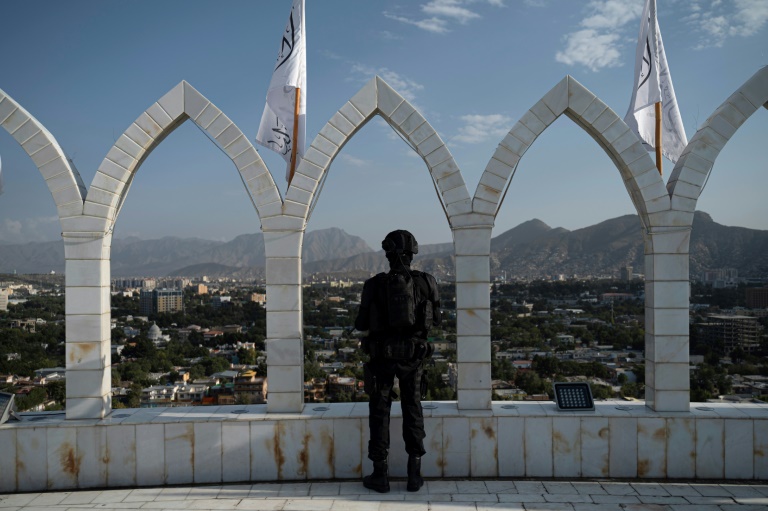
President Joe Biden faced intense criticism for the chaotic withdrawal from Afghanistan but one year later both he and the United States have largely turned the page, even as the war-ravaged country still faces mounting challenges.

Biden put out a written statement to mourn 13 US soldiers killed on August 26, 2021 in a bombing outside the Kabul airport but otherwise has stayed low-key on the anniversary of the end of America’s longest war, instead holding events on gun violence and democracy at home.

In a message to the armed forces, Defense Secretary Lloyd Austin paid tribute to the 2,461 US troops who died in the war and hailed Americans’ efforts to build “a brighter future for the Afghan people” — now once again living under Taliban militants.

“As our country looks back on two decades of combat in Afghanistan, I understand that many people have hard questions about the costs of the war and what their sacrifices meant,” said Austin, who led forces early in the war.

“These are important discussions, and I hope we will keep having them with thoughtfulness and respect.”

– Washington ‘echo chamber’ –

Biden was a longstanding critic of the Afghanistan war, believing ordinary Americans had little at stake in a grinding conflict he saw as a costly distraction from other priorities.

As Kabul fell, with the government crumbling within days despite $2 trillion pumped into Afghanistan over two decades, Biden was adamant he would not back down.

One year later, Biden appears to have been right, at least in the narrow political sense.

Afghanistan figures nowhere among top priorities for Americans and a new Gallup poll found that 50 percent of them believe the entire war was a mistake, compared with nearly universal support after the September 11, 2001 attacks prompted the invasion that toppled the Taliban.

“It’s very easy to poke holes in the decision to leave without providing viable alternatives in good faith,” said Adam Weinstein, a research fellow at the Quincy Institute for Responsible Statecraft, which advocates military restraint.

“DC is its own echo chamber in which a few people are discussing it but for the majority of Americans, it’s not an anniversary that matters to them,” he said.

“They’re worried about inflation, student debt, the divisions that exist in our country and so forth. They’re not thinking about the one-year anniversary of a war that most of the country had no stake in.”

But the scenes from Afghanistan preceded a sharp drop in the approval rating of Biden, who was elected promising smooth, competent leadership after the pandemonium under his predecessor Donald Trump.

Afghanistan was not the only factor, with Covid cases also spiking at the time. But one year later, Biden’s approval rating, while still underwater, has been rebounding after key legislative wins.

– ‘Betrayal’ for women –

The Afghanistan war, which stretched over four presidencies, no longer defines Biden’s foreign policy after six months of intense efforts to arm Ukraine and isolate Russia for its invasion.

Biden has kept up aid to Afghanistan while bypassing the Taliban and proved his argument that the United States could fight terrorism without boots on the ground by ordering a drone strike in Kabul that killed Al-Qaeda chief Ayman al-Zawahiri.

Critics question why Zawahiri was living in the Afghan capital at all. And the Taliban’s return has been a punch in the gut to those who fought for a different Afghanistan, especially one that ensures the rights of women and girls, once again denied education under the militants’ austere interpretation of Islam.

Teresa Casale, executive director of Mina’s List, which advocated a role for women in Afghan negotiations, said that guarantees should have been in place before the US military left.

“The withdrawal, without that, we absolutely categorize as a disaster and I would even go further to say a betrayal,” she said.

“Afghanistan has turned into the worst women’s rights crisis on Earth while a little bit over a year ago 27 percent of the parliament were women.”

She faulted both Trump for negotiating directly with the Taliban and Biden for ordering an unconditional pullout before Afghan talks could advance.

While Trump sealed the withdrawal with the Taliban, his Republican Party has roundly criticized the Biden administration’s handling of it and has vowed hearings on Afghanistan if it wins November congressional elections.

“Because of their actions, or lack thereof, the fallout of this debacle has irreparably harmed both our national security and global image,” said Republican Representative Mike Waltz.

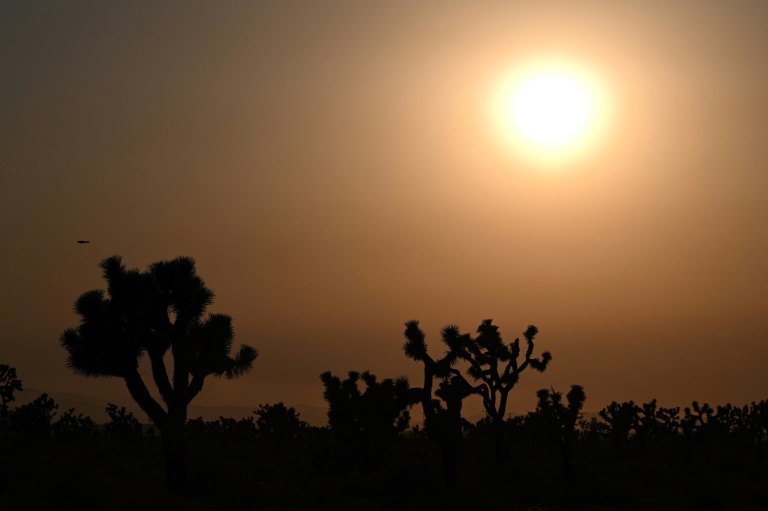
'Dangerous' heat wave hits southwestern US

A “dangerous” heat wave was taking hold of the southwestern United States Tuesday, with punishing temperatures expected for the next week.

Forecasters said the mercury could reach as high as 112 Fahrenheit (44 Celsius) in the densely populated Los Angeles suburbs as a heat dome settles in over parts of California, Nevada and Arizona.

“Dangerously hot conditions expected through the week,” the National Weather Service warned.

“A prolonged period of excessive heat will significantly increase the potential for heat related illnesses, particularly for those working or participating in outdoor activities,” the NWS said.

“Those without access to adequate or reliable cooling or hydration will be at most risk, but much of the population could be susceptible to impacts as well.”

Nighttime temperatures are not expected to offer much relief, with lows struggling to get below 80 Fahrenheit in many places.

Things were heating up in and around Los Angeles on Tuesday, with inland areas already experiencing stifling temperatures.

But, said David Sweet, a meteorologist at the NWS in Oxnard, California, it is going to get worse.

“We’re looking at a heat wave starting on Wednesday and continuing through at least Monday of next week,” he told AFP.

“During that time, we’ll be looking at conditions hot enough to warrant an excessive heat warning,” he added.

It is not unusual for southern California to experience heat waves in September, but temperatures above 100 Fahrenheit are considered hot even for a place almost perpetually baked by sunshine.

The heat wave comes after swathes of the southwest were lashed with torrential rains over recent weeks.

Some areas, including the notoriously dusty Death Valley, suffered flooding, and one person died after being swept away in Zion National Park in Utah.

Scientists say global warming, which is being driven chiefly by humanity’s unending appetite for the power that fossil fuel provides, is making natural weather variations more extreme.

Heat waves are getting hotter and more intense, while storms are getting wetter and, in many cases, more dangerous.

Stocks extend Fed-induced sell-off into third day

Global markets mostly tumbled again on Tuesday, extending losses sparked by last week’s Federal Reserve warning that more tough anti-inflation steps are on the way.

Wall Street indices tumbled around one percent, quickly dashing any hopes of a “turnaround Tuesday” after a small rebound in share prices prior to opening.

London’s FTSE 100 also closed lower after a public holiday the day before, while the Paris CAC 40 fell after staging a rally earlier in the day.

The Frankfurt DAX bucked the trend to end the day up 0.5 percent.

Elsewhere, Asian stocks indices diverged on Tuesday, winning limited support from bargain-buying.

Most markets have been slumping since Friday after Federal Reserve chief Jerome Powell warned of more interest rate hikes ahead — and no chance of a policy pivot — as it fights four-decade high inflation, even at the cost of economic pain.

A closely watched US survey found Americans consumers to be happier about the state of the economy than expected, and more willing to spend. And official figures showed job openings increased last month.

The strong data will boost the idea that the US economy does not need extra help from the Fed, said Ipek Ozkardeskaya, Swissquote Bank analyst.

“Cherry on top: the consumer sentiment regarding the future is improving,” she said. “Hence, there is no reason for the Fed to soften its stance.” 

– Energy woes –

Central banks are scrambling worldwide to tame consumer prices that have surged higher since Russia invaded Ukraine in late February.

German inflation data showed consumer prices rose by 7.9 percent in the year to August as the ongoing energy crisis further stoked price pressures.

In Spain, the inflation rate slowed to 10.4 percent in August as fuel prices eased, but it remained elevated due to rising electricity and food prices.

The European Central Bank — which raised interest rates for the first time in over a decade in July — is expected to hike them again when it meets next week.

Energy prices retreated on Tuesday, however, with oil contracts tanking on fears about a major hit to demand from any global economic slowdown — and more Covid restrictions in key consumer market China.

Brent North Sea crude fell below $100 per barrel.

Natural gas prices, which have soared this year over supply disruptions from key producer Russia, dipped in Europe as German Chancellor Olaf Scholz said government measures have left his country better prepared to cope with further delivery cuts in the winter.

Many European countries are facing severe supply problems as Moscow turns off the gas taps in response to EU military and diplomatic backing for Ukraine.

Russian energy giant Gazprom plans to suspend gas deliveries through the Nord Stream pipeline, which runs to Germany, for three days of “maintenance” work from Wednesday.

– Key figures at around 2030 GMT –

New York – Dow: DOWN 1.0 percent at 31,790.87 points (close)

New York – S&P 500: DOWN 1.1 percent at 3,986.16(close)

New York – Nasdaq: DOWN 1.1 percent at 11,883.14 (close)

London – FTSE 100: DOWN 0.9 percent at 7,361.63 points (close)

Frankfurt – DAX: UP 0.5 percent at 12,961.14 (close)

Paris – CAC 40: DOWN 0.2 percent at 6,210.22 (close)

EURO STOXX 50: DOWN 0.2 percent at 3,561.92 (close)

Tokyo – Nikkei 225: UP 1.1 percent at 28,195.58 (close)

Hong Kong – Hang Seng Index: DOWN 0.4 percent at 19,949.03 (close)

Shanghai – Composite: DOWN 0.4 percent at 3,227.22 (close)

Euro/dollar: UP at $1.0024 from $0.9972 on Monday

Pound/dollar: DOWN at $1.1661 from $1.1709

Euro/pound: UP at 85.95 pence from 85.38 pence

Dollar/yen: DOWN at 138.66 yen from 138.68 yen

West Texas Intermediate: DOWN 5.5 percent at $91.64 per barrel

Brent North Sea crude: DOWN 5.5 percent at $99.31 per barrel

burs-rox-bfm/hs

Iraq protesters disperse after Sadr demands end to deadly clashes

Iraqi supporters of powerful cleric Moqtada Sadr withdrew Tuesday from Baghdad’s Green Zone after he demanded an end to fighting between rival Shiite forces and the army that left 30 dead and hundreds wounded.

The clashes that erupted on Monday pitted Sadr loyalists against Shiite factions backed by neighbouring Iran — violence that prompted Iraq’s president to push for early elections and the prime minister to threaten to resign. 

Sadr, a grey-bearded preacher with millions of devoted followers who once led a militia against American and Iraqi government forces, gave followers “60 minutes” to withdraw after which he would threaten to “disavow” those who remained.

“I apologise to the Iraqi people, the only ones affected by the events,” Sadr said in a speech from his base in the Shiite holy city of Najaf.

“Shame on this revolution… Regardless of who was the initiator, this revolution, as long as it is marred by violence, is not a revolution,” he said.

“I thank the security forces and members of Hashed al-Shaabi,” he added.

In a later tweet, he called on the authorities to compensate the families of victims.

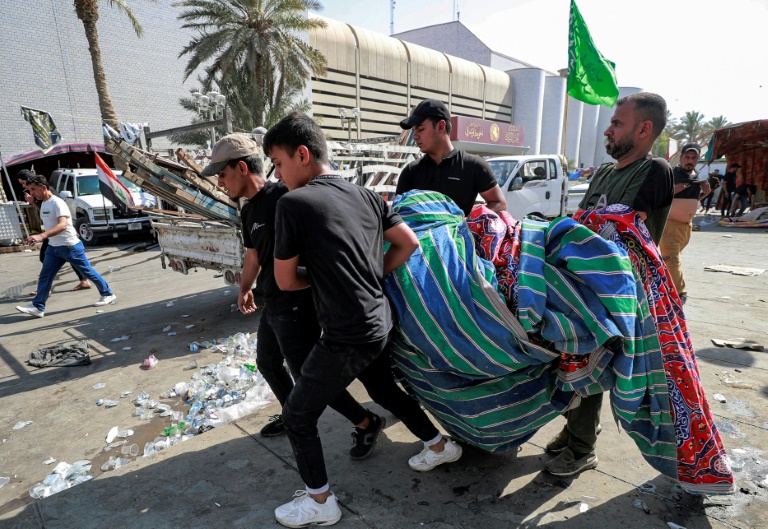
After Sadr’s speech was broadcast live on television, his supporters started dismantling encampments and clearing the Green Zone, where municipal workers began cleaning up shells and bullet casings left in the wake of the unrest. 

The army lifted a nationwide curfew, with concrete barriers removed from main thoroughfares and traffic slowly resumed its normal flow. 

As calm returned on Tuesday, President Barham Saleh encouraged “new, early elections in accordance with a national consensus,” saying they could provide “an exit from the stifling crisis”.

Prime Minister Mustafa al-Kadhemi said investigations have been launched into the unrest and threatened to resign if the political paralysis continues.

“If they want to continue to stir up chaos, conflict, discord and rivalry… I will take the moral and patriotic step and vacate my post at the appropriate time,” he said in a speech. 

– ‘Bargaining tactics’ –

Tensions have soared in Iraq amid a political crisis that has left the country without a new government, prime minister or president for months.

They escalated sharply after Sadr’s supporters on Monday afternoon stormed the government palace inside the high-security Green Zone following their leader’s announcement that he was quitting politics.

Overnight, shelling targeted the Green Zone that houses government buildings and diplomatic missions amid the angry protests.

Violence continued on Tuesday morning — with the rattle of automatic gunfire and heavier explosions of rocket-propelled grenades — as Sadr’s supporters clashed with the army and men of the Hashed al-Shaabi, former Tehran-backed paramilitaries integrated into the Iraqi security forces.

Medics said 30 Sadr supporters had been killed since Monday and 570 others wounded — some with bullet wounds and others suffering tear gas inhalation.

A mass funeral was held Tuesday in Najaf for some of the protesters killed in Baghdad.

“I think this strategy of violence and destabilisation is part of Sadr’s negotiation and bargaining tactics,” said Renad Mansour of British think tank Chatham House.

Sadr — a longtime player in the war-torn country’s political scene, though he himself has never directly been in government — announced he was quitting politics two days after he said “all parties” including his own should give up government positions in order to help resolve the political crisis.

– Early elections –

Sadr’s bloc emerged from last October’s election as the biggest in the legislature, with 73 seats, but short of a majority.

Since then the country has been mired in political deadlock due to disagreement between Shiite factions over forming a coalition.

In June, Sadr’s lawmakers quit in a bid to break the logjam, which led to a rival bloc, the pro-Iran Coordination Framework, becoming the largest.

Sadr’s supporters had for weeks been staging a sit-in outside Iraq’s parliament, after storming the legislature’s interior on July 30, demanding fresh elections be held.

The Coordination Framework wants a new head of government to be appointed before any new polls are held.

On Tuesday, the Framework called on “parliament and other state institutions to return to exercising their constitutional functions”.

Under the constitution, parliament can only be dissolved by an absolute majority vote in the house, following a request by one-third of deputies or by the prime minister with the approval of the president.

The US ambassador in Baghdad, Alina Romanowski, posted a statement welcoming calls for protesters to “cease conflict” and urging “all citizens to allow their government institutions to continue to function”.

In response to the clashes on Monday, the UN mission in Iraq had warned of “an extremely dangerous escalation” and called on all sides to “refrain from acts that could lead to an unstoppable chain of events”.

Outgoing UN rights chief Bachelet to be temporarily succeeded by deputy

UN High Commissioner for Human Rights Michelle Bachelet, whose term ends Wednesday, will be temporarily replaced by her deputy until her successor is named, the UN secretary-general’s spokesperson said Tuesday. 

“Tomorrow is Michelle Bachelet’s last day. I don’t expect an announcement tomorrow” on her successor, Stephane Dujarric told a press briefing. 

Until the appointment of a replacement, as “of the first of September, Nada Youssef Al Nashif, who is a deputy High Commissioner for Human Rights, will be the officer in charge,” he added.

Asked about a possible date for UN chief Antonio Guterres to announce his nomination for the sensitive post, Dujarric said he could not “predict what will be happening.” 

“We’re trying to do this as quickly as possible, as diligently as possible,” he said.

The person chosen by Guterres will then have to be confirmed by the UN General Assembly. 

Bachelet took office on September 1, 2018, and announced in June that she would not seek a second term in order to spend time with her family and in her own country. 

The former Chilean president has been severely criticized in recent months by the United States and also by major NGOs, who accuse her of a lack of firmness in the face of human rights violations in China. Some have accused her of behaving as a “diplomat” rather than as a defender of human rights. 

In an open letter to the UN Secretary General, more than 60 NGOs called in June for a new human rights chief with “courage” in the face of the most powerful countries. 

“This is not a job for a nice, quiet diplomat, because a quiet diplomat has no leverage. Nobody listens to a quiet diplomat. Nobody changes their behavior because of a quiet diplomat,” Kenneth Roth, the outgoing head of Human Rights Watch, said in a recent interview with AFP.

Webb telescope captures new detail of Phantom Galaxy

The James Webb space telescope has revealed dazzling new detail of a previously known slice of the cosmos 32 million light-years away, in a new picture released by NASA and the European Space Agency (ESA).

The infrared technology of the telescope, launched in December 2021, has allowed for an even clearer view of the so-called Phantom Galaxy than astronomers had ever seen before.  

“Webb’s sharp vision has revealed delicate filaments of gas and dust in the grandiose spiral arms which wind outwards from the center of this image,” NASA and the ESA said Monday. 

“A lack of gas in the nuclear region also provides an unobscured view of the nuclear star cluster at the galaxy’s center,” the agencies said in a statement.

The whirling celestial form, officially called M74, is located in the Pisces constellation 32 million light-years away from Earth. 

The Webb image shows the galaxy’s brilliant white, red, pink and light blue appendages of dust and stars swirling around a bright blue center, all set against the dark backdrop of deep space. 

M74 was previously photographed by the Hubble telescope, which captured the galaxy’s spiraling blue and pink arms, but instead showed its glowing center as a soft yellow. 

The Phantom Galaxy is a “favorite target for astronomers studying the origin and structure of galactic spirals,” NASA and the ESA said. The picture taken by Webb will help them “learn more about the earliest phases of star formation in the local Universe,” and record more information about 19 star-forming galaxies close to our own Milky Way. 

Astronomers will also use the picture to “pinpoint star-forming regions in the galaxies, accurately measure the masses and ages of star clusters, and gain insights into the nature of the small grains of dust drifting in interstellar space,” the statement said. 

Webb’s new pictures have thrilled the space community as the telescope orbits the Sun at a distance of a million miles (1.6 million kilometers) from Earth, in a region of space called the second Lagrange point.

The telescope, which has a primary mirror more than 21 feet (6.5 meters) wide, is an international collaboration between NASA, the ESA and the Canadian Space Agency. It is expected to operate for approximately 20 years.

Pakistan floods 'worst in country's history', aid efforts gather pace

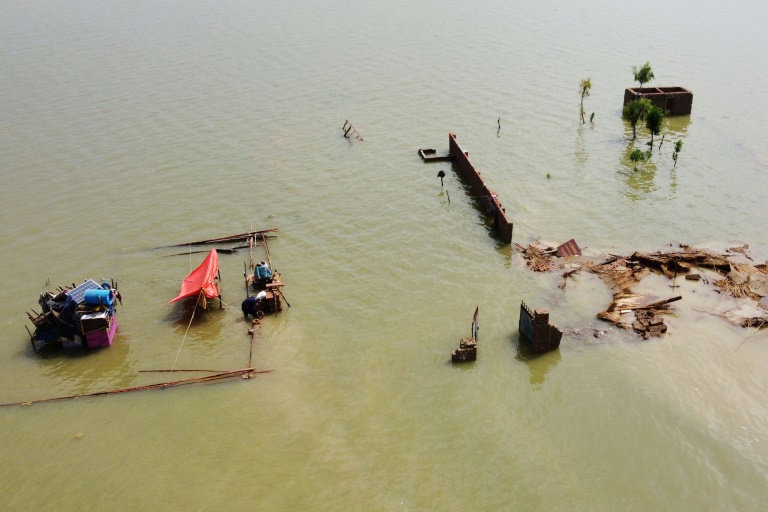
Aid efforts ramped up across flooded Pakistan on Tuesday to help tens of millions of people affected by relentless monsoon rains that have submerged a third of the country and claimed more than 1,100 lives.

Prime Minister Shehbaz Sharif called the flooding “the worst in the history of Pakistan”, adding it would cost at least $10 billion to repair damaged infrastructure spread across the country. 

The rains that began in June have unleashed powerful floods across the country that have washed away swathes of vital crops and damaged or destroyed more than a million homes.

Authorities and charities are struggling to accelerate aid delivery to more than 33 million people, a challenging task in areas cut off because many roads and bridges have been critically damaged.

Displaced people have been wandering what dry land remains, seeking shelter, food and drinking water.

“For God’s sake help us out,” said Qadir, 35, who was camped out with his extended family on a road near the southern city of Sukkur.

“We walked along the road for three days to reach here. There’s nothing left back at home, we only managed to save our lives.”

In the country’s south and west, many Pakistanis have crammed onto elevated highways and railroad tracks to escape the flooded plains.

“We don’t even have space to cook food. We need help,” Rimsha Bibi, a schoolgirl in Dera Ghazi Khan in central Pakistan, told AFP.

Pakistan receives heavy — often destructive — rains during its annual monsoon season, which are crucial for agriculture and water supplies.

But such intense downpours have not been seen for three decades.

Pakistani officials have blamed climate change, which is increasing the frequency and intensity of extreme weather around the world.

– ‘Mind-boggling devastation’ –

“To see the devastation on the ground is really mind-boggling,” Pakistan’s climate change minister Sherry Rehman told AFP.

“When we send in water pumps, they say, ‘Where do we pump the water?’ It’s all one big ocean, there’s no dry land to pump the water out.”

She said “literally a third” of the country was under water, comparing scenes from the disaster to a dystopian movie.

Tributaries of the Indus River, which runs the length of the South Asian nation, have sent torrents of water rushing downstream.

Pakistan as a whole has been deluged with twice the usual monsoon rainfall, the meteorological office said, but Balochistan and Sindh provinces have seen more than four times the average of the last three decades.

– ‘Monsoon on steroids’ –

The disaster could not have come at a worse time for Pakistan, where the economy is in free fall.

Appealing for international help, the government has declared an emergency.

Aid flights have arrived in recent days from China, Turkey and the United Arab Emirates, while other countries including Canada, Australia and Japan have also pledged assistance.

The United Nations launched a formal $160 million appeal on Tuesday to fund emergency aid.

“Pakistan is awash in suffering. The Pakistani people are facing a monsoon on steroids — the relentless impact of epochal levels of rain and flooding,” UN Secretary-General Antonio Guterres said in a video statement, calling it a “colossal crisis”.

His spokesman later said that Guterres would visit the country next week in “solidarity” with victims.

And the United States said Tuesday that it was sending $30 million in humanitarian assistance. 

Pakistan’s Sharif promised donors that any funding would be responsibly spent.

“I want to give my solemn pledge and solemn commitment… every penny will be spent in a very transparent fashion. Every penny will reach the needy,” he said.

Pakistan was already desperate for international support and the floods have compounded the challenge.

Prices of basic goods — particularly onions, tomatoes and chickpeas — are soaring as vendors bemoan a lack of supplies from the flooded breadbasket provinces of Sindh and Punjab.

There was some relief on Monday when the International Monetary Fund approved the revival of a loan programme for Pakistan, releasing a $1.1 billion tranche.

Makeshift relief camps have sprung up all over Pakistan — in schools, on motorways and in military bases.

In the northwestern town of Nowshera, a technical college was turned into a shelter for up to 2,500 flood victims.

They sweltered in the summer heat with sporadic food aid and little access to water.

“I never thought that one day we will have to live like this,” said 60-year-old Malang Jan.

“We have lost our heaven and are now forced to live a miserable life.”

Close Bitnami banner
Bitnami