World

18 die as Madagascar police shoot at albino kidnap protesters: medic

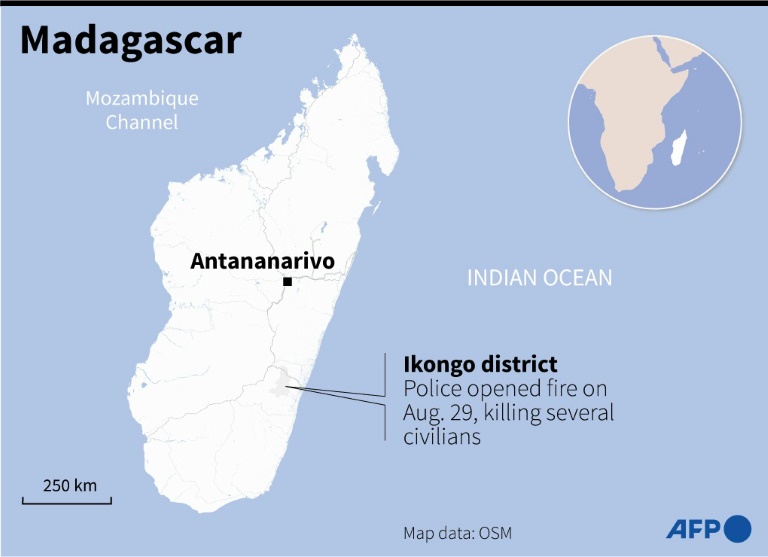
Eighteen people died Monday after police in Madagascar opened fire on what they called a lynch mob angered at the kidnapping of an albino child, a senior doctor told AFP.

Dozens were wounded, some of them seriously.

“At the moment, 18 people have died in all, nine on the spot and nine in hospital,” said doctor Tango Oscar Toky, chief physician at a hospital in southeastern Madagascar.

“Of the 34 injured, nine are between life and death,” said the doctor giving graphic details of the injuries. “We are waiting for a government helicopter to evacuate them to the capital”.

Around 500 protesters armed with blades and machetes “tried to force their way” into the station, a police officer involved in the shooting said, speaking on condition of anonymity. 

“There were negotiations, (but) the villagers insisted,” the officer told AFP over the phone from the town of Ikongo, 350 kilometres (about 220 miles) from the capital Antananarivo.

Police first fired teargas and then rounds in the air to try to disperse the crowd, he said. 

“They continued to force their way through. We had no choice but to defend ourselves,” the officer added.

The national police in the capital confirmed the “very sad event”, but only gave a toll of 11, with 18 injured. 

Andry Rakotondrazaka, the national police chief, told a news conference that what happened was a “very sad event. It could have been avoided but it happened”.

He said the police “did everything to avoid confrontation”, including negotiating with the crowd,

“But there were provocations”… (and) there were people with “long-bladed knives and sticks”, he said, adding others hurled stones towards the police. 

“The gendarmes used tear gas. But that was not enough to stop the crowd from advancing. There was shooting in the air.” 

But in the end the gendarmes had “no choice but to resort to self-defence… and limit the damage by shooting”.

The kidnapping took place last week, according to Jean-Brunelle Razafintsiandraofa, a member of parliament for Ikongo district.

– Revenge attacks –

Revenge attacks are common in Madagascar.

In February 2017, a mob of 800 people barged into Ikongo prison in search of a murder suspect they intended to kill.

They overpowered guards and 120 prisoners broke out of jail.

In 2013, a Frenchman, a Franco-Italian and a local man accused of killing a child on the tourist island of Nosy Be were burned alive by a crowd. 

Some sub-Saharan African countries have suffered a wave of assaults against people with albinism, whose body parts are sought for witchcraft practices in the mistaken belief that they bring luck and wealth. 

Albinism, caused by a lack of melanin, the pigment that colours skin, hair and eyes, is a genetic condition that affects hundreds of thousands of people across the globe, particularly in Africa.

Under The Same Sun, a Canada-based charity working to combat discrimination, has been logging cases of similar violence across Africa.

It ranks Burundi, Democratic Republic of Congo, Malawi, Mozambique and Tanzania as the countries where such attacks are most prevalent.

Madagascar, a large Indian Ocean island country, is ranked among the poorest in the world. 

strs-ub-sn/ach

Russia struggles to recruit soldiers for Ukraine: Pentagon

Russia is struggling to find more soldiers to fight in Ukraine, even tapping prisons, and many new recruits are older, in poor shape and lacking training, a senior US defense official said Monday.

The official noted Russian President Vladimir Putin’s decree last Thursday to increase the headcount of the country’s army by about 10 percent to 1.15 million servicemen, starting January next year.

After experiencing significant setbacks and heavy troop losses in six months after invading Ukraine, the Pentagon believes that “this effort is unlikely to succeed, as Russia has historically not met personnel and strength targets,” the official said.

“Russia has already begun trying to expand recruitment efforts,” the official told journalists on the basis of anonymity.

“They’ve done this in part by eliminating the upper age limit for new recruits, and also by recruiting of prisoners,” the official said.

“Many of these new recruits have been observed as older, unfit and ill-trained,” the official said.

The Pentagon’s conclusion is that any more recruits added may not effectively expand overall combat power by the end of the year, according to the official.

Even before the war, Russia’s armed forces may have been 150,000 short of their stated goal of one million, the official said.

In early August, US Under Secretary of Defense Colin Kahl estimated that 70-80,000 Russians had been killed or wounded in Ukraine since the invasion on February 24.

Iran says nuclear deal 'meaningless' without end to watchdog probe

Iran’s president said Monday that reviving a 2015 atomic deal with world powers would be pointless unless the UN nuclear watchdog put an end to its probe of undeclared sites in the country.

Ebrahim Raisi’s comments came as Tehran reviews the US response to its suggestions on a “final” text put forward by the EU to salvage the landmark deal.

The United States had been adamant that Tehran cooperate with the International Atomic Energy Agency (IAEA) to clear up suspicions about earlier work at three undeclared sites.

“In the negotiations, safeguard issues are one of the fundamental ones. All of the safeguard issues must be resolved,” Raisi told reporters at a news conference in the capital Tehran.

“Without resolving the safeguard issues, talking about the agreement is meaningless,” he added.

The IAEA has referred to the traces of nuclear materials as a “safeguards” issue.

Iran has repeatedly urged the agency to end the issue before any revived deal is implemented, but US State Department spokesman Vedant Patel on Thursday said “we do not believe there should be any conditionality” between the deal and undeclared sites.

In June, the IAEA’s board of governors adopted a resolution censuring Iran for failing to adequately explain the previous discovery of traces of enriched uranium at three sites not declared by Tehran as having hosted nuclear activities.

Last week, amid rising hopes of a revived deal, IAEA chief Rafael Grossi, in an interview with CNN, rejected the idea of the agency closing its probe without receiving answers.

“This idea that politically we are going to stop doing our job is unacceptable for us,” he said. “So far Iran has not given us the technically credible explanations we need.”

In his latest report to IAEA member states on the implementation of the 2015 deal, Grossi on Monday said Iran had begun enriching uranium in one of three recently installed centrifuge cascades in Natanz.

The agreement between Iran and six world powers — Britain, China, France, Germany, Russia and the United States — gave the Islamic republic sanctions relief in exchange for curbs on its nuclear programme.

– No plan to meet Biden –

Since taking office in 2021, President Joe Biden has sought to return the United States to the deal unilaterally abandoned by his predecessor Donald Trump in 2018.

The Vienna talks, which began in April last year, aim to return Washington to the nuclear pact, including through the lifting of sanctions on Iran, and to return Tehran to full compliance with its commitments.

The indirect negotiations between Tehran and Washington have so far been carried out through the mediation of the European Union.

Raisi reiterated his opposition to meeting with Biden during the UN General Assembly next month. 

“There’s no benefit in a meeting between me and him… There is no plan for such a meeting and there will not be any,” he added.

Israel, Iran’s arch-enemy, has been pushing its ally, the United States, as well as other Western countries to stop the nuclear negotiations with Tehran.

Israeli Prime Minister Yair Lapid on Sunday said any new agreement with Tehran would have to include an expiration date, and tighter supervision that would also “address Iran’s ballistic missile programme”.

“We can reach such an agreement if a credible military threat is put on the table,” Lapid added.

Raisi said that actions by Israel including “the assassination of (Iranian) nuclear scientists” and “acts of sabotage” against nuclear facilities could “not stop” Iran’s nuclear programme.

He also warned Israel that it “may not have the time to act if it decides to do something” against Iran.

The 2015 deal, known formally as the Joint Comprehensive Plan of Action, aimed to prevent Iran from developing a nuclear weapon — something it has always denied wanting to do.

“Nuclear weapons have no place in our defence doctrine,” Raisi stressed.

US regulators sue firm selling sensitive location data

US regulators on Monday filed a lawsuit to stop data broker Kochava from selling smartphone location information that could help trace visits to “sensitive locations” like reproductive health clinics.

The action by the Federal Trade Commission comes as privacy rights advocates fear that massive troves of information collected from people’s smartphone or internet use could serve to track down women seeking abortion care.

Geolocation data purchased by Idaho-based Kochava comes from hundreds of millions of mobile devices, and could be used to trace people’s movements to or from health clinics, places of worship, drug-addiction centers, or domestic violence shelters, the FTC said in a press release.

“Where consumers seek out health care, receive counseling, or celebrate their faith is private information that shouldn’t be sold to the highest bidder,” Samuel Levine, head of the FTC’s bureau of consumer protection said in a press release.

The FTC lawsuit argues that Kochava is making it possible to identify people based on their health care decisions or religion, then exposing them to “threats of stigma, stalking, discrimination, job loss and even physical violence.”

The FTC is asking a federal court in Idaho to order Kochava to stop selling sensitive geolocation data and to delete whatever data of that kind it has collected.

Kochava did not immediately respond to a request for comment.

Kochava buys location information gathered from mobile devices, then packages it in ways that can identify specific devices and show precisely where they were at given times, according to the FTC.

“For example, the location of a mobile device at night is likely the user’s home address and could be combined with property records to uncover their identity,” the FTC said.

People are typically unaware that their location data is being bought and sold by Kochava, according to the suit.

Privacy advocates have called on internet firms to stop collecting data on users that could be demanded by prosecutors or others out to prosecute women for reproductive health care decisions.

The lawsuit comes just months after the Supreme Court overturned the landmark 1973 Roe v. Wade ruling that guaranteed women’s right an abortion.

IMF approves revival of massive Pakistan loan program

The IMF board on Monday approved an agreement to revive a massive loan program for Pakistan, as the country grapples with devastating monsoon flooding that has worsened an economic crisis.

The Washington-based crisis lender will release $1.1 billion to the country immediately, and has added an additional $500 million to the total size of the package, bringing it to about $6.5 billion.

In addition, the International Monetary Fund agreed to the government’s request to extend the package through June 2023.

The original $6 billion bailout package was signed by former prime minister Imran Khan in 2019, but repeatedly stalled when his government reneged on agreed reforms on subsidies and failed to significantly improve tax collection.

The aid comes as “Pakistan’s economy has been buffeted by adverse external conditions, due to spillovers from the war in Ukraine, and domestic challenges,” said IMF Deputy Managing Director Antoinette Sayeh in a statement.

“Steadfast implementation of corrective policies and reforms remain essential to regain macroeconomic stability, address imbalances and lay the foundation for inclusive and sustainable growth,” she said.

The government reached an agreement with IMF staff last month to restart the suspended aid package.

The new agreement follows months of deeply unpopular belt-tightening by the government of Shehbaz Sharif, who took power in April and has effectively eliminated fuel subsidies and introduced new measures to broaden the tax base.

Finance Minister Miftah Ismail, announcing the approval on Twitter, applauded Sharif “for taking so many tough decisions and saving Pakistan from default.”

The latest disbursement brings the total received under the IMF Extended Fund Facility to about $4 billion.

– Desperate for aid –

Pakistan is desperate for international support for its economy, which suffers from poor revenue collection and dwindling foreign reserves to pay its crippling debt.

The new government has slashed a raft of subsidies to meet the demands of global financial institutions, but risks the wrath of an electorate already struggling under double-digit inflation.

Sharif’s new coalition government has said it will make the tough decisions needed to turn the economy around.

Successive administrations have blamed their predecessors for the country’s economic woes, but analysts say the malaise stems from decades of poor management and a failure to tackle endemic corruption and widespread tax avoidance.

In a bid to secure the IMF loan, Sharif has imposed three fuel price hikes — cumulatively totalling 50 percent — and raised the cost of electricity to effectively end the subsidies introduced by Khan.

Ismail told the national assembly last month that the steps were “essential” to preserve the country from default.

“We knew it would damage our political reputation, but still we did it,” he said. 

The latest budget has earmarked 3.95 trillion rupees ($18.8 billion) just to service the country’s whopping debt of $128 billion.

Sayeh welcomed the government’s intention to achieve a small budget surplus in 2023.

“Containing current spending and mobilizing tax revenues are critical to create space for much-needed social protection and strengthen public debt sustainability,” she said.

She also called recent interest rate increases a “necessary step” to rein in inflation.

Under the deal agreed with the IMF, policy priorities included steadfast implementation of the budget to reduce the need to borrow.

Pakistan also agreed to continue power sector reforms, tighten monetary policy to tackle inflation, strengthen governance, combat corruption and improve the social security net.

NASA scrubs launch of giant Moon rocket, may try again Friday

NASA has scrubbed a test flight of its powerful new rocket, in a setback to its plan to send humans back to the Moon and eventually to Mars, but may shoot for another launch attempt on Friday.

“We don’t launch until it’s right,” NASA administrator Bill Nelson said after an engine issue forced a cancellation of Monday’s flight from the Kennedy Space Center in Florida.

“This is a very complicated machine,” Nelson said. “You don’t want to light the candle until it’s ready to go.”

The goal of the mission, baptized Artemis 1 after the twin sister of Apollo, is to test the 322-foot (98-meter) Space Launch System (SLS) rocket and Orion crew capsule that sits on top.

The mission is uncrewed — mannequins equipped with sensors are standing in for astronauts and will record acceleration, vibration and radiation levels.

Mike Sarafin, mission manager of Artemis 1, said the space agency is hoping to make another launch attempt later this week.

“Friday is definitely in play,” Sarafin said.

NASA would have a better idea of whether a Friday launch is feasible after a meeting on Tuesday of the management team, he said.

“We just need a little bit of time to look at the data,” Sarafin said.

Next Monday, September 5, is an alternative launch date.

Blastoff had been planned for 8:33 am (1233 GMT) but was cancelled because a test to get one of the rocket’s four RS-25 engines to the proper temperature range for launch was not successful.

Delays are “part of the space business,” Nelson said, expressing confidence NASA engineers will “get it fixed and then we’ll fly.”

Tens of thousands of people — including US Vice President Kamala Harris — had gathered to watch the launch, which comes 50 years after Apollo 17 astronauts last set foot on the Moon.

“Our commitment to the Artemis Program remains firm, and we will return to the Moon,” Harris tweeted.

Veteran NASA astronaut Stan Love told reporters he was disappointed but “not really surprised.”

“This is a brand new vehicle,” Love said. “It has a million parts. All of them have to work perfectly.”

– Extreme temperatures –

Overnight operations to fill the orange-and-white rocket with ultra-cold liquid hydrogen and oxygen were briefly delayed by a risk of lightning.

A potential leak was detected during the filling of the main stage with hydrogen, causing a pause. After tests, the flow resumed.

NASA engineers later detected the engine temperature problem and decided to scrub the launch.

The Orion capsule is to orbit the Moon to see if the vessel is safe for people in the near future. At some point, Artemis aims to put a woman and a person of color on the Moon for the first time.

During the 42-day trip, Orion will follow an elliptical course around the Moon, coming within 60 miles (100 kilometers) at its closest approach and 40,000 miles at its farthest — the deepest into space by a craft designed to carry humans.

One of the main objectives is to test the capsule’s heat shield, which at 16 feet in diameter is the largest ever built.

On its return to Earth’s atmosphere, the heat shield will have to withstand speeds of 25,000 miles per hour and a temperature of 5,000 degrees Fahrenheit (2,760 degrees Celsius) — roughly half as hot as the Sun.

– Crewed mission to Mars –

NASA is expected to spend $93 billion between 2012 and 2025 on the Artemis program, which is already years behind schedule, at a cost of $4.1 billion per launch.

The next mission, Artemis 2, will take astronauts into orbit around the Moon without landing on its surface.

The crew of Artemis 3 is to land on the Moon in 2025 at the earliest.

And since humans have already visited the Moon, Artemis has its sights set on another lofty goal: a crewed mission to Mars.

The Artemis program aims to establish a lasting human presence on the Moon with an orbiting space station known as Gateway and a base on the surface.

Gateway would serve as a staging and refueling station for a voyage to the Red Planet that would take a minimum of several months.

Tens of millions battle Pakistan floods as death toll rises

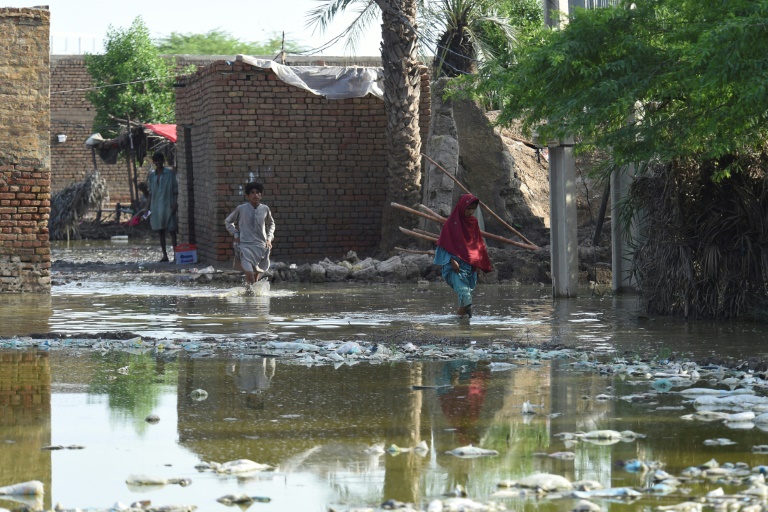
Tens of millions of people across Pakistan were Monday battling the worst monsoon floods in a decade, with countless homes washed away, vital farmland destroyed and the country’s main river threatening to burst its banks.

Climate Change Minister Sherry Rehman said a third of the nation was under water, creating a “crisis of unimaginable proportions”.

Officials say 1,136 people have died since June, when the seasonal rains began, but the final toll could be higher as hundreds of villages in the mountainous north have been cut off after flood-swollen rivers washed away roads and bridges.

The annual monsoon is essential for irrigating crops and replenishing lakes and dams across the Indian subcontinent, but it can also bring destruction.

This year’s flooding has affected more than 33 million people — one in seven Pakistanis — said the National Disaster Management Authority.

“It’s all one big ocean, there’s no dry land to pump the water out,” Rehman told AFP, adding the economic cost will be devastating.

This year’s floods are comparable to those of 2010, the worst on record, when more than 2,000 people died.

Flood victims have taken refuge in makeshift camps that have sprung up across the country, where desperation is setting in.

“Living here is miserable. Our self-respect is at stake,” said Fazal e Malik, sheltering in the grounds of a school now home to around 2,500 people in the town of Nowshera in Khyber Pakhtunkhwa province.

“I stink but there is no place to take a shower. There are no fans.”

Near Sukkur, a city in southern Sindh province and home to an ageing colonial-era barrage on the Indus River that is vital to preventing further catastrophe, one farmer lamented the devastation wrought on his rice fields.

Millions of acres of rich farmland have been flooded by weeks of non-stop rain, but now the Indus is threatening to burst its banks as torrents of water course downstream from tributaries in the north.

“Our crop spanned over 5,000 acres on which the best quality rice was sown and is eaten by you and us,” Khalil Ahmed, 70, told AFP.

“All that is finished.”

– Landscape of water –

Much of Sindh is now an endless landscape of water, hampering a massive military-led relief operation.

“There are no landing strips or approaches available… our pilots find it difficult to land,” one senior officer told AFP.

The army’s helicopters were also struggling to pluck people to safety in the north, where soaring mountains and deep valleys make for treacherous flying conditions.

Many rivers in Khyber Pakhtunkhwa province — which boasts some of Pakistan’s best tourist spots — have overflowed, demolishing scores of buildings including a 150-room hotel that crumbled into a raging torrent.

The government has declared an emergency and appealed for international help, and on Sunday the first aid flights began arriving — from Turkey and the UAE.

The floods could not have come at a worse time for Pakistan, where the economy is in free fall.

In Washington later Monday, the International Monetary Fund executive board approved the revival of a $6 billion loan programme essential for the country to service its foreign debt.

“We should now be getting the 7th & 8th tranche of $1.17 billion,” Finance Minister Miftah Ismail said on Twitter.

The United Nations announced that it will launch a formal appeal Tuesday for $160 million to fund emergency aid for the flood-battered country.

“The situation is expected to worsen with more ongoing rainfall,” Stephane Dujarric, the UN Secretary-General spokesman, warned during a press briefing Monday. The UN has already allocated $10 million in emergency aid.

But it is already clear it will take more to repair and rebuild after this monsoon.

Prices of basic goods — particularly onions, tomatoes and chickpeas — are soaring as vendors bemoan a lack of supplies from the flooded breadbasket provinces of Sindh and Punjab.

The meteorological office said the country as a whole had been deluged with twice the usual monsoon rainfall, but Balochistan and Sindh had seen more than four times the average of the last three decades.

Padidan, a small town in Sindh, was drenched by more than 1.2 metres (47 inches) of rain since June, making it the wettest place in Pakistan.

– More arriving daily –

Across Sindh, thousands of displaced people are camped alongside elevated highways and railway tracks — often the only dry spots as far as the eye can see.

More are arriving daily at Sukkur’s city ring road, belongings piled on boats and tractor trollies, looking for shelter until the floodwaters recede.

Sukkur Barrage supervisor Aziz Soomro told AFP the main headway of water was expected to arrive around September 5, but he was confident the 90-year-old sluice gates would cope.

The barrage diverts water from the Indus into 10,000 kilometers (6,210 miles) of canals that make up one of the world’s biggest irrigation schemes, but the farms it supplies are now mostly under water.

The only bright spark was the latest weather report that said there was little chance of rain for the rest of the week.

Tens of millions battle Pakistan floods as death toll rises

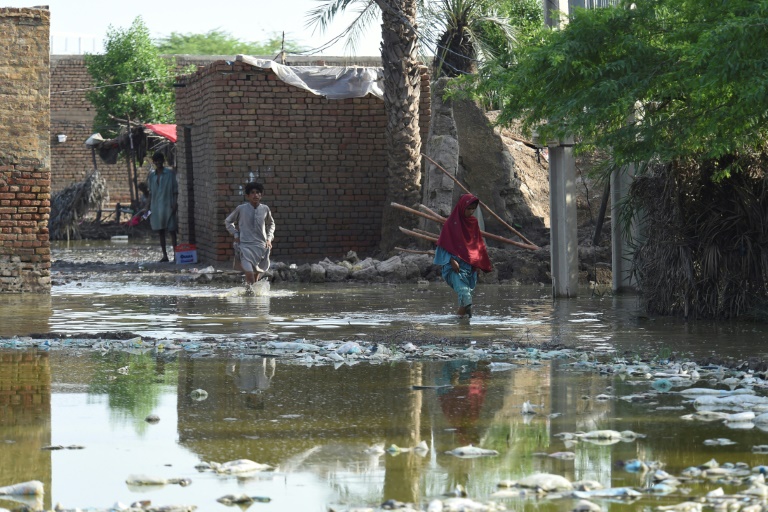
Tens of millions of people across Pakistan were Monday battling the worst monsoon floods in a decade, with countless homes washed away, vital farmland destroyed and the country’s main river threatening to burst its banks.

Climate Change Minister Sherry Rehman said a third of the nation was under water, creating a “crisis of unimaginable proportions”.

Officials say 1,136 people have died since June, when the seasonal rains began, but the final toll could be higher as hundreds of villages in the mountainous north have been cut off after flood-swollen rivers washed away roads and bridges.

The annual monsoon is essential for irrigating crops and replenishing lakes and dams across the Indian subcontinent, but it can also bring destruction.

This year’s flooding has affected more than 33 million people — one in seven Pakistanis — said the National Disaster Management Authority.

“It’s all one big ocean, there’s no dry land to pump the water out,” Rehman told AFP, adding the economic cost will be devastating.

This year’s floods are comparable to those of 2010, the worst on record, when more than 2,000 people died.

Flood victims have taken refuge in makeshift camps that have sprung up across the country, where desperation is setting in.

“Living here is miserable. Our self-respect is at stake,” said Fazal e Malik, sheltering in the grounds of a school now home to around 2,500 people in the town of Nowshera in Khyber Pakhtunkhwa province.

“I stink but there is no place to take a shower. There are no fans.”

Near Sukkur, a city in southern Sindh province and home to an ageing colonial-era barrage on the Indus River that is vital to preventing further catastrophe, one farmer lamented the devastation wrought on his rice fields.

Millions of acres of rich farmland have been flooded by weeks of non-stop rain, but now the Indus is threatening to burst its banks as torrents of water course downstream from tributaries in the north.

“Our crop spanned over 5,000 acres on which the best quality rice was sown and is eaten by you and us,” Khalil Ahmed, 70, told AFP.

“All that is finished.”

– Landscape of water –

Much of Sindh is now an endless landscape of water, hampering a massive military-led relief operation.

“There are no landing strips or approaches available… our pilots find it difficult to land,” one senior officer told AFP.

The army’s helicopters were also struggling to pluck people to safety in the north, where soaring mountains and deep valleys make for treacherous flying conditions.

Many rivers in Khyber Pakhtunkhwa province — which boasts some of Pakistan’s best tourist spots — have overflowed, demolishing scores of buildings including a 150-room hotel that crumbled into a raging torrent.

The government has declared an emergency and appealed for international help, and on Sunday the first aid flights began arriving — from Turkey and the UAE.

The floods could not have come at a worse time for Pakistan, where the economy is in free fall.

In Washington later Monday, the International Monetary Fund executive board approved the revival of a $6 billion loan programme essential for the country to service its foreign debt.

“We should now be getting the 7th & 8th tranche of $1.17 billion,” Finance Minister Miftah Ismail said on Twitter.

The United Nations announced that it will launch a formal appeal Tuesday for $160 million to fund emergency aid for the flood-battered country.

“The situation is expected to worsen with more ongoing rainfall,” Stephane Dujarric, the UN Secretary-General spokesman, warned during a press briefing Monday. The UN has already allocated $10 million in emergency aid.

But it is already clear it will take more to repair and rebuild after this monsoon.

Prices of basic goods — particularly onions, tomatoes and chickpeas — are soaring as vendors bemoan a lack of supplies from the flooded breadbasket provinces of Sindh and Punjab.

The meteorological office said the country as a whole had been deluged with twice the usual monsoon rainfall, but Balochistan and Sindh had seen more than four times the average of the last three decades.

Padidan, a small town in Sindh, was drenched by more than 1.2 metres (47 inches) of rain since June, making it the wettest place in Pakistan.

– More arriving daily –

Across Sindh, thousands of displaced people are camped alongside elevated highways and railway tracks — often the only dry spots as far as the eye can see.

More are arriving daily at Sukkur’s city ring road, belongings piled on boats and tractor trollies, looking for shelter until the floodwaters recede.

Sukkur Barrage supervisor Aziz Soomro told AFP the main headway of water was expected to arrive around September 5, but he was confident the 90-year-old sluice gates would cope.

The barrage diverts water from the Indus into 10,000 kilometers (6,210 miles) of canals that make up one of the world’s biggest irrigation schemes, but the farms it supplies are now mostly under water.

The only bright spark was the latest weather report that said there was little chance of rain for the rest of the week.

IAEA team heads to nuclear plant, Ukraine launches offensive in south

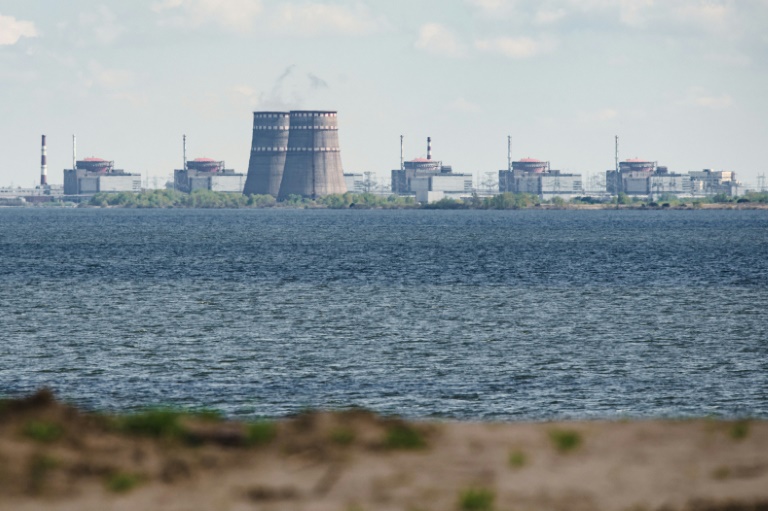
International Atomic Energy Agency chief Rafael Grossi said on Monday he was en route to inspect Ukraine’s Zaporizhzhia nuclear plant, as Kyiv’s forces launched a counter-offensive to retake the Russian-occupied southern region of Kherson.

The coastal region of Kherson and its capital city of the same name have been contested by Russian troops since the war broke out six months ago.

“Today there was a powerful artillery attack on enemy positions in… the occupied Kherson region,” local government official Sergey Khlan told Ukraine’s Pryamyi TV channel.

“This is what we have been waiting for since the spring — it is the beginning of the de-occupation of Kherson region.”

Russia’s defence ministry said it had repulsed attacks in the Kherson and Mykolaiv regions and inflicted “heavy losses” on Ukrainian forces.

Kherson city lies some 200 kilometres (125 miles) southwest of the Zaporizhzhia nuclear plant — Europe’s largest atomic facility — which has also been occupied by Russian troops since early March. 

The plant was targeted over the weekend by fresh shelling, its operator said, with Moscow and Kyiv trading blame for attacks around the complex of six nuclear reactors in Energodar, a town on the banks of the Dnipro River.

Ukraine’s nuclear agency Energoatom has warned of the risk of a radiation leak.

Russian troops “continued to fire at Energodar and the Zaporizhzhia nuclear power plant” on Sunday, injuring 10, among them four plant workers, it said in an update early on Monday.

As of 10:00 am (0700 GMT), the plant was operating “with the risk of violating radiation and fire safety standards”. 

Russia’s defence ministry accused Ukrainian troops of shelling near the plant on Sunday, claiming it had shot down a “Ukrainian strike drone” approaching a nuclear fuel and radioactive waste storage area. 

Kremlin spokesman Dmitry Peskov urged the international community “to put pressure on the Ukrainian side so it stops endangering the European continent by shelling”.

Peskov said Russia saw the IAEA visit as “necessary” and had been “waiting for this mission for a long time”, insisting it would ensure its safety in the face of “constant” risks. 

– ‘Radiation blackmail’ –

Ukrainian President Volodymyr Zelensky on Monday called for sanctions against Russia’s state nuclear energy agency Rosatom over the occupation of the plant.

“It’s not normal that there are no sanctions against Rosatom for its radiation blackmail at the Zaporizhzhia nuclear plant,” he said.

“The Russians are the only terrorists in the world that have managed to turn a nuclear plant into a battlefield.”

The UN’s nuclear watchdog has for months been asking to visit the site, warning of “the very real risk of a nuclear disaster”.

Writing on Twitter, Grossi on Monday said an IAEA support and assistance mission was “now on its way” with the team due to arrive “later this week”. 

The United Nations has called for an end to all military activity in the area surrounding the complex.

Ukraine initially feared an IAEA visit would legitimise the Russian occupation of the site before finally supporting the idea of a mission.

In its Monday update, Energoatom said the Russians had “increased pressure on the personnel of the plant to prevent them from disclosing (to the IAEA) evidence of the occupiers’ crimes at the plant and its use as a military base”.

The G7 industrial powers on Monday demanded free access for the IAEA team to “engage directly, and without interference, with the Ukrainian personnel responsible for operating these facilities”.

Ukraine was the site of the world’s worst nuclear catastrophe in 1986, when a reactor at the northern Chernobyl plant exploded and spewed radiation into the atmosphere.

Experts say any leak at Zaporizhzhia would more likely be on the scale of the 2011 Fukushima disaster in Japan.

Energoatom on Monday warned any leak would scatter radiation over swathes of southern Ukraine and southwestern regions of Russia. 

The United States on Monday urged a complete shutdown of the plant and renewed calls for a demilitarised zone around the facility.

– Kherson official assassinated –

Russian investigators reported that a former pro-Zelensky Ukrainian lawmaker who had joined the local Moscow-backed administration in Kherson had been shot dead at his home on Sunday.

Alexei Kovalev, “the deputy head of the military and civil administration in the Kherson region was killed by bullets,” the investigators said on Telegram.

With tensions high around the plant, Ukraine’s rescue services have been holding training sessions on managing the risk of nuclear accidents. 

Schools in Zaporizhzhia city began distributing iodine pills to reduce medical risk of radiation in the event of a disaster, with some 200 people turning up to collect them on Friday when distribution began, an AFP correspondent said.

“The tablet is taken in case of danger, when the alarm is raised,” said Elena Karpenko, a nurse at the Zaporizhzhia Children’s Hospital. 

burs-hmw/imm/jj

IAEA team heads to nuclear plant, Ukraine launches offensive in south

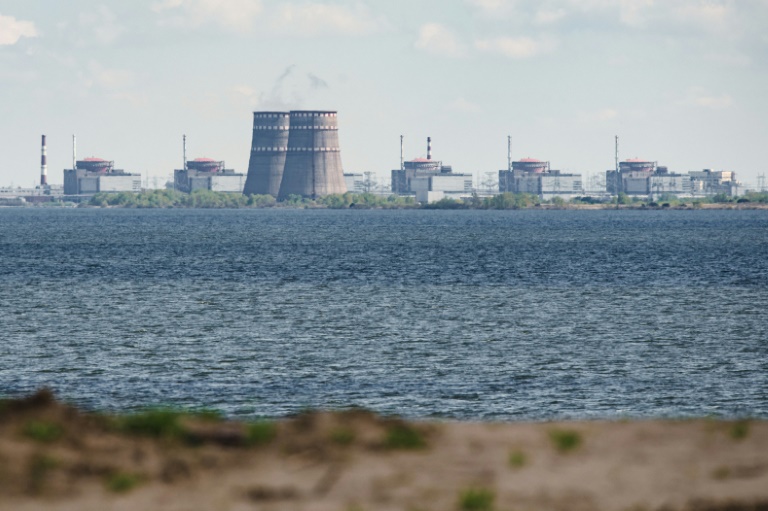
International Atomic Energy Agency chief Rafael Grossi said on Monday he was en route to inspect Ukraine’s Zaporizhzhia nuclear plant, as Kyiv’s forces launched a counter-offensive to retake the Russian-occupied southern region of Kherson.

The coastal region of Kherson and its capital city of the same name have been contested by Russian troops since the war broke out six months ago.

“Today there was a powerful artillery attack on enemy positions in… the occupied Kherson region,” local government official Sergey Khlan told Ukraine’s Pryamyi TV channel.

“This is what we have been waiting for since the spring — it is the beginning of the de-occupation of Kherson region.”

Russia’s defence ministry said it had repulsed attacks in the Kherson and Mykolaiv regions and inflicted “heavy losses” on Ukrainian forces.

Kherson city lies some 200 kilometres (125 miles) southwest of the Zaporizhzhia nuclear plant — Europe’s largest atomic facility — which has also been occupied by Russian troops since early March. 

The plant was targeted over the weekend by fresh shelling, its operator said, with Moscow and Kyiv trading blame for attacks around the complex of six nuclear reactors in Energodar, a town on the banks of the Dnipro River.

Ukraine’s nuclear agency Energoatom has warned of the risk of a radiation leak.

Russian troops “continued to fire at Energodar and the Zaporizhzhia nuclear power plant” on Sunday, injuring 10, among them four plant workers, it said in an update early on Monday.

As of 10:00 am (0700 GMT), the plant was operating “with the risk of violating radiation and fire safety standards”. 

Russia’s defence ministry accused Ukrainian troops of shelling near the plant on Sunday, claiming it had shot down a “Ukrainian strike drone” approaching a nuclear fuel and radioactive waste storage area. 

Kremlin spokesman Dmitry Peskov urged the international community “to put pressure on the Ukrainian side so it stops endangering the European continent by shelling”.

Peskov said Russia saw the IAEA visit as “necessary” and had been “waiting for this mission for a long time”, insisting it would ensure its safety in the face of “constant” risks. 

– ‘Radiation blackmail’ –

Ukrainian President Volodymyr Zelensky on Monday called for sanctions against Russia’s state nuclear energy agency Rosatom over the occupation of the plant.

“It’s not normal that there are no sanctions against Rosatom for its radiation blackmail at the Zaporizhzhia nuclear plant,” he said.

“The Russians are the only terrorists in the world that have managed to turn a nuclear plant into a battlefield.”

The UN’s nuclear watchdog has for months been asking to visit the site, warning of “the very real risk of a nuclear disaster”.

Writing on Twitter, Grossi on Monday said an IAEA support and assistance mission was “now on its way” with the team due to arrive “later this week”. 

The United Nations has called for an end to all military activity in the area surrounding the complex.

Ukraine initially feared an IAEA visit would legitimise the Russian occupation of the site before finally supporting the idea of a mission.

In its Monday update, Energoatom said the Russians had “increased pressure on the personnel of the plant to prevent them from disclosing (to the IAEA) evidence of the occupiers’ crimes at the plant and its use as a military base”.

The G7 industrial powers on Monday demanded free access for the IAEA team to “engage directly, and without interference, with the Ukrainian personnel responsible for operating these facilities”.

Ukraine was the site of the world’s worst nuclear catastrophe in 1986, when a reactor at the northern Chernobyl plant exploded and spewed radiation into the atmosphere.

Experts say any leak at Zaporizhzhia would more likely be on the scale of the 2011 Fukushima disaster in Japan.

Energoatom on Monday warned any leak would scatter radiation over swathes of southern Ukraine and southwestern regions of Russia. 

The United States on Monday urged a complete shutdown of the plant and renewed calls for a demilitarised zone around the facility.

– Kherson official assassinated –

Russian investigators reported that a former pro-Zelensky Ukrainian lawmaker who had joined the local Moscow-backed administration in Kherson had been shot dead at his home on Sunday.

Alexei Kovalev, “the deputy head of the military and civil administration in the Kherson region was killed by bullets,” the investigators said on Telegram.

With tensions high around the plant, Ukraine’s rescue services have been holding training sessions on managing the risk of nuclear accidents. 

Schools in Zaporizhzhia city began distributing iodine pills to reduce medical risk of radiation in the event of a disaster, with some 200 people turning up to collect them on Friday when distribution began, an AFP correspondent said.

“The tablet is taken in case of danger, when the alarm is raised,” said Elena Karpenko, a nurse at the Zaporizhzhia Children’s Hospital. 

burs-hmw/imm/jj

Close Bitnami banner
Bitnami