World

Pakistan's south braces for deluge from swollen northern rivers

Pakistan’s flooded southern Sindh province braced Sunday for a fresh deluge from swollen rivers in the north as the death toll from this year’s monsoon topped 1,000.

The mighty Indus River that courses through Pakistan’s second-most populous region is fed by dozens of mountain tributaries to the north, but many have burst their banks following record rains and glacier melt.

Officials warned torrents of water are expected to reach Sindh in the next few days, adding misery to millions already affected by the floods.

“Right now, Indus is in high flood,” said Aziz Soomro, the supervisor of Sukkur Barrage — a massive colonial-era construction that regulates the river’s flow and redirects water to a vast system of canals.

The annual monsoon is essential for irrigating crops and replenishing lakes and dams across the Indian subcontinent, but it also brings destruction.

Officials say this year’s monsoon flooding has affected more than 33 million people — one in seven Pakistanis — destroying or badly damaging nearly a million homes.

On Sunday, the country’s National Disaster Management Authority said the death toll from the monsoon rains had reached 1,033, with 119 killed in the previous 24 hours.

It said this year’s floods were comparable to 2010 — the worst on record — when over 2,000 people died and nearly a fifth of the country was under water.

Prime Minister Shehbaz Sharif, who cancelled a trip to Britain to oversee relief operations, said he had never seen anything like it before.

“Village after village has been wiped out. Millions of houses have been destroyed. There has been immense destruction,” he said after flying over Sindh by helicopter.

Thousands of people living near flood-swollen rivers in Pakistan’s north were ordered to evacuate from danger zones, but army helicopters and rescuers are still plucking laggards to safety.

“People were informed around three or four o’clock in the morning to evacuate their houses,” rescue worker Umar Rafiq told AFP. 

“When the flood water hit the area we had to rescue children and women.”

Many rivers in the area — a picturesque tourist destination of rugged mountains and valleys — have burst their banks, demolishing scores of buildings including a 150-room hotel that crumbled into a raging torrent.

Guest house owner Nasir Khan, whose business was badly hit by the 2010 flooding, said he had lost everything.

“It has washed away the remaining part of the hotel,” he told AFP.

The flood-swollen rivers were also yielding unlikely riches.

Locals scrambled to snag thousands of valuable cedar, pine and oak logs that had likely been illegally harvested in the mountains but were being washed downstream.

– Climate change to blame –

Officials blame the devastation on human-driven climate change, saying Pakistan is unfairly bearing the consequences of irresponsible environmental practices elsewhere in the world.

Pakistan is eighth on NGO Germanwatch’s Global Climate Risk Index, a list of countries deemed most vulnerable to extreme weather caused by climate change.

Exacerbating the situation, corruption, poor planning and the flouting of local regulations mean thousands of buildings have been erected in areas prone to seasonal flooding.

The government has declared an emergency and mobilised the military to deal with what Climate Change Minister Sherry Rehman has called “a catastrophe of epic scale”.

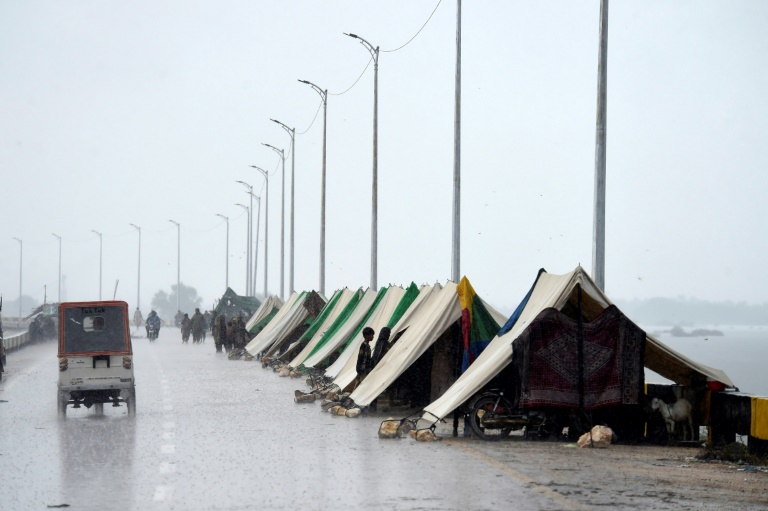
In parts of Sindh, the only dry areas are the elevated roads and railroad tracks, alongside which tens of thousands of poor rural folk have taken shelter with their livestock.

Near Sukkur, a row of tents stretched for two kilometres, with people still arriving by boats loaded with wooden charpoy beds and pots and pans — the only possessions they could salvage.

“Water started rising in the river from yesterday, inundating all the villages and forcing us to flee,” labourer Wakeel Ahmed, 22, told AFP.

Sukkur Barrage supervisor Soomro told AFP every sluice gate was open to deal with a river flow of more than 600,000 cubic metres per second.

The flooding could not come at a worse time for Pakistan, where the economy is in free fall and the former prime minister Imran Khan was ousted by a parliamentary vote of no confidence in April.

While the capital Islamabad and adjoining twin garrison city of Rawalpindi have escaped the worst of the flooding, its effects were still being felt.

“Currently supplies are very limited,” said Muhammad Ismail, a produce shopkeeper in Rawalpindi.

“Tomatoes, peas, onions and other vegetables are not available due to the floods,” he told AFP, adding prices were also soaring.
Pakistan's south braces for deluge from swollen northern rivers

Pakistan’s flooded southern Sindh province braced Sunday for a fresh deluge from swollen rivers in the north as the death toll from this year’s monsoon topped 1,000.

The mighty Indus River that courses through Pakistan’s second-most populous region is fed by dozens of mountain tributaries to the north, but many have burst their banks following record rains and glacier melt.

Officials warned torrents of water are expected to reach Sindh in the next few days, adding misery to millions already affected by the floods.

“Right now, Indus is in high flood,” said Aziz Soomro, the supervisor of Sukkur Barrage — a massive colonial-era construction that regulates the river’s flow and redirects water to a vast system of canals.

The annual monsoon is essential for irrigating crops and replenishing lakes and dams across the Indian subcontinent, but it also brings destruction.

Officials say this year’s monsoon flooding has affected more than 33 million people — one in seven Pakistanis — destroying or badly damaging nearly a million homes.

On Sunday, the country’s National Disaster Management Authority said the death toll from the monsoon rains had reached 1,033, with 119 killed in the previous 24 hours.

It said this year’s floods were comparable to 2010 — the worst on record — when over 2,000 people died and nearly a fifth of the country was under water.

Prime Minister Shehbaz Sharif, who cancelled a trip to Britain to oversee relief operations, said he had never seen anything like it before.

“Village after village has been wiped out. Millions of houses have been destroyed. There has been immense destruction,” he said after flying over Sindh by helicopter.

Thousands of people living near flood-swollen rivers in Pakistan’s north were ordered to evacuate from danger zones, but army helicopters and rescuers are still plucking laggards to safety.

“People were informed around three or four o’clock in the morning to evacuate their houses,” rescue worker Umar Rafiq told AFP. 

“When the flood water hit the area we had to rescue children and women.”

Many rivers in the area — a picturesque tourist destination of rugged mountains and valleys — have burst their banks, demolishing scores of buildings including a 150-room hotel that crumbled into a raging torrent.

Guest house owner Nasir Khan, whose business was badly hit by the 2010 flooding, said he had lost everything.

“It has washed away the remaining part of the hotel,” he told AFP.

The flood-swollen rivers were also yielding unlikely riches.

Locals scrambled to snag thousands of valuable cedar, pine and oak logs that had likely been illegally harvested in the mountains but were being washed downstream.

– Climate change to blame –

Officials blame the devastation on human-driven climate change, saying Pakistan is unfairly bearing the consequences of irresponsible environmental practices elsewhere in the world.

Pakistan is eighth on NGO Germanwatch’s Global Climate Risk Index, a list of countries deemed most vulnerable to extreme weather caused by climate change.

Exacerbating the situation, corruption, poor planning and the flouting of local regulations mean thousands of buildings have been erected in areas prone to seasonal flooding.

The government has declared an emergency and mobilised the military to deal with what Climate Change Minister Sherry Rehman has called “a catastrophe of epic scale”.

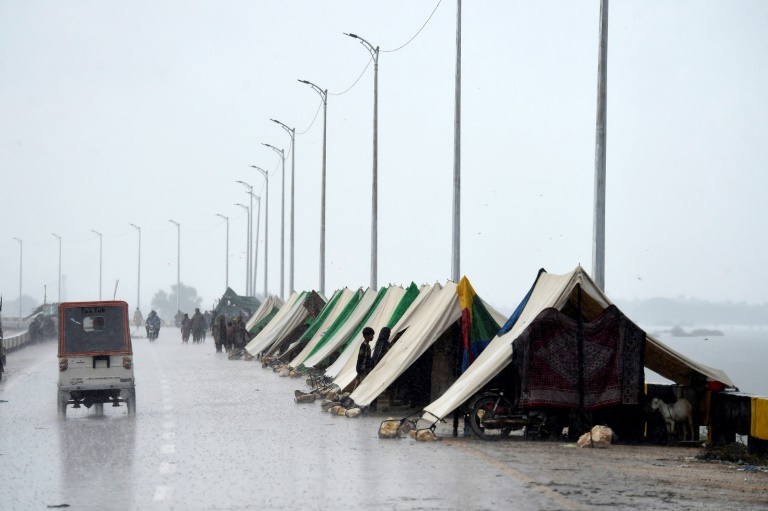
In parts of Sindh, the only dry areas are the elevated roads and railroad tracks, alongside which tens of thousands of poor rural folk have taken shelter with their livestock.

Near Sukkur, a row of tents stretched for two kilometres, with people still arriving by boats loaded with wooden charpoy beds and pots and pans — the only possessions they could salvage.

“Water started rising in the river from yesterday, inundating all the villages and forcing us to flee,” labourer Wakeel Ahmed, 22, told AFP.

Sukkur Barrage supervisor Soomro told AFP every sluice gate was open to deal with a river flow of more than 600,000 cubic metres per second.

The flooding could not come at a worse time for Pakistan, where the economy is in free fall and the former prime minister Imran Khan was ousted by a parliamentary vote of no confidence in April.

While the capital Islamabad and adjoining twin garrison city of Rawalpindi have escaped the worst of the flooding, its effects were still being felt.

“Currently supplies are very limited,” said Muhammad Ismail, a produce shopkeeper in Rawalpindi.

“Tomatoes, peas, onions and other vegetables are not available due to the floods,” he told AFP, adding prices were also soaring.

Six dead as truck hits Dutch village barbecue

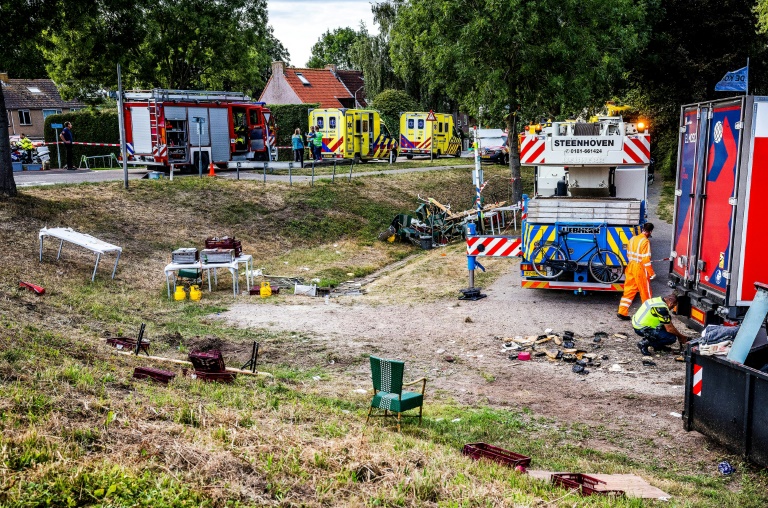
Dutch police on Sunday said six people were killed and seven other people hurt after a truck ran off the top of a dike road and ploughed into revellers at a neighbourhood barbecue.

The accident happened around six pm (1600 GMT) on Saturday when the Spanish-registered lorry left the road in the village of Nieuw-Beijerland, 30 kilometres (18 miles) south of Rotterdam.

The victims were three women aged 28, 32 and 75, and three men aged 41, 50 and 62, all from the local area, police said. One of the injured was in a critical condition in hospital.

Police had first confirmed at least two dead after the vehicle drove into the crowded community barbecue, which Dutch news reports said was being hosted by an ice-skating club.

“We now have six people killed and seven injured, one seriously after yesterday’s accident,” police spokeswoman Mirjam Boers told AFP.

“We are still investigating what exactly happened,” she said.

Photographs from the scene identified the truck as belonging to the El Mosca company, based in Spain.

Boers confirmed the 46-year-old driver from Spain had been arrested “and was not under the influence of alcohol,” at the time of the accident.

“He was arrested for causing a fatal accident and serious bodily injury. His role in the incident is under investigation. For the time being, we are keeping all scenarios about the facts open,” police said in a statement.

– ‘Unimaginable sadness’ –

Dutch King Willem-Alexander and Queen Maxima said they were “shocked” by the tragedy.

“We are shocked and moved by the terrible accident in Nieuw-Beijerland last night in which so many people were killed. An unimaginable sadness within this close-knit community,” the king and queen said in an official message.

“The families affected are in our thoughts and we wish the injured strength on their way to the best possible recovery.”

Dutch Prime Minister Mark Rutte also sent s condolences.

“Terrible news … my thoughts are with the victims and relatives of this terrible drama. I wish them a lot of strength,” Rutte said on Twitter.

Quoting witnesses, the Rijnmond regional broadcaster said the truck stopped for a moment at a T-junction on the narrow Zuidzijdsedijk dike, before taking off and ploughing into the revellers.

Three of the victims — a mother, son and daughter-in-law who was eight months pregnant — came from the same family, the broadcaster reported, quoting a local church announcement.

The incident has shaken the tight-knit community of the Nieuw-Beijerland region with police calling for more witnesses to help with the investigation.

“Due to the neighbourhood barbecue, many people were present during the incident,” police said.

Photographs from the scene on Saturday night showed several chairs scattered in the wake of the lorry.

Thousands rally in Argentina to support ex-leader Kirchner

Supporters of Argentine Vice President Cristina Kirchner — on trial for alleged corruption — gathered across the country on Saturday, with police using tear gas and water cannon in the capital Buenos Aires.

Kirchner, 69, is accused of fraudulently awarding public works contracts in her stronghold in Patagonia, and prosecutors have asked that she face 12 years in jail and a lifetime ban from politics.

Thousands responded to a social media campaign and gathered peacefully in town squares across Argentina, though in Buenos Aires some supporters breached police barricades to reach Kirchner’s home.

“There has been too much blood in Argentina for them to continue threatening those who think differently with gunfire, bullets, tear gas and pepper spray,” Kirchner told supporters.

The ex-president, who ruled from 2007 to 2015, called on her opponents “to stop competing among themselves” about who hates Peronists more, referencing the political movement she subscribes to, based on the ideas of former ruler Juan Peron.

“It is incredible the degree of cynicism and perversion of not assuming and taking charge of what they want: to exterminate Peronism,” she said.

Kirchner is the Senate president and enjoys parliamentary immunity.

Even if convicted — the verdict is expected at the end of the year — she would not go to prison unless her sentence was ratified by the country’s Supreme Court, or she loses her Senate seat at the next elections at the end of 2023.

Dutch truck crash toll climbs to six dead: police

Dutch police on Sunday raised the death toll to six with seven other people hurt after a horse-and-trailer truck ran off a dike road, ploughing into revellers.

The accident happened around six pm (1600 GMT) on Saturday when the Spanish-registered truck left the road on the narrow Zuidzijdsedijk, 30 kilometres (18 miles) south of Rotterdam.

Police had first confirmed at least two dead after the vehicle drove into a community barbecue, which Dutch news reports said was being hosted by an ice-skating club.

“We now have six people killed and seven injured, one seriously after yesterday’s accident,” police spokeswoman Mirjam Boers told AFP.

“We are still investigating what exactly happened,” she said.

Photographs from the scene identified the truck as belonging to the El Mosca company, based in Spain.

Boers confirmed the driver had been arrested “and was not under the influence of alcohol,” at the time of the accident.

Quoting witnesses, the Rijnmond regional broadcaster said the truck stopped for a moment at a T-junction on the dike, before taking off and ploughing into the revellers.

The incident has shocked the tight-knit community of the Nieuw-Beijerland region with police calling for more witnesses to help with the investigation.

Two US Navy warships transit through Taiwan Strait

Two United States warships sailed through the Taiwan Strait on Sunday, the American navy said, the first such transit since China staged unprecedented military drills around the island.

In a statement, the US Navy said the transit “demonstrates the United States’ commitment to a free and open Indo-Pacific.”

Tensions in the Taiwan Strait soared to their highest level in years this month after US House Speaker Nancy Pelosi visited Taipei. 

Beijing reacted furiously, staging days of air and sea exercises around Taiwan. Taipei condemned the drills and missile tests as preparation for an invasion.

Taiwan lives under constant threat of an invasion by China, which claims the self-ruled, democratic island as part of its territory to be seized one day — by force if necessary.

Washington diplomatically recognizes Beijing over Taipei, but maintains de facto relations with Taiwan and supports the island’s right to decide its own future.

The US Seventh Fleet said the pair of Ticonderoga-class guided-missile cruisers — the USS Antietam and the USS Chancellorsville — conducted the “routine” transit on Sunday “through waters where high seas freedoms of navigation and overflight apply in accordance with international law.”

“These ships transited through a corridor in the Strait that is beyond the territorial sea of any coastal State,” a statement said. 

“The United States military flies, sails, and operates anywhere international law allows.”

The Chinese People’s Liberation Army (PLA) said the US had “openly hyped up” the ships’ passage through the Strait.

“The PLA Eastern Theatre Command is following and warning the US vessels throughout their entire journey, and is aware of all movements,” spokesman Senior Colonel Shi Yi said.

“Troops in the (eastern) theatre remain on high alert and are prepared at all times to foil any provocations.”

Taiwan’s defense ministry confirmed a pair of warships sailed from north to south through the channel.

“During their southward journey through the Taiwan Strait, the military is fully monitoring relevant movements in our surrounding sea and airspace, and the situation is normal.”

– ‘Freedom of navigation’ –

The Seventh Fleet is based in Japan and is a core part of Washington’s navy presence in the Pacific.

The US and Western allies have increased “freedom of navigation” crossings by naval vessels of both the Taiwan Strait and South China Sea to reinforce the concept that those seas are international waterways, sparking anger from Beijing.

Washington has said its position on Taiwan remains unchanged and has accused China of threatening peace in the Taiwan Strait and using the visit by Pelosi as a pretext for military exercises.

China’s drills included firing multiple ballistic missiles into waters off Taiwan — some of the world’s busiest shipping routes — which was the first time Beijing has taken such a step since the mid-1990s.

Taiwan staged its own drills, simulating a defense against invasion and displaying its most advanced fighter jet in a rare nighttime demonstration.

Under President Xi Jinping, China’s tone on Taiwan has grown more aggressive, with increased military activity and more combative messaging in recent years.

Pakistan's south braces for deluge from swollen northern rivers

Pakistan’s flooded southern Sindh province braced Sunday for a fresh deluge from swollen rivers in the north as the death toll from this year’s monsoon topped 1,000.

The mighty Indus River that courses through Pakistan’s second-most populous region is fed by dozens of mountain tributaries to the north, but many have burst their banks following record rains and glacier melt.

Officials warned torrents of water are expected to reach Sindh in the next few days, adding misery to millions already affected by the floods.

“Right now, Indus is in high flood,” said Aziz Soomro, the supervisor of a barrage that regulates the river’s flow near Sukkur.

The annual monsoon is essential for irrigating crops and replenishing lakes and dams across the Indian subcontinent, but it also brings destruction.

Officials say this year’s monsoon flooding has affected more than 33 million people — one in seven Pakistanis — destroying or badly damaging nearly a million homes.

On Sunday, the country’s National Disaster Management Authority said the death toll from the monsoon rains had reached 1,033, with 119 killed in the previous 24 hours.

It said this year’s floods are comparable to 2010 — the worst on record — when over 2,000 people died and nearly a fifth of the country was under water.

Thousands of people living near flood-swollen rivers in Pakistan’s north were ordered to evacuate from danger zones, but army helicopters and rescuers are still plucking laggards to safety.

“People were informed around three or four o’clock in the morning to evacuate their houses,” rescue worker Umar Rafiq told AFP. 

“When the flood water hit the area we had to rescue children and women.”

Many rivers in the area — a picturesque tourist destination of rugged mountains and valleys — have burst their banks, demolishing scores of buildings including a 150-room hotel that crumbled into a raging torrent.

Guest house owner Nasir Khan, whose business was badly hit by the 2010 flooding, said he had lost everything.

“It has washed away the remaining part of the hotel,” he told AFP.

– Climate change to blame –

Officials blame the devastation on human-driven climate change, saying Pakistan is unfairly bearing the consequences of irresponsible environmental practices elsewhere in the world.

Pakistan is eighth on NGO Germanwatch’s Global Climate Risk Index, a list of countries deemed most vulnerable to extreme weather caused by climate change.

Exacerbating the situation, corruption, poor planning and the flouting of local regulations mean thousands of buildings have been erected in areas prone to seasonal flooding.

The government has declared an emergency and mobilised the military to deal with what Climate Change Minister Sherry Rehman has called “a catastrophe of epic scale”.

In parts of Sindh, the only dry land are the elevated roads and rail tracks, alongside which tens of thousands of poor rural folk have taken shelter with their livestock.

Near Sukkur, a row of tents stretched for two kilometres, with people still arriving by boats loaded with wooden charpoy beds and pots and pans — the only possessions they could salvage.

“Water started rising in the river from yesterday, inundating all the villages and forcing us to flee,” labourer Wakeel Ahmed, 22, told AFP.

Barrage supervisor Soomro told AFP every sluice gate was open to deal with a river flow of more than 600,000 cubic metres per second.

The flooding could not come at a worse time for Pakistan, where the economy is in free fall and the former prime minister Imran Khan was ousted by a parliamentary vote of no confidence in April.

While the capital Islamabad and adjoining twin garrison city of Rawalpindi have escaped the worst of the flooding, its effects were still being felt.

“Currently supplies are very limited,” said Muhammad Ismail, a produce shopkeeper in Rawalpindi.

“Tomatoes, peas, onions and other vegetables are not available due to the floods,” he told AFP, adding prices were also soaring.

Egypt dims lights to boost foreign reserves

An economic crisis spurred by the Ukraine war is casting darkness upon Egypt’s streets, as the government dims lights to free up energy for export and bolster hard currency reserves.

Russia’s invasion of Ukraine had an immediate impact on Egypt, the world’s biggest wheat importer which has relied on the ex-Soviet states for over 80 percent of its grain.

Egypt, which turned to the International Monetary Fund for a loan after the war erupted, is pumping more natural gas abroad to increase its foreign currency reserves — a move that has come in for criticism.

And while the government announced electricity rationing this month, signs of wastage elicit scorn.

“I see streetlights still working during daylight hours… and we’re suffering from high electricity bills,” said a disgruntled Cairo resident in his 30s who spoke on condition of anonymity.

The country’s vital tourism sector has also been hit by the Ukraine conflict, cutting the flow of holidaymakers to a country still hurting from the 2011 revolution and Covid-19 pandemic.

Economic growth slowed to 3.2 percent in the fourth quarter of 2021-22 against 7.7 percent last year, although annual expansion was 6.6 percent.

Despite the better-than-expected annual figure, the government said growth had tapered off in the wake of  “global political and economic developments”.

Egypt’s monetary policy has been caught between a rock and a hard place since Russia invaded Ukraine in February.

Inflation hit a three-year high of 14.6 percent in July after Egypt devalued the pound, pushing up the price of imports and depleting forex reserves by $7.8 billion since February to $33.1 billion in July.

– Capital flight –

Egypt is negotiating an IMF loan to help mitigate fallout from the Ukraine war on the country, where 30 percent of the 103 million population lives in poverty.

But the talks have stretched out for six months, raising eyebrows among analysts.

“The fact that talks with the IMF have dragged is probably a sign that some officials are reluctant to follow through on the Fund’s demands and would prefer to rely on support from the oil-flush Gulf economies,” London’s Capital Economics said.

“We need to speed up negotiations with the IMF,” said Hany Genena, an economist and lecturer at American University in Cairo.

“Since last week, there has been a severe shortage of dollars provided to importers by banks in various sectors.”

Cairo had previously secured a $12-billion IMF loan in 2016 that required it to slash subsidies and devalue the pound.

In 2020, Egypt received two more loans, including $5.4 billion tied to reforms and $2.8 billion to tackle Covid.

Genena said Egypt needed to undertake more “drastic” reforms to restore its forex reserves, including a full float of the pound.

Last week, as the currency plunged to a near all-time low of 19.1 to the dollar, central bank governor Tarek Amer resigned.

It was unclear why Amer quit, but Egyptian media suggested it was because of his reluctance to implement a full float.

James Swanston of Capital Economics said the currency needed to depreciate to 25 pounds to the dollar by the end of 2024 “to avoid external imbalances rebuilding”.

But $14.6 billion worth of investments has flown out of the country in the first quarter of 2022, reflecting concerns over the Ukraine war.

Capital Economics said, however, that investment pledges worth $22 billion from Gulf countries will “go some way to alleviating external financing concerns”.

– Gas lifeline –

Among Egypt’s slate of measures to preserve foreign currency was a decision to let the pound slip 17 percent against the greenback in March.

The government said electricity rationing seeks to achieve “an additional surplus — at an average of 15 percent of the natural gas pumped to power stations — that can be exported and bring in hard currency.”

Among the measures to conserve energy were “reducing lighting in streets and public squares.”

Since 2018, Egypt has been ramping up its natural gas capacity, now setting its sights on an energy-hungry Europe, which is eager to decrease reliance on Russian gas.

The government announced this month “exceptional aid to nine million families at a cost of $52 million per month,” but for many, the soaring cost of living had already done enough damage. 

Mahmoud al-Saeedy, a fruit salesman in Cairo, has depleted his savings trying to keep up with rising prices.

“I return to my village in the south every 40 or 50 days, with only 600 pounds ($31.3) to give to my family,” he told AFP.

“What can they do with it?”

Ethereum crypto overhaul targets environmental impact

The world’s second biggest cryptocurrency after bitcoin, ethereum, will soon overhaul its blockchain technology to curb the network’s much-criticised environmental impact.

Ethereum, whose digital unit ether tumbled in a crypto crash earlier this year, will in September undergo a major technical revolution.

So what is the backdrop for the looming reset — known as the Merge — and how will it calm prices and cut electricity usage?

– Why does crypto use so much energy? –

Bitcoin, ethereum and other such currencies are “mined” by solving complex puzzles using powerful computers that consume enormous amounts of energy in vast warehouses, often near cheap electricity sources.

A blockchain is the decentralised and secure ledger for recording those transactions, which occur when encrypted codes are passed across a computer network.

Users validate their success via a so-called “proof of work” mechanism that rewards them with cyber currency — but only after they have proved their participation in such energy-intensive mining.

The lucrative crypto industry is worth about $1.0 trillion, despite crashing in the first half of 2022.

However, ethereum is still down by a hefty 55 percent in value so far this year.

– Why is ethereum popular? –

Ethereum is nevertheless regarded as vital because it is where most virtual assets, including headline-grabbing non-fungible tokens (NFTs), are bought and sold.

That is partly because users can create “smart contracts” or algorithmic computer code, which carry out customised transactions for different functions.

“The ethereum blockchain is the base layer infrastructure of the majority of the whole crypto ecosystem,” summarised Lennart Ante, CEO and co-founder of the Blockchain Research Lab.

“Everything relies on ethereum,” he told AFP.

“In the last few years, there have been other similar platforms such as Solana or Cadano, but none of these have this huge network and this huge amount of developers and projects, and historical success.”

– Why is it changing? –

Ethereum’s broad adoption makes it even more important to address environmental concerns and change tack, as those worries had sparked a partial boycott.

“Proof-of-work mining is environmentally destructive, expensive, and inefficient,” summarised digital currency specialist Eswar Prasad, a professor at Cornell University.

Yet the carbon footprint of a decentralised blockchain system is difficult to assess because electricity sources are not always identified.

– What is the switch? –

Ethereum creator Vitalik Buterin has planned for a switch to a so-called “proof of stake” mechanism from the middle of September.

This means that participation no longer requires proof of electricity usage, and instead relies on staking blocks of ether.

Users will then validate, or effectively bet their currency, in order to try and win more ether.

Ethereum currently consumes about 45 terawatt hours of power per year.

Bitcoin in contrast is estimated to use 95 terawatt hours of power per year, equivalent to Pakistan’s annual consumption.

– What are pros and cons? –

Experts estimates the upgrade will use 99 percent less energy than the current set-up.

It would therefore allow users to execute quicker and more efficient transactions.

“The energy consumption would be close to zero,” Ante told AFP.

“You do not need any of the hardware anymore, only the software.”

At the same time, the new approach is not without risks.

Some users might decide to switch to rival networks where they can still able to use enormous amounts of energy to mine currency.

Prasad also cautioned that the proof-of-stake method was “not perfect” owing to liquidity and governance concerns.

Ethereum crypto overhaul targets environmental impact

The world’s second biggest cryptocurrency after bitcoin, ethereum, will soon overhaul its blockchain technology to curb the network’s much-criticised environmental impact.

Ethereum, whose digital unit ether tumbled in a crypto crash earlier this year, will in September undergo a major technical revolution.

So what is the backdrop for the looming reset — known as the Merge — and how will it calm prices and cut electricity usage?

– Why does crypto use so much energy? –

Bitcoin, ethereum and other such currencies are “mined” by solving complex puzzles using powerful computers that consume enormous amounts of energy in vast warehouses, often near cheap electricity sources.

A blockchain is the decentralised and secure ledger for recording those transactions, which occur when encrypted codes are passed across a computer network.

Users validate their success via a so-called “proof of work” mechanism that rewards them with cyber currency — but only after they have proved their participation in such energy-intensive mining.

The lucrative crypto industry is worth about $1.0 trillion, despite crashing in the first half of 2022.

However, ethereum is still down by a hefty 55 percent in value so far this year.

– Why is ethereum popular? –

Ethereum is nevertheless regarded as vital because it is where most virtual assets, including headline-grabbing non-fungible tokens (NFTs), are bought and sold.

That is partly because users can create “smart contracts” or algorithmic computer code, which carry out customised transactions for different functions.

“The ethereum blockchain is the base layer infrastructure of the majority of the whole crypto ecosystem,” summarised Lennart Ante, CEO and co-founder of the Blockchain Research Lab.

“Everything relies on ethereum,” he told AFP.

“In the last few years, there have been other similar platforms such as Solana or Cadano, but none of these have this huge network and this huge amount of developers and projects, and historical success.”

– Why is it changing? –

Ethereum’s broad adoption makes it even more important to address environmental concerns and change tack, as those worries had sparked a partial boycott.

“Proof-of-work mining is environmentally destructive, expensive, and inefficient,” summarised digital currency specialist Eswar Prasad, a professor at Cornell University.

Yet the carbon footprint of a decentralised blockchain system is difficult to assess because electricity sources are not always identified.

– What is the switch? –

Ethereum creator Vitalik Buterin has planned for a switch to a so-called “proof of stake” mechanism from the middle of September.

This means that participation no longer requires proof of electricity usage, and instead relies on staking blocks of ether.

Users will then validate, or effectively bet their currency, in order to try and win more ether.

Ethereum currently consumes about 45 terawatt hours of power per year.

Bitcoin in contrast is estimated to use 95 terawatt hours of power per year, equivalent to Pakistan’s annual consumption.

– What are pros and cons? –

Experts estimates the upgrade will use 99 percent less energy than the current set-up.

It would therefore allow users to execute quicker and more efficient transactions.

“The energy consumption would be close to zero,” Ante told AFP.

“You do not need any of the hardware anymore, only the software.”

At the same time, the new approach is not without risks.

Some users might decide to switch to rival networks where they can still able to use enormous amounts of energy to mine currency.

Prasad also cautioned that the proof-of-stake method was “not perfect” owing to liquidity and governance concerns.

Close Bitnami banner
Bitnami