World

Facebook agrees to settle Cambridge Analytica privacy suit

Facebook has reached a preliminary agreement in a long-running lawsuit seeking damages from the social network for allowing third parties, including the company Cambridge Analytica, to access users’ private data. 

According to a document filed Friday in a San Francisco court, Facebook says it is submitting a draft “agreement in principle” and has requested a stay of proceedings for 60 days to finalize it. 

The social network did not indicate the amount or terms of the agreement in the class action. 

When asked by AFP, Facebook said late Saturday night they had “no comment to share at this time.”

The deal comes as Meta boss Mark Zuckerberg and former chief operating officer Sheryl Sandberg, who announced her resignation in June, were due to testify in court in September as part of the scandal. 

In a lawsuit initiated in 2018, Facebook users accused the social network of violating privacy rules by sharing their data with third parties including the firm Cambridge Analytica, which was linked to Donald Trump’s 2016 presidential campaign. 

Cambridge Analytica — which has since shut down — had collected and exploited, without their consent, the personal data of 87 million Facebook users, to which the platform had given it access. 

This information was allegedly used to develop software steering US voters in favor of Trump. 

In 2019, federal authorities fined Facebook $5 billion for misleading its users and imposed independent oversight of its personal data management. 

Since the Cambridge Analytica scandal broke, Facebook has removed access to its data from thousands of apps suspected of abusing it, restricted the amount of information available to developers, and made it easier for users to calibrate restrictions on personal data sharing.

In Germany, the stuttering bid to jumpstart coal plants

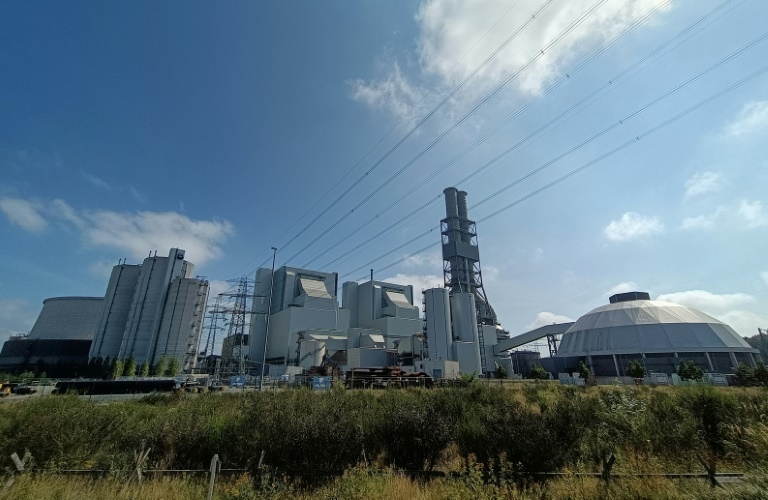
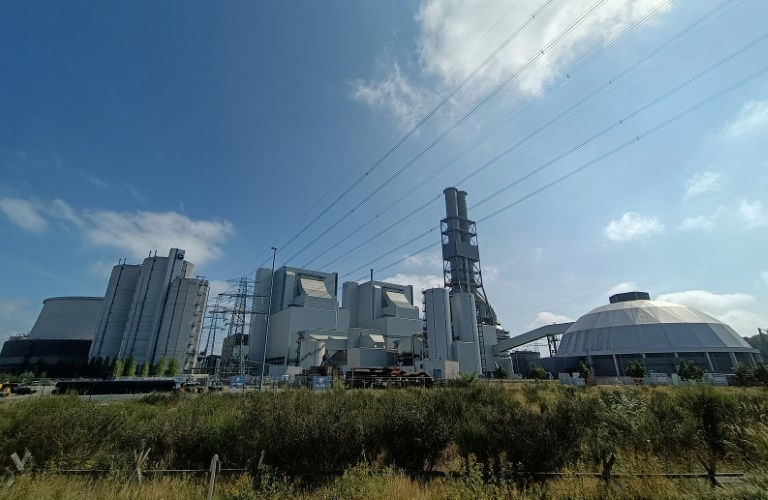
A year after the last wisps of smoke disappeared into the skies from the imposing chimneys of the Moorburg coal plant, hopes had grown that the mothballed site would see new life as Germany scrambles to secure energy supplies.

Russia’s curtailing of gas exports to Germany in the wake of the Ukraine war has forced Berlin to make the radical decision to restart coal power stations, at least temporarily.

But infrastructure issues, manpower shortages and logistical problems are proving to be major obstacles for the restart.

At Moorburg, operator Vattenfall has dashed hopes of new operations, saying simply that “restarting it would be neither technically, economically nor legally feasible”. 

“Many parts have been dismantled and sold,” said Robert Wacker, director of the site.

Even power plants that had not been completely shut, but put in reserve to generate power only occasionally, are struggling with a complete reboot.

Further south from Moorburg, energy group Uniper will on Monday fire up its Heyden 4 site, which had been a reserve plant since mid-2021.

But the company warned that its output would be affected by railway capacity limits in ferrying hard coal to the site.

– Dismantled –

Germany began winding down its coal-fired power plants in the last few years, in view of meeting a target to end usage of the fossil fuel by 2030. 

But Russia’s invasion of Ukraine has upended plans as Moscow reduced energy exports to Germany in what Berlin believes is retaliation for its support for Kyiv.

Chancellor Olaf Scholz’s government has said it would stick to the 2030 coal exit timetable, but in the meantime, it authorised the restart of 27 mothballed plants or those put in reserve to help fill the energy gap until March 2024.

With a capacity of 875 megawatts (MW), Uniper’s Heyden 4 figures as the largest on the list. 

But the Moorburg plant, located in the suburb of Hamburg, had been one of the most modern in the world.

It was shut down in the summer of 2021, just six years after it was put into service, in exchange for a public subsidy programme aimed at cutting coal from Germany’s energy mix.

Since then, the operator has started dismantling and selling the parts that are not necessary for hydrogen — a priority for Germany’s future energy sources. 

Before it closed, the plant churned out around 11 billion kilowatts per year — the equivalent of the electricity consumption for the city of Hamburg.

But now, the installation is no longer complete.

In the turbines hall, thousands of small components have been packed away into boxes. A rotor, an element that allows the turbine to turn, is packed in aluminium, ready to be sent off.

The transformer is also no longer functioning.

“Without the transformer, the power plant is no longer linked to the network and cannot produce any electricity,” said Vattenfall. 

Pointing at rust that has accumulated on the components over the last year, the operator’s spokesman Gudrun Bode said: “We can’t restart a plant just like that.”

– Retired –

With winter round the corner, the race is getting tighter for Germany to ramp up its power generation capacity.

But so far, only one — the Mehrum plant with a capacity of 690 MW, has restarted. 

Besides technical issues, power suppliers are struggling with an acute worker shortage.

In Moorburg, “most of those who left have found a job, or are retired,” said Wacker.

Energy giant RWE told AFP it is seeking several hundreds of workers as it prepares to reopen three plants with a capacity each of 300 MW.

Logistics was also turning out to be tricky, with a drought further putting pressure on the distribution network.

The river Rhine has been a key route for coal transport to power plants in the west of the country. 

But record low water levels over the last week have limited shipments and forced suppliers to turn to rail transport — putting further pressure on strained cargo trains.

Uniper has said Heyden 4’s operation will be “limited partly by limits of rail transport capacity bringing coal to the site.”

Energy supplier STEAG has also said that it would bring into operation two coal-fire plants from its reserve.

It has targeted November as a possible restart date, but it also noted that current rules require sites to have coal supplies for 30 days — something that would be unachievable “given the current tight logistics situation on rail transport”.

In a bid to unblock the jam, Berlin decided Wednesday to prioritise coal and oil cargo over passenger travel this winter.


In Germany, the stuttering bid to jumpstart coal plants

A year after the last wisps of smoke disappeared into the skies from the imposing chimneys of the Moorburg coal plant, hopes had grown that the mothballed site would see new life as Germany scrambles to secure energy supplies.

Russia’s curtailing of gas exports to Germany in the wake of the Ukraine war has forced Berlin to make the radical decision to restart coal power stations, at least temporarily.

But infrastructure issues, manpower shortages and logistical problems are proving to be major obstacles for the restart.

At Moorburg, operator Vattenfall has dashed hopes of new operations, saying simply that “restarting it would be neither technically, economically nor legally feasible”. 

“Many parts have been dismantled and sold,” said Robert Wacker, director of the site.

Even power plants that had not been completely shut, but put in reserve to generate power only occasionally, are struggling with a complete reboot.

Further south from Moorburg, energy group Uniper will on Monday fire up its Heyden 4 site, which had been a reserve plant since mid-2021.

But the company warned that its output would be affected by railway capacity limits in ferrying hard coal to the site.

– Dismantled –

Germany began winding down its coal-fired power plants in the last few years, in view of meeting a target to end usage of the fossil fuel by 2030. 

But Russia’s invasion of Ukraine has upended plans as Moscow reduced energy exports to Germany in what Berlin believes is retaliation for its support for Kyiv.

Chancellor Olaf Scholz’s government has said it would stick to the 2030 coal exit timetable, but in the meantime, it authorised the restart of 27 mothballed plants or those put in reserve to help fill the energy gap until March 2024.

With a capacity of 875 megawatts (MW), Uniper’s Heyden 4 figures as the largest on the list. 

But the Moorburg plant, located in the suburb of Hamburg, had been one of the most modern in the world.

It was shut down in the summer of 2021, just six years after it was put into service, in exchange for a public subsidy programme aimed at cutting coal from Germany’s energy mix.

Since then, the operator has started dismantling and selling the parts that are not necessary for hydrogen — a priority for Germany’s future energy sources. 

Before it closed, the plant churned out around 11 billion kilowatts per year — the equivalent of the electricity consumption for the city of Hamburg.

But now, the installation is no longer complete.

In the turbines hall, thousands of small components have been packed away into boxes. A rotor, an element that allows the turbine to turn, is packed in aluminium, ready to be sent off.

The transformer is also no longer functioning.

“Without the transformer, the power plant is no longer linked to the network and cannot produce any electricity,” said Vattenfall. 

Pointing at rust that has accumulated on the components over the last year, the operator’s spokesman Gudrun Bode said: “We can’t restart a plant just like that.”

– Retired –

With winter round the corner, the race is getting tighter for Germany to ramp up its power generation capacity.

But so far, only one — the Mehrum plant with a capacity of 690 MW, has restarted. 

Besides technical issues, power suppliers are struggling with an acute worker shortage.

In Moorburg, “most of those who left have found a job, or are retired,” said Wacker.

Energy giant RWE told AFP it is seeking several hundreds of workers as it prepares to reopen three plants with a capacity each of 300 MW.

Logistics was also turning out to be tricky, with a drought further putting pressure on the distribution network.

The river Rhine has been a key route for coal transport to power plants in the west of the country. 

But record low water levels over the last week have limited shipments and forced suppliers to turn to rail transport — putting further pressure on strained cargo trains.

Uniper has said Heyden 4’s operation will be “limited partly by limits of rail transport capacity bringing coal to the site.”

Energy supplier STEAG has also said that it would bring into operation two coal-fire plants from its reserve.

It has targeted November as a possible restart date, but it also noted that current rules require sites to have coal supplies for 30 days — something that would be unachievable “given the current tight logistics situation on rail transport”.

In a bid to unblock the jam, Berlin decided Wednesday to prioritise coal and oil cargo over passenger travel this winter.
China's jobless youth left in the lurch

China’s slowing economy has left millions of young people fiercely competing for an ever-slimming raft of jobs and facing an increasingly uncertain future.

Official data released this month showed one in five young people in Chinese cities was out of work in July — more than three times the national average and the highest recorded since January 2018.

Nearly 11 million graduates entered China’s bleak job market this summer with the economy growing at 0.4 percent in the second quarter, the weakest in two years.

Zhao Yuting, 22, told AFP companies were reluctant to hire as the economy cools — and that experienced workers were now jostling for entry-level jobs, elbowing out green hands such as her.

Since graduating in July, she submitted her CV to dozens of companies.

Only a handful called her back for an interview, only to turn her down saying she lacked experience.

Armed with a degree in English, Zhao thought she could earn a living as a tutor until she found full-time work.

But recent crackdowns on the tech and education sectors, which usually absorb fresh talent, have evaporated such jobs.

“I’ve been job hunting for two or three months but the prospects of being hired look slim,” said Zhao, who has been forced to move back in with her parents while she hunts for work.

“The longer it takes, the greater the pressure.”

– Slim prospects –

Analysts blame a slowing economy crippled by Covid lockdowns, as well as the large cohort entering the labour force during the graduating season in July and August, for the slim prospects facing China’s youth.

Official data does not track unemployment among rural youth, and the real jobless population could be more than double the official number, estimated Zhuang Bo, an economist at research group TS Lombard.

Blue-collar workers, too, are struggling to find work as growth in the manufacturing and construction sectors cools.

“The reality is more serious than what the data shows,” said Ho-fung Hung, who specialises in China’s political economy at Johns Hopkins University.

“If the problem continues without remedy, it will easily spread social disorders.”

At a job fair in the tech hub Shenzhen, long lines of anxious parents and young graduates waited for a chance to chat with recruiters.

But headhunters at the fair said they were cherry-picking graduates from top universities, because only a few positions were available.

“My goal was to work in Shenzhen, in China’s Silicon Valley,” Luo Wen, a computer science graduate, told AFP.

“But after more than four months of searching, I’m ready to work even in a smaller city, for less pay.”

– ‘I can’t see the future’ –

Graduates who managed to find work this year were offered salaries that were on average 12 percent less than last year, data from online recruitment firm Zhaopin showed.

And while some job seekers were lowering their ambitions, others were biding their time pursuing further studies.

Experts warned that this may lead to “degree inflation”, where employers demand higher and higher qualifications for jobs that do not necessarily require them.

Analysts blamed government policies that saw a rapid rise in college students over the past decade as the economy failed to accommodate more knowledge workers.

“The pandemic and lockdowns simply aggravated the problem,” Hung said.

The government has pledged to shore up employment by offering tax relief for small businesses and more start-up funding.

Premier Li Keqiang has said China’s employment crisis is “complex and grave” and called on state-owned companies to step up to stabilise the economy.

And as growth in the private sector slows, job seekers have flocked to cram schools to prepare for highly competitive civil service exams.

A record-breaking two million people signed up for the national civil service exam last fall.

A recent survey by 51job, one of China’s biggest job search services, found that 40 percent of respondents preferred stable state jobs over corporate careers.

But for Zhao, who cannot afford to study further and does not have the connections to secure a government job, few options remain.

“I feel that I can’t see the future,” she said. 

“I haven’t made any progress. It’s miserable.”

China's jobless youth left in the lurch

China’s slowing economy has left millions of young people fiercely competing for an ever-slimming raft of jobs and facing an increasingly uncertain future.

Official data released this month showed one in five young people in Chinese cities was out of work in July — more than three times the national average and the highest recorded since January 2018.

Nearly 11 million graduates entered China’s bleak job market this summer with the economy growing at 0.4 percent in the second quarter, the weakest in two years.

Zhao Yuting, 22, told AFP companies were reluctant to hire as the economy cools — and that experienced workers were now jostling for entry-level jobs, elbowing out green hands such as her.

Since graduating in July, she submitted her CV to dozens of companies.

Only a handful called her back for an interview, only to turn her down saying she lacked experience.

Armed with a degree in English, Zhao thought she could earn a living as a tutor until she found full-time work.

But recent crackdowns on the tech and education sectors, which usually absorb fresh talent, have evaporated such jobs.

“I’ve been job hunting for two or three months but the prospects of being hired look slim,” said Zhao, who has been forced to move back in with her parents while she hunts for work.

“The longer it takes, the greater the pressure.”

– Slim prospects –

Analysts blame a slowing economy crippled by Covid lockdowns, as well as the large cohort entering the labour force during the graduating season in July and August, for the slim prospects facing China’s youth.

Official data does not track unemployment among rural youth, and the real jobless population could be more than double the official number, estimated Zhuang Bo, an economist at research group TS Lombard.

Blue-collar workers, too, are struggling to find work as growth in the manufacturing and construction sectors cools.

“The reality is more serious than what the data shows,” said Ho-fung Hung, who specialises in China’s political economy at Johns Hopkins University.

“If the problem continues without remedy, it will easily spread social disorders.”

At a job fair in the tech hub Shenzhen, long lines of anxious parents and young graduates waited for a chance to chat with recruiters.

But headhunters at the fair said they were cherry-picking graduates from top universities, because only a few positions were available.

“My goal was to work in Shenzhen, in China’s Silicon Valley,” Luo Wen, a computer science graduate, told AFP.

“But after more than four months of searching, I’m ready to work even in a smaller city, for less pay.”

– ‘I can’t see the future’ –

Graduates who managed to find work this year were offered salaries that were on average 12 percent less than last year, data from online recruitment firm Zhaopin showed.

And while some job seekers were lowering their ambitions, others were biding their time pursuing further studies.

Experts warned that this may lead to “degree inflation”, where employers demand higher and higher qualifications for jobs that do not necessarily require them.

Analysts blamed government policies that saw a rapid rise in college students over the past decade as the economy failed to accommodate more knowledge workers.

“The pandemic and lockdowns simply aggravated the problem,” Hung said.

The government has pledged to shore up employment by offering tax relief for small businesses and more start-up funding.

Premier Li Keqiang has said China’s employment crisis is “complex and grave” and called on state-owned companies to step up to stabilise the economy.

And as growth in the private sector slows, job seekers have flocked to cram schools to prepare for highly competitive civil service exams.

A record-breaking two million people signed up for the national civil service exam last fall.

A recent survey by 51job, one of China’s biggest job search services, found that 40 percent of respondents preferred stable state jobs over corporate careers.

But for Zhao, who cannot afford to study further and does not have the connections to secure a government job, few options remain.

“I feel that I can’t see the future,” she said. 

“I haven’t made any progress. It’s miserable.”

'Sight to behold': tourists flock to Florida for Moon rocket launch

Seeing a rocket blast off to the Moon is “a once-in-a-lifetime thing to experience,” says Joanne Bostandji. 

The 45-year-old has traveled all the way from northern England to Florida with her husband and two children for a space-themed vacation, and they’re prepared to make sure they don’t miss a second of the action as NASA’s newest and most powerful rocket is scheduled to launch for the first time Monday. 

“The plan is to drive very early in the morning and get a spot” on Cocoa Beach, she said, not far from the Kennedy Space Center. 

“I know it’s going be from a far distance, but I still think it’s going be a sight to behold,” Bostandji told AFP as the family waited to enter a park dedicated to space exploration.  

Between 100,000 and 200,000 visitors are expected to attend the launch of the mission, called Artemis 1, which will propel an empty capsule to the Moon as part of a test for future crewed flights.

The “historic nature” of Monday’s flight, the first of several as the United States returns to the Moon, “certainly has increased public interest,” Meagan Happel of Florida’s Space Coast Office of Tourism told AFP.

Traffic jams are expected to start by 4 am, with the launch scheduled at 8:33 am (1233 GMT). 

And even more people might show up if the launch faces a weather delay, as the make-up date falls on a weekend. 

– Space cruise –

Sabrina Morley was able to find an apartment to rent not far from the beach, and plans to bring her two children and a few dozen other people on a boat chartered for the occasion by a company called Star Fleet Tours. 

For $95 a ticket, “we’ll go out into the ocean as close as they can get to the launch and we’ll watch the launch from the boat,” she said

“I’ve never been this close to a launch before,” said the 43-year-old, who grew up in Orlando, less than an hour away. 

As a child, she could see space shuttles taking off from her backyard, like “an orange ball of smoke” rising into the sky.

“We would hear the sonic booms,” she remembered. 

Morley likes that NASA’s Artemis program aims to land a woman on the Moon for the first time, with a crew to head up in 2025 at the earliest.

“Representation matters,” she said, glancing at her two-year-old daughter, who is already wearing an imitation astronaut helmet on her head. 

– Good for business – 

The return of prestigious space launches is an economic boon for the region. A family of three will spend an average of $1,300 over four or five days, according to the tourism office. 

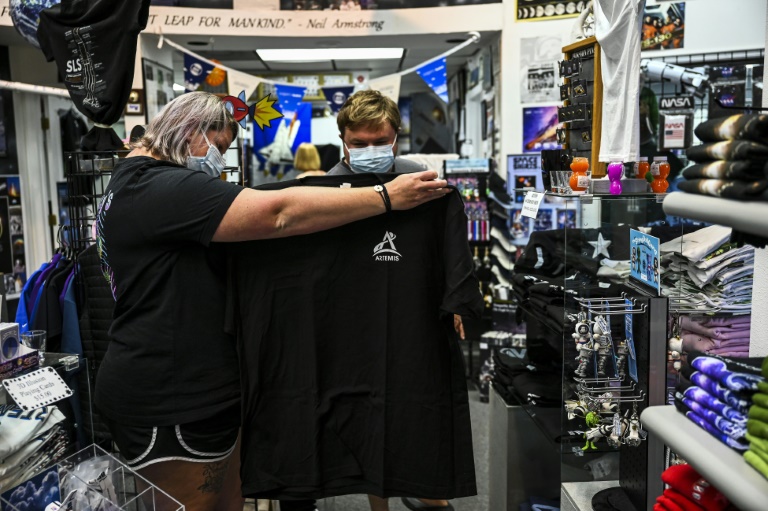
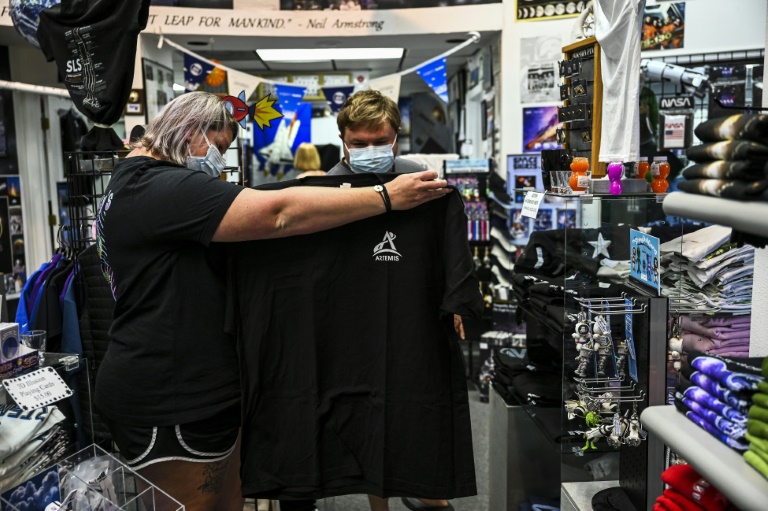
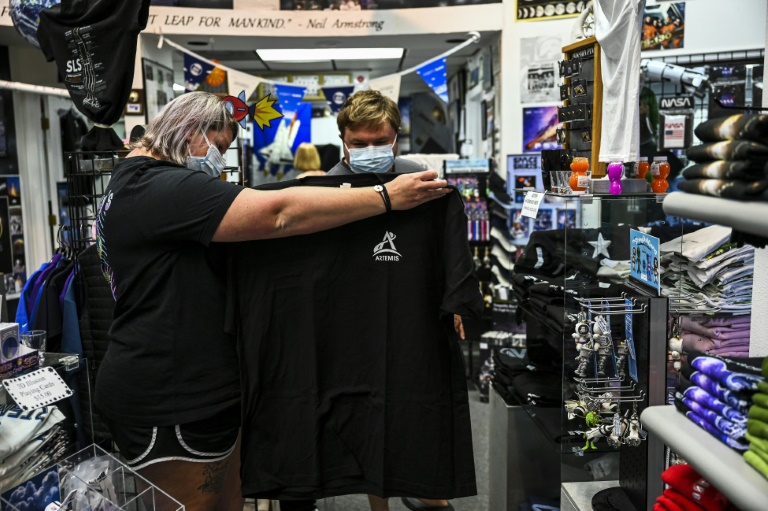
On the main road to Merritt Island, the peninsula where the Kennedy Space Center is located, Brenda Mulberry’s space memorabilia shop is packed with tourists. 

As soon as they enter, visitors are greeted with Artemis T-shirts for sale, printed in-house — there were 1,000 copies made Saturday alone. 

The last few days has seen an influx of customers, Mulberry, who founded “Space Shirts” in 1984, told AFP. 

“They’re just excited I think to see a NASA launch because the private space business is not so motivating to the people,” she said.

This rocket, called the SLS — a large model of which is displayed in front of her shop — “belongs to the people,” Mulberry said. 

“It’s their rocket. It’s not SpaceX rocket,” she added.

There is an air of nostalgia for the Apollo rocket program — it’s been 50 years since the last time a crewed mission went to the Moon, in 1972.

“My family, they had to go to the neighbor’s house to watch (the Apollo missions) because they didn’t have a television,” Bostandji, who was not yet born, said. 

“Now we’re going to see it hopefully for real.”

'Sight to behold': tourists flock to Florida for Moon rocket launch

Seeing a rocket blast off to the Moon is “a once-in-a-lifetime thing to experience,” says Joanne Bostandji. 

The 45-year-old has traveled all the way from northern England to Florida with her husband and two children for a space-themed vacation, and they’re prepared to make sure they don’t miss a second of the action as NASA’s newest and most powerful rocket is scheduled to launch for the first time Monday. 

“The plan is to drive very early in the morning and get a spot” on Cocoa Beach, she said, not far from the Kennedy Space Center. 

“I know it’s going be from a far distance, but I still think it’s going be a sight to behold,” Bostandji told AFP as the family waited to enter a park dedicated to space exploration.  

Between 100,000 and 200,000 visitors are expected to attend the launch of the mission, called Artemis 1, which will propel an empty capsule to the Moon as part of a test for future crewed flights.

The “historic nature” of Monday’s flight, the first of several as the United States returns to the Moon, “certainly has increased public interest,” Meagan Happel of Florida’s Space Coast Office of Tourism told AFP.

Traffic jams are expected to start by 4 am, with the launch scheduled at 8:33 am (1233 GMT). 

And even more people might show up if the launch faces a weather delay, as the make-up date falls on a weekend. 

– Space cruise –

Sabrina Morley was able to find an apartment to rent not far from the beach, and plans to bring her two children and a few dozen other people on a boat chartered for the occasion by a company called Star Fleet Tours. 

For $95 a ticket, “we’ll go out into the ocean as close as they can get to the launch and we’ll watch the launch from the boat,” she said

“I’ve never been this close to a launch before,” said the 43-year-old, who grew up in Orlando, less than an hour away. 

As a child, she could see space shuttles taking off from her backyard, like “an orange ball of smoke” rising into the sky.

“We would hear the sonic booms,” she remembered. 

Morley likes that NASA’s Artemis program aims to land a woman on the Moon for the first time, with a crew to head up in 2025 at the earliest.

“Representation matters,” she said, glancing at her two-year-old daughter, who is already wearing an imitation astronaut helmet on her head. 

– Good for business – 

The return of prestigious space launches is an economic boon for the region. A family of three will spend an average of $1,300 over four or five days, according to the tourism office. 

On the main road to Merritt Island, the peninsula where the Kennedy Space Center is located, Brenda Mulberry’s space memorabilia shop is packed with tourists. 

As soon as they enter, visitors are greeted with Artemis T-shirts for sale, printed in-house — there were 1,000 copies made Saturday alone. 

The last few days has seen an influx of customers, Mulberry, who founded “Space Shirts” in 1984, told AFP. 

“They’re just excited I think to see a NASA launch because the private space business is not so motivating to the people,” she said.

This rocket, called the SLS — a large model of which is displayed in front of her shop — “belongs to the people,” Mulberry said. 

“It’s their rocket. It’s not SpaceX rocket,” she added.

There is an air of nostalgia for the Apollo rocket program — it’s been 50 years since the last time a crewed mission went to the Moon, in 1972.

“My family, they had to go to the neighbor’s house to watch (the Apollo missions) because they didn’t have a television,” Bostandji, who was not yet born, said. 

“Now we’re going to see it hopefully for real.”

'Sight to behold': tourists flock to Florida for Moon rocket launch

Seeing a rocket blast off to the Moon is “a once-in-a-lifetime thing to experience,” says Joanne Bostandji. 

The 45-year-old has traveled all the way from northern England to Florida with her husband and two children for a space-themed vacation, and they’re prepared to make sure they don’t miss a second of the action as NASA’s newest and most powerful rocket is scheduled to launch for the first time Monday. 

“The plan is to drive very early in the morning and get a spot” on Cocoa Beach, she said, not far from the Kennedy Space Center. 

“I know it’s going be from a far distance, but I still think it’s going be a sight to behold,” Bostandji told AFP as the family waited to enter a park dedicated to space exploration.  

Between 100,000 and 200,000 visitors are expected to attend the launch of the mission, called Artemis 1, which will propel an empty capsule to the Moon as part of a test for future crewed flights.

The “historic nature” of Monday’s flight, the first of several as the United States returns to the Moon, “certainly has increased public interest,” Meagan Happel of Florida’s Space Coast Office of Tourism told AFP.

Traffic jams are expected to start by 4 am, with the launch scheduled at 8:33 am (1233 GMT). 

And even more people might show up if the launch faces a weather delay, as the make-up date falls on a weekend. 

– Space cruise –

Sabrina Morley was able to find an apartment to rent not far from the beach, and plans to bring her two children and a few dozen other people on a boat chartered for the occasion by a company called Star Fleet Tours. 

For $95 a ticket, “we’ll go out into the ocean as close as they can get to the launch and we’ll watch the launch from the boat,” she said

“I’ve never been this close to a launch before,” said the 43-year-old, who grew up in Orlando, less than an hour away. 

As a child, she could see space shuttles taking off from her backyard, like “an orange ball of smoke” rising into the sky.

“We would hear the sonic booms,” she remembered. 

Morley likes that NASA’s Artemis program aims to land a woman on the Moon for the first time, with a crew to head up in 2025 at the earliest.

“Representation matters,” she said, glancing at her two-year-old daughter, who is already wearing an imitation astronaut helmet on her head. 

– Good for business – 

The return of prestigious space launches is an economic boon for the region. A family of three will spend an average of $1,300 over four or five days, according to the tourism office. 

On the main road to Merritt Island, the peninsula where the Kennedy Space Center is located, Brenda Mulberry’s space memorabilia shop is packed with tourists. 

As soon as they enter, visitors are greeted with Artemis T-shirts for sale, printed in-house — there were 1,000 copies made Saturday alone. 

The last few days has seen an influx of customers, Mulberry, who founded “Space Shirts” in 1984, told AFP. 

“They’re just excited I think to see a NASA launch because the private space business is not so motivating to the people,” she said.

This rocket, called the SLS — a large model of which is displayed in front of her shop — “belongs to the people,” Mulberry said. 

“It’s their rocket. It’s not SpaceX rocket,” she added.

There is an air of nostalgia for the Apollo rocket program — it’s been 50 years since the last time a crewed mission went to the Moon, in 1972.

“My family, they had to go to the neighbor’s house to watch (the Apollo missions) because they didn’t have a television,” Bostandji, who was not yet born, said. 

“Now we’re going to see it hopefully for real.”

Bolsonaro, Lula set to face off in Brazil presidential election debate

Brazil’s President Jair Bolsonaro is expected to face his biggest rival for the presidency, popular leftist Luiz Inacio Lula da Silva, on Sunday for a debate ahead of October elections, after days of uncertainty over whether they would participate. 

“See you at Band (broadcaster Rede Bandeirantes) tomorrow,” Lula, who was president of Brazil from 2003-2010, tweeted on Saturday.

Bolsonaro has not officially confirmed his participation, but is also expected to appear, according to campaign sources quoted by local media on Saturday.  

“At one point I thought I shouldn’t go, now I think I should… I think my strategy is going to work,” the far-right leader said in an interview with Jovem Pan radio on Friday.

The debate is the first in the campaign calendar ahead of the October 2 elections. Organizers have also invited four other candidates, including former finance minister Ciro Gomes and Senator Simone Tebet.

Polls have put Lula in the lead as the race heats up, with one published by the Datafholha Institute earlier this month showing the leftist leader taking 47 percent of the vote compared to Bolsonaro’s 32 percent. 

In 2018, when Bolsonaro won the election, he participated in the first two presidential debates — but was then stabbed during a campaign rally, and after undergoing surgery he did not return for later debates.

Neither Lula nor another former Brazilian president, Fernando Henrique Cardoso, participated in debates before the first round when they sought re-election in 2006 and 1998, respectively. 

On the eve of the debate, Bolsonaro and Lula both released campaign ads mainly focusing on the economy.

Lula criticized inflation and the spread of hunger, which affects more than 33 million Brazilians. 

Bolsonaro attributed inflation to the pandemic, the war in Ukraine and drought; while promising to maintain a welfare program which transfers money each month to 20 million families. 

Libya clashes kill 23, spark fears of new war

Clashes between backers of Libya’s rival governments killed at least 23 people and damaged six hospitals in Tripoli on Saturday, sparking fears that a political crisis could spiral into a major new armed conflict.

Small arms fire and explosions rocked several districts of the capital overnight and into Saturday, when smoke could be seen rising from damaged buildings.

But cautious calm appeared to have returned on Saturday night, an AFP correspondent said.

The head of the government in Tripoli, Abdulhamid Dbeibah, posted a video of himself surrounded by bodyguards and greeting fighters supporting him.

In an updated toll, the health ministry in Tripoli said 23 people had been killed and 140 wounded in the fighting.  

Six hospitals were hit and ambulances were unable to reach areas affected by the clashes, the ministry had said earlier, condemning “war crimes”.

The two rival administrations vying for control of the North African country and its vast oil resources — one based in the capital, the other approved by a parliament in the country’s east — exchanged blame.

The UN’s Libya mission called for “an immediate cessation of hostilities”, citing “ongoing armed clashes including indiscriminate medium and heavy shelling in civilian-populated neighbourhoods”.

The US ambassador to Libya, Richard Norland, said in a statement that Washington “condemns” the surge in violence, urging an “immediate ceasefire and UN-facilitated talks between the conflicting parties”.

News agency Lana said actor Mustafa Baraka had been killed in one of the neighbourhoods hit by fighting, sparking anger and mourning on social media.

– ‘Threats’ –

Dbeibah’s Government of National Unity said fighting had broken out after negotiations to avoid bloodshed in the western city collapsed.

Dbeibah’s government, installed as part of a United Nations-led peace process following a previous round of violence, is challenged by a rival government led by former interior minister Fathi Bashagha.

Bashagha, who is backed by Libya’s parliament and eastern-based military strongman Khalifa Haftar, says the GNU’s mandate has expired.

But he has so far been unable to take office in Tripoli, as Dbeibah has insisted on only handing power to an elected government.

Dbeibah’s government accused Bashagha of “carrying out his threats” to seize Tripoli by force.

Dbeibah’s GNU said negotiations had been underway to “hold elections at the end of the year to resolve the political crisis”, but that Bashagha had “walked out at the last moment”.

Bashagha denied such talks had taken place, and accused Dbeibah’s “illegitimate” administration of “clinging to power”.

Local media reported later Saturday that a group of pro-Bashagha militias that had been making their way to the capital from Misrata had turned back.

– ‘Urban warfare’ –

Emadeddin Badi, a senior fellow at the Atlantic Council, warned that the violence could quickly escalate.

“Urban warfare has its own logic, it’s harmful both to civilian infrastructure and to people, so even if it isn’t a long war, this conflict will be very destructive as we have already seen,” he told AFP.

He added that the fighting could strengthen Haftar and those close to him.

“They stand to benefit from western Libya divisions and have a better negotiating position once the dust settles.”

Bashagha was appointed in February by the parliament, which was elected in 2014 and is based in the eastern city of Tobruk, but he has been unable to impose his authority in Tripoli.

Initially ruling out the use of violence, the former interior minister has since hinted that he could resort to force.

Last week, he called on “Libyan men of honour” to drop their support for Dbeibah’s “obsolete and illegitimate” administration.

In July, clashes between rival groups in Tripoli left 16 people dead, including a child.

It was the deadliest violence to hit the Libyan capital since Haftar’s ill-fated attempt to seize it by force in 2019 and 2020.

Close Bitnami banner
Bitnami