World

China warns of 'severe threat' to harvest from worst heatwave on record

China’s autumn harvest is under “severe threat” from high temperatures and drought, authorities have warned, promising Wednesday fresh steps to protect crops in the face of the country’s hottest summer on record.

The world’s second-largest economy has been hit by record heat, flash floods and droughts this summer — phenomena that scientists say are becoming more frequent and intense due to climate change.

Southern China has recorded its longest continuous period of high temperatures since records began more than 60 years ago, the agriculture ministry said.

Four government departments urged the conservation of “every unit of water” to protect crops.

“The rapid development of drought superimposed with high temperatures and heat damage has caused a severe threat to autumn crop production,” a statement said Tuesday.

China produces more than 95 percent of the rice, wheat and maize it consumes, but a reduced harvest could mean increased demand for imports in the world’s most populous country — putting further pressure on global supplies already strained by the conflict in Ukraine.

State media reported Wednesday evening that the government had pledged 10 billion yuan ($1.45 billion) to help ensure good rice harvests this autumn.

A meeting of Beijing’s State Council, presided over by Premier Li Keqiang, had agreed the government should “do an even better job in fighting and reducing drought”, broadcaster CCTV said.

Officials also called for “a combination of measures to increase water sources to fight drought, first ensure drinking water for the people, ensure water for agricultural irrigation, and guide farmers to fight drought and protect autumn grain”, it added.

Temperatures as high as 45 degrees Celsius (113 Fahrenheit) have led multiple Chinese provinces to impose power cuts, as cities struggle to cope with a surge in demand for electricity partly driven by people cranking up the air conditioning.

The heat broke records in Sichuan, where a temperature of 43.9 degrees Celsius (111 Fahrenheit) was recorded Wednesday afternoon, the province’s Meteorological Service Centre said in a statement.

The megacities of Shanghai and Chongqing have turned off outdoor decorative lighting, while authorities in Sichuan have imposed industrial power cuts after water levels dropped at key hydroelectric plants.

The searing heat is also drying up the critical Yangtze River, with water flow on its main trunk about 50 percent lower than the average over the last five years, state media outlet China News Service reported last week.

– ‘Worst heatwave ever’ –

In Chongqing, where more than 1,500 people were evacuated from areas hit by multiple wildfires, locals were struggling.

“I feel too hot to sleep every night, and I’m awakened by the heat every morning,” Xu Jinxin, a 20-year-old student, told AFP.

“Because of the electricity shortage, we don’t leave the air conditioner on all day but rather turn it off once it’s cooled down a bit.”

The national meteorological service renewed warnings for drought and high temperatures on Tuesday, calling on 11 provincial governments to activate emergency responses.

Authorities have turned to cloud seeding — a method to induce rainfall — in parts of the country. 

CCTV published footage this month showing meteorological workers shooting catalyst rockets into the sky and firefighters transporting water to farmers in need.

It also broadcast images Wednesday of water trucks supplying people in villages in Sichuan and around Chongqing in a bid to counter shortages.

“The people with water supply difficulties in rural areas of Chongqing are mainly concentrated in mountain towns and relatively remote areas,” CCTV said.

“This is the worst heatwave ever recorded,” climate and energy expert Liu Junyan of Greenpeace East Asia told AFP.

“Climate science shows extreme heat is becoming exponentially worse,” she said.

“So it’s more likely that next year will have record-breaking heat.”

The extreme weather is raising public awareness of climate change in China, with state media “now coming around to covering climate impacts” with unprecedented urgency, Liu said.

Government climate expert Zhou Bing warned over the weekend of mass displacement caused by climate change, describing extreme weather as nature’s “revenge” on humanity.

China has experienced three other episodes of intense heat so far this century — in 2003, 2013 and 2017.

The gap between heatwaves is “significantly shortening”, according to Zhou.

For those living through the sweltering summer, “life goes on with some endurance”, said Xu, the Chongqing student.

China warns of 'severe threat' to harvest from worst heatwave on record

China’s autumn harvest is under “severe threat” from high temperatures and drought, authorities have warned, promising Wednesday fresh steps to protect crops in the face of the country’s hottest summer on record.

The world’s second-largest economy has been hit by record heat, flash floods and droughts this summer — phenomena that scientists say are becoming more frequent and intense due to climate change.

Southern China has recorded its longest continuous period of high temperatures since records began more than 60 years ago, the agriculture ministry said.

Four government departments urged the conservation of “every unit of water” to protect crops.

“The rapid development of drought superimposed with high temperatures and heat damage has caused a severe threat to autumn crop production,” a statement said Tuesday.

China produces more than 95 percent of the rice, wheat and maize it consumes, but a reduced harvest could mean increased demand for imports in the world’s most populous country — putting further pressure on global supplies already strained by the conflict in Ukraine.

State media reported Wednesday evening that the government had pledged 10 billion yuan ($1.45 billion) to help ensure good rice harvests this autumn.

A meeting of Beijing’s State Council, presided over by Premier Li Keqiang, had agreed the government should “do an even better job in fighting and reducing drought”, broadcaster CCTV said.

Officials also called for “a combination of measures to increase water sources to fight drought, first ensure drinking water for the people, ensure water for agricultural irrigation, and guide farmers to fight drought and protect autumn grain”, it added.

Temperatures as high as 45 degrees Celsius (113 Fahrenheit) have led multiple Chinese provinces to impose power cuts, as cities struggle to cope with a surge in demand for electricity partly driven by people cranking up the air conditioning.

The heat broke records in Sichuan, where a temperature of 43.9 degrees Celsius (111 Fahrenheit) was recorded Wednesday afternoon, the province’s Meteorological Service Centre said in a statement.

The megacities of Shanghai and Chongqing have turned off outdoor decorative lighting, while authorities in Sichuan have imposed industrial power cuts after water levels dropped at key hydroelectric plants.

The searing heat is also drying up the critical Yangtze River, with water flow on its main trunk about 50 percent lower than the average over the last five years, state media outlet China News Service reported last week.

– ‘Worst heatwave ever’ –

In Chongqing, where more than 1,500 people were evacuated from areas hit by multiple wildfires, locals were struggling.

“I feel too hot to sleep every night, and I’m awakened by the heat every morning,” Xu Jinxin, a 20-year-old student, told AFP.

“Because of the electricity shortage, we don’t leave the air conditioner on all day but rather turn it off once it’s cooled down a bit.”

The national meteorological service renewed warnings for drought and high temperatures on Tuesday, calling on 11 provincial governments to activate emergency responses.

Authorities have turned to cloud seeding — a method to induce rainfall — in parts of the country. 

CCTV published footage this month showing meteorological workers shooting catalyst rockets into the sky and firefighters transporting water to farmers in need.

It also broadcast images Wednesday of water trucks supplying people in villages in Sichuan and around Chongqing in a bid to counter shortages.

“The people with water supply difficulties in rural areas of Chongqing are mainly concentrated in mountain towns and relatively remote areas,” CCTV said.

“This is the worst heatwave ever recorded,” climate and energy expert Liu Junyan of Greenpeace East Asia told AFP.

“Climate science shows extreme heat is becoming exponentially worse,” she said.

“So it’s more likely that next year will have record-breaking heat.”

The extreme weather is raising public awareness of climate change in China, with state media “now coming around to covering climate impacts” with unprecedented urgency, Liu said.

Government climate expert Zhou Bing warned over the weekend of mass displacement caused by climate change, describing extreme weather as nature’s “revenge” on humanity.

China has experienced three other episodes of intense heat so far this century — in 2003, 2013 and 2017.

The gap between heatwaves is “significantly shortening”, according to Zhou.

For those living through the sweltering summer, “life goes on with some endurance”, said Xu, the Chongqing student.

US warns of sanctions against Turkey over Russia ties

Turkey’s business community confronted growing US pressure on Wednesday to break off its growing ties with Russia or face potentially crippling sanctions linked to the Kremlin’s invasion of Ukraine.

Washington is becoming increasingly alarmed that the Russian government and businesses are using Turkey to evade Western financial and trade restrictions imposed in response to the six-month-old war.

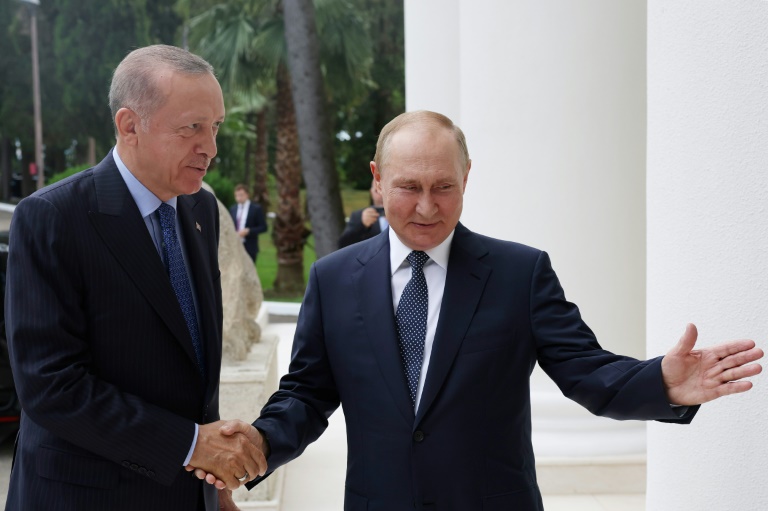
Turkish President Recep Tayyip Erdogan and Russian counterpart Vladimir Putin agreed to step up economic cooperation at a summit in the Black Sea resort of Sochi earlier this month.

Official data show the value of Turkish exports to Russia between May and July growing by nearly 50 percent from last year’s figure.

Turkey’s imports of Russian oil are ballooning and the two sides have agreed to transition to ruble payments for the natural gas exported by the Kremlin-tied giant Gazprom.

US Deputy Secretary of the Treasury Wally Adeyemo paid a rare visit to Ankara and Istanbul in June to express Washington’s worries that Russian oligarchs and big businesses were using Turkish entities to evade Western sanctions.

NATO member Turkey — on good terms with both Moscow and Kyiv — has tried to stay neutral in the conflict and refused to join the international sanctions regime.

– ‘Risk of US sanctions’ –

Adeyemo followed that up with a letter to Turkey’s TUSIAD business association and the American Chamber of Commerce in Turkey warning that companies and banks were in danger of being sanctioned themselves.

TUSIAD said in a statement late Tuesday that it had passed on the letter to Turkey’s foreign ministry as well as finance and trade officials.

The letter’s contents were first reported by The Wall Street Journal this week.

“Any individuals or entities providing material support to US-designated persons are themselves at risk of US sanctions,” Adeyemo wrote.

“Turkish banks cannot expect to establish corresponding relationships with sanctioned Russian banks and retain their corresponding relationships with major global banks as well as access to the US dollar and other major currencies.”

The economic cooperation agreement sealed by Erdogan and Putin includes a deal for more Turkish banks to start processing Russia’s Mir payments system.

Broader cooperation with Russia could help support Turkey’s ailing economy in the run-up to next year’s general election.

Adeyemo raised US concerns again in a phone call to Turkey’s Deputy Finance Minister Yunus Elitas last Friday.

“Underlining that it has deep economic and political relations with Ukraine and Russia, Elitas said that Turkey’s position (on joining) the sanctions has not changed,” Turkey’s finance ministry said in a statement about the call.

The finance ministry added that “it will not allow any institution or individual” to use Turkey to evade the sanctions regime.

Erdogan has previously argued that Ankara cannot join Western sanctions on Moscow because of Turkey’s heavy dependence on Russian oil and natural gas imports.

Some analysts believe that TUSIAD and the American Chamber of Commerce in Turkey — largely made up of big business with a global reach — are unlikely to violate the regime because they place more value on open access to US financial markets.

Timothy Ash of BlueBay Asset Management in London told AFP “smaller, domestically focused” companies were more likely to strike deals with sanctioned Russian entities that opened the way to two-way trade.

“It worries me though that the message from the top in Turkey seems to be that it’s fine to do more business with Russia, and it’s important to try and exploit opportunities to counterbalance costs from sanctions, even prosper from them.”

Steep drop in military aircraft keep US goods orders flat in June

Orders for big-ticket US-manufactured goods were flat in July after four straight monthly increases due to a plunge in the volatile military aircraft category, according to government data released Wednesday.

New orders for durable goods held steady at $273.5 billion, after the nearly 50 percent drop in demand for defense aircraft and parts — a segment that surged more than 80 percent in June, the Commerce Department reported.

The result was far worse than economists had projected, but excluding the defense sector, orders rose 1.2 percent, the data showed.

Economists say businesses are likely to pull back on investments, fearing Americans will become more cautious about spending amid the highest inflation in 40 years, even though families are buoyed by a stockpile of savings.

Despite high prices and rising interest rates, there were nonetheless signs of continued demand, although some categories hinted at a slowdown, including appliances, which fell, and autos, where orders increased but by much less than in recent months, as did computers and electronics.

Ian Shepherdson of Pantheon Macroeconomics said the data show orders are “holding up” despite business surveys pointing to weaker investment plans.

And while auto orders undershot, “they are trending strongly higher as chip supply improves,” he said in an analysis.

“People report to surveys that they are miserable and anxious about the state of the economy, but they keep spending anyway because the huge pile of pandemic savings allows them to cushion the hit to their real incomes from high inflation.”

The drop in military aircraft orders was offset by the 14.5 percent jump in non-defense planes, the report said.

Biden announces nearly $3 bn in Ukraine weapons aid

President Joe Biden announced nearly $3 billion in military aid to Kyiv on Wednesday — the biggest US package so far — to mark Ukraine’s independence day, six months after Russia invaded the country.

In a statement, Biden signaled the firmness of Washington’s commitment to Ukraine’s struggle, saying the $2.98 billion for arms and other equipment aimed “to ensure it can continue to defend itself over the long term.” 

The new funds will be for air defense systems, artillery and the much-in-demand ammunition for those systems, as well as radars and systems to counter Russian drones, Biden said.

Congratulating Ukraine on its independence, which was declared from the Soviet Union in 1991, Biden said the US “is committed to supporting the people of Ukraine as they continue the fight to defend their sovereignty.”

“Today is not only a celebration of the past, but a resounding affirmation that Ukraine proudly remains — and will remain — a sovereign and independent nation.”

Biden also hailed Ukraine’s resistance against the invasion, which President Vladimir Putin launched on February 24 after years of unsuccessfully trying to reassert Russian control over a westward-looking country that has pushed strongly for membership in NATO and the European Union.

Thousands of soldiers on both sides and thousands of civilians have died in the largest-scale battles seen in Europe since World War II. Despite Russian expectations of a quick victory, Ukrainian armed forces, which are trained and armed by Western allies, have pushed the invaders back to a swath of territory in the country’s east and south.

“Six months of relentless attacks have only strengthened Ukrainians’ pride in themselves, in their country, and in their thirty-one years of independence,” Biden said.

“Today and every day, we stand with the Ukrainian people.”

However, despite rumors of a Ukrainian counter-offensive to try and retake large portions of occupied territory in the south, the battle lines remain largely frozen, indicating a possibly lengthy test of resolve for both sides, and also for Ukraine’s Western backers.

The funds released by Biden Wednesday can be used for immediate war costs, including acquisitions of supplies and arms, and are separate from the Presidential Drawdown Authority (PDA), under which Biden has been able to order transfers of weapons and ammunition to Ukraine’s forces from existing US military stockpiles.

On Friday, the Pentagon announced the latest package under the PDA: $775 million worth of various missiles, artillery, and anti-armor weapons and ammunition, as well as a fleet of armed mine-removal vehicles.

Fighting resumes in northern Ethiopia after five-month lull

Fighting erupted between government forces and Tigrayan rebels in northern Ethiopia on Wednesday, shattering a five-month truce between the warring sides.

The renewed warfare follows both sides repeatedly blaming the other for a lack of progress towards negotiations to end the brutal 21-month conflict in Africa’s second most populous nation. 

The Tigray People’s Liberation Front (TPLF) said government forces and their allies had launched a “large scale” offensive towards southern Tigray early Wednesday after a months-long lull in fighting.

But the Government Communication Service accused the TPLF of striking first, saying it had “destroyed the truce”.

“Disregarding the numerous peace options presented by the Ethiopian government, the armed wing of the terror group TPLF, pushing with its recent provocations starting 5 am (0200 GMT) today committed an attack” around southern Tigray, it said in a statement.

The rival claims could not be independently verified as access to northern Ethiopia is restricted, but there were reports of fighting around southern Tigray in areas bordering the Amhara and Afar regions.

“They launched the offensive early this morning around 5 am local time. We are defending our positions,” TPLF spokesman Getachew Reda told AFP in Nairobi in a brief message.

He said on Twitter that the “large-scale” offensive was launched “against our positions in the southern front” by the Ethiopian army and special forces and militias from neighbouring Amhara.

– ‘Deafening warning’ –

The March truce paused fighting in a war that first began in November 2020, allowing a resumption of international aid to war-stricken Tigray after a three-month break.

Prime Minister Abiy Ahmed’s government and the TPLF have been locked in a war of words in recent weeks even as both sides have raised the prospect of peace talks.

The two sides disagree on who should lead negotiations, and the TPLF also insists basic services must be restored to Tigray’s six million people before dialogue can begin.

Abiy’s government says any negotiations must be led by the African Union’s Horn of Africa envoy Olusegun Obasanjo, who is leading the international push for peace, but the rebels want outgoing Kenyan President Uhuru Kenyatta to mediate.

William Davison, senior Ethiopia analyst for the International Crisis Group, said all parties should cease fighting before “a return to full-blown war”.

“This serious breach of the truce agreed earlier this year demonstrates the need for the two parties to arrange unconditional face-to-face negotiations as soon as these hostilities cease,” Davison said in a statement.

“It is also a deafening warning to the key international and regional actors that they must immediately ensure peace talks actually occur.”

– ‘Enough of this war’ –

On Tuesday, the Ethiopian National Defence Force had issued a statement accusing the TPLF of seeking to “defame” the army by claiming government forces were moving towards their positions or shelling them with heavy weapons.

The conflict has killed untold numbers of people, with widespread reports of atrocities including mass killings and sexual violence.

Millions of people need humanitarian assistance in Tigray, the country’s northernmost region, and neighbouring Afar and Amhara.

The UN’s World Food Programme said last week that nearly half the population in Tigray is suffering from a severe lack of food.

“Hunger has deepened, rates of malnutrition have skyrocketed, and the situation is set to worsen as people enter peak hunger season until this year’s harvest in October,” it said.

The dire assessment came despite the March truce allowing the resumption of desperately needed international aid convoys to Tigray’s capital Mekele, with fuel shortages making it difficult to distribute supplies.

Tigray is largely cut off from the rest of Ethiopia, without basic services such as electricity, communications and banking.

Abiy sent troops into Tigray in November 2020 to topple the TPLF after months of seething tensions with the party that had dominated Ethiopian politics for three decades.

The 2019 Nobel Peace Prize winner said it came in response to rebel attacks on army camps. 

The TPLF mounted a comeback, recapturing Tigray and expanding into Afar and Amhara, before the war reached a stalemate.

Last Wednesday, an Ethiopian government committee tasked with looking into negotiations called for a formal ceasefire to enable the resumption of services to Tigray as part of a proposal it planned to submit to the AU.

“If you can’t win, then you’ve got to sit down and talk,” Abiy said Sunday in remarks carried on state media.

“My advice is… let’s have enough of (this) war.”

War in Ukraine: latest developments

Here are the latest developments in the war in Ukraine:

– ‘Fight until the end’: Zelensky –

Ukrainian President Volodymyr Zelensky vows in an Independence Day address that his country will fight Russia’s invasion “until the end” and will not be making “any concession or compromise”.

“We don’t care what army you have, we only care about our land. We will fight for it until the end,” Zelensky says in a video address, on the day which also marks six months since the invasion began.

Since Russian President Vladimir Putin sent in troops on February 24, 2022, Zelensky has led the resistance from Kyiv.

Tensions were high in the capital as both Zelensky and the US State Department warned that Russia could step up attacks around the holiday.

The celebrations are muted this year and large gatherings have been banned in Kyiv.

– Biden announces $3 billion in military aid –

US President Joe Biden announces $3 billion in fresh military aid to Ukraine, as it marks its Independence Day.

“I am proud to announce our biggest tranche of security assistance to date: approximately $2.98 billion of weapons and equipment to be provided through the Ukraine Security Assistance Initiative,” Biden says in a statement.

Ukraine has been locked in a grinding war of attrition with Russian troops in the east and south with neither side advancing significantly in weeks.

– Pope appeals for peace for ‘beloved’ Ukraine –

Pope Francis renews calls for peace “for the beloved Ukrainian people”.

Following his weekly general audience at the Vatican, Francis directed his address to “the beloved Ukrainian people who for six months today have been suffering the horror of war”.

He also warns of the risk of nuclear catastrophe in the region. 

“I hope that concrete steps will be taken to put an end to the war and to avert the risk of a nuclear disaster in Zaporizhzhia,” he says, referring to the Russian-controlled nuclear plant in southern Ukraine — Europe’s largest — that has been the target of military strikes, blamed by each side on the other.

– Germany vows continued support –

Chancellor Olaf Scholz assures Kyiv of Germany’s support for as long as necessary.

“Germany… stands firmly by the side of the threatened Ukraine today and for as long as Ukraine needs our support,” he says in a video posted on Twitter.

“We will continue to supply weapons” and “train Ukrainian soldiers on the latest European military equipment”, Scholz says after announcing fresh deliveries worth more than 500 million euros ($500 million) on Tuesday.

The new tranche of weapons — including three IRIS-T anti-aircraft systems as well as armed recovery vehicles and rocket-launchers — is mostly earmarked for delivery in 2023.

“We will continue our sanctions. We will support Ukraine financially and help rebuild the destroyed cities and villages,” Scholz says.

– Belarus leader congratulates Ukraine –

The authoritarian leader of ex-Soviet Belarus Alexander Lukashenko congratulates Ukraine on its Independence Day.

Russia launched its invasion of Ukraine six months ago from several directions, including from Belarusian territory. 

“I am convinced that today’s contradictions will not be able to destroy the centuries-old foundation of sincere good neighbourly ties between the peoples of our two countries,” Lukashenko says in a statement released by his press service. 

Belarus relies financially and politically on its close ally Russia. 

Western countries have slapped Belarus with new sanctions this year for its role in Russia’s offensive. 

burs-jmy/kjm

Privacy activists target Google over French 'spam' emails

Google is breaking EU law by sending users of its email service Gmail direct advertising messages, activists said in a complaint sent to French regulators on Wednesday.

It is the latest in a long line of complaints filed by the activist group NOYB (None of Your Business), which has fought the tech giant for years on data privacy.

The French data regulator CNIL has been among the most active in Europe, doling out huge fines against Google and Facebook in particular.

The activist group provided screenshots to CNIL that showed marketing messages at the top of a user’s inbox.

The messages were marked with a green box and the word “annonce”, French for advert.

The group said under EU law, that kind of marketing was allowed only if users had consented.

“Spam is a commercial email sent without consent. And it is illegal,” said NOYB lawyer Romain Robert in a statement.

“Spam does not become legal just because it is generated by the email provider.” 

CNIL confirmed to AFP it had received the complaint. 

Google told AFP it had no comment as yet.

Google and Facebook’s parent company Meta are at the centre of a long-running battle over their data-collection practices in Europe.

The French regulator fined Google 150 million euros ($150 million) and Meta 60 million euros last December over their failure to provide users with an easy opt-out for cookies, files that track users around the web.

The two firms also face scrutiny over their practice of sending the personal data of EU residents to servers in the United States.

NOYB has filed dozens of cases with regulators across the bloc arguing that the practice is illegal.

South African inflation hits new 13-year high

Inflation in South Africa accelerated to its highest level in 13 years in July, pushed mainly by surging food, transport and electricity prices, official data showed Wednesday as workers staged protests over the high cost of living.

Consumer prices rose at an annual rate of 7.8 percent in July, up from 7.4 percent in June, the national statistics agency StatsSA said in a statement.

The publication of the latest statistics coincided with protests in major cities over the worsening economic conditions, which have been particularly crushing for the poorest in the continent’s most industrialised country. 

Strikers led by South Africa’s two largest trade unions called for government action to combat rising poverty and the cost of living in the world’s most unequal country.

While the new inflation figure is bad news for consumers, economists see the country likely reaching a tipping point and believe inflation could ease in the coming months. 

This “is likely the peak in the current inflation cycle,” according to Investec bank chief economist Annabel Bishop.

“Inflation will be lower this time next year,” said Dawie Roodt, an economist with the financial services firm Efficient Group. 

Inflation has been soaring worldwide, fuelled by supply chain disruptions after the easing of Covid restrictions as well as surging energy and food prices following Russia’s invasion of Ukraine.

For South Africans, it has resulted in rising costs for necessities including food, electricity, fuel and medication, the statistics agency said.

Although grain prices are on the decline internationally, Roodt said, “it takes as much as two years before a price shock works its way through the economy.”

Prices for breads and cereals were up 13.7 percent in July, from 11.2 percent in June. It means a loaf of white bread now costs 17.84 rand ($1.05) compared to 15.57 rand ($0.91) a year ago, the statistics agency said.

The price of fuel increased by 56.2 percent on last year. 

Rising inflation prompted the country’s central bank to impose the steepest hike to the benchmark interest rate last month, raising it by three-quarters of a percentage point to 5.5 percent.

Roodt said another hike is likely to come. 

It will have a spiralling impact on the broader economy with higher rates resulting in higher debt repayments for consumers, which will hit household budgets, said Christie Viljoen, senior manager and economist for PwC South Africa. 

“This, in turn, results in reduced spending power for consumers and companies. This is a challenge for South Africa which is a consumer-driven economy,” he said.

The rising cost of living is taking a toll on a population where the unemployment rate hovers near 34 percent.

The government called the unemployment figures a “major concern” on Wednesday, saying more needed to be done to improve conditions following the pandemic. 

“Job creation and economic recovery remain the top priorities for government,” said cabinet spokeswoman Phumla Williams in a statement. 

Heatwave triggers 'false autumn' in UK

Searing summer temperatures in the UK have not just parched the earth and dried up rivers, lakes and reservoirs but are also seeing trees shed their leaves early.

Instead of green, many gardens, parks and woods are now a sea of orange, yellow, red and brown, with thick carpets of leaves on the ground.

The early leaf fall — dubbed a “false autumn” — is a sign of stress, as trees shed their leaves to try to retain moisture.

But experts say while older trees with deep roots can withstand the drier conditions, younger, less established ones could be at risk.

“The trees are enacting the hormones they use in autumn to just retract and ensure their survival,” said Rosie Walker, of the Woodland Trust conservation charity.

“They’ll keep going like this for a few years but it is going to start impacting our trees if we’re not very careful,” she told BBC radio.

Temperatures soared above 40 degrees Celsius (104 degrees Fahrenheit) for the first time in Britain in July, with the month the driest on record in many parts of southern and eastern England.

Climate change has been blamed for the searing heatwave, which has led to drought being declared and a ban on the use of hosepipes to save water in some areas.

The Woodland Trust said fallen leaves are most likely to come from birch, silver birch and rowan trees.

“We saw the first turn in silver birch on August 12, which is incredibly early,” said Walker, adding that other species were also shedding their leaves.

The Trust meanwhile said it recorded its earliest ever appearance of ripe wild blackberries — normally an autumn fruit — on June 28.

That, and the premature ripening of other berries and nuts, could hit wildlife such as small mammals and birds who store energy in September and October for the cold winter months.

Animals such as dormice consume high-fat foods such as hazelnuts and other hedgerow fruits in autumn but could struggle if they are gone by August.

Steve Hussey, from the Devon Wildlife Trust in southwest England, said: “Nature’s timing is everything for our wildlife.

“The climate crisis is bringing with it seasonal weather patterns which our wildlife is just not adapted to.

“Our long, hot summer and the ‘false autumn’ will have a knock-on for many species right into the real autumn months and beyond.”

Close Bitnami banner
Bitnami