World

Court suspends Thai PM Prayut from office

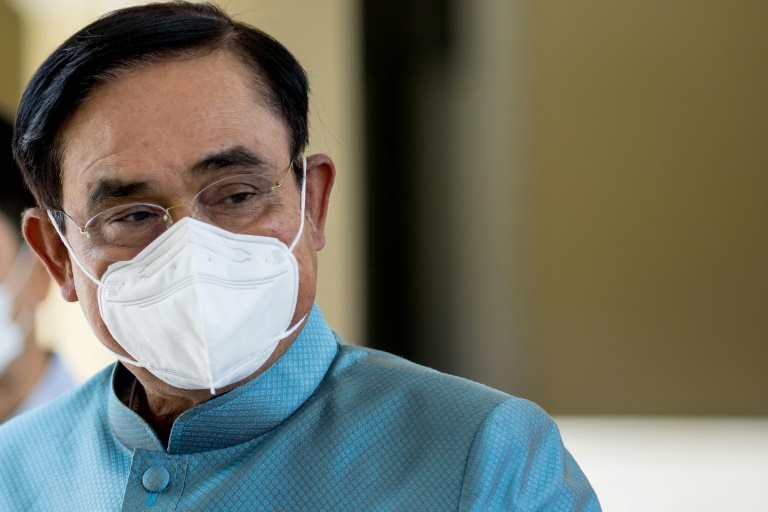
Thailand’s Constitutional Court on Wednesday suspended Prime Minister Prayut Chan-O-Cha from office while it considers a legal challenge that could see him thrown out months before an expected general election.

The court agreed unanimously to hear a case brought by opposition parties who argue Prayut has reached the end of his eight-year term limit as prime minister.

Judges also agreed by five votes to four to suspend Prayut from office until the case is decided, the court said in a statement.

“The court considered the petition and supporting documents and deems the facts according to the request indicate reasonable grounds to suspect that there is a case as requested,” the statement said.

“Thus, a majority vote (five against four) for (Prayut) to be suspended as prime minister, effective August 24, 2022, until the court issues a verdict.”

Prayut, who will continue in his role as defence minister, has 15 days to respond to the case against him.

Prawit Wongsuwan, one of Prayut’s deputies and another former army chief, will take over as caretaker prime minister while the case is decided.

“The current cabinet will continue its duty as normal because General Prayut has not been ousted from his post, only suspended from duty,” said Wissanu Krea-ngam, another deputy prime minister. 

Pita Limjaroenrat, leader of the opposition Move Forward Party which was among those that backed the petition, said the country needed fresh leadership.

“It is like rowing a boat round the bathtub, going from General Prayut to General Prawit,” Pita told reporters at parliament.

– Legal wrangle –

It is not the first time the Constitutional Court has played a role in Thai politics — it cancelled the results of general elections in 2006 and 2014.

The kingdom’s 2017 constitution bars the prime minister from serving more than eight years in total, and opposition parties say Prayut, who took power in a 2014 coup, has reached the limit.

Several hundred anti-government protesters rallied at Bangkok’s Democracy Monument on Tuesday ahead of the court ruling and further demonstrations are planned.

Anucha Burachaisri, a spokesman for the prime minister’s office, urged “all groups” to “respect the results of the court’s hearings and avoid criticising the performance of the court”.

Supporters of the 68-year-old leader argue that the clock on his rule began when the 2017 constitution was instituted, or even after the 2019 general election.

If the court follows this logic, Prayut could technically continue to serve until 2025 or 2027 — if he wins a general election which is due by March.

The former army chief came to power in a military coup that ousted Yingluck Shinawatra’s democratically elected government.

He headed the junta regime for five years and continued as prime minister after the 2019 national elections.

The stern, blunt-speaking Prayut has found himself increasingly out of favour with voters. A recent opinion poll found two-thirds of respondents wanted him to vacate office immediately.

Under Prayut’s watch, the kingdom registered its worst economic performance in 30 years and his government has also faced criticism over its handling of the pandemic.

Youth-led pro-democracy rallies in Bangkok in 2020 attracted tens of thousands of people at their peak, and a key demand of the movement was for Prayut to resign.

On Wednesday, police had placed shipping containers on some streets near government buildings in anticipation of fresh protests.
Angolans vote for president in tightest ever race

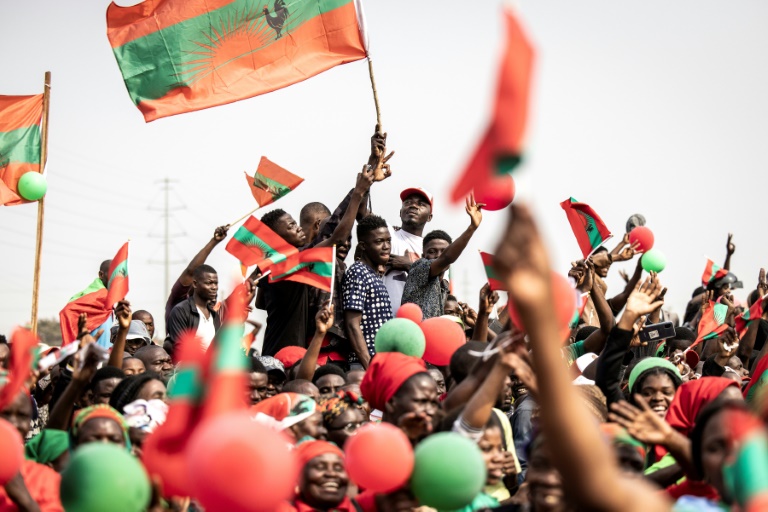
Angolans were casting ballots on Wednesday in what was expected to be the most competitive vote in their country’s democratic history, with incumbent president Joao Lourenco squaring up against charismatic opposition leader Adalberto Costa Junior.

The election has been overshadowed by Angola’s many woes — a struggling economy, inflation, poverty and drought, compounded by the death of a former strongman president.

The People’s Movement for the Liberation of Angola (MPLA), which has ruled the oil-rich nation for nearly five decades, is facing its most serious challenge since the first multiparty vote in 1992.

“It’s been 20 years of peace and we are still poor,” said Lindo, a 27-year-old electrician queueing up to vote in Nova Vida, a middle-class suburb of the capital Luanda.

“The people want change — the government doesn’t provide for people’s basic needs,” said Lindo, who gave only his first name. 

Eight political parties are running, but the real contest lies between the MPLA and its long-standing rival and ex-rebel movement the National Union for the Total Independence of Angola (UNITA).

Opinion polls suggest that support for the MPLA — which won 61 percent of the vote in 2017 elections — will dwindle, while the UNITA, which has entered an electoral pact with two other parties, will make gains. 

But UNITA’s inroads might not be enough to unseat Lourenco, 68, who succeeded veteran leader Jose Eduardo dos Santos five years ago.

“The margins will be closer than ever before… but the advantages of incumbency mean MPLA is still odds on to pip Costa (Junior),” said Eric Humphery-Smith, an analyst at London-based Verisk Maplecroft.

– Appeal to vote  –

The MPLA traditionally wields a grip over the electoral process and state media in Angola, but the opposition is urging supporters not to be intimidated.

“This is a historic day,” Costa Junior declared, after casting his ballot.

“It is important that this day be a celebration,” he said, urging “full turnout and for all ballots to be counted.”

Lourenco urged citizens to come out and vote because “in the end it’s all of us who will emerge winners and it is democracy that wins” he said after casting his ballot at Lusiada de Angola University in Luanda.

Opposition and civic groups have raised fears of voter tampering, and social media is rife with claims of dead people registered to vote.

Costa Junior, 60, is popular among young people — a significant and growing voting bloc — and has pledged to “eradicate poverty” and create jobs.

– Poverty and graft –

Lourenco, a Soviet-educated former general who had promised a new era for Angola when he was first elected, has trumpeted a list of achievements.

He is credited with making far-reaching reforms in one of southern Africa’s economic powerhouses. 

They include boosting transparency in the financial sector and efficiency in parastatal organisations, and promoting business-friendly policies to lure foreign investors. His government has managed to attract back global diamond miner De Beers, which had quit 10 years ago.

But little has changed for most of Angola’s 33 million people for whom life is a daily grind.

Angola is Africa’s second largest crude producer, but the oil bonanza also nurtured corruption and nepotism under dos Santos, who died in Spain last month.

The low-key, night-time repatriation of his remains in the final leg of campaigning has added a macabre touch to the election. 

Dos Santos will be buried on Sunday, which would have been his 80th birthday.

Analysts warn that any MPLA attempts to capitalise on the funeral could backfire, given widespread anger over his legacy among young people.

Some 14.7 million people are registered to vote at 13,200 polling stations across the vast southern African nation.

Angolans living overseas are for the first time able to cast ballots from abroad.

Results are expected within a few days. In past elections, results have been contested, in a process that can take several weeks.

Global stocks fall as investors eye US Fed outlook

Asian and European equities fell Wednesday as investors awaited news on the next US interest rate hikes.

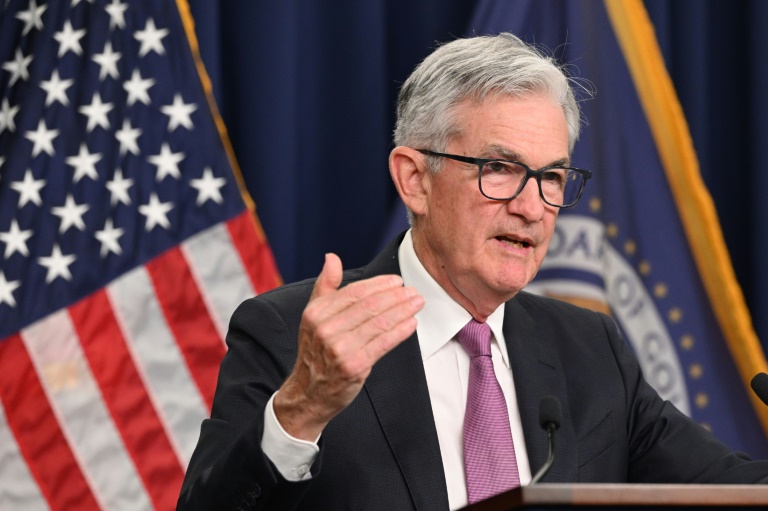
With the Jackson Hole meeting of central bankers this week, focus is on what US Federal Reserve chief Jerome Powell will say about plans to tackle high prices — with many fearing higher borrowing costs could send the world’s biggest economy into recession in its battle to rein in inflation.

The euro held close to a two-decade low against the dollar, and the greenback struck a two-year peak against China’s yuan.

Oil extended gains on hopes of an OPEC output cut, while gas prices remain elevated on Russian supply tensions.

– Losing momentum –

“Markets seem to have lost their momentum,” noted AJ Bell investment director Russ Mould.

“Investors have become nervous once again, with all eyes on Powell and what he says this coming Friday.” 

Central banks face a delicate balancing act between battling inflation, with Russia’s war in Ukraine sending energy prices soaring, and avoiding recession.

Yet concerns are growing that spiking energy costs could still prompt a worldwide downturn.

“Investor anxiety is growing that a combination of central banks raising rates and higher energy prices will tip the global economy into a long recession,” said CMC Markets analyst Michael Hewson.

Wall Street ended mostly lower Tuesday, and key markets in Asia followed suit Wednesday.

– Rollercoaster ride –

The foreign exchange market has faced a rollercoaster ride so far this week.

The euro tumbled on Tuesday to $0.9901 — a new two-decade low — but later clawed back losses as the greenback was hit by poor US economic data.

The dollar had strengthened this week ahead Powell’s speech, as markets speculate that the Fed will continue to tighten its monetary policy.

Higher interest rates boost the American currency as they make dollar-denominated debt more attractive to investors.

But the euro also has been weighed down by a gloomy outlook for the eurozone economy amid fears of a halt to Russia’s gas deliveries.

– Key figures at around 1030 GMT –

London – FTSE 100: DOWN 0.3 percent at 7,463.45 points

Frankfurt – DAX: DOWN 0.2 percent at 13,168.54 

Paris – CAC 40: DOWN 0.1 percent at 6,358.94

EURO STOXX 50: FLAT at 3,652.24

Tokyo – Nikkei 225: DOWN 0.5 percent at 28,313.47 (close)

Hong Kong – Hang Seng Index: DOWN 1.2 percent at 19,268.74 (close)

Shanghai – Composite: DOWN 1.9 percent at 3,215.20 (close)

New York – Dow: DOWN 0.5 percent at 32,909.59 points (close)

Euro/dollar: DOWN at 0.9940 from 0.9970 on Tuesday

Pound/dollar: DOWN at 1.1784 from 1.1836

Euro/pound: UP at 84.37 pence from 84.23 pence

Dollar/yen: UP at 136.58 yen from 136.36 yen

West Texas Intermediate: UP 0.8 percent at $94.45 per barrel

Brent North Sea crude: UP 0.6 percent at $100.80

Whistle blows in Germany for world's first hydrogen train fleet

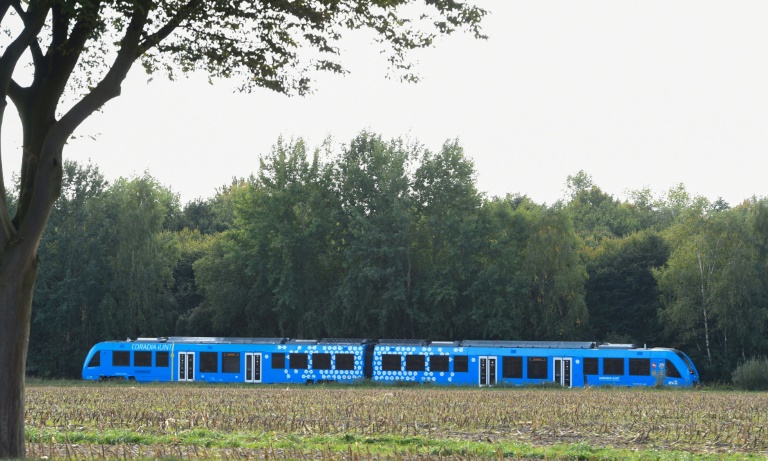
Germany on Wednesday inaugurated a railway line powered entirely by hydrogen, a “world premiere” and a major step forward for green train transport despite nagging supply challenges.

A fleet of 14 trains provided by French industrial giant Alstom to the German state Lower Saxony has replaced diesel locomotives on the 100 kilometres (60 miles) of track connecting the cities of Cuxhaven, Bremerhaven, Bremervoerde and Buxtehude near Hamburg.

“We are very proud to put this technology into operation together with our strong partners as a world premiere,” Alstom CEO Henri Poupart-Lafarge said in a statement.

Hydrogen trains have become a promising way to decarbonise the rail sector and replace climate-warming diesel, which still powers 20 percent of journeys in Germany.

Billed as a “zero emission” mode of transport, the trains mix hydrogen on board with oxygen present in the ambient air, thanks to a fuel cell installed in the roof. This produces the electricity needed to pull the train.

Regional rail operator LNVG said the fleet, which cost 93 million euros (dollars), would prevent 4,400 tonnes of CO2 being released into the atmosphere each year.

– Run for its money –

Designed in the southern French town of Tarbes and assembled in Salzgitter in central Germany, Alstom’s trains — called Coradia iLint — are trailblazers in the sector.

The project created jobs for up to 80 employees in the two countries, according to Alstom. 

Commercial trials have been carried out since 2018 on the line with two hydrogen trains but now the entire fleet is adopting the groundbreaking technology.

The French group has inked four contracts for several dozen trains between Germany, France and Italy, with no sign of demand waning. 

In Germany alone “between 2,500 and 3,000 diesel trains could be replaced by hydrogen models”, Stefan Schrank, project manager at Alstom, told AFP.

“By 2035, around 15 to 20 percent of the regional European market could run on hydrogen,” according to Alexandre Charpentier, a rail expert at consultancy Roland Berger.

Hydrogen trains are particularly attractive on short regional lines where the cost of a transition to electric outstrips the profitability of the route. 

Currently, around one out of two regional trains in Europe runs on diesel.

But Alstom’s competitors are ready to give it a run for its money. German behemoth Siemens unveiled a prototype hydrogen train with national rail company Deutsche Bahn in May, with a view to a roll-out in 2024.

But, despite the attractive prospects, “there are real barriers” to a big expansion with hydrogen, Charpentier said.

For starters, trains are not the only means of transport hungry for the fuel.

The entire sector, whether it be road vehicles or aircraft, not to mention heavy industry such as steel and chemicals, is eyeing hydrogen to slash CO2 emissions.

– Colossal investment –

Although Germany announced in 2020 an ambitious seven-billion-euro plan to become a leader in hydrogen technologies within a decade, the infrastructure is still lacking in Europe’s top economy.

It is a problem seen across the continent, where colossal investment would be needed for a real shift to hydrogen.

“For this reason, we do not foresee a 100-percent replacement of diesel trains with hydrogen,” Charpentier said.

Furthermore, hydrogen is not necessarily carbon-free: only “green hydrogen”, produced using renewable energy, is considered sustainable by experts. 

Other, more common manufacturing methods exist, but they emit greenhouse gases because they are made from fossil fuels. 

The Lower Saxony line will in the beginning have to use a hydrogen by-product of certain industries such as the chemical sector.

The French research institute IFP specialising in energy issues says that hydrogen is currently “95 percent derived from the transformation of fossil fuels, almost half of which come from natural gas”. 

Europe’s enduring reliance on gas from Russia amid massive tensions over the Kremlin’s invasion of Ukraine poses major challenges for the development of hydrogen in rail transport.

“Political leaders will have to decide which sector to prioritise when determining what the production of hydrogen will or won’t go to,” Charpentier said. 

Germany will also have to import massively to meet its needs. 

Partnerships have recently been signed with India and Morocco, and Chancellor Olaf Scholz sealed a green hydrogen deal with Canada on a visit this week, laying a path for a transatlantic supply chain.

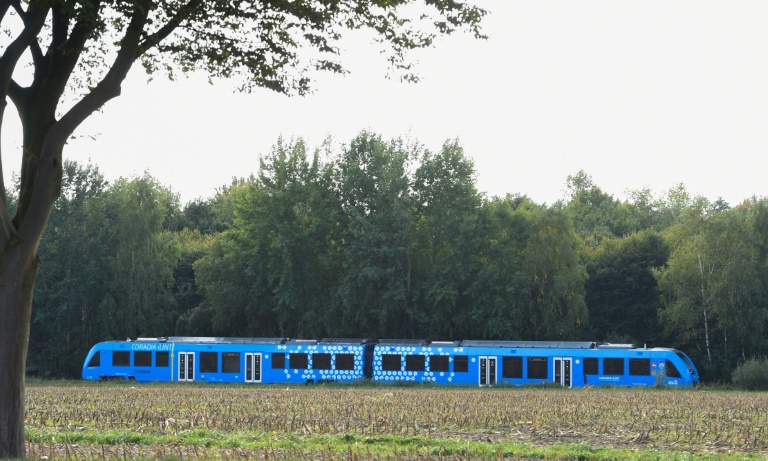
Whistle blows in Germany for world's first hydrogen train fleet

Germany on Wednesday inaugurated a railway line powered entirely by hydrogen, a “world premiere” and a major step forward for green train transport despite nagging supply challenges.

A fleet of 14 trains provided by French industrial giant Alstom to the German state Lower Saxony has replaced diesel locomotives on the 100 kilometres (60 miles) of track connecting the cities of Cuxhaven, Bremerhaven, Bremervoerde and Buxtehude near Hamburg.

“We are very proud to put this technology into operation together with our strong partners as a world premiere,” Alstom CEO Henri Poupart-Lafarge said in a statement.

Hydrogen trains have become a promising way to decarbonise the rail sector and replace climate-warming diesel, which still powers 20 percent of journeys in Germany.

Billed as a “zero emission” mode of transport, the trains mix hydrogen on board with oxygen present in the ambient air, thanks to a fuel cell installed in the roof. This produces the electricity needed to pull the train.

Regional rail operator LNVG said the fleet, which cost 93 million euros (dollars), would prevent 4,400 tonnes of CO2 being released into the atmosphere each year.

– Run for its money –

Designed in the southern French town of Tarbes and assembled in Salzgitter in central Germany, Alstom’s trains — called Coradia iLint — are trailblazers in the sector.

The project created jobs for up to 80 employees in the two countries, according to Alstom. 

Commercial trials have been carried out since 2018 on the line with two hydrogen trains but now the entire fleet is adopting the groundbreaking technology.

The French group has inked four contracts for several dozen trains between Germany, France and Italy, with no sign of demand waning. 

In Germany alone “between 2,500 and 3,000 diesel trains could be replaced by hydrogen models”, Stefan Schrank, project manager at Alstom, told AFP.

“By 2035, around 15 to 20 percent of the regional European market could run on hydrogen,” according to Alexandre Charpentier, a rail expert at consultancy Roland Berger.

Hydrogen trains are particularly attractive on short regional lines where the cost of a transition to electric outstrips the profitability of the route. 

Currently, around one out of two regional trains in Europe runs on diesel.

But Alstom’s competitors are ready to give it a run for its money. German behemoth Siemens unveiled a prototype hydrogen train with national rail company Deutsche Bahn in May, with a view to a roll-out in 2024.

But, despite the attractive prospects, “there are real barriers” to a big expansion with hydrogen, Charpentier said.

For starters, trains are not the only means of transport hungry for the fuel.

The entire sector, whether it be road vehicles or aircraft, not to mention heavy industry such as steel and chemicals, is eyeing hydrogen to slash CO2 emissions.

– Colossal investment –

Although Germany announced in 2020 an ambitious seven-billion-euro plan to become a leader in hydrogen technologies within a decade, the infrastructure is still lacking in Europe’s top economy.

It is a problem seen across the continent, where colossal investment would be needed for a real shift to hydrogen.

“For this reason, we do not foresee a 100-percent replacement of diesel trains with hydrogen,” Charpentier said.

Furthermore, hydrogen is not necessarily carbon-free: only “green hydrogen”, produced using renewable energy, is considered sustainable by experts. 

Other, more common manufacturing methods exist, but they emit greenhouse gases because they are made from fossil fuels. 

The Lower Saxony line will in the beginning have to use a hydrogen by-product of certain industries such as the chemical sector.

The French research institute IFP specialising in energy issues says that hydrogen is currently “95 percent derived from the transformation of fossil fuels, almost half of which come from natural gas”. 

Europe’s enduring reliance on gas from Russia amid massive tensions over the Kremlin’s invasion of Ukraine poses major challenges for the development of hydrogen in rail transport.

“Political leaders will have to decide which sector to prioritise when determining what the production of hydrogen will or won’t go to,” Charpentier said. 

Germany will also have to import massively to meet its needs. 

Partnerships have recently been signed with India and Morocco, and Chancellor Olaf Scholz sealed a green hydrogen deal with Canada on a visit this week, laying a path for a transatlantic supply chain.

Indian tycoon's bid for broadcaster stokes media freedom worries

An Indian billionaire close to Prime Minister Narendra Modi is trying to buy a broadcaster seen as the last major critical voice on television, stoking fears about media freedom in the world’s largest democracy.

Under Modi, India has slipped 10 places in the Reporters Without Borders press freedom ranking to 150 out of 180, with critical reporters often finding themselves behind bars and hounded on social media by supporters of the ruling BJP.

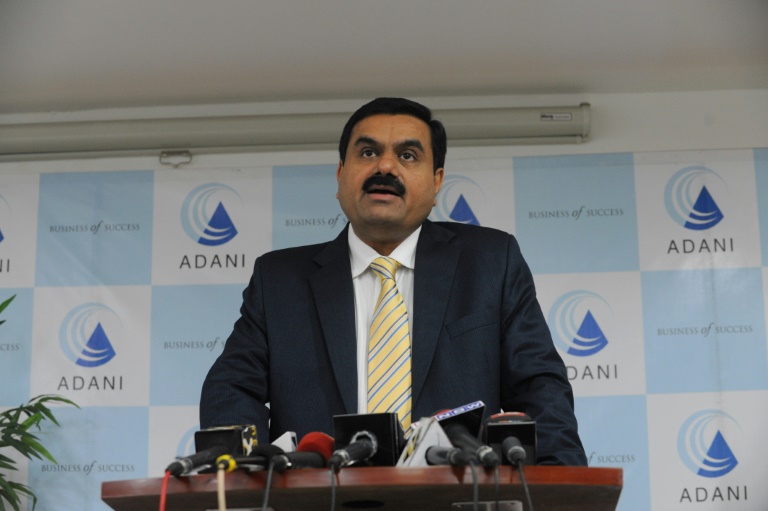
Gautam Adani — Asia’s richest person, with interests ranging from Australian coal mines to India’s busiest ports — announced late Tuesday that his firm had indirectly acquired a 29-percent stake in NDTV and was bidding for a further 26 percent.

NDTV said that the move came “without any discussion” with the broadcaster, “or the consent of the NDTV founders”, journalist Radhika Roy and economist Prannoy Roy.

Its two channels, one in Hindi and one in English, stand out among India’s myriad rolling news broadcasters for inviting on critics of the government as well as their hard-hitting reporting.

It has already been hit by a slew of legal cases that its owners said were a result of its reporting.

On Wednesday morning an employee at NDTV told AFP that there was a “general sense of shock and disbelief” in the newsroom following the announcement.

“We only found out from other news agency flashes and channels about the takeover and then all hell broke loose,” the employee said, asking to remain anonymous.

“People are still trying to figure out what has happened and what will happen. There is a sense of uncertainty since it is only a matter of time till the new management comes in.”

Geeta Seshu, founder of the Free Speech Collective, an independent organisation that advocates press freedom, said that “the space for independent journalism has shrunk alarmingly over the last few years.”

“The few brave journalists who continue to put out information are also battling court cases, are lodged in jail for long periods without bail, attacked or silenced permanently,” Seshu told AFP.

– Self-made billionaire –

Seshu said that while NDTV has been “struggling” commercially for some time, “the manner of this takeover is shocking, given the naked display of economic and political muscle”.

The Adani group’s closeness to the government was “hardly a secret”, she added. 

Self-made billionaire Adani, 60, this year overtook fellow Indian Mukesh Ambani to become Asia’s richest man, with a net worth of $139 billion according to Forbes, behind Jeff Bezos and ahead of Bill Gates.

Modi and Adani both come from the western state of Gujarat, and the latter’s conglomerate has expanded aggressively in recent years, including into new areas like airports and renewable energy.

But this growth into capital-intensive businesses has raised alarms, with Fitch Group’s CreditSights warning on Tuesday that the group was “deeply overleveraged”.

Ambani’s wealth and influence have also grown under Modi — he now owns more than 70 media outlets that are followed by at least 800 million Indians, according to Reporters Without Borders.

This includes a majority stake in Network18, one of the biggest media conglomerates in the country, which owns several leading broadcasters.

– ‘Oligarchs’ –

NDTV’s integrity has been a bright spot in a media landscape compromised by increasing corporate control, said P Sainath, the founder and editor of the grassroots reporting network People’s Archive of Rural India. 

“Under the circumstances and under the pressure they’ve worked in, they really stand out,” he said.

Hartosh Singh Bal, journalist at Caravan magazine — a rare critical voice among print media — said the takeover could bring the curtain down on “the only channel left that could be called partly independent”.

“The government influence on the media is growing. The control of what I call oligarchs — the Adanis and the Ambanis — is also growing and it will keep on growing,” he told AFP.

“This (takeover) means there is almost no independent media left and that shrinking space is extremely dangerous.”

Power cuts and sleepless nights in China's record heatwave

The lights are out along a once-bustling boulevard in a tourist spot at the epicentre of China’s hottest summer on record, as people take refuge indoors from the searing heat engulfing the country’s southwest.

The region is suffering through its longest continuous period of high temperatures since records began more than 60 years ago, with scientists warning such hot and dry spells will worsen as climate change warms the planet.

Temperatures as high as 45 degrees Celsius (113 Fahrenheit) have forced authorities to impose power cuts to cope with a surge in demand for electricity partly driven by people cranking up the air conditioning.

On the streets of Chongqing, a city of 30 million, locals line up for mandatory Covid tests in the wee hours of the morning, keen to avoid long queues in the scorching heat of the day.

One woman told AFP she took shelter in a local ballroom during the day — a spot particularly busy as the elderly seek shelter from the sun and while away the hours dancing under a dimmed light.

The power shortages have now forced locals to scale back their use of air conditioning, making life a struggle.

“Since the heatwave, I feel too hot to sleep every night, and the heat wakes me up every morning,” Xu Jinxin, a 20-year-old student, told AFP.

“Because of the electricity shortage, we don’t leave the AC on all day,” he said. 

“We’re trying to use less and save more, trying to use fans if we can, and life goes on with some endurance.”

At Chongqing’s most popular tourist spot along the Jialing River, the lights have been cut to save power and the once-busy street has gone quiet.

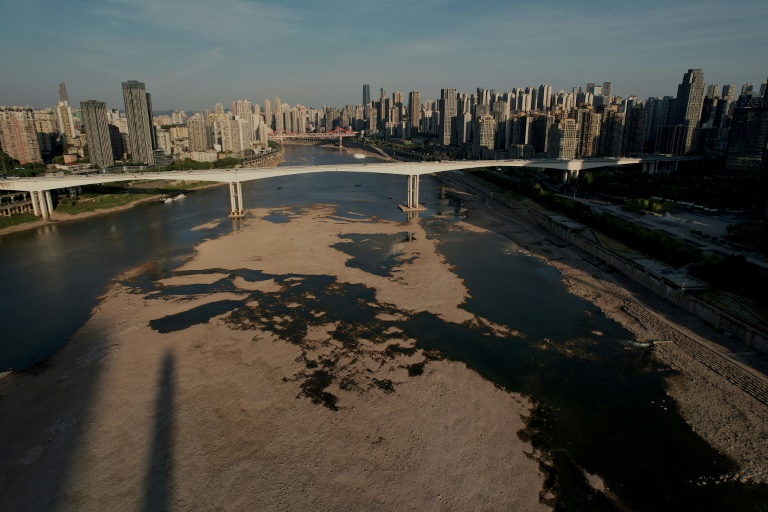
Locals bathe in what water remains in the dried-out riverbed and pose for photos.

The Jialing is a tributary of the mighty Yangtze — a key node for southwestern China’s trade that is now drying up, with water flow on its main trunk about 50 percent lower than the average over the last five years.

Local businesses — already hit hard by two years of Covid-19 — are suffering, with one bar worker saying the power shortages had affected nightlife.

“Most of the equipment like the ice-maker and the lighting in the bar are high-power machines, and the recent electricity shortage has compelled the bar to suspend business,” Liu, a singer, told AFP. 

“This affects my work and my life as well.”

Even the taps are running hot.

“In previous summers when we turned on the faucet, we might get hot water flowing for one minute, and cool water after that,” said Zhang, a 25-year-old woman who did not give her first name.

“This year, even after two or three minutes, it still feels like boiling water.”

burs-oho/mca/axn

Flood toll tops 800 in Pakistan's 'catastrophe of epic scale'

Record monsoon rains were causing a “catastrophe of epic scale”, Pakistan’s climate change minister said Wednesday, announcing an international appeal for help in dealing with floods that have killed more than 800 people since June.

The annual monsoon is essential for irrigating crops and replenishing lakes and dams across the Indian subcontinent, but each year it also brings a wave of destruction.

Heavy rain continued to pound much of Pakistan Wednesday, with authorities reporting more than a dozen deaths — including nine children — in the last 24 hours.

“It has been raining for a month now. There is nothing left,” a woman named Khanzadi told AFP in badly hit Jaffarabad, Balochistan province.

“We had only one goat, that too drowned in the flood… Now we have nothing with us and we are lying along the road and facing hunger.”

Climate Change Minister Sherry Rehman said authorities would launch an appeal for international help once an assessment was complete.

“Given the scale of the disaster there is no question of the provinces, or even Islamabad, being able to cope with this magnitude of climate catastrophe on their own,” she told AFP. 

“Lives are at risk, thousands homeless. It is important that international partners mobilise assistance.”

Pakistan is eighth on a list of countries deemed most vulnerable to extreme weather caused by climate change, according to the Global Climate Risk Index compiled by environmental NGO Germanwatch.

– From heatwave to flood –

Earlier this year much of the nation was in the grip of a heatwave, with temperatures hitting 51 degrees Celsius (124 Fahrenheit) in Jacobabad, Sindh province.

The city is now grappling with floods that have inundated homes and swept away roads and bridges.

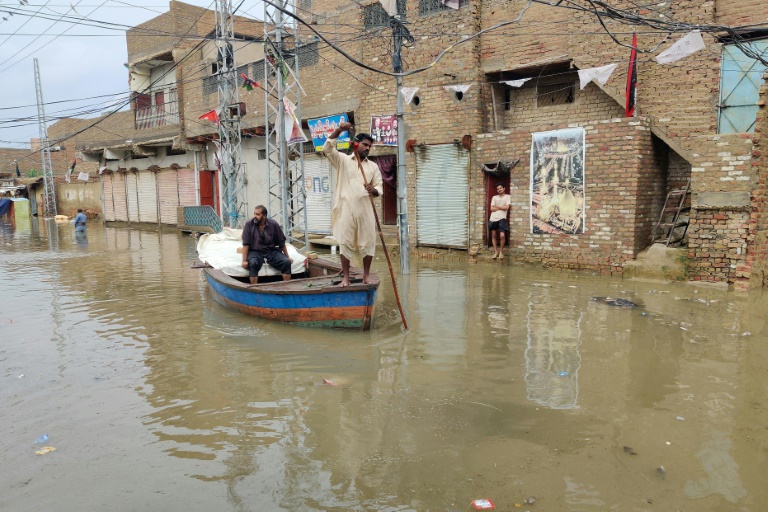
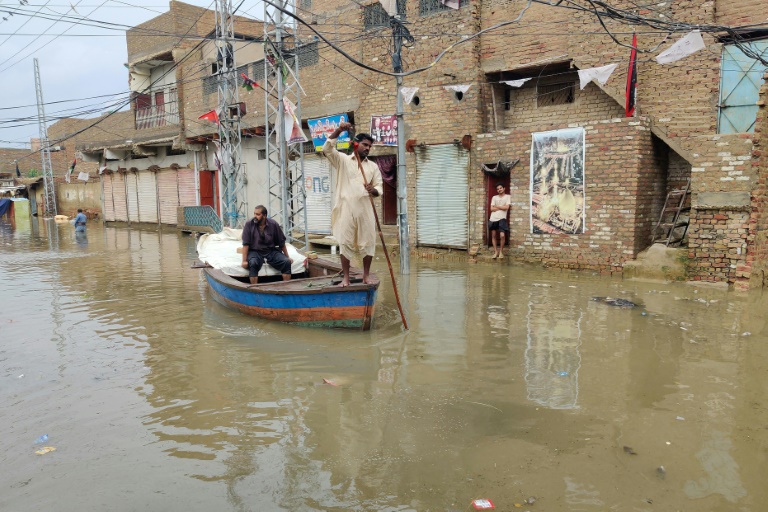
In Sukkur, about 75 kilometres (50 miles) away, volunteers were using boats along the flooded streets of the city to distribute food and fresh water to people trapped in their homes. 

Zaheer Ahmad Babar, a senior met office official, told AFP that this year’s rains were the heaviest since 2010, when over 2,000 people died and more than two million were displaced by monsoon floods that covered nearly a fifth of the country.

Rainfall in Balochistan province was 430 percent higher than normal, he said, while Sindh was nearing 500 percent.

The town of Padidan in Sindh had received over a metre (39 inches) of rain since August 1, he added.

“It is a climate catastrophe of epic scale,” Rehman said, adding three million people had been affected.

The National Disaster Management Authority said in a statement that nearly 125,000 homes had been destroyed and 288,000 more were damaged by the floods.

Some 700,000 livestock in Sindh and Balochistan had been killed, and nearly two million acres of farmland destroyed, officials added.

Nearly 3,000 kilometres of roads had also been damaged.

Flood toll tops 800 in Pakistan's 'catastrophe of epic scale'

Record monsoon rains were causing a “catastrophe of epic scale”, Pakistan’s climate change minister said Wednesday, announcing an international appeal for help in dealing with floods that have killed more than 800 people since June.

The annual monsoon is essential for irrigating crops and replenishing lakes and dams across the Indian subcontinent, but each year it also brings a wave of destruction.

Heavy rain continued to pound much of Pakistan Wednesday, with authorities reporting more than a dozen deaths — including nine children — in the last 24 hours.

“It has been raining for a month now. There is nothing left,” a woman named Khanzadi told AFP in badly hit Jaffarabad, Balochistan province.

“We had only one goat, that too drowned in the flood… Now we have nothing with us and we are lying along the road and facing hunger.”

Climate Change Minister Sherry Rehman said authorities would launch an appeal for international help once an assessment was complete.

“Given the scale of the disaster there is no question of the provinces, or even Islamabad, being able to cope with this magnitude of climate catastrophe on their own,” she told AFP. 

“Lives are at risk, thousands homeless. It is important that international partners mobilise assistance.”

Pakistan is eighth on a list of countries deemed most vulnerable to extreme weather caused by climate change, according to the Global Climate Risk Index compiled by environmental NGO Germanwatch.

– From heatwave to flood –

Earlier this year much of the nation was in the grip of a heatwave, with temperatures hitting 51 degrees Celsius (124 Fahrenheit) in Jacobabad, Sindh province.

The city is now grappling with floods that have inundated homes and swept away roads and bridges.

In Sukkur, about 75 kilometres (50 miles) away, volunteers were using boats along the flooded streets of the city to distribute food and fresh water to people trapped in their homes. 

Zaheer Ahmad Babar, a senior met office official, told AFP that this year’s rains were the heaviest since 2010, when over 2,000 people died and more than two million were displaced by monsoon floods that covered nearly a fifth of the country.

Rainfall in Balochistan province was 430 percent higher than normal, he said, while Sindh was nearing 500 percent.

The town of Padidan in Sindh had received over a metre (39 inches) of rain since August 1, he added.

“It is a climate catastrophe of epic scale,” Rehman said, adding three million people had been affected.

The National Disaster Management Authority said in a statement that nearly 125,000 homes had been destroyed and 288,000 more were damaged by the floods.

Some 700,000 livestock in Sindh and Balochistan had been killed, and nearly two million acres of farmland destroyed, officials added.

Nearly 3,000 kilometres of roads had also been damaged.

Japan eyes nuclear power push to combat energy crunch

Japan’s prime minister on Wednesday called for a push to revive the country’s nuclear power industry in a bid to tackle soaring imported energy costs linked to the war in Ukraine.

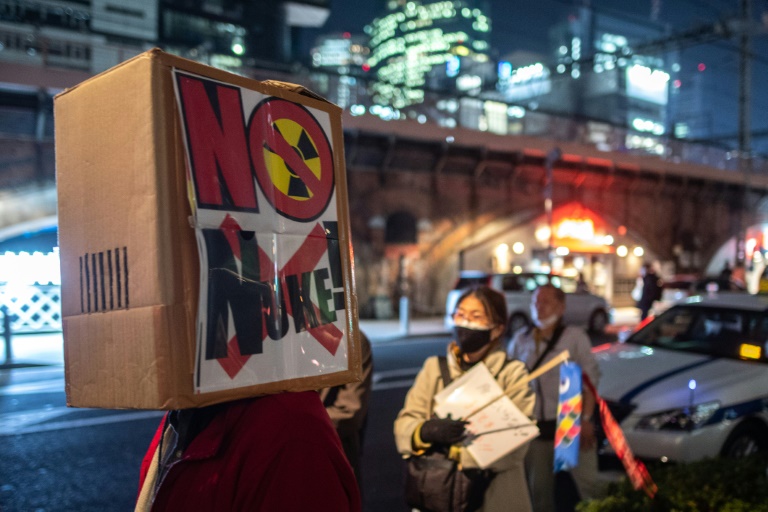
Such a move could prove controversial, after the 2011 Fukushima disaster led to the suspension of many nuclear reactors over safety fears.

Like many countries, Japan — which is aiming to become carbon neutral by 2050 — has faced a squeeze on its energy supplies since Russian forces entered Ukraine six months ago.

The nation has also sweltered through record-breaking temperatures this summer, with residents asked to conserve power wherever possible.

“Russia’s invasion of Ukraine has vastly transformed the world’s energy landscape” and so “Japan needs to bear in mind potential crisis scenarios”, Prime Minister Fumio Kishida said at an energy policy meeting.

Japan should consider building next-generation nuclear reactors, he said, while the government will discuss bringing more nuclear plants online and extending the service life of reactors if safety can be guaranteed.

Kishida called for “concrete conclusions by the end of the year” on the topic, which remains a sensitive one after a deadly tsunami in March 2011 caused a meltdown at the Fukushima plant, the worst nuclear disaster since Chernobyl.

Eleven years on, 10 of Japan’s 33 nuclear reactors are back in action, although not all are operational year-round, and the country is heavily dependent on imported fossil fuels.

The national nuclear safety watchdog has approved in principle the restart of seven more reactors, but those moves often face opposition from local communities.

– ‘All it takes’ –

“In addition to securing the operations of the 10 reactors that are already back online, the government will spearhead an effort to do all it takes to realise the restart” of the others whose safety has been approved, Kishida said.

The prime minister, who joined the meeting remotely after testing positive for Covid-19, also urged policymakers to consider “constructing next-generation nuclear reactors equipped with new safety mechanisms”.

Before the Fukushima disaster, around a third of Japan’s power generation came from nuclear sources, but in 2020 the figure was less than five percent.

Japan’s government has overhauled and strengthened nuclear safety standards, and wants nuclear power to account for 20 to 22 percent of electricity production by 2030, as part of efforts to reach carbon neutrality.

Tom O’Sullivan, a Tokyo-based energy consultant at Mathyos Advisory, said building next-generation reactors in Japan would be a “major step”, because “all the current reactors are conventional ones”.

Bringing more existing nuclear plants online will need to be approved by local governors, which could prove “politically challenging”, O’Sullivan told AFP.

“But again, there’s a different environment now after the Ukraine war,” he said. Polls in recent months also show that public opinion may be softening towards the use of nuclear power.

“I don’t think it’s just the electricity costs. It’s the reliance on Russia, for natural gas, oil and coal… the Japanese public have really woken up to that,” O’Sullivan said.

Japan has imposed sanctions on Russia over the war in Ukraine along with other G7 countries, and the government has pledged to try and reduce its energy dependence on Moscow.

The price of Japanese shares related to nuclear power surged in afternoon trade as local media reported the possible plans, with Tokyo Electric Power ending up 9.96 percent and Mitsubishi Heavy Industries jumping 6.85 percent.

Close Bitnami banner
Bitnami