World

UK spies accused over arrest of Sikh blogger in India

Human rights groups on Tuesday said UK intelligence agencies may have shared information with India that led to the arrest and torture of a Sikh blogger from Scotland.

Jagtar Singh Johal, 35, has been held in detention in India for more than four years.

He is accused of being part of a terror plot against right-wing Hindu leaders and has been charged with conspiracy to murder.

“Our investigators have uncovered critical information that in 2017, the UK government may have authorised MI5 and MI6 to share information about UK citizen Jagtar Singh Johal,” two organisations, Reprieve and Redress, said in a joint statement.

They claimed this tip-off “led to his unlawful arrest and torture in India”.

Current prime minister Boris Johnson was foreign minister at the time.

Britain is bound by international treaties such as the European Convention on Human Rights not to hand over citizens where they are at risk of torture.

But family members of Johal and other British citizens detained abroad or recently released have called for a law obliging the UK government to actively protect people caught up in such cases.

Johal, from Dumbarton in west Scotland, has filed a legal claim against the UK government and is being represented by British law firm Leigh Day.

He has filed a petition with the High Court in London and is asking for a public apology and redress from the government.

“It would be totally unacceptable for the UK government’s actions to have placed an individual, let alone a British citizen, at risk of torture or the death penalty,” said Leigh Day partner Waleed Sheikh.

– Electric shocks –

Reprieve and Redress said Johal was abducted in 2017 with a sack over his head while in India for his wedding.

He was held incommunicado for 10 days and tortured with electric shocks to his ear lobes, nipples and genitals until he signed a “false confession”.

“Evidence has now been uncovered that the British intelligence agencies, MI5 and MI6, may have contributed to Jagtar’s detention and torture by sharing intelligence with the Indian authorities,” the NGOs said.

They accused the UK of having acted while “there was a real risk that Jagtar could be tortured, mistreated or face the death penalty”.

Rupert Skilbeck, director of Redress, called for a “full review of the way that the UK government responds when UK citizens are tortured abroad” and “the role of the intelligence community in this case”.

Leigh Day is arguing that an anonymised case study in a 2018 report by a British interior ministry body, the Investigatory Powers Commission, appears to discuss Johal’s case.

The commission oversees the use of covert investigatory powers by UK authorities, including the police and intelligence services.

It said domestic spy agency MI5 and MI6 passed information on a British national to foreign authorities resulting in their detention and torture.

– ‘Release Johal’ –

“Britain is fortunate that its civil service doggedly documents wrongdoing,” wrote The Times newspaper.

“It was only because of the investigatory powers commissioner’s annual report that Johal’s treatment and the hand of the British state in it was revealed.”

The UN working group on arbitrary detention reported this year that Johal’s arrest was “excessive” and “arbitrary” and on “discriminatory grounds”.

Prime Minister Johnson subsequently accepted this.

The UN working group said the “appropriate remedy would be to release Mr Johal immediately”.

The “online activist… contributed to a magazine and website documenting the persecution of the Sikh religious minority in India,” the UN report said.

India has aired TV footage of Johal’s alleged confession but has denied physical and mental torture, it added.

The activist was being held in Tihar prison in New Delhi, the UN body said.

The Foreign Commonwealth and Development Office said in response to the claims that it would be “inappropriate” to comment during legal proceedings.
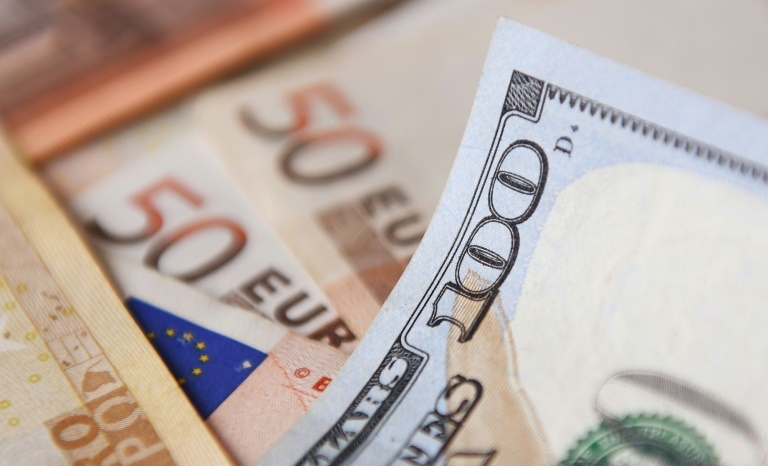
Euro strikes fresh 20-year low as eurozone economy shrinks again

The euro dived Tuesday to a new two-decade dollar low and equities wavered, as data highlighted the shrinking eurozone economy and the worsening energy crunch.

The single currency, hit also by the US Federal Reserve’s rate-hiking plans before this week’s hotly-awaited comments from Chair Jerome Powell, tumbled to $0.9901.

The shared unit had already plunged below parity Monday on recession fears to plumb the lowest levels since 2002, when it came into physical circulation.

In the latest blow, S&P Global’s closely-watched monthly composite purchasing managers’ index (PMI), which measures corporate confidence, languished in August below the key 50-point level.

That stoked long-running worries of a protracted economic downturn.

– ‘Overarching threat’ –

“Eurozone PMIs … confirm concerns of an impending recession in Europe on the back of high inflation and energy crunch, as they signal declining activity for two months in a row,” warned Citi analyst Luis Costa.

He added: “The energy crunch remains an overarching threat to economic stability in Europe.”

Equities in the region wavered amid stubborn worries that the US Federal Reserve will carry on ramping up interest rates to fight inflation.

Rising US interest rates also push the dollar higher against other currencies.

On Tuesday, natural gas prices remain elevated on fears over a temporary halt to Russia’s gas deliveries to Europe.

The Dutch TTF Gas Futures contract stood at 274.50 euros per megawatt hour, although this was down slightly from Monday.

Gas had spiked to record peaks in March after key producer Russia launched its invasion of neighbouring Ukraine.

That has sparked surging domestic energy bills, fuelling decades-high inflation that has prompted tighter monetary policy around the world.

– ‘More effective than Kalashnikovs’ –

“As it has become painfully obvious, natural gas is a much more effective weapon in the hands of Russian politicians than the Kalashnikov in the hands of their soldiers,” noted PVM analyst Tamas Varga.

This has hit the single currency hard because the bloc relies heavily on imported Russian gas, indicated Societe Generale analyst Kit Juckes. 

Fears increased after Russia’s Gazprom said Friday that the Nord Stream pipeline would be closed for maintenance at the end of the month, cutting Europe’s crucial gas deliveries.

“The euro’s problem is … the threat from continued squeezing of gas supplies and the cost of replacing Russian gas,” Juckes said.

Asian markets fell again Tuesday as traders grew increasingly jittery over rising US rates.

Wall Street fell deep into the red on Monday with the S&P 500 and Nasdaq both off more than two percent.

With the Jackson Hole symposium of central bankers and finance chiefs taking place this week, the focus is on what Fed chief Jerome Powell says about its plans to tackle prices, with many fearing officials could send the economy into recession.

Oil prices — which have fallen for weeks as recession worries hit demand expectations — rebounded after Saudi Arabia suggested OPEC and other major producers could cut output citing “volatility” in crude markets.

– Key figures at around 1100 GMT –

London – FTSE 100: DOWN 0.3 percent at 7,510.01 points

Frankfurt – DAX: UP 0.1 percent at 13,243.90 

Paris – CAC 40: FLAT at 6,376.74

EURO STOXX 50: UP 0.1 percent at 3,660.73

Tokyo – Nikkei 225: DOWN 1.2 percent at 28,452.75 (close)

Hong Kong – Hang Seng Index: DOWN 0.8 percent at 19,503.25 (close)

Shanghai – Composite: DOWN 0.1 percent at 3,276.22 (close)

New York – Dow: DOWN 1.9 percent at 33,063.61 (close)

Euro/dollar: DOWN at $0.9930 from $0.9943 Monday

Pound/dollar: DOWN at $1.1764 from $1.1767

Euro/pound: DOWN at 84.39 pence from 84.98 pence

Dollar/yen: DOWN at 137.42 yen from 137.48 yen

West Texas Intermediate: UP 1.8 percent at $91.98 per barrel

Brent North Sea crude: UP 1.5 percent at $97.88

burs-rfj/lth

Sadr supporters launch sit-in outside top Iraq judicial body

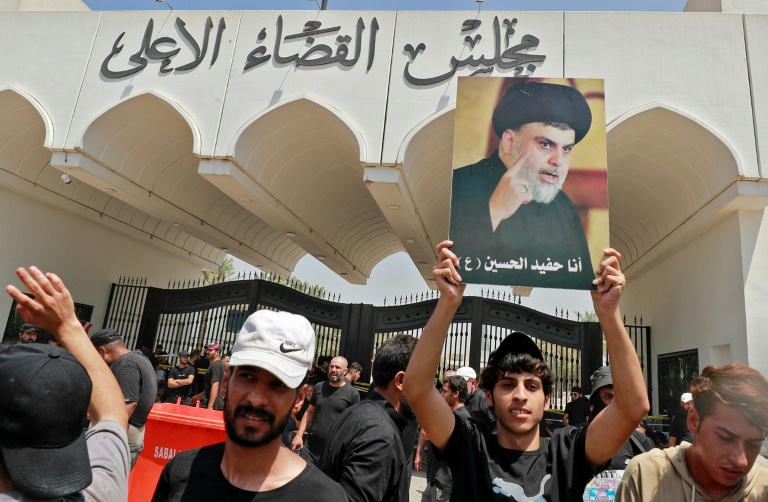
Several hundred supporters of Shiite cleric Moqtada Sadr launched a sit-in outside Iraq’s top judicial body on Tuesday, ratcheting up tensions in a showdown with a rival Shiite alliance.

Caretaker Prime Minister Mustafa al-Kadhemi cut short a visit to Egypt, where he had been due to take part in a five-nation summit, to return home to monitor developments.

Kadhemi “called on all political parties to calm down and to take advantage of the opportunity for national dialogue to get the country out of its current crisis”, a statement from his office said.

The standoff between rival Shiite factions has triggered an intensifying war of words, but so far no violence.

The Sadrists, who have already been camped outside parliament for the past three weeks, pitched tents outside the gates of the judicial body’s Baghdad headquarters, AFP correspondents reported.

They carried placards demanding the dissolution of parliament and new elections, 10 months after an inconclusive poll failed to deliver a majority government.

Even though his political bloc has taken part in previous administrations, securing top jobs in government ministries, Sadr himself has managed to keep above the political fray and is lionised by his supporters as an outsider dedicated to the fight against a corrupt elite.

“We want to stamp out corruption,” said Abu Karar al-Alyawi, a Sadr supporter among those demonstrating on Tuesday.

“The judicial system is being blackmailed or maybe it’s corrupt too.” 

On August 10, Sadr gave the Supreme Judicial Council one week to dissolve parliament to end the political deadlock but the council ruled that it lacked the authority to do so.

In the face of Tuesday’s protest, the council announced it was suspending work until further notice. 

– Talks boycotted by Sadrists –

Police deployed in numbers around the headquarters, which unlike parliament, lies outside Baghdad’s high-security Green Zone government and diplomatic compound.

Sadr’s opponents in the so-called Coordination Framework, who have been holding a sit-in of their own just outside the Green Zone, want a transitional government before new polls are held.

They include former paramilitaries of the Tehran-backed Hashed al-Shaabi network, and the party of ex-prime minister Nuri al-Maliki, a longtime Sadr foe.

Last week, the prime minister convened crisis talks with party leaders, but they were boycotted by the Sadrists.

Since the aftermath of the US-led invasion of 2003, Iraq has been governed under a sectarian power-sharing system that reserves the premiership for the country’s Shiite majority community.

The Sadrists insist that after emerging from 2021 elections as the largest bloc in parliament, the constitution be amended to give it the right to nominate the prime minister, something their opponents strongly oppose.

The persistent failure of the rival Shiite factions to form a government in a country blighted by ailing infrastructure and crumbling public services has sparked mounting public frustration.

Iraqis grown used to daily power cuts lasting much of the day now also face water shortages as drought ravages swathes of the country.

Despite its oil wealth, many Iraqis are mired in poverty, and some 35 percent of young people are unemployed, according to the United Nations.

ak-gde/kir/hc

Najib sent to jail after Malaysia top court upholds sentence in 1MDB scandal

Malaysia’s highest court Tuesday upheld former prime minister Najib Razak’s 12-year jail sentence for corruption in the 1MDB financial scandal, a decision analysts said could slam the door to a political comeback.

Najib’s daughter-in-law Nur Sharmila Shaheen said the family was told he was sent to Kajang Prison, located south of the capital Kuala Lumpur.

“My father-in-law asked us to take care of the family. He remained strong and calm,” she said.

Federal Court chief justice Maimun Tuan Mat, speaking on behalf of a five-judge panel, said the tribunal found Najib’s “complaints as contained in the petition of appeal devoid of any merit”.

“On the totality of the evidence, we find the conviction of the appellant on all seven charges safe. We also find that the sentence imposed is not manifestly excessive,” she added.

The appeals are “unanimously dismissed and the conviction and sentence are affirmed”, Maimun said.

The 69-year-old former prime minister looked somber and dejected, seated by his wife Rosmah and two children as the verdict was read.

Journalists who were in an adjacent room watching the proceedings through video link saw Najib surrounded by family members, friends and party mates before the connection was cut off.

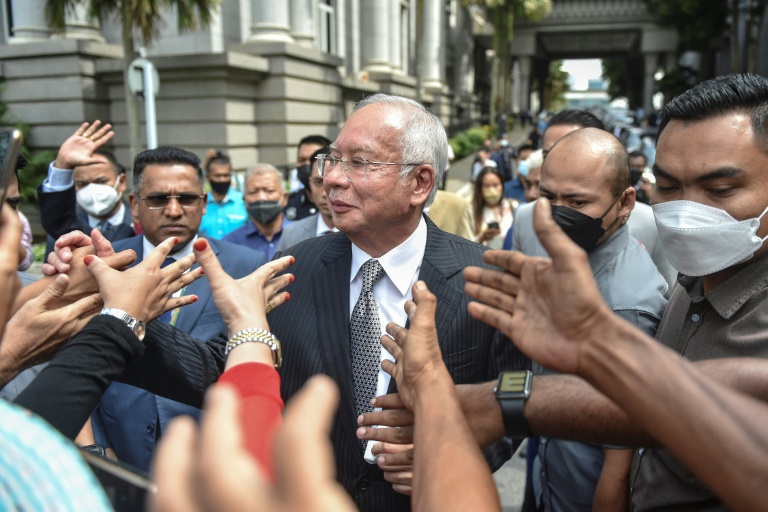
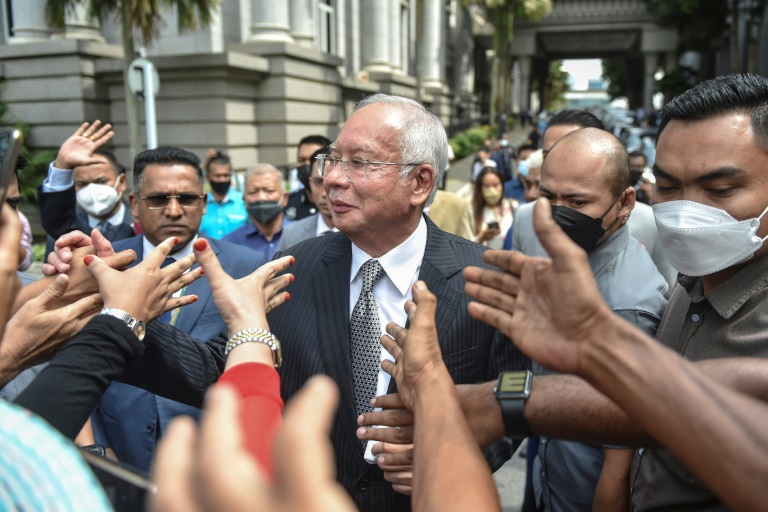
Outside the court, teary-eyed family members and supporters hugged each other.

Earlier in the day when Najib arrived in court, around 300 supporters mobbed his car chanting “bossku” — “my boss” in Malay — a rallying cry among his defenders.

Just before the verdict was read, Najib, who had said he received an unfair trial, made an impassioned plea asking for a two-month adjournment so he can adequately prepare for a defence.

During a break in the proceedings, he spoke to supporters, telling them “if I am guilty, please forgive me”.

– Barred from elections –

Najib is the UK-educated son of one of Malaysia’s founding fathers who had been groomed for the prime minister’s post from a young age.

The final ruling on the jail sentence also came four years after his long-ruling party’s shock election defeat in 2018, during which allegations he and his friends embezzled billions of dollars from state fund 1MDB were key campaign issues.

A lower court in July 2020 found Najib guilty of abuse of power, money laundering and criminal breach of trust over the transfer of 42 million ringgit ($10 million) from SRC International, a former unit of state fund 1MDB, to his personal bank account.

An appellate court in December denied his appeal, prompting him to go to the Federal Court for a final recourse.

Some analysts said the decision will likely derail any plans by Najib for a political comeback.

“Under Malaysian law, Najib cannot stand for this election and the next election (if found guilty),” James Chin, a professor of Asian studies at the University of Tasmania, told AFP before the verdict was announced.

“Obviously, his political career is gone.” 

There has been speculation that polls may be held this year, though elections are not due until September 2023.

But Oh Ei Sun, principal adviser for think-tank Pacific Research Center of Malaysia, said one way out for Najib is to get the king’s pardon.

“He could still apply for clemency (from the king),” he told AFP. “And if pardoned, as many expect, he could easily mount a comeback as his feudalistically minded supporters are numerous in number.”

Oh said, however, that the current Prime Minister Ismail Sabri Yaakob — who belongs to the same United Malays National Organisation party — must recommend a pardon.

Najib and his ruling party were voted out in 2018 following allegations of their involvement in a multibillion-dollar financial scandal at 1MDB.

He and his associates were accused of stealing billions of dollars from the country’s investment vehicle and spending it on everything from high-end real estate to pricey art.

Najib sent to jail after Malaysia top court upholds sentence in 1MDB scandal

Malaysia’s highest court Tuesday upheld former prime minister Najib Razak’s 12-year jail sentence for corruption in the 1MDB financial scandal, a decision analysts said could slam the door to a political comeback.

Najib’s daughter-in-law Nur Sharmila Shaheen said the family was told he was sent to Kajang Prison, located south of the capital Kuala Lumpur.

“My father-in-law asked us to take care of the family. He remained strong and calm,” she said.

Federal Court chief justice Maimun Tuan Mat, speaking on behalf of a five-judge panel, said the tribunal found Najib’s “complaints as contained in the petition of appeal devoid of any merit”.

“On the totality of the evidence, we find the conviction of the appellant on all seven charges safe. We also find that the sentence imposed is not manifestly excessive,” she added.

The appeals are “unanimously dismissed and the conviction and sentence are affirmed”, Maimun said.

The 69-year-old former prime minister looked somber and dejected, seated by his wife Rosmah and two children as the verdict was read.

Journalists who were in an adjacent room watching the proceedings through video link saw Najib surrounded by family members, friends and party mates before the connection was cut off.

Outside the court, teary-eyed family members and supporters hugged each other.

Earlier in the day when Najib arrived in court, around 300 supporters mobbed his car chanting “bossku” — “my boss” in Malay — a rallying cry among his defenders.

Just before the verdict was read, Najib, who had said he received an unfair trial, made an impassioned plea asking for a two-month adjournment so he can adequately prepare for a defence.

During a break in the proceedings, he spoke to supporters, telling them “if I am guilty, please forgive me”.

– Barred from elections –

Najib is the UK-educated son of one of Malaysia’s founding fathers who had been groomed for the prime minister’s post from a young age.

The final ruling on the jail sentence also came four years after his long-ruling party’s shock election defeat in 2018, during which allegations he and his friends embezzled billions of dollars from state fund 1MDB were key campaign issues.

A lower court in July 2020 found Najib guilty of abuse of power, money laundering and criminal breach of trust over the transfer of 42 million ringgit ($10 million) from SRC International, a former unit of state fund 1MDB, to his personal bank account.

An appellate court in December denied his appeal, prompting him to go to the Federal Court for a final recourse.

Some analysts said the decision will likely derail any plans by Najib for a political comeback.

“Under Malaysian law, Najib cannot stand for this election and the next election (if found guilty),” James Chin, a professor of Asian studies at the University of Tasmania, told AFP before the verdict was announced.

“Obviously, his political career is gone.” 

There has been speculation that polls may be held this year, though elections are not due until September 2023.

But Oh Ei Sun, principal adviser for think-tank Pacific Research Center of Malaysia, said one way out for Najib is to get the king’s pardon.

“He could still apply for clemency (from the king),” he told AFP. “And if pardoned, as many expect, he could easily mount a comeback as his feudalistically minded supporters are numerous in number.”

Oh said, however, that the current Prime Minister Ismail Sabri Yaakob — who belongs to the same United Malays National Organisation party — must recommend a pardon.

Najib and his ruling party were voted out in 2018 following allegations of their involvement in a multibillion-dollar financial scandal at 1MDB.

He and his associates were accused of stealing billions of dollars from the country’s investment vehicle and spending it on everything from high-end real estate to pricey art.

Storm forces Philippine schools to shut day after reopening

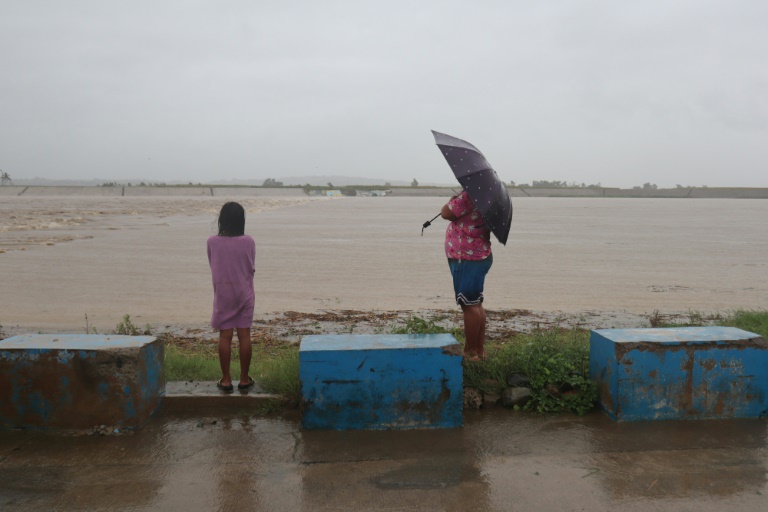
Schools were ordered shut across the northern Philippines Tuesday — a day after many resumed in-person learning for the first time since Covid-19 hit — as torrential rain and strong winds pounded the main island of the archipelago.

Severe tropical storm Ma-on struck the northeast coast of Luzon around mid-morning, raking the largely agricultural region with gusts of up to 185 kilometres (115 miles) an hour, the state weather service said.

Two people were injured by falling trees in the mountainous province of Cagayan where intense rain caused the main river and its tributaries to swell overnight, provincial disaster official Ruelie Rasping said.

“We’re currently being hit by strong winds and heavy rain. The Cagayan river is rising,” Rasping told AFP.

The provincial capital Tuguegarao was drenched with 98 millimetres (3.9 inches) of “torrential” rain over a three-hour period after the storm made landfall, an official at the state weather bureau told AFP.

Ma-on was expected to sweep in a northwest direction across the country and head out over the South China Sea late Tuesday or early Wednesday.

Some low-lying areas of the capital Manila were left in knee-deep floodwater, as the storm intensified the southwest monsoon.

President Ferdinand Marcos Jr suspended classes and work in government offices in the national capital region and surrounding provinces until Wednesday, his spokeswoman said.

It followed similar orders issued by provinces in Ma-on’s path.

The Philippines, ranked among the most vulnerable nations to the impacts of climate change, is hit by an average of 20 storms every year.

Ma-on was the first significant one since April when tropical storm Megi unleashed landslides and flooding that killed more than 200 people mostly on the central island of Leyte.

Ma-on struck a day after the Philippines reopened classrooms for face-to-face lessons, more than two years after the pandemic hit.

New silo collapse in blast-ravaged Beirut port: AFP

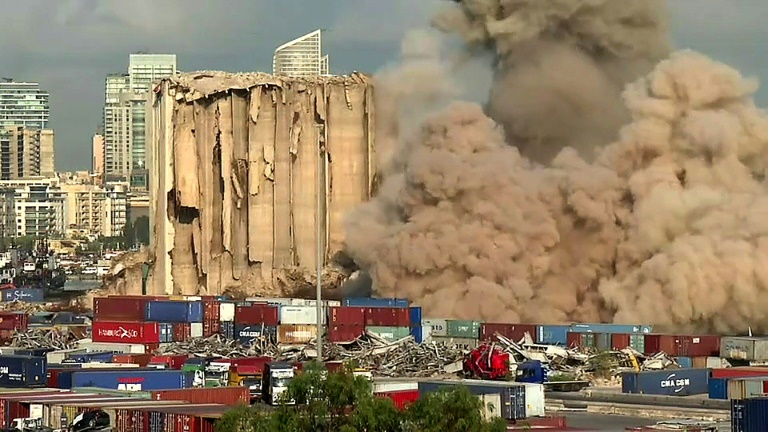
Eight more grain silos at Beirut port toppled Tuesday, succumbing to damage from a devastating 2020 explosion in the third such collapse in a month, AFP correspondents reported.

A cloud of dust rose over the port after the collapse, which brought down the last of the northern block of silos that was more heavily damaged in the blast and where a fire had been burning since last month.

The remaining southern block is more stable and not at imminent risk of collapse, said French civil engineer Emmanuel Durand, who has installed sensors on the silos.

The silos had absorbed much of the impact of the massive explosion of haphazardly stored ammonium nitrate fertiliser that killed more than 200 people on August 4, 2020.

Only 12 of the original 48 silos are still standing, all of them in the southern block, Durand said.

A fire has been burning in the silos for more than a month as remaining grain stocks ferment in the summer heat.

The complex has come to symbolise the tragic blast, but also state negligence and corruption, which many Lebanese blame for the explosion.

“We hold authorities responsible for what happened with the silos,” said Mariana Fodoulian, who lost her sister in the explosion.

“We must preserve the southern block of silos” as a memorial, Fodoulian said, echoing the demands of many blast victim relatives.

In April, the government ordered the silos’ demolition but the operation was put on hold, partly because of the objections of victims’ relatives.

Relatives had called for a sit-in near the port at 1400 GMT.

Public Works Minister Ali Hamieh announced last week that the government had agreed to reserve 25,000 square metres (270,000 square feet) of the port to build new grain silos.

This is larger than the current complex which occupies a space of 21,000 square metres (226,000 square feet).

Hamieh said funding would come from international donors as well as the government, which has been bankrupted by a crushing financial crisis.

str-jos/aya-ho/kir

After 'doomsday' floods, Sudanese fear worse to come

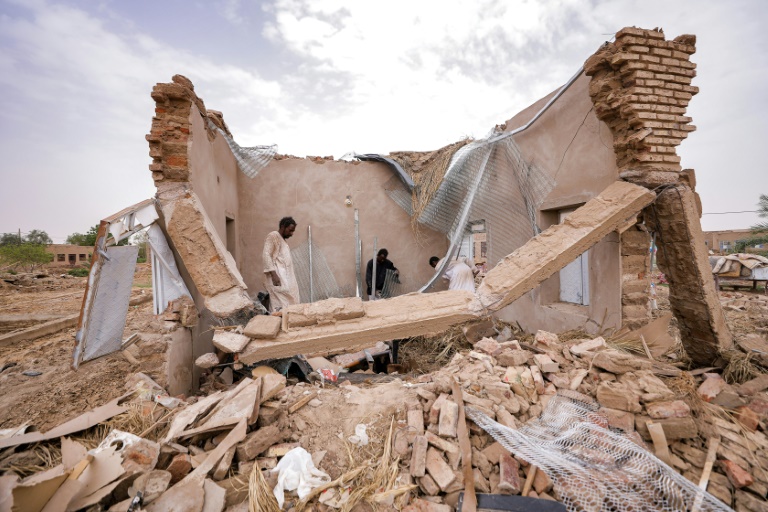
In the Sudanese village of Makaylab, Mohamed Tigani picked through the pile of rubble that was once his mud-brick home, after torrential rains sparked heavy floods that swept it away.

“It was like doomsday,” said Tigani, 53, from Makaylab in Sudan’s River Nile state, some 400 kilometres (250 miles) north of the capital Khartoum.

“We have not seen rains and floods like that in this area for years,” he said, scouring for anything to help build a shelter for his pregnant wife and child.

In Sudan, heavy rains usually fall between May and October, and the country faces severe flooding every year, wrecking property, infrastructure and crops.

This year, floods have killed at least 79 people and left thousands homeless, according to official figures.

On Sunday, Sudan declared a state of emergency due to floods in six states, including River Nile.

The crisis comes as Sudan reels from deepening political unrest and a spiralling economic crisis exacerbated by last year’s military coup led by army chief Abdel Fattah al-Burhan.

Almost a quarter of Sudan’s population — 11.7 million people — need food aid.

The United Nations Office for the Coordination of Humanitarian Affairs (OCHA), citing government figures, estimates over 146,000 people have been affected by flooding this year, with 31,500 homes damaged or destroyed.

But the UN warns that with more than a month of rain still expected, flooding could affect up to 460,000 people this year — far higher than the average 388,600 people affected between 2017 and 2021.

“Compared to the same period of 2021, the number of affected people and localities this year has doubled,” OCHA said Monday. 

The flooding is not just along the Nile River, with the war-ravaged western region of Darfur the hardest hit, where over 90,000 people are affected.

– ‘Only just starting’ –

Since the start of the devastating rainy season, thousands of Sudanese families have been left homeless, sheltering under tattered sacking.

“Everything is totally destroyed,” said Haidar Abdelrahman, sitting in the ruins of his home at Makaylab.

OCHA warns that “swollen rivers and pools of standing water increase the risk of water-borne disease such as cholera, acute watery diarrhoea, and malaria”.

Abdelrahman said he fears the floodwaters have also forced scorpions and snakes to move. “People are scared,” he said. 

“People are in serious need of basic aid against insects and mosquitoes,” said Seifeddine Soliman, 62, from Makaylab.

But health ministry official Yasser Hashem said the situation is “so far under control” with “spraying campaigns to prevent mosquitoes”.

Out of around 3,000 residents in Makaylab, they had been receiving about six or seven cases daily, mainly diarrhoea, he said.

Upstream, on the White Nile, neighbouring South Sudan has seen record rainfalls and overflowing rivers in recent years, forcing hundreds of thousands of people from their homes, with the UN saying the “extraordinary flooding” was linked to the effects of climate change.

The floods on the Nile in Sudan also come despite Ethiopia’s controversial construction upstream across the Blue Nile of a 145-metre (475-foot) tall hydroelectric dam.

Some experts, such as the US-based research and campaign group International Rivers, have warned that changing weather patterns due to climate change could result in irregular episodes of flooding and drought in the Nile drainage basin, the world’s longest river.

In Makaylab, many fear the devastating floods are only the beginning.

“The rainy season is just starting,” said Abdelrahman. “And there is no place for people to go.”

After 'doomsday' floods, Sudanese fear worse to come

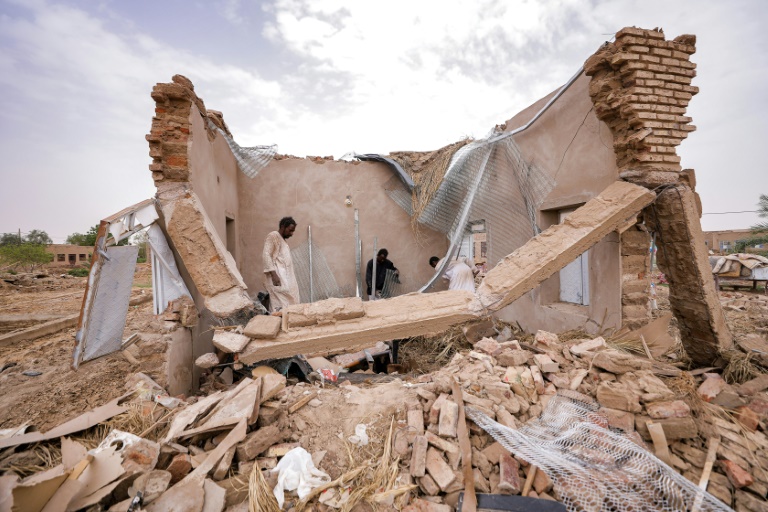
In the Sudanese village of Makaylab, Mohamed Tigani picked through the pile of rubble that was once his mud-brick home, after torrential rains sparked heavy floods that swept it away.

“It was like doomsday,” said Tigani, 53, from Makaylab in Sudan’s River Nile state, some 400 kilometres (250 miles) north of the capital Khartoum.

“We have not seen rains and floods like that in this area for years,” he said, scouring for anything to help build a shelter for his pregnant wife and child.

In Sudan, heavy rains usually fall between May and October, and the country faces severe flooding every year, wrecking property, infrastructure and crops.

This year, floods have killed at least 79 people and left thousands homeless, according to official figures.

On Sunday, Sudan declared a state of emergency due to floods in six states, including River Nile.

The crisis comes as Sudan reels from deepening political unrest and a spiralling economic crisis exacerbated by last year’s military coup led by army chief Abdel Fattah al-Burhan.

Almost a quarter of Sudan’s population — 11.7 million people — need food aid.

The United Nations Office for the Coordination of Humanitarian Affairs (OCHA), citing government figures, estimates over 146,000 people have been affected by flooding this year, with 31,500 homes damaged or destroyed.

But the UN warns that with more than a month of rain still expected, flooding could affect up to 460,000 people this year — far higher than the average 388,600 people affected between 2017 and 2021.

“Compared to the same period of 2021, the number of affected people and localities this year has doubled,” OCHA said Monday. 

The flooding is not just along the Nile River, with the war-ravaged western region of Darfur the hardest hit, where over 90,000 people are affected.

– ‘Only just starting’ –

Since the start of the devastating rainy season, thousands of Sudanese families have been left homeless, sheltering under tattered sacking.

“Everything is totally destroyed,” said Haidar Abdelrahman, sitting in the ruins of his home at Makaylab.

OCHA warns that “swollen rivers and pools of standing water increase the risk of water-borne disease such as cholera, acute watery diarrhoea, and malaria”.

Abdelrahman said he fears the floodwaters have also forced scorpions and snakes to move. “People are scared,” he said. 

“People are in serious need of basic aid against insects and mosquitoes,” said Seifeddine Soliman, 62, from Makaylab.

But health ministry official Yasser Hashem said the situation is “so far under control” with “spraying campaigns to prevent mosquitoes”.

Out of around 3,000 residents in Makaylab, they had been receiving about six or seven cases daily, mainly diarrhoea, he said.

Upstream, on the White Nile, neighbouring South Sudan has seen record rainfalls and overflowing rivers in recent years, forcing hundreds of thousands of people from their homes, with the UN saying the “extraordinary flooding” was linked to the effects of climate change.

The floods on the Nile in Sudan also come despite Ethiopia’s controversial construction upstream across the Blue Nile of a 145-metre (475-foot) tall hydroelectric dam.

Some experts, such as the US-based research and campaign group International Rivers, have warned that changing weather patterns due to climate change could result in irregular episodes of flooding and drought in the Nile drainage basin, the world’s longest river.

In Makaylab, many fear the devastating floods are only the beginning.

“The rainy season is just starting,” said Abdelrahman. “And there is no place for people to go.”

UN split over ban on Taliban officials' travel

Members of the United Nations Security Council remained divided Monday over whether to exempt some of Afghanistan’s Taliban officials from a travel ban, diplomatic sources said.

Under a 2011 Security Council resolution, 135 Taliban leaders are subject to a sanctions regime that includes asset freezes and travel bans.

Thirteen of them benefited from an exemption from the travel ban, renewed regularly, to allow them to meet officials from other countries abroad. 

But this exemption ended last Friday, after Ireland objected to its automatic renewal for another month.

In June, the Sanctions Committee in charge of Afghanistan, comprised of the Security Council’s 15 members, had already removed from the exemptions list two Taliban ministers responsible for education, in retaliation for the drastic reduction in the rights of women and girls that was imposed by the hardline Islamist regime.

Several Western countries would like to further reduce the list, according to diplomatic sources.

They highlight the failure to respect the commitments to uphold human rights or fight terrorism that were made by the Taliban when they returned to power a year ago.

Early this month the United States announced the killing of Al-Qaeda leader Ayman al-Zawahiri in a drone strike on Kabul, calling into question the Taliban’s promise not to harbor militant groups.

China and Russia, however, supported a regular extension of exemptions list.

“These exemptions are still just as necessary,” the Chinese presidency of the Security Council said last week, deeming it “counterproductive” to link human rights to travel issues for Taliban officials. 

Since last week, and again Monday, several compromise proposals that would more or less shrink the list of officials concerned, or the number of authorized destinations, have been rejected on both sides, according to diplomatic sources.

Discussions are expected to continue.

Pending a possible decision, none of the Taliban officials on the sanctions list can travel.

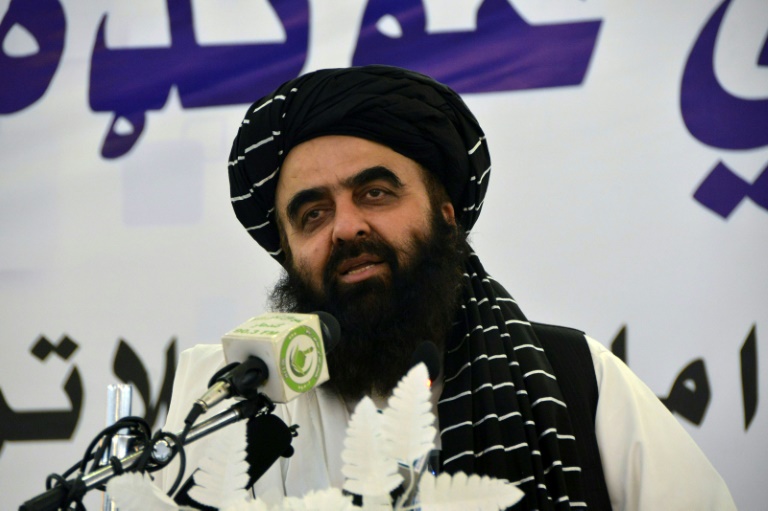
That was of particular concern to the Taliban’s foreign minister, Amir Khan Muttaqi, who has visited Qatar several times in recent months for diplomatic discussions and who was among the 13 exemptions. 

In a statement posted Saturday on Twitter, a foreign ministry spokesman called on the Security Council “not to use sanctions as pressure tool” and said all sanctions against Taliban officials should be lifted.

“If the travel ban is extended, it will create distance instead of promoting dialogue & engagement, an outcome that must be prevented,” the spokesman said.

Close Bitnami banner
Bitnami