World

Sri Lanka faces international censure over arrests

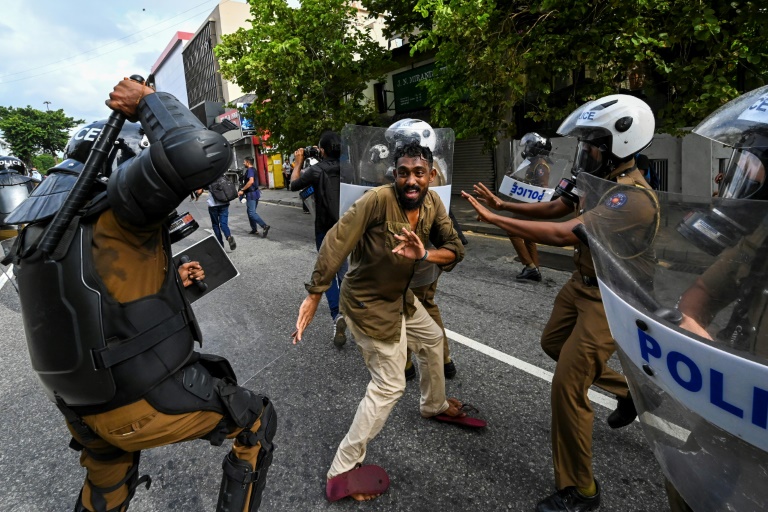
Sri Lanka’s new government came under international censure Monday over the use of tough anti-terror laws to detain protesters who forced Gotabaya Rajapaksa to step down from the presidency last month.

Three student activists arrested last week during the first anti-government rally after the end of a state of emergency were being held under the Prevention of Terrorism Act (PTA), authorities said late Sunday, including student leader Wasantha Mudalige.

The PTA allows suspects to be detained for 90 days without judicial review.

“Using laws that don’t conform with international human rights standards – like the PTA – erodes democracy in Sri Lanka,” said US ambassador to Sri Lanka Julie Chung. 

“We encourage the government to uphold the rights of the people to express their views,” she tweeted.

The European Union said it was “concerned” by the development, with the EU office in Colombo tweeting that there had been a “de-facto moratorium of the use of #PTA”.

Another 13 demonstrators arrested at Thursday’s protest have either been released on bail or are being held under normal procedures.

UK-based rights group Amnesty International said the use of anti-terror laws against peaceful protesters was a sign authorities were “unwilling to withstand any form of criticism and are systematically stifling dissenting voices”.

“Charges of terrorism do not commensurate with any offences the protesters are alleged to have committed,” said its South Asia Director Yamini Mishra.

“Time and time again, the Act has been used as a tool to silence government critics, journalists and minorities.”

An unprecedented economic collapse sparked often huge anti-government rallies in Sri Lanka this year, after the country ran out of foreign currency to finance imports, leaving its 22 million people enduring chronic shortages of essential goods, rolling blackouts and spiralling inflation.

The government imposed a state of emergency that gave security forces sweeping detention powers, but the ordinance lapsed last week.

Sri Lanka defaulted on its $51 billion foreign debt in mid-April and is in talks with the International Monetary Fund for a possible bailout.
Markets mostly drop as traders mull Fed outlook, gas price spike

World stocks mostly sank Monday and the dollar rallied on concern the Federal Reserve will stick to its interest rate-hiking plans to combat runaway inflation.

Eurozone equities also tanked as spiking natural gas prices sparked fears that winter energy shortages could spark recession, helping push the euro back under parity against the greenback.

Oil dipped on speculation over an Iran nuclear deal that could ease a supply crunch caused by producer Russia’s invasion of Ukraine.

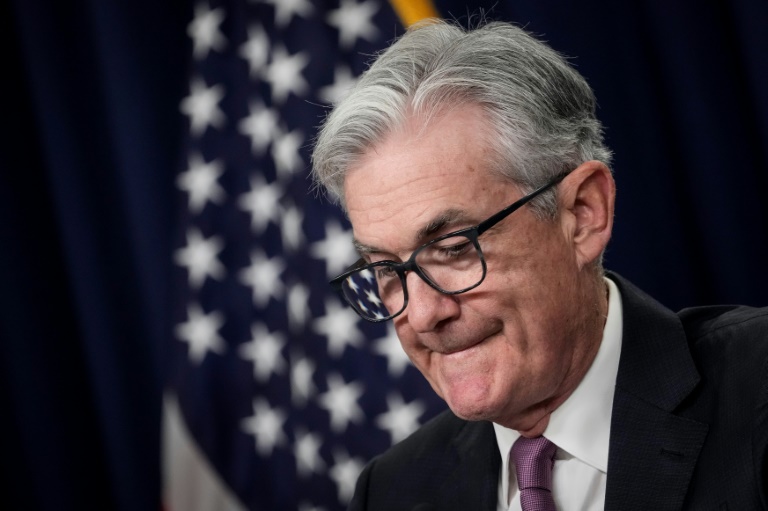
All eyes are on this week’s symposium in Jackson Hole, Wyoming, where Fed boss Jerome Powell will deliver a speech that traders will follow for an idea about the US central bank’s next moves.

– ‘Critical moment’ –

Stocks “began Monday in downbeat mood ahead of what could prove to be a critical moment for markets at the end of this week”, said AJ Bell investment director Russ Mould.

“The Jackson Hole summit of central bankers and finance ministers is widely expected to see Powell take to the floor — and puncture optimism which has built up over hopes the Fed may be nearing the point at which it pivots away from rate hikes.”

A dip in price rises and signs of economic slowdown had raised hopes policymakers would ease up — and possibly cut rates next year — after two successive, 75-basis-point hikes, helping equities rally globally.

But that optimism has slowly been eroded in recent weeks as Fed officials, including Powell, have warned that the battle against inflation was far from won, particularly as the jobs market remained resilient.

The euro is under additional pressure after Russia’s Gazprom said late Friday that the Nord Stream pipeline would be closed for maintenance at the end of the month, cutting Europe’s daily gas deliveries.

As a result, Europe’s Dutch TTF Gas Futures contract soared on Monday to almost 293 euros per megawatt hour, not far from record highs hit after Russia launched its assault on Ukraine.

– ‘Recessionary risk’ –

“European gas prices pushed higher again … on renewed concerns about flows through Nord Stream 1,” Rabobank analyst Jane Foley told AFP.

“This focussed attention on recessionary risk for the eurozone. A clear break of parity risks a moves towards $0.95,” she added.

In early morning London deals, the euro dipped as low as $0.9990 before clawing its way back above the psychological barrier.

Surging energy prices have this year driven inflation to 40-year peaks in nations including Britain and the United States, in turn prompting tighter monetary policy.

US banking group Citi has forecast that UK inflation would peak at 18.6 percent next January on the back of rocketing domestic energy prices.

Before the weekend, all three main Wall Street indices had fallen and Asia mostly followed suit on Monday.

However, Shanghai stocks rose after China’s central bank cut prime loan rates as it tries to bolster the world’s second-biggest economy, which has been ravaged by lockdowns as part of a zero-Covid strategy.

The prospect of more US hikes also sent the dollar rallying versus the yen, and it is nearing the 140 yen mark for the first time in 24 years.

– Key figures at around 1100 GMT –

London – FTSE 100: DOWN 0.3 percent at 7,530.80 points

Frankfurt – DAX: DOWN 1.6 percent at 13,327.85 

Paris – CAC 40: DOWN 1.2 percent at 6,418.13

EURO STOXX 50: DOWN 1.3 percent at 3,680.84

Tokyo – Nikkei 225: DOWN 0.5 percent at 28,794.50 (close)

Hong Kong – Hang Seng Index: DOWN 0.6 percent at 19,656.98 (close)

Shanghai – Composite: UP 0.6 percent at 3,277.79 (close)

New York – Dow: DOWN 0.9 percent at 33,706.74 points (close)

Euro/dollar: DOWN at $1.0009 from $1.0037 Friday

Pound/dollar: DOWN at $1.1808 from $1.1829

Euro/pound: DOWN at 84.76 pence from 84.86 pence

Dollar/yen: DOWN at 136.91 yen from 136.97 yen

West Texas Intermediate: DOWN 0.1 percent at $90.68 per barrel

Brent North Sea crude: DOWN 0.2 percent at $96.53

Kenya's Odinga mounts court challenge to presidential poll result

Kenya’s defeated presidential candidate Raila Odinga filed a petition to the country’s top court on Monday challenging the result of the August 9 election that handed victory to his rival William Ruto.

Odinga, a veteran opposition leader who ran with the backing of President Uhuru Kenyatta and the ruling party, has rejected the outcome of the poll, branding it a “travesty.”

He narrowly lost to Ruto by around 230,000 votes — less than two percentage points.

The 77-year-old politician filed a physical copy of the petition with barely an hour to go before the court’s 2 pm (1100 GMT) deadline for accepting the case. An online copy was filed earlier in the day, according to a member of his legal team.

Hundreds of supporters cheered as dozens of boxes of evidence were unloaded from a truck outside the court.

“We have hopes that we have made a good case and will win,” Daniel Maanzo, a member of Odinga’s legal team, told AFP.

Although polling day passed off peacefully, the announcement of the results a week ago sparked angry protests in some Odinga strongholds and there are fears that a drawn-out dispute may lead to violence in a country with a history of post-poll unrest.

Since 2002, every presidential election in Kenya has triggered a dispute, with this year’s outcome also causing a rift within the Independent Electoral and Boundaries Commission (IEBC) which oversaw the poll.

Odinga, who was making his fifth bid for the top job, said last week that the figures announced by the IEBC were “null and void and must be quashed by a court of law”.

According to a copy of the 72-page petition seen by AFP, Odinga’s team alleges that IEBC chairman Wafula Chebukati failed to tally around 140,000 votes.

As a result, Ruto “did not meet the constitutional threshold of 50% plus 1 of the valid votes cast” — a requirement for him to be declared the winner.

Judges now have 14 days to issue a ruling. If they order an annulment, a new vote must be held within 60 days.

– ‘We want justice’ –

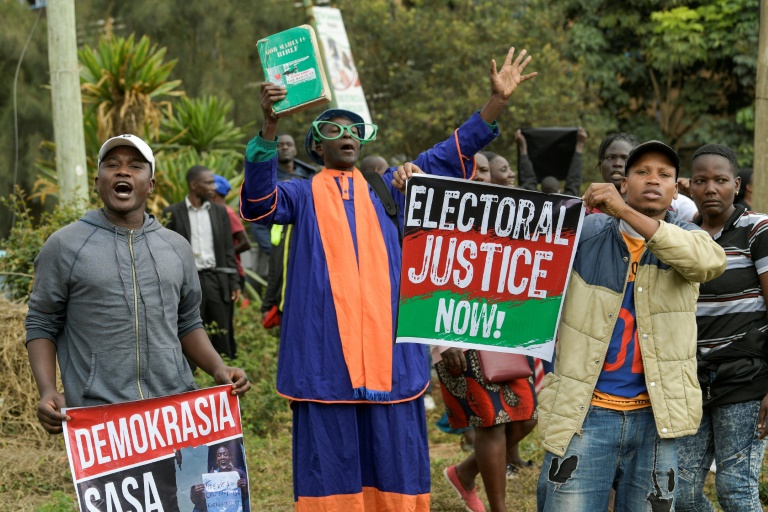
Odinga supporters began gathering outside the court hours before his arrival, blowing whistles and waving placards reading “Electoral Justice Now!” and “We want justice now”. 

“Odinga must win so that we get the 6,000 shillings ($50) promised in his manifesto,” said one man, wearing a crown made with plants who was referring to a monthly cash handout for vulnerable households.

Another man — armed with a Bible and wearing huge green glasses — knelt down in prayer as police guarded the court premises.

Judges are also expected to consider other challenges against the result, with a court clerk telling reporters the tribunal had already received two petitions filed by a voter and a non-profit organisation.

The IEBC was under heavy pressure to deliver a clean vote after facing sharp criticism over its handling of the August 2017 election, which was also challenged by Odinga.

The court annulled that election in a first for Africa and ordered a re-run which was boycotted by Odinga. Dozens of people died during a police crackdown on protests.

In a shock development shortly before the results of this year’s poll were announced, four of the IEBC’s seven commissioners accused chairman Chebukati of running an “opaque” operation and later said the numbers did not add up.

Chebukati dismissed the claims, insisting he had carried out his duties according to the law of the land despite “intimidation and harassment”.

– Divided opinion –

Legal experts are divided on whether Chebukati needed the commissioners’ backing to announce the results, with constitutional lawyer Charles Kanjama telling AFP there was “some ambiguity” surrounding the issue.

Odinga has previously said he was cheated of victory in the 2007, 2013 and 2017 elections, and the poll’s aftermath is being keenly watched as a test of democratic maturity in the East African powerhouse.

On the campaign trail, both frontrunners pledged to resolve any disputes in court rather than on the streets.

Since the results were declared, Odinga has commended his supporters for “remaining calm” while Ruto has taken a conciliatory tone and promised to “work with all leaders”.

Kenya’s worst electoral violence occurred after the 2007 vote, when more than 1,100 people died in politically motivated clashes involving rival tribes.

If the Supreme Court upholds the results, Ruto will become Kenya’s fifth president since independence from Britain in 1963, taking over the reins of a country battling surging inflation, high unemployment and a crippling drought.

Pakistan opposition warns Khan arrest would be 'red line'

Pakistan opposition leaders warned Monday that authorities would cross a “red line” if they arrested former prime minister Imran Khan after he was reported under the anti-terrorism act for comments he made about the judiciary.

Since being ousted by a vote of no confidence in April, Khan has held mass rallies across the country, warning state institutions including the military not to back the coalition government led by his long-time political rival Shehbaz Sharif.

Hundreds of people gathered outside Khan’s house Monday — ostensibly to prevent police from reaching him — but the former leader has been fighting a raft of charges for months and has so far not been arrested.

“Wherever you are, reach Bani Gala today and show solidarity with Imran Khan,” tweeted former information minister Fawad Chaudhry, referring to Khan’s home.

“Imran Khan is our red line.”

A First Information Report was filed with police Sunday — the first step of a process that could lead to formal charges and arrest.

Lawyers for Khan preemptively applied for pre-arrest bail at the Islamabad High Court Monday, which was granted until at least Thursday.

– ‘Frivolous’ accusations –

There was a low-key police presence outside Khan’s residence Monday, with around 500 party supporters gathered in the affluent suburb of Bani Gala.

Muhammad Ayub said he had travelled overnight from Peshawar in the northwest to show support for Khan.

“We will protest and will block roads if Khan is arrested,” he told AFP.

In a statement, Khan’s Pakistan Tehreek-e-Insaf party (PTI) said the latest accusations against him were “frivolous”.

“We have serious reservations on this politically motivated move which leads towards further instability in the country,” it said.

On Saturday he criticised a magistrate responsible for keeping a PTI official in police custody, after party leaders say he was tortured in detention.

Khan’s main goal is an early general election — the next one must be held before October next year — but the government has shown no sign of wanting to go to the polls as it grapples with major economic problems.

Khan swept into power in 2018 thanks to an electorate weary of the dynastic politics of the country’s two major parties, with the former cricket star promising to sweep away decades of entrenched corruption and cronyism. 

But under his rule the country’s economy went into free fall, and the International Monetary Fund suspended a $6 billion loan programme that the new government has only just gotten back on track.

Khan also lost the support of the military.

Political Analyst Hassan Askari Rizvi told AFP that filing the latest case against Khan was not symbolic, but rather a genuine attempt to stifle him.

“The government is using the state institutions to malign the opposition,” he said, adding ordinary Pakistanis were being hurt by the political wrangling.

“The only thing left for the ruling party and the opposition is to malign each other. In the current situation, the real priority should be the economy so that the common man can get some relief.”

Over the weekend, Pakistan’s media watchdog banned television channels from broadcasting live addresses by Khan, saying he was “spreading hate speech”.

“His provocative statements against state institutions and officers… is likely to disturb public peace and tranquillity,” the Pakistan Electronic Media Regulatory Authority said.

Hong Kong media tycoon Jimmy Lai to face no-jury trial

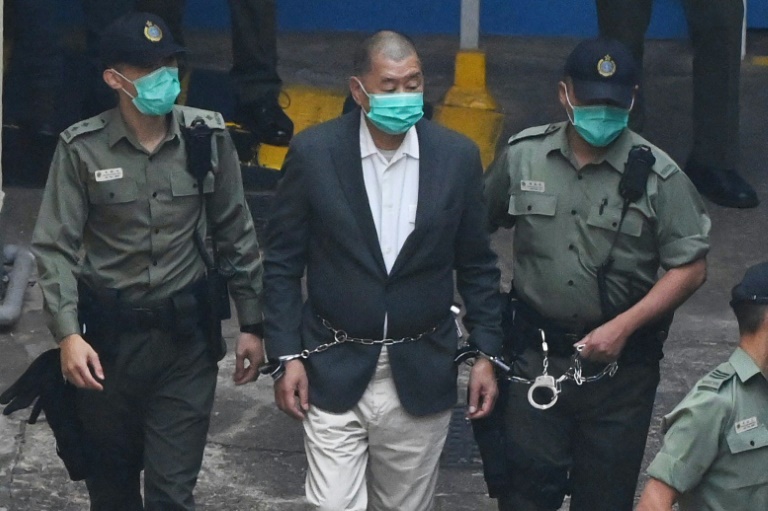
Jailed Hong Kong media tycoon Jimmy Lai will face a no-jury court when he goes on trial under a new Beijing-imposed national security law, AFP has learned.

Hong Kong Secretary for Justice Paul Lam has ordered the trial to be heard by three judges handpicked by the government to try national security cases in the latest move away from the city’s trial-by-jury tradition.

A copy of the order, seen by AFP, cited the “involvement of foreign elements” in the case, the “personal safety of jurors and their family members” and the “risk of perverting the course of justice if the trial is conducted with a jury”.

Trial by jury has been used by Hong Kong’s common law legal system for 177 years but legislation imposed by China in 2020 to curb dissent allows cases to be heard by dedicated national security judges.

So far authorities have rejected jury trials for all three major cases that have made it to the High Court, where defendants can face up to life in prison.

Lai, 74, is one of Hong Kong’s best known democracy activists and is openly loathed by Beijing.

For years his Apple Daily tabloid newspaper was scathing in its criticism of China’s Communist Party and openly supportive of democracy.

It collapsed last year after its funds were frozen under the new security law and many of its senior staff, including Lai, were charged with “collusion with foreign forces”, one of the new national security crimes.

On Monday, prosecutor Anthony Chau informed the court that six Apple Daily executives have indicated that they plan to plead guilty.

A guilty plea usually entitles defendants to a sentence reduction. 

Two other activists linked to the case have already pleaded guitly and been convicted on the same charge.

Lai, who is currently serving a protest-related sentence, plans to plead not guilty, meaning a full trial is expected towards the end of the year or early next year, the court heard.

Last week AFP reported that the largest national security trial to date — that of 47 prominent democracy activists — will also be heard without a jury, citing a similar order from the justice ministry.

China says its security law has restored stability after huge and sometimes violent democracy protests rocked Hong Kong in 2019.

Critics says it has criminalised dissent and eviserated Hong Kong’s freedoms.

Last month a UN watchdog said the “overly broad interpretation of and arbitrary application” of the security law had led to deteriorating freedoms and it called for the law to be repealed.

Poaching, horn trade declining but rhinos still threatened

Poaching and the illegal trade in horns have fallen in recent years but remain grave threats for the rhino’s survival, the International Union for Conservation of Nature (IUCN) said Monday.

The Switzerland-based body said 2,707 rhinos were poached in Africa between 2018 and 2021, of which 90 percent were killed in South Africa, mainly in the Kruger National Park.

South Africa is home to nearly 80 percent of the world’s rhinos.

“Rhino poaching rates in Africa have continued to decline from a peak of 5.3 percent of the total population in 2015 to 2.3 percent in 2021,” it said in a report. 

“The overall decline in poaching of rhinos is encouraging, yet this remains an acute threat to the survival of these iconic animals,” said Sam Ferreira, Scientific Officer with the IUCN SSC African Rhino Specialist Group.

The IUCN said 2020 was an abnormal year for rhino poaching with Covid confinement and curbs on trade and movement.

“Global lockdowns and restrictions due to the Covid-19 pandemic saw several African countries experience dramatically reduced poaching rates in 2020 compared to previous years. 

“South Africa lost 394 rhinos to poaching in 2020, while Kenya recorded no rhino poaching that year. However, as COVID-19 travel restrictions lifted, some range states reported new increases in poaching activities – for example, South Africa reported 451 and Kenya six poached rhinos in 2021,” it said.

“These numbers are still significantly lower than during the peak in 2015, when South Africa alone lost 1175 rhinos to poaching.”

The population of rhinos in Africa has fallen by 1.6 percent annually, from 23,562 in 2018 to 22,137 at the end of last year.

IUCN said the number of white rhinos — which it classifies as vulnerable on its Red List of Threatened Species — declined by almost 12 percent from 18,067 to 15,942 during this period.

However, the number of black rhinos — deemed critically endangered by the body — rose by 12 percent to 6,195.

“To support the growth of rhino numbers, it is essential to continue active population management and anti-poaching activities for all subspecies across different range states,” the IUCN said.

Alongside the decline in poaching, data analysed for range and consumer states suggests that, on average, between 575 and 923 rhino horns entered illegal trade markets each year between 2018 and 2020, compared to approximately 2,378 per year between 2016 and 2017.

– 2020 an ‘abnormal’ year –

However, in 2019, before the COVID-19 outbreak, the reported seized weight of illegal rhino specimens reached its highest point of the decade, perhaps due to increased regulations and law enforcement efforts.

“2020 did represent an abnormal year with low levels of reported illegal activity, law enforcement, and government reporting,” said Sabri Zain, TRAFFIC Director of Policy. 

IUCN said the numbers of the one-horned rhino, found mainly in India and Nepal, and the critically endangered Javan rhino had increased since 2017.

“Thanks to conservation efforts including strengthened law enforcement, the number of greater one-horned rhinos in India and Nepal increased from an estimated 3,588 in 2018 to 4,014 at the end of 2021, while the total population of Javan rhinos increased from between 65 and 68 individuals in 2018 to 76 at the end of 2021,” it said.

But the number of Sumatran rhinos fell to an estimated 34 from 47 in 2021, compared with 40 to 78 individuals in 2018.

The IUCN classifies the Sumatran rhino, the smallest of all rhino species, as critically endangered. 

The World Wide Fund for Nature estimates fewer than 80 Sumatran rhinos remain in the world, mainly on the Indonesian island of Sumatra and Borneo.

The IUCN report said 11 rhino poaching incidents were recorded in Asia — 10 in India and one in Nepal —  since the beginning of 2018, all of which involved greater one-horned rhinos. 

“Detection of carcasses in dense rainforests remains a challenge, and there were no reports of illegal killings of Sumatran rhinos despite the substantial population declines recorded,” it added.

Bad guys turn good in China 'Minions' movie ending

What’s small, yellow, loves bananas and promotes the rule of law? A Minion, at least according to an edited version of the latest animated film featuring supervillain Gru and his army of tiny sidekicks being screened in China. 

The fifth instalment of the lucrative “Despicable Me” franchise, “Minions: The Rise of Gru”, premiered in China this month, several weeks after the film opened in United States cinemas.

But while the international version of the kung fu-filled family-friendly romp set in 1970s San Francisco tells the story of how the dastardly Gru cut his teeth as a tween criminal, filmgoers in China are treated to an alternative ending in which the good guys win.

A series of subtitled still images inserted into the credits sequence on mainland Chinese screens reassures audiences that police catch Gru’s law-breaking mentor Wild Knuckles and lock him up for 20 years after a failed heist.

International viewers simply see Knuckles give police the slip by faking his death earlier in the film’s concluding scenes, but in the Chinese version he puts his con artist skills to positive use in prison, where he follows his “love of acting” and sets up a theatrical troupe.

As for Gru, he “eventually became one of the good guys”, devoted to raising his family, the Chinese ending says.

It is not the first time a popular foreign film has been altered for cinemas in China, where the entertainment industry faces some of the world’s strictest censorship rules and is tasked with promoting “healthy” values.

David Fincher’s 1999 cult classic “Fight Club” starring Brad Pitt and Edward Norton was given similar treatment when Chinese streaming platform Tencent Video in January uploaded a version where police shut down the protagonist’s plan to bring down modern civilisation.

And the highly anticipated return of US sitcom “Friends” to Chinese streaming platforms in February prompted fury among fans after viewers noticed a LGBTQ plotline was cut.

It is unclear if the “Minions” ending was altered due to censors’ demands or if producers considered it a more palatable conclusion for the Chinese market.

Universal did not immediately respond to AFP’s request for comment.

Social media reaction to the Chinese “Minions” ending was mixed, with one person on the Twitter-like Weibo social media platform saying they had gone to the cinema specifically to see the new ending but was disappointed that it was “just subtitles”.

Other fans were upset by the discontinuity between young Gru’s virtuous transformation in the new film, a prequel, and his continued villainous behaviour in the other films, set in the present day.

“We can only say that the Gru of the main films lives in another parallel Minion universe,” one Weibo user complained.

Shanghai's Bund to go dark as China heatwave prompts power cuts

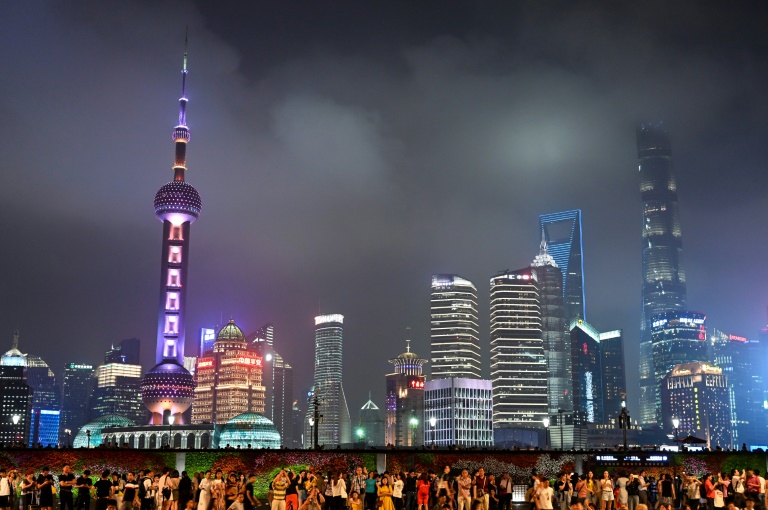
Shanghai will switch off decorative lights along its famed Bund riverfront for two days from Monday, city authorities said, in response to a nationwide heatwave that has sent power demands soaring.

Multiple provinces have announced power cuts to cope with a surge in demand, driven partly by people cranking up the air conditioning to cope with temperatures as high as 45 degrees Celsius (113 degrees Fahrenheit).

China has been hit by extreme weather this summer, including record temperatures, flash floods and droughts — phenomena that scientists have warned are becoming more frequent and intense due to climate change.

To save power, Shanghai authorities said in a notice Sunday that they would switch off “landscape lighting” at the Bund, the city’s most famous landmark.

Ornamental lights, billboards and video screens on both sides of the Huangpu River would be turned off on Monday and Tuesday, according to the notice.

The heatwave has reduced stretches of the Yangtze River, China’s most vital inland waterway, to unprecedented drought levels, according to official data.

That has resulted in high pressure on hydroelectric plants that supply power to some of the country’s key economic zones.

In the southwestern megacity of Chongqing, home to 31 million, authorities on Monday declared that all shopping malls must only operate between 4:00pm and 9:00pm daily to cut power costs until the “temperature and supply-demand situation” changes.

The city last week announced industrial power cuts lasting until Wednesday and reduced scenic lighting at tourist attractions.

In neighbouring Sichuan, authorities on Sunday extended industrial power cuts and activated their highest level of emergency response to deal with the heatwave.

“Since July this year, the province has faced the most extreme high temperatures, the lowest rainfall in the corresponding period in history… (and) the highest power load in history,” local authorities said.

Some of the world’s biggest automakers — including Japanese giant Toyota and Elon Musk’s Tesla — operate factories in Sichuan.

The province is also home to parts manufacturers that are crucial to global auto supply chains.

Many major factories were forced to halt work because of the Sichuan power cuts, which were supposed to end on Saturday but were extended to Thursday, Chinese news outlet Caixin reported.

Analysts have warned that Sichuan’s power woes could have ripple effects on the wider Chinese economy and international supply chains.

Hydropower generated in the province supplies domestic consumers and factories, but also industrial powerhouse provinces Jiangsu and Zhejiang.

Shanghai's Bund to go dark as China heatwave prompts power cuts

Shanghai will switch off decorative lights along its famed Bund riverfront for two days from Monday, city authorities said, in response to a nationwide heatwave that has sent power demands soaring.

Multiple provinces have announced power cuts to cope with a surge in demand, driven partly by people cranking up the air conditioning to cope with temperatures as high as 45 degrees Celsius (113 degrees Fahrenheit).

China has been hit by extreme weather this summer, including record temperatures, flash floods and droughts — phenomena that scientists have warned are becoming more frequent and intense due to climate change.

To save power, Shanghai authorities said in a notice Sunday that they would switch off “landscape lighting” at the Bund, the city’s most famous landmark.

Ornamental lights, billboards and video screens on both sides of the Huangpu River would be turned off on Monday and Tuesday, according to the notice.

The heatwave has reduced stretches of the Yangtze River, China’s most vital inland waterway, to unprecedented drought levels, according to official data.

That has resulted in high pressure on hydroelectric plants that supply power to some of the country’s key economic zones.

In the southwestern megacity of Chongqing, home to 31 million, authorities on Monday declared that all shopping malls must only operate between 4:00pm and 9:00pm daily to cut power costs until the “temperature and supply-demand situation” changes.

The city last week announced industrial power cuts lasting until Wednesday and reduced scenic lighting at tourist attractions.

In neighbouring Sichuan, authorities on Sunday extended industrial power cuts and activated their highest level of emergency response to deal with the heatwave.

“Since July this year, the province has faced the most extreme high temperatures, the lowest rainfall in the corresponding period in history… (and) the highest power load in history,” local authorities said.

Some of the world’s biggest automakers — including Japanese giant Toyota and Elon Musk’s Tesla — operate factories in Sichuan.

The province is also home to parts manufacturers that are crucial to global auto supply chains.

Many major factories were forced to halt work because of the Sichuan power cuts, which were supposed to end on Saturday but were extended to Thursday, Chinese news outlet Caixin reported.

Analysts have warned that Sichuan’s power woes could have ripple effects on the wider Chinese economy and international supply chains.

Hydropower generated in the province supplies domestic consumers and factories, but also industrial powerhouse provinces Jiangsu and Zhejiang.

Shanghai's Bund to go dark as China heatwave prompts power cuts

Shanghai will switch off decorative lights along its famed Bund riverfront for two days from Monday, city authorities said, in response to a nationwide heatwave that has sent power demands soaring.

Multiple provinces have announced power cuts to cope with a surge in demand, driven partly by people cranking up the air conditioning to cope with temperatures as high as 45 degrees Celsius (113 degrees Fahrenheit).

China has been hit by extreme weather this summer, including record temperatures, flash floods and droughts — phenomena that scientists have warned are becoming more frequent and intense due to climate change.

To save power, Shanghai authorities said in a notice Sunday that they would switch off “landscape lighting” at the Bund, the city’s most famous landmark.

Ornamental lights, billboards and video screens on both sides of the Huangpu River would be turned off on Monday and Tuesday, according to the notice.

The heatwave has reduced stretches of the Yangtze River, China’s most vital inland waterway, to unprecedented drought levels, according to official data.

That has resulted in high pressure on hydroelectric plants that supply power to some of the country’s key economic zones.

In the southwestern megacity of Chongqing, home to 31 million, authorities on Monday declared that all shopping malls must only operate between 4:00pm and 9:00pm daily to cut power costs until the “temperature and supply-demand situation” changes.

The city last week announced industrial power cuts lasting until Wednesday and reduced scenic lighting at tourist attractions.

In neighbouring Sichuan, authorities on Sunday extended industrial power cuts and activated their highest level of emergency response to deal with the heatwave.

“Since July this year, the province has faced the most extreme high temperatures, the lowest rainfall in the corresponding period in history… (and) the highest power load in history,” local authorities said.

Some of the world’s biggest automakers — including Japanese giant Toyota and Elon Musk’s Tesla — operate factories in Sichuan.

The province is also home to parts manufacturers that are crucial to global auto supply chains.

Many major factories were forced to halt work because of the Sichuan power cuts, which were supposed to end on Saturday but were extended to Thursday, Chinese news outlet Caixin reported.

Analysts have warned that Sichuan’s power woes could have ripple effects on the wider Chinese economy and international supply chains.

Hydropower generated in the province supplies domestic consumers and factories, but also industrial powerhouse provinces Jiangsu and Zhejiang.

Close Bitnami banner
Bitnami