World

Biden signs major semiconductors investment bill to compete against China

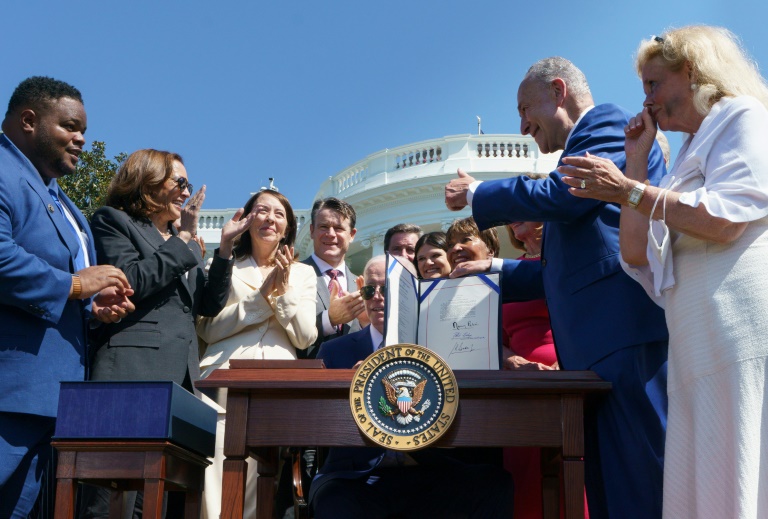
President Joe Biden signed into law Tuesday a multibillion dollar bill boosting domestic semiconductor and other high-tech manufacturing sectors that US leaders fear risk being dominated by rival China.

The Chips and Science Act includes around $52 billion to promote production of microchips, the tiny but powerful and relatively hard-to-make components at the heart of almost every modern piece of machinery.

Tens of billions of dollars more are allocated for scientific research and development.

The White House says the government commitment to bolstering high-tech industries is already drawing in large-scale private investors, with some $50 billion in new semiconductor investment alone. The lion’s share of that is a plan announced by US firm Micron to put $40 billion into domestic expansion by 2030.

Biden said at a White House speech that the cash injection from the Chips Act will help “win the economic competition in the 21st century.”

Entrepreneurs are “the reason why I’m so optimistic about the future of our country,” he said, and “the Chips and Science Act supercharges our efforts to make semiconductors here in America.”

One of the Democrat’s key themes since taking office has been the need to revamp US leadership in cutting-edge innovation and rebuild the homegrown industrial base in the face of China’s mammoth state-backed investments.

Semiconductors are of particular concern because they are vital to everything from washing machines to sophisticated weapons and nearly all are made abroad.

Although the semiconductor was invented in the United States, the country only produces around 10 percent of global supply, according to the White House, with some 75 percent of US supplies coming from east Asia.

“Today’s signing of the bipartisan Chips Act is a historic investment in America’s future. It will boost microchip production at home, strengthen our supply chains, increase domestic research and development, and bolster our national security,” said US Chamber of Commerce vice president Neil Bradley.

– Wider economic, political appeal –

Biden is also counting on the Chips Act to generate enthusiasm among voters, as his Democratic party tries to defend a thin congressional majority from a Republican takeover in this November’s midterm elections.

He told Americans that studies show the expansion of factories will create around a million construction jobs over the next six years — and these will be “union jobs” that pay “the prevailing wage.”

On Wednesday, Biden will sign another bill increasing funding for military veterans exposed to toxins. Like the Chips bill, this won bipartisan support in the usually bitterly divided Congress.

Shortly, Biden is also expected to be signing an enormous domestic investment bill — backed only by Democrats — aimed at fighting climate change and reducing health care costs.

Reflecting on the string of successes in Congress and the sudden momentum for his long stalled agenda, Biden predicted that “people will look back at this week and all we passed, and all we moved on, that we met the moment at this inflection point in history.”

“We bet on ourselves, believed in ourselves and recaptured the story, the spirit and the soul of this nation,” he said.
Biden signs major semiconductors investment bill to compete against China

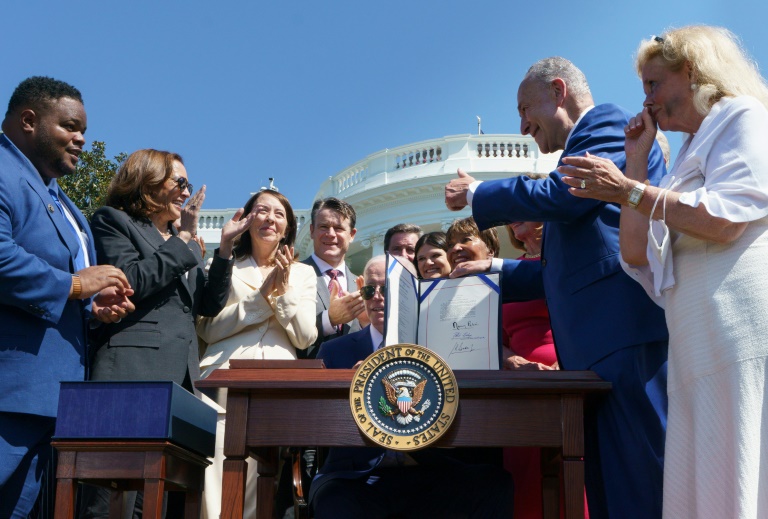
President Joe Biden signed into law Tuesday a multibillion dollar bill boosting domestic semiconductor and other high-tech manufacturing sectors that US leaders fear risk being dominated by rival China.

The Chips and Science Act includes around $52 billion to promote production of microchips, the tiny but powerful and relatively hard-to-make components at the heart of almost every modern piece of machinery.

Tens of billions of dollars more are allocated for scientific research and development.

The White House says the government commitment to bolstering high-tech industries is already drawing in large-scale private investors, with some $50 billion in new semiconductor investment alone. The lion’s share of that is a plan announced by US firm Micron to put $40 billion into domestic expansion by 2030.

Biden said at a White House speech that the cash injection from the Chips Act will help “win the economic competition in the 21st century.”

Entrepreneurs are “the reason why I’m so optimistic about the future of our country,” he said, and “the Chips and Science Act supercharges our efforts to make semiconductors here in America.”

One of the Democrat’s key themes since taking office has been the need to revamp US leadership in cutting-edge innovation and rebuild the homegrown industrial base in the face of China’s mammoth state-backed investments.

Semiconductors are of particular concern because they are vital to everything from washing machines to sophisticated weapons and nearly all are made abroad.

Although the semiconductor was invented in the United States, the country only produces around 10 percent of global supply, according to the White House, with some 75 percent of US supplies coming from east Asia.

“Today’s signing of the bipartisan Chips Act is a historic investment in America’s future. It will boost microchip production at home, strengthen our supply chains, increase domestic research and development, and bolster our national security,” said US Chamber of Commerce vice president Neil Bradley.

– Wider economic, political appeal –

Biden is also counting on the Chips Act to generate enthusiasm among voters, as his Democratic party tries to defend a thin congressional majority from a Republican takeover in this November’s midterm elections.

He told Americans that studies show the expansion of factories will create around a million construction jobs over the next six years — and these will be “union jobs” that pay “the prevailing wage.”

On Wednesday, Biden will sign another bill increasing funding for military veterans exposed to toxins. Like the Chips bill, this won bipartisan support in the usually bitterly divided Congress.

Shortly, Biden is also expected to be signing an enormous domestic investment bill — backed only by Democrats — aimed at fighting climate change and reducing health care costs.

Reflecting on the string of successes in Congress and the sudden momentum for his long stalled agenda, Biden predicted that “people will look back at this week and all we passed, and all we moved on, that we met the moment at this inflection point in history.”

“We bet on ourselves, believed in ourselves and recaptured the story, the spirit and the soul of this nation,” he said.
Jury finds ex-Twitter worker spied for Saudi royals

A former Twitter worker was found guilty on Tuesday of spying for Saudi officials keen to unmask critics on the platform.

Ahmad Abouammo was pronounced guilty on criminal counts including money laundering, fraud, and being an illegal agent of a foreign government, according to a copy of the verdict.

Prosecutors in federal court in San Francisco told jurors that Abouammo sold Twitter user information for cash and an expensive watch some seven years ago.

His defense team contended that he did nothing more than accept gifts from free-spending Saudis for simply doing his client management job.

“The evidence shows that, for a price and thinking no one was watching, the defendant sold his position to an insider of the crown prince,” US prosecutor Colin Sampson said in final remarks to the jury.

Defense attorney Angela Chuang countered that while there certainly appeared to be a conspiracy to get revealing information about Saudi critics from Twitter, prosecutors failed to prove Abouammo was part of it.

Abouammo quit Twitter in 2015 and took a job at e-commerce titan Amazon in Seattle, where he lives, according to court documents.

Jurors deliberated for three days before finding Abouammo guilty on 6 of the 11 charges against him.

Chuang conceded to the jury that Abouammo did violate Twitter employee rules by not telling the San Francisco-based company that he had received $100,000 in cash and a watch valued at more than $40,000 from someone close to the Saudi crown prince.

However, she downplayed the significance of the gift, saying it amounted to “pocket change” in Saudi culture known for generosity and lavish presents.

– Trust traded for cash? –

Abouammo was arrested in Seattle in November of 2019.

Prosecutors accused Abouammo and fellow Twitter employee Ali Alzabarah of being enlisted by Saudi officials between late 2014 and early the following year to get private information on accounts firing off posts critical of the regime.

The then-Twitter workers could use their credentials to glean email addresses, phone numbers, birth dates and other private data to identify people behind anonymous accounts, prosecutors said.

Abouammo remained free on Tuesday pending sentencing, despite concerns expressed by prosecutors that he might try to flee the country.

Alzabarah, a Saudi national, is being sought on a charge of failing to register in the United States as an agent of a foreign government as required by United States law, according to an FBI statement.

Chuang contended in court that prosecutors were trying to punish Abouammo for Alzabarah’s actions.

“As much as the government wishes that was Mr Alzabarah sitting at the table right now, it is not,” Chuang told jurors.

“And that is on them, they let Mr Alzabarah flee the country while he was under FBI surveillance.”

FBI raid on Trump's home ignites political firestorm

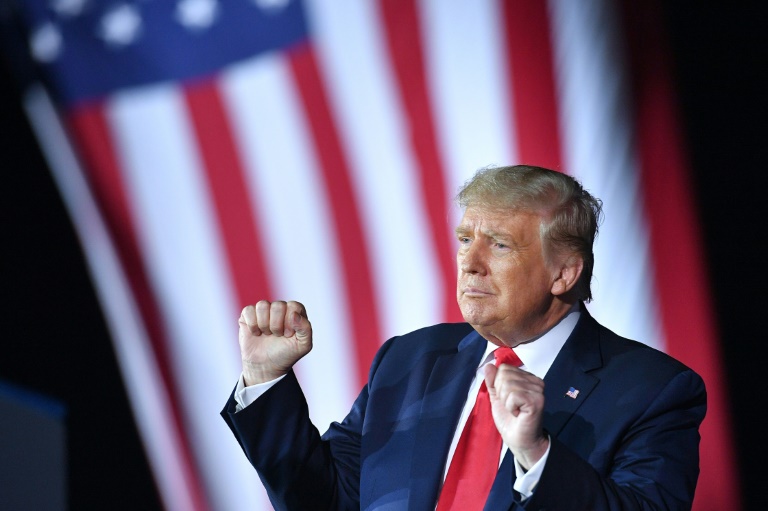
Top Republican leaders flung their support behind former US president Donald Trump on Tuesday after an extraordinary FBI raid on his palatial Florida residence sparked a political firestorm in an already bitterly divided country.

The FBI move marked a stunning escalation of legal probes into the 45th president and comes as he is weighing another White House run.

Several former advisors to the 76-year-old Trump urged him to immediately confirm that he would be a presidential candidate in 2024.

“Nothing like this has ever happened to a President of the United States before,” Trump said of the FBI operation at his Mar-a-Lago resort in West Palm Beach.

He denounced the FBI raid as a “weaponization of the Justice System” by “Radical Left Democrats who desperately don’t want me to run for President in 2024.”

At the White House, Press Secretary Karine Jean-Pierre said President Joe Biden did not have any advance notice about the raid and respected the independence of the Justice Department.

Asked about the potential for civil unrest in reaction to Trump’s legal problems, Jean-Pierre said “there’s no place for political violence in this country.”

The Federal Bureau of Investigation, which is led by Christopher Wray, a Trump appointee, declined to provide a reason for the raid.

But US media outlets said agents were conducting a court-authorized search related to the potential mishandling of classified documents that had been sent to Mar-a-Lago after Trump left the White House in January 2021.

Trump has also faced intense legal scrutiny for his efforts to overturn the results of the 2020 election and over the January 6 attack on the US Capitol by his supporters.

Since leaving office, Trump has remained the country’s most divisive figure, continuing to sow falsehoods that he actually won the 2020 vote.

A day after the  raid on Mar-A-Lago, US Representative Scott Perry — a Trump ally — said that FBI agents had confiscated his cell phone, but did not specify why it was taken.

“This morning, while traveling with my family, three FBI agents visited me and seized my cell phone,” Perry told FOX News, condemning “these kinds of banana republic tactics.”

– Allies rally round –

Leading Republicans rallied around the former president, who was not present at Mar-a-Lago when the raid took place.

Trump’s former vice president Mike Pence, a potential 2024 rival, expressed “deep concern” and said the raid smacked of “partisanship” by the Justice Department.

Kevin McCarthy, who is seeking to become speaker of the House of Representatives if Republicans win November’s midterm elections, accused the Justice Department of “weaponized politicization.”

Republican Senator Lindsey Graham, a Trump ally, said “launching an investigation of a former president this close to an election is beyond problematic.”

Representative Elise Stefanik, the third-ranking House Republican, called it a “dark day in American history.”

“If the FBI can raid a US President, imagine what they can do to you,” Stefanik tweeted, to which Democratic Representative Ted Lieu replied: “Why can’t the FBI investigate a US President? We’re not Russia, where the law doesn’t apply to the head of state and his cronies.”

Nancy Pelosi, the Democratic speaker of the House, told NBC that “no person is above the law.”

– Presidential paperwork –

In his statement, Trump did not give any indication about why the FBI raided his home but said: “They even broke into my safe!”

Andrew McCabe, a former FBI deputy director, told CNN that agents may have been looking for “something specific” related to the probe into the handling of classified information.

The National Archives said in February that it had recovered 15 boxes of documents from Mar-a-Lago and asked the Justice Department to look into Trump’s handling of classified material.

The recovery of the boxes raised questions about Trump’s adherence to presidential records laws enacted after the 1970s Watergate scandal that require Oval Office occupants to preserve records.

Trump’s former communications director Alyssa Farah Griffin told CNN the raid could fire up his supporters, a small number of whom rallied outside Mar-a-Lago on Tuesday.

“If it’s seen as some sort of massive overreach and not something incredibly serious, this is a very good day for Donald Trump,” Farah Griffin said.

For weeks, Washington has been riveted by hearings in Congress about the January 6 storming of the Capitol and Trump’s attempts to overturn the 2020 election.

Attorney General Merrick Garland has been repeatedly pushed over whether the Justice Department is building a case against Trump over the Capitol riot.

Trump is also being investigated for his efforts to alter the 2020 voting results in the state of Georgia, while his business practices are being probed in New York in separate cases.

Firefighters, helicopters battle to contain Cuba fuel depot blaze

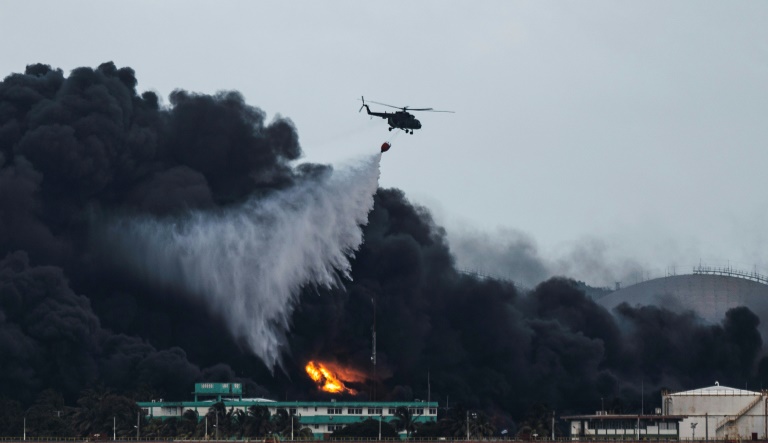
Helicopters and firefighters battled Tuesday to contain a days-old blaze at a fuel depot in Cuba that has already destroyed four tanks and was threatening four more.

The fire, which started on Friday after lightning struck one of the tanks, left a 60-year-old firefighter dead and 14 colleagues missing, according to authorities.

More than 100 people were reported injured, with 22 still hospitalized.

About 5,000 people have been evacuated from around the disaster zone on the outskirts of Matanzas, an industrial city of 140,000 people some 100 kilometers (60 miles) west of Havana.

As teams prepared Tuesday to try and douse the fire with foam, fears were rising that the blaze could threaten the fuel supply to thermoelectric plants at a time Cuba is already battling electricity outages.

Four military helicopters flew repeated sorties over the depot, dropping sea water on the blaze.

“The firefighting teams continue to clear a path to the flames so the teams charged with applying the foam can get to the place,” Matanzas governor Mario Sabines said on Twitter. 

He added that smoke from the fire had reduced visibility to near zero, and drones were deployed to provide a better view.

– Help arrives –

Four of the eight tanks on site have already collapsed in the blaze, have spilled their contents, and were still burning, according to deputy fire chief Alexander Avalos Jorge.

Water was being sprayed on the remaining four tanks, clustered just 150 meters (about 492 feet) from the other four tanks, in a bid to keep them cool.

The tanks each have a capacity of some 50,000 cubic meters or 50 million liters of fuel.

The Matanzas depot, built in the 1980s and modernized several times, supplies the Antonio Guiteras thermoelectric plant, the largest in the communist nation.

The plant features five docks to receive ships of up to 180,000 tonnes, and can handle 40,000 barrels a day.

The big question now is “the supply of fuel to thermoelectric plants,” said Jorge Pinon, a Cuban expert in energy policy at the University of Texas.

“The problem with (electricity generation) has not been the lack of fuel, but the plants are very old and have maintenance problems. Now they will also have a lack of fuel,” he said.

“If they lose Matanzas, they lose the ability to supply the power plants,” said Pinon.

The disaster comes at a time when the island — with an outdated energy network and persistent fuel shortages — has faced mounting difficulties in meeting energy demands.

Since May, authorities have imposed energy blackouts of up to 12 hours a day in some regions — sparking protests around the nation of 11 million people. 

Thirteen flights have arrived from Mexico and four from Venezuela with technicians, firefighters and equipment, including fire retardant foam, fire hoses, helicopter water buckets, spray pumps and medicines.

A Mexican Navy logistics support ship also arrived at Matanzas Bay Tuesday with a helicopter on deck.

And Cuba’s deputy foreign minister, Carlos Fernandez de Cossio, thanked the United States — which has maintained six decades of sanctions against the communist nation — for an offer of “technical advice.”

New US strategy to make monkeypox vaccine go further

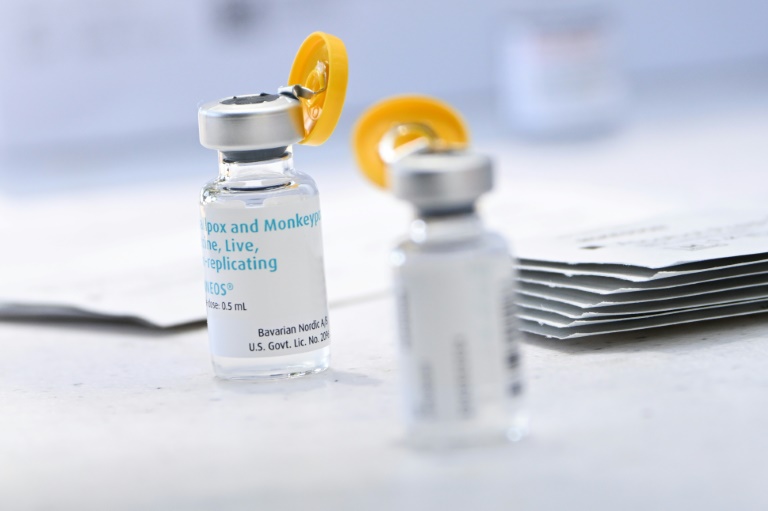
US health authorities on Tuesday authorized a new procedure for injecting the monkeypox vaccine that should make it possible to inoculate more people with the same amount of the drug, at a time when doses are running short in the country. 

The Food and Drug Administration also authorized giving the vaccine to people under the age of 18 who are considered to be at high risk of infection. 

For those over 18, health workers will now be able to administer the vaccine differently, via an intradermal injection — that is, between the upper layers of the skin — and not with a deeper, subcutaneous injection. 

The new method will “increase the total number of doses available for use by up to five-fold,” the FDA said in a statement. 

Two injections, four weeks apart, will still be necessary. 

The FDA said it was drawing on data from a 2015 clinical trial that showed a similar immune response in people given a subcutaneous injection compared to those given a fifth of the dose via an intradermal shot. 

At present, some 620,000 doses of the vaccine — manufactured by Bavarian Nordic, and marketed under the name Jynneos in the United States — have been distributed across the country.

Another 440,000 additional doses are still to be distributed, which could allow up to 2.2 million injections under the new strategy. 

The government has also ordered an additional five million doses, which will start arriving from September and run through 2023, affording the potential to administer 25 million doses. 

The decisions came after the FDA issued an emergency use authorization for the vaccine, a move that itself followed the declaration of a public health emergency last week. 

For the authorization in minors, the FDA said it had reviewed safety data for the vaccine, as well as data for another vaccine given in children against smallpox. 

“We feel very comfortable with the safety of the approach,” said Peter Marks of the FDA at a press conference, noting a recent increase in the number of children who have potentially been exposed to infected people. 

The United States has registered nearly 9,000 cases of monkeypox, a fifth of them in New York state. The vast majority of cases involve men who have had sex with men.

Russia says Crimea airbase blast was ammo detonation, not attack

Moscow insisted Tuesday that major blasts at a key military airbase on the Russian-annexed Crimea peninsula were caused by exploding ammunition rather than Ukrainian fire.

Dramatic amateur footage shared on social media appeared to show panicked holidaymakers fleeing a Crimean beach with young children, as ballooning clouds of grey smoke rose over the horizon.

The blasts rocked the Saki airfield on the 167th day of Moscow’s invasion.

Russia annexed the Crimean peninsula in 2014 and has used the region as a staging ground for its attacks on Ukraine, but it has rarely been a target for Ukrainian forces.

The Russian defence ministry said “several aviation munitions detonated” at the base in an incident the head of the region said had left one person dead. 

Local health officials earlier said five people, including one child, had been injured.

The defence ministry said it was looking to establish the reason for the explosions but indicated the airfield was not targeted in an attack.

There was no immediate reaction from Kyiv.

Ukraine’s army, which for months pleaded for long-range artillery from Western allies, has been hitting targets deeper in Russian-held territory since some started arriving in recent weeks. 

Kyiv has also taken credit for several acts of sabotage inside Russian-held territory.

Moscow seized Crimea from Ukraine in the wake of massive nationwide street demonstrations that led to the ouster of a Kremlin-friendly president.

Those protests precipitated fighting between the army and Moscow-backed separatists in eastern Ukraine, which would lay the groundwork for Moscow’s full-scale assault on February 24 this year.

The invasion has left thousands dead, forced millions in Ukraine from their homes, and littered the country with land mines.

On Tuesday, the United States announced that it will provide $89 million for demining efforts in Ukraine.

“Russia’s unlawful and unprovoked further invasion of Ukraine has littered massive swaths of the country with landmines, unexploded ordnance, and improvised explosive devices,” the State Department said in a statement.

“These explosive hazards block access to fertile farmland, delay reconstruction efforts, prevent displaced communities from returning to their homes, and continue to kill and maim innocent Ukrainian civilians,” it said. 

– Mandatory evacuations –

The Russian invasion has led to a deep rupture in economic ties between Moscow and the West.

In response to sanctions for the invasion, Russia has squeezed gas supplies to Europe.

It announced on Tuesday that its oil deliveries through Ukraine had been halted.

Transneft, the Russian pipeline operator, said the Ukrainian side had stopped flows because it was “not receiving funds for these services”.

The Ukrainian side did not comment.

One of the impacted countries, Slovakia, confirmed flows had been halted for several days, and a spokesman for Bratislava refinery Slovnaft cited “technical problems at the bank level in connection with the payment of transit fees from the Russian side”.

The Kremlin lashed out after Ukrainian President Volodymyr Zelensky said in an interview that Europe should close their borders to Russians in response to the war. 

The Ukrainian leader told The Washington Post that current Western sanctions against Moscow were too weak, in a call that has been echoed by Russia’s neighbours Estonia and Finland.

“The irrationality of thinking in this case is off the charts,” Kremlin spokesman Dmitry Peskov told reporters.

On the frontlines, Ukraine said Russia was pursuing a campaign of bombardment of the east of the country that has left much of the industrial Donbas region in ruins.

Kyiv said Tuesday it had transported at least 3,000 people out of the battle-scarred eastern region of Donetsk since it ordered evacuations ahead of winter. 

The Ukrainian authorities are asking people to leave the area, as they do not expect to be able to provide it with heat during the cold winter months.

The presidency earlier said that three people had been killed and 19 more wounded in Russian shelling across the Donetsk region on Monday.

The head of the central region of Dnipro, meanwhile, said that 11 medical facilities had relocated there from the battle-torn Kharkiv and Lugansk regions further east.

“Those facilities transferred over 100 pieces of equipment and 10 ambulances,” Dnipro regional governor Valentyn Reznichenko said.

“The hospitals are restarting work. They are mostly receiving displaced people.”

Global stock markets retreat on eve of US inflation data

Stock markets were mostly lower and the dollar fell on Tuesday as investors nervously await the release of key US inflation data later this week.

If the official consumer price data Wednesday come in above analysts’ forecasts, the markets could see a sharp sell-off, analysts warned.

With inflation already at the highest level in 40 years, concern is growing that further interest rate increases by the world’s major central banks could go too far and tip the global economy into recession.

Federal Reserve officials in recent days have stressed that more hikes are coming to tame soaring inflation, with a third straight three-quarter point increase on the table next month.

The inflation data “could effectively set the mood for the rest of the summer,” said OANDA analyst, Craig Erlam.

“That seems quite dramatic, but if we fail to see a drop in the headline rate… it could really take the wind out of the sails of stock markets as it would be very difficult for the (Fed) to then hike by anything less than 75 basis points in September,” the expert said.

While US gasoline prices have been coming down, which takes some of the pressure off American families, the overall rate remains high.

Swissquote Bank analyst Ipek Ozkardeskaya said the recent drop in energy and commodity prices “should have a cooling effect… but higher labour costs could keep inflation sticky at undesirably high levels.”

Oil prices reversed some of the prior day’s gains and remain around six-month lows as recession fears mount and investors fret over the impact on demand. 

The markets are also keeping an eye on Iran nuclear talks after the European Union submitted a “final text” at negotiations to salvage a 2015 deal.

An agreement could open the way for Tehran to resume sales of crude on international markets, partly filling the gap left by the ban on Russian exports following the invasion of Ukraine. 

US tech shares tumbled after a second major chip maker issued an earnings warning.

“It seems that the technology sector along with the rest of the economy is slowing,” said Tom Cahill of Ventura Wealth Management.

– Key figures at around 2045 GMT –

New York – Dow: DOWN 0.2 percent at 32,774.41 (close)

New York – S&P 500: DOWN 0.4 percent at 4,122.47 (close)

New York – Nasdaq: DOWN 1.2 percent at 12,493.93 (close)

London – FTSE 100: UP 0.1 percent at 7,488.15 (close)

Frankfurt – DAX: DOWN 1.1 percent at 13,534.97 (close)

Paris – CAC 40: DOWN 0.5 percent at 6,490.00 (close)

EURO STOXX 50: DOWN 1.1 percent at 3,715.37

Tokyo – Nikkei 225: DOWN 0.9 percent at 27,999.96 (close)

Hong Kong – Hang Seng Index: DOWN 0.2 percent at 20,003.44 (close)

Shanghai – Composite: UP 0.3 percent at 3,247.43 (close)

Euro/dollar: UP at $1.0213 from $1.0194 Monday

Pound/dollar: UP at $1.2071 from $1.2079

Euro/pound: UP at 84.57 pence from 84.35 pence

Dollar/yen: UP at 135.12 yen from 134.98 yen

Brent North Sea crude: DOWN 0.1 percent at $96.57 per barrel

West Texas Intermediate: DOWN 0.1 percent at $90.70 per barrel

US stocks sink with all eyes on consumer price data

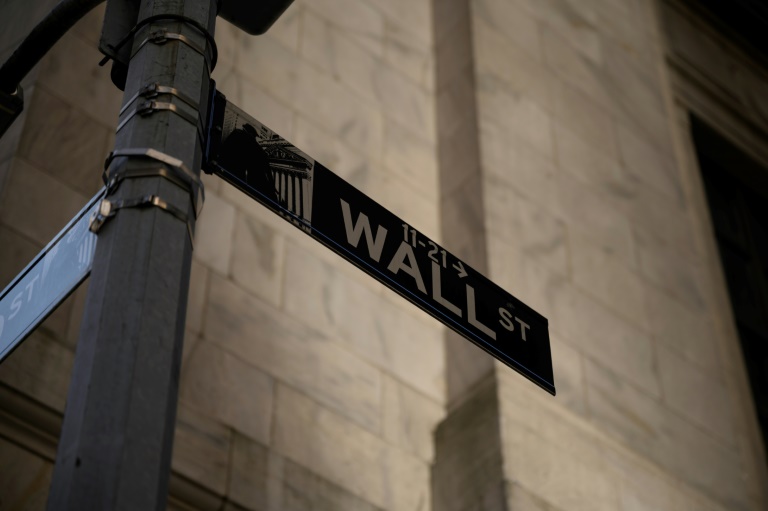
With all eyes on back-to-back inflation data coming this week, Wall Street stocks tumbled again on Tuesday as earnings warnings tanked tech shares.

Investors may have been taking advantage of a recent upswing in share prices to cash out before the government reports on July consumer prices on Wednesday, followed by producer prices Thursday.

While the data are expected to show monthly inflation slowing from June, the annual pace is likely to remain near 40-year highs.

“There is a real concern about what numbers we can get on the inflation tomorrow, Thursday and even Friday with the consumer sentiment numbers,” said Tom Cahill of Ventura Wealth Management.

“There are a lot of things to look at between now and the end of the week and a lot of profit has been made over the past couple of weeks so I think there is a bit of profit taking going on,” he told AFP.

The three major indices opened in the red and remained there throughout the trading session.

The tech-rich Nasdaq Composite Index lost 1.2 percent to finish at 12,493.93, pulled down after Micron Technologies became the second big chipmaker to warn of downbeat revenue due to ongoing global supply snarls, following a similar caution by Nvidia on Monday.

“It seems that the technology sector along with the rest of the economy is slowing,” Cahill said.

The Dow Jones Industrial lost 0.2 percent to end the day at 32,774.41, while the broad-based S&P 500 fell 0.4 percent to 4,122.47.

Micron — which also announced a $40 billion investment in the US chip manufacturing — dropped 3.7 percent, and Nvidia fell 3.9 percent.

Biden signs ratification of Finland, Sweden NATO bids

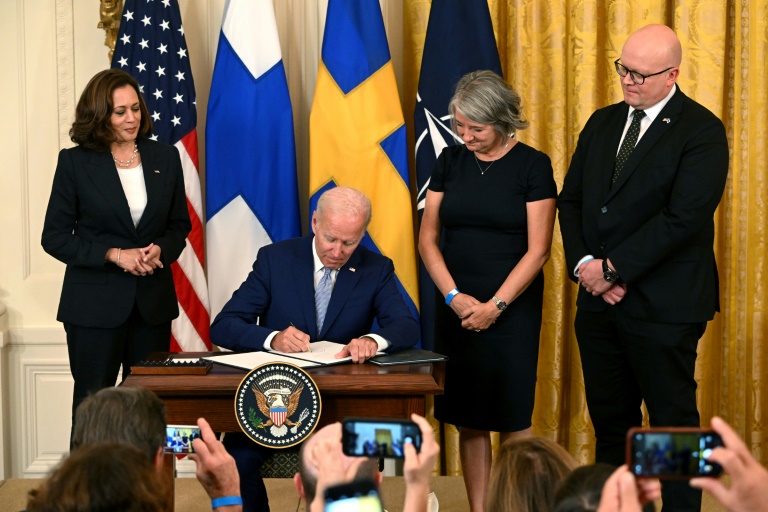
President Joe Biden on Tuesday signed US ratification of bids by Finland and Sweden to enter NATO, taking expansion of the Western alliance in response to Russia’s Ukraine invasion one step closer.

Biden said the two northern European countries would become “strong, reliable highly capable new allies” by making the “sacred commitment” to mutual defense in the US-led transatlantic alliance.

Earlier this month, the Senate voted 95-1 in favor of the Nordic states’ accession, making the United States the 23rd of the 30 NATO countries to give formal endorsement. Unanimous support is needed for new membership.

Biden, who has made restoring traditional US alliances a cornerstone of his administration after Donald Trump’s move to upend ties around the world, praised NATO as “the foundation of American security.”

“The United States is committed to the transatlantic alliance.”

Biden also praised Finland and Sweden, saying both have “strong democratic institutions, strong militaries and strong and transparent economies” that would now bolster NATO.

President Vladimir Putin’s Russia “shattered peace and security in Europe” by invading Ukraine, Biden said. “Putin thought he could break us apart…. Instead, he is getting exactly what he did not want.”

The White House said that ahead of the signing ceremony, Biden talked by telephone with Swedish Prime Minister Magdalena Andersson and Finland’s President Sauli Niinisto.

“President Biden congratulated them on the US Senate’s swift, bipartisan ratification of their NATO accession protocols, and welcomed Finland and Sweden moving one step closer to becoming NATO Allies,” the White House said.

While the process plays out, “President Biden affirmed that the United States will work with Finland and Sweden to remain vigilant against any threats to our shared security, and to deter and confront aggression or threat of aggression,” the statement said.

Close Bitnami banner
Bitnami