World

Biden signs major semiconductors investment bill to compete against China

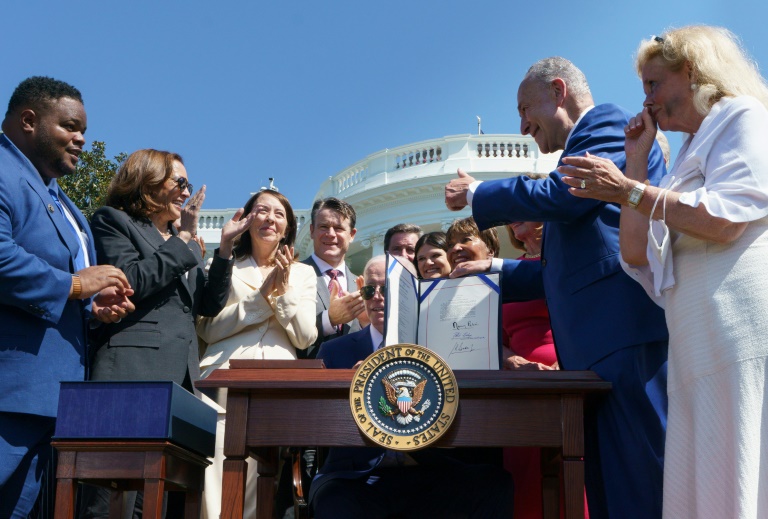
President Joe Biden signed into law Tuesday a multibillion dollar bill boosting domestic semiconductor and other high-tech manufacturing sectors that US leaders fear risk being dominated by rival China.

The Chips and Science Act includes around $52 billion to promote production of microchips, the tiny but powerful and relatively hard-to-make components at the heart of almost every modern piece of machinery.

Tens of billions of dollars more are allocated for scientific research and development.

The White House says the government commitment to bolstering high-tech industries is already drawing in large-scale private investors, with some $50 billion in new semiconductor investment alone. The lion’s share of that is a plan announced by US firm Micron to put $40 billion into domestic expansion by 2030.

Biden said at a White House speech that the cash injection from the Chips Act will help “win the economic competition in the 21st century.”

Entrepreneurs are “the reason why I’m so optimistic about the future of our country,” he said, and “the Chips and Science Act supercharges our efforts to make semiconductors here in America.”

One of the Democrat’s key themes since taking office has been the need to revamp US leadership in cutting-edge innovation and rebuild the homegrown industrial base in the face of China’s mammoth state-backed investments.

Semiconductors are of particular concern because they are vital to everything from washing machines to sophisticated weapons and nearly all are made abroad.

Although the semiconductor was invented in the United States, the country only produces around 10 percent of global supply, according to the White House, with some 75 percent of US supplies coming from east Asia.

“Today’s signing of the bipartisan Chips Act is a historic investment in America’s future. It will boost microchip production at home, strengthen our supply chains, increase domestic research and development, and bolster our national security,” said US Chamber of Commerce vice president Neil Bradley.

– Wider economic, political appeal –

Biden is also counting on the Chips Act to generate enthusiasm among voters, as his Democratic party tries to defend a thin congressional majority from a Republican takeover in this November’s midterm elections.

He told Americans that studies show the expansion of factories will create around a million construction jobs over the next six years — and these will be “union jobs” that pay “the prevailing wage.”

On Wednesday, Biden will sign another bill increasing funding for military veterans exposed to toxins. Like the Chips bill, this won bipartisan support in the usually bitterly divided Congress.

Shortly, Biden is also expected to be signing an enormous domestic investment bill — backed only by Democrats — aimed at fighting climate change and reducing health care costs.

Reflecting on the string of successes in Congress and the sudden momentum for his long stalled agenda, Biden predicted that “people will look back at this week and all we passed, and all we moved on, that we met the moment at this inflection point in history.”

“We bet on ourselves, believed in ourselves and recaptured the story, the spirit and the soul of this nation,” he said.
Biden signs major semiconductors investment bill to compete against China

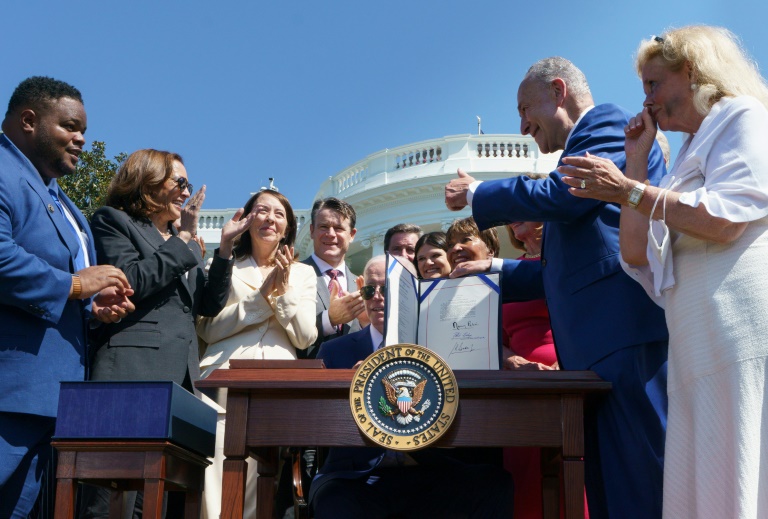
President Joe Biden signed into law Tuesday a multibillion dollar bill boosting domestic semiconductor and other high-tech manufacturing sectors that US leaders fear risk being dominated by rival China.

The Chips and Science Act includes around $52 billion to promote production of microchips, the tiny but powerful and relatively hard-to-make components at the heart of almost every modern piece of machinery.

Tens of billions of dollars more are allocated for scientific research and development.

The White House says the government commitment to bolstering high-tech industries is already drawing in large-scale private investors, with some $50 billion in new semiconductor investment alone. The lion’s share of that is a plan announced by US firm Micron to put $40 billion into domestic expansion by 2030.

Biden said at a White House speech that the cash injection from the Chips Act will help “win the economic competition in the 21st century.”

Entrepreneurs are “the reason why I’m so optimistic about the future of our country,” he said, and “the Chips and Science Act supercharges our efforts to make semiconductors here in America.”

One of the Democrat’s key themes since taking office has been the need to revamp US leadership in cutting-edge innovation and rebuild the homegrown industrial base in the face of China’s mammoth state-backed investments.

Semiconductors are of particular concern because they are vital to everything from washing machines to sophisticated weapons and nearly all are made abroad.

Although the semiconductor was invented in the United States, the country only produces around 10 percent of global supply, according to the White House, with some 75 percent of US supplies coming from east Asia.

“Today’s signing of the bipartisan Chips Act is a historic investment in America’s future. It will boost microchip production at home, strengthen our supply chains, increase domestic research and development, and bolster our national security,” said US Chamber of Commerce vice president Neil Bradley.

– Wider economic, political appeal –

Biden is also counting on the Chips Act to generate enthusiasm among voters, as his Democratic party tries to defend a thin congressional majority from a Republican takeover in this November’s midterm elections.

He told Americans that studies show the expansion of factories will create around a million construction jobs over the next six years — and these will be “union jobs” that pay “the prevailing wage.”

On Wednesday, Biden will sign another bill increasing funding for military veterans exposed to toxins. Like the Chips bill, this won bipartisan support in the usually bitterly divided Congress.

Shortly, Biden is also expected to be signing an enormous domestic investment bill — backed only by Democrats — aimed at fighting climate change and reducing health care costs.

Reflecting on the string of successes in Congress and the sudden momentum for his long stalled agenda, Biden predicted that “people will look back at this week and all we passed, and all we moved on, that we met the moment at this inflection point in history.”

“We bet on ourselves, believed in ourselves and recaptured the story, the spirit and the soul of this nation,” he said.

France readies rescue of beluga astray in Seine

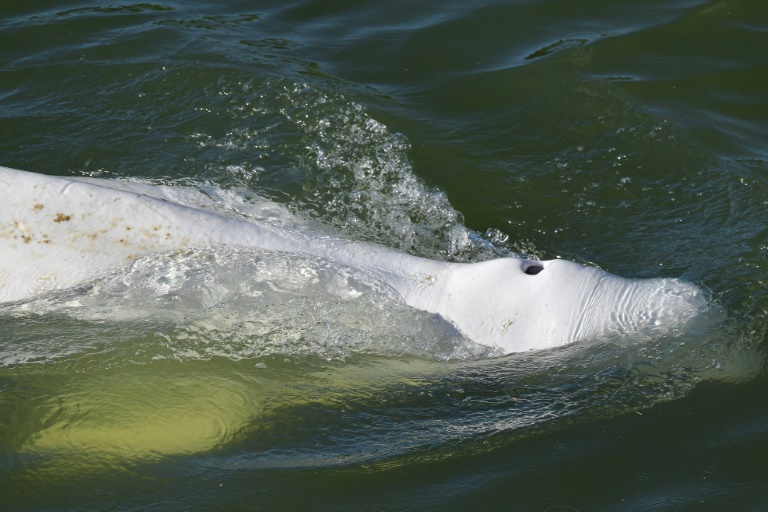
French marine experts will attempt Tuesday to rescue a beluga whale that swam up the Seine river and return it to the sea, officials said, a complex and risky operation for an animal already sick and malnourished.

The four-metre (13-foot) cetacean, a protected species usually found in cold Arctic waters, was spotted a week ago heading towards Paris, and is now some 130 kilometres (81 miles) inland.

“An operation to transport the beluga astray in the Seine will be attempted this evening,” said government officials in the Eure department, who are orchestrating the effort.

The animal’s progress inland has been blocked by a lock at Saint-Pierre-La-Garenne in Normandy, and its health has deteriorated after it refused to eat.

But its condition is currently “satisfactory”, Isabelle Brasseur of the Marineland sea animal park in southern France, Europe’s biggest, told AFP.

She is part of a Marineland team sent to assist with the rescue, alongside the Sea Shepherd France NGO.

“What’s exceptional is that here the banks of the Seine are not accessible for vehicles… everything is going to have to be done by hand,” Brasseur said.

So far the beluga has not turned around, and experts have dismissed any attempt to “nudge” it back toward the English Channel with boats, saying it would stress the weakened animal and probably be futile in any case.

Starting at around 8:00 pm (1800 GMT), the team will try to get the animal weighing 800 kilogrammes (nearly 1,800 pounds) onto a refrigerated truck and drive it to an undisclosed seawater basin where it can be treated for several days before being released into the open sea, the Eure authorities said.

“There it will, we hope, have a better chance of survival,” said NGO Sea Shepherd France, which is assisting the operation, Tuesday.

It added that tranquilisation is not an option, since belugas are so-called “voluntary breathers” that need to be awake to inhale air.

– ‘Have to get it out’ –

“In any case, we have to get it out of there… and try to figure out what is wrong,” Brasseur said.

Veterinarians will keep constant watch during the move.

“There may be internal problems that we can’t see,” she said, despite the fact that belugas are “extremely hardy” as a species.

Interest in the beluga’s fate has spread far beyond France, generating a large influx of financial donations and other aid from conservation groups as well as individuals, officials said.

Sea Shepherd on Monday issued an appeal in particular for heavy-duty ropes, nets, mattresses and other equipment. 

Belugas are normally found only in cold Arctic waters, and while they migrate south in the autumn to feed as ice forms, they rarely venture so far.

According to France’s Pelagis Observatory, specialised in sea mammals, the nearest beluga population is off the Svalbard archipelago, north of Norway, 3,000 kilometres from the Seine.

The trapped whale is only the second beluga ever sighted in France. The first was pulled out of the Loire estuary in a fisherman’s net in 1948.

burs-jh/kjm

UK meteorologists, water firms issue warnings as extreme heatwave looms

The UK’s meteorological agency on Tuesday issued an “amber” warning for extreme heat while the country’s biggest water provider said restrictions loom, as Britain braces for another punishing heatwave later this week. 

The warning by the Met Office, covering much of southern England and parts of eastern Wales from Thursday through Sunday, predicts possible impacts to health, transport and infrastructure from the heat.  

Temperatures are set to soar to the mid-30s Celsius for several days, it noted.

The sweltering conditions come just weeks after the last heatwave pushed the mercury over 40 degrees Celsius (104 degrees Fahrenheit) for the first time in Britain.

Climate scientists overwhelmingly agree that carbon emissions from humans burning fossil fuels are heating the planet, raising the risk and severity of droughts, heatwaves, and other extreme weather events.

“Thanks to persistent high pressure over the UK, temperatures will be rising day-on-day through this week and an extreme heat warning has been issued,” Met Office deputy chief meteorologist Dan Rudman said in a statement.  

Months of exceptionally dry weather across England are taking their toll, with Thames Water — which supplies London and its surroundings — the latest water provider to warn of imminent restrictions.

The firm said it is planning to issue a so-called hosepipe ban in the coming weeks “given the long-term forecast” of hot and dry weather for the southeast.

Several other UK water suppliers have already announced similar moves ahead of this week’s heatwave, but Thames Water’s 15 million customers would make it the most impactful so far.

The Met Office has confirmed it was the driest July in England since 1935, and little or no rain is forecast for most of the parched areas in the short term.

“Water companies are already managing the unprecedented effects of the driest winter and spring since the 1970s,” said Peter Jenkins, of Water UK, which represents the industry.

“With more hot, dry weather forecast, it’s crucial we be even more mindful of our water use to minimise spikes in demand and ensure there’s enough to go around.”

The parched conditions have seen wildfires break out near houses, including on the outskirts of London, a relatively rare occurrence in Britain.

In neighbouring France, a “historic” drought currently exacerbated by a third extreme heatwave this summer has seen a spate of wildfires nationwide as well as water restrictions ordered in nearly all its 96 mainland departments.

More than 47,000 hectares have already burnt in France this year, including a record amount in July alone, according to the European Union’s satellite monitoring service EFFIS.

On Tuesday, more than 3,000 people in southern France’s Aveyron region, including holidaymakers, were evacuated as a fire swept through at least 700 hectares of vegetation without causing any injuries.

UK meteorologists, water firms issue warnings as extreme heatwave looms

The UK’s meteorological agency on Tuesday issued an “amber” warning for extreme heat while the country’s biggest water provider said restrictions loom, as Britain braces for another punishing heatwave later this week. 

The warning by the Met Office, covering much of southern England and parts of eastern Wales from Thursday through Sunday, predicts possible impacts to health, transport and infrastructure from the heat.  

Temperatures are set to soar to the mid-30s Celsius for several days, it noted.

The sweltering conditions come just weeks after the last heatwave pushed the mercury over 40 degrees Celsius (104 degrees Fahrenheit) for the first time in Britain.

Climate scientists overwhelmingly agree that carbon emissions from humans burning fossil fuels are heating the planet, raising the risk and severity of droughts, heatwaves, and other extreme weather events.

“Thanks to persistent high pressure over the UK, temperatures will be rising day-on-day through this week and an extreme heat warning has been issued,” Met Office deputy chief meteorologist Dan Rudman said in a statement.  

Months of exceptionally dry weather across England are taking their toll, with Thames Water — which supplies London and its surroundings — the latest water provider to warn of imminent restrictions.

The firm said it is planning to issue a so-called hosepipe ban in the coming weeks “given the long-term forecast” of hot and dry weather for the southeast.

Several other UK water suppliers have already announced similar moves ahead of this week’s heatwave, but Thames Water’s 15 million customers would make it the most impactful so far.

The Met Office has confirmed it was the driest July in England since 1935, and little or no rain is forecast for most of the parched areas in the short term.

“Water companies are already managing the unprecedented effects of the driest winter and spring since the 1970s,” said Peter Jenkins, of Water UK, which represents the industry.

“With more hot, dry weather forecast, it’s crucial we be even more mindful of our water use to minimise spikes in demand and ensure there’s enough to go around.”

The parched conditions have seen wildfires break out near houses, including on the outskirts of London, a relatively rare occurrence in Britain.

In neighbouring France, a “historic” drought currently exacerbated by a third extreme heatwave this summer has seen a spate of wildfires nationwide as well as water restrictions ordered in nearly all its 96 mainland departments.

More than 47,000 hectares have already burnt in France this year, including a record amount in July alone, according to the European Union’s satellite monitoring service EFFIS.

On Tuesday, more than 3,000 people in southern France’s Aveyron region, including holidaymakers, were evacuated as a fire swept through at least 700 hectares of vegetation without causing any injuries.

Firefighters, helicopters battle to contain Cuba fuel depot blaze

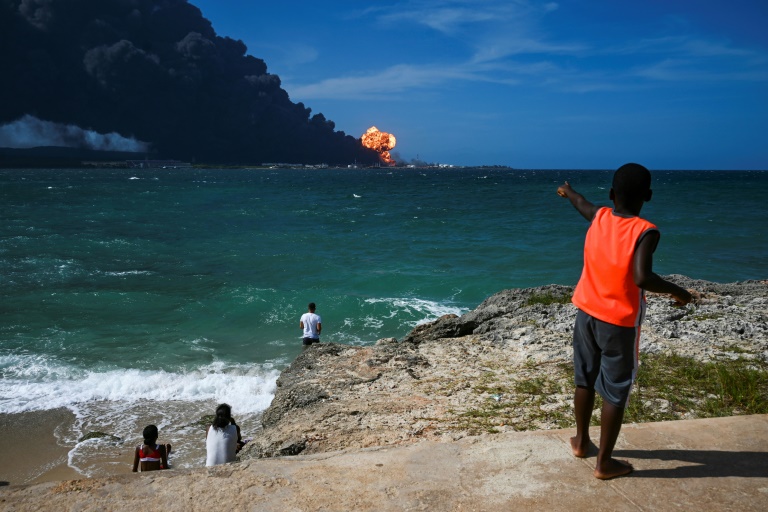
Helicopters and firefighters battled Tuesday to gain access to four tanks at a fuel depot that has been ablaze for days, hoping to deploy special foam to control the flames.

The fire, which started on Friday, has left one firefighter dead and 14 more missing.

From dawn, AFP reporters saw four military helicopters flying over the depot in Matanzas, an industrial city around 100 kilometers (60 miles) west of Havana, dropping sea water in a bid to extinguish the blaze.

Four out of the eight tanks on site have already fallen victim to the flames, deputy fire chief Alexander Avalos Jorge said, and authorities are now trying to protect the other four.

“The firefighting teams continue to clear a path to the flames so the teams charged with applying the foam can get to the place,” said Matanzas governor Mario Sabines on Twitter. 

Sabines added that the smoke from the fire had left visibility at a minimum and drones were being used to provide greater precision to operations.

Firefighters and specialists in fuel fires from Mexico and Venezuela have arrived in Cuba to help their local counterparts.

The fire broke out on Friday in the city of 140,000 people after lightning struck one of the tanks at the depot, which is of strategic importance for the island nation.

Each of the eight tanks can hold up to 50 million liters of fuel — three have collapsed while a fourth has been engulfed by flames.

Some 125 people injured by the blaze were taken to hospital with 22 remaining in care. Some 5,000 people have been evacuated from around the disaster zone, authorities reported.

Two firefighters previously reported as missing have been located among those receiving hospital treatment.

Stock markets lower on eve of US inflation data

Stock markets were mostly lower and the dollar fell on Tuesday as investors nervously await the release of key US inflation data later this week, traders said.

If the data, scheduled for publication on Wednesday, come in above analysts’ forecasts, the markets could see a sharp sell-off, analysts warned.

With inflation already at the highest level in 40 years, concern is growing that further monetary tightening by the world’s major central banks could go too far and tip the global economy into recession.

The inflation data “could effectively set the mood for the rest of the summer,” said OANDA analyst, Craig Erlam.

“That seems quite dramatic, but if we fail to see a drop in the headline rate… it could really take the wind out of the sails of stock markets as it would be very difficult for the (US Federal Reserve) to then hike by anything less than 75 basis points in September,” the expert said.

The US central bank has already raised borrowing costs by three-quarters of a percentage point twice in recent months in a bid to tame runaway prices.

Swissquote Bank analyst Ipek Ozkardeskaya said the recent drop in energy and commodity prices “should have a cooling effect… but higher labour costs could keep inflation sticky at undesirably high levels”.

Oil prices rose, but remain around six-month lows as recession fears mount and investors fret over the impact on demand. 

The markets are also keeping an eye on Iran nuclear talks after the European Union submitted a “final text” at negotiations to salvage a 2015 deal.

An agreement could open the way for Tehran to resume sales of crude on international markets, partly filling the gap left by the ban on Russian exports following the invasion of Ukraine. 

Edward Moya, analyst at OANDA trading group, said “it seems unlikely a breakthrough will happen anytime soon. 

“Tehran seems like they are willing to negotiate, but an imminent decision to agree to the EU’s proposal seems unlikely,” he said. 

– Key figures at around 1545 GMT –

New York – Dow: FLAT at 32,822.27 points

London – FTSE 100: UP 0.1 percent at 7,488.15 (close)

Frankfurt – DAX: DOWN 1.1 percent at 13,534.97 (close)

Paris – CAC 40: DOWN 0.5 percent at 6,490.00 (close)

EURO STOXX 50: DOWN 1.1 percent at 3,715.37

Tokyo – Nikkei 225: DOWN 0.9 percent at 27,999.96 (close)

Hong Kong – Hang Seng Index: DOWN 0.2 percent at 20,003.44 (close)

Shanghai – Composite: UP 0.3 percent at 3,247.43 (close)

Euro/dollar: UP at $1.0227 from $1.0194 Monday

Pound/dollar: UP at $1.2091 from $1.2079

Euro/pound: UP at 84.60 pence from 84.35 pence

Dollar/yen: UP at 135.00 yen from 134.98 yen

Brent North Sea crude: UP 0.2 percent at $96.81 per barrel

West Texas Intermediate: DOWN 0.1 percent at $90.66 per barrel

Biden signs major semiconductors investment bill to compete against China

President Joe Biden signed into law Tuesday a multibillion dollar bill boosting domestic semiconductor and other high-tech manufacturing sectors that US leaders fear risk being dominated by rival China.

The Chips and Science Act includes around $52 billion to promote production of microchips, the tiny but powerful and relatively hard-to-make components at the heart of almost every modern piece of machinery.

Tens of billions of dollars more are allocated for scientific research and development.

The White House says the government commitment to bolstering high-tech industries is already drawing in large-scale private investors, with some $50 billion in new semiconductor investment alone. The lion’s share of that is a plan announced by US firm Micron to put $40 billion into domestic expansion by 2030.

Biden said at a White House speech that the cash injection from the Chips Act will help “win the economic competition in the 21st century.”

Entrepreneurs are “the reason why I’m so optimistic about the future of our country,” he said, and “the Chips and Science Act supercharges our efforts to make semiconductors here in America.”

One of the Democrat’s key themes since he took office has been the need to revamp US leadership in cutting-edge innovation and rebuild the homegrown industrial base in the face of China’s mammoth state-backed investments.

Semiconductors are of particular concern because they are vital to everything from washing machines to sophisticated weapons and nearly all are made abroad.

Although the semiconductor was invented in the United States, the country only produces around 10 percent of global supply, according to the White House, with some 75 percent of US supplies coming from east Asia.

Biden is also counting on the Chips Act to generate enthusiasm among voters, as his Democratic party tries to defend a thin congressional majority from a Republican takeover in this November’s midterm elections.

He told Americans that studies show the expansion of factories will create around a million construction jobs over the next six years — and these will be “union jobs” that pay “the prevailing wage.”

On Wednesday, Biden will sign another bill increasing funding for military veterans exposed to toxins. Like the Chips bill, this won bipartisan support in the usually bitterly divided Congress.

Shortly, Biden is also expected to be signing an enormous domestic investment bill — backed only by Democrats — aimed at fighting climate change and reducing health care costs.

Reflecting on the string of successes in Congress and the sudden momentum for his long stalled agenda, Biden predicted that “people will look back at this week and all we passed, and all we moved on, that we met the moment at this inflection point in history.”

“We bet on ourselves, believed in ourselves and recaptured the story, the spirit and the soul of this nation,” he said.

Biden signs major semiconductors investment bill to compete against China

President Joe Biden signed into law Tuesday a multibillion dollar bill boosting domestic semiconductor and other high-tech manufacturing sectors that US leaders fear risk being dominated by rival China.

The Chips and Science Act includes around $52 billion to promote production of microchips, the tiny but powerful and relatively hard-to-make components at the heart of almost every modern piece of machinery.

Tens of billions of dollars more are allocated for scientific research and development.

The White House says the government commitment to bolstering high-tech industries is already drawing in large-scale private investors, with some $50 billion in new semiconductor investment alone. The lion’s share of that is a plan announced by US firm Micron to put $40 billion into domestic expansion by 2030.

Biden said at a White House speech that the cash injection from the Chips Act will help “win the economic competition in the 21st century.”

Entrepreneurs are “the reason why I’m so optimistic about the future of our country,” he said, and “the Chips and Science Act supercharges our efforts to make semiconductors here in America.”

One of the Democrat’s key themes since he took office has been the need to revamp US leadership in cutting-edge innovation and rebuild the homegrown industrial base in the face of China’s mammoth state-backed investments.

Semiconductors are of particular concern because they are vital to everything from washing machines to sophisticated weapons and nearly all are made abroad.

Although the semiconductor was invented in the United States, the country only produces around 10 percent of global supply, according to the White House, with some 75 percent of US supplies coming from east Asia.

Biden is also counting on the Chips Act to generate enthusiasm among voters, as his Democratic party tries to defend a thin congressional majority from a Republican takeover in this November’s midterm elections.

He told Americans that studies show the expansion of factories will create around a million construction jobs over the next six years — and these will be “union jobs” that pay “the prevailing wage.”

On Wednesday, Biden will sign another bill increasing funding for military veterans exposed to toxins. Like the Chips bill, this won bipartisan support in the usually bitterly divided Congress.

Shortly, Biden is also expected to be signing an enormous domestic investment bill — backed only by Democrats — aimed at fighting climate change and reducing health care costs.

Reflecting on the string of successes in Congress and the sudden momentum for his long stalled agenda, Biden predicted that “people will look back at this week and all we passed, and all we moved on, that we met the moment at this inflection point in history.”

“We bet on ourselves, believed in ourselves and recaptured the story, the spirit and the soul of this nation,” he said.
Japanese fashion designer Issey Miyake dies at 84

Japanese fashion designer Issey Miyake, whose global career spanned more than half a century, has died aged 84, an employee at his office in Tokyo told AFP on Tuesday.

“He died on the evening of August 5,” she said over the telephone, without giving further details of his death and declining to be named.

Miyake’s funeral had already taken place, with “only relatives participating” in line with his wishes, and there were no plans for a public ceremony, she said.

Public broadcaster NHK and other Japanese media reported the news of his death, with the Asahi Shimbun newspaper and other outlets saying he had died of liver cancer.

Miyake — who pioneered high-tech, comfortable clothing — was part of a wave of young Japanese designers who made their mark in Paris from the mid-1970s.

The French fashion federation paid tribute to Miyake on Tuesday, saying “he was the first foreign designer to show at Paris Fashion Week in April 1974”.

Miyake “contributed, with unwavering commitment, to the influence of Paris Fashion Week from its beginning,” said Bruno Pavlovsky, president of the Federation de la Haute Couture et de la Mode.

Miyake’s fashion house nurtured many talented young designers, and was known for innovative and dazzling catwalk shows.

After two years of showcasing collections online or with installations during the Covid-19 pandemic, the brand made its live comeback at Paris Fashion Week in June with a men’s show featuring models, dancers and acrobats.

Born in Hiroshima in 1938, he was seven years old when the United States dropped an atomic bomb on the city in August 1945.

He survived the blast, which killed an estimated 140,000 people on impact and led to the end of World War II after the bombing of Nagasaki three days later.

“I have never chosen to share my memories or thoughts of that day,” Miyake wrote in the New York Times in 2009.

“I have tried, albeit unsuccessfully, to put them behind me, preferring to think of things that can be created, not destroyed, and that bring beauty and joy.”

The designer studied at an art school in Tokyo, and moved to Paris in 1965, where he studied at the elite Ecole de la Chambre Syndicale de la Couture Parisienne.

He established the Miyake Design Studio in Tokyo in 1970, and soon afterwards opened his first Paris boutique.

By the 1980s, his career was in full swing as he experimented with materials from plastic to metal wire and even artisanal Japanese paper.

Among his inventions were the “Pleats Please” line, permanently pleated items which do not crease, the futuristic triangles of his “Bao Bao” bag, and his “A-POC (A Piece Of Cloth)” concept — using computers to cut whole garments with no seams.

He also made more than 100 black turtlenecks for Apple co-founder Steve Jobs.

Close Bitnami banner
Bitnami