World

Four Palestinians killed by Israeli forces in West Bank

Israeli forces killed four people Tuesday in the occupied West Bank, the Palestinian health ministry said, including two teens and a man Israel said was a senior militant commander.

The latest violence comes two days after a truce halted deadly conflict between the Israeli military and Islamic Jihad militants in the coastal Palestinian enclave of Gaza, and as Israeli forces continue months of at times deadly raids in the West Bank.

“The terrorist Ibrahim al-Nabulsi was killed in the city of Nablus,” the Israeli army said in a statement, adding that “another terrorist who was staying in the house” also died.

A 16-year-old was also killed in Nablus, and the Palestinian health ministry later said a 17-year-old had been shot dead in the flashpoint southern city of Hebron.

In the old city of Nablus, an AFP correspondent reported Palestinians trading gunfire with Israeli security forces.

The Palestinian Red Crescent Society said its medics treated 69 people for gunshot wounds across the Nablus area, at least four of them in critical condition.

Israeli Prime Minister Yair Lapid hailed the raid as a “highly successful, precise action without casualties” among the security forces.

Israeli forces said they launched a shoulder-fired missile at the house and detained four suspects in the raid.

Nabulsi was a commander of the Al-Aqsa Martyrs’ Brigade, one of the main militant groups present in the West Bank operating under the ruling Fatah party.

Following the deadly raid, the militant group said “the response will fit the crime”.

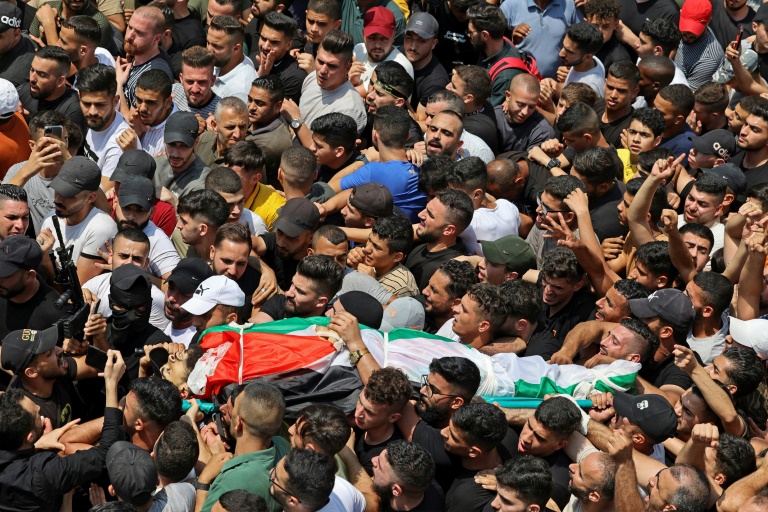
Hundreds of mourners gathered in Nablus for the funeral procession of the three dead, with some militants firing into the air as the bodies were carried through the crowd.

– Teens killed –

The Palestinian health ministry identified those killed as Nabulsi, Islam Sabbouh and Hussein Taha.

Jamal Taha said his 16-year-old son was killed while they were walking to work.

“The army was in the old city. My son went ahead of me to the market, he was carrying his food. There was shooting and four of us were injured,” he told AFP.

Later Tuesday, the Palestinian health ministry said 17-year-old Moamen Jaber was shot in the chest and killed by Israeli forces in Hebron.

An AFP photographer saw the teen’s body at a local hospital following clashes between Palestinians and Israeli soldiers.

In Nablus, heavy gunfire was heard as dozens of Israeli military vehicles brought traffic in one of the West Bank’s largest cities to a standstill.

Clashes with the Israeli army also broke out in other parts of the city, as Palestinians hurled stones at the troops.

“A violent clash developed with dozens of rioters who threw stones and threw explosives at the forces, who responded by means of crowd dispersal and shooting. Several injuries were confirmed,” the army said.

Security forces have conducted near-daily and often deadly operations in the West Bank in recent months, focusing on militants from the Islamic Jihad group.

– Deadly Gaza fighting –

On Friday, Israel launched what it called a “pre-emptive” aerial and artillery bombardment of Islamic Jihad positions in the Gaza Strip, leading militants in the coastal enclave to fire more than a thousand rockets in retaliation, according to the army.

An Egypt-brokered ceasefire reached Sunday ended three days of intense fighting that killed 46 Palestinians, 16 of them children, and wounded 360, according to Gaza’s health ministry.

Israel’s Lapid spoke by telephone with Egyptian President Abdel Fattah al-Sisi on Monday, with the premier praising Cairo for its role in “preserving regional stability and security”.

But following the Nablus raid, a spokesman for Palestinian president Mahmud Abbas said Israel is “not interested in calm and stability”.

“It’s exploiting and killing Palestinians for gains in internal Israeli politics,” Nabil Abu Rudeineh said, alluding to a snap Israeli general election called for November 1.

The Israeli prime minister said Monday the strikes on Gaza had hit the “entire senior military command of Islamic Jihad” in the Palestinian enclave.

Islamic Jihad said 12 of its members had been killed, including commanders Taysir al-Jabari and Khaled Mansour.

Israel insists that some civilians counted in the Palestinian toll were killed by Islamic Jihad rockets that fell short or misfired.
Kenyans vote in close-fought election race

Kenya voted for a new president on Tuesday against a backdrop of economic hardship and growing disenchantment with the political elite, with voting largely peaceful but producing low turnout in some areas.

The country is hoping for an orderly transition of power after almost a decade under two-term President Uhuru Kenyatta, but concerns about vote-rigging linger after past election disputes triggered deadly unrest.

Deputy President and erstwhile heir-apparent William Ruto, 55, is running against Raila Odinga, the 77-year-old veteran opposition leader now backed by longtime rival Kenyatta after a stunning shift in allegiances.

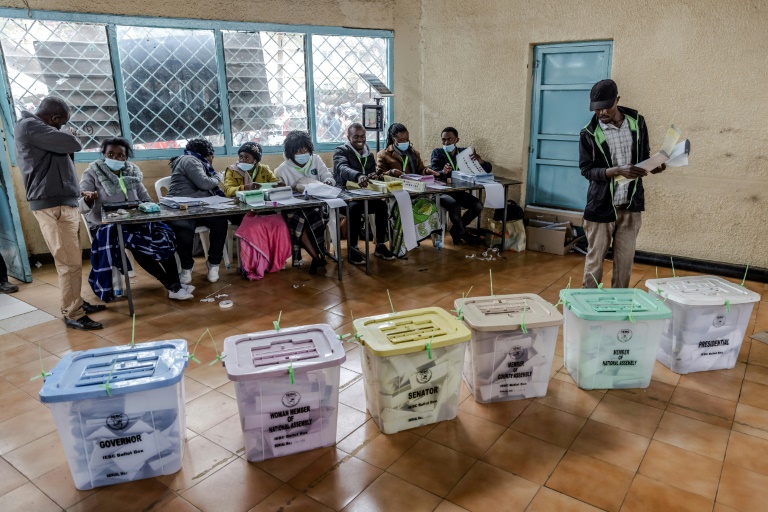
Voters lined up well before dawn to cast their ballots in what has been billed as a key test for democracy in a country where ordinary people have become frustrated with political leaders and their failure to deliver on their promises.

By 4:00 pm (1300 GMT), 10 hours after polling began, turnout was at just over 56 percent of the 22 million registered voters, according to the Independent Electoral and Boundaries Commission (IEBC).

Comparable figures for the August 2017 election were not immediately available but overall turnout then reached 78 percent.

Polls were due to close at 5:00 pm (1400 GMT), with some stations reporting sparse turnout as they shut their doors.

Others continued to host queues of waiting voters while polling stations whose opening was delayed will stay open until later.

“Those of them on the queue, all of them will vote — no-one will be turned away,” said Sylvia Amoni, an election officer in a central district of Nairobi.  

Many people said they hoped this year’s vote would make their lives easier as they struggle to put food on the table amid soaring inflation and a crippling drought.

“I have come to vote to pick someone who bring change to this country,” said unemployed 34-year-old Ruth Iminza in the Nairobi slum of Kibera.

“Everything has gone up including school fees for our children.”

– Hope for fair vote –

Pressure is on the IEBC to ensure a free and fair vote in all six polls — for the presidency as well as for senators, governors, lawmakers, woman representatives and some 1,500 county officials.

The IEBC acknowledged that about 200 electronic voter registration devices had failed, out of a total of more than 46,000.  

Polling was suspended in Wajir, a county bordering Somalia, after a gunfight left election officials trapped inside an office where ballots were stored, the IEBC said.

Police also fired tear gas after youths blocked a road with burning tyres in western Nakuru county after a local vote was suspended.

No presidential election outcome has gone uncontested since 2002, and there will be an anxious wait for this year’s results which are not expected for several days.

Analysts have suggested that Odinga, a onetime political prisoner and former prime minister who is making his fifth stab at the presidency, could edge past his younger rival.

If neither wins more than 50 percent, Kenya will stage a run-off for the first time in its history.

Ruto has painted the election as a battle between ordinary “hustlers” and “dynasties” — the Kenyatta and Odinga families that have dominated Kenyan politics since independence from Britain in 1963.

Since neither man belongs to the dominant Kikuyu tribe, which has produced three of the country’s four presidents, the election will open a new chapter in Kenya’s history.

If Odinga wins, his running mate Martha Karua — a Kikuyu — would become deputy president, the first woman to hold the post.

– ‘We want peace’ –

Kenya’s international partners are closely watching the vote in a country deemed a beacon of regional stability. 

Both Odinga and Ruto have urged a peaceful election, but fears remain that if the loser challenges the outcome — as widely expected — there could be unrest.

Security was tight, with more than 150,000 officers deployed across the country of about 50 million.

The trauma of the 2007 poll, which was followed by politically motivated ethnic clashes that killed more than 1,100 people, runs deep.

Odinga’s challenge to the 2017 election result that saw then foe Kenyatta re-elected was met with a heavy-handed police response that left dozens dead.

Some observers say economic pressure could vie with tribal allegiance as the big motivator for voters in a country where a third of the population lives in poverty.

The new president will have to tackle the cost-of-living crisis, youth unemployment, a $70-billion debt mountain and entrenched corruption.

But first, he will have to make peace with his opponent, Kenyans say.

“There should be no violence. Whoever wins, we will support them and the person who fails should support the winner,” said unemployed Mary Musera, who woke up at 3:00 am to vote in Kibera.

“We want peace.”

Endangered sharks, rays caught in protected Med areas: study

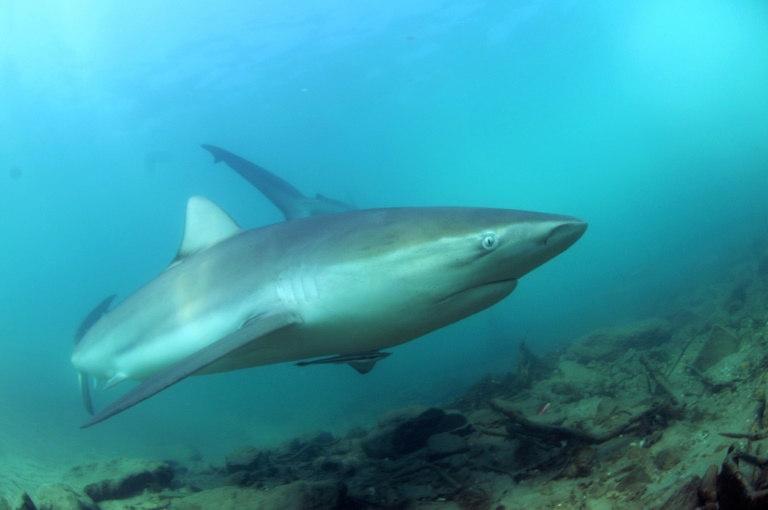
Endangered sharks, rays and skates in the Mediterranean are more frequently caught in protected than in unprotected areas, according to research published Tuesday highlighting the need for better conservation for critically threatened species.

The three types of elasmobranch are among the species most threatened by overfishing. 

While often landed as by-catch — or caught in nets of boats seeking to land other species — demand for their fins and meat has driven an estimated 71-percent decline in ocean sharks and rays since 1970. 

Although they are among the oldest marine species on Earth, their slow growth rate and late maturity mean one third of elasmobranchs are categorised by the International Union for the Conservation of Nature (IUCN) as at risk of extinction. 

While dozens of nations have banned large-scale fishing of endangered shark, ray and skate species, true global catch figures are likely to be hugely underestimated as 90 percent of the world’s fishing fleet is made up of small-scale boats.

Researchers in Italy wanted to get a better idea of how species fare in the Mediterranean’s partially protected areas, which allow some fishing with restrictions.

They used photo-sampling and image analysis to compile a database covering more than 1,200 small-scale fishing operations across 11 locations in France, Italy, Spain, Croatia, Slovenia and Greece. 

– Protected areas –

The team then used statistical models to demonstrate that catches of threatened species were higher in partially protected areas than in areas with no protection at all.

“People assume that it is large-scale trawlers that are impacting biodiversity, which is true and there’s a lot of evidence for this,” said co-author Antonio Di Franco, from the Sicily Marine Centre.

“There is less research on small-scale fishing’s impact and our research shows that there is this potential.”

The team found that catches they analysed in partially protected areas landed 24 species of shark, skate and ray — more than a third of which are endangered.

This is likely in part due to the species’ preference for coastal waters, where most small-scale fisheries prefer to operate. 

“We don’t know the activity of small-scale fisheries in general, we don’t know how many nets they actually fish or where they fish,” said Di Franco. 

Overall, in the partially protected areas studied, 517 elasmobranchs were caught compared with 358 in non-protected areas. 

In terms of mass, the weight of shark, ray or skate species caught in partially protected areas was roughly double that in non-protected areas.

More than 100 countries have committed to increase the amount of protected oceans worldwide to 30 percent by 2030.

Di Franco said there were a number of steps countries could take to help threatened species, including fitting smaller fishing boats with GPS trackers and ensuring that protected areas were joined up, allowing the species to more easily change living regions.

“Protected areas are a great potential benefit to biodiversity but the point is to look at management,” he told AFP. 

“But often countries don’t have the capacity to properly manage stocks.” 

War in Ukraine: latest developments

Here are the latest developments in the war in Ukraine:

– Suspicions over satellite launch –

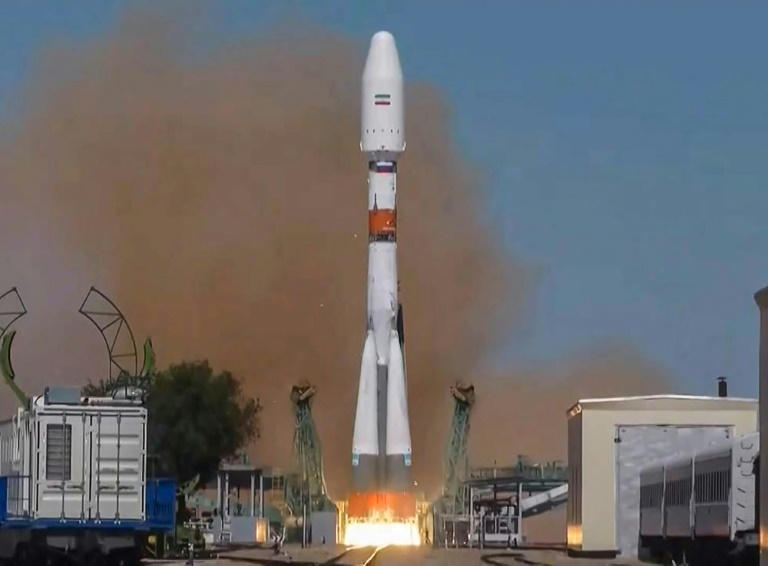
An Iranian satellite launched by Russia blasts off from Kazakhstan and reaches orbit amid suspicions that Moscow might use it to boost its surveillance of military targets in Ukraine.

Russia, increasingly isolated due to Western sanctions over its invasion of Ukraine, is seeking to find new clients for its embattled space programme in the Middle East, Asia and Africa.

Last week, The Washington Post quoted anonymous Western intelligence officials as saying that Russia “plans to use the satellite for several months or longer” to assist its war efforts before allowing Iran to take control.

The space agency of Iran, which has maintained ties with Moscow and refrained from criticism of the Ukraine invasion, stressed on Sunday that the Islamic republic would control the satellite “from day one” in an apparent reaction to the Post’s report.

– Oil supplies to three nations halted –

The supply of Russian oil to three European countries through Ukraine has been halted as the transit payment cannot be processed due to sanctions, Russian firm Transneft says.

It says deliveries to Hungary, Slovakia and the Czech Republic have been affected and that the Ukrainian side stopped the oil transport “due to not receiving funds for these services”. 

Since President Vladimir Putin sent troops to Ukraine, Washington and Brussels have slapped unprecedented sanctions on Moscow, cutting Russia off from international financial institutions. 

The EU has looked to reduce its dependence on Russian energy resources and has agreed to ban more than two-thirds of Russian oil imports.

– Explosions at Crimea airfield –  

Ammunition has detonated at an airfield in Moscow-annexed Crimea but there were no victims, the Russian defence ministry says. 

“Several aviation munitions detonated” near the settlement of Novofyodorovka, it says in a statement carried by Russian news agencies. “As a result of the explosion no one was hurt.”

– Two more grain ships leave Ukraine –

Two more cargo ships carrying grain have left Ukraine, Kyiv’s infrastructure ministry says, under a deal with Russia to ease agricultural exports from Ukrainian ports that had been blocked by the war.

It said that one of the ships, the Rahmi Yaggi, was bound for Turkey with 5,300 tons of products, while the Ocean Lion was carrying some 65,000 tons of corn to South Korea.

With the departures, a total of 12 ships have left three different Ukrainian Black Sea ports under the deal brokered in late July by the UN and Turkey.

Exports from Ukraine — one of the world’s biggest grain producers — had been halted by a Russian naval blockade and Ukrainian mining of the ports.

burs-jmy/eab/kjm

Spain police start wearing bodycams to boost security

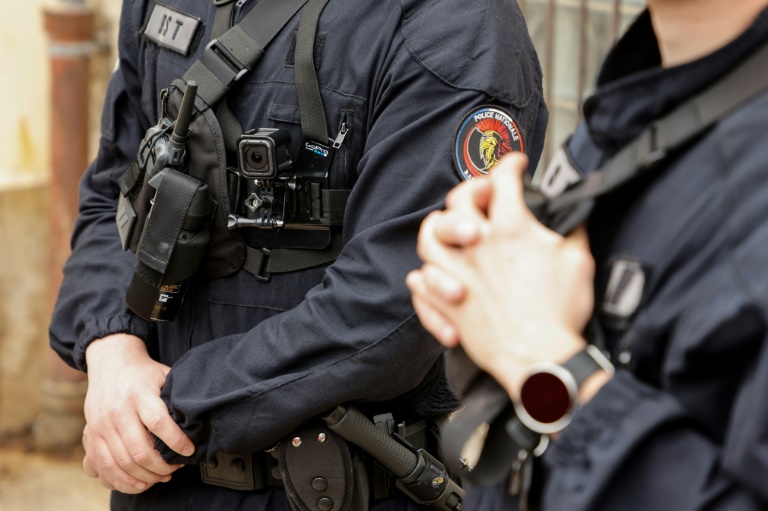
Spanish police have begun wearing body cameras to record their interactions with the public in a move aimed at ensuring greater security that is gaining ground in Europe and the US. 

The interior ministry said the bodycam was launched Monday and would be “rolled out on a gradual basis to all police officers”, without saying how many were involved in the initial stages. 

Spain’s TVE public television said the tiny cameras were being attached to the officers’ uniforms and could be activated either manually or automatically. 

The main Spanish police union JUPOL hailed the move on Twitter, saying it was in response to “a request that the union has been making”. 

“It will guarantee security, both for us to avoid any kind of misrepresentation of our interventions, as well as for the public, who will be able to clearly see the police’s professionalism and that there is no abuse of power nor excesses,” union spokesman Pablo Perez told TVE.

Forces in Europe and the United States are increasingly turning to such technology to boost transparency following a string of fatal shootings and other claims against police over the past decade.

“The cameras are being used under public safety protocols in order to record everything that happens in the event of an unwarranted offence during an operation,” Spanish Interior Minister Fernando Grande Marlaska told TVE ahead of the rollout. 

“If they are activated, it is to guarantee security and really be transparent so that the officers’ actions can be seen and checked,” the minister said.

“This means security for both the police and the public,” he added, suggesting that in time, they would also be available to Spain’s Guardia Civil rural police force.

France began trialling bodycams, known as “pedestrian cameras”, in 2013 before a gradual rollout in 2015 in a move welcomed by police, but greeted with scepticism by rights groups who said there was no guarantee they would be always activated.

Police in London and New York also began pilot schemes in 2014 with credit-card sized cameras clipped onto their uniforms with the technology gradually deployed over the following years.

But the cameras have had mixed success. The absence of any legal obligation governing their use can also limit their scope to uncover police misconduct.

France readies rescue of beluga astray in Seine

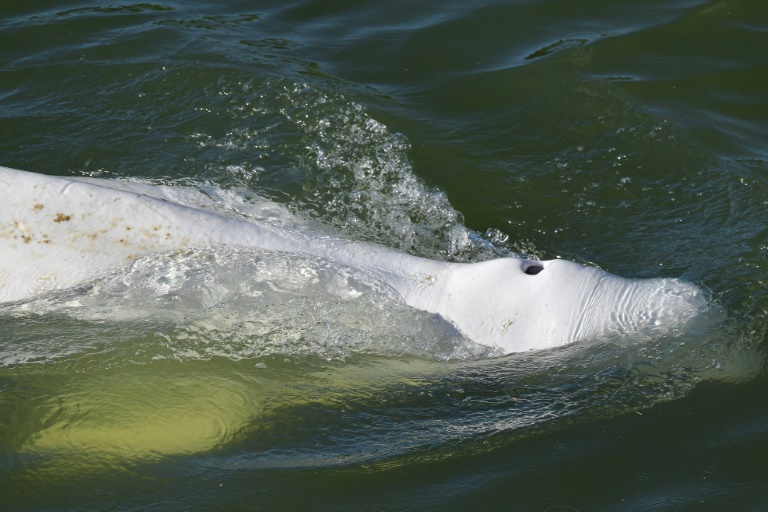
Marine experts will attempt Tuesday to rescue a beluga whale that swam up the Seine river and return it to the sea, officials said, a complex and risky operation for an animal already sick and malnourished.

The four-metre (13-foot) cetacean, a protected species usually found in cold Arctic waters, was spotted a week ago heading towards Paris, and is now some 130 kilometres inland.

“An operation to transport the beluga astray in the Seine will be attempted this evening,” said government officials in the Eure department, who are orchestrating the effort.

The animal’s progress inland has been blocked by a lock at Saint-Pierre-La-Garenne in Normandy, and its health has deteriorated after it refused to eat.

But its condition is currently “satisfactory”, Isabelle Brasseur of the Marineland sea animal park in southern France, Europe’s biggest, told AFP.

She is part of a Marineland team sent to assist with the rescue, alongside the Sea Shepherd France NGO.

“What’s exceptional is that here the banks of the Seine are not accessible for vehicles… everything is going to have to be done by hand,” Brasseur said.

So far the beluga has not turned around, and experts have dismissed any attempt to “nudge” it back toward the English Channel with boats, saying it would stress the weakened animal and probably be futile in any case.

Starting at around 8:00 pm (1800 GMT), the team will try to get the animal weighing 800 kilogrammes (nearly 1,800 pounds) onto a truck and drive it to an undisclosed seawater basin where it can be treated before being released, the Eure authorities said.

The Sea Shepherd France NGO, which is assisting the operation, said Tuesday that tranquilisation is not an option, since belugas are so-called “voluntary breathers” that need to be awake to inhale air.

– ‘Have to get it out’ –

“In any case, we have to get it out of there… and try to figure out what is wrong,” Brasseur said.

Veterinarians will keep constant surveillance during the move.

“There may be internal problems that we can’t see,” she said despite the fact that belugas are “extremely hardy” as a species.

Interest in the beluga’s fate has spread far beyond France, generating a large influx of financial donations and other aid from conservation groups as well as individuals, officials said.

Sea Shepherd on Monday issued an appeal in particular for heavy-duty ropes, nets, mattresses and other equipment. 

Belugas are normally found only in cold Arctic waters, and while they migrate south in the autumn to feed as ice forms, they rarely venture so far.

According to France’s Pelagis Observatory, specialised in sea mammals, the nearest beluga population is off the Svalbard archipelago, north of Norway, 3,000 kilometres from the Seine.

Lowest July Antarctic sea ice on record: monitor

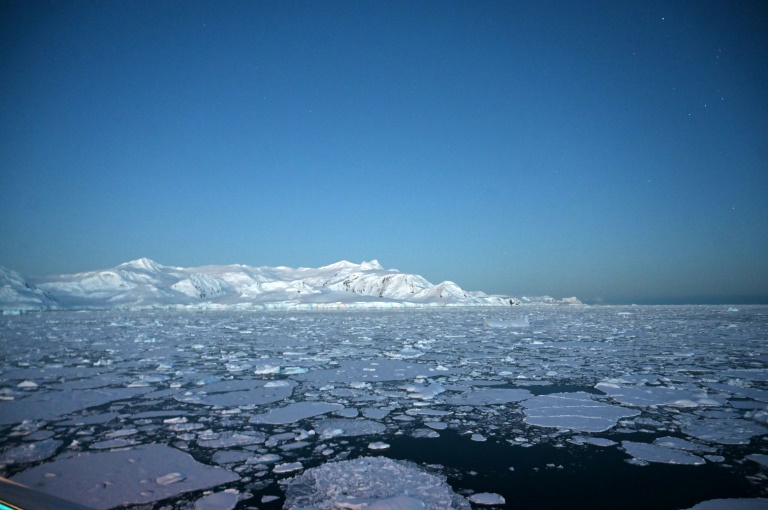
Last month saw the lowest extent of Antarctic sea ice on record for July, according to the European Union’s satellite monitoring group. 

The Copernicus Climate Change Service (C3S) found  Antarctic sea ice extent reached 15.3 million square kilometres (5,900,000 square miles) — some 1.1 million km2, or seven percent, below the 1991-2020 average for July. 

This was the lowest ice cover for July since satellite records began 44 years ago, and followed record low Antarctic sea ice levels for June too.

C3S said the low ice values continued a string of below-average monthly extents observed since February 2022.

The service said in its monthly bulletin the Southern Ocean saw “widespread areas of below-average sea ice concentration” last month. 

Arctic sea ice cover meanwhile was four percent lower than average, making it the 12th lowest July sea ice extent on record. 

In a month that saw temperature records broken across parts of northern Europe and Britain, C3S said July was drier than average for much of the continent, noting a number of low-precipitation records in several locations. 

“These conditions affected the economy locally and facilitated the spread and intensification of wildfires,” it said. 

C3S said July was also abnormally dry across much of North America, South America, Central Asia and Australia.

Climate change makes extreme heat and drought more likely to occur.

“We can expect to continue seeing more frequent and longer periods of extremely high temperatures, as global temperatures increase further,” said senior C3S scientist Freja Vamborg. 

The service said last month was however wetter than usual in eastern Russia, northern China and in a large wet band spanning from eastern Africa across Asia to northwest India.

Stock markets mostly drop on eve of US inflation

Stock markets mostly retreated and the dollar dropped Tuesday on the eve of key US inflation data.

Investors are on edge ahead of Wednesday’s figures, with some observers warning that an above-estimate reading on inflation, which is already at a four-decade high, could spur another sharp market sell-off.

There is a growing expectation also that central bank interest rate hikes aimed at curbing soaring prices will go too far and tip the global economy into recession.

Swissquote Bank analyst Ipek Ozkardeskaya said the recent drop in energy and commodity prices “should have a cooling effect on inflation, yet, higher labour costs could keep inflation sticky at undesirably high levels”.

Oil prices rose but remain around six-month lows as recession fears mount and traders fret over the impact on demand. 

They are keeping tabs also on Iran nuclear talks after the European Union submitted a “final text” at negotiations to salvage a 2015 deal.

An agreement could open the way for Tehran to resume sales of crude on international markets, partly helping to plug a hole left by the ban on Russian exports following the invasion of Ukraine. 

Edward Moya, analyst at OANDA trading group, said “it seems unlikely a breakthrough will happen anytime soon. 

“Tehran seems like they are willing to negotiate, but an imminent decision to agree to the EU’s proposal seems unlikely”, he added.

European and Asian stock markets mainly retreated after Wall Street provided a glum lead overnight.

Tech firms took a hit following a disappointing earnings report from chip giant Nvidia, seen as a warning that the end of the downturn was still some way off.

“While it’s tempting to buy into the narrative that we’ve seen the lows of the year, none of the price action thus far serves to support that conclusion,” said CMC Markets analyst Michael Hewson.

“Nvidia’s profit warning merely serves to underline the challenges facing, not only the tech sector, but the wider global economy.”

Hong Kong reversed a morning rally after its government denied claims it was considering removing an extra stamp duty for mainland Chinese buying property in the city.

– Key figures at around 1100 GMT –

London – FTSE 100: FLAT at 7,480.32 points

Frankfurt – DAX: DOWN 0.9 percent at 13,565.22

Paris – CAC 40: DOWN 0.4 percent at 6,499.55

EURO STOXX 50: DOWN 0.7 percent at 3,729.89

Tokyo – Nikkei 225: DOWN 0.9 percent at 27,999.96 (close)

Hong Kong – Hang Seng Index: DOWN 0.2 percent at 20,003.44 (close)

Shanghai – Composite: UP 0.3 percent at 3,247.43 (close)

New York – Dow: UP 0.1 percent at 32,832.54 (close)

Euro/dollar: UP at $1.0227 from $1.0194 Monday

Pound/dollar: UP at $1.2101 from $1.2079

Euro/pound: UP at 84.51 pence from 84.35 pence

Dollar/yen: DOWN at 134.91 yen from 134.98 yen

Brent North Sea crude: UP 1.0 percent at $97.65 per barrel

West Texas Intermediate: UP 1.0 percent at $91.68 per barrel

Taiwan accuses China of preparing invasion, holds defence drill

Taiwan held an artillery drill Tuesday simulating defence against an attack as its top diplomat accused Beijing of preparing to invade the island after days of massive Chinese war games.

China launched its largest-ever air and sea exercises around Taiwan last week in a furious response to a tour by US House Speaker Nancy Pelosi, the highest-ranking American official to visit the self-ruled island in decades. 

Taiwan lives under the constant threat of invasion by China, which views its neighbour as part of Chinese territory to be seized one day — by force if necessary.

“China has used the drills in its military playbook to prepare for the invasion of Taiwan,” foreign minister Joseph Wu told a press conference in Taipei on Tuesday, accusing Beijing of using Pelosi’s visit as a pretext for military action.

“China’s real intention is to alter the status quo in the Taiwan Strait and entire region.”

The Chinese military said its Taiwan drills continued Tuesday and involved air and sea units.

The Eastern Theater Command of the People’s Liberation Army said in a statement that it was conducting training exercises around the island, “focusing on joint blockade and joint support operations”.

Taiwan’s military said it detected 45 Chinese planes and 10 ships operating in the Taiwan Strait on Tuesday, with 16 planes crossing the median line — —  an unofficial demarcation between China and Taiwan that Beijing does not recognise.

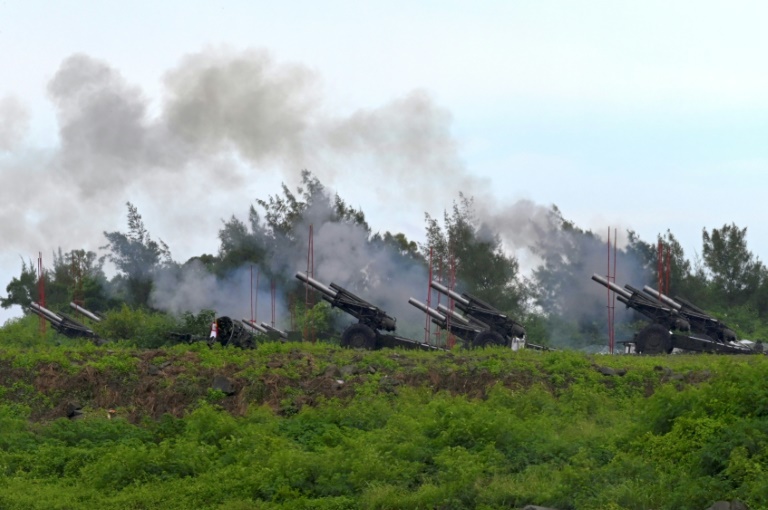
Lasting just under an hour, Taiwan’s drill in the southern county of Pingtung included the firing of target flares and artillery, lasting just under an hour, said Lou Woei-jye, spokesman for Taiwan’s Eighth Army Corps.

Soldiers fired from howitzers tucked into the coast, hidden from view of the road that leads to popular beach destination Kenting.

The drills, which will also take place Thursday, included the deployment of hundreds of troops and about 40 howitzers, the army said. 

Tuesday’s exercise attracted a crowd of onlookers.

“We need to have some countermeasures against mainland China’s blockade,” said one of the spectators, who only gave his surname Chen.

“Conducting military drills will also let them know Taiwan is prepared. I hope both sides can have some restraint.”

On Monday, spokesman Lou told AFP the drills were previously scheduled and were not in response to China’s exercises. 

The island routinely stages military drills simulating defence against a Chinese invasion.

But the latest drill prompted an ominous warning from Beijing, which regularly unleashes fiery rhetoric against Taiwan’s independence hopes.

“Any conspiracy to go against the trend of history and resist reunification through arms… will end in failure like a mantis trying to stop a chariot,” foreign ministry spokesman Wang Wenbin told a regular briefing Tuesday.

– ‘Not worried’ –

The anti-landing exercise took place after China extended its own joint sea and air drills around Taiwan on Monday, but Washington said it did not expect an escalation from Beijing.

“I’m not worried, but I’m concerned they’re moving as much as they are. But I don’t think they’re going to do anything more than they are,” US President Joe Biden told reporters at Dover Air Force Base.

Taiwan’s Wu on Tuesday condemned Beijing for pressing on with military exercises around the island, accusing them of trying to control the Taiwan Strait and waters in the wider Asia-Pacific region.

“It is conducting large-scale military exercises and missile launches, as well as cyber-attacks, a disinformation campaign and economic coercion in order to weaken public morale in Taiwan,” he said.

Wu went on to thank Western allies, including the US, for standing up to China.

“It also sends a clear message to the world that democracy will not bow to the intimidation of authoritarianism,” he said.

Taiwan has insisted that no Chinese warplanes or ships entered its territorial waters — within 12 nautical miles of land — during Beijing’s drills.

But its defence ministry said Tuesday the extension of the drills showed China’s “threat of force has not diminished” around the island and all of its units would “maintain combat readiness”.

The Chinese military released a video last week of an air force pilot filming the island’s coastline from his cockpit, showing how close it came to Taiwan’s shores.

On Tuesday, the Chinese military released more details about the anti-submarine drills it had conducted a day earlier around the island.

The Eastern Theater Command said the exercises were aimed at enhancing the ability of air and sea units to work together while hunting submarines.

The scale and intensity of China’s drills — as well as its withdrawal from key talks on climate and defence — have triggered outrage in the United States and other democracies.

But foreign ministry spokesman Wang on Monday defended Beijing’s behaviour as “firm, forceful and appropriate” to American provocation. 

“We urge the US to do some earnest reflection, and immediately correct its mistakes,” he told a regular briefing.

France readies 'exceptional' rescue of beluga astray in Seine

French officials are moving ahead with a delicate plan to transport a beluga whale back to the ocean after it swam far up the Seine river toward Paris, putting its life in danger, a marine expert said Tuesday.

The four-metre (13-foot) cetacean was discovered a week ago and appears sick and underweight but its condition is “satisfactory,” Isabelle Brasseur of the Marineland sea animal park in southern France, Europe’s biggest, told AFP.

“As of this morning we have an idea of something that could work, we’re going to explain and refine it with the people who are going to help us,” she said.

Belugas are a protected species that cannot survive long in fresh water. 

This one is currently around 130 kilometres (80 miles) inland from the English Channel at Saint-Pierre-La-Garenne in Normandy.

“What’s exceptional is that here the banks of the Seine are not accessible for vehicles… everything is going to have to be done by hand,” Brasseur said.

It is stuck behind a lock and unable to move further inland — it’s now some 80 kilometres from the French capital — but is not turning around, and officials warn that attempts to “nudge” the beluga back toward the sea are not viable.

The idea is to take the beluga by road to an undisclosed seawater basin where it can be treated before being released. 

But the challenges are considerable and the journey is likely to further stress an animal weighing 800 kilogrammes (nearly 1,800 pounds).

The Sea Shepherd France NGO, which is assisting the operation, said in a statement Tuesday that tranquilisation was not an option, since belugas are so-called “voluntary breathers” that need to be awake to inhale air.

– Appeal for donations –

“In any case, we have to get it out of there… and try to figure out what is wrong,” Brasseur said.

Veterinarians will keep constant surveillance during the move.

“There may be internal problems that we can’t see,” she said despite the fact that belugas are “extremely hardy” as a species.

Sea Shepherd has issued an appeal for donations of heavy-duty ropes, nets, mattresses and other equipment. 

Belugas are normally found only in cold Arctic waters, and while they migrate south in the autumn to feed as ice forms, they rarely venture so far.

According to France’s Pelagis Observatory, specialised in sea mammals, the nearest beluga population is off the Svalbard archipelago, north of Norway, 3,000 kilometres from the Seine.

Close Bitnami banner
Bitnami