World

The women desperate to work in Taliban-ruled Afghanistan

Since their takeover a year ago, the Taliban have squeezed Afghan women out of public life, imposing suffocating restrictions on where they can work, how they can travel, and what they can wear.

There is hardly a woman in the country who has not lost a male relative in successive wars, while many of their husbands, fathers, sons and brothers have also lost their jobs or seen their income shattered as a result of a deepening economic crisis. 

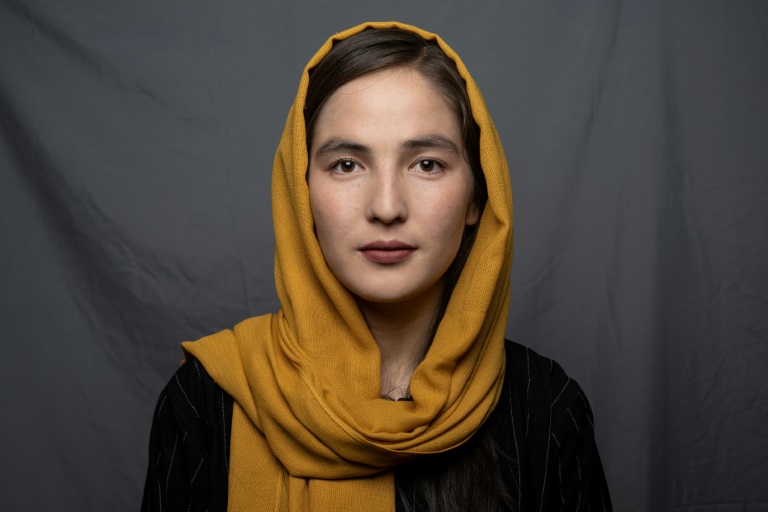
AFP took a series of portraits of women in major cities — Kabul, Herat and Kandahar — who are trying to keep households together by whatever means they can.

“During these hard times, it is my job that has made me happy,” 40-year-old baker Shapari told AFP.

“My husband is jobless, and staying at home. I am able to find food for my children.”

Women have been barred from most government employment — or had their salaries slashed and told to stay at home.

They are often also first to be sacked from struggling private businesses — particularly those unable to segregate the workplace in line with Taliban rules.

Some jobs remain open, though women face far steeper obstacles than male colleagues.

– ‘Queen of the honey bees’ –

Tahmina Usmani, 23, is one of a few women journalists who have been able to continue working in the sector.

In order to circumvent a Taliban order to cover their faces while on the air, she and others at Afghanistan’s news broadcaster TOLOnews wear a Covid face mask.

“I was able to join TOLOnews and be the voice for women in Afghanistan, which makes me feel great,” she said.

Ghuncha Gul Karimi, another woman photographed by AFP, grew her beekeeping business to produce honey for sale after her husband left the country.

“I’ve taken up two extra jobs and bought a motorcycle to drive myself from the honey farm and back,” she said.

“I am determined to become the queen of honey bees.”

Even before the Taliban’s return to power, Afghanistan was a deeply conservative, patriarchal country with progress in women’s rights limited largely to major cities.

Women generally cover their hair with scarves, while the burqa –- mandatory for all women under the Taliban’s first regime, from 1996 to 2001 –- continued to be widely worn, particularly outside the capital Kabul.

Earlier this year, the religious police ordered women to cover themselves completely in public, preferably including their faces.

Nagasaki mayor warns of 'crisis' on atom bomb anniversary

Nuclear weapons present a “tangible and present crisis” after Russia’s invasion of Ukraine, the mayor of Nagasaki said Tuesday, the 77th anniversary of the atomic bombing that destroyed the Japanese city.

On August 9, 1945, Nagasaki was flattened in an inferno that killed 74,000 people, three days after the world’s first nuclear bomb attack in Hiroshima.

The twin strikes by the United States led to the end of World War II, and to this day Japan remains the only country to be hit by atomic weapons in wartime.

But on Tuesday, mayor Tomihisa Taue sounded a note of alarm.

“In January this year, the leaders of the United States, Russia, the United Kingdom, France and China released a joint statement affirming that ‘a nuclear war cannot be won and must never be fought’,” he said.

“However, the very next month Russia invaded Ukraine. Threats of using nuclear weapons have been made, sending shivers throughout the globe.

“The use of nuclear weapons is not a ‘groundless fear’ but a ‘tangible and present crisis’,” Taue said, warning that they could be unleashed through mistaken judgements, malfunctions or in terror attacks.

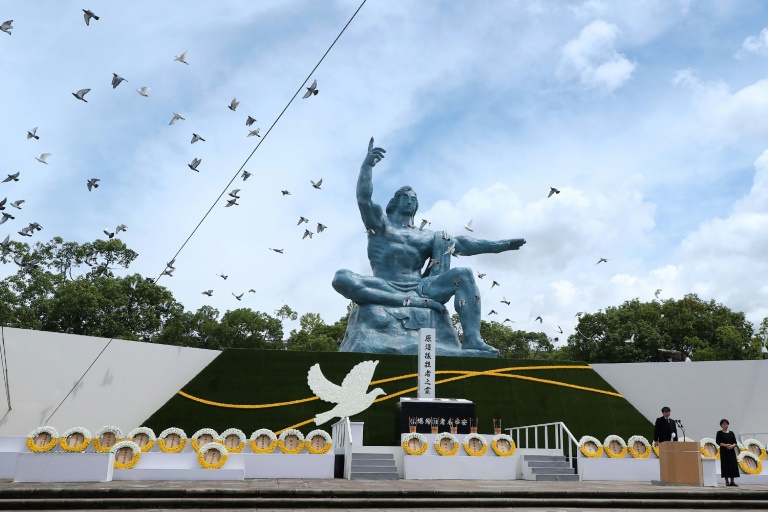
Survivors and foreign dignitaries joined by hundreds of members of the public offered a silent prayer at 11:02 am (0202 GMT), the exact moment the bomb was dropped on the port city.

Bells rang out and doves were released during the sombre memorial at Nagasaki’s Peace Park, with purified water offered in a prayer ceremony for the victims who died of burns and other injuries.

Instead of waging war, mankind should foster “a ‘culture of peace’ that spreads trust, respects others and seeks resolutions through dialogue”, Taue said.

On Saturday, UN head Antonio Guterres gave a speech in Hiroshima on the anniversary of the attack that killed around 140,000 people, including those who perished after the blast from radiation exposure.

He warned that “humanity is playing with a loaded gun” as crises with the potential for nuclear disaster proliferate worldwide.

A message from Guterres, read out in Japanese at Tuesday’s ceremony, said that “in these times of high tensions and low levels of trust, we should draw on the lessons of Nagasaki”.

Japan has long called for a world free of nuclear weapons but has not joined a nuclear ban treaty that took effect in 2021, saying it hopes to bridge the gap between nuclear powers which did not join the treaty and non-nuclear countries.

Taiwan holds military drill as China accused of preparing invasion

Taiwan held an artillery drill Tuesday simulating a defence against an attack as its top diplomat accused Beijing of preparing to invade the island after days of massive Chinese war games.

China launched its largest-ever air and sea exercises around Taiwan last week in a furious response to a visit by US House Speaker Nancy Pelosi, the highest-ranking American official to visit the self-ruled island in decades. 

Taiwan lives under the constant threat of invasion by China, which views its neighbour as part of Chinese territory to be seized one day, by force if necessary.

“China has used the drills and its military playbook to prepare for the invasion of Taiwan,” Joseph Wu told a press conference in Taipei on Tuesday, accusing Beijing of using Pelosi’s visit as a pretext for military action.

“China’s real intention is to alter the status quo in the Taiwan Strait and entire region,” he said.

Taipei’s drill started in the southern county of Pingtung shortly after 0040 GMT with the firing of target flares and artillery, ending just under an hour later at 0130 GMT, said Lou Woei-jye, spokesman for Taiwan’s Eighth Army Corps. 

Soldiers fired from howitzers tucked into the coast, hidden from view of the road that leads to popular beach destination Kenting.

The drills, which will also take place Thursday, included the deployment of hundreds of troops and about 40 howitzers, the army said. 

On Monday, Lou told AFP the drills had been scheduled previously and were not in response to China’s exercises. 

The island routinely stages military drills simulating defence against a Chinese invasion, and last month practised repelling attacks from the sea in a “joint interception operation” as part of its largest annual exercises.

The anti-landing exercises come after China extended its own joint sea and air drills around Taiwan on Monday, but Washington said it did not expect an escalation from Beijing.

“I’m not worried, but I’m concerned they’re moving as much as they are. But I don’t think they’re going to do anything more than they are,” Biden told reporters at Dover Air Force Base.

China has not confirmed if its drills in the Taiwan Strait will continue Tuesday.

But Taiwanese foreign minister Joseph Wu condemned Beijing for extending its military exercises around the island, accusing them of trying to control the Taiwan Strait and waters in the wider Asia-Pacific region.

“It is conducting large-scale military exercises and missile launches, as well as cyber-attacks, a disinformation campaign and economic coercion in order to weaken public morale in Taiwan,” he said.

Wu went on to thank Western allies, including the US after Pelosi’s visit, for standing up to China.

“It also sends a clear message to the world that democracy will not bow to the intimidation of authoritarianism,” he said.

– ‘Not worried’ –

Taiwan has insisted that no Chinese warplanes or ships entered its territorial waters — within 12 nautical miles of land — during Beijing’s drills.

The Chinese military, however, released a video last week of an air force pilot filming the island’s coastline and mountains from his cockpit, showing how close it had come to Taiwan’s shores.

Its ships and planes have also regularly crossed the median line —  an unofficial demarcation between China and Taiwan that the former does not recognise — since drills began last week.

Ballistic missiles were fired over Taiwan’s capital, Taipei, during the exercises last week, according to Chinese state media.

On Tuesday, the Chinese military released more details about the anti-submarine drills it had conducted a day earlier around the island.

The People’s Liberation Army’s Eastern Theater command said the exercises were aimed at enhancing the ability of air and sea units to work together while hunting submarines.

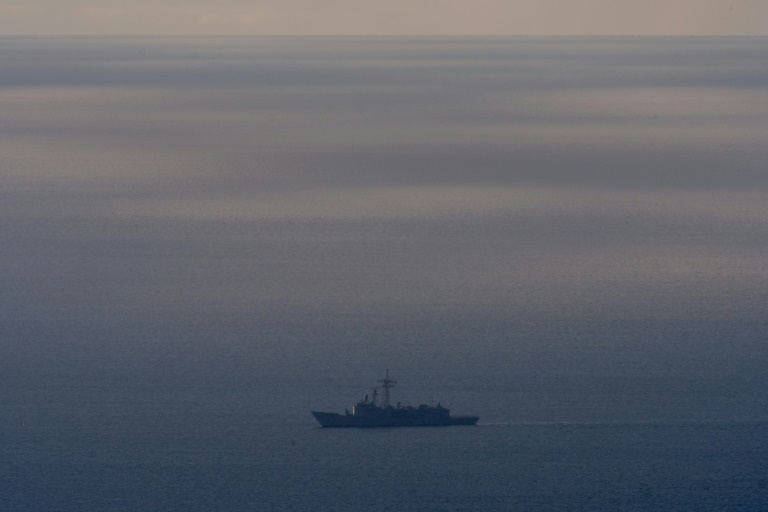
It said maritime patrol aircraft, fighter jets, helicopters and a destroyer practiced locating and attacking targets in the waters off Taiwan.

The scale and intensity of China’s drills — as well as its withdrawal from key talks on climate and defence — have triggered outrage in the United States and other democracies.

The drills have also shown how an increasingly emboldened Chinese military could carry out a gruelling blockade of the island, experts say.

But Beijing on Monday defended its behaviour as “firm, forceful and appropriate” to American provocation. 

“(We) are only issuing a warning to the perpetrators,” foreign ministry spokesman Wang Wenbin told a regular briefing, promising China would “firmly smash the Taiwan authorities’ illusion of gaining independence through the US”.

“We urge the US to do some earnest reflection, and immediately correct its mistakes.”

'Happy that infidels are out': Afghan Taliban fighters

The Taliban are a hardline Islamist movement that originated in Afghanistan’s southern province of Kandahar in the 1990s. 

They take their name from “talib”, the Arabic word for student — a reference to the Islamic colleges or madrassas their cadres emerged from.

Following a lightning offensive that pushed US-led forces out after 20 years of military presence, the group made a stunning return to power on August 15 last year.

Led by a reclusive cleric named Hibatullah Akhundzada, the Taliban are consolidating their power on the back of tens of thousands of fighters who fought the deadly insurgency.

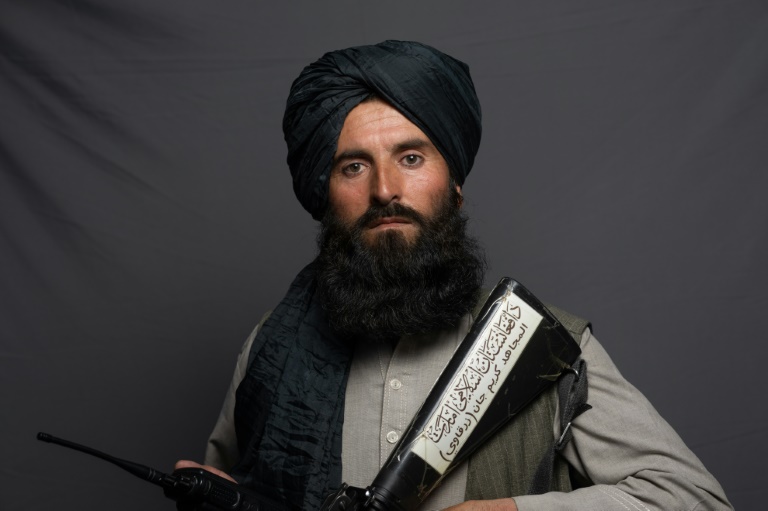
AFP took a series of portraits of Taliban fighters in Kandahar, the movement’s power centre, and also in the capital, Kabul.

“I’m happy that the infidels are out and the mujahideen (fighters) have established their rule,” said fighter Sharifullah Khobib, 22, from Kandahar.

Carrying an AK-47 and dressed in a traditional shalwar kameez and black turban, the fighter was happy that an “Islamic government was back in power”.

Several fighters said that Afghanistan was now safe for the first time in decades.

“I’m a military man and I can say that no Afghan is now being killed, which means everyone is safe,” said Mohammad Waleed, 30, a guard at a Shiite mosque in Kabul.

Islamic State jihadists have claimed several attacks on minority groups, including targeting Shiite mosques since the Taliban takeover.

Many fighters deployed in Kabul come from further afield, but primarily the Pashtun ethnic group form the bulk of the movement’s cadre.

Most have studied in Sunni madrassas in Pakistan, and for them, establishing a system based on sharia has been the biggest achievement of the war.

“All men and women can now live freely across Afghanistan,” said fighter Niamatullah, 27.

The Taliban’s austere interpretation of sharia has put severe restrictions on Afghan women, squeezing them out of public life, many government jobs and education.

But for the fighters, their only regret is the government is still not recognised internationally.

“While we are happy to have a new Islamic government, it is sad the world has still not recognised us,” said Matiullah Qureshi, 22, as he took his position at a checkpoint in Kandahar. 

dl-abh-jd-fox/ser/ssy

Jittery Kenya votes in close-fought election race

Kenyans lined up to vote in a high-stakes election Tuesday, with the East African powerhouse on edge as two political heavyweights battle it out in a fiercely contested race for the presidency.

Kenyans are praying for a peaceful transition of power after almost a decade under President Uhuru Kenyatta, but concerns about vote-rigging linger in a nation still haunted by previous election disputes that descended into deadly violence.

More than 22 million have registered to vote in an election taking place against a backdrop of soaring prices for food and fuel, a punishing drought that has left millions hungry, and deep disenchantment with the political elite, particularly among the youth.

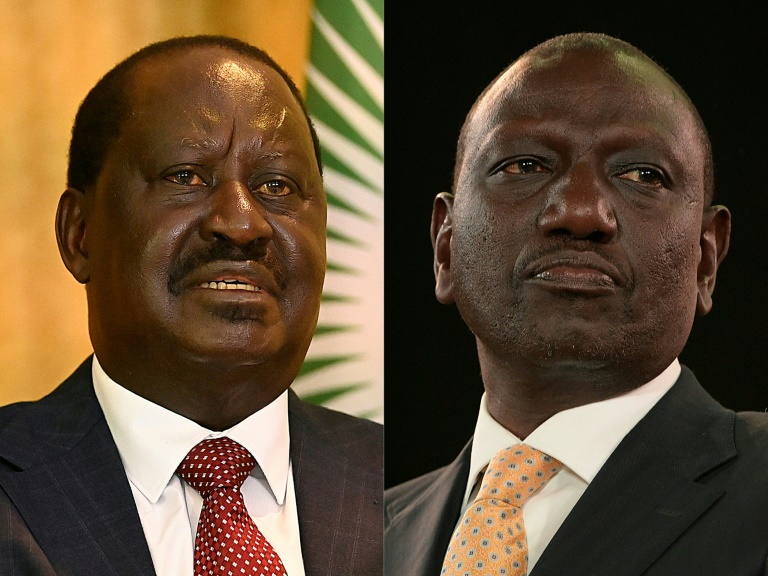
The deputy president and erstwhile heir apparent William Ruto, 55, is pitted against Raila Odinga, the 77-year-old veteran opposition leader now backed by Kenyatta after a stunning shift in political allegiances.

Before dawn in Odinga’s stronghold in the lakeside city of Kisumu, voters in lines many hundreds of metres long queued in the dark outside polling stations as motorcyclists passed by honking and blowing whistles.

Moses Otieno Onam, 29, said woke up at 3:00 am to be near the front of the queue in Obunga, an informal settlement in the city centre.

“I woke up early so that I go and choose my leader who might bring change. I have hope in that,” he told AFP.

Polling stations opened from 6:00 am (0300 GMT) and are due to close at 5:00 pm (1400 GMT).

Analysts have in recent days suggested that Odinga, a onetime political prisoner and former prime minister who is making his fifth bid for the job, could narrowly edge past his younger rival.

But if neither wins more than 50 percent, Kenya would be forced to hold a run-off for the first time in its history.

Despite mudslinging on the hustings and widespread disinformation, campaigning passed off largely peacefully in contrast to previous polls.

Pressure is on the Independent Electoral and Boundaries Commission to ensure a free and fair vote in all six polls — for the presidency as well as for senators, governors, lawmakers, woman representatives and some 1,500 county officials.

But already, the election has run into some hitches, with six IEBC officials arrested Monday and the commission suspending constituency or gubernatorial polls in several counties because of erroneous ballot papers.

IEBC head Wafula Chebukati vowed that the body would not hesitate to take “stern action” against any official flouting election laws. 

– Beacon of stability –

Kenya’s international partners are keenly watching the vote in a country considered a beacon of stability and democracy in a troubled region, with diplomats voicing cautious optimism it will pass off largely violence-free.

Both Odinga and Ruto have called for a peaceful vote, but fears remain that if the losing candidate challenges the outcome — as widely expected — the discord could erupt into street fighting.

Security is tight, with more than 150,000 officers being deployed.

The trauma of the 2007 election, which was followed by a horrific bout of politically motivated ethnic clashes that killed more than 1,100 people, still looms large.

And Odinga’s challenge to the 2017 election result that saw then foe Kenyatta re-elected was met with a heavy-handed police response which left dozens dead.

The Supreme Court ordered a rerun in 2017, citing widespread irregularities in the counting process and mismanagement by the IEBC.

No presidential election outcome has gone uncontested since 2002, and there will be an anxious wait for this year’s results which are not expected for several days.

“Kenya votes, East Africa holds breath,” was the headline in The East African regional newspaper.

With neither Ruto nor Odinga belonging to the dominant Kikuyu tribe, which has produced three of the country’s four presidents, the election will open a new chapter in Kenya’s history.

– ‘Jobs, jobs, jobs’ –

Ruto, who said he once sold chickens on the roadside, has painted the election as a battle between ordinary “hustlers” and “dynasties” — the Kenyatta and Odinga families that have dominated Kenyan politics since independence from Britain in 1963.

Some observers say economic pressures could compete with tribal allegiances as the key factor driving voter behaviour in a country where a third of the population lives in poverty.

“The reshaped electoral chessboard means the outcome will probably come down to the degree to which Odinga and Ruto can muster support outside their respective bases,” the International Crisis Group’s East and Southern Africa analyst Meron Elias said in a note.

Lawyers David Mwaure and George Wajackoyah — the latter an eccentric former spy who wants to legalise marijuana — are also running but are likely to trail far behind the frontrunners.

If Odinga wins, his running mate Martha Karua would become deputy president, the first woman to hold the post.

Both candidates have vowed to get the economy back on its feet, rein in Kenya’s mammoth $70 billion debt mountain and tackle the corruption that infects every level of society.

Already hit hard by the Covid pandemic that threw hundreds of thousands out of work, Kenyans are now battling soaring inflation as the Ukraine war sends prices of basic necessities spiralling.

Kurdish Iraqi farmer sprouts online advice, green awareness

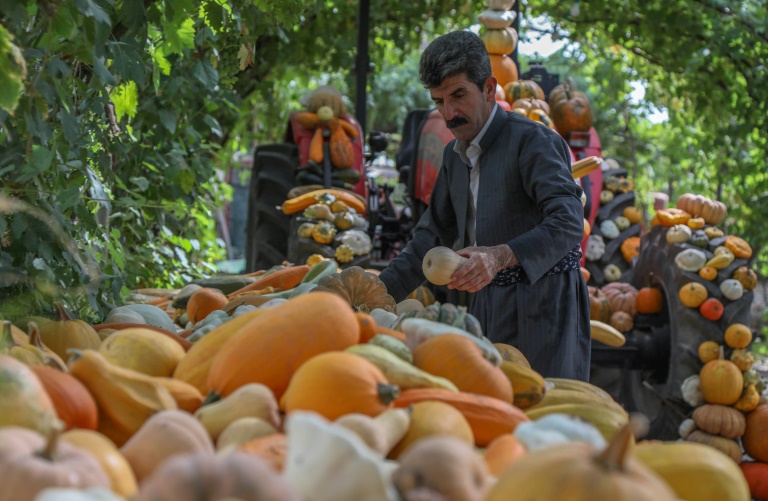
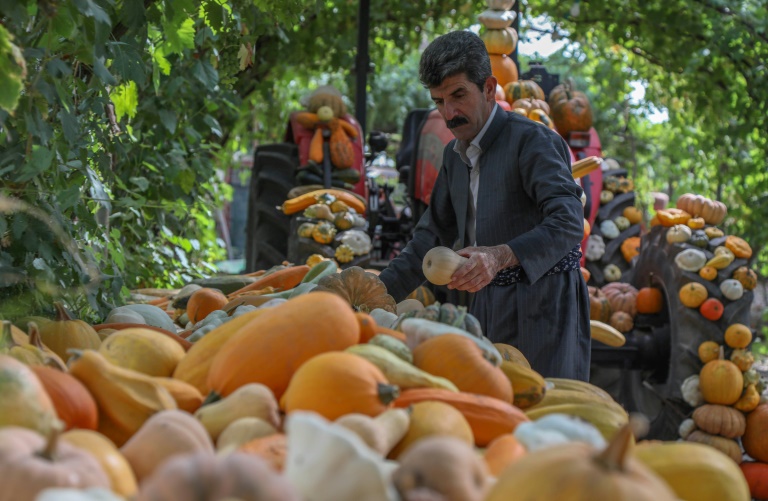
Kurdish Iraqi farmer Azad Muhamad has become a social media star by sharing tips on growing fresh fruit and vegetables in the sun-parched country that is highly vulnerable to climate change.  

The moustachioed 50-year-old with almost half a million Facebook followers posts weekly videos on topics such as protecting fruit trees, dealing with insects and helping people get more from their farms and gardens.

“They should make you agriculture minister,” one of his fans, Ahmed Hassan, commented on a recent video.

Muhamad also uses his popular online platform to raise awareness about protecting the environment and the need to support local farmers, in his native Kurdistan region and beyond.

“Developed-country farmers have government support and harvesting machines,” said Muhamad. 

“Our farmers do everything themselves with their own sweat — and when they lose money at the end of the year, they start over with the same passion and energy.”

He also has a message for authorities in Iraq, which the UN classifies as the world’s fifth most vulnerable country to climate change and where many are mired in poverty despite Iraq’s oil wealth.

“Our land is fertile, and our earth is like gold,” Muhamad told AFP.

Therefore, he said, the government should “focus on agriculture rather than oil, for a sustainable economy”.

– ‘Preserve environment’ –

From his farm near Halabja, Muhamad squats among grape vines and other plants, wearing traditional Kurdish clothing as a friend uses a mobile phone to film him.

Many of his followers, he said, are not farmers but people who “have transformed their roof into gardens — and that’s a way to better preserve the environment”.

He invites his Facebook followers to post their questions, and says some farmers have sent him videos of their crops, thanking him for his help.

“That makes me very happy,” he said.

In one video, he advises farmers to space their trees out by just two metres (six feet) instead of four to keep the soil shady and damp, protecting it from the scorching summer heat.

“With desertification, and low rainfall, we must change how we plant trees,” he said.

“Look at these tomatoes,” he added, gesturing at a group of plants. “Because they are in the shade, they are juicy and perfect — whereas these that are in the direct sun have been burned.”

Iraq’s northern Kurdistan region has been spared the worst effects of desertification, water scarcity and drought that have ravaged other parts of the country.

“The region has high rainfall precipitation compared to the rest of Iraq,” said a 2019 study involving United Nations agencies and the autonomous Kurdistan regional government.

But the report warned that “local agricultural production is in severe competition with foreign goods with largely lower prices” … “mainly from Turkey and Iran, whose products have flooded Iraqi markets”.

It urged “more investments” to improve irrigation, along with water management to promote sustainability, to ensure the efficient use of resources and “mitigate the effects of climate change”.

– ‘Fresh and organic’ –

Hamid Ismail Abdulrahman, a fellow farmer in Halabja, said low water levels in wells had impacted agricultural development.

Twice a week, the 47-year-old opens his farm to families who can buy “fresh and organic products”, from tomatoes to corn and eggplant.

He said climate change had greatly affected agriculture all over Iraq, though “southern Iraq has the lion’s share of this impact, while in the north the effect is less”.

With Iraq already witnessing record low rainfall and high temperatures in recent years, Muhamad warned that “if the government doesn’t act now and present a concrete plan… the damage will be done”.

Muhamad has recently opened a small educational area on his farm, and now also receives visits from university students.

He says he hopes his initiatives will have a longer-term impact.

“Some people leave behind a mosque” when they die, he said, but “I want to leave behind my agricultural knowledge.”

Kurdish Iraqi farmer sprouts online advice, green awareness

Kurdish Iraqi farmer Azad Muhamad has become a social media star by sharing tips on growing fresh fruit and vegetables in the sun-parched country that is highly vulnerable to climate change.  

The moustachioed 50-year-old with almost half a million Facebook followers posts weekly videos on topics such as protecting fruit trees, dealing with insects and helping people get more from their farms and gardens.

“They should make you agriculture minister,” one of his fans, Ahmed Hassan, commented on a recent video.

Muhamad also uses his popular online platform to raise awareness about protecting the environment and the need to support local farmers, in his native Kurdistan region and beyond.

“Developed-country farmers have government support and harvesting machines,” said Muhamad. 

“Our farmers do everything themselves with their own sweat — and when they lose money at the end of the year, they start over with the same passion and energy.”

He also has a message for authorities in Iraq, which the UN classifies as the world’s fifth most vulnerable country to climate change and where many are mired in poverty despite Iraq’s oil wealth.

“Our land is fertile, and our earth is like gold,” Muhamad told AFP.

Therefore, he said, the government should “focus on agriculture rather than oil, for a sustainable economy”.

– ‘Preserve environment’ –

From his farm near Halabja, Muhamad squats among grape vines and other plants, wearing traditional Kurdish clothing as a friend uses a mobile phone to film him.

Many of his followers, he said, are not farmers but people who “have transformed their roof into gardens — and that’s a way to better preserve the environment”.

He invites his Facebook followers to post their questions, and says some farmers have sent him videos of their crops, thanking him for his help.

“That makes me very happy,” he said.

In one video, he advises farmers to space their trees out by just two metres (six feet) instead of four to keep the soil shady and damp, protecting it from the scorching summer heat.

“With desertification, and low rainfall, we must change how we plant trees,” he said.

“Look at these tomatoes,” he added, gesturing at a group of plants. “Because they are in the shade, they are juicy and perfect — whereas these that are in the direct sun have been burned.”

Iraq’s northern Kurdistan region has been spared the worst effects of desertification, water scarcity and drought that have ravaged other parts of the country.

“The region has high rainfall precipitation compared to the rest of Iraq,” said a 2019 study involving United Nations agencies and the autonomous Kurdistan regional government.

But the report warned that “local agricultural production is in severe competition with foreign goods with largely lower prices” … “mainly from Turkey and Iran, whose products have flooded Iraqi markets”.

It urged “more investments” to improve irrigation, along with water management to promote sustainability, to ensure the efficient use of resources and “mitigate the effects of climate change”.

– ‘Fresh and organic’ –

Hamid Ismail Abdulrahman, a fellow farmer in Halabja, said low water levels in wells had impacted agricultural development.

Twice a week, the 47-year-old opens his farm to families who can buy “fresh and organic products”, from tomatoes to corn and eggplant.

He said climate change had greatly affected agriculture all over Iraq, though “southern Iraq has the lion’s share of this impact, while in the north the effect is less”.

With Iraq already witnessing record low rainfall and high temperatures in recent years, Muhamad warned that “if the government doesn’t act now and present a concrete plan… the damage will be done”.

Muhamad has recently opened a small educational area on his farm, and now also receives visits from university students.

He says he hopes his initiatives will have a longer-term impact.

“Some people leave behind a mosque” when they die, he said, but “I want to leave behind my agricultural knowledge.”

Asian markets mixed as focus turns to inflation data

Asian equities were mixed Tuesday as investors await US inflation data later in the week, after a jobs report suggested the Federal Reserve would likely need to continue its sharp interest rate hikes to tame runaway prices.

A rally across global markets from June lows appears to have hit the buffers after Friday’s forecast-busting employment reading showed the world’s top economy remained resilient but meant more monetary tightening was on the cards.

There had been a hope that recent weak data — including one showing the economy contracted for two straight quarters — would allow the bank to take its foot off the pedal in lifting borrowing costs, and possibly begin cutting in 2023.

Now, investors are on edge ahead of Wednesday’s figures, with some observers warning that an above-estimate reading on inflation, which is already at a four-decade high, could spur another sharp market sell-off.

There is a growing expectation that central bank interest rate hikes will go too far and tip the global economy into recession.

Saira Malik, at investment manager Nuveen, told Bloomberg Television said the losses could kick in when investors realise “the Fed is not going to pivot on interest-rate hikes in early 2023, inflation should remain pretty persistent and rate hikes should continue”.

Wall Street provided a glum lead as tech firms took a hit following a disappointing earnings report from chip giant Nvidia caused by lower-than-expected gaming income.

“Nvidia is one of those companies that does things right and has the majority of analysts backing their stock,” said OANDA’s Edward Moya, adding that  its “warning is reminding traders of how severe the macro impacts might be on tech for the rest of the year”. 

In early exchanges, Asian equities fluctuated.

Tokyo, Hong Kong, Seoul, Taipei and Manila were in the red, while Shanghai, Sydney, Wellington and Jakarta edged up.

Oil prices edged down and remain around six-month lows as recession fears mount and traders fret over the impact on demand. They are also keeping tabs on Iran nuclear talks after the European Union submitted a “final text” at talks to salvage a 2015 deal.

An agreement could open the way for Tehran to resume sales of crude on international markets, partly helping to plug a hole left by the ban of Russian exports following its invasion of Ukraine. 

However, Moya added that “it seems unlikely a breakthrough will happen anytime soon. Tehran seems like they are willing to negotiate, but an imminent decision to agree to the EU’s proposal seems unlikely”.

– Key figures at around 0230 GMT –

Tokyo – Nikkei 225: DOWN 0.9 percent at 28,009.35 (break)

Hong Kong – Hang Seng Index: DOWN 0.4 percent at 19,976.74

Shanghai – Composite: UP 0.3 percent at 3,245.31

Euro/dollar: DOWN at $1.0192 from $1.0194 Monday

Pound/dollar: DOWN at $1.2077 from $1.2079

Euro/pound: UP at 84.39 pence from 84.35 pence

Dollar/yen: DOWN at 134.78 yen from 134.98 yen

West Texas Intermediate: DOWN 0.6 percent at $90.23 per barrel

Brent North Sea crude: DOWN 0.5 percent at $96.13 per barrel

New York – Dow: UP 0.1 percent at 32,832.54 (close)

London – FTSE 100: UP 0.6 percent at 7,482.37 (close)

Inside Afghanistan's secret schools, where girls defy the Taliban

Nafeesa has discovered a great place to hide her schoolbooks from the prying eyes of her disapproving Taliban brother — the kitchen, where Afghan men rarely venture.

Hundreds of thousands of girls and young women like Nafeesa have been deprived of the chance of education since the Taliban returned to power a year ago, but their thirst for learning has not lessened.

“Boys have nothing to do in the kitchen, so I keep my books there,” said Nafeesa, who attends a secret school in a village in rural eastern Afghanistan.

“If my brother comes to know about this, he will beat me.”

Since seizing power a year ago, the Taliban have imposed harsh restrictions on girls and women to comply with their austere vision of Islam — effectively squeezing them out of public life.

Women can no longer travel on long trips without a male relative to escort them.

They have also been told to cover up with the hijab or preferably with an all-encompassing burqa — although the Taliban’s stated preference is for them to only leave home if absolutely necessary.

And, in the cruellest deprivation, secondary schools for girls in many parts of Afghanistan have not been allowed to reopen.

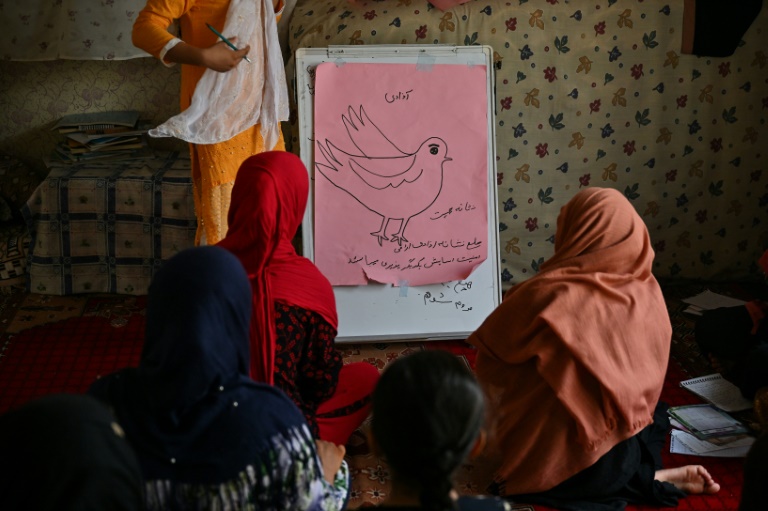
But secret schools have sprung up in rooms of ordinary houses across the country.

A team of AFP journalists visited three of these schools, interviewing students and teachers whose real names have been withheld for their safety.

This is their story.

– ‘We want freedom’ –

Decades of turmoil have played havoc with Afghanistan’s education system, so Nafeesa is still studying secondary school subjects even though she is already 20.

Only her mother and older sister know about it.

Her brother fought for years with the Taliban against the former government and US-led forces in the mountains, returning home after their victory imbued with the hardline doctrine that says a woman’s place is the home.

He allows her to attend a madrassa to study the Koran in the morning, but in the afternoon she sneaks out to a clandestine classroom organised by the Revolutionary Association of the Women of Afghanistan (RAWA). 

“We have accepted this risk, otherwise we will remain uneducated,” Nafeesa said.

“I want to be a doctor… We want to do something for ourselves, we want to have freedom, serve society and build our future.”

When AFP visited her school, Nafeesa and nine other girls were discussing freedom of speech with their female teacher, sitting side-by-side on a carpet and taking turns reading out loud from a textbook.

To get to class, they frequently leave home hours earlier, taking different routes to avoid being noticed in an area made up mostly of members of the Pashtun ethnic group, who form the bulk of the Taliban and are known for their conservative ways.

If a Taliban fighter asks, the girls say they are enrolled in a tailoring workshop, and hide their schoolbooks in shopping bags or under their abaya and burqa overgarments.

They not only take risks, but also make sacrifices — Nafeesa’s sister dropped out of school to limit any suspicions her brother might have.

– No justification in Islam –

Religious scholars say there is no justification in Islam for the ban on girls’ secondary school education and, a year since taking power, the Taliban still insist classes will be allowed to resume.

But the issue has split the movement, with several sources telling AFP a hardline faction that advises supreme leader Hibatullah Akhundzada opposed any girls’ schooling — or at best, wanted it limited to religious studies and practical classes such as cooking and needlework.

The official line, however, remains that it is just a “technical issue” and classes will resume once a curriculum based on Islamic rules is defined.

Primary girls still go to school and, for now at least, young women can attend university — although lectures are segregated and some subjects cut because of a shortage of female teachers.

Without a secondary school certificate, however, teenage girls will not be able to sit university entrance exams, so this current crop of tertiary female students could be the country’s last for the foreseeable future. 

“Education is an inalienable right in Islam for both men and women,” scholar Abdul Bari Madani told AFP.

“If this ban continues, Afghanistan will return to the medieval age… an entire generation of girls will be buried.”

– Lost generation –

It is this fear of a lost generation that spurred teacher Tamkin to convert her home in Kabul into a school.

The 40-year-old was almost lost herself, having been forced to stop studying during the Taliban’s first stint in power, from 1996 to 2001, when all girls’ schooling was banned.

It took years of self-study for Tamkin to qualify as a teacher, only for her to lose her job at the education ministry when the Taliban returned last year.

“I didn’t want these girls to be like me,” she told AFP, tears rolling down her cheeks.

“They should have a better future.”

With the support of her husband, Tamkin first turned a storeroom into a class. 

Then she sold a family cow to raise funds for textbooks, as most of her girls came from poor families and couldn’t afford their own.

Today, she teaches English and science to about 25 eager students.

On a rainy day recently, the girls trickled into her classroom for a biology lesson.

“I just want to study. It doesn’t matter what the place is like,” said Narwan, who should be in grade 12, sitting in a room packed with girls of all ages.

Behind her, a poster on a wall urges students to be considerate: “Tongue has no bones, but it is so strong that it can break the heart, so be careful of your words.”

Such consideration by her neighbours has helped Tamkin keep the school’s real purpose hidden.

“The Taliban have asked several times ‘what’s going on here?’ I have told the neighbours to say it’s a madrassa,” Tamkin said.

Seventeen-year-old Maliha believes firmly the day will come when the Taliban will no longer be in power. 

“Then we will put our knowledge to good use,” she said. 

– ‘Not afraid of Taliban’ –

On the outskirts of Kabul, in a maze of mud houses, Laila is another teacher running underground classes.

Looking at her daughter’s face after the planned reopening of secondary schools was cancelled, she knew she had to do something.

“If my daughter was crying, then the daughters of other parents must also be crying,” the 38-year-old said.

About a dozen girls gather two days a week at Laila’s house, which has a courtyard and a garden where she grows vegetables and fruit.

The classroom has a wide window opening to the garden, and girls with textbooks kept in blue plastic folders sit on a carpet — happy and cheerful, studying together.

As the class begins, one by one they read out the answers to their homework. 

“We are not afraid of the Taliban,” said student Kawsar, 18.

“If they say anything, we will fight it out but continue to study.”

But the right to study is not the only aim for some Afghan girls and women — who are all too frequently married off into abusive or restrictive relationships.

Zahra, who attends a secret school in eastern Afghanistan, was married at 14 and now lives with in-laws who oppose the idea of her attending classes.

She takes sleeping pills to fight her anxiety — worried her husband’s family will force him to make her stay home.

“I tell them I’m going to the local bazaar and come here,” said Zahra of her secret school.

For her, she says, it is the only way to make friends.

ash-ecl-jd-fox/ser/cwl

Guatemalan journalist critical of president charged with four felonies

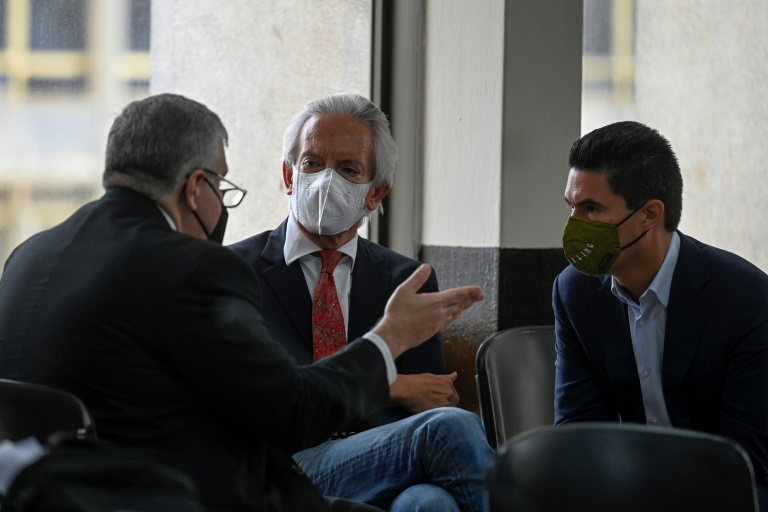
Guatemalan prosecutors on Monday charged journalist Jose Ruben Zamora with crimes including money laundering and blackmail.

Zamora was arrested last week and the offices of El Periodico, a newspaper he founded that has accused key political figures in the country of corruption, were raided.

The publication’s staff denounced the actions as retaliation for its previous reporting on President Alejandro Giammattei, as well as Attorney General Consuelo Porras, whom the United States designated earlier this year for “significant corruption.”

Prosecutor Cinthya Monterroso charged Zamora with money laundering, conspiracy, influence peddling and blackmail.

At the time of his arrest, a spokesman for the Public Prosecutor’s Office told AFP Zamora was being investigated “not for his journalist work, but as a businessman.”

According to Monday’s charges, Zamora had asked a banker to help him deposit 300,000 Quetzals ($37,500) into the Guatemalan banking system in order to hide “the true origin” of the funds.

At the hearing, prosecutors presented as evidence the cash Zamora had allegedly delivered to the banker via a courier.

Monterroso said the banker, Ronald Garcia, had told prosecutors that Zamora had possibly obtained the money from several businessmen whom he had “blackmailed” not to publish negative information about them.

Zamora has said that the case against him was a “set-up” by Giammattei and Porras.

The Guatemalan government has distanced itself from Zamora’s arrest, which has sparked a wave of calls to respect freedom of expression, as well as warnings of attacks against independent media.

In June, the Inter-American Commission on Human Rights added Guatemala to its list of countries where it has noted serious human rights violations, a charge Giammattei rejects. Cuba, Venezuela and Nicaragua are also on the list.

The public prosecutor’s office, under the leadership of Porras, has been criticized for arresting and prosecuting several anti-mafia judges and prosecutors.

Close Bitnami banner
Bitnami