World

Amnesty defiant despite Ukraine report outcry

Rights group Amnesty International has remained defiant under its high-profile secretary general in the face of a growing outcry over a report critics alleged boosted Russia in its invasion of Ukraine.

Its August 4 press release that accused Ukraine of endangering civilians by creating army bases in residential areas sparked one of the most explosive controversies for a major rights group in recent years.

Ukraine’s President Volodymyr Zelensky, backed by a chorus of Ukrainian officials, lashed out at Amnesty saying it sought to shift “the responsibility from the aggressor to the victim.”

But the issue has also caused friction within the respected organisation founded in 1961, which won the Nobel Peace Prize in 1977 and now has branches in over 70 countries.

The head of its Ukraine office, Oksana Pokalchuk, resigned, saying her team had not been properly consulted over a report “that sounded like support for Russian narratives.”

The controversy represents the biggest crisis yet for Amnesty under its secretary general Agnes Callamard, a battle-hardened French rights expert who was a big-name choice to lead the London-based body after serving as the UN’s special rapporteur on extrajudicial executions.

It was in that capacity that she led the international investigation into the murder of Saudi journalist Jamal Khashoggi at the kingdom’s Istanbul consulate in 2018, producing a report that pointed the finger at the responsibility of crown prince Mohammed bin Salman.

Shortly after taking office, she took decisive action to reverse a decision by Amnesty to strip Russian opposition figure Alexei Navalny of his “prisoner of conscience” status due to past nationalist comments.

– ‘Shredding its credibility’ –

After the Ukraine report was published, Callamard took issue with the “social media mobs and trolls” who were attacking the organisation’s research and vowed that this would “not dent our impartiality.”

On Friday, she told AFP in an email that Amnesty “fully stands by” the report that was subject to the “same rigorous standards” as all of Amnesty’s publications.

In a statement Sunday, Amnesty said it deeply regretted the “distress and anger” sparked by the press release while reaffirming that “We fully stand by our findings.”

Its statement, the organisation said, had documented how in all 19 towns and villages visited by its researchers there were instances where “Ukrainian forces had located themselves right next to where civilians were living.”

The assessment was based on the rules of international humanitarian law (IHL), Amnesty said, while also noting the multiple reports it had published over the last month accusing Russia of violations and war crimes in Ukraine.

But its defence has done nothing to dampen the opprobrium being heaped on the organisation both in Ukraine and abroad.

The Times of London wrote in an editorial that Amnesty was “shredding its credibility by serving as a megaphone for the propaganda of the Putin regime” with a report that “pays no attention to the realities of military operations.”

“Amnesty is now utterly morally bankrupt –- its anti-Western obsession has driven it into the gutter,” the right-wing Daily Telegraph added.

– ‘Little to none’ –

Meanwhile the report found an eager readership at the Russian embassy in London, usually no fan of Amnesty, which claimed in a tweet that the report’s findings confirmed “exactly what Russia has been saying all along.”

But in an article for the Ukrainska Pravda website, British human rights lawyer Wayne Jordash and Ukrainian lawyer Anna Mykytenko accused Amnesty of using “unclear” methodology and considering “little to none” of the military or humanitarian context.

“The conclusions are short on facts and analysis and long on intemperate accusation,” they wrote.

Amnesty has insisted it reached out to the Ukrainian government several days before the report’s publication, sharing GPS coordinates and other sensitive information it withheld from the press release to protect civilians on the ground.

Among Putin’s opponents, one of Navalny’s allies, Ivan Zhdanov, simply damned the report as “a typical example of ‘useful idiots’.”  

The most lacerating criticism came from Pokalchuk, who said that the report, rather than “protecting civilians, instead has become a tool of Russian propaganda.”

Thursday’s release was disowned by Amnesty’s Ukraine team, who refused to translate it or upload it to their website.

“If you don’t live in a country invaded by occupiers who are tearing it to pieces, you probably don’t understand what it’s like to condemn an army of defenders,” Pokalchuk said.


Climate deniers use past heat records to sow doubt online

With Europe gripped by successive heatwaves, climate-change deniers are spreading scepticism by publishing data on social media on extreme temperatures allegedly recorded decades ago to imply scientists are exaggerating global warming.

But experts say the figures cited from the past are often incorrect or taken out of context — and even if accurate do not change the fact that heatwaves are becoming more frequent and intense.

The posts typically include heat records from almanacs or newspaper reports from the past, arguing that they are similar to the record highs set during this year’s heatwaves in Europe.

One post that has gone viral on Facebook includes a screen grab of a brief article published in the New York Times on June 23, 1935, which said the mercury had hit 127 degrees Fahrenheit (52.7 degrees Celsius) in Zaragoza, in northeastern Spain, the day before.

That temperature is much higher than the record for the highest temperature in Spain of 47.6 degrees Celsius recorded on August 14, 2021 by national weather office Aemet at the La Rambla meteorological station in the southern province of Cordoba.

Contacted by AFP Fact Check, Aemet spokesman Ruben del Campo said the highest temperature recorded in Zaragoza that day in 1935 was just 39 degrees Celsius.

“The figure of over 52 degrees in incorrect. It is not a figure that is in our climate database, and in fact, there is no log of a temperature above 50 degrees Celsius,” he said.

And “even if the figure was correct, which I stress it is not, that is not proof that climate changes does not exist”, he added.

– ‘Warmer now’ –

Spanish daily newspaper La Vanguardia in 1935 also reported that temperatures had hit the low 50s in Zaragoza but explained that the measurement was taken “in the sun”.

Scientists recommend a series of strict criteria to ensure an accurate temperature reading.

“Sensors must be protected from the sun and the rain, and the temperature inside the weather station must be the same as what it is outside,” said Aemet meteorologists Ricardo Torrijo.

Another post that has gone viral on Facebook, Telegram and Twitter since last June shows a front page of Spanish weekly magazine El Espanol from August 1957 with the headline: “The hottest summer of the century”.

It referred to a reading of a temperature of 50 degrees Celsius in central Spain, which was also taken in the sun.

Isabel Cacho, a climate expert at the University of Barcelona, said that “in the hypothetical case” that the mercury soared above 50 degrees Celsius, “this would not be an argument to question that it is warmer now”.

– ‘Not change trend’ –

Climate scientists overwhelmingly agree that carbon emissions from humans burning fossil fuels are heating the planet, raising the risk, length and severity of heatwaves and other extreme weather events.

“These figures of high temperatures (in the past) do not discredit the existence of climate change,” said Jose Luis Garcia, a climate change expert at Greenpeace in Spain.

“They are unrelated. One thing is one-off temperature data and another very different thing is the tendency towards an increase in the average temperature.”

Pedro Zorrilla, a Spanish expert in climate change, said the “anomaly” of a very high temperature recorded in 1935 would have a “very small effect” on average temperatures.

“It does not change the trend,” he added.

Records show heatwaves are occurring with greater frequency in the Iberian Peninsula, said Mariano Barriendos, a geography and history professor at the University of Barcelona. 

“It is relatively usual for a hot air mass to enter the peninsula from the Sahara Desert. What is worrying is that heatwaves are happening more often,” he said.

US calls on Russia to stop military activity at nuclear sites

The White House called on Russia on Monday to cease all military operations around nuclear facilities in Ukraine.

“Fighting near a nuclear plant is dangerous,” White House spokeswoman Karine Jean-Pierre told reporters aboard Air Force One during a flight to Kentucky, where President Joe Biden is to tour flood-damaged areas.

“And we continue to call on Russia to cease all military operations at or near Ukrainian nuclear facilities and return full control to Ukraine,” Jean-Pierre said.

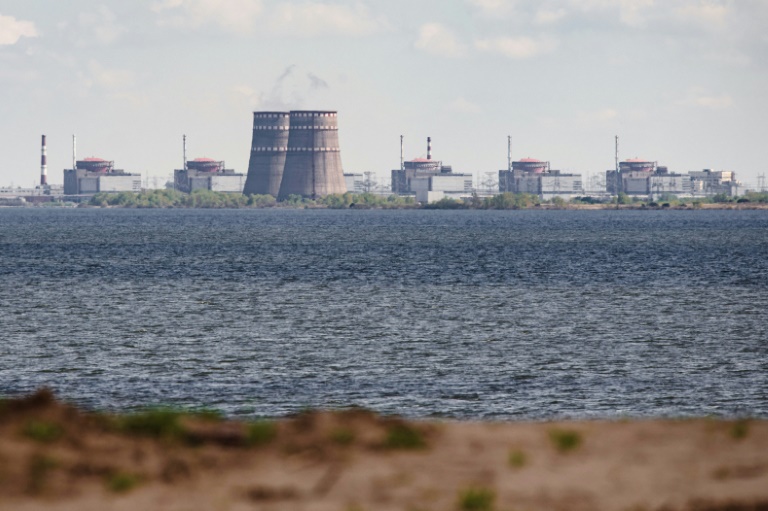
Zaporizhzhia — Europe’s largest atomic power complex — was occupied by Russia early in its invasion and recent fighting there has raised fears of a nuclear accident.

Jean-Pierre said the United States is continuing to “closely monitor” the situation at the facility and radiation sensors have “thankfully” not shown any indications of an increase or abnormal radiation levels.

“We are also aware of the reports of mistreatment of the (plant) staff and we applaud the Ukrainian authorities and operators for their commitment to nuclear safety and security under trying circumstances,” she said.

The White House spokeswoman said the United States supports the efforts of the UN’s nuclear watchdog, the International Atomic Energy Agency, to assist Ukraine with nuclear safety and security measures.

Kyiv called on Monday for the establishment of a demilitarised zone around the nuclear power station in eastern Ukraine.

In recent days, it has been the scene of strikes that have damaged several structures, forcing the shutdown of a reactor.

“What needs to be done is to remove occupying forces from the station and to create a de-militarised zone on the territory of the station,” said Petro Kotin, president of Ukraine’s nuclear energy company, Energoatom.

The recent fighting at the plant has prompted the IAEA to warn of “the very real risk of a nuclear disaster.”

The Kremlin on Monday accused Ukrainian forces of firing on the Zaporizhzhia plant, warning of potential “catastrophic consequences” for Europe.

After 'historic' US climate bill, scientists urge global action

Scientists on Monday welcomed the passing of US President Joe Biden’s “historic” climate bill while calling for other major emitters — namely the European Union — to follow suit and implement ambitious plans to slash emissions.

The bill, which would see an unprecedented $370 billion invested in cutting US emissions 40 percent by 2030, should provide a launchpad for green investment and kickstart a transition towards renewable energy in the world’s largest emitter.

It passed the Senate on Sunday night after months of arduous negotiations and only after a number of tax and energy provisions were tacked on to Biden’s original proposal. 

Michael Pahle, from the Potsdam Institute for Climate Impact Research, said the bill was particularly relevant to EU lawmakers, who he said were on the verge of adopting “the world’s most ambitious climate policy” in the form of the bloc’s “Fit for 55” plan. 

“The EU’s policy can only succeed — economically and politically — when major emitters and trade partners take similar action,” he told AFP. 

“Especially in face of the changing geopolitical landscape, US-EU cooperation is key and the bill an important enabling factor.” 

The EU initiative — which envisages a 55-percent emissions fall by 2030 — has no set budget as yet. 

But a recent assessment found member states would need to spend an 350 billion euros more each year than they did between 2011-2020 in order to hit the climate and energy targets. 

Simon Lewis, professor of global chance science at University College London, said the US bill showed how lawmakers can advance climate legislation while responding to voters’ short-term concern over fuel price inflation. 

“It’s really important that the world’s largest economy is investing in climate and doing it as part of a package to generate jobs and a new, cleaner, greener economy,” Lewis told AFP. 

“Part of that is a package tackling inflation. I think that shows the world how to get climate policy passed, by hitching it to things that really matter to ordinary people, to make sure it’s part of an overarching package to make life better for people.”

– ‘Massive increase’ –

The independent Rhodium Group think tank said the “historic and important” bill — officially the Inflation Reduction Act — would reduce US emissions by at least 31 percent by 2040, compared with 2005 levels. 

However it said that with favourable macroeconomic conditions including increasingly high fossil fuel prices and cheap renewables, a 44-percent emissions drop was possible. 

“The cost of living is here partly because we didn’t get out of fossil fuels early enough,” said Lewis. 

“This bill means is that the transition away from fossil fuels is about to speed up.”

Eric Beinhocker, director of the Institute of New Economic Thinking at the Oxford Martin School, said the bill would lead to a “massive increase” in clean technology and would drive the cost of renewables down even further. 

“This is particularly important when the world is suffering not just from the climate effects of fossil fuels but also from their skyrocketing costs,” he told AFP.

The legislation provides millions to help conserve forests and billions in tax credits to some of the country’s worst-polluting industries to accelerate their transition to greener tech.

It almost didn’t happen, however, with the bill delayed for months after Democrat Joe Manchin blocked Biden’s more expensive Build Back Better infrastructure plan.

Pahle said that a failure by the US to agree an ambitious emissions cutting plan would have been a “major drawback on the viability of the Paris Agreement”.

The 2015 accord enjoins nations to work to limit global temperature rises to “well below” two degrees celsius above pre-industrial levels and envisages a safer 1.5C heating cap. 

With a little over 1.1C of warming so far, Earth is already being buffeted by extreme weather such as drought and storms supercharged by rising temperatures.

– Just the start –

Although acknowledging that the bill represented progress, scientists were quick to stress that it was far from perfect. 

Michael Mann, director of Penn State’s Center for Science, Sustainability and the Media, said the bill’s commitment to build new gas pipelines was “a step backwards”. 

“It’s difficult to reconcile a promise to decarbonise our economy with a commitment to new fossil fuel infrastructure,” he said. 

Radhika Khosla, from the University of Oxford’s Smith School, said that only action on a global scale could achieve the emissions cuts necessary to stave off the worst impacts of global heating. 

“The effects of climate change are being felt by all of us,” she said. 

“This summer alone parts of the globe as disparate as China, the UK and Tunisia all saw record-breaking, deadly heatwaves.

“Lasting change will require ambitious action from all of us as well,” she told AFP.

Third fuel tank collapses as helicopters battle Cuban blaze

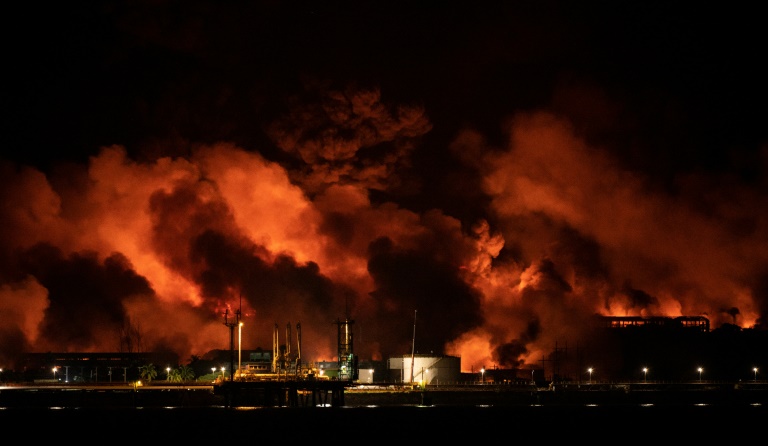
Cuban army helicopters scrambled to contain a blaze that felled a third tank at a fuel depot on Monday after burning for days, as the search continued for 16 missing firefighters.  

According an official update, the confirmed toll from the fire was one person dead, with 24 people receiving treatment in hospital — five of them in a critical condition. Many others were treated for burn wounds.  

The fire on the outskirts of Matanzas, a city of 140,000 people 100 kilometers (60 miles) east of Havana, broke out late Friday after lightning struck one of eight tanks at the depot.

On Monday, the governor of the western Matanzas province said the blaze had spread to a third tank, which collapsed like two others before it.

“The third tank also collapsed, after the second spilled its fuel” as it caved in on Sunday, governor Mario Sabines told state TV.  

He said the blaze area was “very big” and the containment effort “very complex.”

Aircraft, firefighters and other specialists and equipment arrived in Cuba from Mexico and Venezuela on Sunday after the island nation asked for help from “friendly countries.”  

Sabines said the teams were preparing an operation to attack the flames with foam, “but this could take a while.”

– Efforts ‘intensifying’ –

Some 1,900 people had been evacuated from around the disaster site, officials have said.  

“Work is intensifying to combat the fire,” the Cuban presidency said on Twitter Monday, adding this was a “decisive day” for the effort.  

After the first tank caught fire late Friday, the blaze spread to a second tank by the early hours of Saturday.  

The first two tanks collapsed overnight Sunday, causing three more reported injuries and spilling their oil.

According to the Cupet state oil company, the first tank had contained about 26,000 cubic meters of crude, about half its capacity.  

The second contained 52,000 cubic meters of fuel oil. It was not immediately clear how full the third tank was.  

Firefighters had been battling to prevent the third tank from catching fire, dousing it with water to keep it cool, but ultimately to no avail.  

The depot supplies the Antonio Guiteras thermoelectric plant, the largest in the communist nation. 

The disaster comes at a time the island — with an outdated energy network and persistent fuel shortages — has faced mounting difficulties in meeting energy demands.

Since May, authorities have imposed energy blackouts of up to 12 hours a day in some regions — sparking protests around the Portugal-sized nation of 11 million people. 

China holds fresh military drills around Taiwan

China carried out fresh military drills around Taiwan Monday, Beijing said, defying calls to end its largest-ever exercises encircling the island in the wake of a visit by US House Speaker Nancy Pelosi.

Beijing has raged at the trip by Pelosi — the highest-ranking elected US official to visit Taiwan in decades — ripping up a series of talks and cooperation agreements with Washington, most notably on climate change and defence.

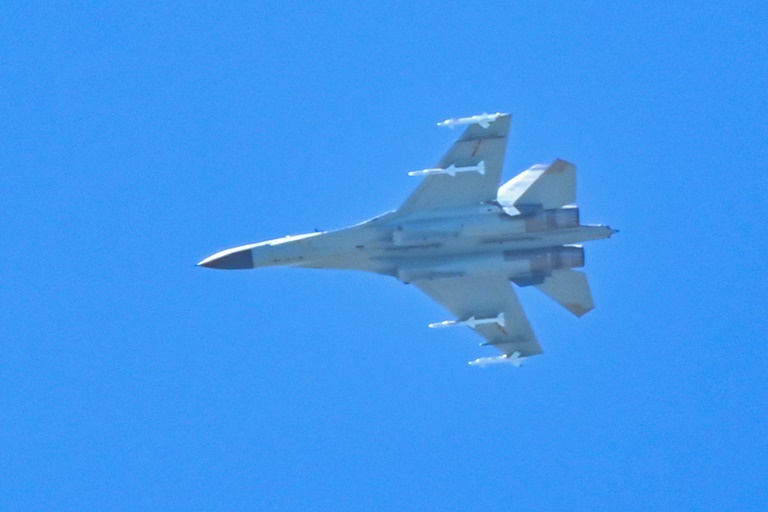
It has also deployed fighter jets, warships and ballistic missiles in what analysts have described as practice for a blockade and ultimate invasion of the self-ruled democratic island that China claims as its territory.

Those drills had been expected to draw to a close on Sunday, but China said Monday they were still ongoing.

“The eastern theatre of the Chinese People’s Liberation Army continued to carry out practical joint exercises and training in the sea and airspace around Taiwan island,” the military said.

The exercises, the PLA’s Eastern Command added, were “focusing on organising joint anti-submarine and sea assault operations”.

Taipei condemned Beijing for extending the drills.

“China’s provocation and aggression have harmed the status quo of the Taiwan Strait and raised tensions in the region,” the island’s foreign ministry said in a statement.

The Taiwanese military said it detected 39 Chinese warplanes and 13 ships operating in the strait on Monday.

Of those, 21 aircraft crossed the median line — an unofficial demarcation between China and Taiwan that the former does not recognise.

US President Joe Biden expressed concern Monday but said he did not expect the situation to escalate further.

“I’m not worried, but I’m concerned they’re moving as much as they are. But I don’t think they’re going to do anything more than they are,” Biden told reporters at Dover Air Force Base. 

– Taipei defiant –

Taiwan has remained defiant throughout the Chinese drills.

Its military said it would hold anti-landing exercises in Taiwan’s south on Tuesday and Thursday.

“We will practise counter moves against simulated enemy attacks on Taiwan,” Lou Woei-jye, spokesman for the Eighth Army Corps, told AFP. 

They will include the deployment of hundreds of troops and about 40 howitzer guns, the military said.

Taiwan has insisted that no Chinese warplanes or ships have entered Taiwan’s territorial waters — within 12 nautical miles of land — during Beijing’s drills.

But to show how close it came to Taiwan’s shores, the Chinese military released a video of an air force pilot filming the island’s coastline and mountains from his cockpit.

The Eastern Command also shared a photo it said was of a warship on patrol with Taiwan’s shoreline visible in the background.

Ballistic missiles were fired over Taiwan’s capital during the exercises last week, according to Chinese state media.

The scale and intensity of China’s drills — as well as its withdrawal from key talks on climate and defence — have triggered outrage in the United States and other democracies.

– ‘Issuing a warning’ –

Beijing on Monday defended its behaviour as “firm, forceful and appropriate” to American provocation. 

“(We) are only issuing a warning to the perpetrators,” foreign ministry spokesman Wang Wenbin told a regular briefing, promising China would “firmly smash the Taiwan authorities’ illusion of gaining independence through the US”.

“We urge the US to do some earnest reflection, and immediately correct its mistakes.”

Experts say the drills have revealed an increasingly emboldened Chinese military capable of carrying out a gruelling blockade of the island and obstructing US forces from coming to Taiwan’s aid.

“In some areas, the PLA might even surpass US capabilities,” Grant Newsham, a researcher at the Japan Forum for Strategic Studies and a former US Navy officer, told AFP.

“If the battle is confined to the area right around Taiwan, today’s Chinese navy is a dangerous opponent — and if the Americans and Japanese do not intervene for some reason, things would be difficult for Taiwan.”

prw-oho-aw-qan/st

Beluga whale is now stationary in Seine: NGO

A malnourished beluga whale that has swum up France’s River Seine is no longer progressing but is still alive, environmental group Sea Shepherd said Monday.

Hopes are fading to save the animal, which was first spotted on Tuesday in the river that runs through Paris to the English Channel.

“It is alert but not eating,” Sea Shepherd France president Lamya Essemlali told AFP in a text message.

There was, however, “no worsening of its condition”, she said.

Since Friday, the whale has been between two locks some 70 kilometres (44 miles) north of the French capital.

Rescuers are considering last-ditch efforts to extract the animal from the Seine as the river’s warm water is harming its health.

One alternative would be to open the locks in the hope that the beluga will swim towards the English Channel, authorities said.

Opening the locks would harbour the risk of the whale moving further upriver towards Paris, which would be even more disastrous.

Several attempts to feed the whale have failed in the past days.

A three-person team from Marineland, Europe’s biggest sea animal theme park located in the southern French resort of Antibes, was expected to arrive on site later Monday.

“We’ve been following the operations at a distance from the start,” said Isabelle Brasseur, in charge of education, research and conservation at Marineland.

“We are slowly making progress,” she told AFP. “There’s not an ideal solution, we must weigh the pros and the cons” of each option to rescue the whale.

One of the experts on the team is a specialist for sea mammals, she said, adding they were bringing a stretcher and other equipment to try and move the animal.

On Saturday, veterinarians administered “vitamins and products to stimulate its appetite”, said a statement on Sunday by the police in Normandy’s Eure department, which is overseeing the rescue effort.

Belugas are normally found only in cold Arctic waters, and while they migrate south in the autumn to feed as ice forms, they rarely venture so far.

An adult can reach up to four metres (13 feet) in length.

According to France’s Pelagis Observatory, specialised in sea mammals, the nearest beluga population is off the Svalbard archipelago, north of Norway, 3,000 kilometres from the Seine.

Gaza clears rubble, buries dead as truce with Israel holds

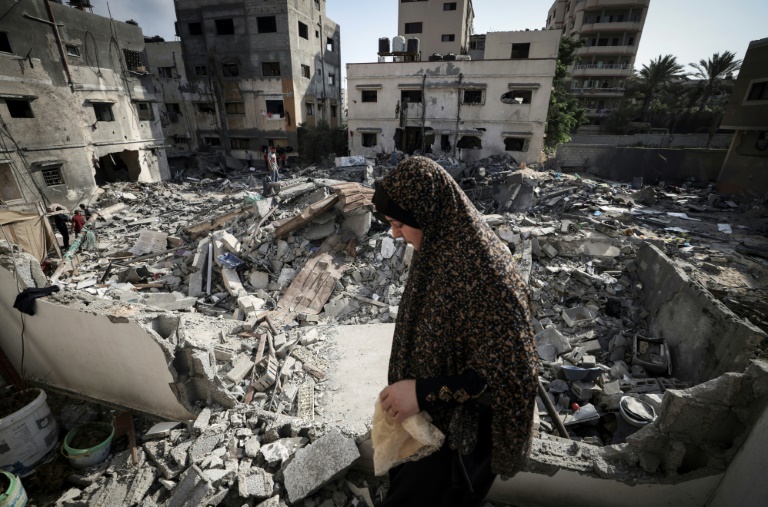
Shell-shocked Gazans on Monday sifted through the rubble of three days of deadly conflict between Israel and Islamic Jihad militants as a truce held and life slowly returned to normal.

An Egypt-brokered ceasefire reached late Sunday ended the intense fighting that killed 44 people, including 15 children, and wounded 360 in the enclave according to Gaza’s health ministry.

Israel had since Friday launched a heavy aerial and artillery bombardment of Islamic Jihad positions in Gaza, leading the militants to fire over a thousand rockets in retaliation, according to the Israeli army.

As relative calm returned to Gaza Monday, and electricity was restored, Palestinians tried to salvage their belongings from the rubble of shattered homes and to start clearing the debris.

“We received the news of the ceasefire with joy and happiness and we went back to our work,” said Gaza shopkeeper Hazem Douima. 

“We did not want more bloodshed.”

Bereaved families buried their dead, including at one funeral joined by hundreds of mourners in Jabalia in the northern Gaza Strip where a family laid to rest four minors killed in the conflict.

“Gaza is tending to its wounds,” said one resident, Mohammed Alai.

A senior Israeli diplomatic official, speaking on condition of anonymity, said that “most of the civilians who were killed in Gaza were killed by Islamic Jihad rockets” that fell short or misfired.

Gaza’s sole power plant, after a two-day shutdown, “started working to generate electricity”, said spokesman Mohammed Thabet, hours after fuel trucks passed the reopened good border crossing.

The outage had sparked fears about the impact on hospitals overwhelmed with casualties amid Gaza’s worst fighting since an 11-day war with militant movement Hamas last year.

– ‘Right to respond’ –

The Israeli military said roads would gradually reopen in the border area where restrictions were imposed in the lead-up to the offensive, which Israel said was launched to stop looming attacks.

Three people in Israel were wounded by shrapnel and 31 lightly hurt while running for safety, emergency services said.

Israeli Prime Minister Yair Lapid’s office late Sunday agreed to the truce but said that “if the ceasefire is violated”, Israel “maintains the right to respond strongly”.

Islamic Jihad, an Iran-backed group designated as a terrorist organisation by several Western nations, also accepted the truce but said it too “reserves the right to respond”.

US President Joe Biden welcomed the truce and thanked Egyptian President Abdel Fattah al-Sisi for Cairo’s role in brokering it. 

European Union foreign policy chief Josep Borrell warned it was “crucial to work to consolidate the ceasefire”.

Tehran said it will always “defend the active resistance”.

Islamic Jihad said 12 of its leaders and members had been killed. 

The group’s Mohammad al-Hindi said the ceasefire deal “contains Egypt’s commitment to work towards the release of two prisoners”.

They were named as Bassem al-Saadi, a senior figure in the group’s political wing who was recently arrested in the occupied West Bank, and Khalil Awawdeh, a militant also in Israeli detention.

– ‘Serious blow’ –

North of Gaza in the Israeli city of Asheklon where air raid silents had wailed and people fled to bunkers, beachgoers returned to the Mediterranean shore. 

Sitting in a cafe, Eitan Casandini said locals were feeling “very good”.

“After we destroy them we can sleep peacefully,” he told AFP. “I don’t think (Islamic) Jihad will do anything again in the next three or four years.”

Islamic Jihad is aligned with Gaza’s rulers Hamas but often acts independently.

Hamas has fought four wars with Israel since seizing control of the enclave in 2007, including the conflict in May last year.

Israel has said it was necessary to launch a “pre-emptive” operation against Islamic Jihad, while the diplomatic official said the group had been planning an attack by sniper fire or with anti-tank missiles.

The army killed senior leaders of Islamic Jihad in Gaza, including Taysir al-Jabari and Khaled Mansour.

The senior Israeli diplomatic official said Islamic Jihad had been dealt “a very serious blow” which had “taken them back decades”.

Hope and excitement in hometowns of Kenya's presidential favourites

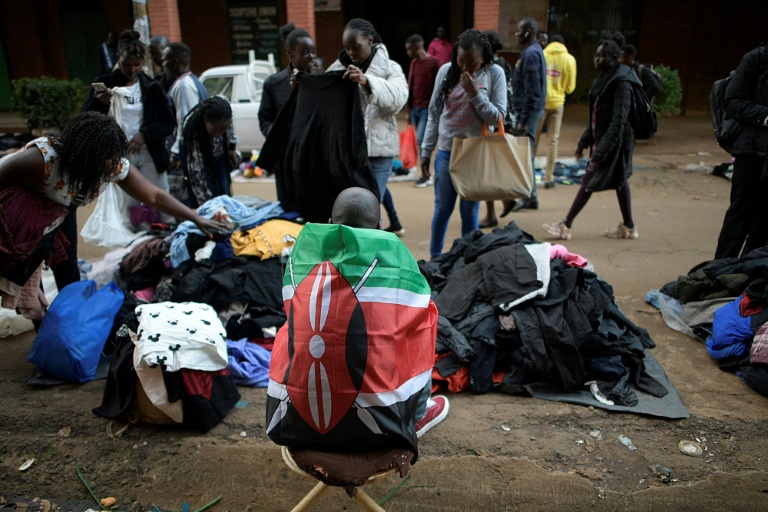
On the eve of Kenya’s election, yellow banners drape William Ruto’s bastion of Eldoret, where voters are quietly optimistic their hometown hero will emerge the next president after a bruising contest.

Some 90 kilometres away (55 miles), not a single Ruto banner flies in Kisumu, the stronghold of his opponent Raila Odinga, whose victory is considered a foregone conclusion by many in the lakeside city.

Eldoret and Kisumu have been hotbeds of electoral violence in the past and Tuesday’s poll is too close to call, raising fears of similar civil unrest.

But in Eldoret, voters say they are confident peace will prevail even as they firmly back Ruto — a son of the soil and ally-turned-foe of the ruling establishment, which now supports opposition veteran Odinga.

The Rift Valley’s biggest city has been painted yellow and the ubiquitous presence of wheelbarrows — the symbol of Ruto’s United Democratic Alliance (UDA) party — serves as a clear reminder of Eldoret’s allegiances.

But along a busy intersection, dozens of Odinga supporters gathered freely near a group of Ruto fans at a so-called “Bunge la Mwananchi”, or “citizens’ parliament”.

“In the previous elections, it was not possible to have two groups supporting two different candidates so close to each other,” said Alfred Ekale, a 38-year-old security guard and Ruto backer.

“Everyone was suspicious of each other and there was a lot of tension.

“This time we are all together here, from different tribes, and we can coexist without tension.”

– ‘Time to party’ – 

To the southwest in sunny Kisumu, a carnival-like atmosphere was building as the hours ticked down to voting day.

Motorcycles dashed back and forth with riders blaring vuvuzela horns for Odinga, a political titan in the western regions around Lake Victoria known affectionally as “Baba” (Father).

Odinga — like his father before him — fought Kenya’s rulers from the opposition trenches, running unsuccessfully in four presidential elections he claimed were rigged, and spending years in jail as a political prisoner.

Now with the ruling party backing his candidacy, many in Kisumu see victory this time as preordained — going as far as to call Odinga the “president-in-waiting.”

“We expect a big celebration, because we know the person who is going to win the election. The people of Kisumu are ready,” said Abdallah Abuga, a motorcycle taxi driver in the city centre. 

“Raila Amolo Odinga is going to win.”

Odinga would be the first president from Kenya’s Luo community, and many kinsmen believe his victory would bring much-needed development to the region denied for decades by ruling elites in Nairobi. 

“We’ve always been sidelined. Kisumu has always been the opposition,” said Amos Owino, a 31-year-old accounting graduate, who claimed he’d been overlooked for jobs because he was Luo.

“It is the time to change, and a big one, for the whole western region… We are going to celebrate, it’s going to be a party.”

– ‘All is calm’ – 

The Kisumu champion also enjoys some support in Eldoret, where Joseph Owuor said Odinga was the “perfect” candidate to lead Kenya.

Despite rooting for the enemy in Ruto’s very backyard, Owuor said the stone-throwing and divisionism that marred past elections wasn’t a feature this time around.

“This time, there is tolerance,” he said. “I believe that everything will go well. I think it will be a free, fair and peaceful election.”

Extra security forces have been deployed to Eldoret with the city — along with Kisumu — identified as possible hotspots for violence by rights monitors.

“They have sent a lot of police, but it is quiet,” said one cab driver in Eldoret as a truckload of soldiers pass by.

In Kisumu — where police have turned water cannons, tear gas and live rounds on voters during past elections — the striking absence of boots on the ground this time is another good omen.

“Their guys are always around. But now there’s no police around here, everything is calm… that again has shown it’s going to be a fair election,” said Owino.

War in Ukraine: latest developments

Here are the latest developments in the war in Ukraine:

– ‘Suicidal’ –

UN Secretary-General Antonio Guterres calls for a halt to shelling at Europe’s largest nuclear power site Zaporizhzhia, saying any attack on a nuclear plant is “suicidal”, without saying either side is responsible.

Moscow and Kyiv have blamed each other for strikes at the plant, which has been under Russian control since the early days of the February 24 invasion. The strikes over the past few days have damaged several structures, forcing the shutdown of a reactor. 

The UN’s nuclear watchdog, the International Atomic Energy Agency (IAEA), has warned of “the very real risk of a nuclear disaster”.

Kyiv on Monday called for the establishment of a demilitarised zone around the station.

– Referendum plan –

Moscow-backed authorities in the southeastern Ukrainian region of Zaporizhzhia say they are pressing ahead with plans to stage a referendum on joining Russia.

“I signed a decree… to start working on the issue of organising a referendum on the reunification of the Zaporizhzhia region with the Russian Federation,” Yevgeny Balitsky, head of the Moscow-installed administration in the occupied part of the region, says on social media.  

The southern Ukrainian regions of Kherson and Zaporizhzhia have been largely under Russia’s control since the first weeks of Moscow’s military campaign.

Both are now being forcefully integrated into Russia’s economy. 

Russia in 2014 annexed the Black Sea peninsula of Crimea from Ukraine after staging a referendum there.

– Kherson counter-offensive –

Ukrainian forces say they have bombed a strategic bridge over the Dnipro river overnight in Kherson, as they seek to claw back the city.

The Antonovskiy bridge is the main land supply link between the city and the south bank of the Dnipro.

It was partly destroyed on July 27, forcing Russian forces to rethink supply lines and possibly resort to using pontoons to cross the water.

Close Bitnami banner
Bitnami