World

Pfizer in talks on $5 billion acquisition: media

American drugmaker Pfizer is close to a deal to purchase Global Blood Therapeutics, which manufactures a recently approved drug against sickle-cell anemia, for $5 billion, the Wall Street Journal has reported.

Pfizer, one of the top makers of Covid-19 vaccines, hopes to conclude talks with GBT within days, the newspaper said Friday, citing people close to the negotiations.

But it said other takeover candidates remain in the running. 

GBT’s sickle-cell treatment, marketed as Oxbryta, was authorized for those over 12 years old in 2019 but gained federal approval in December for children aged four to 11. The blood disorder affects millions.

Sales of Oxbryta helped the laboratory generate first-quarter turnover of $55 million (up 41 percent), while the company registered a net loss of $81.4 million.

GBT, which is based in San Francisco, California, is to publish its second-quarter numbers on Monday.

Pfizer, for its part, saw its second-quarter turnover jump by 47 percent — to a record $27.74 billion — boosted by sales of its Covid vaccine and pills.

Its net profit soared by 78 percent, to $9.9 billion.

GBT shares on the New York Stock Exchange were up 33.03 percent at the close on Friday, at $63.84, for a market capitalization of more than $4 billion.

Pfizer shares slipped by 1.18 percent, to $49.27.

UK boy dies after life support stopped at end of long legal battle

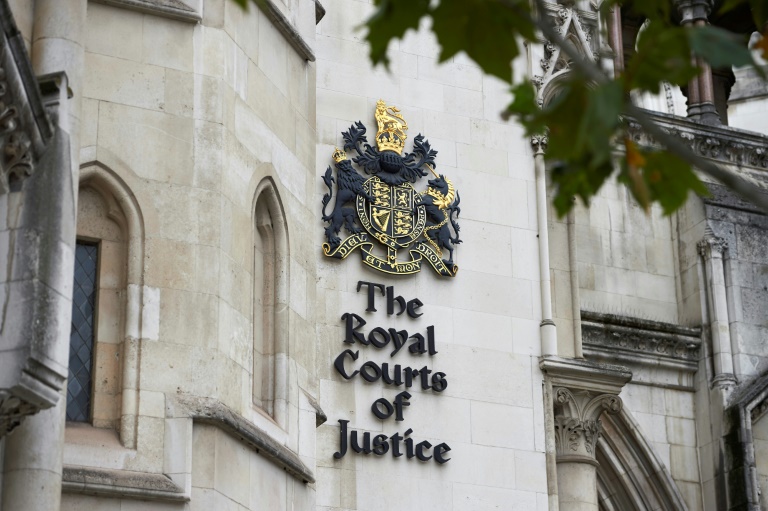
A London hospital on Saturday withdrew life support for 12-year-old British boy Archie Battersbee after his parents lost a long, emotive and divisive legal battle.

Archie’s mother, Hollie Dance, said her son passed away just over two hours after the artificial ventilation was stopped.

“Such a beautiful little boy. He fought right until the very end,” she told reporters, sobbing, outside the Royal London Hospital.

“I’m the proudest mum in the world,” Dance said, after spending the night at his bedside with other relatives.

One of these, Ella Carter, denounced Archie’s final moments as “barbaric”, however. She said that after his ventilation was switched off, “he went completely blue”.

“There is absolutely nothing dignified about watching a family member or a child suffocate,” she said.

Dance found Archie unconscious at home in April with signs he had placed a cord around his neck, possibly after taking part in an online asphyxiation challenge.

The hospital trust’s chief medical officer, Alistair Chesser, said in a statement that “Archie died after treatment was withdrawn in line with court rulings about his best interests”.

Chesser thanked the medical staff who cared for Archie, saying they “provided high quality care with extraordinary compassion over several months in often trying and distressing circumstances”.

At the entrance to the hospital in east London, well-wishers left flowers and cards, and lit candles in the shape of the letter “A”.

“My boy is 12, the same age as Archie, and this just puts things in perspective,” Shelley Elias, 43, said after leaving her own offerings at the site earlier Saturday.

“I did not know what to write because there are no words that will take the pain away,” she said.

A judge in June agreed with doctors that Archie was “brain-stem dead”, allowing life support to be discontinued, but the family fought through the courts to overturn that. 

Arguing that Archie could benefit from treatment in Italy or Japan, they took their case all the way to the European Court of Human Rights in Strasbourg, which this week declined to intervene.

The parents also lost a last-ditch legal bid to have Archie transferred to a hospice for his final hours.

“All legal routes have been exhausted,” a spokesman for the campaign group Christian Concern, which has been supporting the family, said late Friday.

– ‘Charlie’s Law’ –

The case is the latest in a series that have pitted parents against Britain’s legal and healthcare systems.

The involvement of groups such as Christian Concern in support of desperate parents has drawn criticism for prolonging the pain of all concerned. 

Such groups are often working to their own agendas, according to Dominic Wilkinson, professor of medical ethics at the University of Oxford.

“They may have different political or other views, (and) have reason to wish to tell the parents things that may not be accurate,” he said on Sky.

After a highly charged battle between the hospital and his parents, 23-month-old Alfie Evans died in April 2018 when doctors in Liverpool, in northwestern England, withdrew life support.

His parents had the support of Pope Francis to take him to a clinic in Rome, but lost a final court appeal days before he died.

Charlie Gard, born in August 2016 with a rare form of mitochondrial disease that causes progressive muscle weakness, died one week short of his first birthday after doctors withdrew life support.

His parents had fought a five-month legal battle for Charlie to be taken to the United States for experimental treatment, eliciting support from then US president Donald Trump and evangelical groups.

The parents have been pushing the UK government to adopt “Charlie’s Law”, proposed legislation that would strengthen parents’ rights when disputes arise over the treatment of their children.

“The whole system has been stacked against us,” Archie’s mother Dance said Friday, but many on social media also questioned her actions and the family’s fundraising.

“Reform must now come through Charlie’s Law so that no parents have to go through this.”

Israel warns aerial onslaught against Gaza militants could last a week

Israel’s military warned Saturday deadly aerial operations against Palestinian militants in Gaza could last a week, as cross-border fire reverberated for a second day in the worst escalation since last year’s war.

Israel has said it was forced to launch a “pre-emptive” operation against Islamic Jihad, insisting the group was planning an imminent attack following days of tensions along the border with Gaza, a Palestinian enclave. 

Health authorities in Gaza, controlled by the Islamist group Hamas, said a five-year-old girl was among 13 people killed by the Israeli bombardment, adding that more than 110 others have been wounded.

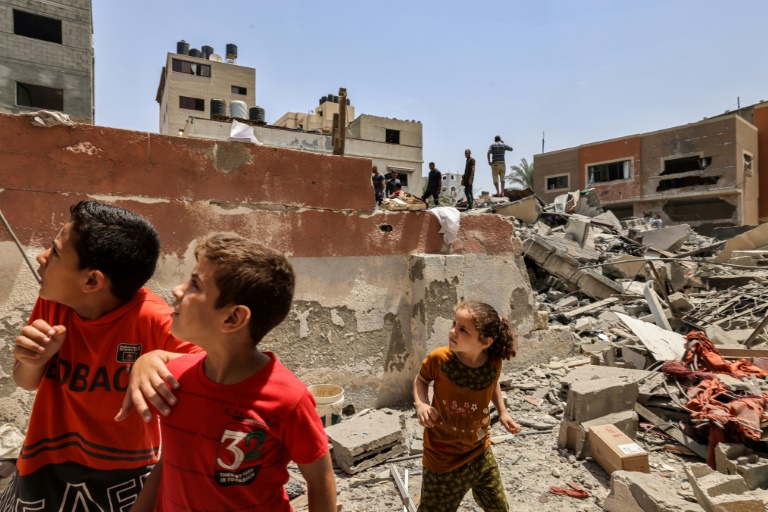
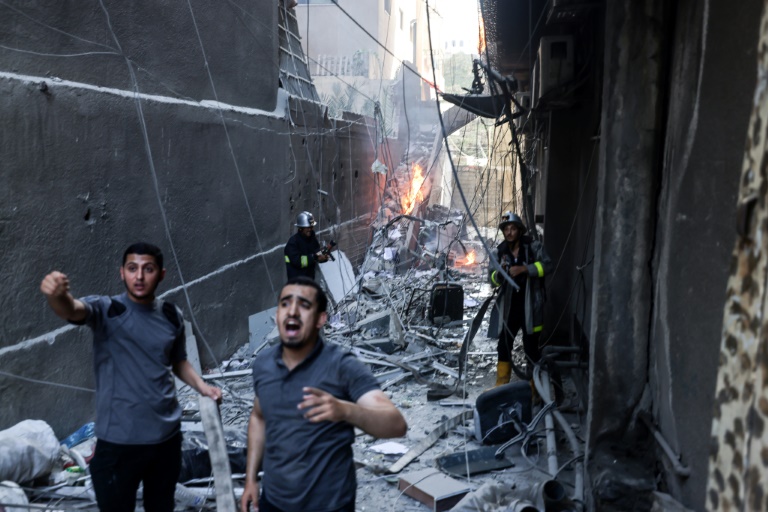
In Jabalia, in the north of Gaza, Fouad Farajallah was on Saturday surveying what remained of his home, hit by an Israeli strike the day before.

“I was sitting here on the sofa, with my wife and children, and suddenly it all fell on us,” he said, surrounded by debris from a partially collapsed roof in a strike he said wounded his wife and son. 

Israel’s strikes were met with barrages of rockets from the Palestinian side, and cross-border fire continued in both directions on Saturday, stoking fears of a repeat of an 11-day conflict in May 2021 that devastated Gaza. 

Daily life in the enclave has come to a standstill, with streets largely deserted and most shops closed. Its sole power station ground to a halt due to a lack of fuel after Israel closed its border crossings days earlier, according to the electricity distributor. 

Civilians on the Israeli side meanwhile repeatedly fled to air shelters, but there were no immediate reports of casualties. 

– ‘Declaration of war’ –

An Israeli military spokesman said its forces were “preparing for the operation to last a week,” and told AFP that the army is “not currently holding ceasefire negotiations”.

Sources within Islamic Jihad ruled out a ceasefire soon, with one saying: “for the movement the focus is on the battlefield”. 

Israel and Islamic Jihad confirmed the killing of Taysir al-Jabari, a key leader of the militant group, in a Friday strike on a building in the west of Gaza city. 

Islamic Jihad is aligned with Hamas, but often acts independently. It declared that the initial Israeli bombardment amounted to a “declaration of war”.

“Israel isn’t interested in a wider conflict in Gaza, but will not shy away from one either,” Prime Minister Yair Lapid had warned in a nationally televised address on Friday. 

Jamal al-Fadi, a political science professor at Gaza’s Al-Azhar University, said he expected the violence to end “within days”.

“Islamic Jihad is reacting in a limited manner and by doing so is preventing the occupation (Israeli military) from intensifying its airstrikes,” he told AFP.

Both Islamic Jihad and Hamas are considered terrorist organisations by much of the West.

Hamas has fought four wars with Israel since seizing control of Gaza in 2007, including the conflict last May. 

A flare up with Islamic Jihad came in 2019, following Israel’s killing of Baha Abu al-Ata, Jabari’s predecessor. Hamas did not join the fray in that episode.

Hamas’s moves now could prove crucial, with the group facing pressure from some to restore calm in order to improve living conditions in Gaza.

Mairav Zonszein, a senior analyst at the International Crisis Group think tank, said Hamas currently has an interest in staying on the sidelines as it has recently won more economic aid for Gazans. 

“But if more civilians are killed, then it will feel obligated to respond,” she told AFP.

– Five-year-old girl –

Mohammed Abu Salameh, the director of Shifa, Gaza City’s main hospital, said medics are facing “acute shortages of medical supplies”. 

On Friday, the health ministry reported “a five-year-old girl, targeted by the Israeli occupation” was among those killed. 

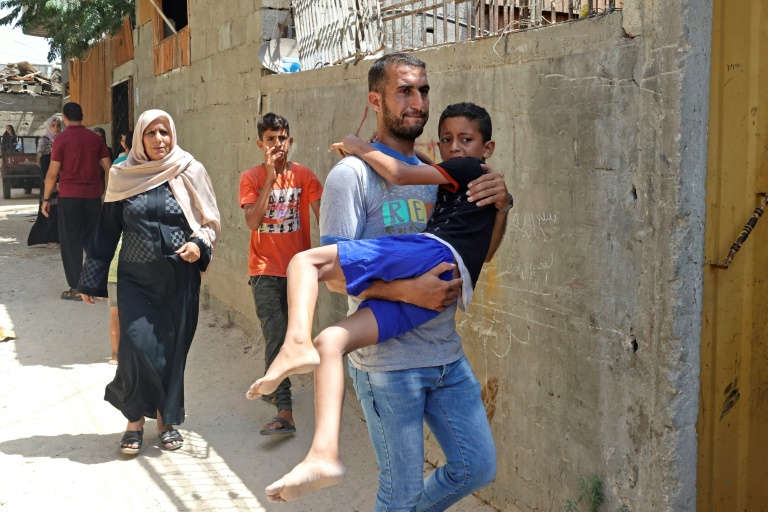
The girl, Alaa Kaddum, had a pink bow in her hair and a wound on her forehead, as her body was carried by her father at her funeral.

Israeli military spokesman Richard Hecht said Friday “we are assuming about 15 killed in action” in Gaza, referring to Palestinian combatants.

The Gaza strikes followed the arrest in the occupied West Bank of two senior members of Islamic Jihad, including Bassem al-Saadi, who Israel accuses of orchestrating recent attacks. 

Israel on Saturday broadened its operation against Islamic Jihad, announcing the arrest of 19 people it said were members of the group in the occupied West Bank. 

Israel has conducted a near relentless wave of often deadly raids inside the West Bank since mid-March in response to lethal attacks on Israeli citizens. 

'Enough!': Exhausted Gazans again under fire

With empty streets and drawn curtains, Gaza feels like a ghost town. Its residents — tested by repeated wars — feel like they are living the same scenes again and again.

Before Israel launched its “pre-emptive” strikes on militants in the Gaza Strip, the Palestinian territory was enjoying a summer unlike any other in recent years. 

Gaza’s beaches, long deemed too polluted with waste water for swimmers, had been declared mostly usable again, allowing Palestinians swimmers and surfers to rediscover the joys of the sea. 

All that came to an abrupt halt on Friday when Israel again bombarded the territory, citing threats from Islamic Jihad militants.

“We were living in peace and suddenly the bombardment began,” said 40-year-old Mohammed Hamami.

“Enough! Enough!” he exclaimed. “Each month or each year there is a war.”

There have been four conflicts since 2007 between Israel and armed groups from Gaza.

The beach promenade, one of the impoverished and overcrowded territory’s rare leisure spots, crowded less than 24 hours earlier, was desolate on Saturday.

Street vendors stayed home and cafes were closed. 

Fifteen months after the last conflict between Israel and armed groups in the territory brought devastation to countless Gazans, Hamami said he was “surprised” that Israel had attacked again.

Twice in July Israeli jets had struck Gaza after what the military said was rocket and rifle fire from the territory. But this time the military said it was preparing for a week-long operation.

The Jewish state has blockaded Gaza since 2007, the year Hamas Islamists took power in the territory. 

– ‘Fear, anxiety’ –

Israel’s army said its latest campaign was targeting militant sites and fighters, estimating that 15 combatants had been killed. 

Palestinian militants retaliated with rocket fire.

The Hamas-run health ministry has reported 13 deaths from Israeli fire including a five-year-old girl, Alaa Kaddum. Her father carried her at her funeral, with a wound on her forehead and a pink bow in her hair. 

More than 110 other people have been wounded, the ministry said. 

For Gazans, the long night and second day of Israeli strikes stirred familiar and unwelcome emotions. 

“This latest escalation brings back images of fear, anxiety, and the feeling that we are all alone,” said Dounia Ismail, a Gaza City resident.

The incessant explosions and air strikes had kept her up all night, she said.

“It has become a habit for Palestinians in Gaza to prepare a survival bag, which contains a few important things, like photos, documents and some money and medicine,” in case they have to flee their homes, said Ismail. 

“I hope this escalation won’t turn into a bigger conflict and I hope the Egyptian mediation will restore calm.” 

In Jabalia, in Gaza’s north, Fouad Farajallah inspected what remained of his home, hit by an Israeli strike on Friday.

The living room had turned into a mass of sheet metal and rubble, the fan dangling from the ceiling.

“I was sitting here on the sofa, with my wife and children, and suddenly it all fell on us,” he said. 

“My wife broke her hand and my son was wounded by shrapnel.” 

Even when silence appears to return between bombardments, something else fills the air: the buzzing of Israeli drones.

Taiwan accuses Beijing of simulating invasion as US-China relations nosedive

Taiwan accused the Chinese army of simulating an attack on its main island Saturday, as Beijing continued its retaliation for US House Speaker Nancy Pelosi’s Taipei visit.

Relations between the two superpowers nosedived following Pelosi’s trip to China’s self-ruled neighbour — which it claims as its territory — prompting calls from the UN for an urgent de-escalation of tensions.

Beijing maintained some of its largest-ever military drills around Taiwan on Saturday — exercises aimed at practising a blockade and ultimate invasion of the island, analysts say. 

Taipei said it observed “multiple batches” of Chinese planes and ships operating in the Taiwan Strait, some of which crossed a demarcation line that divides the strait, but which Beijing does not recognise.

“They were judged to be conducting a simulation of an attack on Taiwan’s main island,” the island’s defence ministry said.

In response, the democratic island’s military mobilised air and land patrols and deployed land-based missile systems, the ministry said.

As of 5:00 pm local time (0900 GMT), Taiwan’s army said “20 Communist planes and 14 ships were detected in the waters around Taiwan conducting joint air-sea exercises”.

At least 14 of them crossed the median line, it said, forcing Taipei to scramble patrol planes to ward off the jets.

Taiwan’s army released images on Saturday of a sailor on one of its frigates monitoring a Chinese ship within touching distance alongside the caption: “Absolutely not photoshopped!” 

It also showed soldiers activating its land-based missile systems to track the Chinese planes.

US Secretary of State Antony Blinken, meeting with his Philippine counterpart on Saturday, said Washington was “determined to act responsibly” to avoid a major global crisis.

The environment became the latest victim of the geopolitical jousting a day earlier, as Beijing said it would withdraw from a series of talks and cooperation agreements with Washington — most notably on climate change and defence cooperation. 

China should not hold talks on issues of global concern such as climate change “hostage”, Blinken said, as it “doesn’t punish the United States, it punishes the world”.

– New drills planned –

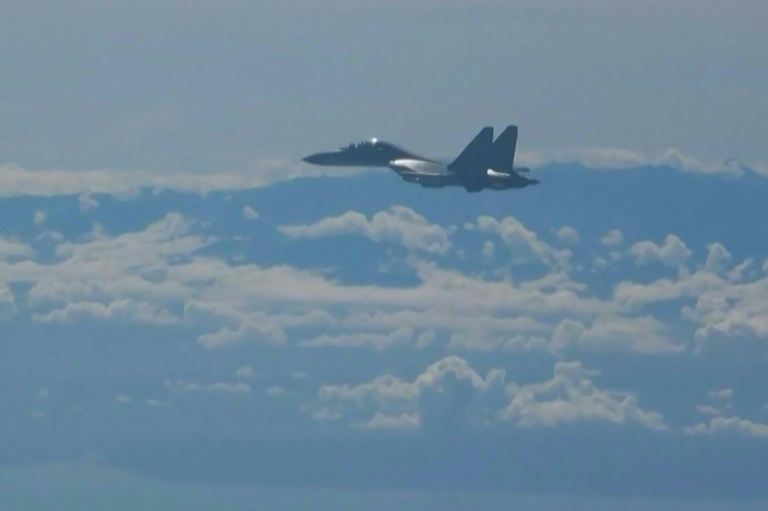
In a bid to show how close China’s forces have been getting to Taiwan’s shores, Beijing’s military overnight released a video of an air force pilot filming the island’s coastline and mountains from his cockpit.

And the Eastern Command of the Chinese army shared a photo it said was taken of a warship patrolling in seas near Taiwan, the island’s shoreline clearly visible in the background.

The drills have also seen Beijing fire ballistic missiles over Taiwan’s capital, according to Chinese state media.

Beijing said it would also hold a live-fire drill in a southern part of the Yellow Sea — located between China and the Korean peninsula — from Saturday until August 15.

Taiwan has remained defiant, insisting it will not be cowed by what Taipei’s government earlier called its “evil neighbour”. 

Taiwan’s foreign ministry told Beijing on Saturday to “immediately stop raising tensions and taking provocative actions to intimidate the Taiwanese people”.

The Mainland Affairs Council, Taipei’s highest policymaking body on China, also condemned the drills after Saturday’s apparent simulation.

– Peace ‘vital’ –

The scale and intensity of China’s drills have triggered outrage in the United States and other democracies.

Blinken and the foreign ministers of Japan and Australia issued a joint statement calling on China to halt the exercises after meeting on the sidelines of an Association of South East Asian Nations (ASEAN) summit in Cambodia.

But Beijing’s decision to withdraw from hard-won cooperation on climate change has now sparked wider fears about the future of the planet.

US National Security Council spokesman John Kirby told reporters in Washington the decision was “fundamentally irresponsible”.

UN Secretary-General Antonio Guterres warned the two superpowers must continue to work together — for the world’s sake.

“For the secretary-general, there is no way to solve the most pressing problems of all the world without an effective dialogue and cooperation between the two countries,” his spokesman Stephane Dujarric said.

– ‘The new normal’ – 

With tensions over Taiwan having risen to their highest level in nearly 30 years, with an elevated risk of military conflict, experts told AFP the latest downturn in relations between the two countries could be long-lasting.

The suspension Friday of bilateral military and maritime dialogue while China continues its military exercises was “particularly worrisome”, said Bonnie Glaser, a China expert at the German Marshall Fund.

“We don’t know what else they will do,” she said. “We just don’t know if this is just a temporary thing.”

John Culver, a former CIA Asia analyst, said in a discussion hosted by the Center for Strategic and International Studies that Beijing’s main purpose with its military exercises was to establish a “new normal”. 

“The Chinese want to show… that a line has been crossed by the speaker’s visit,” Culver said.

Turkey to pay for some Russian gas in rubles: Erdogan

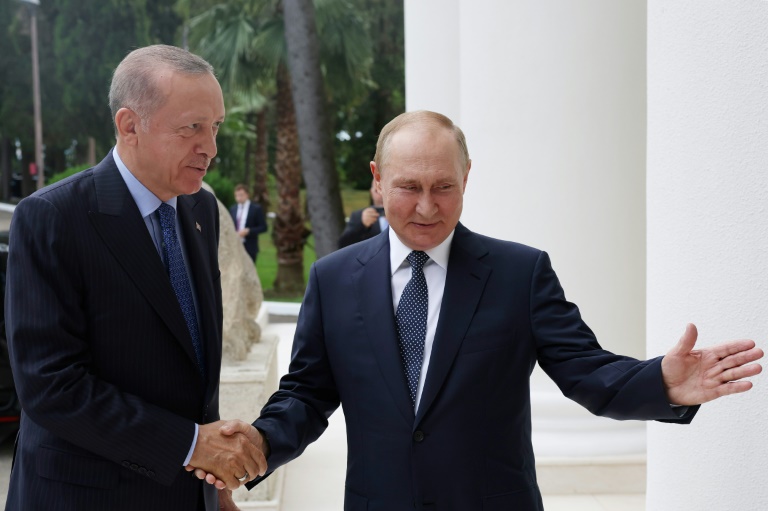
President Recep Tayyip Erdogan has confirmed that Turkey will start paying for some of its Russian natural gas imports in rubles.

The announcement was initially made by Moscow late Friday after more than four hours of talks between Erdogan and Russian President Vladimir Putin in Sochi.

The United States is leading international efforts to impose economic sanctions on Russia in response to its February invasion of Ukraine.

But NATO member Turkey has tried to remain neutral in the conflict because of its heavy dependence on Russian energy.

Russia accounted for about a quarter of Turkey’s oil imports and 45 percent of its natural gas purchases last year.

“As Turkey, our door is open to everyone,” Erdogan was quoted Saturday as telling Turkish reporters on his flight home from Sochi.

“One good thing about this Sochi visit is that we agreed on the ruble with Mr. Putin,” Erdogan said.

“Since we will conduct this trade in rubles, it will of course bring money to Turkey and Russia.”

Neither Erdogan nor Russian officials have said what portion of the gas will be covered by ruble payments.

Avoiding paying for the gas in dollars helps Turkey protect its dwindling hard currency reserves.

The Turkish government is reported to have spent tens of billions of dollars in the past year trying to prop up the lira against steep declines during its latest economic crisis.

The lira has still lost 55 percent of its value against the dollar and consumer prices have soared by 80 percent in the past 12 months.

The crisis has complicated Erdogan’s path to a third decade in power in elections due by next July.

The United States and European Union are trying to pressure Russia’s energy clients from switching to ruble payments to limit Moscow’s ability to wage its war against Ukraine.

Ruble payments help Russia avoid restrictions on dollar transactions with Moscow that the United States is trying to impose on global banks.

Turkey has refused to join the sanctions regime against Russia and instead pushed for truce talks between Moscow and Kyiv.

Erdogan and Putin pledged in Sochi to expand economic cooperation in sectors including banking and industry.

Life support for UK boy to be stopped after long legal battle

A London hospital on Saturday was due to withdraw life support for 12-year-old British boy Archie Battersbee after his parents lost a long and emotive legal battle.

Archie’s mother, Hollie Dance, found her son unconscious at home in April with signs he had placed a cord around his neck, possibly after taking part in an online asphyxiation challenge.

“It’s been really hard,” Dance told Sky News late Friday, breaking down in tears, before the family spent the night at Archie’s bedside in the Royal London Hospital.

“Despite the hard, strong face and appearance obviously in front of the cameras up until now, I’ve been pretty broken,” she said.

Life support was to be withdrawn at 10:00 am (0900 GMT), Dance said, although there was no word from the hospital an hour later.

At the entrance to the hospital in east London, well-wishers left flowers and cards, and lit candles in the shape of the letter “A”.

“My boy is 12, the same age as Archie, and this just puts things in perspective,” Shelley Elias, 43, said after leaving her own offerings at the impromptu vigil.

“I did not know what to write because there are no words that will take the pain away,” she said.

A judge in June agreed with doctors that Archie was “brain-stem dead”, allowing life support to be discontinued, but the family fought through the courts to overturn that. 

Arguing that Archie could benefit from treatment in Italy or Japan, they took their case all the way to the European Court of Human Rights in Strasbourg, which this week declined to intervene.

The parents also lost a last-ditch legal bid to have Archie transferred to a hospice for his final hours.

“All legal routes have been exhausted,” a spokesman for the campaign group Christian Concern, which has been supporting the family, said late Friday.

“The family are devastated and are spending precious time with Archie.”

– ‘Charlie’s Law’ –

The case is the latest in a series that have pitted parents against Britain’s legal and healthcare systems.

The involvement of groups such as Christian Concern in support of desperate parents has drawn criticism for prolonging the pain of all concerned. 

After a highly charged battle between the hospital and his parents, 23-month-old Alfie Evans died in April 2018 when doctors in Liverpool, in northwestern England, withdrew life support.

His parents had the support of Pope Francis to take him to a clinic in Rome, but lost a final court appeal days before he died.

Charlie Gard, born in August 2016 with a rare form of mitochondrial disease that causes progressive muscle weakness, died one week short of his first birthday after doctors withdrew life support.

His parents had fought a five-month legal battle for Charlie to be taken to the United States for experimental treatment.

They have since been pushing the UK government to adopt “Charlie’s Law”, proposed legislation that would strengthen parents’ rights when disputes arise over the treatment of their children.

“The whole system has been stacked against us,” Archie’s mother Dance said.

“Reform must now come through Charlie’s Law so that no parents have to go through this.”

Israel, Palestinian militants trade fire in major Gaza escalation

Israel hit Gaza with air strikes on Saturday and a Palestinian militant group retaliated with a barrage of rocket fire, in the territory’s worst escalation of violence since a war last year.

Israel has said it was forced to launch a “pre-emptive” operation against Islamic Jihad, insisting the group was planning an imminent attack following days of tensions along the Gaza border.

Health authorities in Gaza, a Palestinian enclave controlled by the Islamist group Hamas, said 12 people have been killed by Israel’s bombardment, including a five-year-old girl, with more than 80 others injured. 

Israel’s closure of a key goods crossing four days ago resulted in Gaza’s sole power plant shutting down on Saturday.

Israel and Islamic Jihad have both confirmed the killing of Taysir al-Jabari, a key leader of the militants, in a Friday strike on a building in the west of Gaza city. 

Islamic Jihad, a group that is aligned with Hamas but often acts independently, said that initial Israeli bombardment amounted to a “declaration of war” and unleashed a barrage of rockets towards Israel.

The rocket fire and Israeli strikes were continuing on Saturday, risking a repeat of an 11-day conflict in May 2021 that devastated Gaza and forced countless Israelis to rush to bomb shelters.

Daily life in the enclave has come to a standstill, with streets largely deserted and most shops closed. 

Mohammed Thabet, spokesman for the Gaza Electricity Distribution Company, said Saturday the power station shut down “due to the fuel shortage”.

Diesel for the plant is usually trucked in from Egypt or Israel, which closed its two border crossings with Gaza on Tuesday citing security concerns.

– Escalation, mediation –

“Israel isn’t interested in a wider conflict in Gaza, but will not shy away from one either,” Prime Minister Yair Lapid said in a nationally televised address on Friday. 

Air raid sirens sounded across southern Israel on Saturday, but there were no immediate reports of casualties or major damage.

The Israeli military said the vast majority of 160 rockets fired from Gaza had either fallen within the Palestinian territory, or been intercepted by the Iron Dome aerial defence system.

Officials in border areas urged people to stay close to shelters, which have also been opened in the coastal city of Tel Aviv. 

Egypt, a historic broker between Israel and armed groups in Gaza, was seeking to mediate and may host an Islamic Jihad delegation later Saturday, Egyptian officials told AFP in Gaza.

But sources within Islamic Jihad denied a ceasefire was on the cards, with one saying: “there is no talk whatsoever of Egyptian mediation and for the movement the focus is on the battlefield.”

The Arab League “condemned in the strongest possible terms the ferocious Israeli aggression against Gaza.”

Hamas has fought four wars with Israel since seizing control of Gaza in 2007, including the conflict last May. 

Both Hamas and Islamic Jihad are considered terrorist organisations by much of the West. 

A flare up with Islamic Jihad came in 2019, following Israel’s killing of Baha Abu al-Ata, Jabari’s predecessor. Hamas did not join the fray in that episode.

Hamas’s moves now could prove crucial, with the group facing pressure from some to restore calm in order to improve economic conditions in Gaza.

– Five-year-old girl –

Mohammed Abu Salameh, the director of Shifa, Gaza City’s main hospital, said medics are facing “acute shortages of medical supplies”. 

On Friday, the health ministry reported “a five-year-old girl, targeted by the Israeli occupation” was among those killed. 

The girl, Alaa Kaddum, had a pink bow in her hair and a wound on her forehead, as her body was carried by her father at her funeral.

Israeli military spokesman Richard Hecht said “we are assuming about 15 killed in action” in Gaza, referring to Palestinian combatants.

Israeli tanks were lined up along the border, after the military said Thursday it was reinforcing its troops. 

The measures followed the arrest in the occupied West Bank of two senior members of Islamic Jihad, including Bassem al-Saadi, who Israel accuses of orchestrating recent attacks. 

Israel on Saturday broadened its operation against Islamic Jihad, announcing the arrest of 19 people it said were members of the group in the occupied West Bank. 

Israel has conducted a near relentless wave of often deadly raids inside the West Bank since mid-March in response to lethal attacks on Israeli citizens. 

Taiwan accuses Beijing of simulating invasion as US-China relations nosedive

Taiwan accused the Chinese army of simulating an attack on its main island Saturday, as Beijing continued its retaliation for US House Speaker Nancy Pelosi’s Taipei visit.

Relations between the two superpowers nosedived following Pelosi’s trip to China’s self-ruled neighbour — which it claims as its territory — prompting calls from the UN for an urgent de-escalation of tensions.

Beijing maintained some of its largest-ever military drills around Taiwan on Saturday — exercises aimed at practising a blockade and ultimate invasion of the island, analysts say. 

Taipei said it observed “multiple batches” of Chinese planes and ships operating in the Taiwan Strait, some of which crossed a demarcation line that divides the strait, but which Beijing does not recognise.

“They were judged to be conducting a simulation of an attack on Taiwan’s main island,” it said.

The democratic island’s military mobilised air and land patrols and deployed land-based missile systems in response, the defence ministry said in a tweet.

US Secretary of State Antony Blinken, meeting with his Philippine counterpart on Saturday, said Washington was “determined to act responsibly” to avoid a major global crisis.

The environment became the latest victim of the geopolitical jousting a day earlier, as Beijing said it would withdraw from a series of talks and cooperation agreements with Washington — most notably on climate change and defence cooperation. 

China should not hold talks on issues of global concern such as climate change “hostage”, Blinken said, as it “doesn’t punish the United States, it punishes the world”.

In a bid to show just how close China’s forces have been getting to Taiwan’s shores, Beijing’s military overnight released a video of an air force pilot filming the island’s coastline and mountains from his cockpit.

And the Eastern Command of the Chinese army shared a photo it said was taken of a warship patrolling in seas near Taiwan, the island’s shoreline clearly visible in the background.

Taiwan’s army released images on Saturday of one of its frigates monitoring a Chinese ship within touching distance, and soldiers activating its land-based missile systems.

The drills have also seen Beijing fire ballistic missiles over Taiwan’s capital, according to Chinese state media.

Beijing said it would also hold a live-fire drill in a southern part of the Yellow Sea — located between China and the Korean peninsula — from Saturday until August 15.

Taiwan has remained defiant, insisting it will not be cowed by its “evil neighbour”. 

– Peace ‘vital’ –

The scale and intensity of China’s drills have triggered outrage in the United States and other democracies, with the White House summoning China’s ambassador to Washington to rebuke him over Beijing’s actions.

Blinken and the foreign ministers of Japan and Australia issued a joint statement calling on China to halt the exercises after meeting on the sidelines of an Association of South East Asian Nations (ASEAN) summit in Cambodia.

Beijing’s decision to withdraw from hard-won cooperation on climate change has now sparked wider fears about the future of the planet.

It’s “impossible to address the climate emergency if the world’s number one and number two economies and number one and number two emitters are not taking action”, Alden Meyer, a senior associate at E3G, a climate-focused think tank, told AFP.

National Security Council spokesman John Kirby told reporters in Washington the decision was “fundamentally irresponsible”.

UN Secretary-General Antonio Guterres warned the two superpowers must continue to work together — for the world’s sake.

“For the secretary-general, there is no way to solve the most pressing problems of all the world without an effective dialogue and cooperation between the two countries,” his spokesman Stephane Dujarric said.

– ‘The new normal’ – 

With tensions over Taiwan having risen to their highest level in nearly 30 years with an elevated risk of military conflict, experts told AFP the latest downturn in relations between the two superpowers could be long-lasting.

The suspension Friday of bilateral military and maritime dialogue while China continues its military exercises was “particularly worrisome”, said Bonnie Glaser, a China expert at the German Marshall Fund.

“We don’t know what else they will do,” she said. “We just don’t know if this is just a temporary thing.”

John Culver, a former CIA Asia analyst, said in a discussion hosted by the Center for Strategic and International Studies that Beijing’s main purpose with its military exercises was to change that status quo.

“I think that this is the new normal,” Culver said. 

“The Chinese want to show… that a line has been crossed by the speaker’s visit.”

Greek park fire exposes 'chronic failure': NGOs

Days after one of Greece’s top national parks narrowly escaped massive destruction from a massive fire that raged for over a week, the country’s environment ministry congratulated itself.

Among Greece’s underfunded and understaffed habitats, the Dadia national park is — on paper — one of Greece’s best protected areas as one of Europe’s most important breeding grounds for vultures and other birds of prey.

“Respect and protection of the environment was and remains a fundamental pledge of our government,” environment minister Costas Skrekas said in a statement on Tuesday.

But many Greek environmental groups differ.

Spyros Psaroudas, director of the Callisto wildlife group, says there is a “chronic failure” in Greece’s nature protection, adding that the present government seeks to create a business-friendly environment at the expense of wildlife.

“There is a lack of coordination among ministries and of a clear assignment of responsibilities…all this leads to illegal activities that are never punished,” adds Nadia Andreanidou, policy officer for the Mediterranean Association to Save the Sea Turtles (Medasset).

“It is a vicious circle and it leads to poor management of the protected areas,” she told AFP.

Forestry engineer Dimitris Vasilakis, who helped draw up Dadia’s operational plan, says the park has just four rangers to patrol 800 square kilometres (308 square miles).

The local forest service in Soufli that supervises Dadia annually receives less than 50,000 euros from the state, a fifth of what it’s supposed to, Vasilakis said.

Over 300 firefighters battled for eight days last month to keep the blaze away from the Dadia nesting grounds at the heart of the park.

On Tuesday, the environment ministry said the July 21 fire had destroyed just over 2,200 hectares (54.6 acres) of forest at Dadia. 

Early estimates suggest predator nesting grounds were largely unaffected.

The incident has put a spotlight on Greece’s long and troubled history of environmental protection.

Even as the park burned two weeks ago, the government tried to push through parliament new legislation which nearly a dozen NGOs said further weakened protective restrictions in Greece’s national parks.

On the seventh day of the fire, the legislation was unexpectedly withdrawn by the government for “further consultation”.

The planned draft law would have permitted additional activities in protected areas, including roads, tourism sites and electricity and telecoms storage facilities. 

– Legal vacuum –

Greece has been repeatedly referred to the European court of justice over its failure to protect its natural habitats.

The court rapped Athens on the issue in December 2020, noting that the country by its own admission had created safeguards for less than 20 percent of over 240 protected areas.

A key omission, environmental groups say, is the absence of legal safeguards and regulations governing Greece’s share of the Natura 2000 network — core European breeding and resting sites for rare and threatened species that are protected under EU law.

Charikleia Minotou, head of the Zakynthos programme for the protection of loggerhead turtles run by the Greek chapter of the Worldwide Fund for Nature (WWF), says there are “hundreds” of complaints and fines against illegal development that authorities fail to follow up.

And in 2018, when a presidential decree was issued to protect the gulf of Kyparissia on the Ionian Sea — a key habitat for loggerhead turtles and deep-sea whales — it was challenged by three town councils, two tourism companies and scores of local residents.

– Focus on energy –

The emphasis of the conservative government of Prime Minister Kyriakos Mitsotakis is on hydrocarbon exploration, says Minotou.

Even before the Russian attack on Ukraine in February sparked energy shortage fears across Europe, Greece had earmarked exploration sites in the Ionian Sea.  

In February, several Cuvier’s beaked whales washed up on coasts during seismic research in the Ionian. The state hydrocarbon management agency denied this was caused by its activities.

In the few instances where new legislation is introduced, the results often pose a threat to conservation, Greek environment groups say.

In 2020, Greece formed a new national body to manage its parks, the Natural Environment and Climate Change Agency (Necca). In the process, 36 park management bodies were merged into a new group of 24.

However, environment groups note that the new body has crucially excluded NGOs and local authorities and citizens’ associations from park governing boards.

“We need national parks where local society participates and is represented democratically,” says Psaroudas from the Callisto wildlife group.

Close Bitnami banner
Bitnami