World

More grain leaves Ukraine amid military tactics row

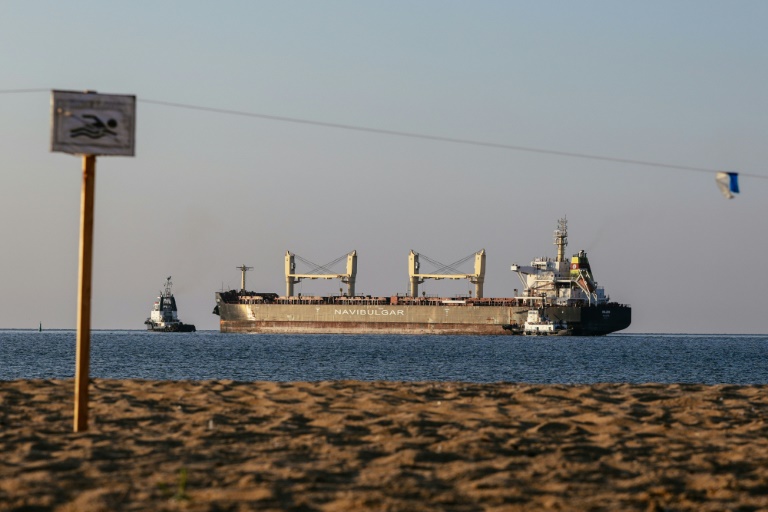
Three ships loaded with grain for the global market left Ukraine on Friday, amid a mushrooming controversy over accusations that the war-torn country is violating international law and endangering civilians in its defence against Russia’s invasion.

The vessels loaded with more than 57,000 tonnes of Ukrainian grain departed Black Sea ports under a recent agreement between Moscow and Kyiv aimed at easing a global food shortage. 

The government in Kyiv said on social media two ships carrying Ukrainian maize — the Maltese-flagged Rojen and the Turkish Polarnet — set off from Chornomorsk while the Panama-flagged Navistar departed Odessa. 

“Our main goal is to increase the trans-shipment volume in our ports. We have to process 100 carriers per month to be able to export the necessary amount of foodstuffs,” said Infrastructure Minister Oleksandr Kubrakov.

Grain shipments have resumed under a deal struck last month between Kyiv and Moscow — mediated by Turkey and under the aegis of the UN — in a bid to alleviate a crisis where food prices have soared in several countries.  

But the rare diplomatic win has been overshadowed by a report Thursday in which Amnesty International listed incidents in 19 cities and towns where Ukrainian forces appeared to have put civilians in harm’s way by establishing bases in residential areas.

– Victim blaming –

Ukrainian President Volodymyr Zelensky equated the accusations to victim blaming in an evening address in which he said the rights group had sought to offer “amnesty (to) the terrorist state and shift the responsibility from the aggressor to the victim”.  

“There is no condition, even hypothetically, under which any Russian strike on Ukraine becomes justified. Aggression against our state is unprovoked, invasive and terrorist,” he added.  

“If someone makes a report in which the victim and the aggressor are supposedly equal in some way… then this cannot be tolerated.”  

After a four-month investigation, Amnesty said it had found that the Ukrainian military had established bases in schools and hospitals, and launched attacks from populated areas, asserting that the tactics violated international humanitarian law.  

The group noted, however, that the tactics “in no way justify Russia’s indiscriminate attacks”, which have battered civilian populations.  

On Friday, the Ukrainian presidency reported Russian bombardments targeting several towns and villages, including Nikopol and Kryvyi Rig in the east, where houses and a gas station were damaged by shelling

Several missiles hit the central city of Zaporizhzhia overnight, where Moscow has been accused of storing heavy weapons at Europe’s largest nuclear power plant in occupied Ukrainian territory.

There was also heavy bombardment of Ukraine’s second city Kharkiv, in the northeast, where housing, shops, a market and an educational institution were damaged.

– Counter-offensive –

Eight people were killed and four wounded on Thursday by a Russian strike that hit a bus stop in Toretsk, near the eastern frontline, according to the regional governor.  

Ukrainian forces are conducting a counter-offensive in the country’s south, where they claim to have retaken more than 50 villages previously controlled by Moscow.

They also claimed to have liberated two villages in the eastern Donetsk region on Thursday and one near Kharkiv on Friday. 

The attacks have not affected the grain shipment deal, which provides for the establishment of secure corridors in the Black Sea to allow merchant ships to export between 20 and 25 million tonnes of Ukrainian grain held up in ports. 

A similar agreement signed at the same time allows Russia to export its agricultural products and fertiliser despite Western sanctions.   

Turkey hopes the agreements could build confidence and lead to a ceasefire between the two countries. 

Separately, the European Union on Thursday announced it was slapping sanctions on former Ukrainian president Viktor Yanukovych and his son Oleksandr for allegedly undermining Ukraine’s security. 

Yanukovych was overthrown in 2014 by a popular uprising against the pro-Russian stance his government had taken. Following his ouster, Moscow moved to annex Ukraine’s Crimean peninsula and backed separatists in the eastern Donbas region.


Three colonial-era burials found in pre-Hispanic Peru sanctuary

A team of Peruvian archaeologists uncovered three burials from the Spanish colonial period on top of a pre-Hispanic temple, which may be up to 500 years old, a researcher said Thursday.

Peru was under Spanish rule for nearly 300 years, from 1532 when they invaded and defeated the Inca empire until 1821 when popular uprisings led to independence. 

“We are working with the hypothesis that the remains belong to a colonial cemetery,” Lucenida Carrion, head of the Archaeology Directorate of the Park of Legends in the Peruvian capital, told AFP. 

The park’s 54 archeological monuments and sanctuaries have been the subject of study for decades. 

“In this summit, we have discovered the burials of two adults and a child who were wrapped in cotton cloth,” the archaeologist added. 

The temple, or pre-Hispanic sanctuary known as “Tres Palos” where the burial site is located, is more than 1,000 years old and is located on land adjacent to the park.  

After the pre-Hispanic era, the site was inhabited by settlers from colonial Lima.

“We are considering whether the remains are from the colonial era,” Carrion said, pointing to the clothes, hair and a Christian crucifix found on one of the remains.  

“This finding is important because it will help us determine if there has been a continuous occupation at this site since pre-Hispanic times.”  

During the 15th and 16th centuries, the “Tres Palos” sanctuary was used by the Incas as a tambo (food deposit) and during the colonial era, adobe (mud and straw) houses were built. 

– Wooden cross –

“What stands out is the cross carried on the chest of one character. This cross indicates the moment of transformation to Christianity of the natives or inhabitants that populated this place,” Carrion said. 

Other than the brown wooden cross, sandals, textile fragments, bracelets, funeral mantles and the remains of ceramic vessels were also discovered. 

The archaeological team’s findings are among the most important in recent years and add to the study of numerous material testimonies uncovered inside the archaeological complex of Maranga, located near the coast of Lima. 

“The works carried out in the place allow us to establish that its history dates back approximately 2,000 years and that they were occupied by the Lima culture, the Ychsma and finally the Incas,” Carrion said. 

The Park of Legends, built in 1964, is named after the pre-Hispanic legends illustrated at the entrance of the enclosure. 

In 2018, a team of archaeologists found a 1,300-year-old cemetery from the pre-Hispanic Lima culture near the park. 

Pelosi says US will 'not allow' China to isolate Taiwan

US House Speaker Nancy Pelosi said Friday that the United States will “not allow” China to isolate Taiwan, after her visit to the self-ruled island infuriated Beijing.

China, which views Taiwan as part of its territory, launched its largest-ever military exercises around the island after Pelosi defied stern threats to become the highest-profile US official to set foot on Taiwanese soil in years.

Now in Tokyo on the final leg of her Asian tour, Pelosi did not comment directly on the drills but argued that American politicians should be able to travel to Taiwan freely.

“They may try to keep Taiwan from visiting or participating in other places, but they will not isolate Taiwan by preventing us to travel there,” she told reporters.

“We will not allow them to isolate Taiwan,” she said, adding that her trip was “not about changing the status quo” in the region.

When asked if the tour had been more about her own legacy than benefiting Taiwan, Pelosi replied: “This isn’t about me — it’s about them.” 

She called the democratic island “one of the freest countries in the world”, saying she was “proud” of her work showcasing concerns related to mainland China, from alleged trade violations and arms proliferation to human rights.

The 82-year-old politician arrived on Thursday from South Korea, another key US ally, where she visited the border with the nuclear-armed North.

It is her first time in Japan since 2015, and on Friday morning she met Prime Minister Fumio Kishida, who said Japan had “called for the immediate cancellation of the military drills”.

Pelosi also held talks with Japan’s House of Representatives speaker Hiroyuki Hosoda, and was scheduled to meet members of the US forces in Japan.

– Ballistic missiles –

Tokyo said five Chinese ballistic missiles were believed to have fallen in Japan’s exclusive economic zone (EEZ), with four of those presumed to have flown over Taiwan’s main island.

The EEZ extends up to 200 nautical miles from Japan’s coastline, beyond the limits of its territorial waters.

Kishida condemned the missile launches as a “serious problem that impacts our national security and the safety of our citizens”.

Parts of Japan’s southernmost Okinawa region are close to Taiwan, as are islets at the centre of a long-running dispute between Tokyo and Beijing.

In May, US President Joe Biden also angered Beijing on a visit to Japan, when he said US forces would defend Taiwan militarily if China attempted to take control of the island by force.

But Biden and his team insisted at the time that their decades-old approach to Taiwan remained in place.

This means support for its government while diplomatically recognising Beijing over Taipei, and opposing a formal independence declaration by Taiwan or a forceful takeover by China.

On Friday, Pelosi said the United States wanted to find “common ground” with China on issues from rights to climate change.

“Again, it isn’t about our visit determining what the US-China relationship is. It’s a much bigger and longer-term challenge, and one that we have to recognize that we have to work together in certain areas,” she said.

Tetsuo Kotani, a professor at Meikai University and senior fellow at the Japan Institute of International Affairs, said the Chinese drills could give the Japanese public a “more realistic” view of Tokyo’s defence capacity compared to Beijing, which has steadily expanded its military might.

“The latest military exercise has shown that what’s happening in Ukraine can happen in Asia,” he told AFP.

Thai nightclub fire kills 13, PM orders probe

Thailand’s prime minister on Friday ordered an investigation into a massive blaze that tore through a nightclub, killing at least 13 people.

The fire broke out around 1:00 am (1800 GMT Thursday) at the Mountain B nightspot in Chonburi province’s Sattahip district, about 150 kilometres (90 miles) southeast of Bangkok.

Video footage posted by a rescue service showed desperate revellers fleeing the club screaming, their clothes ablaze, as a huge fire raged in the background.

The Sawang Rojanathammasathan Rescue Foundation said 13 people were killed and more than 40 injured, 14 of them seriously.

The service said the blaze was accelerated by flammable acoustic foam on the walls of the club, and it took firefighters more than three hours to bring it under control.

Prime Minister Prayut Chan-O-Cha offered condolences to the victims’ families and said he had ordered a probe into the fire.

The dead — four women and nine men — were found mostly crowded by the entrance and in the bathroom, their bodies severely burned, the service said. 

They were aged between 17 and 49 and all are believed to have been Thai.

“There is not death related to foreigners,” police lieutenant colonel Boonsong Yingyong of the Phlu Ta Luang police station, which oversees the area where the blaze occurred, told AFP by phone.

– Charred wreck –

One of the victims was the singer of the band playing at the club, his mother told local media.

“I don’t know what to say. The death came all of a sudden,” Premjai Sae-Oung told reporters.

She said a musician friend who managed to escape had told her the fire broke out in front of the band and spread rapidly.

Images of the aftermath showed how the fire had turned the inside of the club into a blackened wreck, with the charred metal frames of furniture scattered among ashes. 

Engineers are inspecting the one-storey building amid fears it could collapse.

Interior minister Anupong Paochinda told reporters it appeared the Mountain B was operating “without permission” to run as an entertainment venue.

Concerns have long been raised about Thailand’s lax approach to health and safety regulations, particularly in its countless bars and nightclubs.

A massive inferno erupted at a New Year’s Eve party at Bangkok’s swanky Santika club in 2009, killing 67 people and injuring more than 200.

The Santika owner was jailed for three years over the blaze, which began when fireworks were let off as a rock band called Burn played on stage.

More recently, four people were killed in a fire caused by an electrical fault at a club on the holiday island of Phuket, a magnet for foreign tourists, in 2012.

South Korea's first lunar orbiter launched by SpaceX

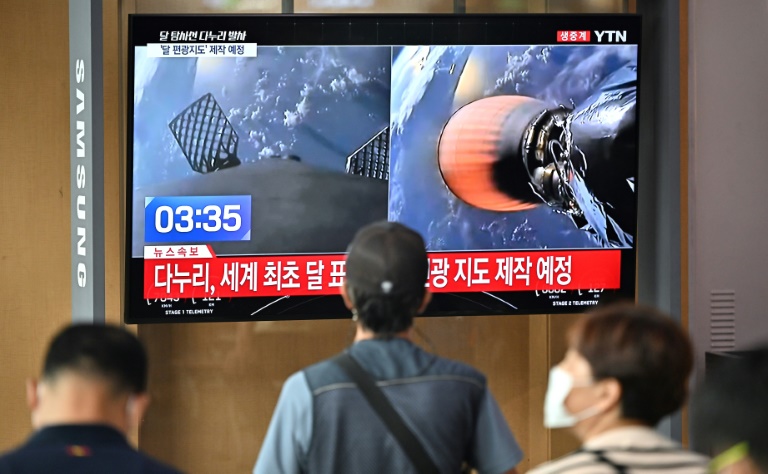
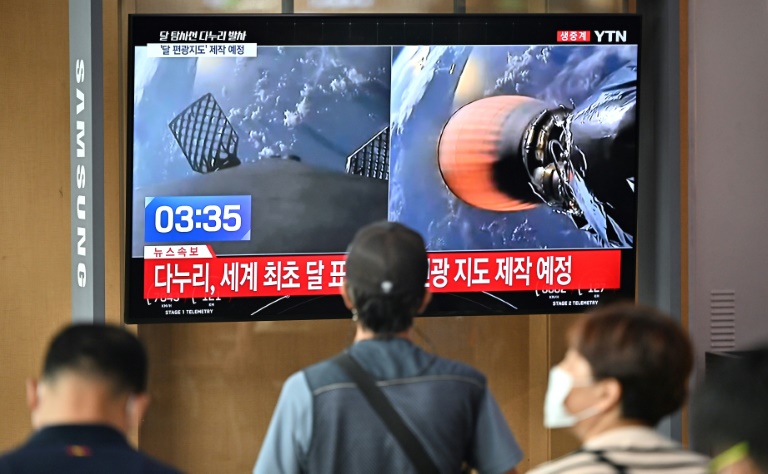
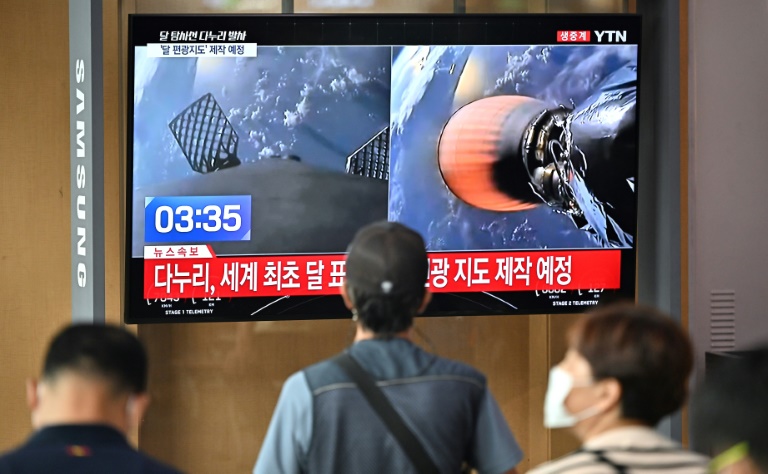
South Korea’s first lunar orbiter successfully launched on a year-long mission to observe the Moon, Seoul said Friday, with the payload including a new disruption-tolerant network for sending data from space.

Danuri — a portmanteau of the Korean words for “Moon” and “enjoy” — was on a Falcon 9 rocket launched from Cape Canaveral in Florida by Elon Musk’s aerospace company SpaceX. It aims to reach the Moon by mid-December.

“South Korea’s first lunar orbiter ‘Danuri’ left for space at 8:08 am on August 5, 2022,” Seoul’s science ministry said in a tweet, sharing a video of the rocket blasting off trailing a huge column of smoke and flames.

Danuri “successfully entered orbit towards the moon”, Seoul’s vice science minister Oh Tae-seok told reporters later Friday, saying that researchers were already communicating with Danuri through NASA’s deep-space antenna in Canberra, Australia.

“Analysis of the received satellite information confirmed that Danuri’s solar panel was properly unfolded to start power generation,” he said, adding everything appeared to be going smoothly.

Danuri will use six different instruments, including a highly sensitive camera provided by NASA, to conduct research, including investigating the lunar surface to identify potential landing sites.

One of the instruments will evaluate disruption-tolerant, network-based space communications, which, according to South Korea’s science ministry, is a world first.

– BTS in space –

Danuri will also try to develop a wireless Internet environment to link satellites or exploration spacecraft, Seoul has said.

The lunar orbiter will stream K-pop sensation BTS’ song “Dynamite” to test this wireless network.

Scientists also hope Danuri will find hidden sources of water and ice in areas of the Moon, including the permanently dark and cold regions near the poles.

“This is a very significant milestone in the history of Korean space exploration,” said Lee Sang-ryool, head of the Korea Aerospace Research Institute, in a video shown before the launch.

“Danuri is just the beginning, and if we are more determined and committed to technology development for space travel, we will be able to reach Mars, asteroids, and so on in the near future.”

South Korean scientists say Danuri — which took seven years to build — will pave the way for the nation’s more ambitious goal of landing on the Moon in the next decade. 

“South Korea will become the seventh country in the world to have launched an unmanned probe to the Moon,” an official at the Korea Aerospace Research Institute told AFP.

“We hope to continue contributing to the global understanding of the Moon with what Danuri is set to find out.”

– Lunar ambitions –

Danuri was launched by a private company — SpaceX — but South Korea recently became one of a handful of countries to successfully launch a one-tonne payload using their own rockets.

In June, the country’s homegrown three-stage rocket nicknamed Nuri — a decade in development at a cost of 2 trillion won ($1.5 billion) — launched successfully and put a satellite into orbit, on its second attempt after a failure last October.

That launch — coupled with Danuri’s launch Friday — helps bring South Korea ever closer to achieving its space ambitions.

In Asia, China, Japan and India all have advanced space programmes — and the South’s nuclear-armed neighbour North Korea has also demonstrated satellite launch capability.

Ballistic missiles and space rockets use similar technology and Pyongyang put a 300-kilogram (660-pound) satellite into orbit in 2012 in what Washington condemned as a disguised missile test.

South Korea's first lunar orbiter launched by SpaceX

South Korea’s first lunar orbiter successfully launched on a year-long mission to observe the Moon, Seoul said Friday, with the payload including a new disruption-tolerant network for sending data from space.

Danuri — a portmanteau of the Korean words for “Moon” and “enjoy” — was on a Falcon 9 rocket launched from Cape Canaveral in Florida by Elon Musk’s aerospace company SpaceX. It aims to reach the Moon by mid-December.

“South Korea’s first lunar orbiter ‘Danuri’ left for space at 8:08 am on August 5, 2022,” Seoul’s science ministry said in a tweet, sharing a video of the rocket blasting off trailing a huge column of smoke and flames.

Danuri “successfully entered orbit towards the moon”, Seoul’s vice science minister Oh Tae-seok told reporters later Friday, saying that researchers were already communicating with Danuri through NASA’s deep-space antenna in Canberra, Australia.

“Analysis of the received satellite information confirmed that Danuri’s solar panel was properly unfolded to start power generation,” he said, adding everything appeared to be going smoothly.

Danuri will use six different instruments, including a highly sensitive camera provided by NASA, to conduct research, including investigating the lunar surface to identify potential landing sites.

One of the instruments will evaluate disruption-tolerant, network-based space communications, which, according to South Korea’s science ministry, is a world first.

– BTS in space –

Danuri will also try to develop a wireless Internet environment to link satellites or exploration spacecraft, Seoul has said.

The lunar orbiter will stream K-pop sensation BTS’ song “Dynamite” to test this wireless network.

Scientists also hope Danuri will find hidden sources of water and ice in areas of the Moon, including the permanently dark and cold regions near the poles.

“This is a very significant milestone in the history of Korean space exploration,” said Lee Sang-ryool, head of the Korea Aerospace Research Institute, in a video shown before the launch.

“Danuri is just the beginning, and if we are more determined and committed to technology development for space travel, we will be able to reach Mars, asteroids, and so on in the near future.”

South Korean scientists say Danuri — which took seven years to build — will pave the way for the nation’s more ambitious goal of landing on the Moon in the next decade. 

“South Korea will become the seventh country in the world to have launched an unmanned probe to the Moon,” an official at the Korea Aerospace Research Institute told AFP.

“We hope to continue contributing to the global understanding of the Moon with what Danuri is set to find out.”

– Lunar ambitions –

Danuri was launched by a private company — SpaceX — but South Korea recently became one of a handful of countries to successfully launch a one-tonne payload using their own rockets.

In June, the country’s homegrown three-stage rocket nicknamed Nuri — a decade in development at a cost of 2 trillion won ($1.5 billion) — launched successfully and put a satellite into orbit, on its second attempt after a failure last October.

That launch — coupled with Danuri’s launch Friday — helps bring South Korea ever closer to achieving its space ambitions.

In Asia, China, Japan and India all have advanced space programmes — and the South’s nuclear-armed neighbour North Korea has also demonstrated satellite launch capability.

Ballistic missiles and space rockets use similar technology and Pyongyang put a 300-kilogram (660-pound) satellite into orbit in 2012 in what Washington condemned as a disguised missile test.

South Korea's first lunar orbiter launched by SpaceX

South Korea’s first lunar orbiter successfully launched on a year-long mission to observe the Moon, Seoul said Friday, with the payload including a new disruption-tolerant network for sending data from space.

Danuri — a portmanteau of the Korean words for “Moon” and “enjoy” — was on a Falcon 9 rocket launched from Cape Canaveral in Florida by Elon Musk’s aerospace company SpaceX. It aims to reach the Moon by mid-December.

“South Korea’s first lunar orbiter ‘Danuri’ left for space at 8:08 am on August 5, 2022,” Seoul’s science ministry said in a tweet, sharing a video of the rocket blasting off trailing a huge column of smoke and flames.

Danuri “successfully entered orbit towards the moon”, Seoul’s vice science minister Oh Tae-seok told reporters later Friday, saying that researchers were already communicating with Danuri through NASA’s deep-space antenna in Canberra, Australia.

“Analysis of the received satellite information confirmed that Danuri’s solar panel was properly unfolded to start power generation,” he said, adding everything appeared to be going smoothly.

Danuri will use six different instruments, including a highly sensitive camera provided by NASA, to conduct research, including investigating the lunar surface to identify potential landing sites.

One of the instruments will evaluate disruption-tolerant, network-based space communications, which, according to South Korea’s science ministry, is a world first.

– BTS in space –

Danuri will also try to develop a wireless Internet environment to link satellites or exploration spacecraft, Seoul has said.

The lunar orbiter will stream K-pop sensation BTS’ song “Dynamite” to test this wireless network.

Scientists also hope Danuri will find hidden sources of water and ice in areas of the Moon, including the permanently dark and cold regions near the poles.

“This is a very significant milestone in the history of Korean space exploration,” said Lee Sang-ryool, head of the Korea Aerospace Research Institute, in a video shown before the launch.

“Danuri is just the beginning, and if we are more determined and committed to technology development for space travel, we will be able to reach Mars, asteroids, and so on in the near future.”

South Korean scientists say Danuri — which took seven years to build — will pave the way for the nation’s more ambitious goal of landing on the Moon in the next decade. 

“South Korea will become the seventh country in the world to have launched an unmanned probe to the Moon,” an official at the Korea Aerospace Research Institute told AFP.

“We hope to continue contributing to the global understanding of the Moon with what Danuri is set to find out.”

– Lunar ambitions –

Danuri was launched by a private company — SpaceX — but South Korea recently became one of a handful of countries to successfully launch a one-tonne payload using their own rockets.

In June, the country’s homegrown three-stage rocket nicknamed Nuri — a decade in development at a cost of 2 trillion won ($1.5 billion) — launched successfully and put a satellite into orbit, on its second attempt after a failure last October.

That launch — coupled with Danuri’s launch Friday — helps bring South Korea ever closer to achieving its space ambitions.

In Asia, China, Japan and India all have advanced space programmes — and the South’s nuclear-armed neighbour North Korea has also demonstrated satellite launch capability.

Ballistic missiles and space rockets use similar technology and Pyongyang put a 300-kilogram (660-pound) satellite into orbit in 2012 in what Washington condemned as a disguised missile test.

ASEAN condemns lack of Myanmar peace progress

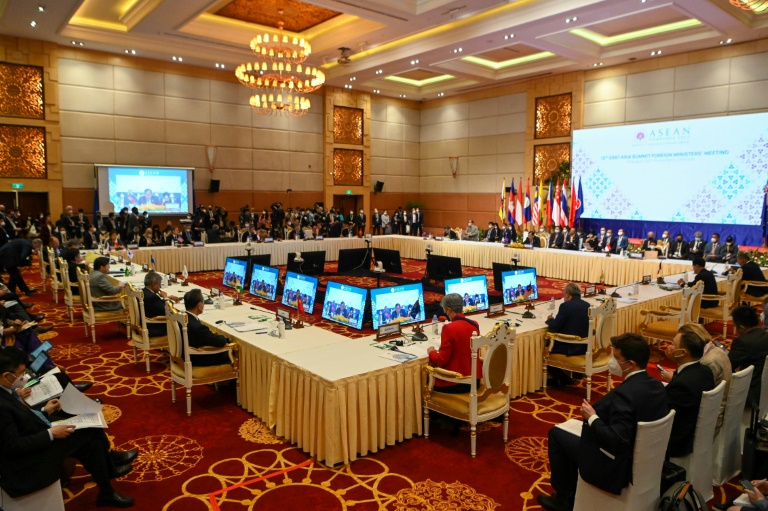
Southeast Asian ministers Friday condemned the lack of progress on a crisis resolution plan for coup-hit Myanmar, demanding the junta take action before a regional summit later this year.

Myanmar has been in chaos since a putsch in February last year, and the death toll from the military’s brutal crackdown on dissent has passed 2,100, according to a local monitoring group.

Anger is growing among some Association of Southeast Asian Nations (ASEAN) members at the generals’ stonewalling, particularly after the execution last month of four prisoners — including two prominent pro-democracy figures.

The 10-member bloc — spearheading so far fruitless efforts to resolve the turmoil — issued a joint statement after foreign minister talks in Phnom Penh.

The ministers said they were “deeply disappointed by the limited progress in and lack of commitment of the Naypyidaw authorities to the timely and complete implementation of the five point consensus”.

And in a veiled warning to Myanmar’s junta, the statement — referencing Article 20 of the ASEAN charter — noted the leaders’ meeting later this year could still take action over “non-compliance”.

ASEAN decisions are usually taken by consensus, but Article 20 allows a summit to override this principle.

Myanmar’s top diplomat, Wunna Maung Lwin, was not invited to Phnom Penh and was also left out of a foreign ministers’ retreat in February, while junta leader Min Aung Hlaing was snubbed at a leaders’ summit last year.

The foreign ministers also condemned last month’s executions of Phyo Zeya Thaw, a rapper-turned-lawmaker from ousted civilian leader Aung San Suu Kyi’s National League for Democracy party, and veteran political activist Kyaw Min Yu, better known as “Jimmy”.

Earlier in the week, Malaysia — which has led calls for tougher action — indicated that Myanmar could face suspension from the bloc, should members not see concrete progress ahead of the leaders’ summit.

ASEAN has long been derided by critics as a toothless talking shop, but in addition to Malaysia, the Philippines, Indonesia and Singapore have pushed for a firmer line on Myanmar.

Friday’s statement said ASEAN’s special envoy to Myanmar must be allowed to meet with “all relevant stakeholders” — alluding to the military junta’s decision to block access to the detained Suu Kyi.

The Nobel laureate and democracy icon faces a raft of charges that could see her jailed for more than 150 years.

– Taiwan tensions –

The latest communique did not specifically mention this week’s spat between China and the United States following US House Speaker Nancy Pelosi’s visit to Taiwan.

A furious Beijing kicked off its biggest-ever military exercises in waters surrounding the self-ruled island in response to the visit on Thursday.

But the ASEAN foreign ministers warned against “provocative action”.

The situation “could lead to miscalculation, serious confrontation, open conflicts and unpredictable consequences among major powers”, they said in a joint statement published Thursday.

On Friday, the ministers also held regional security talks with their counterparts from the US, China, Russia, Japan and Australia at the East Asia Summit.

India hikes interest rates to pre-pandemic level

India’s central bank on Friday hiked interest rates for the third time in four months, as Asia’s third-largest economy contends with a widening trade deficit and weakening currency.

The Reserve Bank of India (RBI) raised its key lending rate by 50 basis points to 5.40 percent — a level last seen in August 2019 — three months after kicking off a monetary tightening cycle in May.

“Successive shocks to the global economy are taking their toll,” RBI governor Shaktikanta Das said in a televised address, pointing to surging inflation and lower global growth.

“Disquietingly, globalisation of inflation is coinciding with de-globalisation of trade. The pandemic and the war have ignited tendencies towards greater fragmentation.”

India bounced back strongly from the coronavirus pandemic with one of the world’s fastest growth rates but is now grappling with rising costs as commodity prices remain elevated.

The International Monetary Fund last week slashed India’s growth outlook for the ongoing financial year ending March 2023 to 7.4 percent from the 8.2 percent forecast in April.

A broad dollar rally in recent months has contributed to the Indian rupee depreciating sharply to below 80, its lowest level against the greenback on record.

Das said the rupee has fared “much better” than other emerging market currencies and “moved in a relatively orderly fashion, depreciating 4.7 percent against the US dollar” since April 1.

He added that the Indian economy was “holding steady and progressing in an ocean of turbulence and uncertainty”.

India’s merchandise trade deficit widened to a record $31 billion in July, compared to $10.6 billion in the same month last year, provisional data released Tuesday showed.

Imports were more than twice as high as exports, led by petroleum products and coal.

India imports more than 80 percent of its crude oil needs and the country’s 1.4 billion people have been hit with rising petrol costs.

Consumer inflation has consistently overshot the central bank’s two-to-six percent target range in the first six months of the year, hitting an eight-year high of 7.79 percent in April, before cooling to 7.01 percent in June.

The RBI retained its growth forecast at 7.2 percent for the 2022-23 financial year and retained its inflation forecast at 6.7 percent.

Aggressive rate hikes by the US Federal Reserve have further exacerbated outflows, with foreign investors withdrawing a net $30 billion from debt and equity in the first half of 2022.

India’s benchmark Sensex index erased early losses to trade 0.56 percent higher on Friday following the interest rate decision.

India hikes interest rates to pre-pandemic level

India’s central bank on Friday hiked interest rates for the third time in four months, as Asia’s third-largest economy contends with a widening trade deficit and weakening currency.

The Reserve Bank of India (RBI) raised its key lending rate by 50 basis points to 5.40 percent — a level last seen in August 2019 — three months after kicking off a monetary tightening cycle in May.

“Successive shocks to the global economy are taking their toll,” RBI governor Shaktikanta Das said in a televised address, pointing to surging inflation and lower global growth.

“Disquietingly, globalisation of inflation is coinciding with de-globalisation of trade. The pandemic and the war have ignited tendencies towards greater fragmentation.”

India bounced back strongly from the coronavirus pandemic with one of the world’s fastest growth rates but is now grappling with rising costs as commodity prices remain elevated.

The International Monetary Fund last week slashed India’s growth outlook for the ongoing financial year ending March 2023 to 7.4 percent from the 8.2 percent forecast in April.

A broad dollar rally in recent months has contributed to the Indian rupee depreciating sharply to below 80, its lowest level against the greenback on record.

Das said the rupee has fared “much better” than other emerging market currencies and “moved in a relatively orderly fashion, depreciating 4.7 percent against the US dollar” since April 1.

He added that the Indian economy was “holding steady and progressing in an ocean of turbulence and uncertainty”.

India’s merchandise trade deficit widened to a record $31 billion in July, compared to $10.6 billion in the same month last year, provisional data released Tuesday showed.

Imports were more than twice as high as exports, led by petroleum products and coal.

India imports more than 80 percent of its crude oil needs and the country’s 1.4 billion people have been hit with rising petrol costs.

Consumer inflation has consistently overshot the central bank’s two-to-six percent target range in the first six months of the year, hitting an eight-year high of 7.79 percent in April, before cooling to 7.01 percent in June.

The RBI retained its growth forecast at 7.2 percent for the 2022-23 financial year and retained its inflation forecast at 6.7 percent.

Aggressive rate hikes by the US Federal Reserve have further exacerbated outflows, with foreign investors withdrawing a net $30 billion from debt and equity in the first half of 2022.

India’s benchmark Sensex index erased early losses to trade 0.56 percent higher on Friday following the interest rate decision.

Close Bitnami banner
Bitnami