World

Myanmar junta charges Japanese journalist with encouraging dissent

A Japanese journalist detained in Myanmar has been charged with breaching immigration law and encouraging dissent against the military, the ruling junta said Thursday.

Myanmar’s military has clamped down on press freedoms since its coup last year, arresting reporters and photographers as well as revoking broadcasting licences as the country plunged into chaos.

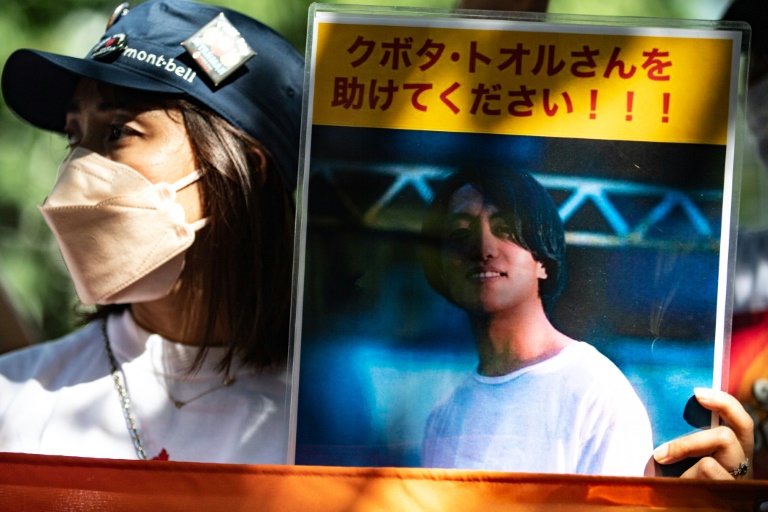
Toru Kubota, who was held while covering a protest in Yangon last week, “has been charged under section 505 (a) and under immigration law 13-1”, the junta said in a statement.

505 (a) — a law that criminalises encouraging dissent against the military and carries a maximum three-year jail term — has been widely used in the crackdown on dissent.

Breaching immigration law 13-1 carries a maximum penalty of five years in prison.

Filmmaker Kubota, 26, was detained near an anti-government rally in Yangon along with two Myanmar citizens.

After the charges were filed, he was transferred from police custody to Yangon’s Insein prison, a security source told AFP, requesting anonymity.

“He’s in good health and embassy officials have visited him already at the police station where he has been detained.”

According to a profile on FilmFreeway, Kubota has previously made documentaries on Myanmar’s Muslim Rohingya minority and “refugees and ethnic issues in Myanmar”.

Kubota had arrived in Myanmar on July 14 and was filming a “documentary featuring a Myanmar person”, his friend Yoshitaka Nitta told a press conference in Tokyo on Wednesday. 

He is the fifth foreign journalist to be detained in Myanmar, after US citizens Nathan Maung and Danny Fenster, Robert Bociaga of Poland and Yuki Kitazumi of Japan — all of whom were later freed and deported.

Fenster, who was held in May last year as he attempted to leave the country, faced a closed-door trial inside Insein on charges of unlawful association, incitement against the military and breaching visa rules.

He was sentenced to 11 years in prison before being pardoned and deported.

– ‘War on journalists’ –

“The regime has declared war on journalists, and 505a is its preferred charge,” said Richard Horsey of the International Crisis Group.

“This charge against a Japanese journalist shows the regime is determined to continue stifling objective reporting, whether by local or foreign journalists.”

Japan’s foreign ministry said in a statement that its embassy in Myanmar was “appealing to the Myanmar authorities for the early release of the Japanese man, and will continue to make efforts to gather information and request his early release”.

Tokyo is a top donor to Myanmar and has long-standing relations with the country’s military.

The already isolated junta stoked further international outrage last week when it announced the execution of four prisoners, in the country’s first use of capital punishment in decades. 

“The situation in Burma has gone from bad to worse,” United States Secretary of State Antony Blinken said, using the country’s former name, after talks with EU foreign policy chief Josep Borrell.

Blinken met Borrell on the sidelines of a meeting of Southeast Asian foreign ministers in Cambodia, from which Myanmar’s top diplomat has been excluded over the junta’s failure to open talks with its political opponents.

More than 2,100 people have been killed in the crackdown on dissent in Myanmar and almost 15,000 arrested, according to a local monitoring group.

As of March this year, 48 journalists remain in custody across the country, according to the monitoring group Reporting ASEAN.

Only China jailed more reporters than Myanmar last year, according to the Committee to Protect Journalists.
Seoul says Pelosi DMZ visit sends clear message to North

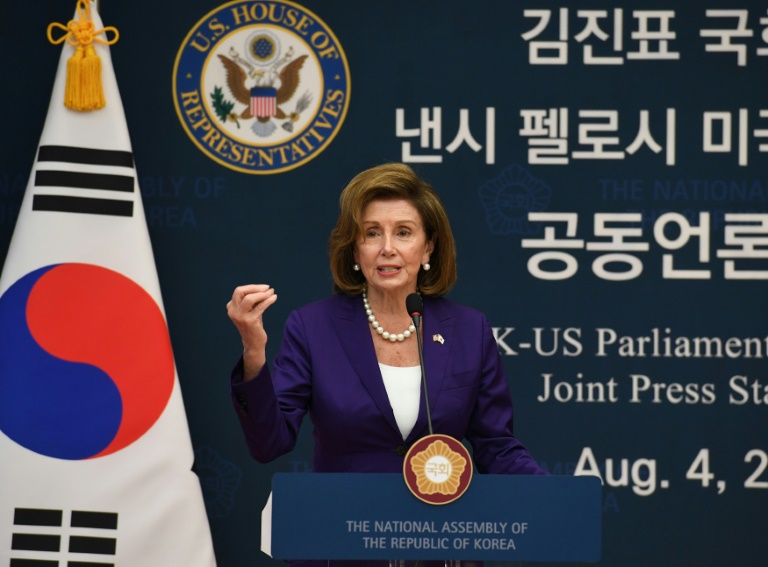
After her high-profile trip to Taiwan, US House Speaker Nancy Pelosi was in South Korea Thursday where her agenda included a visit to the heavily fortified Demilitarized Zone (DMZ) — but not a meeting with the country’s president.

Pelosi, who arrived in Seoul late Wednesday, met top parliamentary officials in the capital before her scheduled trip to the border with the nuclear-armed North, where the two neighbours’ forces stand face to face, a South Korean official said.

She will be the highest-ranking US official to visit the Joint Security Area (JSA) and inter-Korean truce village of Panmunjom since then president Donald Trump met North Korean leader Kim Jong Un there in 2019.

But those talks collapsed and North Korea has conducted a record-breaking blitz of weapons tests so far this year, including firing an intercontinental ballistic missile at full range for the first time since 2017.

Pelosi discussed the “grave situation” and growing threat posed by North Korea’s nuclear weapons programmes with her South Korean counterpart, National Assembly Speaker Kim Jin-pyo.

And her trip to the DMZ is seen by President Yoon Suk-yeol as “a sign of strong deterrence between South Korea and the US against North Korea,” an official from his office said Thursday.

– Pelosi snub? –

Yoon, who spoke to Pelosi by phone but did not meet her in person as he is officially on holiday this week, is facing growing domestic criticism over his perceived snub of the second in line to the US Presidency.

Local media and lawmakers from Yoon’s party have pointed to the fact that no official delegation was sent to greet Pelosi, even as Yoon was photographed attending a play in central Seoul the same night.

“What should we make of the fact that [Yoon] is watching a play and have a gathering [with the actors] but not meeting the US House Speaker?” a former lawmaker from Yoon’s People’s Power party, Yoo Seung-min, wrote on Facebook Thursday.

“Speaker Pelosi is visiting the JSA today. It is undesirable to think that the leader of our ally’s parliament visits the forefront of our security but there won’t be any meetings between our president and her.”

Yoon took office in May, vowing to boost ties with the United States, including ramping up the joint military drills that always infuriate North Korea, which views them as rehearsals for invasion.

He had also struck a hawkish, anti-China tone on the campaign trail, saying he wanted to buy an additional THAAD US missile system to counter the North, despite staunch opposition from Beijing.

But critical local media reports now speculate he may have avoided meeting Pelosi in a bid to placate China.

– Taiwan visit –

At a brief press conference in Seoul, during which she did not take any questions, Pelosi hailed the “special” relationship between South Korea and the United States — but made no mention of her visit to Taipei.

“The US-Republic of Korea relationship is special to us,” she said, adding that the bond which was forged during the Korean war “from urgency and security… has become the warmest of friendships.”

Pelosi had defied repeated Chinese warnings to visit Taiwan, which China considers its territory. Beijing had said any such trip would be viewed as a major provocation.

It has since launched massive military drills around the island.

China is North Korea’s key ally and trade partner.

Pyongyang on Wednesday echoed Beijing’s criticism of the Pelosi visit to Taiwan, describing it as “impudent interference” in China’s internal affairs and blaming Washington for raising regional tensions.

South Korea is the fourth stop in Pelosi’s Asia tour, following Singapore, Malaysia and Taiwan.

She is scheduled to fly to Japan later on Thursday for the final leg of her Asia trip.

European stocks mainly rise, London down as rate hike looms

European stocks mostly rose Thursday but London fell before an expected interest rate hike from the Bank of England, while traders tracked Chinese military drills around Taiwan.

Oil prices edged higher, one day after sinking as major producers announced a small output increase.

The London stock market declined ahead of the Bank of England’s latest rate decision at 1100 GMT.

The BoE is tipped by economists to ramp up interest rates by a half-point, the biggest hike in almost 30 years, mirroring aggressive monetary policy elsewhere as it seeks to cool decades-high inflation.

“All eyes (are) on (the) BoE to see if follows other central banks and delivers a larger hike,” said MUFG analyst Lee Hardman.

Rising interest rates tend to weigh on shares because they lift business loan repayments and eat further into consumers’ incomes.

In company news, Rolls-Royce shares sank 10 percent after the British engine maker revealed it tanked into a £1.6-billion ($1.9-billion) net loss in the first half on adverse currency movements, despite rebounding revenues.

Frankfurt and Paris stock markets meanwhile advanced.

Most Asian indices tracked a Wall Street rally fuelled by healthy economic and earnings data, despite lingering Taiwan concerns.

New York surged Wednesday after a report on the crucial US services sector showed surprise improvement, soothing recession fears in the world’s top economy.

That came as several companies — including Electronic Arts, Starbucks and Moderna — posted strong earnings, extending a broadly positive reporting season in the face of surging inflation and rising interest rates.

Markets have swung this week after a number of Federal Reserve officials lined up to suggest there were still some big US rate hikes likely and talk of cuts next year might be overdone.

– Pelosi visit –

The mood in Asia was also a lot more settled after the upheaval of this week’s visit to Taiwan by US House Speaker Nancy Pelosi, which sparked outrage in China with warnings of stern military and economic responses.

Beijing has suspended a limited amount of cross-strait imports and exports, and on Thursday began its largest-ever military exercises encircling Taiwan that are expected to last for days.

Soon after, Taiwan’s defence ministry said it was “preparing for war without seeking war”.

Taipei stocks fell again on worries that the Chinese manoeuvres would hit shipping lanes and flights into Taiwan.

– Key figures at around 0940 GMT –

London – FTSE 100: DOWN 0.2 percent at 7,431.05 points

Frankfurt – DAX: UP 0.9 percent at 13,706.27

Paris – CAC 40: UP 0.5 at 6,504.53

EURO STOXX 50: UP 0.6 percent at 3,755.04

Tokyo – Nikkei 225: UP 0.7 percent at 27,932.20 (close)

Hong Kong – Hang Seng Index: UP 2.1 percent at 20,174.04 (close)

Shanghai – Composite: UP 0.8 percent at 3,189.04 (close)

New York – Dow: UP 1.3 percent at 32,812.50 (close)

Euro/dollar: UP at $1.0188 from $1.0166 Wednesday

Pound/dollar: UP at $1.2166 from $1.2149

Euro/pound: UP at 83.73 pence from 83.63 pence

Dollar/yen: UP at 134.26 yen from 133.86 yen

Brent North Sea crude: UP 0.4 percent at $97.16 per barrel

West Texas Intermediate: UP 0.3 percent at $90.95 per barrel

burs/rfj/lth

Bemused tourists granted front row seats to China's latest fire and fury

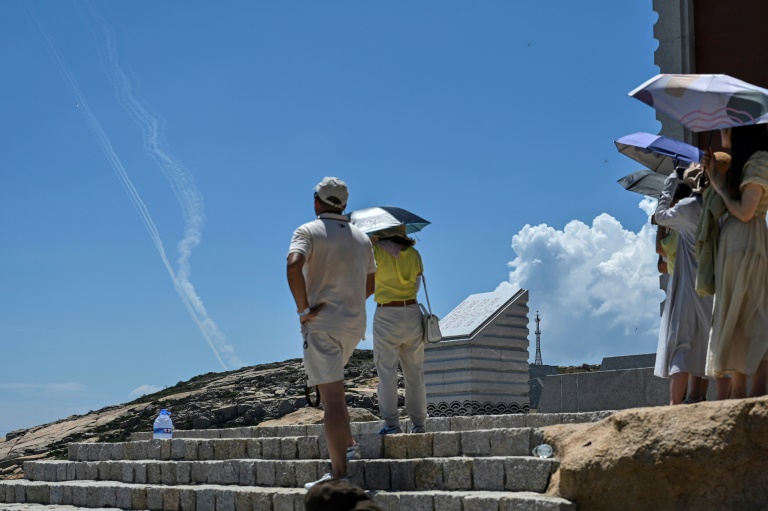
The hum of holiday vibes and the selfie-snapping is interrupted by the roar of explosions as projectiles shoot up into the sky, prompting oohs and aahs from the surprised tourists. 

Visitors to Pingtan island, a popular destination with resplendent sea and reefs that attracts thousands of visitors every summer, have been granted a front row seat to China’s latest fury at Taiwan.

The unprecedented military exercises are a response to this week’s visit to the self-ruled island by US House Speaker Nancy Pelosi — seen by Beijing as a major provocation.  

The closest point in mainland China to Taiwan, about 125 kilometres away across the strait, Pingtan lies on the frontlines. 

Tourists in shorts, t-shirts and caps defy the 38 degree Celsius (100 degrees Fahrenheit) temperature and crowd on the eastern tip of the island. 

But the afternoon beach fun is swiftly punctuated by the boom of missile fire across the Taiwan Strait, sending tourists’ heads spinning. 

Their cameras swiftly shift from documenting family fun to the latest geopolitical missive between Beijing and Taipei, facing the azure sky to capture the projectiles soaring from military installations located only a few kilometres away. 

“It’s a little worrying all that… come on, let’s go,” a woman carrying a parasol to protect herself from the sun told her friends as other anxious tourists broke camp. 

Further on, another group of tourists arrive to find out what all the commotion is about. 

“We suddenly heard a huge noise. It surprised us at the time!”  a student who came with friends and who introduces himself as Jack, tells AFP. 

“If we were scared? Not at all”, says the smiling young man.  

The Chinese military manoeuvres, which are taking place in six maritime areas around Taiwan, began Thursday noon (0400 GMT) and will continue until Sunday noon (0400 GMT). 

Spectators flock to Iceland volcano

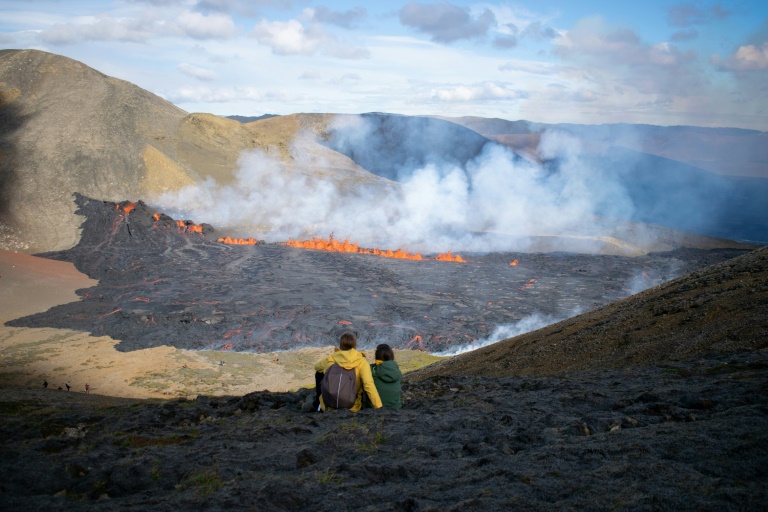
Curious onlookers made their way Thursday to the site of a volcano erupting near Iceland’s capital Reykjavik to marvel at the bubbling lava, a day after the fissure appeared in an uninhabited valley.

The eruption was around 40 kilometres (25 miles) from Reykjavik, near the site of the Mount Fagradalsfjall volcano in southwestern Iceland that spewed magma for six months between March and September 2021.

While last year’s eruption was easily accessible on foot and drew more than 435,000 tourists, the new eruption is trickier to access, requiring a strenuous 90-minute hilly hike from the closest car park. 

Despite that, more than 1,830 people visited the site on the first day of the eruption, according to the Icelandic Tourist Board, and more visitors were seen trekking to the scene early Thursday.

The fissure was estimated to be around 360 metres (1,181 feet) long, the Icelandic Meteorological Office said Thursday, with lava fountains about 10-15 metres high.

The average lava flow in the first hours was estimated at 32 cubic metres per second, according to measurements done Wednesday at 1705 GMT — 3.5 hours after the eruption began — by scientists from the Institute of Earth Sciences.

That is about four or five times more than at the beginning of last year’s eruption.

“The current eruption is therefore much more powerful,” the Institute wrote in a Facebook post.

The lava covered an area of about 74,000 square metres, it said. 

By comparison, last year’s six-month eruption saw 150 million cubic metres of lava spilled over 4.85 square kilometres.

Officials had initially urged people to refrain from visiting the site until a danger assessment had been conducted.

But on Thursday, the Department of Civil Protection and Emergency Management said only that young children should not walk up to the eruption site.

Gases from a volcanic eruption — especially sulphur dioxide — can be elevated in the immediate vicinity, may pose a danger to health and even be fatal.

Gas pollution can also be carried by the wind.

Mount Fagradalsfjall belongs to the Krysuvik volcanic system on the Reykjanes peninsula in southwestern Iceland.

Known as the land of fire and ice, Iceland has 32 volcanic systems currently considered active, the highest number in Europe. The country has had an eruption every five years on average.

Spectators flock to Iceland volcano

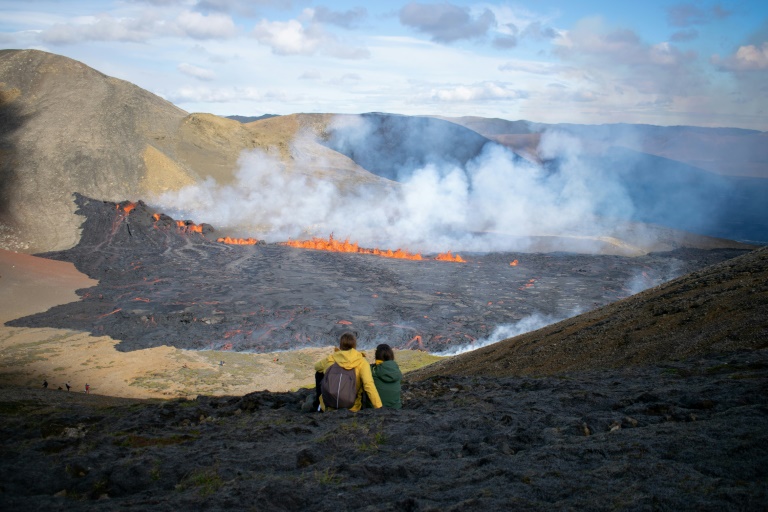
Curious onlookers made their way Thursday to the site of a volcano erupting near Iceland’s capital Reykjavik to marvel at the bubbling lava, a day after the fissure appeared in an uninhabited valley.

The eruption was around 40 kilometres (25 miles) from Reykjavik, near the site of the Mount Fagradalsfjall volcano in southwestern Iceland that spewed magma for six months between March and September 2021.

While last year’s eruption was easily accessible on foot and drew more than 435,000 tourists, the new eruption is trickier to access, requiring a strenuous 90-minute hilly hike from the closest car park. 

Despite that, more than 1,830 people visited the site on the first day of the eruption, according to the Icelandic Tourist Board, and more visitors were seen trekking to the scene early Thursday.

The fissure was estimated to be around 360 metres (1,181 feet) long, the Icelandic Meteorological Office said Thursday, with lava fountains about 10-15 metres high.

The average lava flow in the first hours was estimated at 32 cubic metres per second, according to measurements done Wednesday at 1705 GMT — 3.5 hours after the eruption began — by scientists from the Institute of Earth Sciences.

That is about four or five times more than at the beginning of last year’s eruption.

“The current eruption is therefore much more powerful,” the Institute wrote in a Facebook post.

The lava covered an area of about 74,000 square metres, it said. 

By comparison, last year’s six-month eruption saw 150 million cubic metres of lava spilled over 4.85 square kilometres.

Officials had initially urged people to refrain from visiting the site until a danger assessment had been conducted.

But on Thursday, the Department of Civil Protection and Emergency Management said only that young children should not walk up to the eruption site.

Gases from a volcanic eruption — especially sulphur dioxide — can be elevated in the immediate vicinity, may pose a danger to health and even be fatal.

Gas pollution can also be carried by the wind.

Mount Fagradalsfjall belongs to the Krysuvik volcanic system on the Reykjanes peninsula in southwestern Iceland.

Known as the land of fire and ice, Iceland has 32 volcanic systems currently considered active, the highest number in Europe. The country has had an eruption every five years on average.

Mexico races to rescue trapped coal miners

Rescuers raced Wednesday to free about 10 workers believed to be trapped in a coal mine in northern Mexico, while three others were found alive, authorities said.

Military personnel and rescue dogs were deployed to the scene of the accident in the state of Coahuila, President Andres Manuel Lopez Obrador said.

“At 1:35 pm (1835 GMT) a coal mine collapsed in the municipality of Sabinas, Coahuila, which caused a tunnel to flood” and trapped the workers, he tweeted.

“We hope to find them safe.”

Lopez Obrador had said nine miners were missing, but the security ministry said later that three had been rescued and taken to hospital while 10 were still believed to be inside.

“The work will not stop until they are found,” the ministry said in a statement.

“The Mexican government guarantees all the necessary resources to carry out the search and rescue operations,” it said.

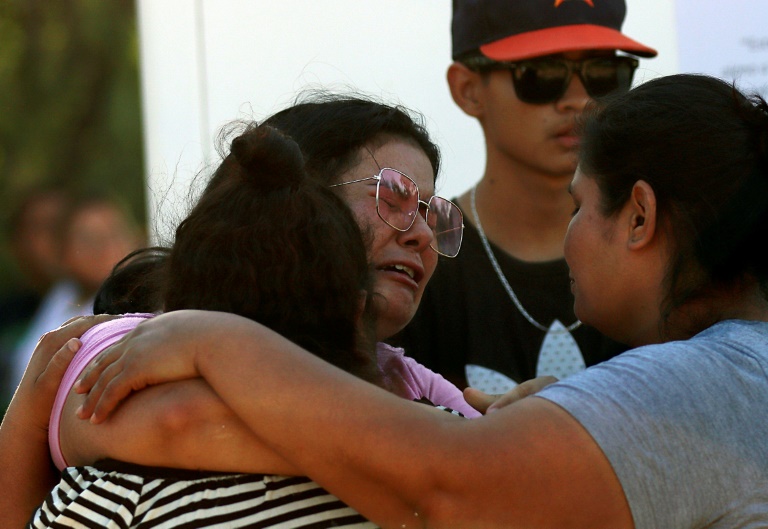
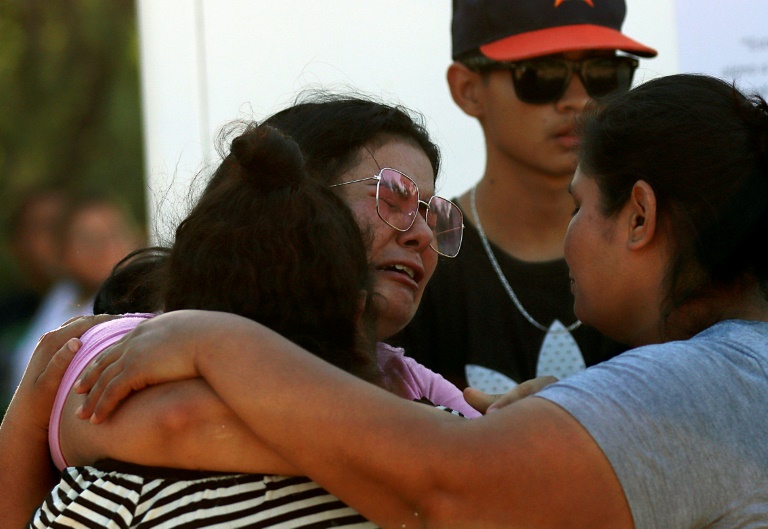
Anxious relatives gathered to wait for news, with some crying and comforting each other at the site, about 1,130 kilometres (700 miles) north of Mexico City.

The mother of one of the workers wept inconsolably, unable to answer questions from the press.

Through tears, another woman at the scene said two of her children worked in the mine, though one of them had managed to escape after the accident.

As night fell hours later, the families gathered under tents outside the mine in silence as state police, the national guard, medical teams and other rescuers worked to find the trapped workers.

Coahuila’s state government said that the miners had been carrying out excavation work when they hit an adjoining area full of water, causing the shaft to collapse and flood.

“The mine began operating in January of this year and until now there have been no reports of any type of anomaly,” it said in a statement.

State governor Miguel Riquelme said he had asked labor authorities and the local prosecutor’s office to prioritize the rescue and investigation.

Coahuila, the country’s main coal-producing region, has seen a series of fatal mining accidents over the years.

The worst was an explosion that claimed 65 lives at the Pasta de Conchos mine in 2006.

Last year, seven miners died when they were trapped after another accident in Coahuila.

Mexico races to rescue trapped coal miners

Rescuers raced Wednesday to free about 10 workers believed to be trapped in a coal mine in northern Mexico, while three others were found alive, authorities said.

Military personnel and rescue dogs were deployed to the scene of the accident in the state of Coahuila, President Andres Manuel Lopez Obrador said.

“At 1:35 pm (1835 GMT) a coal mine collapsed in the municipality of Sabinas, Coahuila, which caused a tunnel to flood” and trapped the workers, he tweeted.

“We hope to find them safe.”

Lopez Obrador had said nine miners were missing, but the security ministry said later that three had been rescued and taken to hospital while 10 were still believed to be inside.

“The work will not stop until they are found,” the ministry said in a statement.

“The Mexican government guarantees all the necessary resources to carry out the search and rescue operations,” it said.

Anxious relatives gathered to wait for news, with some crying and comforting each other at the site, about 1,130 kilometres (700 miles) north of Mexico City.

The mother of one of the workers wept inconsolably, unable to answer questions from the press.

Through tears, another woman at the scene said two of her children worked in the mine, though one of them had managed to escape after the accident.

As night fell hours later, the families gathered under tents outside the mine in silence as state police, the national guard, medical teams and other rescuers worked to find the trapped workers.

Coahuila’s state government said that the miners had been carrying out excavation work when they hit an adjoining area full of water, causing the shaft to collapse and flood.

“The mine began operating in January of this year and until now there have been no reports of any type of anomaly,” it said in a statement.

State governor Miguel Riquelme said he had asked labor authorities and the local prosecutor’s office to prioritize the rescue and investigation.

Coahuila, the country’s main coal-producing region, has seen a series of fatal mining accidents over the years.

The worst was an explosion that claimed 65 lives at the Pasta de Conchos mine in 2006.

Last year, seven miners died when they were trapped after another accident in Coahuila.

Beluga whale spotted in France's Seine river

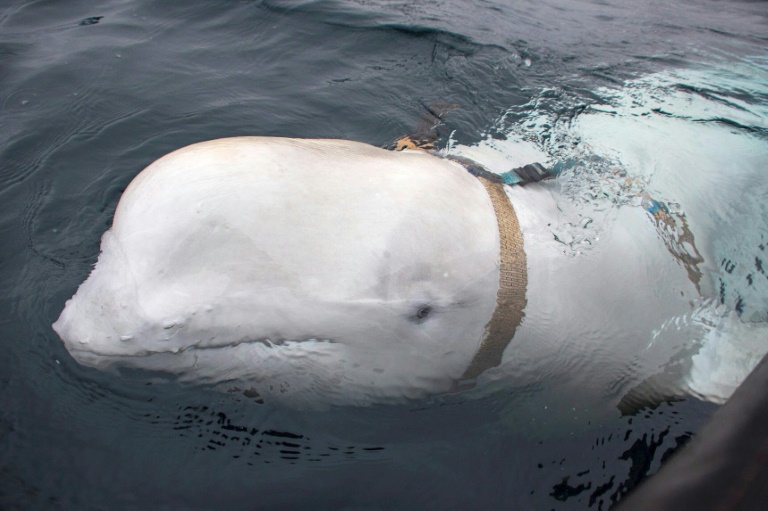
A Beluga whale, a protected species usually found in cold Arctic waters, has been seen in France’s Seine river, with authorities urging people to keep their distance to avoid distressing the animal.

Officials in the Eure department of Normandy said late Wednesday that images suggested it was a beluga separated from its pod, though they did not specify its size nor where exactly it was seen.

An adult beluga can reach up to four metres (13 feet) in length, and while they migrate away from the Arctic in the autumn to feed as ice forms, they rarely venture so far south.

“Studies of its health are underway to determine the best measures to take to ensure its chances of survival,” the Eure regional authorities said.

In May, a killer whale — technically part of the dolphin family — was found dead in the Seine between the port city of Le Havre and Rouen.

The animal had been stranded in the river, which flows through Paris to the Channel, and was unable to find its way back to the ocean despite attempts by officials to guide it.

The Eure authorities said lone belugas do sometimes swim farther south than usual, and are able to temporarily survive in fresh water.

Iran nuclear talks set to restart in Vienna

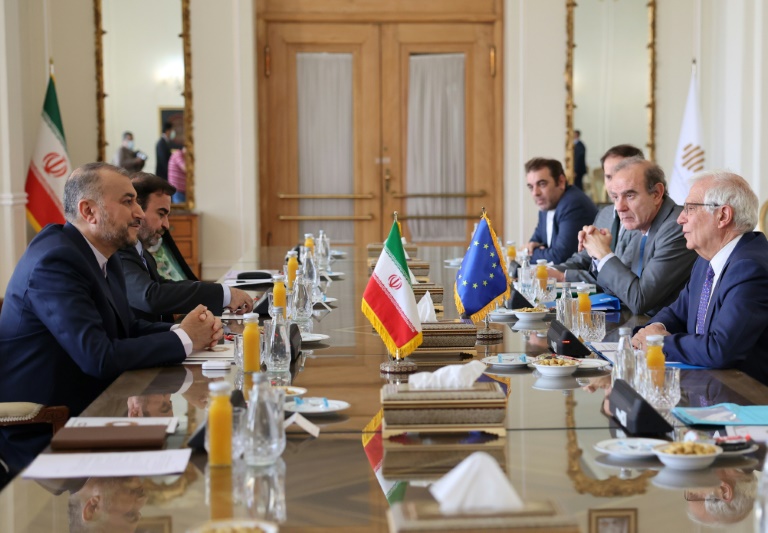
Negotiators were due to kick off a fresh round of talks over Iran’s nuclear programme in Vienna on Thursday, seeking to salvage the agreement on Tehran’s atomic ambitions.

Officials from world powers and Iran were set to meet in the Austrian capital for the first time since March, when negotiations, which began in 2021 to reintegrate the United States into the agreement, stalled.

In late June, Qatar hosted indirect talks between Tehran and Washington in the hope of getting the process back on track — but those talks failed to make a breakthrough. 

In a last-ditch effort, EU foreign policy chief Josep Borrell submitted a compromise proposal last month and called on the parties to accept it to avoid a “dangerous nuclear crisis”.  

Borrell said the draft text includes “hard-won compromises by all sides” and “addresses, in precise detail, the sanctions lifting as well as the nuclear steps needed to restore” the 2015 pact.

Britain, China, France, Germany, Iran, Russia and the United States signed the JCPOA in July 2015. Delegations from all will partake in Thursday’s talks, but officials from the US and Iran are not expected to meet face to face.

The Joint Comprehensive Plan of Action aims to guarantee the civilian nature of Iran’s nuclear programme in exchange for a gradual lifting of sanctions. 

But following the unilateral withdrawal of the United States in 2018 under former president Donald Trump and the re-imposition of US sanctions, Tehran has backtracked on its obligations. 

Iran subsequently exceeded the JCPOA’s uranium enrichment rate of 3.67 percent, rising to 20 percent in early 2021. 

It then crossed an unprecedented 60-percent threshold, getting closer to the 90 percent needed to make a bomb. 

The head of the UN nuclear watchdog, Rafael Grossi, on Tuesday warned Iran’s programme was “moving ahead very, very fast” and “growing in ambition and capacity”.

– Cautious optimism –

Ahead of Thursday’s talks, officials expressed cautious optimism, all the while cautioning that the parties remained far apart on key issues.

The head of US delegation, Rob Malley, and the head of Tehran’s delegation, Ali Bagheri, said on Twitter ahead of the talks that they were coming in good faith but put the onus on each other.

Analysts meanwhile said reviving the JCPOA remained the best option.

“The last thing the United States needs is a nuclear crisis with Iran that could easily escalate to a broader regional conflict,” Suzanne DiMaggio, a senior fellow at the Carnegie Endowment for International Peace, said in a statement.

Ellie Geranmayeh, an analyst at the European Council on Foreign Relations (ECFR), said that “at the end of the day, Tehran and Washington know the alternatives to a JCPOA collapse are terrible.”

“This is unlikely to be a meeting that resolves the outstanding issues” but “it could create the breakthrough necessary to push the talks towards a finishing line rather than a collapse,” she said.

burx-anb/yad/imm

Close Bitnami banner
Bitnami