World

Pelosi Taiwan visit set to dominate ASEAN meet

Southeast Asian foreign ministers will seek ways to help quell the diplomatic storm over Taiwan at regional talks Wednesday, after US House Speaker Nancy Pelosi arrived on the island, enraging Beijing.

Pelosi’s dramatic late-night flight to Taipei, defying threats of reprisals by China, looks set to dominate the meeting of the Association of Southeast Asian Nations (ASEAN) in Phnom Penh, which had been expected to tackle the bloody crisis in Myanmar.

Attention will focus instead on Chinese Foreign Minister Wang Yi and his American counterpart Antony Blinken — both flying into the Cambodian capital for regional security talks with ASEAN on Thursday and Friday.

ASEAN spokesman Kung Phoak, Cambodia’s deputy foreign minister, said the meeting would seek to calm the waters.

He told reporters that ministers would try to find ways the bloc could help “so that the situation in Taiwan will be stable, that won’t lead to a conflict and won’t escalate the political heat between all concerned parties.”

Late Tuesday, China vowed there would be “targeted military actions” in response to Pelosi’s visiting the self-ruled island Beijing claims as part of its territory.

The 10-member bloc is split between countries with close ties to China, such as Myanmar, Cambodia and Laos, and others that are warier of Beijing and its growing international assertiveness. 

But no ASEAN country formally recognises Taiwan and it is not clear what the bloc might do to ease the crisis between the two superpowers.

– Myanmar execution warning –

Cambodian Prime Minister Hun Sen, opening the meeting as chair of ASEAN, condemned Myanmar for executing four prisoners last month in defiance of widespread international pleas for clemency.

Myanmar was plunged into violent turmoil when the military seized power last year, ousting Aun San Suu Kyi’s civilian government. The death toll from the subsequent junta crackdown has passed 2,100, according to local monitors.

ASEAN, long derided as a toothless talking shop that gives political cover to repressive regimes, has spearheaded thus far fruitless efforts to restore peace and voiced anger at the hangings.

Hun Sen said the bloc was “disappointed and disturbed” by the executions and warned that further use of capital punishment would mean a “rethink” of the five-point peace plan agreed to last year with Myanmar.

The plan calls for an immediate end to violence and dialogue between the junta and coup opponents.

But the ministers — meeting face-to-face for the first time since the pandemic — are expected to lament the lack of progress, and Malaysia has said it would present a framework for implementing the plan.

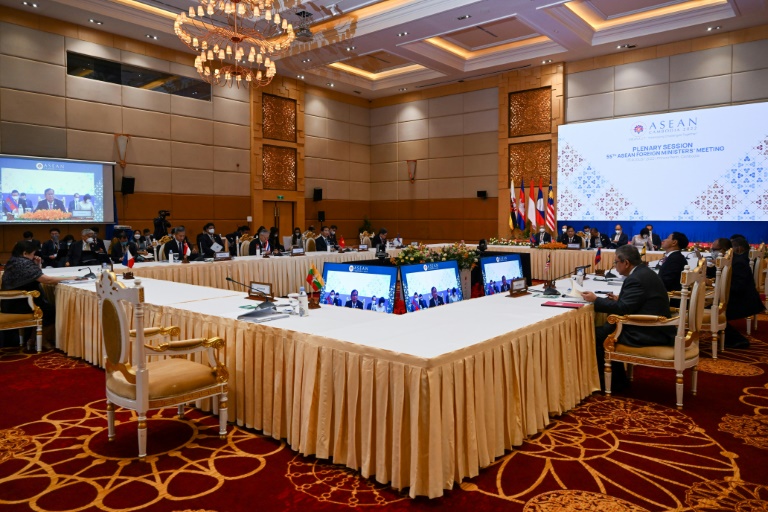
Myanmar itself is not being represented at the meeting after the other members said they would not accept a junta minister and the generals refused to send another official instead.

In a highly visible snub to the regime, a place was set for the Myanmar delegation at the negotiating table, complete with flag, and the chair left empty.

Some member states, led by Malaysia and the Philippines, are pushing to bar the military regime from sending ministers to any ASEAN meetings — including November’s summit — until there is progress on the five-point plan.

– South China Sea –

In addition to Taiwan, the ongoing South China Sea tensions will be another hot-button issue on the agenda.

Beijing claims most of the sea — with competing territorial assertions from Brunei, Malaysia, the Philippines, Taiwan and Vietnam.

Cambodia — a key Beijing ally — last hosted ASEAN in 2012 and was accused of siding with China over the disputed and resource-rich waters, resulting in no communique being issued.

But based on the progress of a senior officials’ meeting, Kung Phoak said he was confident a consensus could be reached and a joint statement released.

“I’m confident things are moving in the right direction. We’re almost there,” he said Tuesday.

Alongside Blinken and Wang, Russia’s top diplomat Sergei Lavrov — who landed in Myanmar for talks with the junta before travelling on to Cambodia — and the European Union’s Josep Borrell will attend meetings with ASEAN counterparts later in the week.

Ministers are expected to grapple with issues ranging from the Russia-Ukraine conflict to North Korean missile tests and regional security concerns.

Dutch farmer protests reap populist support

Dutch farmers’ rowdy protests against government climate plans have caused a stir at home and abroad, with populists worldwide jumping on the bandwagon and even former US president Donald Trump backing them.

“We take all the support that we can get,” says Jaap Kok, a 62-year-old cattle farmer standing in a meadow full of cows near Barneveld in the central Netherlands’ farming belt.

The farmers have wreaked havoc for weeks, dumping manure and garbage on highways, blockading supermarket warehouses with tractors and rallying noisily outside politicians’ houses.

They oppose plans to cut emissions of nitrogen in the Netherlands — the world’s second-biggest agricultural exporter after the United States — by reducing livestock and closing some farms.

While a small group has been blamed for much of the unrest, there have also been large protests involving thousands of tractors.

With the protests garnering global headlines, right-wing figures have been quick to voice support. As well as Trump, they include French far-right leader Marine Le Pen, and Dutch far-right politicians Geert Wilders and Thierry Baudet.

“I would have preferred that the support came from the left but from the right is fine too,” said Kok, whose own farm risks closure. 

“Farmers are always the scapegoat.”

– ‘Very angry’ –

The tiny Netherlands produces huge amounts of food thanks to industrialised farming — but at the cost of being one of Europe’s largest greenhouse gas emitters.

That is especially true of nitrogen, with much of this blamed on ammonia-based fertiliser and cattle-produced manure. Agriculture is responsible for 16 percent of all Dutch emissions.

Nitrogenous gases play an important role in global climate change. Nitrous oxide is a particularly potent greenhouse gas as it is over 300 times more effective at trapping heat in the atmosphere than carbon dioxide.

The Netherlands’ flat landscape sitting just above sea level makes it vulnerable to extreme weather. 

In July the Netherlands recorded its third-highest temperature since records began — 39.4C in the southern city of Maastricht.

Nitrogen-containing substances are also blamed for damage to plant and animal habitats.

Following a 2019 court ruling that the Netherlands was not doing enough to protect its natural areas from nitrogen pollution, the Dutch government said in June that the only way to meet climate goals by 2030 was “radical” cuts to farming. 

This would involve a reduction in particular of around 30 percent to the Netherlands’ herd of some four million cows.

The government has offered some 25 billion euros to help farmers adapt — but has also warned that some closures are possible.

“The farmers are very angry,” said Jos Ubels, vice president of the Farmers Defence Force (FDF), one of the groups coordinating the demonstrations.

“In history, every time there is a problem with a minority they have to shout really hard to be heard, so this is what we are doing.” 

Ubels said his group was not responsible for the roadblocks, saying that it was “just organised by local farmers — they are very angry because they are played with.”

Prime Minister Mark Rutte recently called the protests “life-threatening”, yet there is a groundswell of support.

– ‘Climate tyranny’ –

Upside-down Dutch flags — a symbol of the farmers’ movement — can be see hanging from many houses, lamposts and road bridges.

The Farmer-Citizen Movement (BBB), a centre-right party founded in 2019, would increase its current one seat in parliament to 19 according to latest opinion polls.

But their campaign is also going global.

The FDF’s Ubels was in Warsaw last week for talks with Agriculture Minister Henryk Kowalczyk, of Poland’s right-wing Law and Justice Party-led populist government.

“I will support the position of Dutch farmers in maintaining production… and I hope that their government will change its mind,” Kowalczyk said in a statement.

Trump’s backing has also been a boost.

“Farmers in the Netherlands of all places are courageously opposing the climate tyranny of the Dutch government,” Trump told a rally in Florida in July.

In the Netherlands, a recent farmers’ demo in Amsterdam brought also drew many conspiracy theorists and Covid-sceptics.

British comedian-turned-YouTuber Russell Brand recently told his 5.8 million followers that the Dutch farm plan was part of the “Great Reset” — a conspiracy theory alleging that world leaders orchestrated the pandemic.

The support “says a lot” and shows the government’s “absurd” plans “don’t hold water”, says Wim Brouwer, a farmer in Barneveld and local president of the main Dutch agricultural union LTO.

Brouwer admitted that farmers must do more to cut emissions, but said their sacrifices already far exceeded those made by the industrial and transport sectors.

“The biggest problem is that we have been innovating in agriculture for years, but it’s never enough,” he sighed.

ASEAN warns Myanmar against more executions

Current ASEAN chair Cambodia warned Myanmar on Wednesday not to execute any more prisoners after the hanging of four people — two of them prominent pro-democracy figures — caused international outrage.

Foreign ministers from the Association of Southeast Asian Nations (ASEAN) are discussing how to address the growing crisis in Myanmar at talks in Phnom Penh.

The 10-nation regional bloc has spearheaded so far fruitless efforts to restore peace to the country after a military coup last year, and anger is growing at the junta’s stonewalling tactics.

Myanmar executed four prisoners last month in a move roundly condemned by ASEAN members, who are voicing increased frustration at the lack of progress on the regional bloc’s “five-point consensus” plan on Myanmar’s conflict.

Agreed in April last year, the plan calls for an immediate end to violence and dialogue between the army and coup opponents.

“If more prisoners are to be executed, we will be forced to rethink our role vis a vis ASEAN’s five-point consensus,” Cambodian Prime Minister Hun Sen said as he opened the foreign ministers’ gathering.

Hun Sen said the bloc was “disappointed and disturbed by the execution of these opposition activists despite the appeals from me and others for the death sentences to be reconsidered for the sake of political dialogue, peace and reconciliation”.

But with no Myanmar representatives present for the summit — highlighted by the country’s prominently placed empty chair — Cambodia’s ASEAN spokesman admitted Tuesday that progress over the conflict might be tricky.

The February coup has left Myanmar in disarray, with the death toll from a brutal military crackdown on dissent passing 2,100, according to a local monitoring group.

First Ukrainian grain shipment since invasion set for inspection in Turkey

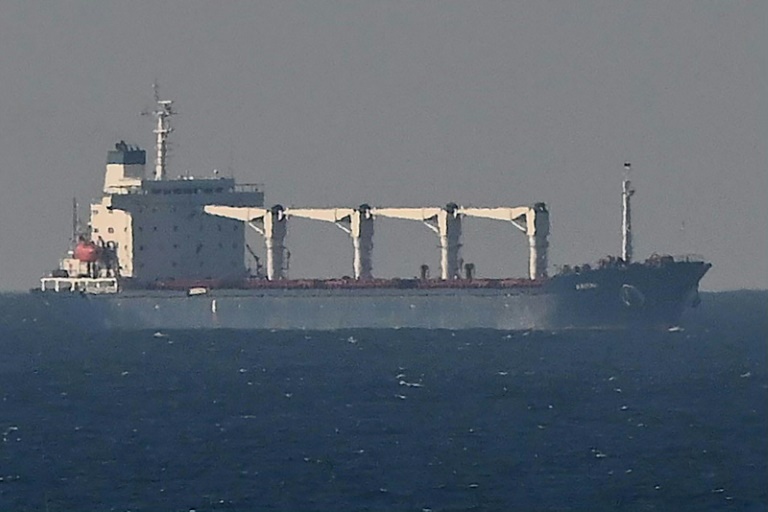
A team of Russian and Ukrainian officials in Turkey is due on Wednesday to inspect the first shipment of grain exported from Ukraine since Moscow’s invasion under a deal aimed at curbing a global food crisis.

The Sierra Leone-flagged Razoni arrived at the edge of the Bosphorus Strait just north of Istanbul on Tuesday, a day after leaving the Black Sea port of Odessa carrying 26,000 tonnes of maize bound for Lebanon.

The ship sailed through a specially cleared corridor in the mine-infested waters of the Black Sea, which had been under a Russian blockade.

It is due to be inspected Wednesday by a team that includes Russian and Ukrainian officials, in accordance with Russia’s wish to ascertain the nature of the cargo, the Turkish defence ministry said.

The Razoni set sail under a deal brokered by Turkey and the United Nations to lift Russia’s naval blockade of the Black Sea and allow the shipment of millions of tonnes of produce to world markets to help curb a global food crisis.

The UN secretary-general’s spokesman Stephane Dujarric said he hoped for “more outbound movement” on Wednesday.

Ukrainian President Volodymyr Zelensky said he wished for “regularity” in shipments. 

“When one ship leaves the port, there are other ships as well — both those loading and those approaching the port,” he said in his nightly address Tuesday.

“Continuity and regularity is the necessary principle. All consumers of our agricultural products need it.”

UN chief Antonio Guterres on Monday “warmly” welcomed the departure of the Razoni, expressing hope “this will bring much-needed stability and relief to global food security especially in the most fragile humanitarian contexts”.

The halt of deliveries from Ukraine — one of the world’s biggest grain exporters — has contributed to soaring food prices, hitting the world’s poorest nations especially hard.

Kyiv says at least 16 more grain ships are waiting to depart.

But it also accuses Russia of stealing Ukrainian grain in territories seized by Kremlin forces and then shipping it to allied countries in Africa and the Middle East, such as Syria.

Russia attacked the Odessa port from which the Razoni set off less than 24 hours after the grain deal was signed in Istanbul on July 22, putting the safety of future deliveries in doubt.

– Donetsk evacuations –

Russia has continued to pound cities and towns across Ukraine’s sprawling front line.

Kyiv said it had started mandatory evacuations from the eastern region of Donetsk, which is bearing the brunt of the Russian offensive, after Zelensky urged the estimated 200,000 remaining residents to leave.

Ukrainian Deputy Prime Minister Iryna Vereshchuk said a train carrying “women, children, elderly people, many people with reduced mobility” arrived in the central city of Kropyvnytskyi on Tuesday morning.

Officials have said they want to get residents out of the battered region before the start of winter as gas pipes for heating have been severed.

In the south of the country, the head of Ukraine’s Kryviy Rig military administration said Russian shelling had killed two civilians in a minibus trying to leave the Moscow-controlled Kherson region.

Ukrainian forces have in recent days been pressing a counter-offensive to drive out the Russians from the region.

Dmytro Butriy, the head of the Ukrainian authorities in Kherson, said Tuesday they had so far taken 53 settlements back under their control.

– More Western arms –

Ukraine was bolstered by more supplies of Western arms — particularly long-range artillery — ahead of the planned push to retake Kherson city.

The United States announced a new tranche of weapons worth $550 million for Ukraine’s forces, including ammunition for increasingly important HIMARS rocket launchers and artillery pieces.

Zelensky thanked President Joe Biden and said “the word ‘HIMARS’ has become almost synonymous with the word ‘justice’ for our country”.

“We still cannot completely break the advantage of the Russian army in artillery and in manpower, and this is very tangible in the battles, especially in Donbas, Pisky, Avdiivka, other directions. It’s just hell there. It can’t even be described in words,” he said in his address Tuesday night.

In Moscow, meanwhile, Russia’s supreme court labelled Ukraine’s Azov regiment a “terrorist” organisation — a decision that could pave the way for fighters captured by the Kremlin to face lengthy jail terms.

Azov fighters were among 2,500 Ukrainian soldiers who surrendered in May after weeks of fierce resistance at the Azovstal steel plant in devastated Mariupol.

The regiment — which was incorporated into Ukraine’s national guard in 2014 — is demonised by Moscow for alleged far-right links. 

Its members were among 50 Ukrainian servicemen killed last week in an attack on a jail holding prisoners of war in Russian-occupied territory. 

Ukraine has accused Moscow of deliberately executing the detainees, while Russia says Ukrainian forces hit the facility with missiles. 

Azov, in response to the Russian court ruling, called on the United States and other countries to recognise Russia as a “terrorist state”.

Kansas votes to maintain abortion rights in US test case

Abortion rights advocates celebrated Tuesday as the Midwestern US state of Kansas voted to maintain the right to the procedure, the first major poll on the flashpoint issue since the Supreme Court overturned nationwide access in June.

Kansans rejected an amendment that would have scrapped language in the state constitution guaranteeing the right to the procedure and could have paved the way for stricter regulations or a ban.

The vote was widely seen as a test case for abortion rights nationwide, as Republican-dominated legislatures rush to impose strict bans on the procedure following the Supreme Court’s decision to overturn Roe v. Wade.

Pro-abortion rights campaigners and supporters celebrated the win for their side of the hotly contested US debate.

“I’m just beside myself,” campaign volunteer Anne Melia told AFP.

When polls closed at 7:00 pm (0000 GMT), Kansas Secretary of State Scott Schwab said turnout was as high as 50 percent on this referendum, local media reported, a number usually expected for a general election.

Poll worker Marsha Barrett said some 250 voters had come to a station in the Kansas City suburb of Olathe by noon — the same number it might see all day in a presidential election. 

“This election is crazy,” Barrett told AFP. “People are determined to vote.”

President Joe Biden also hailed the result. “Tonight, Kansans used their voices to protect women’s right to choose and access reproductive health care,” he said on Twitter.

“It’s an important victory for Kansas, but also for every American who believes that women should be able to make their own health decisions without government interference.”

In a separate statement, he urged Congress to “listen to the will of the American people” and pass a bill codifying the right to abortion.

Other states including California and Kentucky are set to vote on the hot-button issue in November, at the same time as Congressional midterm elections in which both Republicans and Democrats hope to use it to mobilize their supporters nationwide.

– ‘Remarkable’ result –

In Kansas, the ballot centered on a 2019 ruling by the state’s supreme court that guarantees access to abortion. 

In response, the Republican-dominated state legislature introduced an amendment known as “Value Them Both” that would have scrapped the constitutional right — with the stated aim of handing regulation of the procedure back to lawmakers.

In the opposing camp, activists said the campaign was a barely masked bid to clear the way for an outright ban — one state legislator had already introduced a bill that would ban abortion without exceptions for rape, incest or the mother’s life. 

For Ashley All, spokeswoman for pro-abortion rights campaign Kansans for Constitutional Freedom, the result of Tuesday’s referendum was “remarkable.”

“Kansans understood that this amendment would mandate government control over private medical decisions,” she said. 

But voter Sylvia Brantley, 60, told AFP earlier in the day she voted in favor of the change because she believes “babies matter, too.”

She said she wanted to see more regulations, in the hope that “Kansas will not be a marketplace for killing babies.”

Activists complained that the phrasing of the ballot question was counterintuitive and potentially confusing: voting “Yes” to the amendment meant abortion rights would be curbed, while people who wished to keep those rights intact had to vote “No.” 

– All eyes on Kansas –

While abortion rights advocates in Kansas could breathe a sigh of relief in their own state, they still are looking nervously to neighboring Oklahoma and Missouri, which are among at least eight states to have passed near-total bans — the latter making no exceptions for rape or incest — while Midwestern Indiana adopted its own rigid ban on Saturday.

Kansas Governor Laura Kelly tweeted her support for the amendment’s rejection. 

“Kansans stood up for fundamental rights today,” the Democrat said. 

“We rejected divisive legislation that jeopardized our economic future & put women’s health care access at risk.”

One voter in the town of Prairie Village, who declined to give her name, said she struggled to decide which way to vote. 

“I’ve gone back and forth the whole time,” she told AFP, saying she ultimately chose to vote “no.”

“I feel like women should have a choice, but I also don’t want full-term babies aborted,” she said. 

The outcome in Kansas means that abortion will remain permitted up to 22 weeks of pregnancy.

Kansas leans heavily toward the Republican Party, which favors stricter abortion regulations, but a 2021 survey from Fort Hays State University found that fewer than 20 percent of Kansas respondents agreed that abortion should be illegal even in cases of rape or incest.

Clashes erupt in Bolivia capital between police and coca farmers

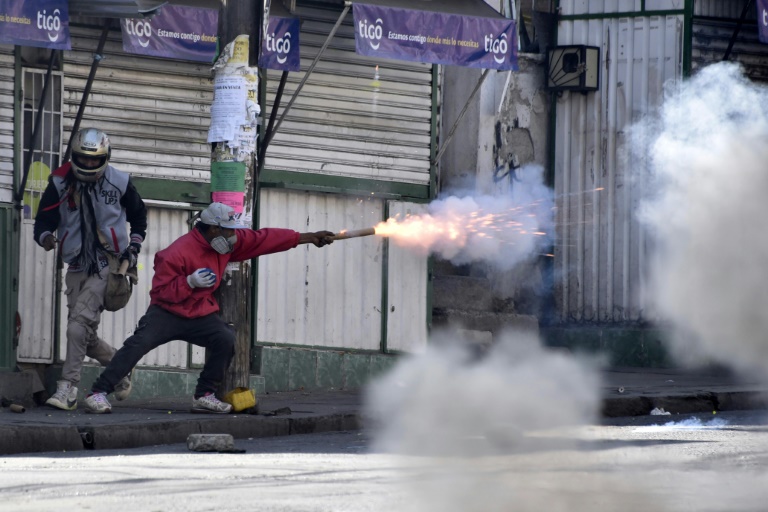
Clashes broke out Tuesday in the Bolivian capital La Paz between police and coca leaf producers in a dispute over control of the coveted commercialization of the plant.

Several uniformed officers and a journalist were injured, several sources reported, as hundreds of growers from the Association of Coca Producers (Adepcoca), as well as opponents of the government of leftist President Luis Arce marched to demand the closure of a parallel market for the plant, which they say is illegal and enjoys government support. 

Last October, thousands of coca leaf growers stormed the country’s main coca market in La Paz following violent clashes with security forces.

The Adepcoca market has become the center of a dispute between two groups of coca growers — one loyal to the government, the other opponents — since last year.

Some 90 percent of Bolivia’s legal coca leaf business, worth $173 million a year, passes through the Adepcoca market, according to UN figures.

The dispute centers around who should control the market.

Violence erupted last year when the group loyal to, and supported by, the government ousted an opposition figure to take control of the premises.

Armin Lluta claimed he was held hostage for hours and beaten up by the government-backed group before they took control of the market.

On Tuesday, protest leader Carlos Choque announced over a loudspeaker: “We are asking that this alleged market for the sale of coca, which has nothing to do with the legal market of Adepcoca, be closed immediately. We will not be afraid if they want to ‘shoot’ us, we are here.” 

The growers began to launch firecrackers and low-intensity explosive devices known as dynamite caps, while police responded with the profuse use of tear gas., AFP witnessed.

“We have several police officers injured by the blast wave of the dynamites that were aggressively thrown at us,” the police said in a statement.

Adepcoca leaders said they will not end their protest until the market closes.

Pelosi Taiwan visit set to dominate ASEAN meet

Southeast Asian foreign ministers will seek ways to help calm rising tensions over Taiwan at regional talks Wednesday, after US House Speaker Nancy Pelosi arrived on the island, enraging Beijing.

Pelosi’s dramatic late-night arrival in Taipei, defying threats of reprisals by China, looks set to dominate the meeting of the Association of Southeast Asian Nations (ASEAN) in Phnom Penh, which had been due to focus on the bloody crisis in Myanmar.

Attention will focus instead on Chinese Foreign Minister Wang Yi and his American counterpart Antony Blinken — both flying into the Cambodian capital for regional security talks with ASEAN on Thursday and Friday.

ASEAN spokesman Kung Phoak, Cambodia’s deputy foreign minister, said the meeting would seek to calm the waters.

He told reporters ministers would try to find ways the bloc could help “so that the situation in Taiwan will be stable, that won’t lead to a conflict and won’t escalate the political heat between all concerned parties.”

Late Tuesday, China vowed there would be “targeted military actions” in response to Pelosi’s visiting the self-ruled island Beijing claims as part of its territory.

The 10-member bloc is split between countries with close ties to China, such as Myanmar, Cambodia and Laos, and others that are warier of Beijing and its growing international assertiveness. 

– Myanmar tensions –

The ministers — meeting face-to-face for the first time since the pandemic — are expected to lament the lack of progress on the bloc’s “five-point consensus” plan agreed upon last year as a way out of Myanmar’s conflict.

The country was plunged into violent turmoil when the military seized power last year, ousting Aun San Suu Kyi’s civilian government, and the death toll from a junta crackdown has passed 2,100 according to local monitors.

ASEAN, long derided as a toothless talking shop that gives political cover to repressive regimes, has spearheaded so far fruitless efforts to restore peace.

The bloc last week condemned the military’s execution of four prisoners, with some member states growing frustrated at the lack of progress.

The five-point plan calls for an immediate end to violence and dialogue between the junta and coup opponents.

But after more than a year without progress, Malaysia has said it would present a framework for its implementation.

Myanmar itself will not be represented at the meeting after the other members said they would not accept a junta minister and the generals refused to send another official instead.

Some member states, led by Malaysia and the Philippines, are pushing to bar the military regime from sending ministers to any ASEAN meetings — including November’s summit — until there is progress on the five-point plan.

– South China Sea –

In addition to Taiwan, the ongoing South China Sea tensions will be another hot-button issue on the agenda.

Beijing claims most of the sea — with competing territorial assertions from Brunei, Malaysia, the Philippines, Taiwan and Vietnam.

Cambodia — a key Beijing ally — last hosted ASEAN in 2012 and was accused of siding with China over the disputed and resource-rich waters, resulting in no communique being issued.

But based on the progress of a senior officials’ meeting, Kung Phoak said he was confident a consensus could be reached and a joint statement released.

“I’m confident things are moving in the right direction. We’re almost there,” he said Tuesday.

Alongside Blinken and Wang, Russia’s top diplomat Sergei Lavrov — who landed in Myanmar for talks with the junta before travelling on to Cambodia — and the European Union’s Josep Borrell will attend meetings with ASEAN counterparts later in the week.

Ministers are expected to grapple with issues ranging from the Russian-Ukraine conflict to North Korea missile tests and regional security concerns.
Kansas votes to maintain abortion rights in US test case

Abortion rights advocates celebrated Tuesday as the Midwestern US state of Kansas voted to maintain the right to the procedure, the first major poll on the flashpoint issue since the Supreme Court overturned nationwide access in June.

Kansans rejected an amendment that would have scrapped language in the state constitution guaranteeing the right to the procedure and could have paved the way for stricter regulations or a ban.

The vote was widely seen as a test case for abortion rights nationwide, as Republican-dominated legislatures rush to impose strict bans on the procedure following the Supreme Court’s decision to overturn Roe v. Wade.

Results showed that votes in favor of keeping abortion in the state constitution far surpassed the votes against. This reflects that fact that a majority of Americans support abortion access, multiple studies have shown.

When polls closed at 7:00 pm (0000 GMT), Kansas Secretary of State Scott Schwab said turnout was as high as 50 percent on this referendum, local media reported, a number usually expected for a general election.

Poll worker Marsha Barrett said some 250 voters had come to a station in the Kansas City suburb of Olathe by noon — the same number it might see all day in a presidential election. 

“This election is crazy,” Barrett told AFP. “People are determined to vote.”

Other states including California and Kentucky are set to vote on the hot-button issue in November, at the same time as Congressional midterm elections in which both Republicans and Democrats hope to use it to mobilize their supporters nationwide.

In Kansas, the ballot centered on a 2019 ruling by the state’s supreme court that guarantees access to abortion. 

In response, the Republican-dominated state legislature introduced an amendment known as “Value Them Both” that would have scrapped the constitutional right — with the stated aim of handing regulation of the procedure back to lawmakers.

In the opposing camp, activists said the campaign was a barely masked bid to clear the way for an outright ban — one state legislator had already introduced a bill that would ban abortion without exceptions for rape, incest or the mother’s life. 

For Ashley All, spokeswoman for pro-abortion rights campaign Kansans for Constitutional Freedom, the amendment would have dealt a blow to “personal autonomy.”

But voter Sylvia Brantley, 60, said she voted in favor of the change because she believes “babies matter, too.”

She said she wants to see more regulations, in the hope that “Kansas will not be a marketplace for killing babies.”

Activists complained that the phrasing of the ballot question was counterintuitive and potentially confusing: voting “Yes” to the amendment meant abortion rights would be curbed, while people who wished to keep those rights intact must vote “No.” 

– All eyes on Kansas –

While abortion rights advocates in Kansas could breathe a sigh of relief in their own state, they still are looking nervously to neighboring Oklahoma and Missouri, which are among at least eight states to have passed near-total bans — the latter making no exceptions for rape or incest — while Midwestern Indiana adopted its own rigid ban on Saturday.

Voter Chris Ehly, in Prairie Village, said he voted “no” because his daughter and wife “are very adamant about the decision.”

“I want to respect them,” he said. 

Another Prairie Village voter, who declined to give her name, said she struggled to decide which way to vote. 

“I’ve gone back and forth the whole time,” she told AFP, saying she ultimately chose to vote “no.”

“I feel like women should have a choice, but I also don’t want full-term babies aborted,” she said. 

The outcome in Kansas means that abortion will remain permitted up to 22 weeks of pregnancy.

Kansas leans heavily toward the Republican Party, which favors stricter abortion regulations, but a 2021 survey from Fort Hays State University found that fewer than 20 percent of Kansas respondents agreed that abortion should be illegal even in cases of rape or incest.

Most Asian markets rise but Taiwan fears keep confidence in check

Asian markets mostly rose Wednesday after the previous day’s reverse, with focus on House Speaker Nancy Pelosi’s visit to Taiwan, which has further strained already tense China-US ties and raised concerns about the long-term impact on the global outlook.

The highest profile trip to the island in 25 years by a US politician was met with condemnation from Beijing, which warned of serious economic and military consequences.

Taiwan said more than 20 Chinese military aircraft had flown into the island’s air defence identification zone — an area wider than its territorial airspace that overlaps with part of China’s air defence zone. The People’s Liberation Army was also due to conduct a series of drills.

Beijing views the self-ruled island as part of its territory to be seized by force if necessary.

No one expected it would spark a conflict, but the crisis sent shivers through trading floors that were already on edge over a range of issues including the Ukraine war, surging inflation, rising interest rates and slowing economic growth.

However, ahead of a meeting between Pelosi and Taiwan President Tsai Ing-wen most markets saw a recovery, with Hong Kong and Shanghai among the best gainers.

Tokyo, Singapore, Seoul, Wellington and Manila were also up, though Taipei, Sydney and Jakarta edged down.

The “short-term implication may be ‘sell the rumour, buy the news’ as the official response so far remains much more restrained versus what the market has feared,” Xiadong Bao, at Edmond de Rothschild Asset Management, said.

“But the mid/long-term implication can be more significant, which may be currently overlooked by the market. The official return of the US influence in Asia-Pacific will inevitably accelerate US-China decoupling.”

Analysts are also keen to find out what the White House’s response will be, particularly ahead of mid-term elections in November with anti-China rhetoric playing well with voters, but with President Joe Biden keen not to further harm economic ties.

SPI Asset Management’s Stephen Innes added that the US administration was probably not likely to cut Trump-era tariffs before then.

The positive start to the day in Asia followed a drop on Wall Street, where the Taiwan crisis was compounded by a series of hawkish comments from Federal Reserve officials indicating more big interest rate hikes could still be in the pipeline.

Stocks rallied last week and Treasury yields dropped after boss Jerome Powell hinted the bank could begin slowing down, but the latest remarks suggest a hoped-for dovish pivot might not be coming just yet as inflation remains stubbornly high.

The latest developments have raised concerns that the volatility on markets would likely continue for some time.

“It’s hard to see any meaningful upside in equities right now,” said Xi Qiao, of UBS Group. “The market is going to trade pretty mixed, stay choppy until we have a little bit more certainty,” she told Bloomberg News.

– Key figures at around 0230 GMT –

Tokyo – Nikkei 225: UP 0.5 percent at 27,740.97 (break)

Hong Kong – Hang Seng Index: UP 0.9 percent at 19,864.26

Shanghai – Composite: UP 0.6 percent at 3,204.47

Taipei – TAIEX: DOWN 0.1 percent at 14,732.65

Dollar/yen: UP at 133.54 yen from 133.10 yen Tuesday

Euro/dollar: UP at $1.0174 from $1.0168

Pound/dollar: UP at $1.2165 from $1.2163

Euro/pound: UP at 83.64 pence from 83.57 pence

West Texas Intermediate: UP 0.1 percent at $94.50 per barrel

Brent North Sea crude: FLAT at $100.54 per barrel

New York – Dow: DOWN 1.2 percent at 32,396.17 (close)

London – FTSE 100: DOWN 0.1 percent at 7,409.11 (close)

Pelosi says Taiwan trip 'in peace' as furious China vows strong response

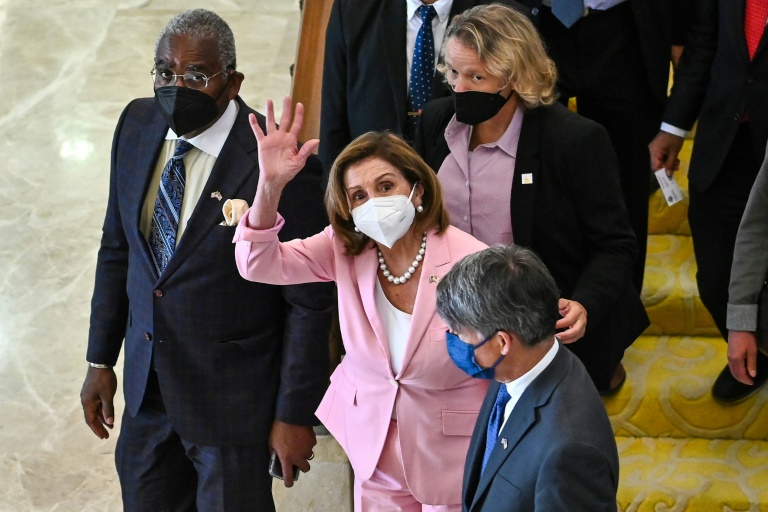
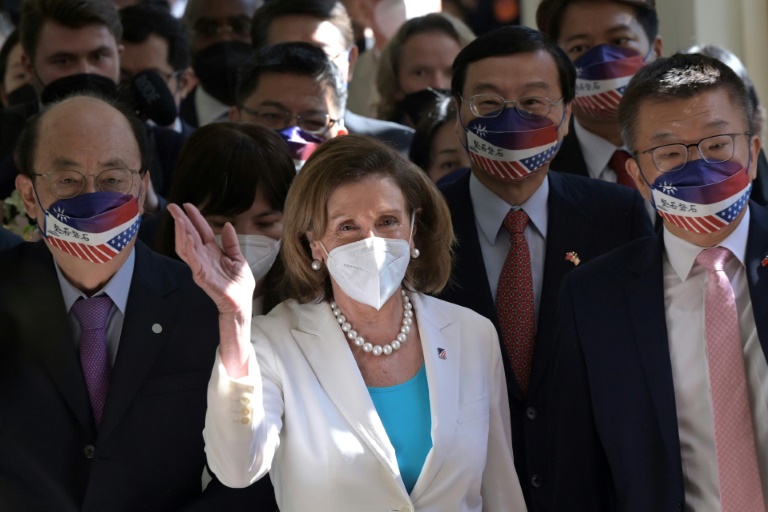
US House Speaker Nancy Pelosi said Wednesday that her delegation had come to Taiwan in “peace for the region”, after the visit enraged Beijing and set off a diplomatic firestorm.

She defied a string of increasingly stark warnings and threats from China, which views Taiwan as its territory and had warned it would consider her visit a major provocation.

Pelosi, second in line to the presidency, is the highest-profile elected US official to visit Taiwan in 25 years.

“We come in friendship to Taiwan, we come in peace to the region,” she said during a meeting with Tsai Chi-chang, the deputy speaker of Taiwan’s parliament.

As Pelosi — who is on a tour of Asia — touched down Tuesday night in a military aircraft after days of feverish speculation about her plans, the reaction from Beijing was swift.

US Ambassador Nicholas Burns was summoned by the Chinese foreign ministry and told that Washington “shall pay the price”.

“The move is extremely egregious in nature and the consequences are extremely serious,” China’s Vice Foreign Minister Xie Feng was quoted as saying by state news agency Xinhua.

“China will not sit idly by.”

The Chinese military said it was on “high alert” and would “launch a series of targeted military actions in response” to the visit.

It promptly announced plans for a series of military exercises this week in waters around the island, straddling vital shipping lanes.

The drills will include “long-range live ammunition shooting” in the Taiwan Strait, which separates the island from mainland China.

The zone of Chinese exercises will be within 20 kilometres (12 miles) of Taiwan’s shoreline at some points, according to coordinates released by the Chinese military.

Taiwan’s defence ministry said more than 21 Chinese military aircraft had flown on Tuesday into the island’s air defence identification zone — an area wider than its territorial airspace that overlaps with part of China’s own air defence zone.

The ministry described the Chinese drills as “an attempt to threaten our important ports and urban areas, and unilaterally undermine regional peace and stability”.

– ‘We shouldn’t be too worried –

Outside the Taiwanese parliament, 31-year-old computer programmer Frank Chen shrugged off the Chinese warnings against Pelosi’s visit.

“I’m not too worried about China’s intimidation,” he told AFP.

“I think China will take more threatening actions and ban more Taiwanese products, but we shouldn’t be too worried.”

There was a small group of pro-China demonstrators outside parliament as well.

“The United States uses Taiwan as a pawn in its confrontation with China, to try to drag China down so (it) can dominate the world,” Lee Kai-dee, a 71-year-old retired researcher, told AFP.

“If the United States continues to act this way, Taiwan will end up like Ukraine.”

China has vowed to seize self-ruled, democratic Taiwan one day, by force if necessary.

Russia’s invasion of Ukraine in February heightened fears in Taiwan that China may similarly follow through on its threats to annex the island.

Beijing tries to keep the island isolated on the world stage and opposes countries having official exchanges with Taipei.

In a call with US President Joe Biden last week, Chinese President Xi Jinping warned Washington against “playing with fire” on Taiwan.

While the Biden administration is understood to be opposed to Pelosi’s Taiwan stop, White House National Security Council spokesman John Kirby said she was entitled to go where she pleased. 

The United States has said, however, that its policy was unchanged towards Taiwan.

This means support for its government while diplomatically recognising Beijing over Taipei, and opposing a formal independence declaration by Taiwan or a forceful takeover by China.

Close Bitnami banner
Bitnami