World

Argentine judge allows some crew of grounded Venezuela plane to depart

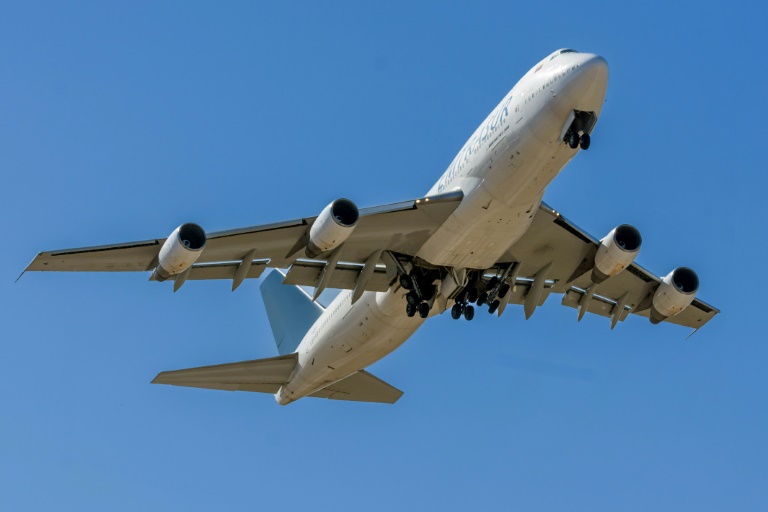
An Argentine judge investigating the Iranian and Venezuelan crew of a cargo plane that has been grounded in Buenos Aires since June authorized the departure of 12 of them on Monday, local media reported.

Federal judge Federico Villena did however order seven of the 19 to be retained in Argentina, the reports said, including four Iranians and three Venezuelans.

According to the ruling disclosed by the press, the judge considered that there were still elements to be investigated pertaining to Iranian Gholamrez Ghasemi, designated by the Argentine intelligence service as a member of Iran’s Revolutionary Guards, as well as three other Iranians and three Venezuelans.

The plane in question arrived in Argentina from Mexico on June 6, with 14 Venezuelans and five Iranians on board, before trying to fly to Uruguay two days later, where it was refused entry.

Uruguay’s Interior Minister Luis Alberto Heber said his country had received a “formal warning from Paraguayan intelligence.”

The plane then returned to Argentina where it has been grounded ever since.

The aircraft belongs to the company Emtrasur, a subsidiary of the Venezuelan Conviasa, which is under sanctions from the US Treasury Department. It was bought a year ago from the Iranian airline Mahan Air, which the United States has accused of links to the Revolutionary Guards.

The Iranian connections are sensitive for Argentina, which has issued warrants for a number of former Iranian leaders for the 1994 attack against the AMIA Jewish center that left 85 dead and some 300 injured.

Ten days ago, Iranian Foreign Minister Hossein Amir Abdollahian asked the Argentine diplomatic representative in Tehran for an “immediate” lifting of the ban on the five Iranian crew members leaving the country.

Before its trip to Argentina, the plane had been in Paraguay in May, from where it took a shipment of cigarettes to the Caribbean island of Aruba, according to its manifest.

China population to begin shrinking by 2025: officials

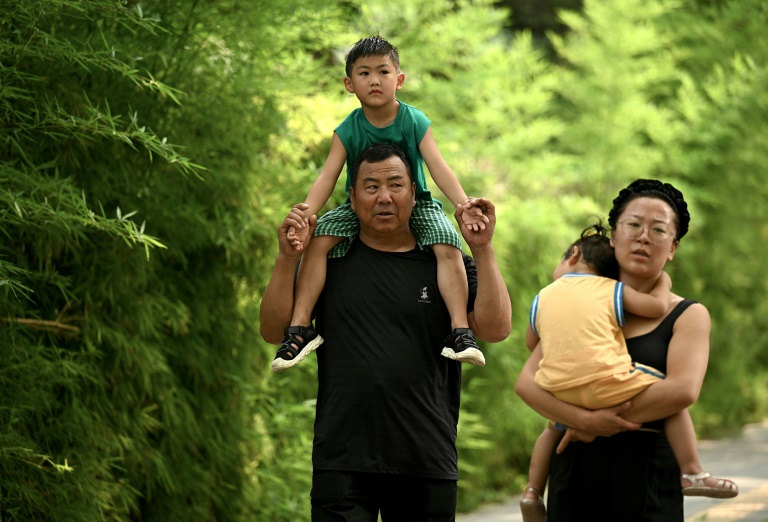
China’s population will begin to shrink by 2025, officials have said, as family sizes grow smaller and citizens age.

The world’s most-populous country has been grappling with a looming demographic crisis as it faces a rapidly ageing workforce, slowing economy and its weakest population growth in decades.

And although officials relaxed the nation’s strict “one-child policy” in 2016 and last year allowed couples to have three children, the birth rate has plunged to a record low.

“The growth rate of the total population has slowed down significantly, and it will enter a stage of negative growth in the ’14th Five-Year Plan’ period,” the National Health Commission said Monday, referring to the period between 2021 and 2025.

In January, authorities said that forecasts expected the population to enter zero growth “or even negative growth” in that five-year span.

“Presently, our country’s policy system for childbirth support is not perfect, and there is a big gap with population development and the people’s expectations,” the NHC said in its latest report.

The total fertility rate has dropped below 1.3 in recent years, it added, while the country is expected to enter a stage of severe ageing around 2035, with more than 30 percent of the population older than 60.

Families are also becoming smaller, “weakening” the functions of pension and childcare, the health commission said, calling for improving child-raising support and for policies on housing, education and taxation to help reduce burdens on families.

Authorities in some parts of China are already introducing family-friendly policies in a bid to combat the slowing birth rate.

The eastern city of Hangzhou announced Monday that families with three children would be able to borrow 20 percent more than the maximum limit when applying for housing provident fund loans for the first time.

Other cities like Nanchang and Changsha have also rolled out supportive policies, according to state media.

Higher costs of living and a cultural shift as people grow used to smaller families have been cited as reasons behind the lower number of babies.

The “one-child policy” was introduced by top leader Deng Xiaoping in 1980 to curb population growth and promote economic development, with some exceptions made for rural families and ethnic minorities.

The global population is expected to hit eight billion in November 2022, according to UN projections, with India on course to surpass China as the world’s most-populous country in 2023.

Crackdown seeks to stifle Iran's critical voices

Executions on a scale not seen for years. Mass arrests of regime critics including top film-makers. Trials of foreign nationals denounced as a sham by their families.

Activists argue Iran is in the throes of an intensified crackdown affecting all sectors of society from trade union activists, to campaigners against the enforced wearing of the headscarf for women, to religious minorities.

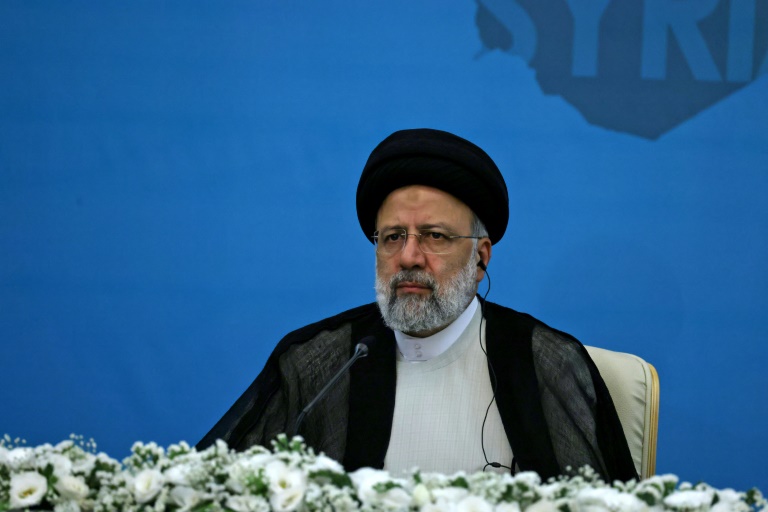
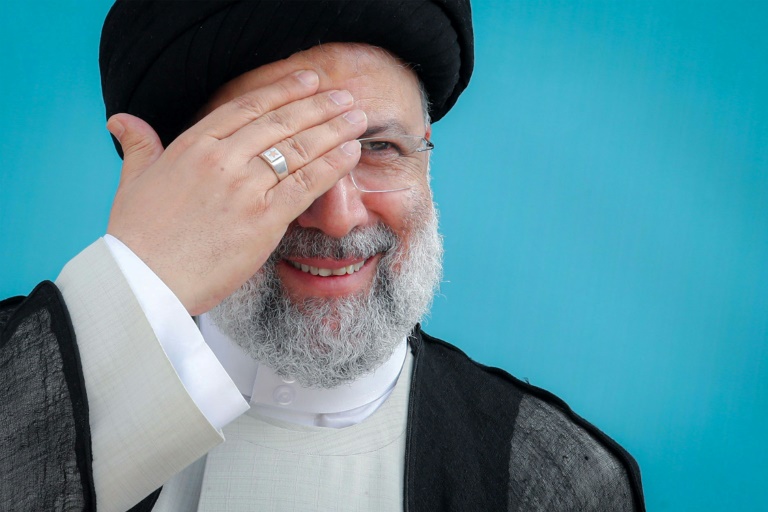
The repression comes one year into the rule of President Ebrahim Raisi, the ultra-conservative former judiciary chief who in August 2021 took over from the more moderate Hassan Rouhani.

Raisi and supreme leader Ayatollah Ali Khamenei, who remains Iran’s number one figure, are battling an economic crisis, as well as a sequence of disasters, including a deadly building collapse in Abadan in May, that have sparked unusual protests.

The economic troubles are partially caused by sanctions over the Iranian nuclear programme. But there is so far no sign world powers and Iran’s leadership are close to the breakthrough needed to revive the 2015 deal over the atomic drive.

“The current crackdown is intimately linked with the upsurge of protests in Iran,” said Ali Fathollah-Nejad, Iran expert at the Issam Fares Institute for Public Policy and International Affairs and American University of Beirut.

He said nationwide protests in December 2017 and November 2019 had left their mark on Iran’s leadership and, while the protests are at root socio-economically driven, they “swiftly turn political and have targeted the entire establishment.”

“Street protests continue to be a threat to regime stability,” he told AFP.

– ‘Instil fear’ –

The rise in executions has been startling, with Iran putting to death twice as many people in the first half of 2022 as it did in the same period a year earlier, according to Iran Human Rights, a Norway-based NGO, which now counts at least 318 hangings this year.

Amnesty International has said Iran is on an “execution spree” with hangings now proceeding at a “horrifying pace”. IHR said that those executed have included 10 women, with three hanged in a single day on July 27, all for murdering their husbands.

Meanwhile, Iran has also resumed amputating the fingers of prisoners convicted of theft, with at least two people suffering this punishment this year which was implemented by a guillotine specially installed in Tehran’s Evin prison, Amnesty said.

Meanwhile, on July 23, Iran also carried out its first public execution in two years.

“The widespread executions are used by the authorities to instil fear in society to prevent further anti-government protests,” said IHR’s director Mahmood Amiry Moghaddam.

– ‘Repressive reflex’ –

There has been a growing movement inside and outside Iran — based around the hashtag “#edam_nakon” (don’t execute) –- to halt the use of the death penalty in the Islamic republic, which executes more people annually than any nation other than China.

One prominent voice has been director Mohammad Rasoulof, whose chilling anti-capital punishment movie “There is No Evil” won the Golden Bear at the Berlin film festival in 2020.

But Rasoulof was arrested in early July after launching in May a petition from directors and actors urging security forces to lay down their arms in the face of protests.

Fellow prize-winning director Jafar Panahi, who for years has been unable to leave Iran, was then detained when he went two days later to inquire about the whereabouts of Rasoulof and told he had to serve a six-year sentence previously handed out.

Behind bars, they join other celebrated dissidents, including the rights activist Narges Mohammadi whose life, rights groups fear, is at risk due to health conditions prison authorities are failing to treat.

The crackdown has also seen the arrest of a number of relatives of victims of the authorities’ violent suppression of protests in November 2019 who have been seeking justice for their loved ones.

“There is no reason to believe these recent arrests are anything but cynical moves to deter popular outrage at the government’s widespread failures,” said Tara Sepehri Far, senior Iran researcher at Human Rights Watch, accusing the government of resorting to “its repressive reflex of arresting popular critics”.

– ‘Outrageous’ –

There have also been arrests in the last two months of the Bahais, in what the Bahai International Community (BIC) calls an “escalating crisis in the Iranian government’s systematic campaign” against the country’s largest non-Muslim religious minority.

At least 20 dual or foreign nationals remain jailed, under house arrest or stuck in Iran, according to the New York based Center for Human Rights in Iran (CHRI), in what their families term a policy of hostage-taking aimed at extracting concessions from the West.

In July, Iran allowed German-Iranian Nahid Taghavi out of jail for medical treatment and released Iran-UK-US citizen Morad Tahbaz with an ankle bracelet. Both, however, remain unable to leave Iran, while a Polish citizen, Belgian, Swede and two French have joined those in prison.

Those behind bars include German national Jamshid Sharmahd who, according to his family, was abducted in the Gulf in July 2020 and now risks the death penalty in a trial expected to reach its conclusion in the next weeks.

“This is a framed job against him aimed at persecuting dissidents and journalists who use their freedom of speech in the free world,” his daughter Gazelle Sharmahd told AFP. “It is outrageous we let this happen,” she said.

Markets sink as talk of Pelosi Taiwan trip fans China-US tension

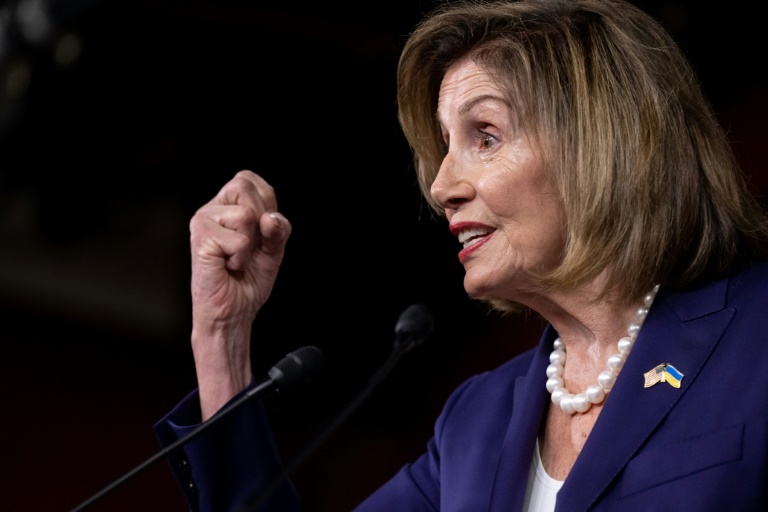
Asian markets tumbled Tuesday on geopolitical fears after reports that House Speaker Nancy Pelosi would visit Taiwan fanned China-US tensions.

Traders were already skittish after a string of data showed economies beginning to take a hit from surging inflation and central bank interest rate hikes aimed at taming prices.

A possible meeting between Pelosi and Taiwanese President Tsai Ing-wen is sure to anger Beijing, which views the island as its territory and has said the White House was playing “with fire”.

While observers do not think the move will spark a conflict, US officials said China was preparing possible military provocations that could include firing missiles in the Taiwan Strait or “large-scale” incursions into Taiwan’s airspace.

White House National Security Council spokesman John Kirby told reporters there was “no reason for Beijing to turn a potential visit consistent with longstanding US policies into some sort of crisis”.

Still, the spike in tensions between the world’s two superpowers has sent shivers through trading floors, compounding worries that Russia’s invasion of Ukraine could escalate into a wider war.

Reports of the visit hit US stocks, with all three main indexes reversing an early rally to end in negative territory.

And Asia followed suit.

Hong Kong and Shanghai led losses, shedding around three percent, while Taipei was off about 1.8 percent. Tokyo was more than one percent lower, while Sydney, Seoul, Singapore, Wellington and Jakarta were also well down.

And on currency markets, the safe-haven yen jumped to a two-month high against the dollar, and the Taiwan dollar dropped 0.7 percent.

“Risk is mounting,” said Stephen Innes of SPI Asset Management.

“As Pelosi is almost sure to visit Taiwan on Tuesday, now it is in China’s hands to see if the situation escalates,” he said, adding that while “it could be little more than a tempest in a teapot still, international and Taiwan investors are pretty concerned”.

“No party wants a real war, but the risk of mishap or even aggressive war game escalation is real, which could always lead to a tactical mistake.”

The flare-up in tensions comes less than a week after Biden and Xi Jinping held phone talks during which the Chinese president warned the United States not to “play with fire” regarding the island.

However, Ayako Yoshioka, at Wealth Enhancement Group, told Bloomberg Radio the crisis may be another “short-term dislocation” for investors but “it’s always concerning when they do happen”.

The selling on markets comes as investors try to assess the outlook for the global economy as leaders try to bring down inflation by lifting rates while at the same time maintaining growth.

Data this week showed the US economy was in a technical recession, China was being battered by Covid lockdowns around the country, and Europe was on the brink as an energy crisis caused by the Ukraine war compounded its own inflation problems.

Traders will be keeping a close eye on the Friday release of US jobs data, which will give fresh insight into the state of the economy, with a weak reading providing the Fed some room to ease back on its rate hikes.

On oil markets, both main contracts extended Monday’s sell-off on falling demand expectations as economies slow.  

– Key figures at around 0230 GMT –

Tokyo – Nikkei 225: DOWN 1.6 percent at 27,549.41 (break)

Hong Kong – Hang Seng Index: DOWN 3.1 percent at 19,551.19

Shanghai – Composite: DOWN 2.1 percent at 3,192.45

Taipei – TAIEX: DOWN 1.9 percent at 14,700.48

Dollar/yen: UP at 130.67 yen from 131.61 yen Monday

Euro/dollar: UP at $1.0272 from $1.0262

Pound/dollar: UP at $1.2259 from $1.2255 

Euro/pound: DOWN at 83.79 pence from 83.70 pence

West Texas Intermediate: DOWN 0.7 percent at $93.24 per barrel

Brent North Sea crude: DOWN 0.8 percent at $00.19 per barrel

New York – Dow: DOWN 0.1 percent at 32,798.40 (close)

London – FTSE 100: DOWN 0.1 percent at 7,413.42 (close)

The killing of Al-Qaeda's Zawahiri: how it happened

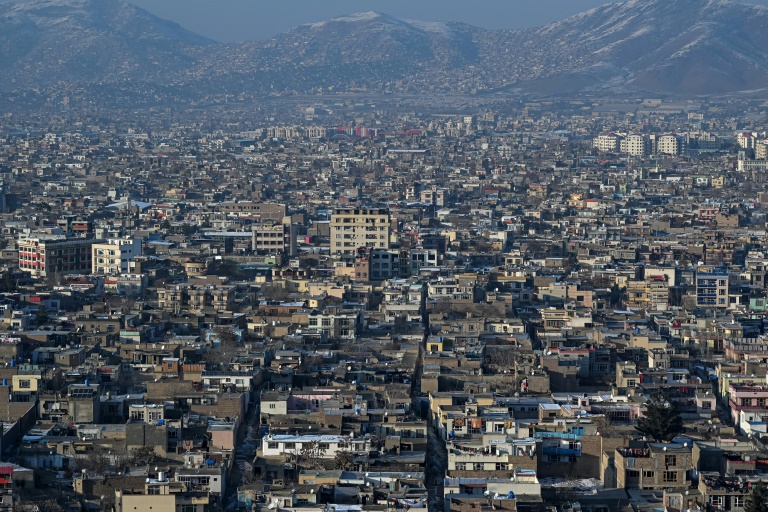
Despite a $25 million US bounty on his head, Al-Qaeda leader Ayman al-Zawahiri apparently felt comfortable enough with the Taliban’s takeover of Afghanistan to move into a home in Kabul where he would regularly appear out in the open, on his balcony.

But the US government had not given up its pursuit of one of the planners of the September 11, 2001 attacks and the heir to Osama bin Laden.

After years of tracking him down, US armed forces fired two Hellfire missiles from a drone flying above the Afghan capital, striking Zawahiri’s safe house and killing him, President Joe Biden announced on Monday.

US officials described an operation as meticulously planned as that which killed bin Laden in his Pakistan hideout in 2011.

That the leader of the violent jihadist group was in Afghanistan was not surprising: since the hard-line Islamist Taliban regained control in August, Al-Qaeda has felt more at home, analysts say. 

But finding him was still hard.

“For several years the US government has been aware of a network that we assessed supported Zawahiri,” a senior administration official told reporters.

But it was only this year that US intelligence learned that his family, his wife, his daughter and her children, had moved to the Afghan capital. 

They were careful, the official said, exercising “longstanding terrorist tradecraft” to prevent anyone tracking them to the Qaeda leader.

Still, eventually Zawahiri showed up, and never left.

“We identified Zawahiri on multiple occasions for sustained periods of time on the balcony,” the official said.

An attack plan developed over May and June. The United States constantly monitored the multi-story residence — just how the official would not say — to understand the family’s pattern of life.

– Detailed safe-house model –

They studied the construction of the home, aiming to hit Zawahiri without threatening the building’s structural integrity, to minimize the risk to civilians.

Defense and intelligence officials finalized the plan in June and presented it to Biden in the White House on July 1, using a detailed model of the residence, as was done before the bin Laden raid. 

Biden asked detailed questions on the structure, weather issues, and the risk to civilians, the official said.

Finally, on July 25, Biden — still ill with a bout of Covid-19 — made the decision. 

It took place with key cabinet officials joining the final briefing, echoing the April 28, 2011 White House meeting where president Barack Obama decided to deploy US special operations troops to enter Pakistan and get bin Laden.

At that time Biden was vice president, and he expressed doubts. The risks of things going wrong were high, bin Laden had not been clearly identified, and relations with Pakistan could suffer, he later recalled.

With Zawahiri, however, no US troops would enter the country; Zawahiri was clearly identified; and relations with the Taliban were next to nil. 

At the end of the discussion on the 25th, Biden — as Obama had done 11 years earlier — asked each participant for their view.

“All strongly recommended approval of this target,” and Biden gave the go-ahead, the official said.

The strike involved a US drone, armed with two precision-guided Hellfire missiles, which were launched at 6:18 am Sunday, Kabul time.

Zawahiri was “killed on the balcony,” the official said.

The missiles appear not to have been ordinary Hellfires, whose high explosives could have destroyed the home.

– ‘Significant blow to Al-Qaeda’ –

Apparent photographs of the building show only a few windows on one floor blown out, and the rest intact.

That points to the likely use of a non-explosive version of the Hellfire, the R9X, which deploys a series of knife-like blades from its fuselage and shreds its target but leaves nearby people and objects intact. 

The so-called “flying ginsu” missile has been used a half-dozen or more times by US forces to kill other jihadist group leaders without hurting bystanders.

The official did not provide details, but expressed strong confidence that Zawahiri had been killed and no others were hurt. 

“Zawahiri’s family members were present in other parts of the safe house at the time of the strike and were purposely not targeted and were not harmed,” he said.

The official said the strike “deals a significant blow to Al-Qaeda and will degrade the group’s ability to operate.”

“As President Biden has consistently said, we will not allow Afghanistan to become a safe haven for terrorists who might bring harm to Americans,” the official said.

A year on, Iran's Raisi faces economy in trouble

A year after Iran’s President Ebrahim Raisi took power, his government has curbed the Covid pandemic but faces a sharp downturn of the sanctions-hit economy as nuclear talks remain stalled.

Having pledged to help especially the poor, the ultraconservative cleric now faces runaway consumer prices that have sparked protests.

Raisi was elected in June last year in a ballot for which less than half of voters turned up, after his major rivals had been disqualified by electoral bodies.

He was inaugurated on August 3 by the supreme leader, Ali Khamenei, and sworn in two days later as head of government in the Islamic republic.

When he formed his cabinet, Raisi named his two top priorities: controlling the region’s worst Covid outbreak, and turning around the battered economy.

Iran’s vaccination campaign, long hampered by US sanctions, was massively stepped up using Chinese and Russian drugs.

For Hamidreza Taraqi, a top official in the Islamic Coalition Party, part of the conservative alliance backing the Raisi, the government has “succeeded in curbing the coronavirus and in eliminating its effects”.

The UN World Health Organization says more than 58 million Iranians, or some 70 percent of the population, have now been fully vaccinated.

“Raisi’s government did oversee widespread coronavirus vaccinations after the state reversed course and approved foreign vaccine imports,” said Henry Rome of the US-based consultancy Eurasia Group.

But on the economic front, Raisi’s record is more mixed as Iran remains hit by biting sanctions that keep it isolated from global financial systems. 

– Nuclear talks –

Iran had hoped for greater prosperity after its 2015 landmark nuclear deal with major powers gave it sanctions relief in exchange for curbs on its atomic programme.

But former US president Donald Trump in 2018 unilaterally withdrew Washington from the agreement and reimposed a punishing sanctions regime.

The economic pain has deepened popular distrust in Iran toward the government, both under the previous president, the moderate Hassan Rouhani, and under Raisi.

The darker mood, say analysts, was reflected in the record abstention rate at last year’s election, which came after the repression of protest movements, especially from December 2017 and again in November 2019. 

Iran had returned to economic growth under Rouhani after the 2018-2019 recession. 

But, hit by Trump’s sanctions which dramatically curbed crucial oil exports, Iran’s GDP per capita is now not expected to recover to its pre-crisis level until next year, according to the International Monetary Fund.

– ‘Social turmoil’ –

In April 2021, with President Joe Biden in the White House, talks on rescuing the nuclear accord began in Vienna.

The negotiations resumed in November 2021 after a pause around Iran’s presidential polls but have yet to produce a breakthrough, while the Raisi government faces a budget deficit that economists consider abysmal.

Inflation, which has been eroding household purchasing power for years, in June reached 54 percent from a year earlier, according to the latest official data.

And the rial currency, which had recovered somewhat early this year on hopes of a deal in the nuclear talks, has since resumed its rapid descent, and reached a new low in June against the dollar.

Then in May, the government started to lift state subsidies on flour and to raise prices on food staples such as oil and dairy products — measures that especially penalised the poor whom Raisi had championed.

“The country’s economic horizon is far from clear… and economists predict we will face more rising prices,” Mehdi Rahmanian, editor of the reformist newspaper Shargh, told AFP.

The rising cost of living has driven protests in several Iranian cities in recent months.

Much now depends on how the nuclear talks go, said Rome.

“If the nuclear negotiations collapse, as appears likely,” he said, “Iran will likely face more significant economic and social turmoil.”

Baby boom: the endangered wildlife revival at Cambodia's Angkor Wat

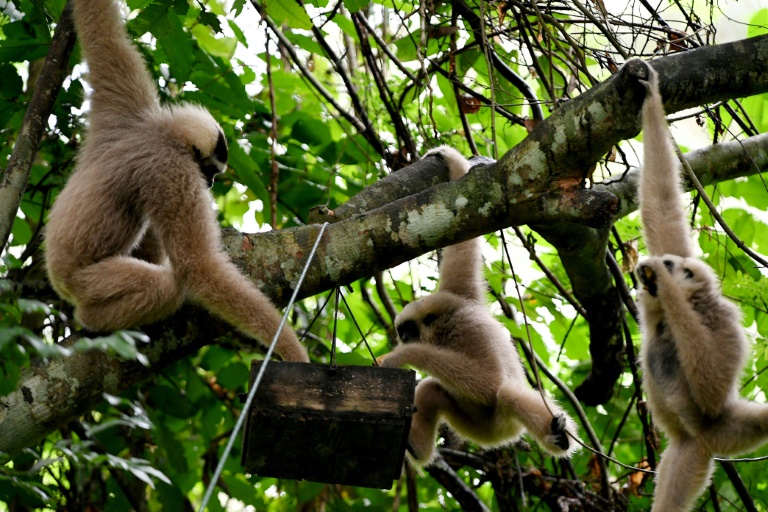
The melodic songs from families of endangered monkeys ring out over the jungle near Cambodia’s Angkor Wat temple complex — a sign of ecological rejuvenation decades after hunting decimated wildlife at the site.

The first pair of rare pileated gibbons were released in 2013 as part of a joint programme between conservation group Wildlife Alliance, the forestry administration and the Apsara Authority — a government agency that manages the 12th-century ruins.

The gibbon duo, named Baray and Saranick, were born from parents rescued from the wildlife trade and produced offspring a year later.

“We have now released four different pairs of gibbons within the Angkor forest and they have gone on to breed and now seven babies have been born,” Wildlife Alliance rescue and care programme director Nick Marx told AFP.

“We are restoring Cambodia’s natural heritage back into their most beautiful cultural heritage.”

Globally, gibbons are one of the most threatened families of primates, while the pileated gibbon is listed as endangered.

Marx says his team rescues some 2,000 animals a year and many more will soon call the Angkor jungle home.

There are hopes that once the baby gibbons reach sexual maturity in about five to eight years, they will also pair up and mate.

“What we are hoping for the future is to create a sustainable population of the animals… that we released here within the amazing Angkor forest,” Marx said.

– ‘Big victory’ –

Cambodian authorities have hailed the gibbon baby boom that began in 2014.

“This means a big victory for our project,” Chou Radina from the Apsara Authority said, adding that as well as gibbons, tourists could now see great hornbills flying over Angkor Wat.

The programme has released more than 40 other animals and birds including silvered langurs, muntjac deers, smooth-coated otters, leopard cats, civets, wreathed hornbills, and green peafowl.

All were rescued from traffickers, donated or born in captivity at the Phnom Tamao wildlife sanctuary near Phnom Penh.

The Angkor Archaeological Park — which contains the ruins of various capitals of the Khmer Empire, dating from the ninth to 15th centuries — has some of the oldest rainforest in Cambodia.

It is also the kingdom’s most popular tourist destination.

Since Angkor Wat became a world heritage site in 1992, its jungle, which covers more than 6,500 hectares, has benefited from increased legal and physical protections.

There are hopes that wildlife sightings will also spark interest in local and foreign tourists and boost conservation education efforts.

– Ongoing threats –

Rampant poaching, habitat loss from logging, agriculture and dam building has stripped much wildlife from Cambodian rainforests.

Last year, authorities removed 61,000 snare traps, environment ministry spokesman Neth Pheaktra said, adding that the government had launched a campaign to discourage hunting and eating of wildlife meat.

But widespread poverty even before the pandemic left many households without much choice but to continue hunting so their families could eat protein.

Animals are also hunted for traditional medicine and to be kept as pets.

According to Global Forest Watch, from 2001-2021 Cambodia lost 2.6 million hectares of tree cover, a 30 percent decrease since 2000.

Commercial interests are trumping protection efforts in some quarters — the Phnom Tamao zoo and wildlife rescue centre is under threat from a shadowy rezoning development plan, Marx said.

Back at Siem Reap — the gateway city to Angkor Wat — villager Moeurn Sarin shops at the market for bananas, watermelon, rambutan and fish to feed the pileated gibbon families and otters.

“We are happy to conserve these animals,” the 64-year-old said, adding he likes to watch the gibbons’ tree swinging antics.

“In the future, these animals will have babies for the young generation to see.”

Baby boom: the endangered wildlife revival at Cambodia's Angkor Wat

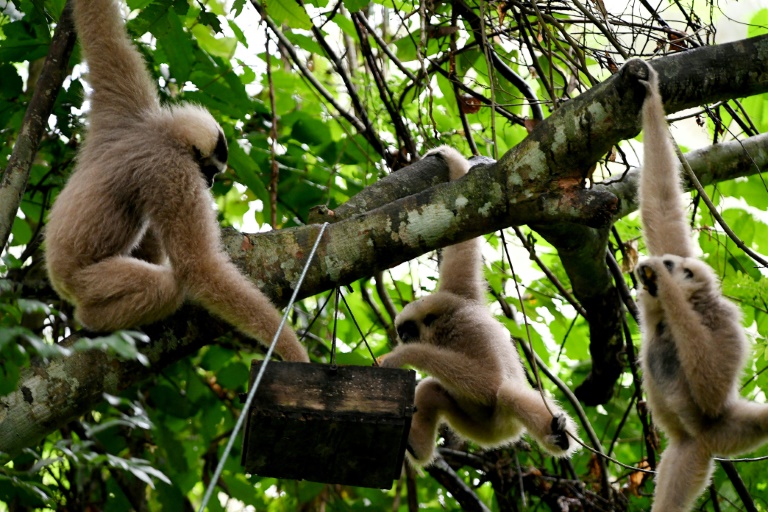
The melodic songs from families of endangered monkeys ring out over the jungle near Cambodia’s Angkor Wat temple complex — a sign of ecological rejuvenation decades after hunting decimated wildlife at the site.

The first pair of rare pileated gibbons were released in 2013 as part of a joint programme between conservation group Wildlife Alliance, the forestry administration and the Apsara Authority — a government agency that manages the 12th-century ruins.

The gibbon duo, named Baray and Saranick, were born from parents rescued from the wildlife trade and produced offspring a year later.

“We have now released four different pairs of gibbons within the Angkor forest and they have gone on to breed and now seven babies have been born,” Wildlife Alliance rescue and care programme director Nick Marx told AFP.

“We are restoring Cambodia’s natural heritage back into their most beautiful cultural heritage.”

Globally, gibbons are one of the most threatened families of primates, while the pileated gibbon is listed as endangered.

Marx says his team rescues some 2,000 animals a year and many more will soon call the Angkor jungle home.

There are hopes that once the baby gibbons reach sexual maturity in about five to eight years, they will also pair up and mate.

“What we are hoping for the future is to create a sustainable population of the animals… that we released here within the amazing Angkor forest,” Marx said.

– ‘Big victory’ –

Cambodian authorities have hailed the gibbon baby boom that began in 2014.

“This means a big victory for our project,” Chou Radina from the Apsara Authority said, adding that as well as gibbons, tourists could now see great hornbills flying over Angkor Wat.

The programme has released more than 40 other animals and birds including silvered langurs, muntjac deers, smooth-coated otters, leopard cats, civets, wreathed hornbills, and green peafowl.

All were rescued from traffickers, donated or born in captivity at the Phnom Tamao wildlife sanctuary near Phnom Penh.

The Angkor Archaeological Park — which contains the ruins of various capitals of the Khmer Empire, dating from the ninth to 15th centuries — has some of the oldest rainforest in Cambodia.

It is also the kingdom’s most popular tourist destination.

Since Angkor Wat became a world heritage site in 1992, its jungle, which covers more than 6,500 hectares, has benefited from increased legal and physical protections.

There are hopes that wildlife sightings will also spark interest in local and foreign tourists and boost conservation education efforts.

– Ongoing threats –

Rampant poaching, habitat loss from logging, agriculture and dam building has stripped much wildlife from Cambodian rainforests.

Last year, authorities removed 61,000 snare traps, environment ministry spokesman Neth Pheaktra said, adding that the government had launched a campaign to discourage hunting and eating of wildlife meat.

But widespread poverty even before the pandemic left many households without much choice but to continue hunting so their families could eat protein.

Animals are also hunted for traditional medicine and to be kept as pets.

According to Global Forest Watch, from 2001-2021 Cambodia lost 2.6 million hectares of tree cover, a 30 percent decrease since 2000.

Commercial interests are trumping protection efforts in some quarters — the Phnom Tamao zoo and wildlife rescue centre is under threat from a shadowy rezoning development plan, Marx said.

Back at Siem Reap — the gateway city to Angkor Wat — villager Moeurn Sarin shops at the market for bananas, watermelon, rambutan and fish to feed the pileated gibbon families and otters.

“We are happy to conserve these animals,” the 64-year-old said, adding he likes to watch the gibbons’ tree swinging antics.

“In the future, these animals will have babies for the young generation to see.”

Beyonce to remove offensive lyric after disabled community outcry

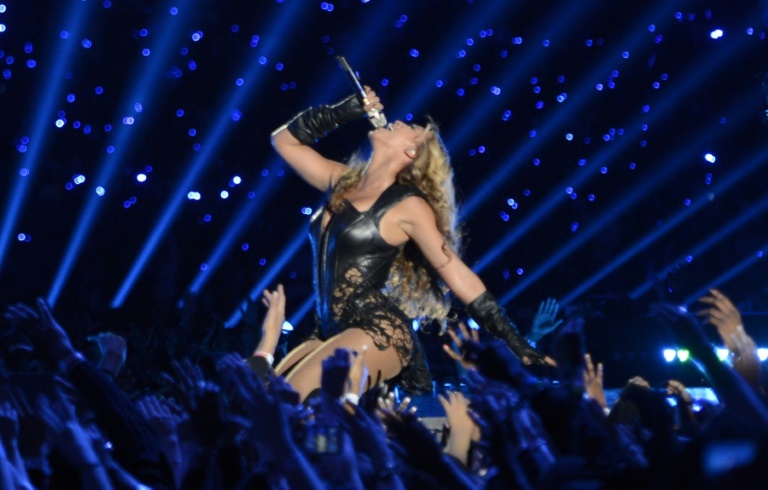
Beyonce will remove a derogatory term for disabled people from her new song “Heated,” a spokesperson said Monday, after its use was condemned as offensive by campaigners.

The US pop megastar will re-record the track from her latest album “Renaissance” on which she originally sang the lyrics “Spazzin’ on that ass, spazz on that ass.”

“The word, not used intentionally in a harmful way, will be replaced,” a spokesperson for Beyonce told AFP via email.

Co-written with Canadian rapper Drake, the dance track appears to use the word “spaz” in the colloquial sense of temporarily losing control or acting erratically.

But disability campaigners noted that the word is derived from “spastic.” 

According to the Centers for Disease Control and Prevention, spasticity is a movement disorder involving stiff muscles and awkward movement, suffered by 80 percent of people with cerebral palsy.

In June, US singer Lizzo re-recorded her song “Grrrls” to remove the same term following complaints that it was derogatory.

Australian disability campaigner Hannah Diviney said the inclusion of the word by Beyonce “feels like a slap in the face to me, the disabled community & the progress we tried to make with Lizzo.”

“Guess I’ll just keep telling the whole industry to ‘do better’ until ableist slurs disappear from music,” she tweeted.

Beyonce’s eagerly anticipated seventh solo studio album “Renaissance” was released Friday, drawing mainly positive reviews with its nods to disco and electronic dance.

Other collaborators on the album — which leaked online in the days prior to its official release — include Nile Rodgers, Skrillex, Nigerian singer Tems, Grace Jones, Pharrell and Beyonce’s rap mogul husband Jay-Z.

In an Instagram post published soon after the album’s release, Beyonce said creating the album “allowed me a place to dream and to find escape during a scary time for the world.

“My intention was to create a safe place, a place without judgment,” she wrote.

“A place to be free of perfectionism and overthinking. A place to scream, release, feel freedom.”

US kills Al-Qaeda chief in Kabul drone strike

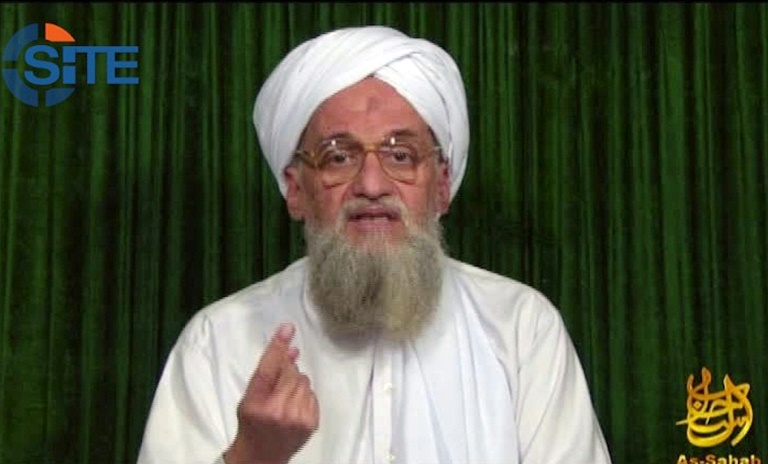
President Joe Biden announced Monday that the United States had killed Al-Qaeda chief Ayman al-Zawahiri, one of the world’s most wanted terrorists and a mastermind of the September 11, 2001 attacks, in a drone strike in Kabul.

In a somber televised address, Biden said he gave the final go-ahead for the high-precision strike that successfully targeted Zawahiri in the Afghan capital over the weekend.

“Justice has been delivered and this terrorist leader is no more,” Biden said, adding that he hoped Zawahiri’s death would bring “closure” to families of the 3,000 people killed in the United States on 9/11.

A senior administration official said Zawahiri was on the balcony of a house in Kabul when he was targeted with two Hellfire missiles, an hour after sunrise on July 31, and that there had been no US boots on the ground in Afghanistan.

“We are not aware of him ever leaving the safe house. We identified Zawahiri on multiple occasions for sustained periods of time on the balcony of where he was ultimately struck,” the official said. 

According to the official’s account, the president gave his green light for the strike on July 25 — as he was recovering in isolation from Covid-19. Biden said there were no civilian casualties in the operation. 

The US official called Zawahiri’s presence in the Afghan capital Kabul a “clear violation” of a deal the Taliban had signed with the US in Doha in 2020 that paved the way for the US withdrawal from Afghanistan.

It was the first known over-the-horizon strike by the United States on an Al-Qaeda target in Afghanistan since American forces withdrew from the country on August 31, 2021. 

Zawahiri, an Egyptian surgeon who grew up in a comfortable Cairo household before turning to violent radicalism, had been on the run for 20 years since the 9/11 attacks.

He took over Al-Qaeda after Osama bin Laden was killed by US special forces in Pakistan in 2011, and had a $25 million US bounty on his head.

Over the weekend the Afghan interior ministry denied reports circulating on social media of a drone strike in Kabul, telling AFP a rocket struck “an empty house” in the capital, causing no casualties.

Early Tuesday in Kabul, however, Taliban spokesman Zabihullah Mujahid tweeted that an “aerial attack” was carried out on a residence in the Sherpur area of the city.

“The nature of the incident was not revealed at first. The security and intelligence agencies of the Islamic Emirate investigated the incident and found in their preliminary investigations that the attack was carried out by American drones,” his tweet said.

The news comes a month before the first anniversary of the final withdrawal of US troops from Afghanistan, leaving the country in the control of the Taliban insurgency that fought Western forces over the preceding two decades.

Under the 2020 Doha deal, the Taliban promised not to allow Afghanistan to be used again as a launchpad for international jihadism, but experts believe the group never broke their ties with Al-Qaeda.

“What we know is that the senior Haqqani Taliban were aware of his presence in Kabul,” the Biden official said. 

Taliban interior minister Sirajuddin Haqqani also heads the feared Haqqani Network, a brutal subset of the Taliban blamed for some of the worst violence of the past 20 years and which has been described by US officials as a “veritable arm” of Pakistani intelligence.

– Doctor turned jihadist –

Zawahiri, 71, lacked the potent charisma that helped bin Laden rally jihadists around the world, but willingly channelled his analytical skills into the Al-Qaeda cause.

He was believed to be the main strategist — the real mastermind who steered operations, including the September 11 attacks, as well as bin Laden’s personal doctor.

Al-Qaeda is believed to have been degraded in the years since the US invasion of Afghanistan, and the White House official said Zawahiri was “one of the last remaining figures who carried this kind of significance.”

The organization, agreed Soufan Center researcher Colin Clarke, is “at a crossroads.”

“Despite Zawahiri’s leadership, which minimized AQ’s losses while rebuilding, the group still faces serious challenges going forward. For one, there’s the question of who will lead al Qaeda after Zawahiri’s gone,” he said.

Zawahiri’s father was a renowned physician and his grandfather a prayer leader at Cairo’s Al-Azhar institute, the highest authority for Sunni Muslims.

He became involved with Egypt’s radical Muslim community at a young age and published several books which came for many to symbolize the radical Islamist movement.

He left Egypt in the mid-1980s, heading for Pakistan’s northwestern city of Peshawar where the resistance to the Soviet occupation of Afghanistan was based.

It was at that time, when thousands of Islamist fighters flooded into Afghanistan during the 1980s, that Zawahiri and bin Laden met, and in 1998 he became one of five signatories to bin Laden’s “fatwa” calling for attacks against Americans.

Jihadist monitor SITE said some militants were questioning the veracity of the report he had been killed, while others believed Zawahiri had achieved his desire of “martyrdom.” 

As for Al-Qaeda’s future without him, SITE said jihadists were bullish, with one writing: “If Sheikh Ayman al-Zawahiri is dead, there are a thousand Aymans.”

sms-fox-pmh-st/ec

Close Bitnami banner
Bitnami