World

Eight dead in 'devastating' Kentucky flooding

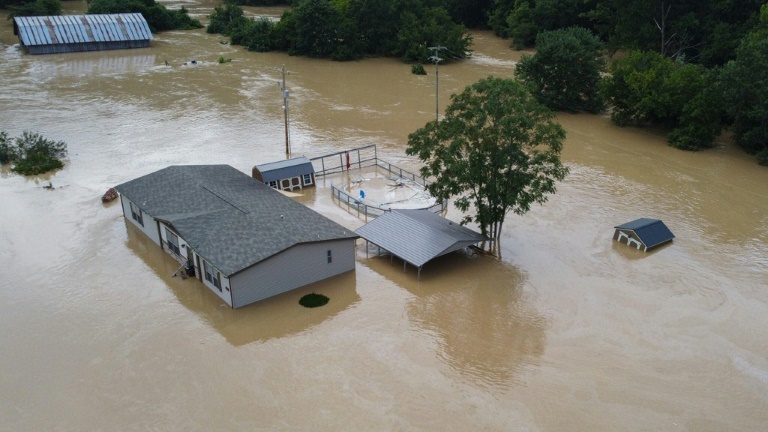
Flash flooding caused by torrential rains has killed at least eight people in eastern Kentucky and left some residents stranded on rooftops and in trees, the governor of the south-central US state said Thursday.

The world has been hit by extreme weather events in recent months, incidents that scientists say are an unmistakable sign of climate change.

“This is going to be the worst flooding in recent memory — devastating and deadly,” Governor Andy Beshear told local NBC affiliate WLEX in an interview.

“We’re going to end up with double-digit deaths. Right now, I believe we can confirm at least eight, but that number is increasing, it seems, by the hour.”

The victims include an 81-year-old woman in Perry County.

Beshear said that responders have rescued “between 20 and 30” people by air. Earlier, he described people standing on rooftops or climbing up trees to escape the floodwaters while waiting for rescue.

Many roads resembled rivers, mangled cars littered the landscape and muddy brown floodwaters lapped against the rooftops of low-lying houses in the state’s Appalachian region.

Some areas reported receiving more than eight inches (20 centimeters) of rain in a 24-hour period.

The North Fork of the Kentucky River at Whitesburg, usually one to two feet deep at this time of year, rose to a staggering 20 feet, well above its previous record of 14.7 feet.

The governor said a state of emergency had been declared in half a dozen counties, and four National Guard helicopters have been deployed to help with rescue efforts.

The Kentucky Department of Fish and Wildlife had deployed Zodiac boats to carry out water rescues.

“There’s a lot of people out there who need help,” Beshear told reporters earlier in the day. “And we’re doing the very best we can to reach each and every one of them.

“The situation right now is tough,” he added.

“Hundreds will lose their homes, and this is going to be yet another event that it’s going to take not months, but likely years for many families to rebuild and recover from,” he said.

Beshear said around 25,000 homes were without power statewide, and many were without water.

The National Weather Service said the area was still at risk of flash flooding and warned more heavy rain was expected.

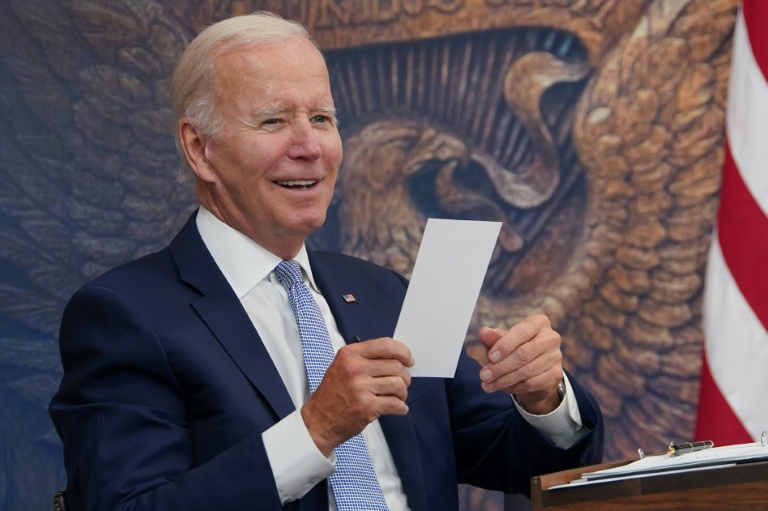
White House Press Secretary Karine Jean-Pierre said President Joe Biden had been briefed about the flooding.

Jean-Pierre said Deanne Criswell, head of the Federal Emergency Management Agency, would travel to Kentucky on Friday and report back to the president.

US tech titans stumble after pandemic boom

Amazon and Apple were a relative bright spot in a week of otherwise lackluster earnings results for an industry reckoning with the end of heady pandemic-era growth.

A crowded period of quarterly financial releases from the world’s biggest tech firms has been marred by misses and uncertainty — making it clear that the boom triggered by Covid-19 restrictions on getting about has tipped toward downturn.

As people are freed from pandemic lifestyles that had them relying on the internet for shopping, playing, working and learning, inflation is pushing up prices and Covid-19 is causing temporary shutdowns of factories in China relied on by tech firms.

Recession fears, a strong dollar, shrinking advertising budgets and inflation — headwinds are coming from every direction at the moment.

“When you think about the number of challenges in the quarter, we feel really good about the growth that we put up,” Apple chief executive Tim Cook said on an earnings call.

For Apple, product sales tallied $63.4 billion in a drop from the same period a year earlier, but the dip was more than made up for by services revenue that climbed to $19.6 billion, earnings figures showed.

Demand for iPads and Mac computers exceeded supply in the recently-ended quarter, the main cause being pandemic restrictions that caused “plant closures and plants running at less than full utilization,” Cook noted.

Apple was also hobbled by an ongoing shortage of computer chips, Cook said.

Meanwhile, US chip giant Intel reported disappointing earnings battered by its own missteps as well as economic conditions — a post-Covid drop in demand and “supply dislocations in China and other parts of the supply chain,” executives said on an earnings call.

Amazon beat sales estimates to reach $121 billion in the quarter, and revenue climbed at its cloud-computing platform Amazon Web Services.

The retailer has made progress reducing ranks of employees that had been beefed up to handle online shopping that surged during the pandemic, executives said.

“Amazon managed pretty well through the second quarter despite tough macro conditions and added costs weighing on its bottom line,” said analyst Andrew Lipsman.

Apple, Microsoft and Facebook-owner Meta have talked of the strong dollar eating into earnings, since when America’s currency gains too much value, it can make products more expensive overseas or eat away at a beneficial exchange rate.

Meta pointed to the greenback’s role in the firm’s first year-on-year revenue decline since going public in 2012.

– Not much good news –

In addition to the generally bumpy economic times, firms such as Netflix and Meta are fighting fierce competition from rivals — and both reported losing some ground.

Meta lost about two million monthly users between quarters, and Netflix shed nearly a million paying customers.

Yet Netflix stock is up about a percent in the past five days, with investors potentially hopeful after the firm projected a coming rebound in subscribers.

Markets seemed similarly assuaged despite Google parent Alphabet missing on revenue and profit.

The Silicon Valley giant’s bad news was not unexpected, as the flow of online ad dollars that fuels the company’s fortunes has slowed as inflation, war and other troubles vex the overall economy.

“Still, with its tremendous market share in search advertising, Google is relatively well positioned to weather the rough waters that lie ahead,” said analyst Evelyn Mitchell.

As advertisers have tightened their belts, and Apple’s privacy changes have bitten into firms’ sales of costly but highly targeted ads, the damage was uneven.

Meta’s income has taken a beating, and with a share price that has lost about half its value since February, it’s clear that investors are still wary about the company’s future.

“The good news, if we can call it that, is that its competitors in digital advertising are also experiencing a slowdown,” said analyst Debra Aho Williamson.

Snapchat’s parent firm, for example, reported that its loss in the recently ended quarter nearly tripled to $422 million, despite revenue increasing 13 percent under “more challenging” conditions than expected.

“We are not satisfied with the results we are delivering, regardless of the current headwinds,” California-based Snap said in a letter to investors last week.

Hungary's Orban defends 'cultural standpoint' in race row

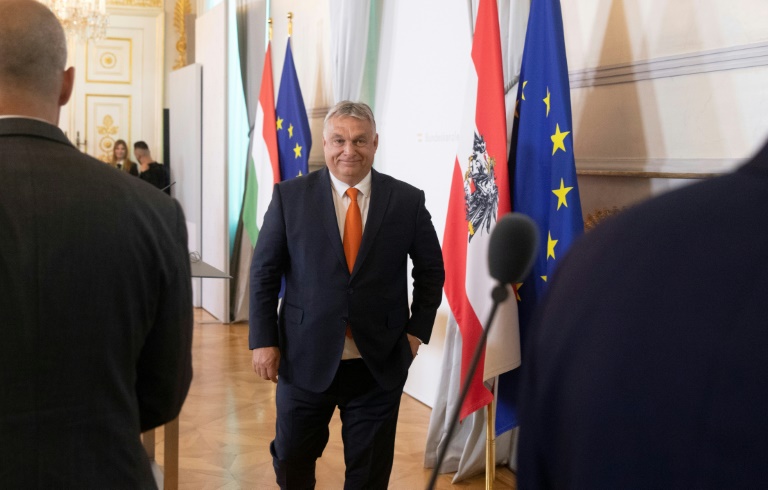
Hungary’s nationalist Prime Minister Viktor Orban on Thursday defended his comments against creating “peoples of mixed-race”, saying they represented a “cultural” standpoint, drawing a stinging rebuke from Washington.

“It happens sometimes that I speak in a way that can be misunderstood… the position that I represent is a cultural… standpoint,” Orban told reporters during a visit to neighbouring Austria.

Orban sparked a storm of criticism after he warned against mixing with “non-Europeans” in a speech in Romania’s Transylvania region, home to a Hungarian community, on Saturday.

The United States on Thursday denounced the remarks as “inexcusable”.

State Department spokesman Ned Price read to reporters a statement from US envoy against anti-Semitism Deborah Lipstadt who said that “rhetoric of this nature is inexcusable” some “75 years after the Holocaust”.

Decades “after the end of the Holocaust, it is inexcusable for a leader to make light of Nazi mass murder,” Lipstadt said.

Price added that the United States and its allies around the world are united by “shared values” along with interests.

“The remarks that we heard from Prime Minister Orban are not reflective of the shared values that tether the United States to Hungary,” Price said.

Austrian Chancellor Karl Nehammer said earlier in a joint news conference with Orban that the issue had been “resolved… amicably and in all clarity”, adding his country “strongly condemned… any form of racism or anti-Semitism”.

– ‘Nazi text’ –

The International Auschwitz Committee has urged the European Union — and Nehammer specifically — to distance themselves from “Orban’s racist undertones”.

Austria is the first EU country to host Orban for talks since he won a fourth straight mandate in an April landslide.

Besides the race row, the two leaders discussed migration and energy security amid tensions over Russia’s invasion of Ukraine.

Vienna sees itself “as an honest broker” and is anxious not to sideline Hungary, an Austrian official told AFP on condition of anonymity.

Jewish community representatives voiced alarm after Orban, an ultra-conservative known for his anti-migrant policy and virulent rhetoric, said that “we do not want to become peoples of mixed-race”.

The 59-year-old also seemed to allude to the Nazi German gas chambers when criticising a Brussels plan to reduce European gas demand by 15 percent following Russia’s invasion of Ukraine.

Hungary was the only EU member to oppose the plan, which passed on a majority vote this week.

An adviser to Orban, Zsuzsa Hegedus, resigned on Tuesday, slamming his speech as “a pure Nazi text”.

In response, Orban stressed his government’s “policy of zero tolerance when it comes to anti-Semitism and racism”, according to a letter made public.

“I am proud of the results which Hungary achieved against racism in recent years,” Orban told reporters on Wednesday.

Both Orban and Nehammer said they would not support any embargo on Russian gas, on which their countries are heavily dependant, with Orban describing any such embargo as a “wall”.

“My advice to the European Union is not to hit this wall,” said the Hungarian, who recently slammed the EU’s sanction policy against Russia as “Europe shooting itself in the lungs”.

He added that he wished Brussels would come up with a new “strategy that is good for the Ukrainians, good for us, good for the European economy and good for the households that have to pay the price of energy”.

pmu-jza/gw/har

Macron defies anger to welcome Saudi strongman

French President Emmanuel Macron on Thursday warmly welcomed Saudi Arabia’s Crown Prince Mohammed bin Salman for talks in Paris, defying anger sparked by hosting the controversial strongman less than four years after the murder of journalist Jamal Khashoggi.

The meeting is the latest step in the diplomatic rehabilitation of the de-facto leader of the kingdom who became a pariah in the West following the killing of Khashoggi by Saudi agents inside Saudi’s Istanbul consulate.

Macron warmly greeted the ruler universally known as MBS ahead of a dinner, with the two men enjoying a warm handshake that they emphasised by using all four hands.

Shaking off criticism from rights groups and Khashoggi’s fiance, Macron then guided MBS up the steps on the red carpet into the Elysee Palace. 

Neither man made any comment but a statement is expected later from the Elysee after the talks.

MBS, seen by supporters as an ambitious and by critics as a tyrant with a ruthless streak, arrived in France following a visit from US President Joe Biden to Riyadh earlier this month.

On his way to France, he stopped in Greece this week, his first trip to the EU since the murder of Khashoggi.

– ‘Outraged’ –

The killing of Khashoggi was described by a UN probe as an “extrajudicial killing for which Saudi Arabia is responsible”.

US intelligence agencies determined that MBS had “approved” the operation that led to Khashoggi’s death. Riyadh denies this, blaming rogue operatives.

“I am scandalised and outraged that Emmanuel Macron is receiving with all the honours the executioner of my fiance, Jamal Khashoggi,” his widow Hatice Cengiz, who had waited outside the consulate in Istanbul when her husband disappeared, told AFP on Thursday.

“All the international investigations carried out up to this point… recognise the responsibility of MBS in the assassination,” Cengiz said.

Amnesty International secretary general Agnes Callamard told AFP she felt “profoundly troubled by the visit, because of what it means for our world and what it means for Jamal (Khashoggi) and people like him.”  

MBS is a man who “does not tolerate any dissent,” she added.

– ‘The only way’ –

But for Western countries desperate to find new sources of energy, the 36-year-old de facto leader of the world’s biggest oil producer has become an essential figure.

The Kremlin’s invasion of Ukraine in February sent energy prices soaring, with Western nations scouring the globe to find supplies to replace oil and gas from Russia. 

An aide to Macron defended the working dinner at a time of a global energy and food crisis, while promising that human rights would be raised.

“He will talk about it (rights) in a general way, but will also take the chance to raise individual cases,” the aide said on condition of anonymity. 

“For the president to have an influence and tackle the problems that European countries and France face… the only way is to talk with all of our partners,” the aide added.  

He repeated France’s longstanding demand that the gruesome dismemberment of Khashoggi be investigated and those responsible be “brought to justice”. 

French Prime Minister Elisabeth Borne denied claims that the country was undermining its public commitments to defend human rights, saying the visit “obviously does not cast doubt on our principles.”

– ‘Open an investigation’ –

The killing of Khashoggi, a Washington Post journalist, drew outrage not just over the elimination of a prominent critic of the Saudi regime, but also for the manner in which it was carried out. 

He was lured into the Saudi consulate on October 2, 2018 before being strangled and dismembered, reportedly with a bonesaw.

Three rights groups, including the Democracy for the Arab World Now (DAWN) group created by Khashoggi, on Thursday filed a criminal complaint in Paris accusing MBS of being an accomplice in the crime.

“French authorities should immediately open a criminal investigation against” MBS, said Sarah Leah Whiston, executive director of DAWN.

There has also been criticism within France, with the Greens presidential candidate Yannick Jadot asking “will Khashoggi’s dismembered body be on the menu? Climate? Human rights? 

“No — it will be oil and weapons. The exact opposite of what should be done.” 

The French president first hosted MBS in 2018, when he took him to an art exhibition at the Louvre museum, and travelled to the kingdom in December 2021 for further talks. 

The Saudi strongman stayed overnight at his Louis XIV chateau in Louveciennes west of Paris which he acquired in 2015, according to a source who asked not to be named.

Despite its name, the 7,000 m2 castle was only built in 2009, by a company headed by Khashoggi’s cousin Emad.

'Rescind the doctrine': Indigenous protest as Pope tours Canada

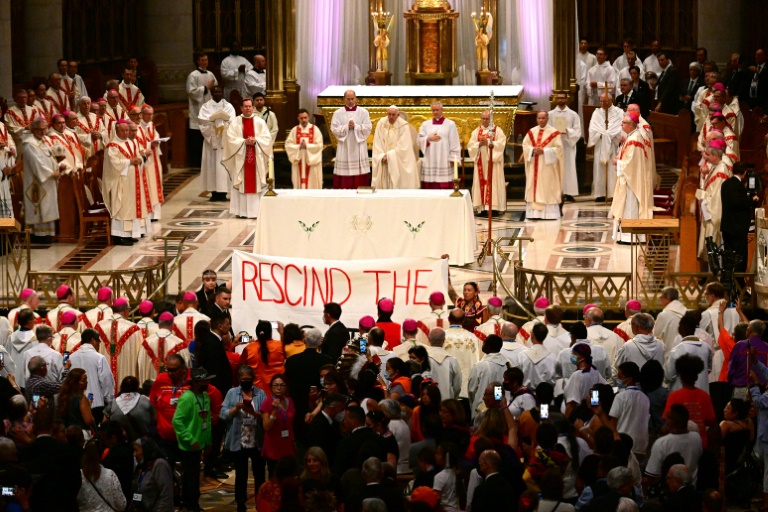
Indigenous women briefly protested as Pope Francis celebrated mass during his visit to Canada on Thursday, demanding that he retract centuries-old Church doctrine that empowered Europeans to colonize non-Christian native lands.

The brief incident at the shrine of Sainte-Anne-de-Beaupre in Quebec province — North America’s oldest Catholic shrine — came as the 85-year-old pontiff attempts to reset the Church’s fraught relationship with Indigenous people.

The two women unfurled a banner in front of the altar, just a few feet away from Francis, which read: “Rescind the doctrine.”

It referred to the Doctrine of Discovery, the 15th century papal edicts that legitimized the seizure of non-Christian lands and people. Calls for the pope to rescind it have followed him on his visit, where he is apologizing for the abuse of Indigenous children in Catholic-run schools.

The writing on the banner was only on the side facing away from the pope, and it was calmly and quickly removed while mass continued uninterrupted.

Later, during a homily at the Notre Dame Cathedral in Quebec City, the pope used the words “sexual abuse” for the first time on his visit — something he has been criticized by Indigenous people for failing to address.

But he did not specifically mention Indigenous people specifically in his comments.

“The Church in Canada has set out on a new path, after being hurt and devastated by the evil perpetrated by some of its sons and daughters. I think in particular of the sexual abuse of minors and vulnerable people, scandals that require firm action and an irreversible commitment,” he said.

“Together with you, I would like once more to ask forgiveness of all the victims.”

From the late 1800s to the 1990s, Canada’s government sent about 150,000 children into 139 residential schools run by the Catholic Church, where they were cut off from their families, language and culture in a failed policy of forced assimilation.

Many were physically and sexually abused, and thousands are believed to have died of disease, malnutrition or neglect.

Indigenous leaders have drawn a straight line between the Doctrine of Discovery and the formation of the residential schools centuries later.

Francis apologized for the abuse Monday in the western Indigenous community of Maskwacis.

While survivors have said his words were overwhelming, many have pointed out that he did not specifically mention the sexual abuse of First Nations, Metis and Inuit children in his comments. 

– ‘Deep dismay’ –

“Personally, it wasn’t enough,” said Abigail Brook, a 23-year-old member of Saint Mary First Nations, told AFP on Thursday.

“Nothing was said about the sexual abuses,” she said, speaking before the pope gave his homily in Quebec City. “We can’t accept reconciliation until he acknowledges that.”

Nevertheless, Desneiges Petiquay said his visit offered a “message of hope.”

The 54-year-old housewife from the Manawan reserve was in the front row at Sainte-Anne-de-Beaupre. 

“This pope, he knows we exist here, he recognizes us,” she told AFP. “Yesterday, I saw him up close, it touched me here,” she added, putting her hand on her heart.

During the mass at Sainte-Anne-de-Beaupre, on the shores of the St Lawrence River some 30 kilometers (18 miles) from Quebec City in Canada’s east, the pope said the Church was asking “burning questions… on its difficult and demanding journey of healing and reconciliation.”

“In confronting the scandal of evil and the Body of Christ wounded in the flesh of our Indigenous brothers and sisters, we too have experienced deep dismay; we too feel the burden of failure,” he said.

“Why did all this happen? How could this happen in the community of those who follow Jesus?”

On Friday, the last day of his six-day trip, the pope will stop in Iqaluit, in the Arctic territory of Nunavut.

Francis has appeared weakened since the beginning of this trip, and is using a wheelchair because of knee pain.

For abuse survivors struggling to heal, Pope's visit to Canada 'not enough'

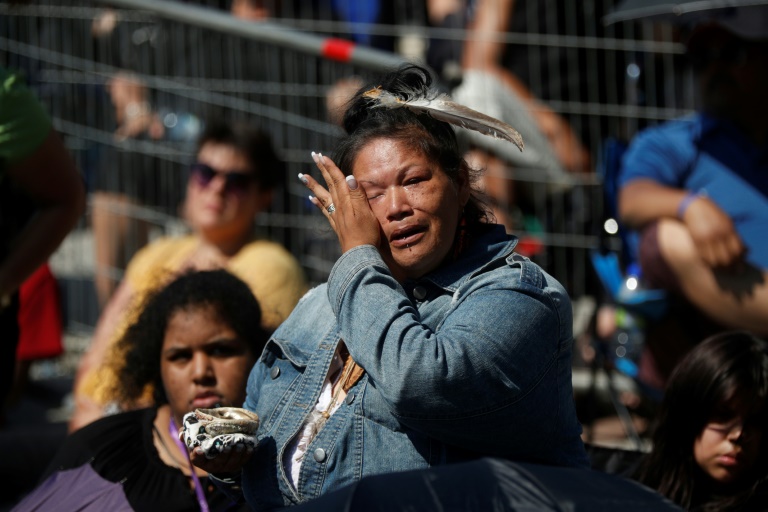
As Pope Francis in his vestments prepared to celebrate mass inside a Canadian shrine on Thursday, a young Indigenous woman stood outside in a bright orange beaded dress stitched with dozens of tiny metallic cones.

Abigail Brooks is a jingle dress dancer — an Indigenous woman whose dancing while wearing the traditional dress is believed to carry healing powers. 

“It’s very important to be here especially in my jingle dress to offer strength, and any emotional and traditional support that our survivors and elders will need,” the 23-year-old told AFP outside Sainte-Anne-de-Beaupre, on the banks of the St Lawrence River in Quebec, in eastern Canada.

Thousands of mainly Indigenous people gathered to see the pope there. Nearby, volunteers burned sage leaves before waving the smoke with feathers, a traditional ritual to heal psychological trauma. A healer recited incantations and held a woman’s arm, while a tear rolled down her cheek. 

Healing has been a major theme of the pope’s visit to Canada this week, where he has begged forgiveness from the country’s First Nations, Metis and Inuit people for decades of abuse at Catholic-run schools.

For nearly a century, up until the 1990s, Canada’s government sent some 150,000 Indigenous children into Church-run residential schools, where they were cut off from their families, language and culture.

The point was to stamp out their Indigenous identity. On top of the trauma of separation, many children endured physical and sexual abuse, and thousands are believed to have died of disease, malnutrition or neglect.

The trauma has lingered for generations. The pope’s apology, for many, has been overwhelming.

“It’s been a shared experience of a release of emotion,” 19-year-old Wocawson told AFP at Sainte-Anne-de-Beaupre, describing “lots of tears, you know, lots of anger, but… lots of love. It’s beautiful.”

“The truth is out in the open with all the accumulated suffering. Everyone has lived too long in shame,” said Ghislain Picard, regional chief of the Assembly of First Nations of Quebec-Labrador.

But for many, including Brooks, the apology is “not enough.”

“Nothing was said about the sexual abuses,” she said. “We can’t accept reconciliation until he acknowledges that.”

Later Thursday, the pope did use the words “sexual abuse” publicly for the first time on his trip — but he referred broadly to the abuse of “minors and vulnerable people” by members of the Catholic Church in Canada, without mentioning Indigenous children in particular.

Brooks also called for Indigenous people to be allowed access to records of what happened in the schools, and for the pope to return Indigenous artifacts currently held by the Vatican Museums.

“That’s going to be a part of reconciliation, to give us back what’s ours,” Brooks says.

– ‘It won’t heal me’ –

The young dancer is not alone in her demands. Over and over again, Indigenous people have made clear that they see the pope’s visit as only the beginning. 

In one of the most dramatic images of his trip so far, as the pope began celebrating mass in Sainte-Anne-de-Beaupre Wednesday, demonstrators unfurled a banner just in front of the altar behind which he stood.

It read, “Rescind the doctrine” — referring to the Doctrine of Discovery, the 15th-century papal edicts that empowered European powers to colonize non-Christian lands and people, who were seen as non-human.

Indigenous leaders have drawn a straight line between the doctrine and the formation of the residential schools centuries later. Everywhere the pope has gone in Canada, voices have called out for it to be lifted. 

The writing on the banner was facing away from the pontiff, and it was calmly removed shortly after.

Francis has made no public mention yet of the doctrine or the artifacts on his trip, though Prime Minister Justin Trudeau said Thursday that he had raised them with the pontiff. 

Trudeau did not give further details, and while the pope has spoken of his “deep shame” and his “firm desire to respond” to Indigenous suffering, it was unclear what further steps he might take.

For some, perhaps there is no way through the devastation.

Jimmy Papatie, a 58-year-old survivor of one of the schools, spoke to AFP through tears.

“I have lived my whole life in fear because of what I experienced at the residential school,” he said by telephone from his home in Quebec.

“I am convinced that I will never heal… the Pope’s visit — if people need to hear it, fine. But it won’t heal me.”

Brooks, the dancer, says her dress was “specifically made for our survivors and the ones that didn’t come home.”

“Each jingle that we tie, we pray for our survivors,” she said. 

“It’s a very powerful dress.”

Wall Street stocks rally again, shrugging off weak GDP report

Wall Street stocks rose on Thursday despite data showing the US economy contracted for a second straight quarter, as investors took it as a signal the Federal Reserve may slow interest rate hikes.

Stocks initially fell after the economic report, which showed US gross domestic product declined at an annual rate of 0.9 percent in the second quarter, following an even bigger drop in the first three months of the year.

But markets pivoted later in the morning, betting that clear signs of economic weakness would prompt the Fed to ease off on steep increases in borrowing costs. The US central bank on Wednesday undertook its second straight 75 basis point increase, and signaled it is prepared to do more.

“The real catalyst … is a belief that bad news (earnings disappointments and weak data) is good news (fewer rate hikes from the Fed),” Briefing.com said in an analysis.

Major US indices finished the session up around one percent, following even bigger gains Wednesday after investors welcomed comments by US Federal Reserve chief Jerome Powell, who said the central bank at some point would be able to slow the pace of rate hikes.

“Well, GDP was quite poor, so there won’t be a hat-trick of 75 basis point hikes in September, that’s for sure,” said Fawad Razaqzada at City Index and FOREX.com.

“The US GDP data has re-affirmed my view that the Fed will have to slow down the pace of the hikes and potentially go in reverse in early 2023,” he added.

Analysts also pointed to improved investor sentiment that has enabled stocks to advance despite lackluster earnings because the results have not been as bad as feared.

Also, many investors believe that “any downturn that we are going through will likely be mild,” said Jack Ablin, chief investment officer of Cresset Asset Management.

But Ablin said it was still too soon to “declare victory” on inflation.

Earlier, European stock markets finished mostly higher.

Europe’s energy sector was in particular focus with Britain’s Shell and France’s TotalEnergies posting bumper second-quarter profits on elevated oil and gas prices. 

Asian indices mostly climbed following Wednesday’s surge on Wall Street.

– Key figures at around 2030 GMT –

New York – Dow: UP 1.0 percent at 32,529.63 (close)

New York – S&P 500: UP 1.2 percent at 4,072.43 (close)

New York – Nasdaq: UP 1.1 percent at 12,162.59 (close)

London – FTSE 100: DOWN less than 0.1 percent at 7,345.25 (close) 

Frankfurt – DAX: UP 0.9 percent at 13,282.11 (close)

Paris – CAC 40: UP 1.3 percent at 6,339.21 (close)

EURO STOXX 50: UP 1.2 percent at 3,652.20 (close)

Tokyo – Nikkei 225: UP 0.4 percent at 27,815.48 (close)

Hong Kong – Hang Seng Index: DOWN 0.2 percent at 20,622.68 (close)

Shanghai – Composite: UP 0.2 percent at 3,282.58 (close)

Euro/dollar: DOWN at $1.0197 from $1.0200 Wednesday

Pound/dollar: UP at $1.2177 from $1.2158 

Euro/pound: DOWN at 83.70 pence from 83.89 pence

Dollar/yen: DOWN at 134.25 yen from 136.57 yen

Brent North Sea crude: UP 0.5 percent at $107.14 per barrel

West Texas Intermediate: DOWN 0.8 percent at $96.42 per barrel

burs-jmb/hs

Biden, Xi agree to hold face-to-face summit

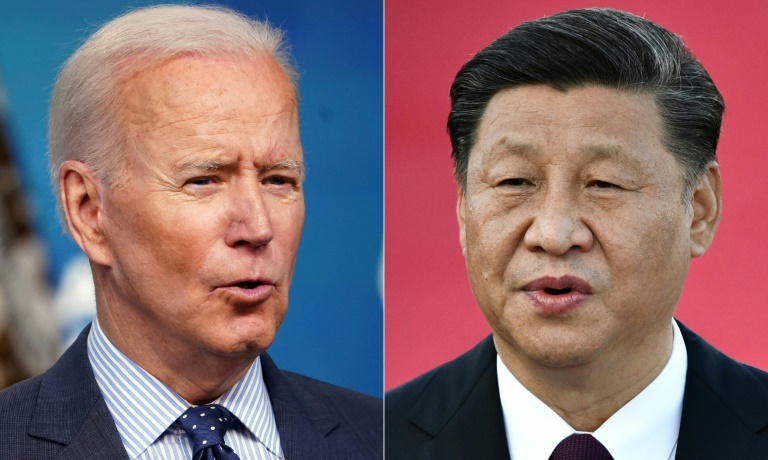
President Joe Biden and his Chinese counterpart Xi Jinping agreed to schedule their first in-person summit during a sometimes tense phone call Thursday where Xi warned the United States not to “play with fire” in Taiwan.

Although this was their fifth phone or video call since Biden took office a year and a half ago, the summit would be their first in-person meeting as leaders. No detail was given on the timing or location.

Biden and Xi “discussed the value of meeting face-to-face and agreed to have their teams follow up to find a mutually agreeable time to do so,” a US official said, speaking on condition of anonymity.

Both sides described the call, which lasted two hours and 17 minutes, as a robust exchange on the many disputes between the world’s two biggest economic powers.

China’s state-run Xinhua agency said Xi delivered harsh words on US policy towards Taiwan, a democratic island with close ties to the United States but which China considers part of its territory.

“Those who play with fire will eventually get burned,” Xi was quoted as telling Biden, repeating language he employed when they spoke last November. “I hope the US side fully understands that.”

Tensions around Taiwan are steadily escalating amid fears that Xi could ultimately order an invasion to impose Beijing’s rule.

In the latest flashpoint, Chinese authorities are furious at unconfirmed plans by Biden ally and speaker of the House of Representatives, Nancy Pelosi, to visit the island.

Although US officials frequently visit Taiwan, separated by a narrow strip of water from the Chinese mainland, Beijing considers a Pelosi trip as a major provocation. She’s second in line to the US presidency and given her position may travel with military transport.

Washington will “bear the consequences” if the trip goes ahead, China warned Wednesday.

During the call, Xi was quoted as telling Biden “the position of the Chinese government and people on the Taiwan issue is consistent.”

“It is the firm will of the over 1.4 billion Chinese people to firmly safeguard China’s national sovereignty and territorial integrity,” he said.

In response, Biden reassured Xi that US policy, known as “strategic ambiguity,” was unchanged — essentially favoring the status quo in Taiwan, with Washington recognizing Chinese sovereignty but opposing any enforcement, allowing the Taiwanese to retain their distinct rule.

“On Taiwan, President Biden underscored that the United States policy has not changed and that the United States strongly opposes unilateral efforts to change the status quo or undermine peace and stability across the Taiwan Strait,” the White House said in a statement.

– No move on tariffs –

Biden prides himself on a close relationship with Xi going back years, but it’s getting hard to mask deepening mistrust between the two countries.

US officials said Biden touched on a raft of sensitive issues, including China’s “genocide and forced labor practices” and its increasingly aggressive military posture across Asia.

The White House described Biden’s outreach as part of “efforts to maintain and deepen lines of communication” and to “responsibly manage our differences and work together where our interests align.”

According to the White House, Biden’s chief hope is to establish “guardrails” for the two superpowers.

This is meant to ensure that while they sharply disagree on democracy, and are increasingly rivals on the geopolitical stage, they can avoid open conflict.

Where to place the guardrails, however, is challenging amid so many unresolved disputes, including a simmering trade war begun under Donald Trump’s presidency.

One big question still completely unresolved is the trade war started under Donald Trump, with 25 percent import duties on billions of dollars of Chinese products.

Despite speculation that Biden could soon ease some of those tariffs to try and lower roaring inflation in the US economy, there was no movement on the issue during his talk with Xi.

“On the question of tariffs, President Biden explained to President Xi… core concerns with China’s unfair practices which harm American workers and harm American families, but he did not discuss any potential steps he might take,” the US official told reporters.

“It would be wrong to believe that somehow a decision on any next steps was somehow waiting for this conversation.”

Recession fears deepen as US economy contracts again

The US economy contracted for a second straight quarter between April and June, according to official data released Thursday, adding fuel to recession fears and creating a headache for President Joe Biden ahead of midterm elections.

Gross domestic product declined at an annual rate of 0.9 percent in the second quarter, following a bigger drop in the first three months of the year, according to the Commerce Department.

While not the official definition, two quarters of negative growth is commonly viewed as a strong signal that a recession is underway, and a downturn in the world’s largest economy would have global consequences — as well as domestic political costs.

Biden insisted that the US economy is “on the right path” despite the slowdown, touting the strong labor market.

“That doesn’t sound like a recession to me,” he said in remarks at the White House, noting unemployment at near record lows and more than a million jobs created in the latest quarter.

But his critics are sure to seize on the report as proof of the veteran Democrat’s mismanagement.

After a 1.6 percent decline in the first three months of the year, the report said the slowdown in the latest quarter was largely due to drops in government spending at all levels, in private investment on goods including autos, and on residential buildings, despite an increase in exports.

But personal consumption expenditures (PCE) continued to increase, though at a slower rate than the prior quarter, the data showed.

Still, American families continue to feel the bite from sky-high inflation, as a result of supply chain snarls due to Covid-19 lockdowns, as well as the fallout from Russia’s war in Ukraine, which has sent food and fuel prices soaring.

Consumer prices topped nine percent in June, the highest in more than four decades, and the GDP data showed another key inflation measure, the PCE price index, rose a still-high 7.1 percent in the latest three months, the same as in the January-March period.

But gas prices at the pump have fallen 74 cents since hitting a record of more than $5 a gallon in mid-June.

The US central bank has been raising interest rates aggressively — with the latest big hike on Wednesday — to try to cool the economy and tamp down price pressures.

“It’s no surprise that the economy is slowing down as the Federal Reserve acts to bring down inflation,” Biden said in a statement shortly after the GDP report was released. 

“But even as we face historic global challenges, we are on the right path and we will come through this transition stronger and more secure,” he said.

– Recession debate –

It would be highly unusual for an economy still adding jobs at a rapid pace, and with near record-low unemployment, to fall into recession. Even so, many economists say the discussion of a downturn is more a matter of when, not if.

That poses a major political headache for the president, who has seen his approval ratings plummet in recent months.

“The government just announced what every American has been feeling for nearly a year — we are in a recession,” House Republican leader Kevin McCarthy said on Twitter. “Democrats would rather redefine a recession than restore a healthy economy.”

But Fed Chair Jerome Powell agreed with Biden and other economists who say the GDP figures are inconsistent with other strong data.

Powell on Wednesday said he does not think the country is currently in a recession because “there are too many areas of the economy that are performing too well.”

Treasury Secretary Janet Yellen said Thursday there was a path to lower inflation without triggering an uptick in joblessness, though she acknowledged “numerous risks” to the economic outlook.

Mike Fratantoni, chief economist of the Mortgage Bankers Association, was among those who echoed Powell’s view, saying: “The ongoing strength in the job market and other signs of growth make it unlikely that this will be categorized as a recession.”

Powell also said it is possible to cool price pressures without causing a downturn or a big jump in joblessness, although he acknowledged the path to threading that needle is narrowing.

But economist Mohamed El-Erian said on Twitter that the data point to “deepening stagflation and flashing red recession risk.”

That impression may be the one that sticks in the minds of investors and consumers. 

Wall Street was initially not happy with the data, but stocks rebounded and ended the day with solid gains of more than one percent.

US House passes bill to boost domestic chip manufacturing

The US House of Representatives passed a bill on Thursday to boost domestic production of semiconductors, the in-demand microchips that power everything from smartphones to cars and weapons.

The CHIPS Act was approved by the House in a 243-187 vote with 24 Republicans joining Democrats and now goes to President Joe Biden for his signature.

Biden had lobbied strongly for passage of the bill, which will increase US competitiveness with major chip-maker China. He welcomed its approval, saying it will “lower the costs of every day goods.”

“And, it will create high-paying manufacturing jobs across the country and strengthen US leadership in the industries of the future at the same time,” the president said in a statement.

“By making more semiconductors in the United States, this bill will increase domestic manufacturing and lower costs for families,” he said. “And, it will strengthen our national security by making us less dependent on foreign sources of semiconductors.”

The legislation provides $52 billion to increase domestic semiconductor production and more than $100 billion over five years for research and development.

The CHIPS Act was passed on Wednesday in the Senate by a rare bipartisan vote of 64 to 33, with 17 Republicans joining hands with Democrats.

Global semiconductor supplies were disrupted by fallout from Covid-19 shutdowns, sparking widespread shortages of the chips — many of which are made in Asia.

Worldwide chip shortages notably slowed production of new automobiles last year, causing prices to increase.

Passage of the CHIPS Act by the House came shortly after a lengthy telephone call between Biden and Chinese President Xi Jinping.

China criticized details of the bill earlier Thursday.

Foreign ministry spokesman Zhao Lijian said that while the act “claims to be aimed at improving the competitiveness of US technology and chips, (it) contains provisions that restrict normal scientific and technological cooperation between China and the United States.

“China is firmly opposed to this,” Zhao told reporters.

Senate passage of the bill came a day after the South Korean group SK announced a huge investment in US semiconductors and other cutting-edge industries.

The conglomerate said in a statement it plans to “increase its new investment in the United States by $22 billion in areas including semiconductors, green energy, and bioscience, creating tens of thousands of new high-tech, high-paying American jobs.”

Close Bitnami banner
Bitnami